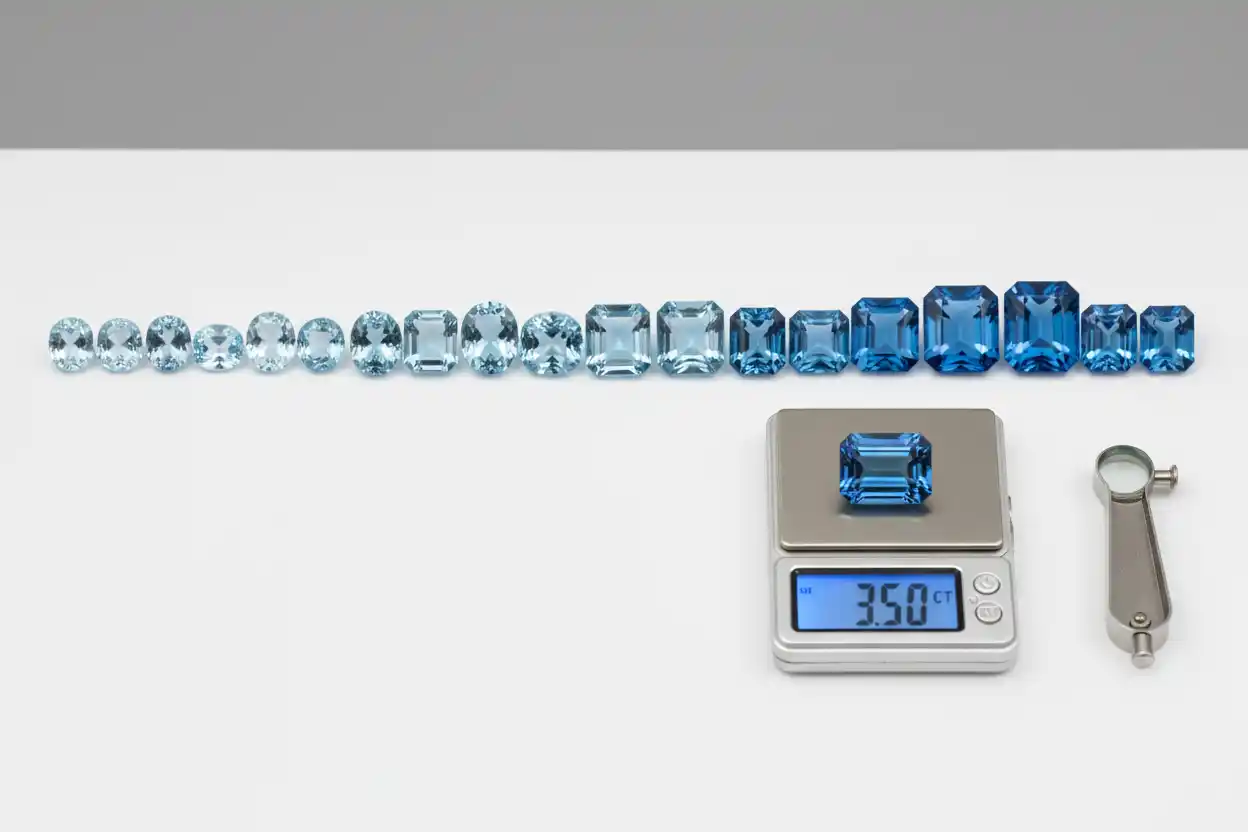
Aquamarine Price: Value Guide, What Raises or Lowers Cost
Aquamarine price is determined by the complete quality profile of the gemstone rather than carat weight alone. Color, clarity, cut, dimensions, treatment, condition, documentation, seller context, and the type of transaction can all affect what a buyer pays. Aquamarine is the blue to green-blue variety of beryl, and GIA identifies color, clarity, cut, and carat weight as its principal quality factors. Fine examples typically combine an attractive blue appearance with strong transparency and effective cutting, while commercial stones can vary widely in saturation, proportions, inclusions, and finish.
That variation is why a single internet figure for “aquamarine price per carat” can be misleading. Two stones weighing exactly three carats can occupy very different value levels if one shows stronger color, cleaner transparency, better proportions, more useful face-up dimensions, and clearer treatment disclosure. Anyone preparing to purchase rather than simply research value should also read the Gems Lore guide on how to buy aquamarine, because price comparison works best when identity, treatment, seller terms, and physical quality have already been evaluated.
Aquamarine Price At a Glance
| Value Factor | What to Examine | Typical Effect on Aquamarine Price |
|---|---|---|
| Color | Hue, tone, saturation, evenness | Attractive moderately strong blue to slightly greenish blue generally commands stronger demand |
| Clarity | Transparency and eye-visible inclusions | Fine faceted aquamarine is commonly expected to look clean to the unaided eye |
| Cut | Proportions, brilliance, windowing, symmetry, polish | Skillful cutting can strengthen beauty; weak cutting can reduce value despite good rough |
| Carat Weight | Weight together with millimeter dimensions | Size matters, but aquamarine is available in comparatively large crystals, so bigger is not automatically better per carat |
| Treatment | Heat and any clarity enhancement | Disclosure matters; stones should be compared on equivalent treatment terms |
| Condition | Chips, abrasion, scratches, worn facet junctions | Damage can reduce desirability and resale value |
| Documentation | Identification report and accurate invoice description | Strong documentation reduces uncertainty but does not itself set market value |
| Origin | Seller claim versus supported locality information | Famous locality names alone do not make an aquamarine fine or valuable |
| Seller Context | Retail service, return rights, reputation, overhead | Similar stones may carry different asking prices in different sales channels |
| Transaction Type | Retail, auction, appraisal, dealer offer, private resale | These figures measure different things and should not be treated as interchangeable |
Why Aquamarine Does Not Have One Universal Price Per Carat
Colored gemstones do not function like standardized commodities in which identical units trade at one fixed price. GIA’s research on colored-stone value emphasizes that color, color uniformity, size, clarity, geographic context in some gems, shape, and quality of cutting interact when value is assessed. Aquamarine adds another complication because large clean crystals are relatively available compared with many rarer gem materials, so weight does not create scarcity in the same way across every size range.
A useful aquamarine price comparison must therefore match stones on more than weight. A three-carat pale stone with a large window should not be compared directly with a three-carat strongly colored, eye-clean aquamarine with lively brilliance. Likewise, a finished ring cannot be reduced to the center stone’s carat weight because its price may also include precious metal, accent diamonds, setting labor, design, retail service, and brand positioning.
This principle also appears in other Gems Lore buying guides. The alexandrite price guide deals with dramatic quality differences caused by color change and rarity, while the andalusite price guide illustrates how optical appearance, cut, clarity, and market demand can alter value even when weight seems comparable. Aquamarine follows its own market pattern, but the need to compare equivalent quality remains the same.
Color Usually Has the Strongest Influence on Aquamarine Price
Aquamarine occurs in a relatively narrow range that includes blue, slightly greenish blue, greenish blue, strongly greenish blue, and green-blue. GIA identifies a moderately strong dark blue to slightly greenish blue as the most desirable commercial color range and notes that purer, more intense blue generally receives stronger value when other factors remain comparable.
This does not mean the darkest possible stone is automatically the best. Attractive color requires balance. An aquamarine can become too gray, too dark, unevenly colored, or optically dull, while a lighter gem can appear lively, clean, and exceptionally bright. Personal preference also matters; some buyers deliberately choose the greener natural-looking side of aquamarine’s range rather than paying a premium for purer blue.
Lighting deserves attention because photographs can exaggerate color. White balance, background, exposure, saturation editing, and directional lighting can make a pale aquamarine look substantially stronger online. When the asking price depends heavily on color quality, buyers should compare images and video under neutral lighting and judge the gem’s actual face-up appearance rather than relying on descriptive terms such as “royal,” “premium,” or “electric.”
Clarity Has an Important but Aquamarine-Specific Role
Aquamarine differs from emerald even though both belong to the mineral species beryl. GIA notes that most faceted aquamarines are eye-clean and that large clean stones can be available without visible inclusions. Because clean material is comparatively normal in faceted aquamarine, obvious inclusions can have a stronger negative effect on commercial desirability than they might in a gemstone where inclusions are expected.
That does not mean every included aquamarine has little value. Translucent or included material can be attractive in cabochons, carvings, beads, or artistic jewelry, and certain internal features can create optical effects such as chatoyancy. The correct price comparison simply needs to keep different material types separate. A translucent carving should not be priced according to standards intended for an eye-clean faceted stone.
Location and visibility of an inclusion matter as well. A small internal feature near the edge may have little effect on face-up beauty, whereas a reflective inclusion directly beneath the table can dominate the gem. Any fracture that approaches the surface also deserves examination for potential durability implications.
Cut Can Raise or Lower Aquamarine Value
Because aquamarine often has relatively light body color, cutting strongly affects how much beauty the finished stone displays. GIA notes that careful cutting is important to brilliance and that aquamarine can be fashioned in many shapes, including emerald cuts, rounds, ovals, and designer cuts.
A well-cut stone should show useful brightness, balanced proportions, an attractive outline, clean polish, and limited distracting windowing. A window occurs when the pavilion angles allow the viewer to see through the center rather than receiving strong light return. Excessive depth creates the opposite problem: extra weight can hide underneath the stone without creating corresponding face-up size.
This is why aquamarine price should be compared using both carat weight and millimeter measurements. Two five-carat gems may have substantially different visible dimensions. One may spread broadly across the finger or pendant, while the other carries a significant portion of its weight in a deep pavilion. The second stone is not necessarily poor, but buyers should understand what their money is purchasing.
Carat Weight Matters Differently in Aquamarine Than in Many Rare Gems
Aquamarine crystals can become very large. GIA notes that large stones are readily available compared with many other gem materials and that very large sizes can eventually attract a smaller buyer pool, causing the per-carat relationship to behave differently from the simple assumption that every additional carat must cost more per carat.
Size also interacts with color. GIA reports that aquamarines often need to be larger to display strongly saturated blue, although certain African deposits can produce attractive saturation in smaller stones. Smaller stones with unusually fine color can therefore command a stronger per-carat price than larger gems of comparable apparent color quality.
Carat weight should consequently be treated as a size measurement, not a quality grade. A twenty-carat pale, poorly cut aquamarine is not automatically finer than a three-carat stone with exceptional color, transparency, and cutting. Total price and price per carat must both be interpreted within the quality level of the individual gemstone.
Treatment Can Influence Price Comparison
Heat treatment is accepted and common in the aquamarine trade. GIA explains that much aquamarine is heated to reduce green coloration and produce a bluer appearance, and its buyer guidance notes that heat-treated color is generally stable. A heated aquamarine is therefore not automatically a poor-quality or undesirable stone.
The critical issue is disclosure. Buyers comparing an explicitly represented untreated aquamarine with a heated stone should understand whether the seller is charging a premium for untreated status and what evidence supports that representation. Treatment status becomes particularly important when the price difference is large.
GIA also notes that fracture filling can occur rarely in aquamarine and that filled stones require more cautious cleaning. Fracture filling should not be treated as equivalent to ordinary heating because it affects the gemstone in a different way and may alter care considerations. Any significant enhancement should be represented accurately on the sales documentation.
AAA and AAAA Aquamarine Are Seller Grades, Not Universal Laboratory Grades
Retail grade labels create considerable confusion in aquamarine pricing. One merchant may describe a stone as AAA, another may call a visually similar stone AAAA, while a third may avoid letter grading entirely. GIA states clearly that no standardized A, AA, or AAA aquamarine grading scale exists, even though individual sellers are free to create their own internal quality descriptions.
A buyer should therefore translate the grade into observable characteristics. Ask what the seller means by AAA. Does the label describe color only, or does it include clarity, cutting, treatment, and size? Is the classification consistent across the seller’s inventory? Can the gem’s quality still be evaluated from photographs, measurements, treatment disclosure, and inspection?
An unexplained letter grade should never substitute for the stone itself.
Laboratory Identification Reports and Appraisals Serve Different Purposes
GIA evaluates aquamarine but does not assign it an overall quality grade. A GIA Colored Stone Identification Report can describe characteristics such as measurements, weight, shape, cutting style, and color, identify whether material is natural or laboratory-grown, and list detectable treatments.
That report is not an appraisal. It does not tell the buyer that a particular retailer’s asking price is fair, nor does it promise a future resale value. An appraisal addresses monetary value for a defined purpose, such as insurance replacement, fair market analysis, estate planning, or another stated basis. The resulting figure can therefore differ materially from both the retail purchase price and the amount a dealer would offer to buy the stone.
This distinction is essential when comparing aquamarine price claims. “Certified,” “appraised,” and “worth” are not interchangeable terms.
Origin Usually Matters Less Than the Actual Quality of Aquamarine
Aquamarine is mined in multiple parts of the world, and certain localities have acquired reputations for fine material. GIA specifically cautions, however, that aquamarines are not automatically fine or valuable merely because they come from a famous mining area.
Trade descriptions associated with particular sources can still influence buyer perception, but an origin label should not overwhelm visual quality. A pale, poorly proportioned stone does not become exceptional simply because a seller attaches an important locality name. Conversely, an attractive aquamarine from a less celebrated source can offer excellent quality.
Seller-stated origin and independently supported origin should also be distinguished. If a locality claim materially increases the asking price, the buyer should ask what evidence supports it rather than assuming that a verbal description has the same authority as laboratory or documented provenance.
Condition Matters, Especially in Previously Worn Jewelry
A loose aquamarine may show abrasion, chips, scratched facets, damaged girdle areas, repolishing, or minor surface wear. Mounted stones can conceal damage beneath prongs or bezels. Condition should therefore be evaluated separately from clarity, because an internal inclusion is not the same as a surface chip created after cutting.
Aquamarine has a Mohs hardness of approximately 7.5 to 8, but hardness describes resistance to scratching rather than complete resistance to breaking or chipping. GIA recommends protecting aquamarine from hard knocks despite its suitability for jewelry.
A damaged stone can remain beautiful and wearable, but the aquamarine price should reflect the condition, cost and feasibility of repolishing, potential weight loss during repair, and any continuing durability concern.
Retail Asking Price, Auction Price, Appraisal and Resale Value Are Not the Same
Retail price includes the seller’s inventory costs, expertise, photography, payment processing, return privileges, warranties, staff, insurance, overhead, and margin. A jewelry brand may add design reputation and craftsmanship. Those components can legitimately increase a final price without becoming intrinsic properties of the aquamarine itself.
An auction price reflects competition for one lot at one sale. A dealer resale offer must leave room for testing, inventory holding time, possible repair, marketing, and eventual profit. An insurance appraisal may estimate the cost of replacing the item through a suitable retail market. These figures answer different financial questions.
For broader context, the Gems Lore article on the most expensive gemstones explains why spectacular auction records should not be treated as everyday price benchmarks. The companion guide to the rarest gemstones in the world also separates geological scarcity from monetary value, an important distinction whenever price discussions drift toward claims of guaranteed appreciation.
What Usually Raises Aquamarine Price?
A premium becomes easier to justify when several favorable qualities occur together rather than when one marketing label carries the entire argument. An aquamarine with appealing blue color, strong transparency, limited visible inclusions, skillful cutting, good face-up dimensions, undamaged condition, clear treatment disclosure, and reliable documentation will generally occupy a stronger market position than a stone with multiple compromises.
Fine color remains particularly influential. An attractive smaller stone can outperform a larger pale example in per-carat terms, and a well-cut gem can look more impressive than a heavier stone that retained unnecessary pavilion depth. Seller reputation and return rights can also justify part of a retail premium because they reduce transaction risk.
What Usually Lowers Aquamarine Price?
Very pale or grayish color, prominent inclusions, weak transparency, excessive windowing, poor symmetry, overly deep cutting, abrasion, chips, questionable treatment disclosure, inaccurate photography, or uncertain identity can all reduce desirability. A lower price does not prove any of these problems exist, but buyers should investigate substantial price differences rather than assuming every bargain is equivalent quality.
Market preference can also reduce price without making a stone objectively bad. Some buyers love pale aquamarine or greenish-blue material even when mainstream demand favors more saturated blue. A lower-priced gem that matches personal taste can therefore offer excellent value when its identity and condition are sound.
How to Compare Two Aquamarines Fairly
Start by matching the material and treatment category, then compare weight and dimensions, color under similar lighting, clarity, cut, condition, and documentation. Only after those factors reasonably align should the price-per-carat calculation carry much weight.
A practical comparison should examine:
Exact carat weight and millimeter dimensions.
Face-up hue, tone, saturation, and color evenness.
Transparency and eye-visible inclusions.
Windowing, extinction, symmetry, polish, and overall cut execution.
Treatment disclosure.
Surface condition and any repairs.
Whether the stone is loose or mounted.
Scope of any independent laboratory report.
Seller return and inspection policy.
Whether the quoted number is retail, appraisal, auction, dealer offer, or private resale.
The same discipline is useful when comparing other accessible colored gems. The Gems Lore amethyst price guide examines how abundant material can still vary significantly by quality, while the andalusite price guide shows why optical quality and market demand must be considered alongside weight.
Conclusion
Aquamarine price makes sense only when the gemstone itself is described in enough detail to support the number. Color normally carries substantial influence, but clarity, cutting, dimensions, weight, treatment, condition, documentation, seller context, and transaction type all affect the final result. GIA’s guidance also makes clear that aquamarine is commonly available in clean and relatively large sizes, which prevents carat weight from functioning as a simple proxy for quality.
The most reliable approach is to compare like with like and refuse false precision. A seller-defined AAA label is not a universal gemological grade, a laboratory identification report is not an appraisal, an appraisal is not a guaranteed resale value, and a famous mine name does not make an ordinary stone exceptional. Buyers who keep those distinctions clear can evaluate aquamarine price with far more confidence.
Frequently Asked Questions
How much does aquamarine cost per carat?
There is no universal aquamarine price per carat that applies reliably to every stone. Color, clarity, cut, dimensions, carat weight, treatment, condition, documentation, and sales channel can produce large differences between superficially similar aquamarines. A per-carat figure is useful only after the stones being compared are reasonably similar in quality.
What is the most valuable aquamarine color?
GIA identifies moderately strong dark blue to slightly greenish blue as the preferred commercial color range. Individual preference still matters, and a stone must also retain attractive transparency, brilliance, and cutting.
Is darker aquamarine always worth more?
No. Stronger blue color can raise value, but darkness alone does not define quality. Grayness, weak transparency, poor proportions, extinction, or dull appearance can reduce desirability even in a dark stone.
Does aquamarine become more expensive as carat weight increases?
Total price can rise with size, but the relationship is not automatically linear. Aquamarine forms in large crystals, and GIA notes that very large stones can have a smaller buyer pool. Smaller stones with unusually fine saturation can sometimes achieve stronger prices per carat than larger stones with more ordinary color.
Is heated aquamarine valuable?
Yes. Heat treatment is common in aquamarine and is widely used to reduce green coloration and create a bluer appearance. Treatment should still be disclosed so buyers can compare equivalent stones.
What does AAA aquamarine mean?
AAA is generally a seller-defined commercial grade rather than a universal laboratory standard. GIA states that no standardized AAA-style quality scale exists for aquamarine. Ask the seller which measurable or observable characteristics the grade represents.
Does a GIA report tell me how much an aquamarine is worth?
No. GIA evaluates and identifies aquamarine but does not assign an overall aquamarine quality grade or market value. Its Colored Stone Identification Report can document characteristics, natural or laboratory-grown status, and detectable treatments.
Is retail aquamarine price the same as resale value?
No. Retail prices include seller costs, services, overhead, and margin. A dealer buying a previously owned stone must account for testing, inventory risk, repair, marketing, and resale margin, so a cash resale offer can be substantially different from the original retail price.
Is aquamarine a guaranteed investment?
No gemstone offers guaranteed appreciation. Aquamarine can be beautiful, collectible, and valuable, but future demand, condition, liquidity, transaction costs, and market conditions can all affect resale. Claims of guaranteed gemstone profits should be treated cautiously.