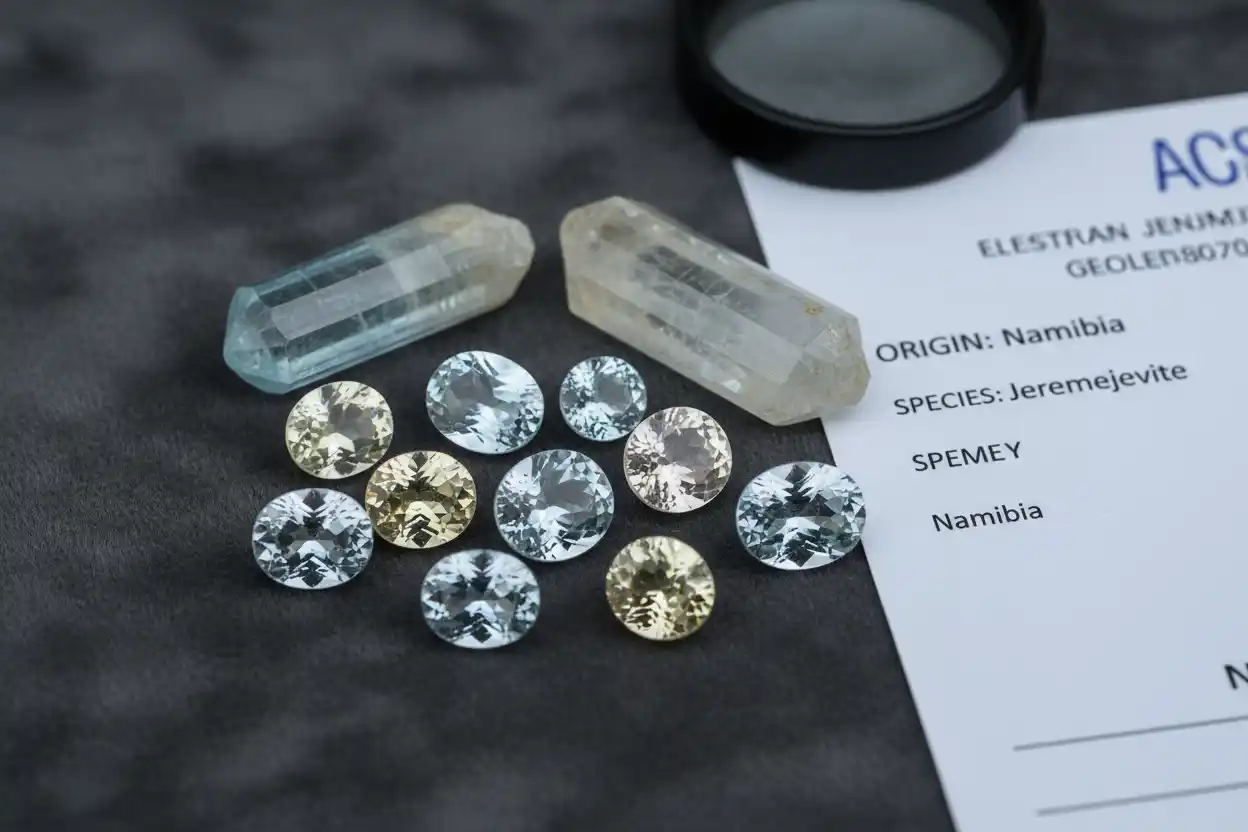
Jeremejevite Price: Market Cost Guide, Quality, Treatments & Availability
Jeremejevite price is difficult to reduce to a dependable universal price-per-carat range because the material occupies a small specialist market in which gem identity, color, transparency, clarity, size, cutting, condition, provenance, and whether the object is a faceted gemstone or a natural mineral specimen can all change value dramatically. Jeremejevite is a rare aluminum borate mineral, and GIA continues to describe it as an uncommon species whose suitable gem material appears only sporadically in the market. A documented GIA collection includes a transparent 2.60-carat Namibian jeremejevite, while GIA’s classic gemological study examined blue specimens as well as an unusually large 4.54-carat light-yellow example, illustrating both the limited supply and the range of colors that can occur.
Rarity alone does not tell a buyer what an individual jeremejevite should cost. A transparent, attractive, well-cut violetish-blue gem can belong to a much stronger market than a cloudy pale crystal of greater weight, while a beautifully terminated natural crystal can command mineral-specimen demand even if it would not yield a superior faceted stone. That is why anyone considering a purchase should first establish the checks covered in the Gems Lore buy jeremejevite guide and then compare only material of similar type, transparency, color, size, provenance, and condition.
Jeremejevite Price At a Glance
| Value Factor | What Usually Raises Jeremejevite Price | What Can Lower Jeremejevite Price |
|---|---|---|
| Identity | Independently confirmed natural jeremejevite | Unverified pale-blue or colorless gem |
| Color | Attractive blue, violetish-blue, aquamarine-blue, or unusual collectible color | Weak, grayish, dull, or unattractive color |
| Transparency | Transparent faceting-quality material | Cloudy, translucent, or opaque material when compared with faceted gems |
| Clarity | Eye-clean or minimally included transparent gem | Heavy fractures, clouds, distracting inclusions |
| Size | Larger fine faceted stones with quality maintained | Added weight without corresponding transparency or beauty |
| Cut | Strong brilliance, useful face-up spread, symmetry, polish | Windowing, excessive depth, weak polish, poor proportions |
| Crystal Form | Complete, aesthetic, well-terminated natural crystal | Broken tips, heavy contact damage, repairs |
| Provenance | Credible Namibia, type-locality, or important collection documentation | Unsupported locality claim |
| Condition | Crisp facets or intact specimen surfaces | Chips, scratches, broken terminations, repolishing |
| Treatment | Clear laboratory findings and seller disclosure | Unsupported absolute treatment claims |
| Documentation | Independent gemological identification | Seller-only certificate for a high-value rare gem |
| Market Type | Comparable faceted-gem or specimen transactions | Mixing specimen, jewelry, appraisal, and resale values |
Transparent Faceting Material Commands a Different Market From Ordinary Crystals
Jeremejevite is known among mineral collectors in crystal form, but only a portion of available material has the transparency, structural integrity, and shape necessary to produce attractive faceted gemstones. GIA’s Gübelin collection describes jeremejevite among uncommon gems that are seldom faceted because suitable starting material is limited, and its documented 2.60-carat Namibian example is transparent with a light grayish violetish-blue color and no significant internal features noted in the collection data.
This means a transparent faceted jeremejevite should not be benchmarked against a rough crystal simply by dividing each object’s price by weight. Faceted material has already survived selection, cutting loss, orientation decisions, polishing, and removal of damaged or heavily included areas, while an attractive crystal specimen may derive its premium from entirely different features such as termination, natural form, matrix association, locality, and collection history.
A transparent gem can therefore carry a high per-carat price even when a considerably heavier specimen costs less per unit of weight, while an exceptional museum-quality crystal can reverse that relationship because specimen aesthetics and provenance become dominant.
Blue and Violetish-Blue Color Usually Attract Strong Gem Demand
Jeremejevite is frequently associated with pale blue to violetish-blue material, particularly from Namibia. GIA documented a 1.78-carat violetish-blue jeremejevite in recent microscopy research and described the species as a rare aluminum borate occurring in prismatic crystals, while the Gübelin collection contains a light grayish violetish-blue 2.60-carat Namibian example.
Stronger attractive blue can support a higher jeremejevite price when transparency and brilliance remain excellent, but darker color should not automatically be interpreted as finer. A gem that becomes gray, overly subdued, or poorly transparent may attract less demand than a lighter but cleaner and brighter stone.
Photography also needs scrutiny. Pale blue gemstones can appear considerably more saturated against dark backgrounds, under cool LED illumination, or after digital color enhancement, so a serious buyer should request neutral-light video and photographs against a white or gray reference.
Yellow Jeremejevite Has Genuine Gemological Precedent
Blue is not the only authentic jeremejevite color. GIA’s classic gemological update was prompted by a 4.54-carat light-yellow jeremejevite and included examination of additional yellow and blue specimens, confirming that yellow material belongs naturally within the species.
A yellow jeremejevite should therefore not be discounted merely because it does not resemble the better-known blue Namibian crystals. Its market may be narrower, yet unusual color can create collector appeal when identity, transparency, size, and provenance are compelling.
The price relationship between yellow and blue material is not fixed. Buyer preference, rarity of a particular specimen, saturation, transparency, cut, and provenance can all matter more than a simple color hierarchy.
Colorless Jeremejevite Needs Especially Strong Identification
Colorless transparent jeremejevite can resemble numerous more common gems, including quartz, beryl, topaz, danburite, synthetic spinel, and other materials. Visual appearance alone provides little protection against an expensive identification mistake.
Jeremejevite has distinctive refractive, birefringent, density, spectral, and chemical properties that trained laboratories can use for separation. GIA’s detailed jeremejevite research employed refractive-index measurements, spectroscopy, Raman analysis, and chemical testing precisely because rare gem identification often requires more than appearance.
For a substantial purchase, independent laboratory identification is one of the strongest ways to protect the value premise behind the jeremejevite price.
Clarity Matters Differently in Jewelry and Collector Gems
Transparent jeremejevite with few eye-visible inclusions can command strong demand because clarity allows its pale color and vitreous luster to remain clean and bright. GIA’s Gübelin specimen was documented without significant internal features, illustrating that notably clean material does exist.
Natural inclusions are not automatically negative. GIA recently documented remarkable hollow branching channels in a 1.78-carat violetish-blue jeremejevite, producing structures resembling rime ice and lightning. The features were interpreted as growth-related hollow channels and provide an unusual example of how internal structure can increase scientific and collector interest even when a conventional jewelry buyer might prefer a cleaner stone.
The value effect therefore depends on what the inclusion does. A beautiful microscopic growth feature can enhance collector interest, while a large reflective fracture crossing the face or a structurally risky crack near the girdle can reduce price.
Size Can Create a Strong Premium When Transparency and Quality Survive
Multi-carat faceted jeremejevite is noteworthy. GIA’s classic study considered a 4.54-carat stone sufficiently unusual to prompt extensive investigation, while its Gübelin collection preserves a 2.60-carat Namibian example and recent research examined a 1.78-carat violetish-blue gem.
These examples should not become artificial thresholds implying that every stone above a particular weight must be exceptionally valuable. Additional production can emerge, and the market is too small for rigid size formulas.
They do provide context, however. A several-carat jeremejevite that remains transparent, attractive, clean, and well cut belongs to a more unusual category than a tiny pale specimen, making independent identification increasingly important as size and price rise together.
Carat Weight Must Be Judged With Millimeter Dimensions
Rare rough creates pressure to retain weight during cutting. A cutter may preserve extra pavilion depth, leave an elongated outline, or accept slightly inefficient proportions because losing a fraction of a carat can have substantial economic consequences.
Two three-carat jeremejevites can therefore look completely different face-up. One might be long, shallow, and visibly impressive, while another concentrates much of its weight below the girdle and presents a smaller visible surface.
Compare length, width, and depth rather than relying on weight alone. This is especially important once a dealer begins using size scarcity as a major reason for the price.
Cut Quality Still Matters Even When the Mineral Is Rare
Rare gemstone rough is not exempt from the fundamentals of colored-stone cutting. GIA’s broader colored-gem research identifies color, origin, size, clarity, shape, and quality of cutting among the major factors affecting value and emphasizes that excellent cutting can add meaningful market appeal.
Windowing, poor polish, excessive depth, asymmetry, and weak light return can all reduce a jeremejevite’s visual quality. A seller may argue that deep cutting was required to preserve rare rough, and that may be true, but the buyer still needs to decide whether the additional retained weight provides sufficient benefit to justify the price.
An expertly precision-cut gem can deserve a separate craftsmanship premium because the cutter accepts more rough loss to produce superior optical performance.
Natural Crystal Specimens Need Their Own Price Logic
A complete jeremejevite crystal should be valued as a mineral specimen rather than as unfinished faceting rough alone. Important specimen factors include natural termination, transparency, luster, color, crystal length, damage, associated minerals, locality, and documented provenance.
GIA studied a reported Namibian collection containing approximately 400 jeremejevite crystals, illustrating how significant crystal groups can become research and collector objects independently of their faceting potential.
A specimen with exceptional natural form may be worth more intact than after cutting, while a broken but highly transparent crystal might have greater value as faceting rough. The intended market changes the valuation.
Namibia Carries Strong Modern Collector Recognition
Namibia is one of the best-known modern jeremejevite sources. GIA has examined extensive collections reportedly from the country and maintains documented Namibian jeremejevite in the Gübelin collection.
This provenance can create collector interest, particularly for well-formed crystals or fine blue material. The country name should not replace actual quality, however. A damaged pale Namibian specimen can be worth less than a superior gem from another source.
Seller claims of Namibian provenance should be supported by credible collection history, supplier records, locality labels, or other evidence rather than inferred solely from blue color.
The Russian Type Locality Has Separate Historical Importance
Jeremejevite was named for Russian mineralogist Pavel Jeremejev, and the type locality is Soktuj Gora in Russia. Current mineralogical reference data continue to list the species as a hexagonal aluminum borate with hardness around 7 and the Russian locality as the type occurrence.
Type-locality specimens can attract specialized mineral collectors even when their color or transparency differs from classic Namibian blue material.
That value is historical and mineralogical rather than simply gem-quality value, reinforcing why specimen prices should not be converted casually into jewelry-gem benchmarks.
Durability Is Reasonable but Replacement Risk Is High
Mineralogical data place jeremejevite around Mohs hardness 7, which gives the stone reasonable resistance to scratching in careful jewelry use. Hardness alone does not eliminate the risk of chips, impact damage, or fracture, and any rare gem should be protected from hard knocks.
Replacement difficulty matters economically. A chipped common gemstone may be relatively straightforward to match; replacing a jeremejevite with similar color, transparency, dimensions, cut, and provenance can be far more difficult.
Condition therefore becomes a meaningful part of jeremejevite price in the secondary market.
Treatment Should Be Handled With Evidence Rather Than Assumptions
GIA’s principal jeremejevite studies focus on identification, chemistry, inclusions, optical properties, and locality rather than documenting a routine commercial enhancement market.
That should not be converted into the unsupported absolute that jeremejevite is never treated. Modern gemstone markets can contain coatings, fillings, irradiation, assembled materials, or other modifications, and a serious laboratory report should be allowed to state what is detectable.
The most defensible valuation language is therefore that routine treatment is not a defining feature of established jeremejevite commerce, while high-value stones should still be purchased with appropriate disclosure and testing.
A Rare Name Does Not Make Every Stone “Investment Grade”
Terms such as investment grade, museum grade, top gem, collector grade, AAA, or exceptional rarity are seller language rather than standardized jeremejevite grades.
GIA’s broader colored-stone valuation framework shows why value must be built from actual measurable and observable characteristics rather than one promotional category. Color, clarity, size, origin, and cut all interact.
A rare species with poor cutting and weak transparency can remain less commercially desirable than a smaller but beautiful example. Geological rarity should support the price only when the individual stone also has qualities that collectors want.
Jeremejevite Price Versus Grandidierite Price
Jeremejevite and grandidierite are both rare collector gems but should not be priced from the same benchmark. Grandidierite is a different mineral species whose premium market focuses heavily on transparent bluish-green faceting material and strong pleochroism.
The Gems Lore grandidierite price guide explains why transparent versus translucent material creates such a major value distinction, while buy grandidierite covers the identification and cutting issues specific to that species.
Both minerals demonstrate that rarity becomes commercially meaningful only after the exact material and quality category are established.
Jeremejevite Price Versus Benitoite Price
Benitoite is another rare collector gem, but its intense blue color, dispersion, geological concentration, and established collector history create a different value system. The Gems Lore benitoite price guide should therefore not be used as a direct per-carat reference for jeremejevite.
A two-carat blue jeremejevite and a two-carat benitoite may both be unusual, yet rarity, optical appeal, source distribution, collector depth, and available comparable sales differ.
This is why a broad “rare gemstone price” category produces poor valuations.
Retail Asking Price Is Not the Same as Market Liquidity
Specialist jeremejevite dealers may spend considerable time finding specimens, establishing provenance, obtaining laboratory reports, cutting rare rough, insuring inventory, and waiting for a knowledgeable collector. Those costs can support a high retail asking price.
A dealer buying the same gem from a private owner faces a different equation. Verification, potential repolishing, inventory holding time, marketing, buyer scarcity, and profit margin all reduce the amount that can be offered immediately.
A gemstone can therefore be extremely rare yet relatively illiquid, which is one of the most important distinctions between geological scarcity and financial investment performance.
Appraisal Value Must Be Kept Separate From Resale Value
An insurance appraisal may estimate the amount needed to replace a rare jeremejevite through a specialist dealer, while fair-market or liquidation values can be considerably lower.
A laboratory identification report serves yet another purpose by establishing what the gemstone is rather than assigning a monetary value.
Buyers should never treat a high appraisal number as proof that a stone can be sold quickly for the same amount.
What Usually Raises Jeremejevite Price?
Jeremejevite price tends to rise when a stone combines independently confirmed identity, desirable blue or violetish-blue color, high transparency, minimal distracting inclusions, useful size, efficient and attractive cutting, crisp condition, credible locality provenance, and documentation appropriate to the financial risk.
Mineral specimens can command additional premiums when they possess complete natural termination, exceptional color, strong luster, important locality, significant crystal size, documented collection history, or outstanding aesthetics.
The highest-value examples are usually combinations of rarity and beauty rather than rarity alone.
What Usually Lowers Jeremejevite Price?
Weak color, heavy cloudiness, significant fractures, poor faceting, excessive hidden depth, windowing, scratches, chips, broken crystal terminations, repaired specimens, unsupported locality claims, uncertain identity, and inflated retailer grades can all reduce market appeal.
A low-quality piece can remain genuinely rare mineralogically, but collectors do not necessarily pay top gem prices for every occurrence of a rare species.
How to Compare Jeremejevite Prices Fairly
A reliable comparison should align the objects by faceted gemstone versus natural crystal specimen, independently confirmed identity, color, transparency, clarity, carat weight, dimensions, cut, specimen completeness, condition, locality provenance, treatment disclosure, documentation, and transaction type. Only after those variables are similar does a numerical price-per-carat comparison become useful, and specimen values often should not be converted to per-carat figures at all.
Conclusion
Jeremejevite price reflects a narrow specialist market in which genuine rarity is only the starting point. GIA documentation confirms blue, violetish-blue, and yellow faceted material, including noteworthy multi-carat specimens, while ongoing research continues to reveal unusual natural growth features within the species.
The strongest faceted-gem premiums generally belong to transparent, attractive, clean, well-cut stones whose identity and condition are independently supported. Mineral specimens follow another value system centered on crystal form, termination, color, locality, provenance, and aesthetics. Namibia carries especially strong modern recognition, but source should remain an additional value factor rather than a substitute for actual quality.
Buyers who separate gem value from specimen value, retail asking price from resale liquidity, and genuine rarity from promotional grading can judge jeremejevite price far more accurately than anyone relying on one universal market-cost chart.
Frequently Asked Questions
How much is jeremejevite worth per carat?
There is no dependable universal jeremejevite price per carat because transparent faceted gems, pale included stones, unusual yellow material, natural crystal specimens, and important locality pieces occupy different markets. Color, transparency, clarity, size, cutting, condition, provenance, and documentation must be aligned before a per-carat comparison becomes meaningful.
Why is jeremejevite expensive?
Jeremejevite is genuinely rare and suitable transparent faceting rough is limited. GIA classifies it among uncommon gemstones that are seldom faceted because suitable material is scarce, and documented multi-carat examples are noteworthy enough to appear in research and major collections.
Is blue jeremejevite more valuable than yellow jeremejevite?
Blue and violetish-blue material attracts strong demand because those colors are closely associated with fine Namibian jeremejevite, but there is no universal rule that every blue stone outranks every yellow one. A large clean yellow gem with exceptional provenance can still be highly collectible, as GIA’s detailed study of a 4.54-carat yellow stone demonstrates.
Are multi-carat jeremejevites rare?
They are uncommon enough to deserve careful verification. GIA documents a 2.60-carat Namibian specimen in the Gübelin collection, a 4.54-carat yellow study stone, and a 1.78-carat violetish-blue specimen in recent research. Size alone does not establish value, but fine multi-carat transparency and color can create a strong premium.
Does Namibia origin increase jeremejevite price?
Credible Namibian provenance can add collector interest because the country has produced important modern jeremejevite crystals and faceted material. GIA has studied a collection of roughly 400 crystals reportedly from Namibia and maintains a documented Namibian gem in the Gübelin collection.
Are jeremejevite inclusions always bad?
No. Heavy fractures or clouds can reduce transparency and durability, but unusual natural growth features can create collector and scientific interest. GIA recently documented branching hollow channels resembling rime ice and lightning in a violetish-blue jeremejevite.
Is jeremejevite durable enough for jewelry?
Jeremejevite has a Mohs hardness around 7 according to current mineralogical reference data, which provides reasonable scratch resistance for careful wear. Rare faceted stones should still be protected from hard impact because equivalent replacements can be difficult to find.
Is jeremejevite routinely treated?
Published GIA jeremejevite research does not describe a routine commercial treatment market as a defining feature of the species. Buyers should nevertheless avoid absolute assumptions and obtain appropriate laboratory testing for significant purchases.
Is a jeremejevite crystal specimen valued by carat?
Usually not in the same way as a faceted gemstone. Mineral specimens are commonly valued by crystal form, termination, color, transparency, locality, aesthetics, condition, and provenance, making a simple price-per-carat comparison misleading.
Does an appraisal guarantee jeremejevite resale value?
No. Insurance appraisal, specialist retail asking price, auction realization, dealer purchase value, and private sale value answer different financial questions. A high appraisal does not guarantee that a buyer will pay the same figure in a future resale.
Does AAA jeremejevite have a standard meaning?
No universal gemological AAA system exists for jeremejevite. Seller grades should be translated into actual color, transparency, clarity, size, cutting, condition, provenance, and documentation before they are used to justify price.
Is jeremejevite a guaranteed investment?
No. Jeremejevite is genuinely rare, but future financial performance depends on quality, provenance, condition, documentation, collector demand, transaction costs, and liquidity. Geological rarity cannot guarantee appreciation.