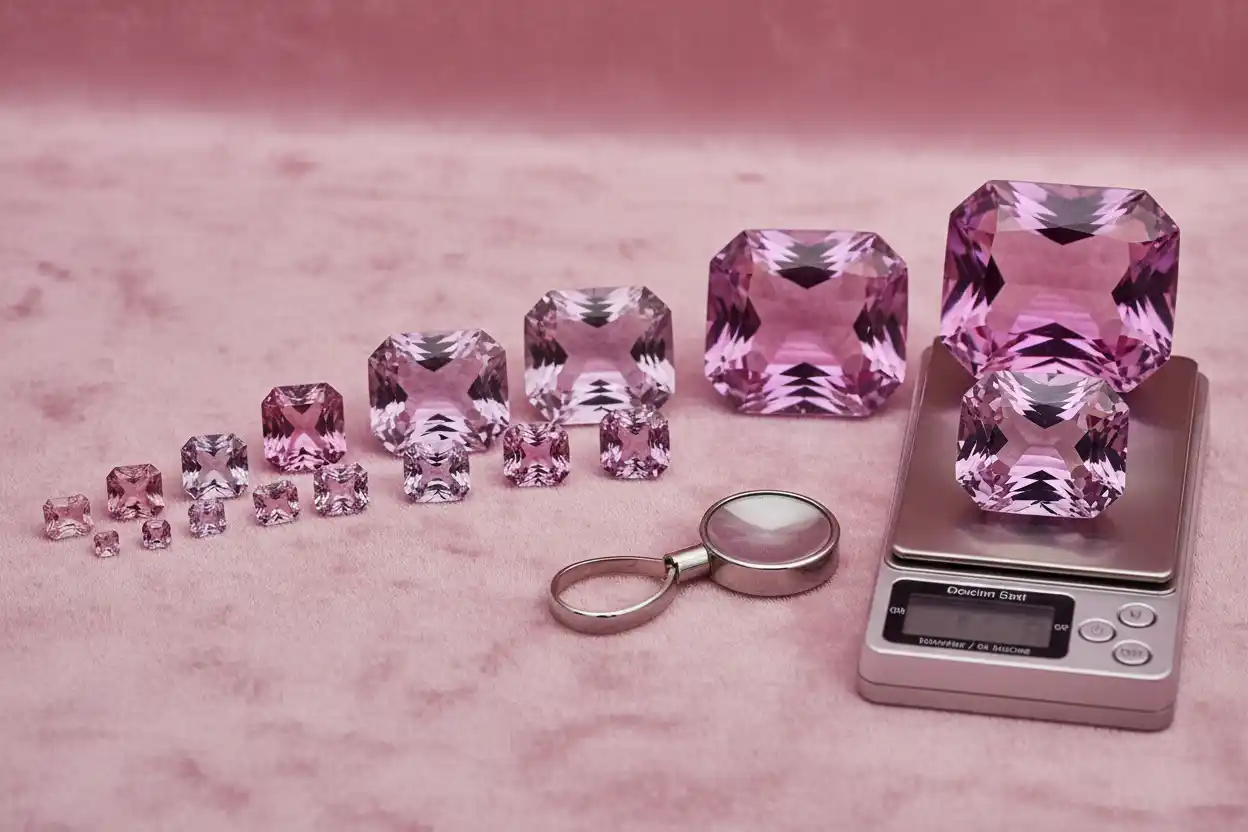
Kunzite Price: Buyer Value Guide, Grade, Supply & Demand
Kunzite price is driven primarily by the quality and intensity of its pink-to-violetish-purple color, followed by clarity, pleochroic orientation, cut, dimensions, condition, treatment history, color stability, and market demand. GIA identifies color as kunzite’s most important value factor and states clearly that the more vivid the color, the higher the value, while also noting that the gem is generally quite clean and can occur in exceptionally large sizes. These characteristics create a market in which a modestly sized vividly colored stone can sometimes be more desirable than a much larger pale gem.
Supply also behaves differently from many rare colored stones. Kunzite can form very large crystals, and GIA notes that unusually large fashioned stones are not uncommon enough for size alone to create an automatic rarity premium; its educational material cites an 880-carat Smithsonian faceted kunzite and illustrates another example exceeding 600 carats. Strong saturation in smaller material can actually be harder to obtain because pale rough may need greater depth or size before sufficient color develops face-up, an effect GIA discusses in its broader colored-gem value research. Buyers should therefore use the Gems Lore buy kunzite guide to establish quality before interpreting any kunzite price.
Kunzite Price At a Glance
| Value Factor | What Usually Raises Kunzite Price | What Can Lower Kunzite Price |
|---|---|---|
| Color | Vivid pink, lilac, violetish pink, or violetish purple | Very pale, grayish, brownish, or weakly saturated color |
| Face-Up Orientation | Strongest attractive pleochroic color visible through table | Poor orientation that makes stone look pale |
| Clarity | Clean transparent appearance | Eye-visible inclusions, clouds, fractures |
| Cut | Good color orientation, polish, symmetry, controlled windowing | Poor orientation, excessive weight retention, weak polish |
| Carat Weight | Larger stone when vivid color and quality remain strong | Large pale stone valued primarily for weight |
| Dimensions | Attractive face-up spread for the weight | Hidden pavilion weight with little visual benefit |
| Light Stability | Well-preserved current color and realistic care history | Noticeable fading or prolonged harsh-light exposure |
| Treatment | Clear irradiation/heat disclosure | Unsupported untreated claim or ambiguous color history |
| Cleavage Condition | No cracks, chips, or structural stress | Cleavage fractures, chipped corners, setting damage |
| Origin | Documented locality when collector provenance matters | Country name used as substitute for color quality |
| Craftsmanship | Precision or artist cutting | Commercial cutting with poor optical performance |
| Setting | Protective design and appropriate jewelry use | High-risk mounting exposing corners to impact |
| Grade | Observable quality characteristics | Undefined AAA/AAAA or investment-grade terminology |
| Market Context | Comparable kunzite retail or resale transaction | Comparison with hiddenite, sapphire, morganite, or unrelated gems |
Vivid Color Produces the Strongest Kunzite Premium
GIA identifies color as kunzite’s most important value factor, and the market generally rewards material whose pink, lilac, or violetish-purple color remains obvious and attractive when viewed face-up under ordinary lighting. Pale stones can still be elegant, especially in larger custom cuts, but they belong to a different value tier from strongly saturated material when all other factors are similar.
Tone and saturation should be considered together. A very dark violet stone is not necessarily superior if poor cutting or extinction suppresses brilliance, while a medium-light gem can look more luminous and appealing despite having slightly less absolute saturation.
The most useful valuation asks how much attractive color the buyer actually sees in normal wear rather than how intense the stone can look under ideal photography.
Small Strongly Colored Kunzite Can Be Scarcer Than Expected
GIA’s colored-gem value research specifically notes that some stones, including kunzite, often need sufficient size or depth to develop strong saturation, which can make small gems with vivid color unusually scarce and surprisingly expensive.
This is an important departure from the assumption that per-carat value must always climb steadily with size. A three-carat vividly colored kunzite can occupy a more desirable niche than a ten-carat gem whose pink is barely visible.
The market therefore rewards color concentration as well as total material quantity.
Large Kunzite Is Not Automatically Rare
GIA states that it is not unusual to find kunzite in large sizes and cites extraordinarily large faceted examples. This makes kunzite fundamentally different from gems in which fine rough above a few carats becomes extremely scarce.
A seller advertising a fifty-carat kunzite as extremely rare solely because of its weight should therefore provide another reason for the premium, such as exceptional saturation, unusual clarity, documented historic provenance, precision cutting, or an important jewelry mounting.
Large size increases total value most effectively when high quality continues across the larger gem.
Color, Not Origin, Usually Determines the Strongest Premium
GIA’s kunzite buyer guidance states directly that color is more important than mine location and advises buyers to seek the most vividly colored stone available.
Afghanistan, Brazil, Madagascar, and California are all recognized kunzite sources, but origin normally does not create the kind of price structure associated with Kashmir sapphire, Colombian emerald, or Burmese ruby.
Collector crystals from historically important mines can be different because mineral-specimen provenance has value of its own, yet a typical faceted jewelry buyer should prioritize the actual stone.
Pleochroic Orientation Can Change Price Significantly
Kunzite is pleochroic, and GIA notes that its best color appears when viewed down the length of the crystal. Cutters therefore orient rough deliberately to present the strongest attractive color face-up.
A poorly oriented stone can contain excellent color in one direction yet look weak when mounted. A well-oriented stone may require the cutter to sacrifice weight but can command stronger demand because the beauty is visible where it matters.
This is why a lower-weight kunzite can legitimately cost more than a larger stone from comparable rough.
Deep Proportions Can Strengthen Kunzite Color
GIA’s cut-quality research uses kunzite to illustrate how deeper proportions can create stronger face-up saturation and reduce a window in pale rough.
Deep cutting should therefore not be condemned automatically. The correct evaluation asks whether the added depth improves face-up color enough to justify the additional weight.
If a deep stone looks richly colored, brilliant, and reasonably sized from above, the proportions may be appropriate. If it is merely heavy and still pale or windowed, the buyer may be paying for mass with little optical benefit.
Clarity Has a Stronger Price Effect Because Clean Material Is Common
GIA notes that kunzite is usually very clean and that inclusions affecting transparency reduce value.
This means eye-visible cloudiness, fractures, dark inclusions, or prominent tubes can have a relatively strong negative effect compared with gemstone varieties that are routinely included.
Microscopic perfection should not become an obsession, however. A tiny inclusion visible only under magnification should be weighed against color, cut, dimensions, and price rather than treated as a fatal defect.
Cleavage Fractures Can Reduce Value More Than Ordinary Inclusions
Kunzite has two perfect cleavage directions and poor toughness. GIA warns that hard blows, pressure, extreme temperature changes, or careless setting can split the stone.
A cleavage crack therefore presents both an appearance problem and a structural risk. An internal inclusion that is completely enclosed and stable may have less effect on price than a surface-reaching fracture near a corner or prong.
Pre-owned stones should be examined carefully from the side because a face-up photograph can hide damage.
Condition Matters Strongly in Large Statement Stones
Large kunzites are frequently used in pendants, cocktail rings, brooches, and statement jewelry. Their size can expose wide facet surfaces and corners to scratches or impacts.
Check facet junctions for abrasion, girdles for chips, tables for scratches, and prong areas for cleavage stress. A damaged large stone may require repolishing or recutting, which can reduce both weight and carefully planned color orientation.
Condition should therefore be treated as an explicit value factor rather than an afterthought.
Light Fading Can Affect Current Market Value
Kunzite can fade after prolonged exposure to strong light or heat. GIA states that this sensitivity applies to both naturally colored and treated material.
A pre-owned stone that has lost saturation may therefore have lower value today than an old appraisal or sales receipt suggests.
The current face-up color is what a new buyer receives, not the historical color claimed when the gemstone was first purchased.
Fading Should Not Be Confused With Normal Minor Lighting Differences
Every colored gemstone looks somewhat different under changing light sources, but kunzite’s known sensitivity involves actual loss of color after excessive exposure rather than merely a temporary shift in appearance.
A dealer should not dismiss real fading as normal indoor-versus-outdoor variation, nor should a buyer assume every slight change between photographs proves permanent color loss.
Side-by-side comparison under controlled lighting provides a more useful assessment.
Irradiation and Heat Can Enhance Kunzite Color
GIA confirms that kunzite can be irradiated and then heat treated to improve color.
Treatment may make pale material more commercially attractive, but it does not eliminate kunzite’s light-sensitivity characteristics. GIA states that treated color can fade with heat and bright light just as natural color can.
A treated stone should be compared with appropriately disclosed treated material if treatment status affects buyer preference or price.
“Natural Kunzite” Does Not Necessarily Mean Untreated
Natural describes the geological origin of the gemstone, while treatment describes what happened after mining. A naturally mined kunzite may still have undergone irradiation and heating.
A seller who answers treatment questions only by saying the stone is natural has not fully answered the question.
For an expensive stone sold at an untreated premium, ask what evidence supports that representation and whether a reputable laboratory has examined the gem.
GIA Evaluates Kunzite but Does Not Grade It
GIA explicitly states that it evaluates kunzite but does not issue an overall quality grade. Its Colored Stone Identification Report can document measurements, weight, shape, cutting style, color, natural or laboratory-grown status, and detectable treatments.
This distinction matters because retailers commonly advertise AAA, AAAA, top quality, premium, or investment-grade kunzite.
Those terms can be used within a merchant’s private system, but no universal conversion exists between the label and a market price.
AAA Kunzite Has No Standardized Price Premium
GIA states specifically that there is no single standard A/AA/AAA quality-grading scale for kunzite.
An AAA stone from one seller could be lighter, deeper, more included, or less well cut than an ungraded stone from another.
Price should therefore be justified by observable face-up color, saturation, clarity, dimensions, cutting, condition, treatment, and service rather than the letter grade.
Large Precision-Cut Kunzite Can Carry a Craftsmanship Premium
Kunzite’s large available crystals and attractive transparency make it popular among precision cutters and lapidary artists. The material can support complicated fantasy cuts, concave facets, large cushions, and dramatic statement designs.
The cutting premium may reflect many hours of skilled work and substantial rough loss rather than rarity of the raw kunzite.
An artist-cut twenty-carat gem can therefore cost far more than a mass-produced stone of the same weight even when their rough quality began similarly.
Jewelry Metal and Design Can Dominate Total Retail Price
A large kunzite set in high-karat gold or platinum with diamond accents can have a finished retail price far above the loose gemstone’s standalone market value.
Brand, craftsmanship, custom setting, side stones, labor, insurance, warranty, and service can all contribute.
Dividing the finished ring or pendant price by the kunzite’s carat weight is consequently a poor way to estimate the loose-stone kunzite price.
Supply Is Broad Enough to Keep Many Kunzites Accessible
GIA characterizes kunzite as relatively affordable despite its beauty and rarity because it remains comparatively unknown, while large material is available.
This creates an interesting market balance: the mineral can be uncommon geologically without commanding the prices of emerald, sapphire, or fine tourmaline because demand, brand recognition, and available large crystals differ.
Rarity should therefore never be used as a standalone financial argument.
Demand Is Strongest for Vivid, Wearable, Well-Cut Stones
The most marketable kunzites tend to combine obvious pink or violetish-purple color with good transparency, eye-clean appearance, attractive dimensions, and a cut that makes the stone look lively.
Extremely pale stones can still appeal to buyers seeking large pastel gems, but the audience may be more price sensitive.
A gemstone that photographs dramatically but looks nearly colorless in ordinary wear can be harder to resell than its original marketing might suggest.
Kunzite Price Versus Hiddenite Price
Kunzite and hiddenite are both spodumene, yet their market structures differ substantially. Fine stable chromium-bearing hiddenite is much scarcer than ordinary kunzite, while large kunzite is relatively available.
Gems Lore’s hiddenite price guide explains how strict variety definition, green color stability, chromium, size, and provenance affect hiddenite valuation, while buy hiddenite covers the authenticity questions surrounding green spodumene.
A shared chemical species therefore does not imply similar price.
Kunzite Price Versus Amethyst Price
Amethyst and kunzite can overlap in lavender and violet colors, but amethyst is quartz and follows a much larger, more standardized commercial supply.
Gems Lore’s amethyst price guide provides the relevant quartz comparison.
A buyer deciding between them should consider not only price and color but also kunzite’s cleavage and light sensitivity versus amethyst’s different durability and treatment profile.
Kunzite Price Versus Rare Collector Gems
Kunzite should not be compared with materials such as jeremejevite or grandidierite merely because all can be described as collectible gemstones. Jeremejevite and transparent grandidierite occupy narrow rarity-driven markets where suitable faceting material is far less available.
Kunzite’s attraction comes more from beautiful color, impressive size, clean transparency, and cutting possibilities than from extreme scarcity of fine material at ordinary jewelry sizes.
Retail Asking Price Is Not Resale Value
Retail kunzite price can include cutting, inventory, setting, photography, shipping, return rights, warranty, storefront overhead, and merchant profit.
A dealer buying a used kunzite must consider current color, possible fading, condition, recutting risk, inventory time, and demand. The cash offer can therefore be much lower than the original retail purchase amount.
This difference does not automatically mean the original retail price was fraudulent; it reflects different transaction economics.
Insurance Appraisal Can Be Higher Than Realizable Cash Value
Insurance appraisals are often designed around replacement cost through an appropriate retail market rather than what a dealer would pay immediately.
For a large custom-cut kunzite, replacement might require locating comparable color, dimensions, and craftsmanship, which can produce a valuation significantly above immediate resale value.
A buyer should understand the purpose of the appraisal before treating its number as market proof.
What Usually Raises Kunzite Price?
Kunzite price tends to rise when a stone combines vivid pink-to-violetish-purple color, good saturation, strong face-up pleochroic orientation, excellent transparency, eye-clean clarity, attractive cutting, useful dimensions, sound cleavage condition, and minimal evidence of fading.
Precision cutting, notable artist provenance, exceptional jewelry craftsmanship, historically important mine provenance, or unusual saturation in a relatively small stone can create additional premiums.
The strongest stones generally look obviously attractive without requiring special lighting or an exaggerated grade description.
What Usually Lowers Kunzite Price?
Very pale color, grayness, weak face-up orientation, heavy inclusions, cleavage cracks, excessive hidden depth, poor polish, visible fading, chips, facet abrasion, ambiguous treatment disclosure, risky mounting, or undefined retailer grades can all reduce value.
Large size does not compensate automatically for these weaknesses because supply already includes exceptionally large kunzite.
How to Compare Kunzite Prices Fairly
A reliable comparison aligns the gemstones by face-up hue, saturation, pleochroic orientation, transparency, clarity, carat weight, length, width, depth, cut quality, cleavage condition, current color, treatment disclosure, setting type, craftsmanship, and transaction market. Only after those variables are reasonably similar should a per-carat figure become the deciding factor.
Conclusion
Kunzite price is governed more strongly by vivid color and presentation than by raw size. GIA identifies color as the gemstone’s leading value factor, describes kunzite as usually very clean, and confirms that large sizes are sufficiently available that impressive carat weight alone does not establish exceptional rarity.
The market rewards stones that show strong pink or violetish-purple face-up color, good transparency, skilled pleochroic orientation, appropriate proportions, and sound condition. Small highly saturated stones can be surprisingly scarce, while deeper cutting can sometimes improve a pale stone’s saturation enough to justify additional depth.
Treatment and ownership also influence value because kunzite can be irradiated and heated, both natural and treated color can fade under prolonged strong light or heat, and perfect cleavage creates poor toughness despite reasonable hardness. Buyers who include those characteristics in the valuation can interpret kunzite price far more accurately than anyone relying on an AAA label or generic dollars-per-carat chart.
Frequently Asked Questions
How much is kunzite worth per carat?
There is no universal kunzite price per carat. Vividness of color, pleochroic orientation, clarity, cut, size, dimensions, treatment, fading, cleavage condition, and craftsmanship can produce major differences between stones.
What is the most important kunzite value factor?
Color is the leading factor. GIA states that more vivid kunzite is more valuable. A strong pink, lilac, or violetish-purple face-up appearance normally commands greater demand than extremely pale material when the remaining quality factors are comparable.
Are large kunzites expensive?
Large total size does not automatically make kunzite expensive because exceptionally large stones are known and GIA states that large material is not unusual. Large stones become substantially more desirable when vivid color, transparency, clarity, good cutting, and condition remain strong.
Can small kunzite be more expensive per carat?
Yes. GIA’s colored-gem value research notes that saturated kunzite color may sometimes require greater size or depth, making smaller strongly saturated stones comparatively scarce.
Why are some kunzites cut deep?
Deep proportions can intensify pale color and reduce windowing in kunzite. GIA specifically uses kunzite as an example of a colored stone in which deeper cutting can create a more saturated face-up appearance.
Does fading lower kunzite value?
It can. Kunzite color can fade after prolonged strong light or heat exposure, so a noticeably faded secondhand stone may have lower current market appeal than a comparable gem retaining stronger saturation.
Is natural kunzite always untreated?
No. A gemstone can be naturally mined and still undergo irradiation and heat treatment. GIA confirms that kunzite can be irradiated and heated to enhance its color.
Does treated kunzite fade?
It can. GIA notes that irradiated-and-heated kunzite can fade with heat and light, and naturally colored kunzite can also fade under the same conditions.
Does AAA kunzite have a standard market value?
No. GIA states that no single standard A/AA/AAA quality scale exists for kunzite. Retailer grades should be replaced with actual color, clarity, cut, dimensions, treatment, and condition when comparing prices.
Does origin affect kunzite price?
Usually less than color and quality. GIA specifically states that kunzite color matters more than where it was mined. Historic mine provenance can add collector interest, but ordinary jewelry valuation should focus first on the gemstone itself.
Is kunzite resale value equal to retail price?
Usually not. Retail price includes merchant costs and margin, while resale offers account for current color, condition, verification, market demand, inventory time, and dealer margin. A high insurance appraisal also does not guarantee the same cash resale amount.
Is kunzite a guaranteed investment?
No. Kunzite can provide excellent beauty and large visual presence, but supply, demand, fading risk, cleavage, treatment, condition, and resale liquidity all influence future value. No size, retailer grade, or appraisal can guarantee appreciation.