Morganite Price: Value Guide, Grade, Supply & Demand
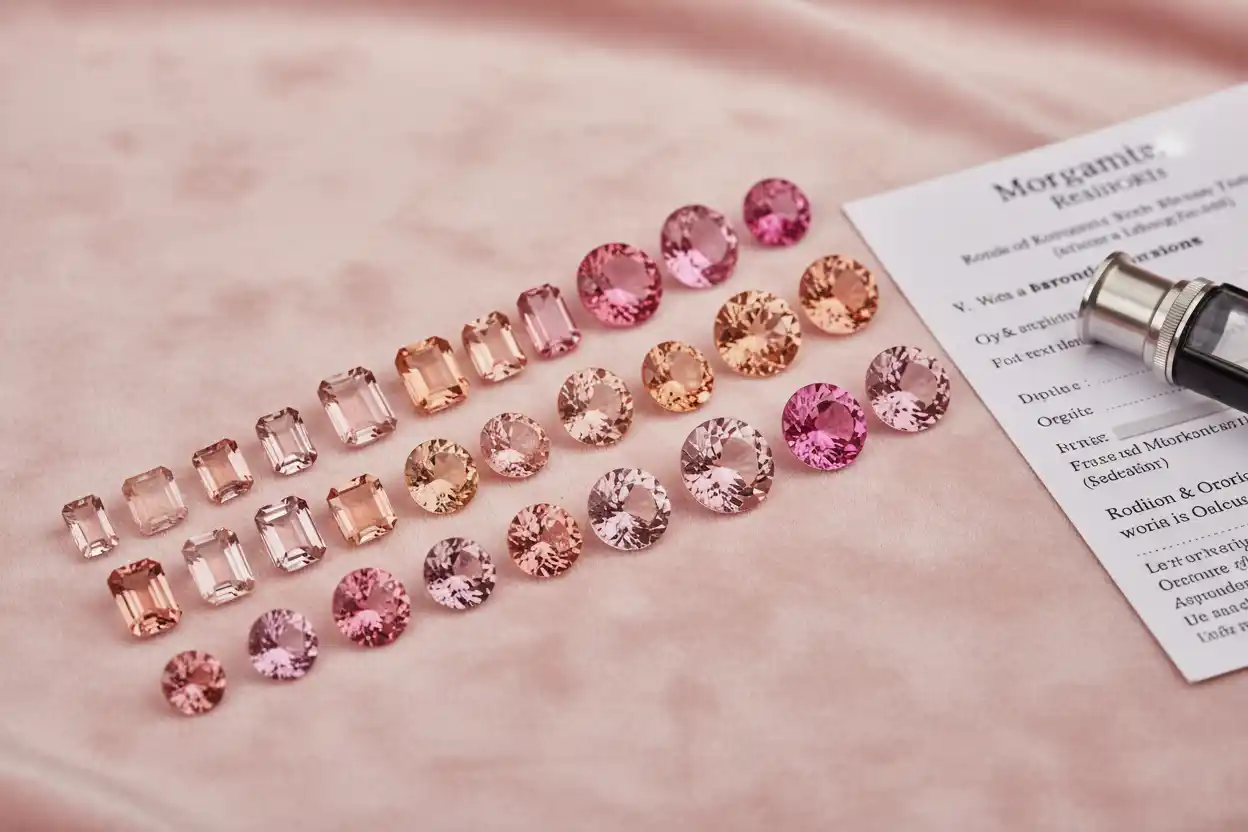
Morganite price is governed primarily by color strength, hue, treatment history, clarity, cutting, size, face-up dimensions, origin or provenance, natural versus synthetic identity, jewelry craftsmanship, and current demand rather than by one universal price-per-carat table. Morganite is the pink to orange-pink variety of beryl, and GIA notes that although the gem is normally pastel, stronger pink color is comparatively rare and commands greater value. Pure pink through purplish pink with strong saturation generally leads the mainstream market, while peach and salmon untreated stones can attract specialized collector premiums even though those warmer hues are less fashionable overall.
Treatment complicates price comparison because heating is routine, stable, and generally undetectable. GIA states that heat commonly removes yellow or orange components, leaving a purer pink appearance, and that the resulting treatment cannot ordinarily be identified gemologically after the fact. This means that an “unheated” morganite price premium should be supported by credible provenance rather than a certificate that merely repeats a seller’s assertion. At the same time, ordinary heated stones should not receive an automatic discount simply for being treated because heat is an established commercial practice in the market.
Morganite Price At a Glance
| Value Factor | What Usually Raises Morganite Price | What Can Lower Morganite Price |
|---|---|---|
| Color | Strong pure pink to purplish pink | Very pale, grayish, brownish, or weak color |
| Untreated Character | Credible attractive peach/salmon provenance | Unsupported “unheated” marketing claim |
| Heat Treatment | Transparent disclosure and attractive stable result | Misrepresentation of treatment history |
| Saturation | Stronger pink while maintaining brightness | Washed-out pastel appearance |
| Clarity | Eye-clean transparency | Obvious inclusions, clouds, fractures |
| Cut | Strong brilliance, symmetry, good color concentration | Windowing, excessive depth, poor polish |
| Face-Up Size | Efficient spread for weight | Heavy stone with substantial hidden depth |
| Carat Weight | Larger stone retaining attractive color | Large pale material without corresponding quality |
| Pleochroic Orientation | More attractive pink direction face-up | Weak orientation reducing color |
| Origin | Documented desirable or historical source | Unsupported country claim |
| Madagascar Provenance | Strong old-stock color and credible documentation | Locality claimed only from appearance |
| Natural Identity | Confirmed natural morganite | Synthetic material represented as natural |
| Report | Independent identity and detectable-treatment information | Seller-only grade |
| Setting | Fine gold/platinum workmanship and suitable design | Retail price inflated mainly by weak setting |
| Resale Context | Exceptional color, provenance, designer demand | Common commercial material with abundant new supply |
Strong Pink Usually Commands the Mainstream Premium
GIA identifies pure pink through purplish pink with strong saturation as the rarest and most valuable mainstream morganite color range. Most material is considerably lighter, often appearing blush, pale rose, peach, or salmon, which creates the pastel character for which the gem is known.
A stronger pink stone therefore usually commands more than a very pale stone of similar size, clarity, and cutting because saturated color is less common. The premium should remain tied to brightness as well as saturation, however. A stone that looks dark, muddy, or brownish does not automatically improve merely because its tone is deeper.
Neutral-light comparison is essential because rose-gold settings, pink backgrounds, warm lighting, and photo saturation can all make weakly colored stones look richer.
Peach and Salmon Can Carry a Collector Premium
The market generally favors pink and rose today, but GIA notes that collectors may value untreated peach-colored morganite more highly than heat-treated pink material. This creates a parallel value structure in which an attractive salmon or peach gem with credible untreated provenance can cost more than a visually pinker heated stone.
The key word is credible. Since the routine heating process may be undetectable, the premium cannot rest entirely on the current color.
Old stock, documented rough, collection history, or other provenance can give an untreated claim more weight.
Routine Heating Makes Treatment Pricing Unusual
Many colored gemstones receive price discounts or premiums according to whether heating can be identified directly in a laboratory. Morganite is different because GIA states that the common heat treatment is not detectable and produces stable color.
This means ordinary market pricing already incorporates the expectation that much pink morganite has been heated. A buyer should not assume that a standard pink stone needs a large discount because heating was likely, nor should a seller demand an extraordinary premium for “unheated” without evidence.
Treatment economics therefore revolve around provenance and buyer preference more than routine laboratory detection.
Very Pale Material Should Not Receive a Strong Color Premium
Morganite can become so lightly colored that the face-up appearance approaches near-colorless beryl under some lighting. Because strong color is scarce, a large pale stone can still remain relatively affordable even when its clarity is excellent.
This is particularly important when retailers market large carat weights. A twenty-carat pale stone is visually impressive in size but may not belong to the same per-carat category as a significantly smaller gem showing saturated rose-pink color.
The Gems Lore buy morganite guide should therefore be used before interpreting size-based price comparisons.
Eye-Clean Clarity Is Expected Rather Than Exceptional
GIA states that faceted morganite is usually free of inclusions visible to the unaided eye. This lowers the rarity premium associated with high clarity compared with emerald.
A clean ten-carat morganite is not automatically extraordinary simply because a similarly clean emerald would be. Morganite forms under different conditions and commonly provides large transparent crystals.
Visible dark inclusions, large multiphase cavities, clouds, or fractures can nevertheless reduce price because buyers have access to many cleaner alternatives.
Magnification-Level Clarity Can Be Overpriced
Once a morganite looks clean at ordinary viewing distance, moving from one microscopic clarity category to another may add little visible benefit. Retailer-created VVS or flawless labels can sound impressive, but they are not part of a standardized GIA morganite grading system.
The better use of budget is often stronger color, superior cut, or better face-up spread.
Step cuts may justify stricter clarity expectations because open facets reveal the interior more clearly than brilliant cushions or ovals.
Cut Has a Direct Relationship With Color
GIA notes that light-colored morganite rough may be cut deeper to intensify face-up color. The strategy can work because a longer light path through the gem makes subtle pink appear stronger.
The economic tradeoff is spread. A deep stone retains more weight below the girdle, so buyers can pay for carats they do not see when looking down at the gem.
A fair morganite price therefore compares both weight and dimensions. Two five-carat cushions can have noticeably different visible size if one is much deeper.
Windowing Can Reduce Value Even in Attractive Pink Material
A shallow pavilion can produce a transparent central window through which the wearer sees the skin, setting, or background instead of rich internal brilliance. Windowing is especially noticeable in pale colored stones because there is already limited saturation to mask the transparent area.
A heavily windowed gem should generally receive a discount relative to a similarly colored stone with balanced light return.
Extremely deep cutting solves one problem by creating another, so the best stones balance color concentration with efficient face-up size.
Pleochroism Makes Cutter Skill Economically Relevant
GIA describes morganite as distinctly pleochroic, showing pale pink and deeper bluish-pink in different crystal directions. Orienting the more attractive direction toward the face of the stone can improve apparent color without any treatment.
Poor orientation can therefore lower value even when the rough itself had good potential.
This factor becomes particularly important in stronger-color crystals where a cutter may need to choose between maximum weight retention and maximum pink saturation.
Morganite Can Be Large Without Becoming Extremely Rare
Morganite crystals can grow to very substantial sizes. GIA reports Brazilian crystals exceeding 10 kilograms and states that large faceted gems are readily available in the modern market.
This fundamentally changes the size-value relationship. Large stones cost more in total, but morganite usually does not experience the same explosive per-carat jump seen in gems whose fine material becomes exceptionally rare above a few carats.
Size premiums should therefore be tied to maintained color, cutting quality, and face-up presence rather than to weight alone.
Large Stones Can Show Better Color
GIA notes that strong morganite color is rare and that gems often need greater size to achieve the finest visual saturation. This means some increase in value with size can be driven by appearance rather than scarcity alone.
A pale small stone can look nearly colorless, while larger material from similarly colored rough can display a recognizably stronger pink because of the increased optical path.
This interaction explains why the market may reward certain large stones even though large morganite crystals themselves are not exceptionally rare.
Brazil’s Large Supply Moderates Geographic Premiums
GIA identifies Minas Gerais, Brazil, as the dominant modern morganite source and notes that most material on the current market comes from Brazilian pegmatites. This substantial supply helps moderate origin premiums for ordinary Brazilian stones.
A Brazilian gem can still command a high price when its color is exceptional, but the premium comes from quality rather than the country name itself.
This differs from markets such as fine ruby or emerald where locality can sometimes exert a much stronger independent influence.
Madagascar Has Historical and Collector Appeal
Morganite’s modern gem identity is closely linked to Madagascar, where important rose beryl discoveries led George Kunz to propose the name in honor of J.P. Morgan. GIA notes that magenta-colored Madagascar rough continues to set a standard for the finest color even though the locality is no longer the dominant modern producer.
Documented old-stock Madagascar morganite can therefore attract a premium, especially when strong color and untreated provenance accompany the locality.
A retailer should not assign Madagascar origin from color resemblance alone.
Mozambique, Afghanistan and Other Sources Add Variety
GIA documents morganite production from Mozambique, Afghanistan, China, Russia, the United States, Namibia, Pakistan, and other locations, though many are minor or inconsistent compared with Brazil.
For most jewelry purchases, these origins matter less than face-up color and cutting. Collector pieces can behave differently when a particular mine or locality is difficult to obtain and well documented.
Geographic origin therefore belongs to the valuation only in proportion to how reliably it is established and how much buyers actually demand it.
Synthetic Morganite Creates a Separate Price Category
GIA confirms that laboratory-grown morganite exists but is not produced in large commercial quantities. Synthetic material can possess essentially the same broad gem properties while lacking natural geological origin.
A synthetic stone should therefore not be benchmarked directly against natural morganite merely because color, size, and clarity appear similar.
Independent laboratory identification is particularly useful when a very large clean stone carries a high natural-origin premium but has uncertain provenance.
GIA Reports Do Not Establish Morganite Market Value
GIA states that it evaluates morganite but does not grade it. Its Colored Stone Identification Report can identify natural versus laboratory-grown material and name detectable treatments.
A report therefore reduces uncertainty but does not say that a stone is AAA, premium grade, or worth a particular dollar amount.
Current market value still depends on color, cut, size, provenance, treatment claims, retailer, jewelry setting, and buyer demand.
Morganite Price Versus Aquamarine Price
Morganite and aquamarine are closely related beryl varieties and share several market characteristics: large crystals, commonly eye-clean clarity, Mohs hardness around the upper 7 range, and strong importance of color. Gems Lore’s aquamarine price guide provides a useful comparison because it shows how beryl can remain available in substantial sizes while fine color still attracts premiums.
Morganite differs because its market favors pink, rose, peach, and salmon, while aquamarine centers on blue and greenish-blue.
The Gems Lore buy aquamarine guide also illustrates why good cutting and treatment understanding remain more useful than simply comparing carat weight.
Morganite Price Versus Emerald Price
Although both are beryl, emerald and morganite follow very different value structures. Gems Lore’s emerald price guide covers a market where fine natural color, limited clarity, origin, treatment, and large-size rarity can create much stronger premiums.
Morganite is generally cleaner and can form much larger usable crystals, so applying emerald-style scarcity assumptions would dramatically overstate ordinary morganite value.
This is also why GIA rejects the trade phrase pink emerald.
Morganite Price Versus Heliodor and Goshenite
The Gems Lore heliodor price guide and goshenite price guide cover yellow and colorless members of the beryl family, reinforcing how much beryl pricing depends on color demand rather than mineral species alone.
Morganite’s commercial premium comes from attractive pink coloration and current jewelry fashion.
A large clean colorless beryl and a large clean vivid-pink morganite may share structural similarities while occupying very different retail markets.
Rose-Gold Settings Can Distort Loose-Stone Comparisons
Rose gold reflects warm pink light through and around a pale morganite, sometimes making the gem look considerably stronger in photographs than it would loose against a neutral background.
That effect is not deceptive when the jewelry is accurately presented because the setting genuinely influences final appearance. It becomes misleading only when the enhanced mounted color is used to imply that the loose stone itself is unusually saturated.
When comparing center-stone prices, inspect neutral-background images or loose-stone video wherever possible.
Finished Jewelry Price Can Be Dominated by the Setting
Morganite is popular in engagement-style rings surrounded by diamonds and mounted in gold or platinum. A substantial portion of the final ticket can therefore come from metal weight, pavé diamonds, custom fabrication, designer branding, warranty, and retailer service rather than the morganite itself.
A relatively inexpensive pale center stone can become part of a high-priced ring when the surrounding jewelry is elaborate.
Price-per-carat calculations based on the completed ring should consequently be avoided.
Retail and Resale Values Can Differ Substantially
Large clean morganite is available in the modern market, which means secondhand buyers can compare used pieces with abundant new inventory. A dealer purchasing a stone from a consumer also needs room for authentication, repolishing, remarketing, and profit.
This can create a wide gap between original retail price and immediate cash resale value, particularly for ordinary heated pale material.
Exceptionally strong color, documented old-stock provenance, important designer jewelry, or unusual untreated material can behave differently, but no guaranteed retention percentage applies.
What Usually Raises Morganite Price?
Morganite price generally rises with strong pure pink or purplish-pink color, good saturation, attractive untreated peach or salmon when well documented, eye-clean transparency, excellent cutting, efficient face-up dimensions, larger size with color maintained, skilled pleochroic orientation, important Madagascar or other provenance, natural identity, credible documentation, and high-quality jewelry craftsmanship.
The strongest premium appears when several of these characteristics combine rather than when a stone simply crosses a carat milestone.
What Usually Lowers Morganite Price?
Very pale or grayish color, excessive brown or orange when the market expects pink, visible inclusions, windowing, excessive depth, weak polish, unsupported unheated claims, synthetic material represented as natural, seller-defined grades, origin claims based only on appearance, damaged condition, or inflated jewelry markup can all reduce value.
A pale heated stone can still provide excellent beauty for the money when it is represented honestly and cut well.
How to Compare Morganite Prices Fairly
Compare stones by natural versus synthetic identity, hue, tone, saturation, heat-treatment assumptions, evidence supporting untreated claims, clarity, cut, face-up dimensions, depth, carat weight, pleochroic orientation, source documentation, condition, laboratory report, setting value, and transaction type. A vivid old-stock untreated Madagascar stone, pale heated Brazilian cushion, synthetic pink beryl, and designer rose-gold diamond ring should never be reduced to one generic morganite price-per-carat average.
Conclusion
Morganite price is primarily a color-and-cut valuation operating within a beryl variety that can form unusually large clean crystals. GIA identifies strong pure pink to purplish pink as the rarest and most valuable mainstream color category, while acknowledging that untreated peach and salmon material can carry special collector appeal.
Routine heat treatment makes this market unusual because the process removes yellow-orange components, creates a stable purer pink, and is not detectable after treatment. Buyers should therefore be skeptical of unsupported unheated premiums while recognizing that heating itself is a normal commercial practice rather than an automatic defect.
Large size also needs perspective. Morganite crystals can exceed 10 kilograms and large faceted gems remain readily available, meaning carat weight alone does not create extreme scarcity. A fair morganite price is the price justified by strong color, good cutting, efficient visible size, trustworthy provenance, natural identity, and the actual jewelry being purchased—not by “pink emerald,” AAAA, or generic rarity claims.
Frequently Asked Questions
How much is morganite worth per carat?
There is no universal morganite price per carat because color saturation, hue, treatment claims, cutting, clarity, size, origin, natural versus synthetic identity, and retail context can vary considerably. Carat-based comparison is useful only after those factors are closely matched.
What morganite color is most expensive?
GIA identifies strongly saturated pure pink to purplish pink as the rarest and generally most valuable mainstream color range. Attractive untreated peach or salmon material can also command collector premiums when provenance supports the claim.
Does heat treatment lower morganite price?
Not automatically. Heat treatment is routine, stable, and widely accepted in morganite. The stronger premium issue is whether a seller claims untreated material and can credibly support that assertion.
Can GIA prove that a morganite is unheated?
GIA states that the common heat treatment used to remove yellow-orange components is not detectable. An unheated premium therefore needs provenance rather than treatment detection alone.
Why is some large morganite inexpensive?
Morganite can form very large crystals, and GIA notes that large faceted stones are readily available. Large weight does not automatically create rarity when color is pale or cutting is ordinary.
Does bigger morganite show better color?
It often can. GIA notes that morganite is commonly light and that larger stones may show stronger visible color. The buyer should still compare face-up dimensions because excessive depth can hide weight.
Is eye-clean morganite rare?
No. Faceted morganite is commonly eye-clean, so visible inclusions tend to reduce value more readily than they would in emerald.
Is Madagascar morganite more valuable?
Documented Madagascar material can carry historical and collector appeal, particularly when strong magenta or unusual untreated color is present. GIA notes that Madagascar’s classic rough still represents a benchmark for strong color.
Where does most morganite come from today?
GIA identifies Minas Gerais, Brazil, as the dominant modern source. Other producing countries include Mozambique, Afghanistan, Namibia, the United States, Madagascar, Pakistan, and additional localities.
Can morganite be synthetic?
Yes. Synthetic morganite exists, though GIA says it is not produced in large commercial quantities. Laboratory testing can distinguish natural from laboratory-grown material.
Does GIA grade morganite AAA?
No. GIA identifies and evaluates morganite but does not provide an overall quality grade. AAA and similar labels are retailer-defined.
Is morganite expensive because it is pink emerald?
Morganite is not pink emerald. GIA considers that term misleading even though morganite and emerald both belong to beryl. Their rarity, clarity, treatment, and size markets are very different.
Does morganite hold its retail value?
There is no guaranteed retention percentage. Large clean material is widely available, and resale depends on color quality, provenance, condition, jewelry design, treatment claims, and current buyer demand.
Is morganite a guaranteed investment?
No. Strong color and special provenance can make individual stones collectible, but future appreciation depends on supply, fashion, condition, treatment assumptions, and resale liquidity rather than on the gemstone name alone.