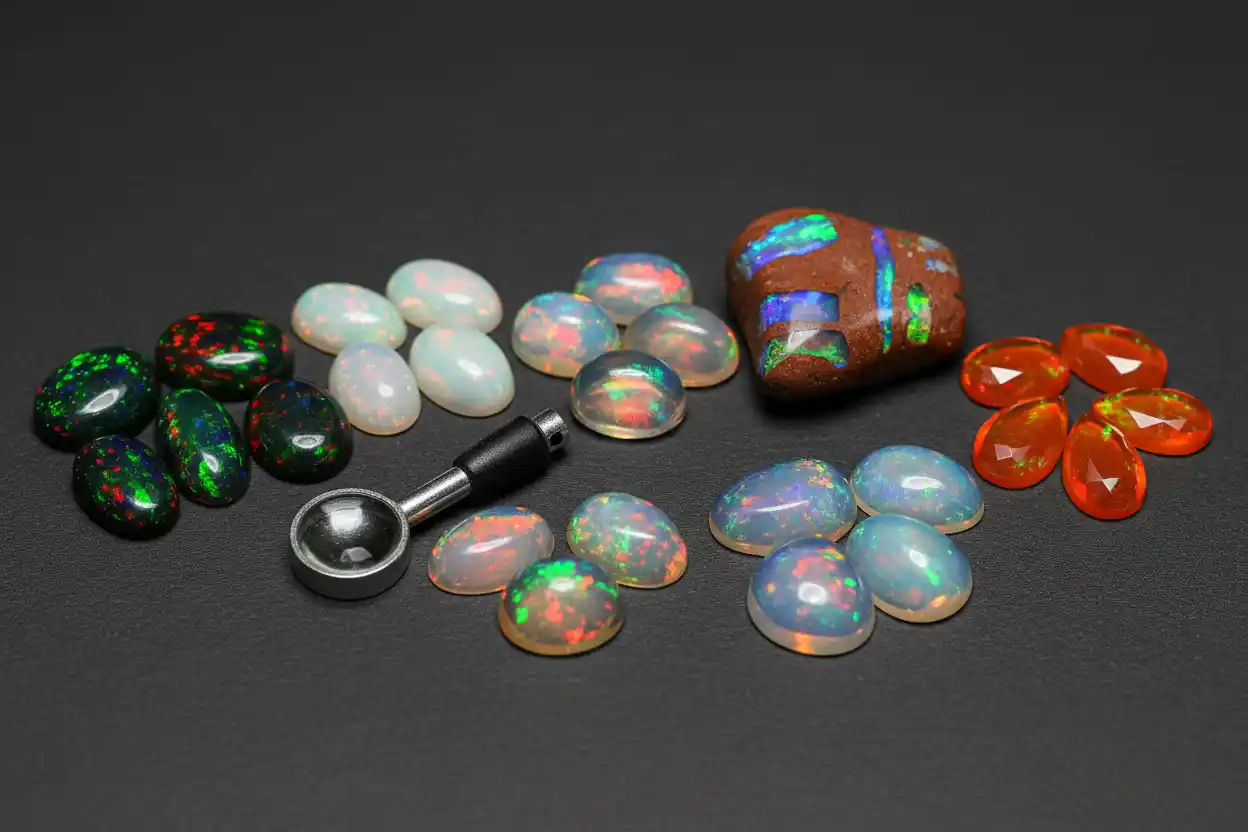
Opal Price Guide: Value and Cost in 2026
Opal prices in 2026 range from below $10 per carat for common or weakly colored material to more than $20,000 per carat for exceptional Black Opal. Most jewelry-quality precious Opal sells between approximately $50 and $1,000 per carat.
The variety must be identified before any price comparison begins. Black, white, crystal, Boulder, Ethiopian and Fire Opal have different body structures, sources, care requirements and market expectations.
Opal Prices by Type in 2026
The following ranges provide broad U.S. and international retail expectations for solid natural Opal.
| Opal type | Broad 2026 retail range | Main value factors |
|---|---|---|
| Common Opal | $1–$30 per carat | Body color, polish, pattern and rarity |
| White or light Opal | $10–$1,000+ per carat | Brightness, color range, pattern and transparency |
| Crystal Opal | $50–$3,000+ per carat | Transparency, play-of-color, coverage and pattern |
| Black Opal | $100–$20,000+ per carat | Body tone, brightness, red color, pattern and origin |
| Boulder Opal | $20–$5,000+ per carat | Color-bar quality, ironstone composition and pattern |
| Ethiopian Opal | $10–$1,000+ per carat | Brightness, pattern, hydrophane behavior and treatment |
| Fire Opal | $10–$1,500+ per carat | Orange or red body color, transparency and play-of-color |
| Pink, blue and other common Opal | $2–$100 per carat | Body color, translucency, pattern and locality |
These ranges overlap because one vivid white Opal can be more valuable than a weak Black Opal, while an exceptional crystal or Boulder stone can outperform ordinary examples from higher-profile categories.
The universal relationship among color, cut, size, rarity and demand appears in How Gemstone Prices Are Determined.
What This Opal Price Guide Covers
This page provides a family-level comparison across major Opal markets.
It does not replace the dedicated pricing pages for Black Opal, Boulder Opal, Ethiopian Opal or Fire Opal.
Each dedicated page owns the detailed pricing, sources, treatment issues and buying concerns for that variety.
The completed Opal guide owns mineral identity, geology and symbolic traditions. The completed Types of Opal page owns the full classification system.
Precious Opal vs Common Opal
Precious Opal displays play-of-color: moving spectral flashes produced by organized silica structures.
Common Opal lacks visible play-of-color. It can still be attractive in pink, blue, green, yellow, orange, dendritic or patterned forms, but its market is usually lower.
The distinction does not depend on whether a stone is natural. Both precious and common Opal can form geologically.
Precious Opal receives the strongest prices because brightness, color range and pattern can produce effects not available in ordinary opaque material.
Common Opal is more often sold as cabochons, beads, carvings and decorative stones. It should not be priced from Black Opal or crystal Opal comparisons.
The Eight Main Opal Value Factors
An Opal’s type establishes its market category. The following factors then determine where the stone falls within that category:
- Brightness of play-of-color
- Body tone
- Predominant spectral colors
- Pattern
- Color coverage
- Directionality
- Transparency and clarity
- Size, cut, condition and treatment
No single factor establishes value by itself. A dark body tone provides strong contrast, but a dull Black Opal may still cost less than a brilliant white or crystal stone.
Brightness Is the Most Important Factor
Brightness describes how strongly the play-of-color appears.
Fine Opal should remain active under ordinary daylight-equivalent and indoor lighting. A stone that needs a phone flashlight to reveal its colors belongs to a lower tier.
Brightness is different from saturation in an ordinary colored gemstone. Opal’s colors move and change as the viewing angle shifts.
A bright green-and-blue stone can be more valuable than a dull stone showing weak red. Red usually commands the highest premium only when it is vivid enough to matter.
Comparisons should be made under similar lighting. A dealer spotlight can make ordinary color appear much stronger than it will look during daily wear.
Body Tone
Body tone refers to the underlying lightness or darkness of the Opal.
Black Opal has a dark body, creating strong contrast with the spectral color. White Opal has a pale or milky body, while crystal Opal remains transparent to semitransparent.
Australian body-tone scales commonly range from N1, the darkest black, to N9, a light or white body.
Darker body tone usually increases value when brightness and pattern are comparable. However, body tone does not compensate for weak play-of-color.
A vivid N6 or N7 stone can be more valuable than a nearly black stone whose color is dull and restricted.
Spectral Color Range
Red is normally the highest-value play-of-color because the silica structure required to produce it is less common.
Orange and yellow also receive premiums, followed generally by green, blue and violet.
This hierarchy is not absolute. Brightness, pattern and coverage can outweigh hue.
A vivid electric-blue Opal with a broad rolling pattern can cost more than a stone containing one tiny red flash.
Full-spectrum Opal displaying red, orange, yellow, green and blue receives strong demand when the colors are bright and well distributed.
Pattern and Its Effect on Price
Pattern describes how play-of-color is organized across the face.
High-value patterns can include:
- Harlequin
- Flagstone
- Ribbon
- Rolling flash
- Broad flash
- Floral
- Chinese writing
- Straw
- Mackerel
- Pinfire
- Honeycomb
- Digit pattern
Harlequin and well-defined block patterns can command major premiums because they are uncommon.
Pattern names are not universally standardized. Sellers may use prestigious labels loosely for irregular patches that do not meet traditional expectations.
The pattern should remain recognizable through natural movement and cover a useful portion of the face.
Color Coverage
Coverage describes how much of the face displays play-of-color.
A stone with bright color across 80% or 90% of its surface normally costs more than one with an active patch surrounded by inactive potch.
Blank central areas reduce value more strongly than inactive edges.
Coverage should also be evaluated from several viewing directions. A pattern visible only from one narrow angle may cover less useful visual area than a slightly softer effect that remains active during movement.
Videos should show full rotation rather than only the strongest frame.
Directionality
Some Opals show their best color only when viewed from one specific angle. Others display attractive color through a broad viewing range.
Highly directional stones can be beautiful in pendants when the setting holds the best angle toward the viewer.
They may be less successful in rings because hand movement constantly changes orientation.
A broad viewing range generally creates stronger jewelry value. Narrow directionality should therefore be reflected in price, even when the best still image looks exceptional.
Cutters often preserve an unusual shape to retain the strongest color plane.
Transparency and Clarity
Crystal Opal is transparent to semitransparent, allowing play-of-color to appear suspended within the body.
Fine transparency can add depth and permit color to be viewed from several directions.
Cloudiness, milky haze and internal inclusions may reduce brilliance. However, some translucent body can strengthen contrast.
Cracks and crazing create far greater problems than ordinary inclusions. A crazed Opal contains a network of fractures that can expand and severely reduce durability.
Sand spots, potch areas and host-rock inclusions may be acceptable in Boulder Opal, where natural ironstone forms part of the design.
Clarity standards must therefore be applied within the correct variety.
Black Opal Prices
Black Opal normally occupies the highest Opal market.
Commercial one-carat stones with weak color may cost below $500 per carat. Fine material commonly ranges from approximately $1,000 to $5,000 per carat.
Exceptional N1-to-N3 body tones with vivid red-inclusive play and rare patterns can reach $5,000 to $20,000 per carat or more.
Lightning Ridge in New South Wales is the source most closely associated with fine Black Opal.
A dark body does not prove high value. Brightness, pattern and condition remain decisive.
Detailed market tiers belong to the Black Opal Price Guide. Practical selection belongs to the Black Opal Buying Guide.
The completed Black Opal guide owns the material’s geological identity.
White and Light Opal Prices
White Opal commonly ranges from approximately $10 to $300 per carat.
Fine stones with broad bright color can reach $300 to $1,000 per carat, while exceptional rare patterns may cost more.
Coober Pedy and other South Australian fields are major sources.
A milky body can soften contrast, so brightness becomes especially important. White Opal showing vivid red, green and orange across most of its face can still be highly valuable.
Weak pinfire color against an opaque chalky body belongs to the commercial tier.
The completed White Opal guide owns variety-specific material context.
Crystal Opal Prices
Crystal Opal ranges from transparent to semitransparent and can occur with light, dark or black body characteristics.
Commercial stones may cost approximately $50 to $300 per carat.
Fine crystal Opal with broad, bright play commonly ranges from $300 to $2,000 per carat.
Exceptional black crystal or red-dominant stones can exceed $3,000 per carat and occasionally compete with fine opaque Black Opal.
Transparency should enhance color rather than create a washed-out appearance. Dark backing beneath a loose crystal stone can also exaggerate contrast, so it should be viewed against several surfaces.
Boulder Opal Prices
Boulder Opal forms as thin precious-Opal seams within ironstone. The natural host rock remains attached to support the color bar.
Commercial material may cost $20 to $200 per carat. Fine stones commonly range from $200 to $2,000 per carat.
Exceptional red-inclusive patterns, Yowah nuts and large artistic compositions can exceed $5,000 per carat equivalent.
Weight includes ironstone, so price per carat must be interpreted differently from a solid Black or crystal Opal.
The Boulder Opal Price Guide owns detailed pricing, while the Boulder Opal Buying Guide owns selection.
The completed Boulder Opal guide provides material context.
Ethiopian Opal Prices
Ethiopian Opal commonly ranges from approximately $10 to $300 per carat.
Fine multicolor stones with strong brightness and attractive patterns may reach $300 to $600 per carat.
Exceptional honeycomb, digit or full-spectrum material can exceed $600 to $1,000 per carat.
Much Welo Opal is hydrophane, meaning it can absorb water and other liquids. This characteristic influences care, contamination risk and buyer confidence.
Smoking, dyeing and impregnation can alter body color and transparency. Treatment disclosure is therefore essential.
The Ethiopian Opal Price Guide owns its current market. The Ethiopian Opal Buying Guide owns hydrophane inspection and seller questions.
The completed Ethiopian Opal guide provides geological context.
Fire Opal Prices
Fire Opal is valued primarily for yellow, orange, reddish-orange or red body color.
Commercial material may cost $10 to $100 per carat. Fine transparent orange or red faceted stones commonly range from $100 to $500 per carat.
Precious Fire Opal combining vivid body color with play-of-color can reach $500 to $1,500 per carat or more.
Mexico is the source most closely associated with transparent Fire Opal, although fire-colored material occurs elsewhere.
The Fire Opal Price Guide owns detailed price bands. Practical selection belongs to the Fire Opal Buying Guide.
The completed Fire Opal guide owns material identity.
Common Opal Prices
Common Opal lacks play-of-color and normally costs far less than precious Opal.
Pink, blue, yellow, green, dendritic and opaque white Opals may sell from approximately $1 to $50 per carat.
Fine locality material, attractive dendrites or unusual body color may cost more.
Examples include Pink Opal, Owyhee Opal, Dendritic Opal and Hyalite, although Hyalite can also show fluorescence and greater transparency.
Completed material guides include Pink Opal, Owyhee Opal, Dendritic Opal and Hyalite Opal.
These varieties should not be priced from Black Opal comparisons merely because they share the Opal name.
Solid Opal vs Doublets and Triplets
Solid Opal consists entirely of natural Opal material, aside from any natural host rock in Boulder or matrix Opal.
A doublet contains a thin Opal layer attached to a dark backing.
A triplet adds a transparent protective cap above the Opal layer.
Doublets and triplets can provide vivid appearance at much lower prices. They are often sold by piece rather than carat because backing and cap material contribute to the weight.
Commercial doublet jewelry may cost $50 to $500. Fine triplets and designer settings can cost more, but they should remain below comparable solid Opal.
The complete construction guide appears in Gemstone Doublets and Triplets.
Authenticity and assembly checks belong to Real vs Fake Opal.
Synthetic Opal Prices
Synthetic Opal reproduces organized silica structures through manufacturing.
It may show vivid play-of-color and repeating patterns at a small fraction of natural Opal prices.
Loose synthetic stones commonly cost from a few dollars to approximately $100, depending on manufacturer, cutting and size.
Plastic and resin imitations can cost even less.
Synthetic origin should be disclosed clearly. A laboratory-created product should not be priced from Australian Black Opal or fine Welo comparisons.
Treatment and synthetic-identification intent belongs to How to Spot Treated or Synthetic Opal.
Opal Treatment and Value
Opal treatments include:
- Smoke treatment
- Dyeing
- Sugar-and-acid treatment
- Oil or resin impregnation
- Surface coating
- Fracture filling
- Composite construction
Treatment can darken the body, strengthen contrast or conceal poor transparency.
A treated stone may still be attractive, but it should cost less than a comparable naturally colored solid Opal.
Treatment stability and care differ. Dyed hydrophane material may absorb additional contaminants, while coated stones can scratch or wear.
The broader enhancement framework appears in Gemstone Treatments Explained.
Size and Price per Carat
Opal price per carat can rise sharply when exceptional brightness and pattern continue into larger sizes.
However, weak large stones remain inexpensive.
| Example | Broad total price |
|---|---|
| 1 ct commercial white Opal | $10–$100 |
| 1 ct fine crystal Opal | $300–$2,000 |
| 1 ct fine Black Opal | $1,000–$5,000 |
| 3 ct good Ethiopian Opal | $150–$900 |
| 5 ct fine Boulder Opal | $1,000–$10,000+ |
| Exceptional major Black Opal | Individually negotiated |
Opal density varies with composition and water content. Dimensions should therefore be compared with weight.
High domes and thick potch backs can add carats without increasing the visible color area proportionally.
Cut and Shape
Opal is usually cut as a cabochon. The curved surface displays play-of-color and preserves enough thickness for stability.
Freeforms are common because cutters follow the strongest color bar rather than forcing rough into standard shapes.
An irregular outline may therefore be more valuable than a calibrated oval when it preserves exceptional pattern.
A fine cut should show:
- Strong color orientation
- Smooth polish
- Balanced dome
- Minimal inactive potch
- Secure girdle
- No visible crazing
- Useful face-up dimensions
The complete stone-selection process belongs to the Opal Buying Guide.
Opal Jewelry Prices in 2026
| Jewelry type | Broad U.S. retail range |
|---|---|
| Silver Opal earrings or pendant | $50–$500 |
| Silver Ethiopian Opal ring | $100–$800 |
| Gold white or crystal Opal ring | $500–$5,000 |
| Fine Black Opal ring | $3,000–$50,000+ |
| Boulder Opal pendant | $500–$20,000+ |
| Designer or high-jewelry Opal piece | Highly variable |
Jewelry prices include metal, accent stones, craftsmanship and brand.
Style-specific content belongs to the Opal Ring Guide, Opal Earrings Guide, Opal Necklace Guide and Opal Bracelet Guide.
Opal’s birthstone history belongs to the October Birthstone Guide.
Durability and Condition
Opal has a Mohs hardness of approximately 5 to 6.5 and can scratch, chip or crack.
Crazing is one of the most serious value problems. A crazed stone should be heavily discounted because fractures can continue expanding.
Heat and sudden temperature changes can also cause damage. Hydrophane Opal may temporarily change after absorbing water.
Doublets and triplets should not be soaked because water can enter between layers.
Complete maintenance guidance belongs to How to Clean Opal Jewelry Safely.
Certification and Appraisal
A laboratory report becomes more useful as the Opal’s price, treatment risk or origin claim increases.
A useful report may identify:
- Natural or synthetic origin
- Solid, doublet or triplet construction
- Opal type
- Geographic origin when determinable
- Detected treatment
- Weight and measurements
No major laboratory provides a universally binding monetary grade for brightness and pattern.
Therefore, certification confirms identity and treatment while market comparison determines price.
The Gemstone Certification Labs comparison explains report scope.
Does Opal Hold Its Value?
Fine Australian Black and Boulder Opal can maintain strong collector demand, particularly when brightness, pattern and condition are exceptional.
Commercial white and Ethiopian Opal generally resell below retail.
Treatment, crazing and poor documentation weaken secondary-market value.
Signed jewelry may derive additional value from design, maker and provenance.
Opal can be collectible, but it should not be purchased on promises of guaranteed appreciation.
The broader resale framework appears in Do Gemstones Hold Their Value?.
Opal vs Moonstone
Opal displays play-of-color through organized silica structures. Moonstone displays adularescence through feldspar layering.
Fine Black Opal can cost far more than even exceptional Moonstone, although commercial stones may overlap.
The complete identification comparison belongs to Moonstone vs Opal.
Price Guide vs Buying Guide
This page owns the family-level comparison of Opal prices.
The dedicated price pages retain ownership of detailed Black, Boulder, Ethiopian and Fire Opal ranges.
Online buyers should request full-motion videos, treatment disclosure, side views and return terms. The broader verification process appears in How to Buy Gemstones Online Without Getting Scammed.
The Buying & Value hub connects Opal pricing with certification, treatment, authenticity and resale guidance.
Frequently Asked Questions
1. How much is Opal worth per carat in 2026?
Opal ranges from below $10 per carat for common or weak material to more than $20,000 per carat for exceptional Black Opal.
2. Which type of Opal is most expensive?
Fine Australian Black Opal generally occupies the highest market, particularly when it has vivid red play and a rare pattern.
3. How much is white Opal worth?
Commercial white Opal may cost $10 to $100 per carat, while fine bright stones can reach several hundred or more.
4. How much is crystal Opal worth?
Crystal Opal commonly ranges from $50 to $3,000 per carat, depending on transparency, brightness, pattern and body tone.
5. How much is Black Opal worth?
Commercial Black Opal may begin near $100 per carat, while fine stones commonly reach $1,000 to $5,000. Exceptional gems can exceed $20,000 per carat.
6. Is red play-of-color always most valuable?
Red normally receives the highest premium, but brightness, pattern and coverage can make a vivid blue-green stone more valuable than a weak red one.
7. Does larger Opal cost more per carat?
Only when strong brightness, pattern and condition continue at the larger size.
8. Are Opal doublets valuable?
They can be attractive and moderately valuable, but they should cost much less than comparable solid natural Opal.
9. Does Ethiopian Opal cost less than Australian Opal?
Usually, yes. Broader Ethiopian supply and hydrophane-care concerns keep most Welo material below fine Australian Black Opal prices.
10. Does Opal need a laboratory report?
A report is advisable for expensive, dark, treated or origin-sensitive Opal and for stones whose solid or composite construction is uncertain.
11. Does Opal hold its value?
Exceptional Australian Black and Boulder Opal may retain collector demand. Commercial and treated stones usually resell below retail.
12. Is Opal a good investment?
Only exceptional documented stones have meaningful collector potential, and appreciation is never guaranteed.
Opal Value Must Begin With the Correct Type
A family-level Opal price is useful only after the material has been classified. A one-carat white Opal, Ethiopian hydrophane Opal, Boulder Opal and Lightning Ridge Black Opal belong to entirely different markets.
In 2026, ordinary jewelry-quality precious Opal often falls between $50 and $1,000 per carat. Prices above that range should correspond to exceptional brightness, color coverage, rare pattern, dark body tone or provenance that clearly distinguishes the stone from commercial material.