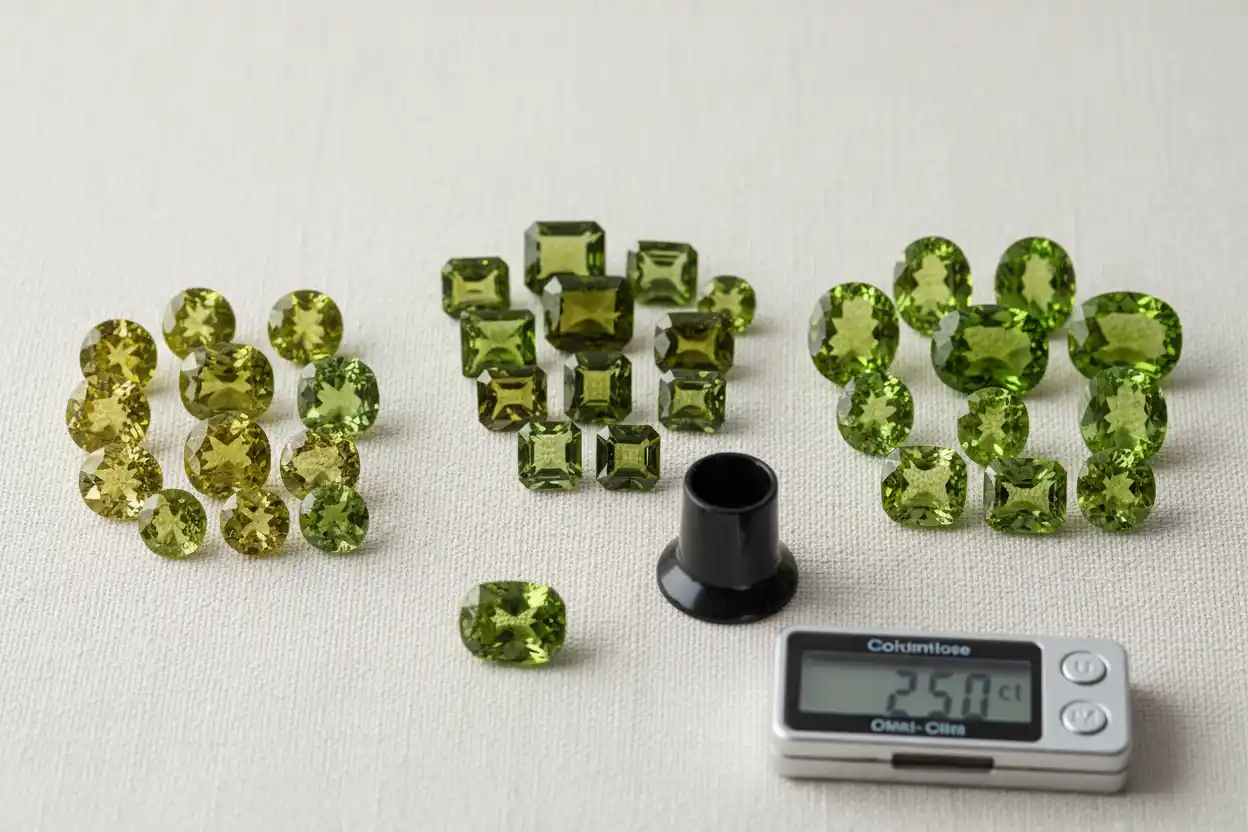
Peridot Price: Buyer Value Guide, Size, Grade & Provenance
Peridot prices currently range from roughly $10 to $40 per carat for many commercial loose stones around 1 to 3 carats, while larger fine Myanmar gems can rise beyond $200 per carat. Current retail examples include a 1.36-carat Chinese oval at about $11 per carat, several 2-carat Myanmar cushions around $35 to $40 per carat, a 6.28-carat Myanmar heart near $216 per carat, and an 11.98-carat Myanmar pear close to $249 per carat.
This sharp increase reflects more than weight. Color, clarity, cut, size, origin, condition, and seller selection all influence value. Peridot is readily available in smaller standard sizes, but large gems with rich green color and clean transparency are more difficult to source. Anyone comparing the market should first understand how to buy Peridot because inexpensive calibrated gems and collector-size stones belong to different price tiers.
Current Peridot Price Benchmarks
Current loose-gem listings provide practical retail reference points.
| Current Peridot example | Weight | Origin | Asking price | Approx. price per carat |
|---|---|---|---|---|
| Green oval | 1.36 ct | China | $14.90 | $10.96 |
| Light lively green pair | 1.50 ct total | China | $20.92 | $13.95 |
| Green cushion | 1.80 ct | Myanmar | $70.60 | $39.22 |
| Green cushion | 2.06 ct | Myanmar | $73.35 | $35.61 |
| Lively green cushion | 2.22 ct | Myanmar | $79.98 | $36.03 |
| Green cushion | 2.50 ct | Myanmar | $99.07 | $39.63 |
| Green heart | 6.28 ct | Myanmar | $1,355.22 | $215.80 |
| Green pear | 11.98 ct | Myanmar | $2,983.02 | about $249 |
These are active retail asking prices rather than auction results or dealer-buy values. The Peridot price per carat rises most dramatically once desirable size combines with rich color and high clarity.
Small Commercial Peridot Is Affordable
Peridot below about 2 carats is widely available from several sources and is commonly cut to calibrated jewelry sizes.
Current Chinese listings illustrate the accessible end of the market. A 1.36-carat oval is about $10.96 per carat, while a 1.50-carat pair averages roughly $13.95 per carat.
Small rounds and ovals are also sold in multi-stone parcels at modest prices.
This lower cost does not mean the stones are imitation or poor by definition. Abundant supply, standardized cutting, and smaller size make genuine natural Peridot accessible.
The 2-Carat Market Can Still Be Modest
Current Myanmar cushions around 1.8 to 2.5 carats cluster roughly between $35 and $40 per carat in the sampled listings.
These stones are generally described as VS or VVS-VS and untreated.
That price level is much higher than small Chinese calibrated stones but still far below larger fine examples.
A 2-carat gem with strong green color and clean transparency can therefore provide good visual size without entering the steepest collector-size price tier.
The final rate still depends on color, proportions, clarity, and seller.
Price Accelerates in Larger Fine Stones
GIA notes that Peridot becomes more expensive in sizes above common calibrated dimensions and that the finest color is often found in stones around 10 carats or larger.
The current retail market reflects this effect.
A 6.28-carat Myanmar heart currently costs about $216 per carat, while an 11.98-carat Myanmar pear reaches approximately $249 per carat.
That is more than five times the per-carat price of many current 2-carat Myanmar examples.
The increase is not caused by weight alone. Large eye-clean stones with rich color are much less common than small commercial gems.
Color Is the Main Quality Driver
GIA identifies pure grass green as the most desirable Peridot color.
Most stones show some yellow, and yellowish green is very common in jewelry. Brownish influence lowers value because it makes the stone look duller or earthier.
A vivid medium green generally receives stronger market interest than a pale or strongly brownish stone.
The Peridot quality grading should therefore prioritize hue, saturation, and tone before microscopic clarity differences.
An eye-clean pale gem can still cost less than a slightly less clean stone with superior face-up green.
Clarity Matters More in Larger Stones
Most fine Peridot can be eye-clean, so obvious inclusions are not generally accepted as unavoidable.
Dark mineral crystals, large lily pads, fractures, and clouds can lower value when visible without magnification.
This becomes particularly important in large gems because internal features are easier to notice across a larger face.
A fine 10-carat stone should combine size with good transparency. If it is heavily included or fractured, its price should not be compared with an exceptional clean gem of the same weight.
Cut Changes Both Beauty and Effective Price
A well-cut Peridot should return light evenly and show its green color across the face.
Poor cutting can create a central window that allows the viewer to see through the stone, reducing color and brilliance. Excessive depth can preserve weight but create a smaller visible footprint.
Price per carat becomes less useful when two stones of identical weight have very different face-up dimensions.
A lighter stone with excellent spread and brightness may deliver more visible value than a heavier deep stone.
Compare length, width, depth, symmetry, polish, and brilliance alongside carat weight.
Myanmar Can Carry a Fine-Quality Premium
Myanmar has a long reputation for producing strong-color transparent Peridot.
Current listings show many Myanmar stones around 2 carats in the mid-$30 to $40-per-carat range, with larger fine stones rising sharply.
Origin does not guarantee quality. A weakly colored or heavily included Myanmar gem may remain inexpensive.
The origin premium becomes more defensible when the stone also displays the color, clarity, and size associated with desirable production.
For high-value examples, provenance should be credible rather than based only on a marketplace title.
Pakistan Is Important for Large Fine Peridot
Pakistan’s Himalayan deposits have produced large Peridot crystals and important faceted stones.
GIA identifies Pakistan alongside Myanmar as a source of some of the finest large gems.
Large Pakistani Peridot can show rich green color and excellent transparency, making it competitive with fine Myanmar stones.
The market does not follow a simple Pakistan-versus-Myanmar formula. Quality, size, cutting, and documentation remain more important than the country name alone.
Collectors may still pay additional attention to confirmed provenance when comparing exceptional large stones.
Arizona Supports the Commercial Market
The San Carlos Apache Reservation in Arizona is an important United States source of Peridot.
Arizona production often supplies smaller stones suitable for commercial jewelry. These gems can show attractive yellowish green to green color at accessible prices.
Their generally smaller size means they do not often compete directly with giant Himalayan or Myanmar collector stones.
An Arizona origin does not imply low quality. It simply belongs to a different production profile where small jewelry sizes are more common.
Zabargad Can Carry a Historic Premium
Zabargad Island in the Red Sea has supplied Peridot for centuries and is one of the most famous historical sources.
GIA notes that the locality is not currently producing commercially and that confirmed Zabargad origin can create a slight premium because of historical significance.
Such pricing is provenance-driven rather than purely visual.
A normal modern green Peridot should not be given a Zabargad premium without convincing evidence.
For historically important gems, provenance records can be as important as conventional color and clarity comparisons.
Treatment Usually Has Little Effect on Price
Unlike sapphire, ruby, emerald, or many topaz varieties, Peridot normally reaches the market without color enhancement.
GIA states that no Peridot is known to be heated routinely to improve its appearance.
This makes claims such as unheated less economically significant than they would be for sapphire.
Fracture filling can occur, and a filled stone should be disclosed and compared with other enhanced examples.
In most transactions, however, color, clarity, size, cut, and origin dominate the price discussion.
Seller Grades Can Distort Market Comparisons
AAA, AA, gem grade, premium, and investment quality are seller-created descriptions rather than universal Peridot standards.
GIA specifically notes that no standardized AAA-style grading scale exists for the gem.
A $250-per-carat stone called AAA should therefore be judged against its actual green color, clarity, size, cutting, and dimensions.
One seller’s AAA may resemble another seller’s AA.
The most useful price comparison uses real specifications rather than grade letters.
Retail Asking Price Is Not Resale Value
The figures in the benchmark table are retail asking prices.
A dealer buying the same gem from a private owner may offer much less because the dealer needs room for inspection, inventory cost, marketing, and profit.
Ordinary small Peridot has plentiful new supply, which can limit resale demand.
Large exceptional stones with strong color, documented provenance, fine cutting, or unusual history may attract more collector interest.
Whether gemstones hold value depends on rarity, original purchase price, condition, documentation, and selling channel.
Meteorite Peridot Has a Different Price Structure
Peridot can rarely occur as gem-quality olivine within pallasite meteorites.
These extraterrestrial gems are not priced like ordinary volcanic Peridot. Scientific interest, meteorite identity, provenance, rarity, size, and cutting all affect their specialist value.
A small pallasitic Peridot can therefore cost far more than a terrestrial stone of similar size.
Documentation is essential because the premium depends on verified meteorite origin.
This specialty category should not be used to estimate the price of normal jewelry Peridot.
Durability Affects Condition and Resale
Peridot has a Mohs hardness of 6.5 to 7 and fair to good toughness.
Scratches, chipped facet junctions, worn polish, and fractures can reduce secondhand value.
Rapid or uneven heat may cause fracturing, and ultrasonic or steam cleaning is not recommended.
Warm soapy water is safest.
A large expensive Peridot deserves careful handling because polishing or recutting damaged areas can reduce both carat weight and historical integrity.
Personal Associations Do Not Set Market Price
The Peridot meaning may include cultural associations with light, renewal, prosperity, or protection. These ideas do not establish commercial quality.
The Peridot benefits discussed in personal traditions and Peridot healing properties discussed in wellness traditions do not create recognized gem-market premiums.
Commercial value is better tied to natural identity, color, clarity, size, cut, condition, provenance, treatment disclosure, and current demand.
FAQs
How much is Peridot worth per carat?
Current sampled commercial stones around 1 to 3 carats range from roughly $10 to $40 per carat, while larger fine Myanmar stones above 6 carats can exceed $200 per carat.
Why does large Peridot cost more?
Large transparent stones with strong green color are less common, so price per carat can rise rapidly once size and quality increase together.
How much is a 2-carat Peridot?
Several current Myanmar examples around 2 carats are priced roughly between $35 and $40 per carat, or approximately $70 to $100 total.
How much is a 10-carat Peridot?
Quality varies widely, but one current 11.98-carat Myanmar stone is listed at about $2,983, close to $249 per carat.
Does pure green Peridot cost more?
Generally yes. GIA identifies pure grass green with minimal yellow or brown as the most desirable color.
Does Myanmar origin increase price?
It can support a premium when the stone also has strong color, clarity, size, and attractive cutting.
Is Pakistani Peridot valuable?
Fine Pakistani stones can be very valuable, especially in larger sizes with strong green color and clean transparency.
Is unheated Peridot more valuable?
Usually not. Routine heat enhancement is not known for Peridot, so unheated is generally not a meaningful rarity claim.
Do visible inclusions lower price?
Yes, especially dark inclusions and obvious fractures. Fine Peridot is commonly eye-clean.
Does Peridot have good resale value?
Ordinary commercial stones often have modest resale demand. Exceptional large, historic, or strongly documented gems can perform differently.
Conclusion
Peridot price rises most sharply when excellent green color, eye-clean clarity, good cutting, and large size occur together. Current small commercial stones can sell for roughly $10 to $40 per carat, while fine Myanmar gems above 6 carats can exceed $200 per carat. Origin can add context, but visible quality remains more important than a country name or seller-created grade.
Current retail asking prices are reference points only. Actual transaction, appraisal, dealer-buy, auction, and resale values can differ.