Sunstone Price Guide: Value and Cost in 2026
Sunstone prices in 2026 commonly range from approximately $5 to $500 per carat. Ordinary Indian or commercial aventurescent feldspar usually costs below $30 per carat, while fine red, green and bicolor Oregon Sunstone can reach $200 to $1,000 per carat.
Exceptional large Oregon gems with vivid red or green color, balanced copper schiller and precision cutting may exceed $1,000 per carat. The Sunstone name covers several feldspar materials, so origin, mineral composition and appearance must be established before comparing prices.
Sunstone Price per Carat in 2026
| Sunstone quality | Typical characteristics | Approximate 2026 retail price |
|---|---|---|
| Entry commercial | Pale yellow, brown, weak aventurescence, included or mass-produced | $3–$15 per carat |
| Good commercial | Attractive gold, peach or red-brown color with visible sparkle | $15–$60 per carat |
| Fine Oregon Sunstone | Transparent yellow, orange or red with controlled copper schiller | $60–$250 per carat |
| Premium Oregon material | Vivid red, green or red-green bicolor with fine clarity and cutting | $250–$750 per carat |
| Exceptional collector quality | Rare saturated color, important size, precision cutting or premium provenance | $750–$1,500+ per carat |
Current specialist examples show how wide the premium market can become. Large reddish-orange Oregon Sunstones with visible schiller may cost several hundred dollars per carat, while exceptional deep-red stones can approach or exceed $800 per carat.
The broader relationship among color, rarity, cutting and demand appears in How Gemstone Prices Are Determined.
What Is Sunstone?
Sunstone is an appearance-based name applied to feldspar that displays warm body color, reflective inclusions or aventurescence.
The category includes material from different feldspar branches. Indian Sunstone commonly belongs to oligoclase or related plagioclase feldspar and contains reflective hematite or goethite inclusions. Oregon Sunstone is copper-bearing labradorite.
Consequently, two gems sold as Sunstone can differ in composition, origin, inclusions and market value.
The completed Sunstone guide owns the material’s geology, properties and traditional symbolism. The completed Feldspar guide explains the wider mineral family.
The full commercial variety structure belongs to Types of Sunstone.
Ordinary Sunstone vs Oregon Sunstone
Most inexpensive Sunstone consists of orange, red-brown or golden feldspar containing reflective hematite or goethite.
Commercial cabochons, beads and faceted stones may cost only a few dollars per carat. The sparkle can be attractive, but the material is broadly available and frequently translucent rather than transparent.
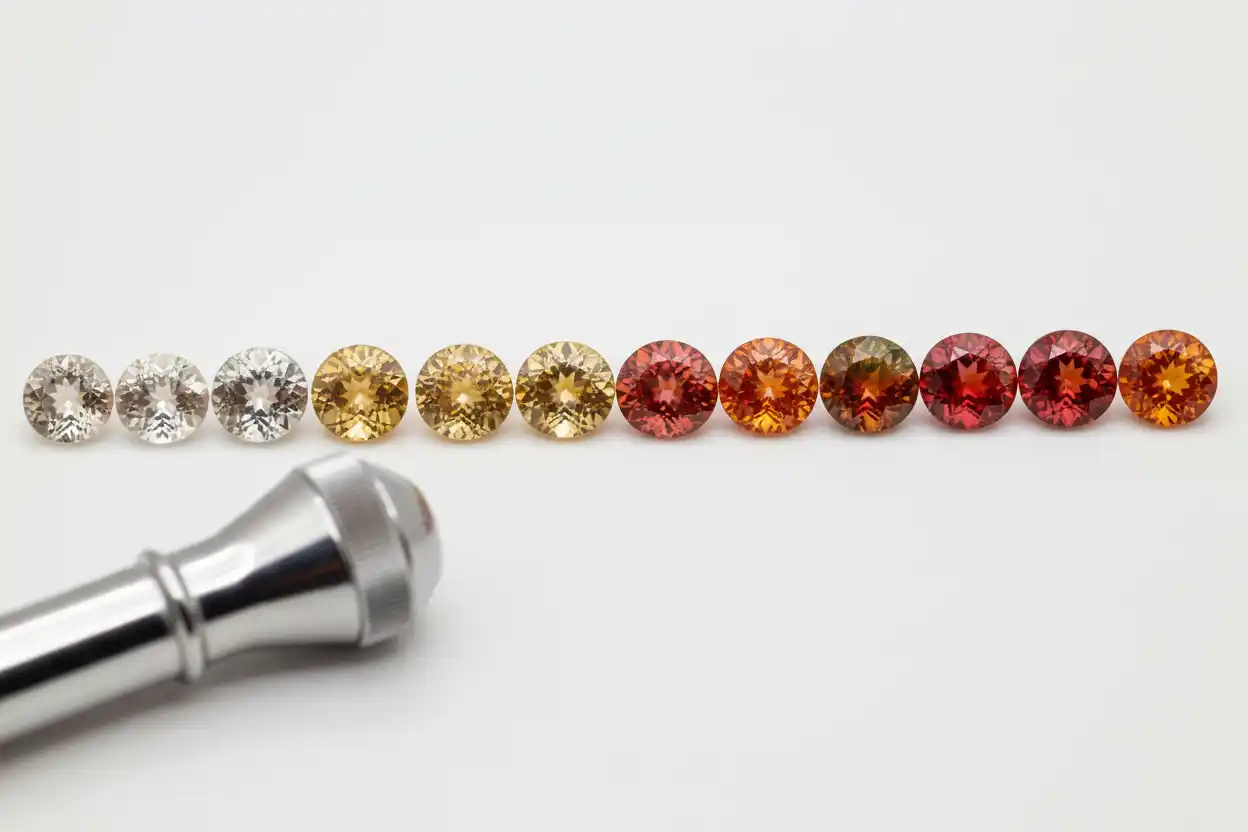
Oregon Sunstone occupies a separate premium category. It can appear colorless, yellow, peach, orange, red, green, teal or bicolor.
Native copper can create color and reflective schiller. Vivid red and green transparent gems are far less common than pale yellow or colorless Oregon material.
The completed Oregon Sunstone guide owns the locality’s geology and material-specific background.
Color Is the Primary Value Factor
Fine Sunstone should display an attractive body color before its aventurescence is considered.
Pale yellow, champagne and colorless material forms the affordable end of the Oregon market. Peach and orange stones occupy a middle tier when their saturation remains strong.
Red receives one of the highest premiums. Fine stones range from orange-red and scarlet to deeper cherry red.
Green Oregon Sunstone is rarer than ordinary yellow and orange material. Vivid green or teal-green gems with useful transparency can command exceptional prices.
Bicolor stones showing red and green together may receive another premium when the boundary looks balanced and the colors remain attractive face-up.
Brown, gray and muddy modifiers generally lower value. Dark color must remain open enough for brilliance and schiller to remain visible.
Copper Schiller and Aventurescence
Schiller describes reflective flashes created by flat inclusions within the feldspar.
In Oregon Sunstone, those inclusions may consist of native copper. Smaller particles can create a diffuse reddish or golden glow, while larger platelets produce distinct glittering reflections.
Schiller does not automatically increase value. The inclusions must enhance the design without obscuring transparency or creating a cluttered appearance.
A transparent red or green stone with restrained schiller may be more valuable than a heavily glittered stone whose body color and brilliance are difficult to see.
Conversely, a dramatic copper pattern can become the main attraction in a cabochon, carving or fantasy cut.
The cutter must orient the inclusions carefully. A slight change in angle can transform bright copper flashes into dull brown planes.
Red Oregon Sunstone Prices
Commercial orange-red Oregon Sunstone may cost approximately $75 to $250 per carat.
Fine red stones with good transparency commonly range from $250 to $600 per carat.
Exceptional deep-red gems, especially above five or ten carats, may reach $600 to $1,500 per carat or more.
The stone should remain red in ordinary indoor lighting. Warm photography can make an orange gem appear scarlet, while dark backgrounds can exaggerate saturation.
Copper schiller can strengthen the appearance, but excessive platelets may reduce clarity. Top value comes from a complete balance of red body color, transparency, sparkle and cutting.
Green and Bicolor Oregon Sunstone Prices
Green Oregon Sunstone commonly occupies the premium market because attractive transparent green material is scarce.
Good gems may cost approximately $200 to $500 per carat. Vivid green or teal-green stones with fine transparency can exceed $500 per carat.
Red-green bicolor stones may range from $250 to $1,000 per carat depending on saturation, division and size.
A premium bicolor gem should display both colors clearly when viewed through the crown. Weak edge zoning or one tiny green patch does not justify the same price as a balanced red-and-green composition.
Large bicolor stones can become collector pieces because the cutter must preserve two valuable zones without creating a window or overly deep pavilion.
Colorless and Yellow Oregon Sunstone
Colorless and pale-yellow Oregon Sunstone is more abundant and generally affordable.
Commercial stones may cost approximately $10 to $50 per carat. Better precision-cut examples can reach $50 to $150 per carat.
Copper schiller may increase the price when it creates a distinctive visual pattern. However, a nearly colorless stone without notable inclusions usually competes with other affordable feldspars.
These stones can provide excellent value for custom cutting because clean Oregon rough is available and the local provenance appeals to buyers seeking an American-mined gemstone.
Indian Sunstone Prices
Indian Sunstone commonly shows red-brown, orange, peach or golden body color with hematite-related aventurescence.
Cabochons and faceted stones generally range from approximately $3 to $30 per carat.
Fine transparent or strongly sparkling stones may reach $30 to $75 per carat, particularly when cutting and polish are superior.
Beads, palm stones and carvings usually sell by piece or strand rather than carat.
Indian material should not be priced as premium Oregon Sunstone merely because it displays strong glitter. Its broader availability and different inclusion system create a separate commercial tier.
Transparency and Clarity
Transparent Sunstone normally receives a premium, especially when combined with vivid red, green or bicolor appearance.
Commercial aventurescent material is frequently translucent. This is acceptable when the inclusions create the intended glow or glitter.
Fractures, clouds and dark mineral inclusions reduce value when they interrupt brilliance or threaten durability.
Copper platelets are desirable in many Oregon stones, but they are still inclusions. Their value depends on orientation, distribution and visual contribution.
A fine stone may contain dramatic schiller while remaining transparent between the reflective planes. Another may look opaque because the platelets are too dense.
Cut Quality and Orientation
Sunstone cutting requires attention to body color, pleochroism, schiller planes and valuable zoning.
A shallow pavilion can produce a transparent window. Excessive depth may preserve rough weight but reduce face-up size.
Faceters may use ovals, cushions, pears, rounds and custom fantasy designs. Freeforms are common when the rough contains localized red, green or copper-rich areas.
Matte facets or concave surfaces can emphasize schiller, but unconventional cutting should produce a deliberate improvement rather than hide poor clarity.
Rounds require greater rough loss and may command premiums in strong colors.
The complete inspection process belongs to the Sunstone Buying Guide.
Sunstone Prices by Carat Weight
| Carat weight | Commercial material | Fine Oregon material | Premium red, green or bicolor |
|---|---|---|---|
| Under 2 ct | $5–$40 per carat | $40–$175 per carat | $150–$500 per carat |
| 2–5 ct | $5–$50 per carat | $60–$250 per carat | $225–$650 per carat |
| 5–10 ct | $5–$60 per carat | $75–$300 per carat | $300–$900 per carat |
| 10–20 ct | $5–$50 per carat | $75–$350 per carat | $350–$1,200 per carat |
| Above 20 ct | Often priced individually | Color and cutting dominate | Collector evaluation required |
Large pale or brown material remains inexpensive. The steepest premiums apply when rare red, green or bicolor appearance continues into larger transparent stones.
Sunstone and Labradorite
Oregon Sunstone belongs to the labradorite side of the feldspar family.
However, commercial dark Labradorite usually displays blue, green or multicolor labradorescence rather than warm copper aventurescence.
The completed Labradorite guide owns that material’s identity, while current pricing appears in the Labradorite Price Guide.
A seller should not use Labradorite’s broad availability to undervalue premium Oregon Sunstone. Likewise, an ordinary gray Labradorite cabochon should not receive an Oregon Sunstone premium.
Sunstone and Moonstone
Sunstone and Moonstone both belong to the feldspar family but display different phenomena.
Moonstone shows adularescence, which appears as a floating glow beneath the surface. Sunstone commonly shows aventurescence or metallic schiller.
The completed Moonstone guide owns the distinction at the material level. Current Moonstone market tiers appear in the Moonstone Price Guide.
The two should not be priced through the same grading system. Blue adularescence drives Moonstone value, while color and reflective inclusions dominate Sunstone pricing.
Copper-Diffused and Misrepresented Feldspar
The feldspar market has experienced controversy involving red and green andesine represented as natural untreated material from Tibet or other regions.
Investigations indicated that some pale feldspar may have been treated through copper diffusion or infusion to create stronger color.
This history makes provenance particularly important for vivid red or green feldspar sold outside the established Oregon market.
A seller should state the mineral identity, origin and known treatment. An unsupported geographic claim should not create a premium.
The broader treatment framework appears in Gemstone Treatments Explained.
Sunstone Jewelry Prices in 2026
| Jewelry type | Broad U.S. retail range |
|---|---|
| Silver jewelry with commercial Sunstone | $40–$300 |
| Silver ring with Oregon Sunstone | $100–$700 |
| Gold pendant or earrings | $400–$3,000 |
| Gold ring with fine red or green Sunstone | $1,000–$8,000 |
| Premium bicolor or designer jewel | $5,000–$25,000+ |
The center stone may dominate the price when it is vivid red, green or bicolor. In commercial jewelry, metal and craftsmanship usually contribute more than the Sunstone itself.
Style-specific guidance belongs to the Sunstone Ring Guide, Sunstone Earrings Guide, Sunstone Necklace Guide and Sunstone Bracelet Guide.
Durability and Care
Sunstone has feldspar’s moderate hardness and cleavage. It can scratch or chip more readily than Sapphire, Spinel and Diamond.
Rings and bracelets should use protective settings, particularly when the stone has visible fractures or thin edges.
Warm water, mild soap and a soft brush provide a cautious cleaning method. Steam and ultrasonic cleaning should generally be avoided.
Complete maintenance guidance belongs to How to Clean Sunstone Jewelry Safely.
Certification and Resale Value
Most inexpensive Sunstone does not require a laboratory report.
Testing becomes more useful when a stone has vivid red or green color, an Oregon origin premium, disputed treatment history or a price above several thousand dollars.
A laboratory can identify feldspar species and may detect evidence relevant to copper treatment or origin. Mine-specific provenance still depends partly on credible supply documentation.
The Gemstone Certification Labs comparison explains report scope.
Commercial Sunstone generally resells below retail. Fine Oregon red, green and bicolor gems have stronger collector potential, though liquidity remains limited.
The broader resale framework appears in Do Gemstones Hold Their Value?.
Price Guide vs Buying Guide
This page owns Sunstone’s 2026 price bands and value factors.
Detailed seller questions, schiller inspection and origin verification belong to the dedicated buying guide.
Online buyers should request neutral-light video, side views, exact dimensions and treatment disclosure using How to Buy Gemstones Online Without Getting Scammed.
The completed Gemstones That Start With S and Crystals That Start With S directories connect Sunstone with the alphabetical site structure.
The Buying & Value hub connects this article with feldspar, treatment, certification and resale guidance.
Frequently Asked Questions
1. How much is Sunstone worth per carat in 2026?
Most Sunstone costs approximately $5 to $500 per carat. Exceptional red, green and bicolor Oregon gems may exceed $1,000 per carat.
2. Why is Oregon Sunstone more expensive?
It can display naturally occurring red, green and bicolor appearances linked to copper, along with distinctive copper schiller and documented U.S. origin.
3. What Sunstone color is most valuable?
Vivid red, green and balanced red-green bicolor generally receive the strongest prices.
4. Does copper schiller always increase value?
No. Fine schiller adds value when it enhances the stone, but dense or poorly oriented platelets can reduce transparency and brilliance.
5. How much is red Oregon Sunstone?
Good red material commonly ranges from approximately $250 to $600 per carat. Exceptional large stones can cost more.
6. How much is green Oregon Sunstone?
Fine transparent green material may cost $200 to $750 per carat, with exceptional gems reaching higher prices.
7. Is Indian Sunstone valuable?
It is generally affordable, commonly costing $3 to $30 per carat. Fine transparent or strongly aventurescent stones may cost more.
8. Does large Sunstone cost more per carat?
Only when rare color, transparency and cutting continue into the larger stone. Large pale commercial material remains inexpensive.
9. Is Sunstone the same as Labradorite?
Some Oregon Sunstone is labradorite feldspar, but ordinary Labradorite and Sunstone follow different appearance-based markets.
10. Can Sunstone be treated?
Yes. Copper-treated feldspar has entered the market, so vivid red or green material with uncertain provenance deserves careful verification.
11. Does Sunstone need a certificate?
Commercial material usually does not. A report is useful for expensive Oregon origin, treatment or rare-color claims.
12. Is Sunstone a good investment?
Premium Oregon gems may retain collector interest, but the secondary market is small and appreciation is not guaranteed.
Sunstone Value Depends on the Type of Feldspar Being Sold
The Sunstone name covers inexpensive aventurescent material and rare copper-bearing Oregon gems. Treating both as one market produces misleading price comparisons.
In 2026, commercial Sunstone often costs below $60 per carat, while fine Oregon material can reach several hundred dollars per carat. The strongest premiums belong to vivid red, green and bicolor gems whose transparency, schiller, cutting and provenance support the price together.