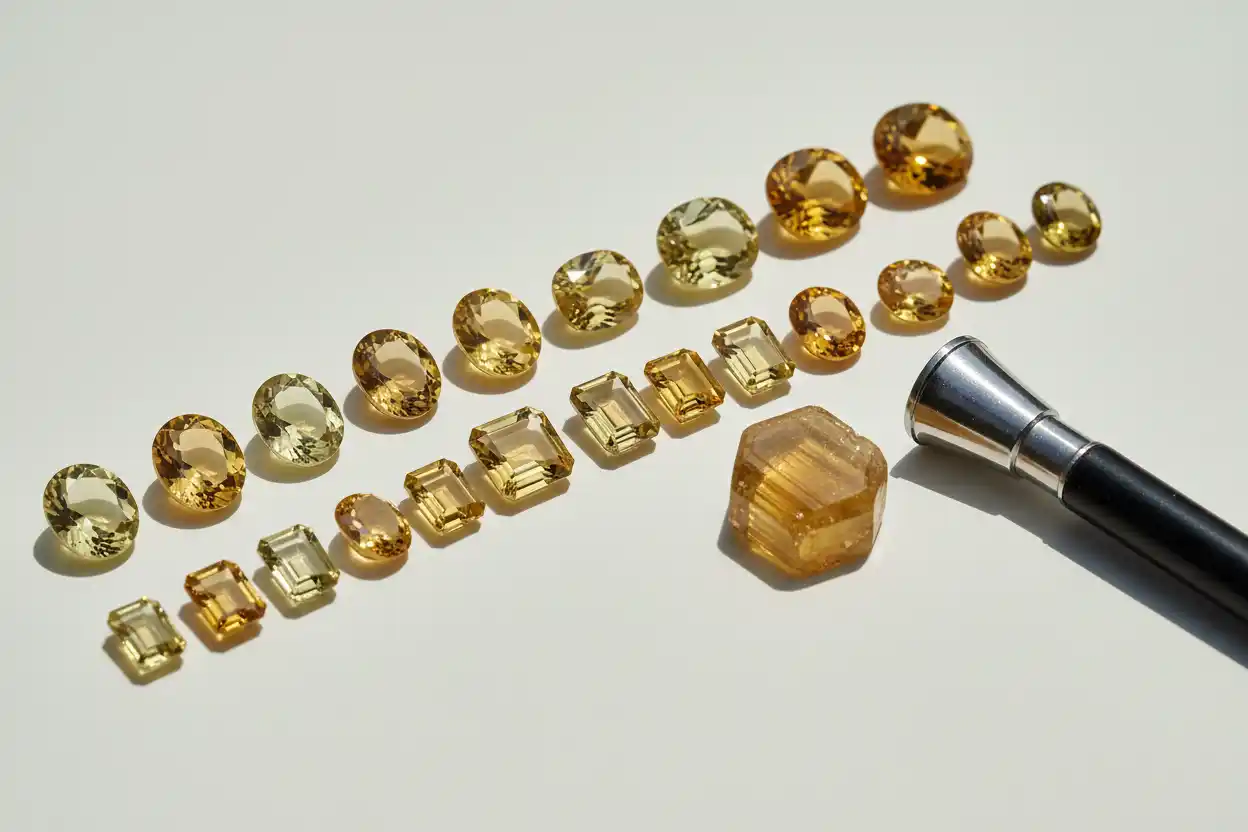
Buy Heliodor: How to Judge Quality, Color, Clarity & Value
Buying heliodor is primarily a question of color, transparency, clarity, cutting, and whether the asking price reflects the individual stone rather than a dramatic rarity claim. Fine heliodor can show bright lemon yellow, golden yellow, honey yellow, or slightly greenish-yellow color with excellent transparency, and clean stones of several carats are readily available.
Current mainstream untreated golden-beryl inventory commonly sits around $22 to $28 per carat for many eye-clean stones between roughly one and four carats. A 3.11-carat untreated Brazilian example is currently around $75, while a 4.30-carat untreated Madagascar cushion is around $108. Specialist custom-cut and collector stones can cost far more, particularly when exceptional color, provenance, precision cutting, or unusually large size supports the premium.
The practical goal is not simply to find the largest yellow beryl. Look for attractive saturation, clean transparency, strong face-up brightness, efficient cutting, sound condition, clear treatment disclosure, and a seller whose return terms allow proper inspection.
Buy Heliodor At a Glance
| Buying factor | Stronger buying signal | What needs caution |
|---|---|---|
| Color | Bright lemon, golden, honey, or attractive greenish yellow | Very pale, muddy, brownish, or uneven color |
| Transparency | Clear and lively face-up appearance | Haze or cloudiness that weakens brightness |
| Clarity | Eye-clean in most faceted jewelry stones | Central fractures or distracting inclusions |
| Cut | Good symmetry, polish, brightness, useful spread | Windowing or excessive hidden depth |
| Size | Quality remains strong as weight rises | Premium based only on carat weight |
| Treatment | Untreated claim or clear disclosure | Vague statements about enhancement |
| Origin | Credible provenance when it affects price | Country name treated as automatic quality |
| Documentation | Useful for costly collector stones | Seller card presented as independent appraisal |
| Price | Compared with similar color and cutting | Comparing commercial stock with custom collector gems |
| Returns | Enough time to inspect the exact stone | Expensive final-sale listing |
For most buyers, color and cutting will create more visible difference than a small change in carat weight.
Heliodor Is Yellow Beryl
Heliodor belongs to the beryl family, alongside emerald, aquamarine, morganite, and goshenite. Iron is responsible for the yellow coloration associated with heliodor and golden beryl.
Trade terminology is not perfectly consistent. Some sellers use heliodor for all yellow-to-golden beryl, while others reserve the name for greener or particular yellow shades and use golden beryl for richer golden stones.
For a buyer, the exact color description is more useful than arguing over a narrow trade-name boundary. The stone should be identified as natural beryl, and its actual yellow hue, saturation, clarity, treatment status, dimensions, and origin should be stated.
The heliodor meaning covers its mineral identity and historical context, while a buying decision should remain centered on the individual gemstone.
Color Should Look Bright Rather Than Merely Dark
Color is one of heliodor’s strongest value factors. Fine stones generally show an attractive yellow, golden yellow, honey yellow, or greenish-yellow appearance without looking gray, muddy, or excessively brown.
A deeper tone is not automatically better. Very dark yellow can reduce brightness, while extremely pale stones may look almost colorless once mounted.
Current mainstream inventory shows light yellow, warm yellow, honey yellow, and richer golden stones selling side by side. The difference in price is often moderate until color becomes unusually attractive or is combined with custom cutting and exceptional clarity.
Evaluate the gem against a neutral background in daylight and normal indoor illumination. Warm photography can make pale yellow appear richer, so one highly saturated listing photograph should not determine the purchase.
Clarity Expectations Should Be High
Fine faceted heliodor is commonly available with strong transparency and high apparent clarity. That means obvious eye-visible inclusions generally deserve more scrutiny than they would in gemstones where inclusions are routinely expected.
Current commercial listings include many VS and VVS stones from roughly one to four carats at moderate prices. A buyer paying a premium should therefore expect the gemstone to look clean and lively face up unless unusual color, provenance, or another feature justifies visible inclusions.
Small internal features near the edge may have little effect. A central fracture, reflective inclusion, or cloud that interferes with brightness can matter much more.
The heliodor quality grading should balance clarity with color, cut, transparency, size, treatment, condition, and provenance rather than assigning value from a clarity label alone.
Cut Quality Can Matter More Than an Extra Carat
Heliodor’s transparency makes poor proportions easy to see. A shallow stone can show windowing through the center, while a very deep stone can retain extra weight without providing equivalent face-up size.
Good cutting should produce attractive brightness, symmetry, polish, and useful spread. Oval, cushion, round, pear, emerald, shield, and custom fantasy cuts can all work well when the proportions suit the rough.
Compare millimeter dimensions alongside carat weight. A three-carat stone that faces up larger and brighter may offer more visual value than a four-carat stone carrying unnecessary depth.
Precision cutting can also create a legitimate premium. Some current custom-cut heliodors cost several times the per-carat price of standard commercial inventory because the price includes skilled cutting, individual design, provenance, and specialist retail positioning.
Ordinary Heliodor Can Be Surprisingly Affordable
Current untreated mainstream listings illustrate how accessible clean yellow beryl can be. A 1.38-carat Madagascar oval is around $38, or about $27 per carat. A 1.86-carat warm-yellow Madagascar pear has been offered around $45, approximately $24 per carat.
A 2.39-carat Madagascar oval is around $60, close to $25 per carat, while a 3.11-carat Brazilian oval is about $75, approximately $24 per carat. A 4.30-carat honey-yellow Madagascar cushion has been offered around $108, also close to $25 per carat.
These examples make the heliodor price useful as a reality check when a routine commercial stone is advertised at a much higher rate without a clear reason.
Premium Heliodor Occupies a Different Market
Commercial prices do not define the entire heliodor market. Exceptional stones can cost considerably more.
A current 6.42-carat untreated golden-yellow heliodor from Ukraine with custom cutting and a laboratory origin report is listed at $1,150, roughly $179 per carat. An 11-carat untreated Ukrainian custom-cut stone is $1,650, or $150 per carat.
A 23.93-carat precision-cut golden beryl is currently $3,240, about $135 per carat, while an exceptional 64.49-carat untreated Madagascar collector stone is listed at $25,796, exactly $400 per carat.
These are specialist asking prices rather than universal benchmarks. They show how precision cutting, unusual scale, strong color, provenance, documentation, and collector presentation can move heliodor far above ordinary inventory.
Size Alone Does Not Guarantee a High Price
Heliodor can occur in substantial clean crystals, so several-carat stones are not automatically rare. Current inventory contains many clean stones between two and four carats without a steep per-carat premium.
Even much larger gems exist. A 23.93-carat collector example and a 64.49-carat custom-cut stone currently sit in specialist inventory, while gemological collections contain substantial yellow beryl specimens.
Size becomes more valuable when color, transparency, clarity, and cutting remain excellent as weight rises.
The heliodor price per carat should therefore distinguish ordinary larger stones from genuinely exceptional large gems instead of assuming one increasing rate applies to every carat.
Origin Can Matter, but Quality Comes First
Brazil, Madagascar, Ukraine, Namibia, Pakistan, and several other regions have produced yellow beryl.
Mainstream commercial inventory currently includes both Brazilian and Madagascar stones at similar per-carat prices, showing that origin alone does not necessarily create a major premium.
Ukraine’s Volyn deposits have collector recognition for exceptionally clean beryl crystals, and current custom-cut examples with documented Ukrainian provenance command much higher asking prices. Part of that premium reflects source interest, but custom faceting, clarity, individual presentation, and documentation also contribute.
A famous locality should never replace visual quality. If a seller charges substantially more because of origin, ask what evidence supports the claim.
Treatment Disclosure Deserves Attention
Many heliodors in current retail inventory are explicitly sold as untreated, so naturally colored yellow beryl is widely available.
Beryl can nevertheless respond to treatment. Heating some yellow or golden beryl can alter its color toward blue, effectively moving the appearance toward aquamarine. Irradiation can also alter color in certain beryls.
Treatment therefore matters even if it is not as dominant a commercial issue as it is with some other gemstones.
A seller should state whether the stone is untreated or whether known heat, irradiation, coating, or another process has been applied. For a modestly priced commercial stone, seller disclosure may be sufficient. A costly collector gemstone can justify independent laboratory examination.
Heliodor and Goshenite Should Not Be Priced the Same Way
Both heliodor and goshenite are beryl, but one is yellow and the other is colorless. That difference changes market demand.
The buy goshenite criteria emphasize transparency, cutting, and colorlessness because there is no saturated body color to create additional appeal. Heliodor introduces yellow hue and saturation as major value factors.
A very pale heliodor may approach near-colorless beryl visually, particularly in weak lighting. If the yellow is barely perceptible, ask whether the seller consistently identifies it as yellow beryl or goshenite.
The name should reflect the gemstone’s actual appearance and gemological identity rather than whichever term produces the higher asking price.
Heliodor and Aquamarine Share a Family but Not a Market
Aquamarine is blue to greenish-blue beryl, while heliodor occupies the yellow range. Their chemistry, treatment behavior, demand, and pricing overlap in some ways but remain commercially distinct.
The buy aquamarine decision places greater emphasis on blue saturation and the common effects of heat treatment on unwanted greenish tones.
Fine aquamarine can command stronger mainstream prices than ordinary heliodor, despite both being beryl. The reason is not simply rarity but consumer demand for blue beryl.
Avoid using aquamarine price expectations to justify a heliodor asking price unless the comparison accounts for color, size, clarity, cutting, provenance, and treatment.
Laboratory Reports Are Most Useful for Higher-Value Stones
A laboratory identification report can support natural beryl identification and record observations about treatment or origin when the laboratory offers and can support those conclusions.
It does not determine the gemstone’s monetary value.
For a $50 or $100 heliodor, the cost of extensive laboratory testing may be disproportionate. For a custom-cut stone costing four figures or a large collector gem carrying a provenance premium, independent documentation becomes easier to justify.
A retailer’s certificate can still be useful as a record of what the seller claims, but it should not automatically be treated as equivalent to an independent laboratory report.
Returns Help Reveal Color and Cut Problems
Yellow gemstones can change noticeably in photographs because camera white balance, warm lighting, dark backgrounds, and editing can intensify golden tones.
Ask for photographs or video of the exact stone under neutral light. Look for actual hue, transparency, windowing, extinction, face-up dimensions, inclusions, and surface condition.
A reasonable return period provides time to inspect the gemstone under daylight and normal indoor lighting. This is particularly important when color saturation accounts for a substantial premium.
Keep a loose stone unmounted until the decision is final. Once setting work begins, returns can become difficult and new chips or abrasions may be introduced.
Heliodor Is Suitable for Many Jewelry Styles
Beryl has a Mohs hardness of about 7.5 to 8, giving heliodor useful resistance to everyday scratching. It can work well in rings, earrings, pendants, and other jewelry when treated sensibly.
Hardness does not make it immune to damage. A hard impact can still chip edges or worsen an existing fracture.
Inspect facet junctions, corners, and the girdle before purchase. Protective settings are especially useful for large stones worn in rings.
Warm water, mild soap, and a soft brush provide a conservative cleaning method. If the gem contains significant fractures or uncertain treatment, aggressive cleaning methods should be avoided.
Symbolic Claims Do Not Establish Gem Value
Modern crystal traditions sometimes associate heliodor with confidence, optimism, vitality, personal power, or mental clarity. These ideas can hold personal or cultural meaning, but they do not create a recognized gemological premium.
The heliodor benefits should remain separate from measurable market factors such as color, clarity, transparency, cut, size, treatment, provenance, and condition.
A seller should not charge more because a stone is claimed to cure illness, guarantee financial success, or produce another scientifically measurable outcome.
Conclusion
A strong heliodor purchase combines lively yellow-to-golden color, high transparency, clean face-up appearance, efficient cutting, sound condition, clear treatment disclosure, and a price appropriate to the exact stone. Mainstream untreated gems can be surprisingly affordable, while custom cutting, unusual size, documented provenance, and collector quality can create much higher prices. Judge the visible gemstone first and the marketing description second.
FAQs
What should I look for when buying heliodor?
Prioritize attractive yellow or golden color, transparency, eye-clean appearance, strong cutting, useful face-up size, sound condition, clear treatment disclosure, and reliable return terms.
How much does heliodor cost?
Many current untreated commercial stones around one to four carats are roughly $22 to $28 per carat. Specialist custom-cut and collector examples can reach well above $100 per carat.
Is golden beryl the same as heliodor?
The terms are often used interchangeably in the trade for yellow-to-golden beryl, although some sellers use narrower color distinctions between them.
What color heliodor is most valuable?
Strong, lively golden yellow or attractive saturated yellow generally receives greater attention than weak, grayish, or muddy color, provided the stone remains bright and transparent.
Is heliodor rare?
Fine heliodor is less common than some ordinary beryl, but clean stones of several carats are available. Large size alone does not prove exceptional rarity.
Is heliodor usually eye clean?
Many faceted heliodors are sold with VS or VVS clarity, so buyers can reasonably expect strong transparency in ordinary jewelry-size stones.
Is untreated heliodor common?
Yes. Current retail inventory contains many explicitly untreated heliodors and golden beryls. Treatment disclosure should still be checked.
Can heliodor be heat treated?
Beryl can respond to heat, and yellow or golden beryl can sometimes shift toward blue under suitable treatment conditions. Sellers should disclose known treatment.
Does origin affect heliodor value?
It can, particularly for documented collector stones from notable deposits, but color, clarity, cut, size, and overall appearance usually matter more for ordinary jewelry gems.
Is heliodor good for rings?
Yes. Its hardness makes it suitable for rings with sensible care and a secure setting, although hard impacts should still be avoided.
Does a laboratory report determine heliodor value?
No. A report can support identification and other gemological findings but does not establish a guaranteed market price.
Does heliodor have good resale value?
Resale depends on color, clarity, cutting, size, provenance, documentation, condition, jewelry craftsmanship, and buyer demand. Retail asking prices should not be assumed to equal future cash resale value.
Price disclaimer: Heliodor prices vary with color, transparency, clarity, cut, size, treatment, provenance, condition, documentation, seller margins, and market demand, so current retail figures should be treated as comparison benchmarks rather than guaranteed resale values.