Buy Hiddenite: How to Judge Quality, Value Factors & Seller Claims
To buy hiddenite intelligently, begin with the material definition rather than the color alone. Hiddenite is the rare green gem variety of spodumene, and strict gemological usage is commonly associated with green color produced by chromium rather than with every pale-green spodumene offered in the marketplace. The Smithsonian National Museum of Natural History identifies hiddenite as green gem spodumene, notes that the classic North Carolina material owes its deep green color to chromium, and cautions that pale green to yellow spodumene from other sources has sometimes been marketed inappropriately as hiddenite.
That distinction is financially important because a transparent chromium-bearing hiddenite with stable attractive green color occupies a much rarer category than generic green spodumene. Irradiation can also modify spodumene color, and GIA warns that irradiated color in spodumene can be short-lived and fade under bright light. A buyer should therefore evaluate identity, color origin, color stability, transparency, clarity, pleochroism, cut, size, cleavage, condition, provenance, treatment disclosure, and documentation together rather than paying a premium simply because a seller uses the word hiddenite.
Buy Hiddenite At a Glance
| Buying Factor | What to Examine | Why It Matters |
|---|---|---|
| Identity | Natural green spodumene consistent with hiddenite | Not every green spodumene should automatically receive a hiddenite premium |
| Chromophore | Evidence of chromium-related natural green color | Chromium is central to strict hiddenite usage |
| Color | Yellowish green through vivid emerald-like green | Strong attractive stable green can drive demand |
| Color Stability | Whether color remains stable under normal light exposure | Irradiated green spodumene can fade |
| Transparency | Transparent gem-quality material versus translucent crystal | Fine transparent stones are much more desirable for faceting |
| Clarity | Fractures, cleavage openings, needles, clouds, crystals | Internal features can affect beauty and structural integrity |
| Pleochroism | Directional variation in green intensity | Orientation can change face-up color considerably |
| Cut | Color orientation, symmetry, polish, windowing, depth | Poor cutting can waste rare green material |
| Size | Carat weight together with dimensions | Fine larger hiddenite is particularly scarce |
| Cleavage | Existing cleavage cracks and setting vulnerability | Spodumene has difficult cleavage and relatively poor toughness |
| Treatment | Irradiation or other color modification | Treated green spodumene should not be represented as equivalent to stable natural hiddenite |
| Provenance | North Carolina or other source claim and supporting evidence | Locality can add collector value but requires documentation |
| Documentation | Independent gemological identification | Especially important when rarity supports a high asking price |
Hiddenite Is Green Spodumene, but the Name Should Be Used Carefully
Spodumene is a lithium aluminum silicate that occurs in several gem colors. Pink to violetish-purple spodumene is known as kunzite, while green chromium-bearing material is associated with hiddenite. The Smithsonian describes hiddenite as the rarest spodumene gem and identifies the classic North Carolina material as chromium-colored green spodumene.
Modern marketplace language can be looser. Some dealers call virtually any green spodumene hiddenite, including pale or unstable material whose green color does not have the same chromium-related basis. Mindat likewise distinguishes true hiddenite from green spodumene whose color is photosensitive and unstable.
This terminology issue should not become a semantic distraction for buyers. The practical question is whether the seller is charging a hiddenite rarity premium. If the answer is yes, the stone should have stronger evidence than “green spodumene” on an invoice.
Color Is the First Quality Factor to Judge
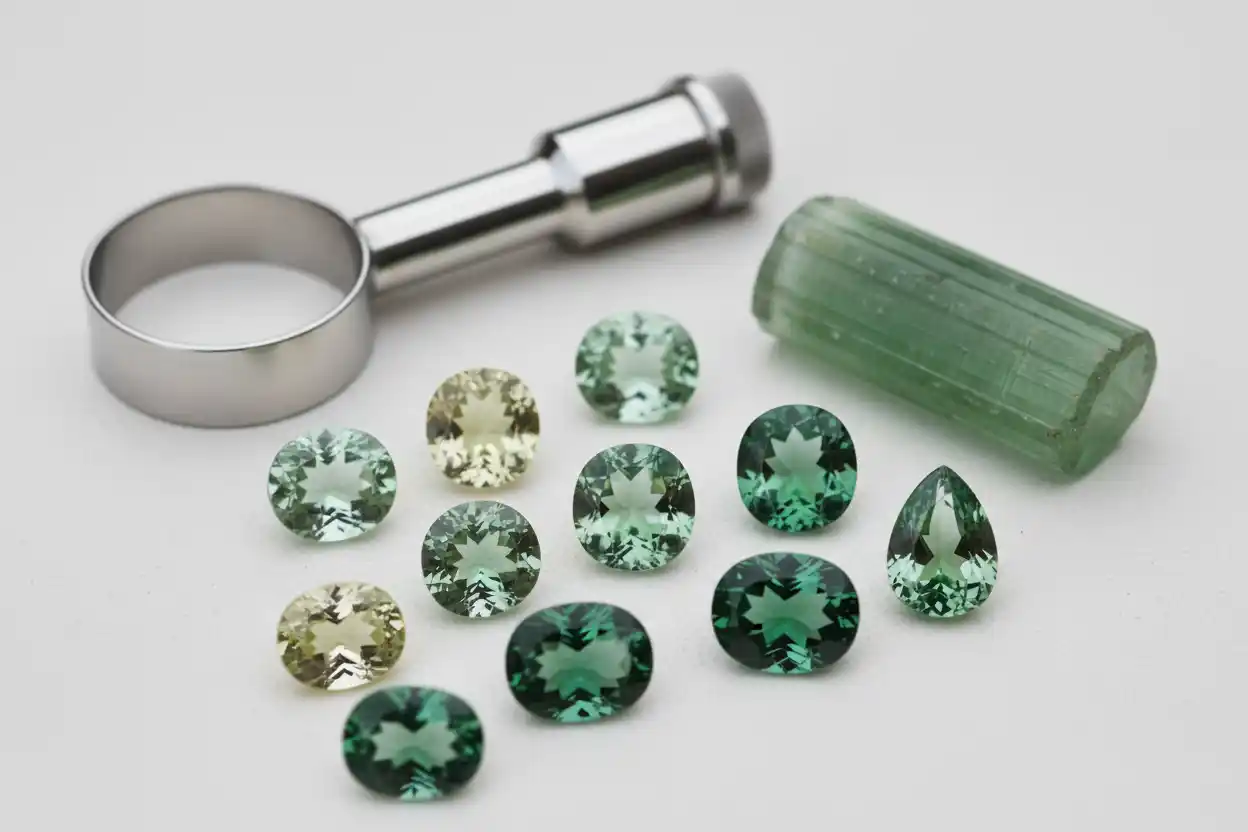
Hiddenite can range from yellowish green and light green through bluish green, grass green, and richer emerald-like green. The classic appeal lies in transparent material whose green color is strong enough to appear distinctive without becoming so dark that transparency and brilliance disappear.
A pale mint-green spodumene can still be attractive, but it should not automatically be valued like deep chromium-colored hiddenite. The richer and more stable the natural green, the more important reliable identification becomes because color itself can be responsible for much of the price difference.
Inspect the gem in neutral daylight-equivalent light as well as normal indoor light. Warm lamps can make yellow-green material appear richer, while phone-camera processing can alter saturation. Continuous video is more useful than heavily edited still photography when a substantial premium rests on vivid green color.
Stable Green Color Matters More Than Temporary Intensity
GIA notes that irradiation can deepen or change color in spodumene and that irradiated spodumene colors tend to fade when exposed to bright light. This creates an important authenticity and value issue because artificially induced green can produce an appearance that resembles valuable green spodumene at the time of sale without maintaining that appearance permanently.
A bright green stone should therefore not be judged only by how vivid it looks when photographed. Ask whether the seller knows the treatment history, whether the color has remained stable through normal light exposure, and whether independent laboratory testing supports the description.
Deliberately exposing a valuable stone to intense sunlight as a home treatment test is not a good buying strategy because fading can permanently change the gem. Professional laboratory examination is safer and more informative.
Do Not Assume Every Green Spodumene Is Hiddenite
The Smithsonian specifically notes that pale green to yellow spodumene from Brazil has historically been marketed incorrectly as hiddenite. The broader lesson applies to any locality: green appearance alone does not automatically justify the rare-variety name.
A seller can accurately offer “natural green spodumene” without proving strict hiddenite status. That stone may still be beautiful and collectible, but the price should reflect what is actually documented.
The distinction resembles other gemstone markets where similar color does not establish identical variety. Gems Lore’s buy emerald guide explains why a green beryl needs the appropriate identity and chromophore framework before it is valued as emerald, while buy grandidierite shows why rare blue-green color alone cannot replace laboratory identification.
North Carolina Has Exceptional Historical Importance
Hiddenite takes its name from William Earl Hidden and is closely tied to Alexander County, North Carolina. The Smithsonian identifies North Carolina as the classic source of gem hiddenite and highlights the distinctive chromium-rich deep green material associated with the locality.
This historic provenance can create collector value beyond ordinary gem quality. A documented North Carolina crystal may appeal to mineral collectors because of locality, crystal form, mining history, and provenance even if it would not produce the finest faceted stone.
Buyers should still distinguish source documentation from verbal attribution. An old handwritten locality card, established collection history, mine record, or specialist provenance can strengthen the claim; a retailer simply saying “North Carolina hiddenite” without evidence provides much less confidence.
Provenance and Gem Quality Are Separate Value Factors
A documented North Carolina hiddenite can be historically important while still having pale color, inclusions, etching, cleavage damage, or a shape better suited to mineral collecting than faceting. A vivid transparent stone without documented North Carolina provenance may be visually superior for jewelry.
This means origin should be layered onto the quality assessment rather than used to replace it. The buyer should ask two separate questions: “How good is this hiddenite?” and “How well documented is its source?”
That separation prevents a famous locality name from hiding weaknesses in the actual gemstone.
Fine Larger Hiddenite Is Especially Scarce
The Smithsonian states that emerald-green hiddenite has never been common and that faceted stones larger than a few carats are extremely rare. Its National Gem Collection includes a 4.69-carat faceted hiddenite described as the largest hiddenite in that collection at the time of the entry, while the museum also holds a 10.02-carat North Carolina hiddenite incorporated into the Hiddenite Butterfly jewel.
These museum examples should not be turned into a rigid commercial size limit, but they provide valuable rarity context. A several-carat transparent, strongly green hiddenite offered for sale deserves careful verification because the combination of size and quality is unusual.
Large weight alone still does not guarantee high quality. Color, transparency, structural soundness, cutting, and evidence supporting the hiddenite identification remain essential.
Transparency Separates Fine Faceted Material From Ordinary Specimens
Transparent hiddenite allows the green bodycolor and internal light return to work together. Cloudy, heavily fractured, or translucent material can remain collectible, particularly as a crystal specimen, but belongs to a different jewelry category.
Inspect the gem face-up and through the side. Some stones look clean from the top but reveal significant fractures or cleavage openings from the pavilion.
A transparent stone with a small harmless inclusion may be preferable to a technically cleaner stone whose poor cut produces a large window or lifeless appearance.
Clarity Should Be Judged With Spodumene’s Structure in Mind
Spodumene can contain fractures, tubular inclusions, crystals, and cleavage-related features. Because hiddenite is rare, moderate natural inclusions may be acceptable if they do not dominate the face-up appearance or threaten structural integrity.
Surface-reaching fractures deserve more attention than small internal crystals because they can affect durability, polishing, and setting safety.
A seller should also distinguish natural inclusions from chips or damage. A crack created during wear is not automatically part of the gem’s natural “character.”
Perfect Cleavage Is a Major Ownership Consideration
Hiddenite is spodumene, so it shares the demanding physical characteristics documented by GIA for gem spodumene. GIA reports a Mohs hardness around 6.5 to 7 for kunzite and describes perfect cleavage in two directions, poor toughness, and susceptibility to splitting from a hard blow or excessive pressure.
This makes hiddenite very different from a similarly colored sapphire or even many garnets. The stone can resist moderate scratching yet still split along a cleavage plane.
Protective mounting is sensible, especially in rings. Pendants, brooches, and earrings generally expose the stone to fewer direct impacts.
Cutters Must Balance Color Orientation Against Cleavage
Spodumene is pleochroic, and GIA notes that cutters orient gem spodumene carefully because the best color can be visible in a particular crystal direction while cleavage makes cutting difficult.
A well-cut hiddenite should therefore be judged for more than symmetry. The cutter must orient the strongest green effectively, avoid unnecessary risk from cleavage, retain enough valuable weight, and still produce attractive brilliance.
Poor orientation can make an otherwise fine crystal appear pale. Excessive depth can preserve weight but create a smaller face-up stone, while a large window can weaken color and brightness.
Face-Up Dimensions Matter Alongside Carat Weight
Rare gemstones encourage cutters to retain every possible fraction of a carat. Hiddenite is no exception.
Two stones with identical carat weights can therefore have very different visible sizes. One might be deep to preserve color or avoid cleavage, while another may have more efficient proportions.
Compare length, width, and depth along with total weight. A slightly lighter stone with a better face-up spread and stronger color can provide substantially more visual impact than a heavier but deep-cut gem.
Irradiated Green Spodumene Requires Special Caution
GIA states that irradiation can change color in spodumene and that induced colors in this material tend to fade under bright light. GIA has also documented irradiated spodumene parcels showing colors not found naturally in untreated material, illustrating that treatment can significantly alter the appearance of the species.
This makes treatment disclosure central when the seller offers a strongly green stone at a hiddenite premium.
The correct response is not to assume every green spodumene is treated. Chromium-bearing natural hiddenite exists. The correct response is to recognize that natural-color and induced-color green spodumene require different evidence.
Avoid Destructive Home Fade Testing
Historical gemology literature sometimes describes light-exposure testing for unstable irradiated spodumene, but deliberately fading a purchased stone is not a sensible consumer test.
If color disappears, the buyer may have permanently altered the gem. If color does not disappear during a short trial, that still does not necessarily establish every aspect of natural color origin.
A reputable laboratory can use spectroscopy, chemistry, microscopy, and other methods to build a much stronger identification conclusion.
GIA Can Identify the Stone Even Though Hiddenite Has No Overall Quality Grade
GIA’s Colored Stone Identification Report can identify any polished, loose, or mounted gem material and list detectable treatments. The report records characteristics such as measurements, weight, cutting style, transparency, color, and identification conclusion.
The report does not assign an overall hiddenite quality grade. Terms such as AAA, AAAA, top chromium, collector grade, and investment grade are seller-defined unless a merchant publishes a transparent private grading system.
For a rare several-carat green spodumene, independent identification can be far more valuable than an impressive retailer label.
A Laboratory Identification Report Is Not a Geographic-Origin Report
GIA currently restricts its Colored Stone Identification & Origin Report to selected gemstone categories, and hiddenite is not among the listed materials.
A report identifying the stone as natural spodumene does not automatically prove that it came from North Carolina.
If locality creates a meaningful price premium, request separate provenance evidence. Mine records, collection history, old labels, or documented chain of ownership can support a source claim in ways that a standard identification report cannot.
Hiddenite Versus Emerald
Hiddenite and emerald can overlap in attractive green color but belong to entirely different mineral species. Hiddenite is spodumene, while emerald is green beryl.
Emerald also has a much larger international market, different inclusion expectations, different treatment practices, and different origin-reporting possibilities. The Gems Lore emerald price guide explains those distinctions.
A hiddenite should never be priced as though green color alone makes it an emerald substitute with equivalent durability or market liquidity.
Hiddenite Versus Other Rare Green Gems
Hiddenite can also overlap visually with tsavorite, demantoid, green tourmaline, and certain grandidierites depending on hue.
Gems Lore’s demantoid garnet price guide and grandidierite price guide show how rare green and blue-green gemstones can reach very different values because mineral identity, rarity, optical performance, durability, and market demand differ.
Correct identification should come before comparisons based on color.
Mineral Specimen Value and Faceted Gem Value Can Diverge
An intact hiddenite crystal from a classic locality can be valuable as a mineral specimen even if inclusions, shape, or cleavage make it unsuitable for faceting.
Mineral collectors may value crystal form, termination, etching, associated minerals, historic mine provenance, and collection history. Jewelry buyers prioritize transparency, color, cut, size, and durability.
A crystal specimen should therefore not be evaluated by dividing its purchase price by weight and comparing that figure with faceted hiddenite.
Common Red Flags When You Buy Hiddenite
Be cautious when:
Every green spodumene is automatically labeled hiddenite.
Pale green material receives the same rarity premium as strong stable chromium-green material.
A large vivid-green stone is sold without independent identification.
The seller cannot discuss irradiation or color stability.
“Natural” is used without answering treatment questions.
North Carolina origin carries a major premium with no provenance evidence.
AAA or investment grade is presented as an international standard.
Deep cutting is hidden behind a large carat number.
Visible cleavage cracks are dismissed as harmless inclusions.
A laboratory identification report is represented as a North Carolina origin report.
The seller guarantees future appreciation.
A rare gemstone deserves stronger evidence as the price rises.
How to Compare Hiddenite Listings Fairly
Compare:
Confirmed spodumene identity.
Basis for using the hiddenite variety name.
Green hue, tone, and saturation.
Color stability.
Transparency.
Eye-visible inclusions.
Cleavage cracks and fractures.
Pleochroic orientation.
Cut quality.
Carat weight.
Length, width, and depth.
Natural versus treated color.
Condition.
North Carolina or other provenance evidence.
Independent laboratory identification.
Seller return and inspection rights.
Only after those factors align does the asking price become meaningfully comparable.
Conclusion
To buy hiddenite confidently, start with the distinction between rare chromium-bearing green spodumene and ordinary green spodumene sold under a prestigious name. The Smithsonian identifies classic hiddenite as rare chromium-colored green spodumene and warns that pale green material from other sources has sometimes been marketed inappropriately as hiddenite.
Color must then be evaluated together with stability, transparency, clarity, pleochroic orientation, cut, size, cleavage, condition, treatment disclosure, and provenance. Spodumene’s hardness is reasonable for jewelry, but its perfect cleavage and poor toughness require much more careful handling than the Mohs number alone suggests.
The strongest purchase is therefore not simply the brightest green stone or the largest carat weight. It is a properly identified, stable, attractive, structurally sound hiddenite whose rarity claims and provenance are supported in proportion to the price being asked.
Frequently Asked Questions
What is hiddenite?
Hiddenite is the rare green gem variety of spodumene. Strict usage is associated particularly with chromium-bearing green material, and the classic source is North Carolina.
Is every green spodumene hiddenite?
Not necessarily. Pale or unstable green spodumene has historically been marketed as hiddenite even when it does not match the stricter chromium-bearing definition.
What causes hiddenite’s green color?
Chromium is strongly associated with the green color of classic hiddenite, particularly the North Carolina material documented by the Smithsonian.
Can green spodumene be treated?
Yes. GIA states that spodumene can be irradiated to deepen or change color and that induced color in spodumene can fade under bright light.
Is hiddenite rare?
Yes. The Smithsonian describes hiddenite as the rarest spodumene gem and notes that faceted classic material above a few carats is extremely rare.
Is hiddenite durable enough for a ring?
It can be used in rings, but hiddenite is spodumene, a mineral with perfect cleavage and relatively poor toughness. GIA recommends protective treatment of gem spodumene and notes that hard blows can cause splitting.
What is hiddenite’s hardness?
Spodumene is approximately 6.5 to 7 on the Mohs scale.
Does North Carolina origin increase hiddenite value?
Credible North Carolina provenance can add collector interest because it is the classic hiddenite locality. The actual premium depends on color, transparency, size, condition, crystal form, and quality of the provenance documentation.
Can GIA identify hiddenite?
GIA’s Colored Stone Identification Report can identify polished gem material and list detectable treatments.
Can GIA confirm North Carolina origin for hiddenite?
Hiddenite is not currently among the gemstone types eligible for GIA’s standard Colored Stone Identification & Origin Report. Locality claims should therefore be supported by separate provenance evidence.
Does AAA hiddenite have an official meaning?
No universal laboratory meaning applies. GIA does not issue overall quality grades for colored stones such as hiddenite.
Is hiddenite a guaranteed investment?
No. Genuine rarity can support value, but future prices depend on quality, size, provenance, treatment, condition, collector demand, liquidity, and transaction costs.