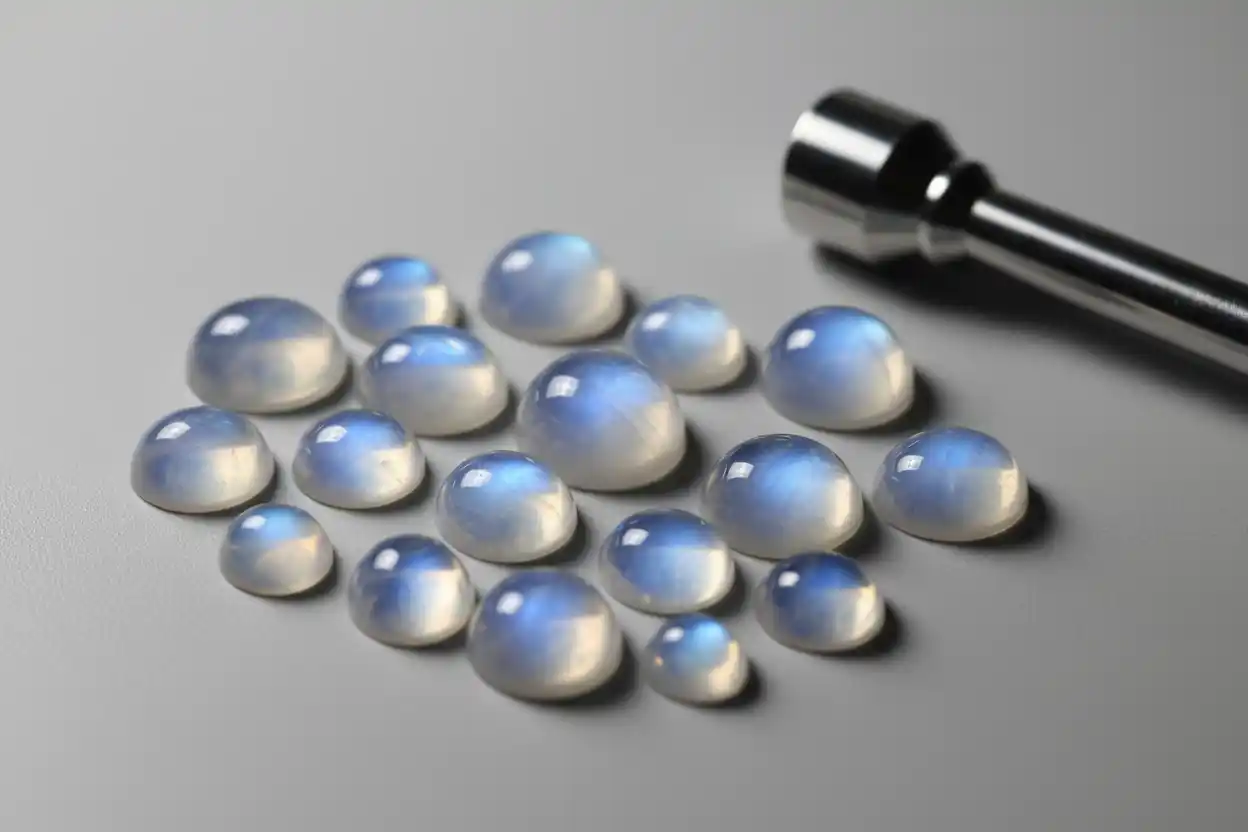
Buy Moonstone: Buyer Priorities, Provenance, Treatments & Returns
To buy moonstone intelligently, evaluate the quality and mobility of the sheen before focusing on carat weight. Moonstone belongs to the feldspar family and is prized for adularescence, the billowing light that appears to move across or beneath the gemstone as the viewing angle changes. GIA explains traditional moonstone as an intergrowth of orthoclase and albite whose microscopic alternating layers scatter light, producing the characteristic glow, while modern gemological research places the effect within the broader family of feldspar iridescence created by submicroscopic exsolution structures.
The most highly prized traditional moonstones are nearly colorless, semitransparent to nearly transparent, relatively free from distracting inclusions, and display a vivid mobile blue sheen centered over the stone. GIA states that blue-sheen colorless moonstone is the highest-value traditional appearance and emphasizes that the sheen should remain easy to see through a wide range of viewing angles rather than appearing only in one narrow position. Bodycolor, transparency, cut orientation, clarity, phenomenon strength, phenomenon color, durability, feldspar identity, provenance, and whether a stone is actually rainbow moonstone rather than traditional moonstone all deserve consideration before price.
Buy Moonstone At a Glance
| Buying Factor | What to Examine | Why It Matters |
|---|---|---|
| Adularescence | Strength, movement, color, centering | The sheen is moonstone’s defining quality |
| Sheen Color | Electric blue, blue-white, silver, white | Blue sheen against colorless body is traditionally most prized |
| Viewing Angle | Wide versus narrow range of visibility | A restricted sheen angle reduces value |
| Bodycolor | Colorless, white, peach, green, gray, brown | Bodycolor changes market segment and contrast |
| Transparency | Nearly transparent to translucent | High transparency can increase desirability when the sheen remains strong |
| Clarity | Centipede cracks, visible fractures, clouds, inclusions | Distracting inclusions can interfere with adularescence |
| Cut | Cabochon height, dome symmetry, orientation | Correct cutting determines whether the phenomenon displays properly |
| Carat Weight | Size together with quality | Large fine moonstone becomes scarcer |
| Rainbow Moonstone | Transparent labradorite, not traditional orthoclase moonstone | Trade terminology affects identity and valuation |
| Cat’s-Eye Effect | Sharpness and centering of chatoyancy | Phenomenal moonstone forms a specialized submarket |
| Star Effect | Strength and alignment of rays | Rare asterism creates another collector category |
| Durability | Mohs 6–6.5, poor toughness, two cleavage directions | Rings need greater protection than pendants |
| Heat Sensitivity | Avoid sudden temperature changes | Heat can cause breakage |
| Cleaning | Warm soapy water only | Steam and ultrasonic cleaning are not recommended |
| Imitation Risk | Coated assemblages, glass, other feldspars | Iridescent look-alikes can mimic moonstone convincingly |
Adularescence Is the Central Moonstone Quality Factor
Moonstone derives its commercial identity from its moving internal glow. GIA describes adularescence as light scattered by thin alternating feldspar layers, producing a billowy sheen that appears to roll across the gem as the observer changes angle. A stone without meaningful sheen may still be feldspar, but it lacks the phenomenon buyers usually pay a premium to obtain.
Quality therefore depends not simply on whether some sheen is visible but on how strong, mobile, centered, and attractive it appears. A weak white patch hidden near the girdle does not compare with a vivid electric-blue band that glides smoothly across the center of the cabochon.
Video is considerably more useful than one still image because moonstone is a dynamic gemstone. A seller should show the stone rotating slowly so buyers can see how quickly the sheen appears, how long it remains visible, and whether it travels naturally across the dome.
Blue Sheen Against a Colorless Body Is the Traditional Premium Combination
GIA identifies colorless moonstone with vivid blue adularescence as the most valuable traditional category. The highest-quality stones can look almost glassy when the sheen is absent, then produce an electric-blue shimmer as the stone moves.
A blue flash should ideally be vivid enough to remain recognizable under ordinary illumination without requiring extreme backlighting. The body itself should avoid strong brown, yellow, or unattractive green coloration when the buyer is seeking the classic high-end colorless look.
This hierarchy does not mean peach, gray, green, or brown moonstone is poor material. Those colors simply occupy different markets and may appeal strongly in designer jewelry.
A Wide Viewing Angle Adds Significant Value
GIA specifically notes that a moonstone loses value when its adularescence can be seen only within a restricted viewing range. This is one of the most practical quality factors because jewelry constantly moves relative to the wearer, observer, and light source.
A stone that flashes strongly while lying flat and continues to glow as it tilts slightly will usually provide a more satisfying experience than one that becomes completely inactive outside one exact angle.
When shopping online, ask for a slow rotation rather than a quick rocking motion designed to hit only the best optical position.
The Sheen Should Be Centered on the Cabochon
Correct orientation allows the phenomenon to pass through the most visible part of the stone. GIA states that ideal adularescence should be centered at the top of the cabochon.
A strong blue flash confined to one lower edge can indicate excellent rough cut inefficiently. A cutter who understands feldspar structure can orient the dome so the light phenomenon moves through the center, even if doing so requires sacrificing rough weight.
This is why cut quality affects moonstone value so strongly despite the apparent simplicity of a smooth cabochon.
Cabochon Height Matters
Moonstone is most often fashioned as a cabochon because the curved surface concentrates the iridescent reflection and makes the phenomenon visible across a wider angular range. Modern GIA research on phenomenal feldspars explains that curvature helps focus the reflected light into a smaller visible area, making the effect easier to observe while the stone moves.
GIA also warns that very flat moonstone cabochons do not display sheen effectively and have lower value.
A premium cabochon should therefore have enough dome height to support the phenomenon without becoming unnecessarily bulky or top-heavy.
Transparency Can Strengthen Fine Moonstone
GIA states that fine moonstone should be nearly transparent and as free from distracting inclusions as possible, while slight translucency can help emphasize adularescence.
Transparency creates the impression that the blue light floats inside the gem rather than sitting on an opaque surface. Highly included or cloudy stones can interrupt this depth and make the effect look diffuse.
A transparent stone without strong sheen is not automatically superior, however. Adularescence remains central to moonstone identity and market appeal.
“Centipede” Inclusions Are Characteristic
Moonstone commonly contains tiny stress cracks known to gemologists as centipedes because their fine branching shape resembles the insect. GIA identifies these as characteristic moonstone inclusions.
A few microscopic centipedes can be useful natural features and may not affect beauty when they are difficult to see without magnification. Large reflective cracks, extensive stress networks, or surface-reaching fractures can reduce transparency and durability.
The buyer should therefore distinguish diagnostic inclusions from distracting or structurally significant damage.
Peach Moonstone Has Its Own Market
Peach moonstone ranges through soft cream, apricot, orange-peach, and warm tan bodycolors, usually with white or silver adularescence rather than the intense electric-blue effect associated with top traditional material.
Its value depends on saturation, evenness, transparency, sheen strength, cut, and polish rather than on how closely it resembles colorless blue-sheen moonstone.
Designer demand can make fine peach material commercially desirable even though traditional grading hierarchies place blue-sheen colorless stones at the top.
Green and Gray Moonstone Should Be Judged on Their Own Appearance
Moonstone occurs naturally in green, gray, brown, white, and other bodycolors, and GIA recognizes this broad range. Green moonstone can display a soft floating light over a translucent green field, while gray moonstone can produce strong silver or blue contrast.
Dark gray material may appeal particularly in modern jewelry where the sheen looks dramatic against a smoky body.
A seller should not need to call every darker stone “black moonstone” as though the term automatically represents a standardized premium grade.
Cat’s-Eye Moonstone Is a Distinct Phenomenal Category
Some moonstones display chatoyancy in addition to or instead of broad adularescence. GIA documents cat’s-eye moonstones and identifies chatoyancy as one of the phenomena occurring in the material.
A fine cat’s-eye should show a relatively sharp, centered line that moves smoothly across the dome when the lighting or stone changes position.
A weak fuzzy stripe should not receive the same premium merely because a seller uses the cat’s-eye label.
Star Moonstone Is Another Specialist Form
Rare moonstones can exhibit asterism, including four-rayed stars. GIA’s review of phenomenal feldspars illustrates a four-rayed star moonstone from Madagascar alongside cat’s-eye examples.
Star quality depends on ray definition, centering, movement, bodycolor, transparency, and the interaction between asterism and adularescence.
This category should be compared with other star moonstones rather than ordinary blue-sheen cabochons.
Rainbow Moonstone Is Technically Labradorite
One of the most important buying distinctions is that commercial rainbow moonstone is generally transparent labradorite rather than traditional alkali-feldspar moonstone. GIA states this explicitly and explains that the trade has accepted the name despite the mineralogical distinction.
Rainbow moonstone can display blue, green, yellow, orange, or multicolor flashes over a pale transparent body. The effect can be beautiful and highly desirable, but the stone should not be priced or described under the assumption that it is the same feldspar composition as classic orthoclase-albite moonstone.
The Gems Lore buy labradorite guide and labradorite price guide provide useful background on the broader labradorite family.
Modern Rainbow Moonstone Can Be Exceptionally Fine
GIA recently documented high-quality transparent rainbow moonstone from Madagascar displaying strong blue adularescence together with unusual orange flash. Gemological testing confirmed the material as plagioclase feldspar within the labradorite variety.
This demonstrates that trade names evolve around appearance and that laboratory identification matters when mineralogical precision affects value.
A vivid transparent rainbow moonstone can command strong demand even though it is technically labradorite rather than traditional moonstone.
Sri Lanka and India Are Important Traditional Sources
GIA identifies India and Sri Lanka among the most important world sources of moonstone and also notes production from Brazil, Madagascar, Myanmar, Tanzania, and parts of the United States.
Sri Lanka is especially associated in the gem trade with transparent colorless material and blue sheen, while India supplies significant quantities of peach, gray, green, and other moonstones.
Country of origin can influence buyer interest, but visual quality should remain the main purchasing criterion unless provenance itself is part of the collecting goal.
Geographic Origin Should Not Be Guessed From Appearance Alone
A colorless blue-sheen cabochon may be described as Sri Lankan style, while peach material might be associated commercially with India, yet appearance alone cannot establish mine origin conclusively.
Retailers should separate provenance claims from aesthetic comparison.
If a major premium depends specifically on documented source, the buyer should request supporting evidence rather than relying on trade assumptions.
Large Fine Moonstone Becomes Scarcer
GIA states that moonstone occurs across a wide size range but that fine-quality material becomes rarer in large sizes and increases in value accordingly.
The important phrase is fine-quality. A large cloudy gray stone with weak sheen is not equivalent in scarcity to a large transparent colorless cabochon with vivid centered blue adularescence.
Carat weight should therefore be evaluated only after phenomenon quality, bodycolor, clarity, and cutting are established.
Dimensions Matter Alongside Weight
Cabochon cutting can hide substantial mass beneath the face-up surface. Two moonstones with the same carat weight can show very different visual size depending on dome height, base thickness, and outline.
A high dome can sometimes improve adularescence, so extra depth is not automatically wasteful. The question is whether the depth contributes to phenomenon and structural integrity or merely inflates weight.
Compare length, width, height, and visible optical performance rather than carats alone.
Faceted Moonstone Belongs to a Different Style Category
GIA notes that faceted moonstone has become increasingly available and that transparent material is generally chosen for faceting. Facets add brilliance and can mask small inclusions, producing a livelier appearance than a traditional cabochon.
The tradeoff is that faceting can change how adularescence presents. Some stones show attractive floating flashes through the faceted body, while others lose the broad smooth phenomenon for which moonstone is famous.
Buy the faceted stone for its actual performance rather than assuming faceting automatically represents higher grade.
Moonstone Is Not a High-Toughness Ring Gem
GIA places moonstone at Mohs 6–6.5 and describes its toughness as poor because feldspar has two cleavage directions. A hard knock can therefore split a moonstone even though the surface resists some ordinary scratching.
This distinction between hardness and toughness matters especially in rings.
Pendants, earrings, and pins are lower-risk choices, while a ring should ideally protect the cabochon with a bezel or low-profile setting and should be removed for sports, gym use, manual work, and activities likely to produce impact.
Heat and Sudden Temperature Change Can Cause Damage
GIA warns that high heat or sudden temperature change can break moonstone. A jeweler should therefore know the center stone is moonstone before soldering, resizing, retipping prongs, or carrying out repairs that involve heat.
Home steam cleaners are also inappropriate.
A gemstone that has survived years of normal wear can still fail suddenly if exposed to thermal stress because cleavage provides directions of structural weakness.
Warm Soapy Water Is the Recommended Cleaning Method
GIA recommends warm soapy water for moonstone and states that ultrasonic and steam cleaners should not be used.
A soft cloth or gentle brush is sufficient for ordinary dirt.
This conservative cleaning routine is also useful when the buyer is uncertain whether the jewelry contains adhesives, assembled components, surface coatings, or repaired fractures.
Imitation Rainbow Moonstone Can Be Sophisticated
GIA has documented assembled imitation rainbow moonstones built from natural quartz, gypsum, iridescent coating, cement, and colorless plastic. Face-up, the assembled cabochons reproduced a white bodycolor and convincing rainbow iridescence similar to commercial rainbow moonstone.
This case demonstrates that an attractive floating rainbow effect does not automatically prove feldspar identity.
For an inexpensive fashion item, formal laboratory testing may be unnecessary, but expensive “collector-grade” rainbow moonstone should receive stronger scrutiny when the seller cannot substantiate identity.
A Seam Can Reveal an Assembled Imitation
The GIA imitation assemblages showed separation planes, different component materials, coating, cement, and gas bubbles in the plastic layer, all of which exposed their constructed nature under gemological examination.
Consumers should not attempt destructive testing, but obvious glue lines, layered construction, plastic-like surfaces, repeated identical iridescence, or a phenomenon confined to an internal film deserve caution.
A reputable seller should disclose assembled products clearly rather than relying on the moonstone appearance.
Treatment Claims Should Remain Precise
Routine moonstone commerce is driven mainly by natural adularescence, bodycolor, clarity, and cutting rather than by a single dominant enhancement process. That does not mean every moonstone is guaranteed untreated, and assembled or coated imitations prove that artificial optical effects can enter the market.
A seller advertising untreated material should be able to explain what is meant by the claim and whether an independent laboratory has examined expensive stones.
Avoid sweeping statements that moonstone can never be treated, coated, assembled, dyed, or imitated.
GIA Identification Can Clarify Material Type
Moonstone terminology spans several feldspar materials, and rainbow moonstone itself is technically labradorite. Professional identification can therefore become useful when mineral identity materially affects value or when the buyer suspects an imitation.
The difference between traditional moonstone, rainbow moonstone, peristerite-like feldspar, coated assemblage, and other iridescent material can be difficult to resolve from photography.
For ordinary inexpensive cabochons, the cost of a major laboratory report may exceed the economic benefit, but high-value specimens justify stronger documentation.
AAA and AAAA Moonstone Are Seller Grades
GIA discusses moonstone quality through sheen, bodycolor, clarity, cut, and carat weight rather than through a universal AAA system.
One seller’s AAA might require vivid blue sheen, while another may use the same label for peach material, rainbow labradorite, or merely eye-clean cabochons.
A meaningful comparison therefore translates the letter grade into actual phenomenon strength, viewing angle, bodycolor, transparency, inclusions, cut, size, and identity.
Moonstone Versus Labradorite
Traditional moonstone and labradorite belong to the broader feldspar family but show different internal structures and optical appearances. Modern GIA research separates moonstone, labradorite, and related iridescent feldspars according to their microtextures and bulk chemistry.
Rainbow moonstone complicates consumer terminology because it is actually transparent labradorite accepted under a moonstone trade name.
A buyer who understands this distinction can compare prices more intelligently without assuming every rainbow-flashing feldspar is traditional moonstone.
Moonstone Versus Labradorite Price
The Gems Lore labradorite price guide emphasizes broad labradorescence, flash coverage, pattern, orientation, bodycolor, and spectrolite provenance.
Moonstone instead places greater value on a floating centered sheen, transparency, clean bodycolor, and phenomenon visibility across a useful range of angles.
Both are phenomenal feldspars, but their strongest premium characteristics are not identical.
Return Rights Are Especially Important for Online Moonstone
Moonstone is difficult to judge from still photographs because a seller can position the stone exactly where the adularescence peaks. A photograph may show a spectacular blue flash that disappears almost completely when the cabochon moves a few degrees.
A meaningful return period lets the buyer evaluate the stone under daylight-equivalent and ordinary indoor lighting, rotate it naturally, inspect clarity, and judge whether the phenomenon remains attractive once the seller’s controlled lighting is removed.
Return exclusions for resized, engraved, or custom-set jewelry should be understood before permanent alteration.
Common Red Flags When You Buy Moonstone
A listing deserves extra scrutiny when only one perfectly angled photograph is provided, the seller refuses movement video, rainbow moonstone is described as traditional orthoclase without qualification, an obvious narrow-angle sheen is marketed as full blue flash, large opaque material is sold at a high premium solely for weight, AAAA is represented as an official laboratory grade, origin is asserted from appearance alone, assembled or coated products are undisclosed, cleaning instructions recommend steam or ultrasonic equipment, or strong investment claims replace concrete gemological information.
How to Compare Moonstone Listings Fairly
Compare moonstones by exact material category, bodycolor, adularescence color, strength, centering, viewing angle, transparency, inclusions, cut, dimensions, carat weight, phenomenon type, provenance, structural condition, setting protection, documentation, and return rights. A transparent Sri Lankan-style blue-sheen orthoclase moonstone, peach Indian moonstone, cat’s-eye moonstone, rainbow labradorite, and assembled imitation do not belong in one undifferentiated price category merely because they all display some form of moving light.
Conclusion
To buy moonstone successfully, prioritize the quality and mobility of the optical phenomenon rather than size or retailer grade. GIA identifies the most prized traditional moonstone as nearly colorless and transparent with a vivid mobile electric-blue sheen, ideally centered on the cabochon and visible across a broad range of viewing angles. Proper cutting matters because the curved cabochon surface and its orientation determine how effectively the internal feldspar structures present adularescence.
Identity also deserves care. Rainbow moonstone is technically labradorite rather than traditional moonstone, while sophisticated assembled imitations can reproduce convincing multicolor iridescence using quartz, gypsum, coatings, cement, and plastic. Buyers should therefore understand what kind of feldspar—or imitation—they are actually purchasing before comparing price.
Durability is the final major constraint. Moonstone is only Mohs 6–6.5, has poor toughness and two cleavage directions, and should be protected from impact, sudden temperature change, ultrasonic cleaning, and steam. A stone combining strong mobile sheen, attractive bodycolor, good transparency, skilled cut, manageable inclusions, correct identity, and an appropriate setting represents a much stronger purchase than one selected solely because it carries a high seller grade.
Frequently Asked Questions
What is the best moonstone quality?
Traditional top-quality moonstone is nearly colorless, semitransparent to nearly transparent, relatively inclusion-free, and shows strong electric-blue adularescence that moves across the stone and remains visible through a useful range of viewing angles.
What causes moonstone’s glow?
The glow comes from light interacting with microscopic intergrowth structures within feldspar, producing the phenomenon known as adularescence.
Is blue moonstone more valuable than white-sheen moonstone?
Traditional market preferences generally place vivid blue adularescence above white or silver sheen when bodycolor, transparency, cut, and size are otherwise comparable.
Is rainbow moonstone real moonstone?
Rainbow moonstone is a legitimate trade gemstone, but mineralogically it is transparent labradorite rather than traditional orthoclase moonstone.
Are peach moonstones valuable?
Fine peach moonstone can be desirable, especially when the color is even, the stone is translucent to transparent, and the sheen is strong. It occupies a different market from premium colorless blue-sheen moonstone.
What are centipede inclusions?
Centipedes are characteristic tension cracks seen in moonstone and named for their branching insect-like appearance. Small examples may have little visible effect, while large cracks can reduce clarity and durability.
Can moonstone show a cat’s eye?
Yes. Some moonstones display chatoyancy, and a smaller number can show star effects. These stones should be evaluated for sharpness, centering, movement, bodycolor, and clarity.
Is large moonstone rare?
Moonstone occurs in many sizes, but GIA states that fine-quality material becomes scarcer in larger sizes. Large size matters most when strong sheen, clarity, color, and cutting remain excellent.
How hard is moonstone?
Moonstone measures approximately 6–6.5 on the Mohs scale and has poor toughness because feldspar has two cleavage directions.
Is moonstone suitable for rings?
It can be worn in rings with care, but protective settings and cautious use are advisable because hard blows can chip or cleave the stone. GIA generally considers pendants, earrings, and pins lower-risk choices.
How should moonstone be cleaned?
GIA recommends warm soapy water and advises against both steam and ultrasonic cleaners.
Can moonstone be imitated?
Yes. GIA has documented sophisticated assembled rainbow-moonstone imitations made from quartz, gypsum, iridescent coating, cement, and plastic.
Does AAA moonstone have an official meaning?
No universal GIA AAA moonstone grade exists. Compare actual adularescence, bodycolor, transparency, clarity, cut, size, identity, and condition rather than relying on seller-defined letters.
Is moonstone a guaranteed investment?
No. Fine large blue-sheen material can be collectible, but future value depends on quality, identity, provenance, condition, fashion, supply, transaction costs, and secondary-market demand.