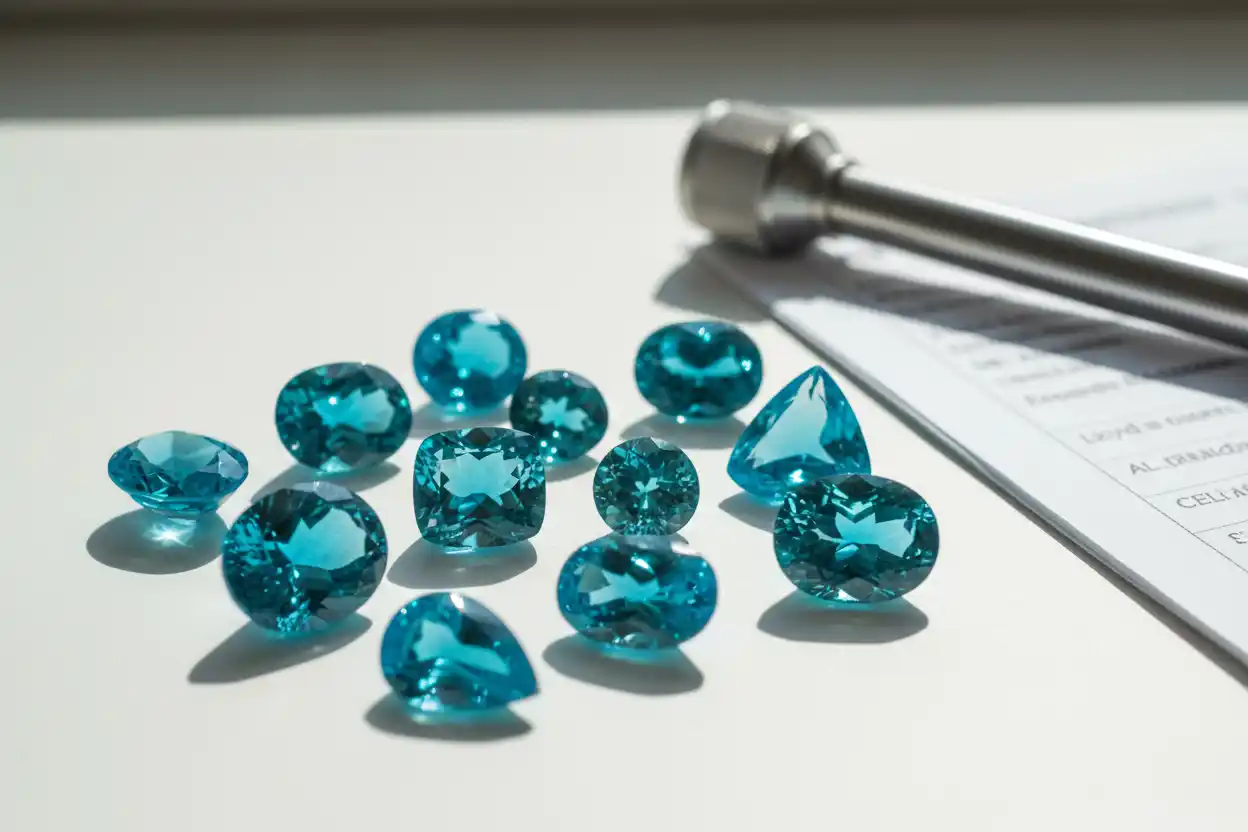
Buy Paraiba Tourmaline: Smart Buying Tips & Red Flags
If you want to buy paraiba tourmaline intelligently, begin with laboratory-confirmed copper-bearing tourmaline identity before neon color, country of origin, carat weight, or price. Paraiba tourmaline occupies one of the most expensive niches within the tourmaline family because qualifying material combines distinctive copper-related blue-to-green color with limited fine supply, yet turquoise color by itself cannot establish the variety. Iron-bearing indicolite, apatite, zircon, sapphire, beryl, coated gems, glass, and manufactured simulants can overlap strongly in photographs.
The original material became famous through discoveries in Brazil’s Paraíba region, while copper-bearing tourmaline with comparable colors was later found in Nigeria and Mozambique. Modern professional terminology generally treats paraiba as a trade variety defined by suitable blue-to-green color and copper-related chemistry rather than as proof that the gemstone came specifically from Brazil, while geographic origin is reported separately when it can be determined. That distinction matters because Brazilian provenance can command a substantial premium, but a Mozambique or Nigerian stone can still be genuine paraiba tourmaline when it meets the relevant laboratory criteria.
The strongest methodology when you buy paraiba tourmaline is therefore variety identity first, face-up brightness second, hue and saturation third, tone fourth, transparency and structural condition fifth, cut sixth, treatment seventh, dimensions eighth, laboratory origin ninth, jewelry construction tenth, and price last. Following that hierarchy prevents terms such as electric blue, neon lagoon, Windex blue, Brazilian color, AAAA, collector grade, or investment stone from replacing evidence.
The broader Paraiba Tourmaline properties guide explains the mineralogy, copper-related color, tourmaline species, localities, physical properties, and wider background. This page focuses specifically on how to buy paraiba tourmaline as a loose gemstone or finished jewel while separating genuine quality from weak copper-bearing material, ordinary indicolite, treatment ambiguity, false Brazilian provenance, poor cutting, excessive filling, and heavily manipulated photography.
What to Judge First When You Buy Paraiba Tourmaline
Paraiba is not a separate mineral species. Most stones belong to elbaite tourmaline, although copper-bearing material belonging to closely related tourmaline species has also been documented. The commercially important distinction is that qualifying stones show an appropriate blue-to-green color range associated principally with copper, normally in a chemical environment that also includes manganese.
When you buy paraiba tourmaline, use this hierarchy:
| Priority | What to evaluate | Why it matters |
|---|---|---|
| 1 | Laboratory-confirmed paraiba variety | Turquoise color alone cannot prove copper-bearing identity |
| 2 | Face-up brightness | Fine material should look luminous rather than dark or gray |
| 3 | Hue | Blue, turquoise, greenish blue, bluish green, and fine green dominate the market |
| 4 | Saturation | Strong color is central to the paraiba premium |
| 5 | Tone | Excessive darkness can destroy the celebrated neon appearance |
| 6 | Transparency | Strong color can justify inclusions, but severe clouding reduces brilliance |
| 7 | Structural condition | Surface-reaching fissures can affect value, durability, filling, and setting |
| 8 | Cut | Orientation, windowing, extinction, depth, and pleochroism strongly affect appearance |
| 9 | Treatment | Heating and clarity enhancement require separate consideration |
| 10 | Dimensions | Deep cutting can preserve expensive weight without good face-up spread |
| 11 | Geographic origin | Brazil, Nigeria, and Mozambique can require advanced chemical analysis |
| 12 | Price | Price makes sense only after identity, quality, treatment, and origin are resolved |
When you buy paraiba tourmaline through this order, you are paying for confirmed material and visible performance rather than for a blue-green description.
Paraiba Color Is Not Enough to Establish Identity
This is the first rule to remember when you buy paraiba tourmaline.
Many gemstones can show turquoise, cyan, lagoon blue, electric blue, teal, or greenish-blue color. Some ordinary iron-bearing tourmalines can look remarkably bright. Apatite can produce vivid Caribbean blue. Zircon can be strongly blue and exceptionally brilliant. Sapphire, aquamarine, topaz, synthetic spinel, glass, cubic zirconia, and coated materials can all overlap with part of the paraiba palette.
The Blue Gemstones guide demonstrates how many unrelated gem species occupy the same broad color family.
A seller saying that a stone has “perfect Paraiba color” is therefore describing appearance, not proving material identity.
When you buy paraiba tourmaline at serious value, chemical confirmation belongs near the beginning of the transaction.
Copper Must Be Established Analytically
Paraiba’s distinctive appearance is associated principally with copper-related absorption within tourmaline, usually alongside manganese and other trace elements.
When you buy paraiba tourmaline, the laboratory should do more than confirm that the object is tourmaline.
It should establish that the gemstone fits the recognized copper-bearing paraiba variety.
Professional identification can involve:
refractive properties, birefringence, pleochroism, spectroscopy, microscopy, and quantitative chemical analysis.
For important stones, trace-element methods are particularly valuable because copper detection and geographic origin can require considerably more analytical precision than ordinary visual testing.
Detecting a Trace of Copper Is Not the Whole Standard
A subtle but important issue arises when sellers treat any detectable copper as sufficient for the paraiba name.
Professional variety definitions also consider color, saturation, tone, and whether copper-related absorption is actually responsible for the recognized blue-to-green appearance.
When you buy paraiba tourmaline, a pale grayish, brownish, pink, weakly colored, or iron-dominated stone should not automatically receive the full paraiba premium simply because an instrument detects some copper.
The trade name represents a combination of chemistry and appropriate appearance.
Understand Paraiba and Paraiba-Type Terminology
The original commercial material came from Brazil, so older market language often treated Paraiba almost as a geographic name.
That changed as comparable copper-bearing tourmalines appeared from Nigeria and Mozambique.
When you buy paraiba tourmaline, you may still encounter sellers who reserve Paraiba for Brazilian stones and use Paraiba-type for African material. Other laboratories and dealers use paraiba for qualifying copper-bearing tourmaline regardless of source, then state Brazil, Mozambique, Nigeria, or an inconclusive origin separately.
The safest approach is not to argue over a seller’s vocabulary.
Ask exactly what the report says.
Brazilian Paraiba and Paraiba Tourmaline Are Not Synonyms
A gemstone can qualify as paraiba tourmaline without originating in Brazil.
Conversely, a blue-green tourmaline from Brazil does not automatically deserve the paraiba variety name unless its chemistry and color support it.
When you buy paraiba tourmaline advertised as Brazilian, verify two independent claims:
- the gemstone qualifies as paraiba tourmaline; and
- the geographic-origin analysis supports Brazil.
That distinction prevents a seller from using the historically famous name as evidence for a country claim.
Color Is the Dominant Visible Value Factor
Once identity is secure, color becomes the leading visible factor.
When you buy paraiba tourmaline, premium material generally shows an unusually vivid blue-to-green appearance that remains bright even outside extreme jewelry-store lighting.
Desirable color descriptions commonly include:
electric blue, neon blue, turquoise blue, greenish blue, bluish green, lagoon blue, vivid green, and related shades.
These expressions are descriptive rather than universal grades.
The key question is whether the stone actually looks unusually luminous.
“Neon” Should Mean Luminous, Not Merely Saturated
The celebrated paraiba effect is often described as neon or electric.
That does not mean the gemstone literally emits light.
Rather, selective absorption and transmission can produce exceptionally vivid color that appears unusually bright for its tone.
When you buy paraiba tourmaline, inspect whether the complete face looks open and luminous.
A very dark blue-green stone may be strongly saturated while failing to show the characteristic brightness buyers are paying for.
Saturation and brightness work together.
Buy Paraiba Tourmaline for Brightness Before Darkness
One of the easiest mistakes is equating deeper color with better color.
When you buy paraiba tourmaline, a medium-light turquoise gem can look far more electric than a dark blue-green stone containing heavy extinction.
The ideal tone allows strong color while still returning abundant light.
Avoid stones that become:
inky, black-ended, muddy, gray, brownish, or almost opaque under ordinary indoor illumination.
Turquoise Blue Is One of the Classic Targets
Vivid turquoise blue occupies the center of the popular paraiba aesthetic.
When you buy paraiba tourmaline in this hue, inspect whether the stone remains distinctly blue-green rather than becoming:
grayish blue, yellowish green, weak aqua, or dark teal.
A high-quality turquoise stone should appear saturated while remaining bright.
Do not rely solely on a black-background photograph because the dark background can exaggerate apparent saturation.
Electric Blue Can Command Exceptional Attention
Bright blue material with minimal green can be particularly striking.
When you buy paraiba tourmaline in an electric-blue range, compare it against ordinary blue tourmaline to make sure the premium is supported by genuine luminance rather than merely an attractive blue hue.
The Indicolite Buying Guide explains why iron-bearing blue tourmaline belongs to a separate market even when visual overlap is strong.
Chemical testing, not color alone, separates these categories reliably.
Greenish Blue and Bluish Green Can Be Excellent
The paraiba market should not be reduced to one perfect swimming-pool blue.
When you buy paraiba tourmaline, fine greenish-blue and bluish-green stones can be exceptionally valuable when they combine:
high saturation, favorable tone, minimal gray or brown, strong brightness, good transparency, and confirmed copper-bearing identity.
The balance between green and blue is partly personal.
Brightness remains more important than the exact naming order.
Fine Green Paraiba Can Be Underrated
Copper-bearing tourmaline can occur in strong green as well.
When you buy paraiba tourmaline that leans green, inspect whether the stone remains vivid and luminous rather than looking like ordinary dark chrome-free green tourmaline.
A highly saturated bright green paraiba can be impressive, particularly when the report supports the variety clearly.
Do not reject excellent material merely because it is not turquoise.
Purple or Violet Rough Needs Careful Treatment Context
Copper-bearing tourmaline can occur with violet, purple, pinkish, or reddish components associated with manganese.
Heating can reduce some of those modifiers and reveal stronger blue or green.
When you buy paraiba tourmaline, therefore, an unusually pure blue may be naturally that color or may have reached its present appearance through heating.
The visual result alone does not tell you treatment history.
Gray Modifiers Reduce the Neon Premium
Gray can suppress brightness dramatically.
When you buy paraiba tourmaline, compare two stones side by side under neutral light.
One may be technically saturated blue but look gray and closed.
Another may have similar hue while appearing far more luminous.
The second stone generally provides the paraiba visual effect more successfully.
Brown and Yellow Modifiers Need Context
Slight green or yellow-green components can belong within legitimate paraiba color ranges, while stronger yellow or brown can push a stone away from the most valuable neon appearance.
When you buy paraiba tourmaline, judge whether secondary modifiers enhance or dull the gem.
A warm green can be attractive.
A muddy brown-green usually deserves a lower premium.
Evaluate Color Under Several Ordinary Lights
Photography can transform paraiba color more aggressively than buyers realize.
Cool white balance can push greenish blue toward saturated cyan.
A black background can deepen apparent color.
Digital saturation can create an almost impossible glowing appearance.
When you buy paraiba tourmaline online, request the exact stone under:
neutral diffused light, ordinary white indoor light, warmer indoor illumination, and a neutral white or gray background.
The color does not have to remain identical.
It should remain attractive.
Do Not Buy Paraiba Tourmaline From One Black-Background Photo
Black can make transparent blue-green material look spectacular.
When you buy paraiba tourmaline, request white and neutral-gray backgrounds as well.
If a stone looks electric only over black but washed out over neutral gray, that contrast dependence should influence your decision.
Fine color should survive realistic viewing.
Check the Background’s White Balance
A simple color-management clue is to inspect objects surrounding the gem.
When you buy paraiba tourmaline online, a white card should look white.
A gray card should look gray.
Skin tones should look plausible.
If the entire scene has been shifted toward cyan or turquoise, the gemstone’s color may have been shifted too.
Pleochroism Is a Major Cutting Factor
Tourmaline is strongly pleochroic.
Different crystallographic directions can show different hues or intensity, and one direction is often much darker than another.
When you buy paraiba tourmaline, the cutter’s orientation can determine whether the face looks:
bright blue, greener, darker, lighter, or heavily extinct.
The broader Tourmaline Buying Guide explains this family-wide cutting challenge.
Paraiba’s exceptional value makes orientation even more consequential.
Look for Black Ends in Elongated Cuts
Tourmaline crystals often grow as elongated prisms, encouraging long rectangles, ovals, emerald cuts, and other elongated shapes.
When you buy paraiba tourmaline, inspect both ends carefully.
One or both ends can become very dark because the cutter is looking through a strongly absorbing crystallographic direction.
A slightly darkened tip may be tolerable.
Large permanent black ends reduce face-up beauty.
Ask for a Complete Slow Rotation
Pleochroism and extinction cannot be judged properly from one view.
When you buy paraiba tourmaline remotely, request a slow actual-stone video.
Watch whether:
the center stays bright, one side turns black, blue shifts strongly toward green, one end loses saturation, inclusions become prominent, or the stone only looks electric for one brief angle.
A strong gemstone should perform through useful normal movement.
Brightness Is More Important Than One Perfect Angle
A seller can find the exact angle where almost any transparent colored stone looks best.
When you buy paraiba tourmaline, ask how the gemstone behaves when it moves away from that position.
A practical jewelry stone should remain attractive across a meaningful viewing range.
Clarity Should Be Judged More Leniently Than Color
Paraiba tourmaline frequently contains:
fluid inclusions, growth tubes, needles, crystals, fingerprints, healed fissures, cavities, and other internal features.
When you buy paraiba tourmaline, strong color can justify more inclusion than buyers would accept in ordinary pale blue or green tourmaline.
A slightly included neon stone can be far more valuable than an eye-clean weakly colored stone.
Color leads.
Eye-Clean Material Still Receives a Major Premium
Tolerance for inclusions does not mean clarity is irrelevant.
When you buy paraiba tourmaline, a vivid gem that is also transparent and eye-clean combines two scarce characteristics.
Such stones can command substantial premiums, especially as size increases.
The buyer should still distinguish microscopic inclusions from structural fractures.
Open Fissures Matter More Than Enclosed Inclusions
A small crystal trapped deep inside the gem may affect appearance minimally.
A surface-reaching fissure can affect:
polish, durability, treatment, setting, cleaning, and future repair.
When you buy paraiba tourmaline, inspect every open crack near:
the girdle, corners, points, pavilion, and prospective prong locations.
Structural condition should be evaluated separately from ordinary clarity.
White Clouds Can Suppress the Neon Effect
Dense whitish inclusions scatter light and can reduce transparency.
When you buy paraiba tourmaline, strong color may compensate for some inclusion, but extensive clouding can make a valuable blue-green hue look sleepy or milky.
A luminous gemstone should still transmit enough light for its color to remain open.
Liquid Inclusions Are Important for Treatment and Repair
Tourmaline commonly contains fluid-rich inclusions.
When you buy paraiba tourmaline, these are not merely clarity features.
They can also increase sensitivity to heating because trapped fluids and thermal stress may contribute to fracturing.
A jeweler should know the gem’s inclusion condition before soldering near the stone.
Fracture Filling Needs Explicit Disclosure
Surface-reaching fissures can be filled with oil, resin, or another substance to reduce visibility.
When you buy paraiba tourmaline, ask directly whether any clarity enhancement has been detected or disclosed.
The Gemstone Treatments guide explains the distinction among heating, filling, coating, irradiation, and other modifications.
A filled natural paraiba tourmaline remains natural tourmaline.
Its treatment category, care, and value differ.
Filling Can Make a Fractured Stone Look Cleaner
Transparent filler reduces the optical contrast between a fracture and the surrounding gem.
When you buy paraiba tourmaline, inspect fissures for:
bubbles, flash effects, different luster, residue at the surface, or an unusually invisible fracture under one direction.
These clues are not conclusive.
A professional laboratory is better equipped to evaluate clarity enhancement.
Ask What Substance Was Used
Not all fillers behave identically.
When you buy paraiba tourmaline with disclosed filling, determine whether the enhancement involves:
oil, resin, polymer, or another material.
That information can affect:
heat sensitivity, cleaning, repair, long-term maintenance, and valuation.
Heavy Filling Deserves a Larger Discount
A small amount of clarity enhancement in one fissure and extensive polymer filling throughout a fractured gem are not equivalent.
When you buy paraiba tourmaline, the degree of treatment should influence the price.
The stronger the gem depends on filler for apparent clarity or stability, the further it moves from comparable untreated or minimally treated material.
Heat Treatment Is Common in the Paraiba Market
Heating can reduce manganese-related purple, pink, red, or brown absorption and reveal brighter blue-to-green color.
When you buy paraiba tourmaline, do not assume that heating means the gemstone is fake.
The underlying material remains natural tourmaline.
The important questions are:
Was heating disclosed?
Can the laboratory determine it?
Does the price reflect the market category appropriately?
Heat Can Be Difficult to Detect
This creates a practical buying problem.
When you buy paraiba tourmaline, a laboratory may be able to confirm copper-bearing identity yet remain unable to determine conclusively whether the stone was heated.
That uncertainty should be represented honestly.
A seller should not turn “no evidence detected” or “treatment undeterminable” into a guaranteed unheated claim.
Unheated Premiums Need a Higher Evidence Threshold
If a seller wants a substantial premium because a stone is supposedly unheated, ask what supports that conclusion.
When you buy paraiba tourmaline, the strongest answer is not:
the color looks natural,
the mine owner said so,
the inclusions look unheated,
or the dealer has experience.
Treatment certainty should be proportionate to the premium.
Where heat cannot be determined conclusively, price should not depend heavily on absolute untreated claims.
Heating Is Usually Stable
A successfully heat-treated copper-bearing tourmaline generally retains its resulting color under ordinary wear.
When you buy paraiba tourmaline, routine heat is therefore primarily a disclosure and valuation issue rather than an expectation that the gemstone will suddenly revert.
Extreme heat during jewelry repair remains a separate risk.
Irradiation Should Be Distinguished From Heating
Tourmaline as a broader gem family can be irradiated to alter color.
When you buy paraiba tourmaline, do not let a generic treatment statement collapse every possibility into the word enhanced.
The laboratory and seller should describe known or detectable treatment as specifically as practical.
Coating Is a Different Treatment Category
A blue-green coating can make another gemstone look more paraiba-like.
When you buy paraiba tourmaline, inspect facet edges, scratches, girdle areas, and high-contact points for a color film or abrupt color change.
Do not scratch the gemstone deliberately.
Professional examination is safer.
Natural Does Not Mean Untreated
This distinction should remain explicit throughout the purchase.
When you buy paraiba tourmaline, a stone can be:
natural and heated,
natural and fracture filled,
natural and coated,
natural and repaired,
or natural and untreated.
The word natural identifies geological origin.
It does not answer every enhancement question.
Cut Quality Must Be Evaluated Despite Rare Rough
Paraiba rough is expensive enough that cutters often prioritize weight retention.
Consequently, finished gems may show:
deep pavilions, thick girdles, asymmetry, odd outlines, included corners, or compromised facet proportions.
When you buy paraiba tourmaline, some compromise can be rational.
The question is whether preserving weight also preserved beauty.
Windowing Is One of the Biggest Cut Risks
A shallow pavilion can allow light to pass through the gemstone instead of returning strongly to the viewer.
When you buy paraiba tourmaline, look through the center over a neutral background.
If the background remains clearly visible across a large region, the stone is windowed.
This can reduce:
saturation, brightness, brilliance, and perceived size quality.
A high-value stone should not receive a pass simply because the rough was rare.
Deep Cutting Creates the Opposite Problem
A deep pavilion may preserve valuable carat weight and can sometimes strengthen color.
It also makes the stone appear smaller from above.
When you buy paraiba tourmaline, compare exact length, width, and depth with weight.
The Carat vs Millimeter Size Chart provides useful context for understanding spread.
A heavier gem is not automatically a larger-looking gem.
Hidden Weight Can Be Extremely Expensive
This matters more in paraiba than in inexpensive commercial tourmaline because every additional fraction of a carat can command a substantial premium in fine material.
When you buy paraiba tourmaline, ask yourself whether extra pavilion depth creates:
stronger color, better brilliance, safer structure, or merely more scale weight.
Pay intentionally.
Slight Asymmetry Can Be Rational
A cutter may preserve a strong neon region, avoid a dangerous fracture, or retain valuable weight by producing a less-than-perfect outline.
When you buy paraiba tourmaline, small asymmetry can be an intelligent trade-off.
Poor polish, random facet placement, severe crookedness, or weak optical performance remain workmanship problems.
Ovals Are Common and Efficient
Oval cutting can preserve elongated tourmaline rough effectively.
When you buy paraiba tourmaline in an oval, inspect:
bow-tie darkness, end extinction, symmetry, color zoning, pavilion depth, and whether one side appears more green or dark because of orientation.
A moving mild bow tie can provide contrast.
A permanent black center should reduce the premium.
Pear Shapes Can Preserve Color Well
Pear cuts are common among expensive colored gemstones because they can follow irregular rough and provide substantial face-up size.
When you buy paraiba tourmaline in a pear, inspect:
the point, rounded shoulders, bow tie, end darkness, and thin girdle sections.
For ring use, the point deserves protective metal.
Emerald and Rectangular Cuts Need End Inspection
Tourmaline’s elongated crystal habit makes rectangular cuts natural choices.
When you buy paraiba tourmaline in an emerald or elongated mixed cut, inspect both ends for excessive darkness caused by pleochroic orientation.
Large open facets also expose inclusions and color zoning more clearly.
A fine rectangular paraiba should look intentionally luminous rather than like a dark blue-green tunnel.
Cushion Cuts Can Balance Color and Brilliance
Cushions can produce strong face-up brightness while preserving valuable rough effectively.
When you buy paraiba tourmaline in a cushion, compare:
corner brightness, center brilliance, depth, symmetry, and color consistency.
A cushion that looks broad but carries a severe window should not receive a premium simply because the outline is fashionable.
Precision Cutting Can Add Genuine Value
Exceptional cutting can improve:
face-up spread, brightness, symmetry, pleochroic orientation, color distribution, and polish.
When you buy paraiba tourmaline from a specialist cutter, a craftsmanship premium can be entirely reasonable.
Judge the result rather than the cutter’s reputation alone.
Compare Weight With Visible Area
One carat is not one visual size.
When you buy paraiba tourmaline, two one-carat stones can look dramatically different because of:
shape, depth, girdle thickness, pavilion angle, and density variation.
A 0.85-carat bright oval can look larger and better than a deeply cut 1.05-carat cushion.
Carat thresholds should not override visible quality.
Size Premiums Become Stronger in Fine Material
Large, strongly colored, transparent paraiba rough is scarce.
When you buy paraiba tourmaline, the price per carat can rise sharply as size increases while quality remains excellent.
That does not mean every large paraiba deserves an extreme premium.
Large dark, windowed, heavily filled, or weakly saturated stones should be valued according to their actual quality.
Brazilian Stones Deserve Separate Origin Analysis
Brazilian material has exceptional historical importance because the original discoveries created the paraiba market.
Fine Brazilian gems can receive significant premiums, particularly when they combine vivid blue or turquoise color with transparency and useful size.
When you buy paraiba tourmaline represented as Brazilian, require more than dealer confidence.
Geographic origin can require advanced trace-element analysis.
Brazil Cannot Be Proven From Color
Some Brazilian stones are extraordinarily vivid.
So are some Mozambique and Nigerian stones.
When you buy paraiba tourmaline, visual inspection cannot reliably establish country of origin because different deposits can overlap in:
color, refractive properties, inclusions, and ordinary chemistry.
Origin requires a more sophisticated analytical comparison with reference material.
Mozambique Produces Exceptional Paraiba Tourmaline
Mozambique has produced significant quantities of copper-bearing tourmaline, including gemstones larger than those commonly encountered from the original Brazilian deposits.
When you buy paraiba tourmaline from Mozambique, do not assume that African origin automatically means second-rate quality.
Fine Mozambican stones can display extraordinary blue, turquoise, blue-green, green, and violet-related colors.
Judge the gemstone first.
Nigeria Is a Legitimate Paraiba Source
Nigeria has also produced copper-bearing tourmalines qualifying for the paraiba trade category.
When you buy paraiba tourmaline represented as Nigerian, expect the same documentation discipline applied to Brazil or Mozambique.
Origin should come from appropriate analysis rather than seller inference.
Some Origin Results Can Be Inconclusive
Even sophisticated laboratories can occasionally encounter trace-element profiles that overlap too strongly for a confident country conclusion.
When you buy paraiba tourmaline, an inconclusive origin result does not mean the stone is fake.
It can still be genuine paraiba tourmaline.
It simply means the geographic evidence does not support a definitive Brazil, Mozambique, or Nigeria call.
Do not allow a seller to convert “inconclusive” into “probably Brazilian” and charge the full origin premium without additional support.
Brazilian Premium Should Follow Visible Quality
A mediocre Brazilian stone should not automatically beat an exceptional Mozambique stone.
When you buy paraiba tourmaline, use this sequence:
color, brightness, transparency, cut, condition, treatment, size, then origin.
Brazilian provenance can amplify a great gemstone.
It should not rescue a weak one.
The Laboratory Report Threshold Should Be Low
Paraiba tourmaline carries enough potential value that significant purchases should generally arrive with a respected colored-stone report.
When you buy paraiba tourmaline, the report may address:
natural tourmaline identity, paraiba variety, weight, dimensions, color, detectable treatment, and geographic origin when requested and determinable.
The Gemstone Certification guide explains why identification, treatment analysis, origin opinion, and appraisal are separate services.
Ask Whether Origin Analysis Was Actually Ordered
A report can confirm paraiba tourmaline without providing geographic origin.
When you buy paraiba tourmaline advertised as Brazilian, check whether the report contains an origin conclusion.
Do not assume the laboratory has confirmed Brazil simply because its logo appears on the paperwork.
Read the Report Wording Yourself
A report may identify:
tourmaline,
copper-bearing tourmaline,
paraiba tourmaline,
or another trade description.
When you buy paraiba tourmaline, make sure the laboratory wording actually supports the category for which you are paying.
A seller should not upgrade “blue tourmaline” to paraiba based solely on its own interpretation.
Match the Report to the Exact Stone
A genuine report belonging to another gemstone provides no protection.
When you buy paraiba tourmaline, compare:
carat weight, length, width, depth, shape, cutting style, color, report photograph, visible inclusions, fissures, and identifying surface features.
Verify the report number through the issuing laboratory when that service is available.
Inclusions Can Help With Report Matching
Tourmaline’s tubes, fractures, crystals, needles, and other natural features can create an individual internal fingerprint.
When you buy paraiba tourmaline, magnified photographs of these features can be extremely useful for matching the stone to its report.
Do not interpret one inclusion as proof of origin or treatment.
Use it as an identification marker for the individual gemstone.
Seller Certificates Are Not Independent Laboratory Reports
A retailer may issue an impressive authenticity card.
It can still be useful because it records what the seller promises.
When you buy paraiba tourmaline at substantial value, however, do not equate an in-house certificate with independent analysis capable of detecting copper, treatment, and geographic origin.
The evidence should match the financial risk.
Appraisals Do Not Prove Paraiba Identity
An appraisal estimates monetary value.
It does not automatically establish copper-bearing variety, treatment, or geographic origin.
When you buy paraiba tourmaline, the correct sequence is:
identify the gemstone, establish treatment and origin where relevant, evaluate quality, then appraise value.
A large replacement figure should never substitute for scientific identification.
“Paraiba Color” Is Not the Same as Paraiba Tourmaline
This wording appears frequently in inexpensive listings.
A cubic zirconia, glass gem, synthetic sapphire, apatite, ordinary tourmaline, or coated stone can all be described visually as Paraiba color.
When you buy paraiba tourmaline, inspect whether the material name actually says natural tourmaline and whether the paraiba variety has appropriate support.
A color description does not create mineral identity.
Apatite Is an Important Lookalike
Blue-green apatite can produce remarkably vivid turquoise color.
When you buy paraiba tourmaline, apatite becomes particularly relevant because photographs can make the two look similar.
Apatite is much softer and has different refractive, density, optical, and chemical characteristics.
Do not scratch a suspected gem to test hardness.
Professional identification is safer.
Blue Zircon Has a Different Optical Personality
Zircon can display strong brilliance and dispersion.
When you buy paraiba tourmaline, a bright blue zircon may show more obvious spectral fire than copper-bearing tourmaline.
Appearance still cannot substitute for testing.
The materials differ significantly in composition, density, birefringence, and structure.
Aquamarine Can Resemble Pale Paraiba
Aquamarine can display attractive blue and greenish-blue shades but generally lacks the intense copper-related neon saturation associated with fine paraiba.
When you buy paraiba tourmaline, an aquamarine-like pale stone should not receive an extreme paraiba premium merely because copper is claimed verbally.
Ordinary Indicolite Is the Closest Family Lookalike
Indicolite is blue tourmaline typically colored largely by iron.
When you buy paraiba tourmaline, indicolite can create the most confusing comparison because both materials belong to the tourmaline family and can overlap in color.
Copper-related chemistry and laboratory variety criteria distinguish paraiba.
Visual blue color alone cannot.
Glass Can Be Surprisingly Convincing
Bright blue-green glass can be cut into impressive stones with clean transparency.
When you buy paraiba tourmaline, be particularly cautious with large flawless turquoise stones priced far below the normal level of rare natural copper-bearing material.
Round gas bubbles may indicate glass in some cases.
Their absence does not prove tourmaline.
“Lab Paraiba” Needs Specific Material Disclosure
A seller may use phrases such as:
lab Paraiba, created Paraiba, Paraiba simulant, Paraiba CZ, Paraiba sapphire, or Paraiba glass.
When you buy paraiba tourmaline, ask what the object physically is.
The paraiba color can be reproduced in many manufactured materials.
Do not assume that every lab-created paraiba listing means laboratory-grown tourmaline with equivalent chemistry.
Cat’s-Eye Paraiba Requires a Separate Quality Method
Some copper-bearing tourmaline can display chatoyancy when aligned inclusions create a moving eye.
When you buy paraiba tourmaline with a cat’s-eye effect, the hierarchy changes.
Judge:
eye sharpness, centering, movement, body color, brightness, dome orientation, transparency, structural condition, and treatment.
A strong eye should travel naturally across the cabochon under a point light.
A fixed surface reflection is not the same phenomenon.
Inclusion-Rich Cat’s-Eye Material Is Not Automatically Low Quality
The inclusions responsible for chatoyancy are necessary for the optical effect.
When you buy paraiba tourmaline in a cat’s-eye category, do not apply ordinary faceted-stone clarity expectations mechanically.
The inclusions should create a strong phenomenon without making the stone unattractively opaque or structurally dangerous.
Matched Pairs Deserve a Real Premium
Matching paraiba tourmaline can be unusually difficult because individual stones vary in:
hue, tone, saturation, brightness, transparency, pleochroism, cut, size, and origin.
When you buy paraiba tourmaline earrings, evaluate both stones simultaneously under the same lighting.
The Paraiba Tourmaline Earrings guide covers pair-specific construction in more detail.
A convincing pair should activate similarly rather than merely having identical carat weights.
Matching Color Is More Important Than Matching Weight
Two gemstones can have equal weight but noticeably different dimensions, brightness, or hue.
When you buy paraiba tourmaline for earrings, prioritize visual balance.
A 0.47-carat and 0.50-carat pair can look much better matched than two 0.50-carat stones with different depths and face-up color.
Ring Use Requires Structural Discipline
Tourmaline ranks around 7–7.5 on the Mohs scale and has fair toughness.
The Gemstone Hardness Chart places its scratch resistance well above many ornamental stones, while the Gemstone Toughness vs Hardness guide explains why hardness alone does not prevent chipping.
When you buy paraiba tourmaline for a ring, structural condition becomes critical because valuable stones can contain fissures and liquid inclusions.
A Protective Ring Setting Is Worth Paying For
The Paraiba Tourmaline Ring guide explains ring-specific choices.
When you buy paraiba tourmaline for frequent wear, inspect:
prong thickness, girdle protection, setting height, corner exposure, halo spacing, metal strength, and whether a fracture sits directly beneath a prong.
The setting should protect a rare center rather than simply show as much surface as possible.
Pointed Shapes Need Extra Protection
Pear and marquise shapes can place vulnerable tips close to impact.
When you buy paraiba tourmaline in one of these outlines, a V-prong or other protective metal structure can reduce risk.
A large open fracture near a point remains a concern even with protection.
Emerald-Cut Corners Need Care
Rectangular tourmalines can contain relatively exposed corners.
When you buy paraiba tourmaline in an emerald-style cut, inspect every corner for:
chips, thin girdle, surface-reaching fissures, and prong pressure.
A corner that already shows damage should not disappear from the evaluation merely because the face-up color is exceptional.
Earrings and Pendants Reduce Impact Exposure
A valuable included stone may be more practical in earrings or a pendant than in an everyday ring.
When you buy paraiba tourmaline for jewelry, match the setting to the individual stone rather than assuming every fine gem belongs in a center ring.
Lower-impact formats can preserve fragile but visually extraordinary material effectively.
Heat During Jewelry Repair Is a Serious Risk
Tourmaline can contain fluid inclusions and may be fracture filled.
High heat can alter color, damage filler, or trigger fracturing.
When you buy paraiba tourmaline already mounted, keep the laboratory and treatment information with the jewel so future repairers know what they are handling.
Do not let a jeweler assume the stone can be treated like diamond or sapphire during soldering.
Ultrasonic Cleaning Is Not a Good Default
Tourmaline’s combination of fair toughness, potential fractures, fluid inclusions, and possible filling makes ultrasonic cleaning unnecessarily risky for valuable paraiba.
When you buy paraiba tourmaline, use lukewarm water, mild soap, and a soft brush as the conservative routine approach.
Steam should also be avoided.
Strong Heat Should Be Avoided
Tourmaline can be damaged by excessive heat and sudden temperature changes.
When you buy paraiba tourmaline, protect it from:
direct torch heat, aggressive steam, rapid hot-to-cold transitions, and repair procedures performed without knowing the gemstone’s inclusion and treatment condition.
Store Paraiba Away From Harder Gems
Sapphire, ruby, topaz, moissanite, and diamond can scratch tourmaline.
When you buy paraiba tourmaline, store it in a separate padded compartment or soft pouch.
Replacement cost makes simple storage precautions particularly worthwhile.
Origin and Ethical Sourcing Are Separate Questions
A laboratory may determine that a gemstone originated in Brazil, Mozambique, or Nigeria.
That does not automatically prove:
mine-level traceability, labor conditions, environmental practices, tax compliance, or responsible sourcing.
When you buy paraiba tourmaline because sourcing matters to you, ask the seller what documentation exists beyond the laboratory origin call.
“Mine Direct” Is Not a Laboratory Conclusion
A dealer may genuinely purchase material close to the mine.
When you buy paraiba tourmaline under a mine-direct claim, ask for the supply-chain evidence supporting that statement.
A laboratory report can confirm material and sometimes country.
It does not necessarily identify the individual miner who recovered the crystal.
Brazilian Mine Names Need Precise Documentation
The original Brazilian market is associated with specific deposits in northeastern Brazil.
When you buy paraiba tourmaline at a premium tied to a particular mine or district, require documentation proportionate to that precision.
A laboratory may confidently identify Brazil without identifying a specific mine.
Do not allow a seller to turn broad country evidence into exact mine provenance without support.
Mozambique Origin Can Provide Strong Value
Buyers who care more about neon appearance than original-source prestige may find exceptional value in Mozambican stones.
When you buy paraiba tourmaline, a slightly larger Mozambique gemstone can offer:
strong saturation, attractive transparency, and more visible size
at a lower origin premium than an equivalent Brazilian gem.
That can be a rational trade-off.
Nigerian Material Can Be Highly Collectible
Nigeria produced meaningful copper-bearing tourmaline but is less dominant in many retail inventories.
When you buy paraiba tourmaline with Nigerian provenance, strong documentation can add collector interest because origin is less commonly encountered than Mozambique in broad retail supply.
The individual gemstone still needs to perform visually.
Price Should Follow Color Before Origin
The Paraiba Tourmaline Price guide provides the dedicated value framework.
When you buy paraiba tourmaline, use this hierarchy before comparing price:
- variety confirmation;
- color and brightness;
- transparency and structural condition;
- cut;
- treatment;
- size;
- geographic origin.
A weak Brazilian stone should not receive unlimited pricing simply because of origin.
Do Not Use One Price Per Carat for Every Paraiba
The market varies too dramatically.
When you buy paraiba tourmaline, the price difference between:
a tiny pale included stone, a bright half-carat Mozambique gem, an eye-clean vivid Brazilian stone, a large exceptional African gem, and a heavily filled commercial stone
can be enormous.
A single per-carat figure obscures the quality hierarchy.
Carat Premiums Can Rise Nonlinearly
Fine larger material becomes increasingly difficult to obtain because the rough must retain:
strong color, transparency, structural integrity, and sufficient size after cutting.
When you buy paraiba tourmaline, a high-quality two-carat gemstone is not simply twice the rarity of an equivalent one-carat stone.
Size becomes increasingly valuable when every other quality factor remains strong.
Buy Paraiba Tourmaline Below Round Carat Thresholds for Value
A 0.87-carat gemstone can look virtually identical in size to a deep one-carat stone.
When you buy paraiba tourmaline, examine millimeter spread rather than buying for the psychological importance of a round carat number.
A smaller bright stone can provide significantly more visible beauty per dollar.
Included Neon Material Can Offer Excellent Value
Color is so important that a vivid included stone may outperform a cleaner weakly colored gem both visually and commercially.
When you buy paraiba tourmaline, one of the strongest value strategies is accepting non-structural inclusions in exchange for superior color.
Avoid confusing inclusion tolerance with fracture tolerance.
A visible enclosed tube can be acceptable.
A large open fissure crossing the stone is another matter.
Greenish Material Can Offer Better Value Than Electric Blue
Market demand often concentrates on turquoise and electric blue.
When you buy paraiba tourmaline, a luminous bluish-green or vivid green stone can offer stronger size or clarity for the same budget.
If you genuinely prefer green, there is little reason to pay the highest premium for a fashionable blue hue.
Mozambique Can Offer Better Size for the Budget
Origin premiums can be substantial.
When you buy paraiba tourmaline, a Mozambique stone may allow you to obtain:
larger face-up dimensions, better clarity, or stronger cut
than a similarly priced Brazilian stone.
Choose whether history or visual performance matters more to you.
Brazilian Origin Is Worth Paying For Only When You Want It
Some buyers value historical significance and collector provenance strongly.
Others primarily want the most vivid copper-bearing blue-green gemstone.
When you buy paraiba tourmaline, define which buyer you are before comparing prices.
A Brazilian premium is valuable to someone who values Brazil.
It is unnecessary to someone who only wants maximum visual performance.
Resale Expectations Should Be Conservative
Fine paraiba tourmaline has strong specialist demand, but no gemstone comes with guaranteed liquidity.
When you buy paraiba tourmaline for long-term value, prioritize:
recognized laboratory documentation, exceptional color, strong condition, useful size, origin evidence, and realistic purchase pricing.
Avoid guaranteed appreciation claims.
Dealer spreads, auction commissions, condition, and the number of qualified buyers all affect resale.
“Investment Grade” Is Not a Standard
A seller may describe a gem as investment paraiba.
When you buy paraiba tourmaline under that label, ask what specifically supports it.
Strong answers might include:
exceptional stable color, clean transparency, rare size, important Brazilian provenance, excellent cutting, no filling, and respected documentation.
The words investment grade themselves add no objective information.
AAAA and 5A Are Seller Grades
There is no single universal independent paraiba grading scale based on repeated A’s.
When you buy paraiba tourmaline, translate every seller grade into measurable or observable qualities.
How vivid is the color?
How bright is the stone?
Is copper-bearing identity confirmed?
Is origin verified?
How included is it?
Is it filled?
How deep is the cut?
What are the dimensions?
Those answers matter.
“Neon Grade” Is Also Not Universal
Neon is one of the most useful descriptive words in the paraiba market, but it remains descriptive.
When you buy paraiba tourmaline, compare stones directly rather than trusting that two different sellers mean the same thing by neon.
One dealer’s electric blue may be another dealer’s medium blue.
Actual-Stone Media Is Essential Online
The broader How to Buy Gemstones Online guide covers transaction safeguards.
Paraiba needs an even stricter visual standard.
When you buy paraiba tourmaline online, request:
neutral-light face-up video, warm-light video, slow full rotation, side view, pavilion view, exact dimensions, inclusion close-ups, and a photograph beside a neutral reference.
Stock imagery is inadequate for a high-value individual gem.
Fast Spinning Videos Hide Weaknesses
Rapid motion under pinpoint lights produces spectacular flashes.
It also makes it difficult to judge:
windowing, extinction, black ends, pleochroism, inclusions, zoning, and stable face-up color.
When you buy paraiba tourmaline, slow video is more useful than dramatic sparkle footage.
Ask to See the Weakest Angle
This is a powerful buying technique.
When you buy paraiba tourmaline, ask the seller to show the position where the gem looks least attractive.
A seller willing to reveal:
dark ends, greener directions, inclusion visibility, and weaker brightness
gives you a much more realistic understanding of the stone.
Ask for the Exact Stone Beside Another Blue Gem
A side-by-side comparison with an ordinary indicolite, aquamarine, or another paraiba can reveal how unusual the brightness really is.
When you buy paraiba tourmaline, direct comparison can be more informative than adjectives.
Just make sure both gems are under the same light and camera settings.
Side Views Reveal Depth and Treatment Risk
A face-up neon stone can distract from a very deep pavilion or open fissure.
When you buy paraiba tourmaline, side images can expose:
hidden weight, zoning, fractures, filling, chipped girdles, and strong pleochroic changes.
Do not buy an expensive transparent stone without understanding its profile.
Pavilion Views Reveal Windowing and Inclusions
The back of the stone can make a supposedly small fissure look much more serious.
When you buy paraiba tourmaline, inspect the pavilion for:
open fractures, cavities, deep chips, polishing defects, dark zones, and excessive depth.
The entire gem is part of the purchase.
Return Terms Should Permit Independent Inspection
A significant purchase should include enough time for appropriate non-destructive professional examination.
When you buy paraiba tourmaline, confirm that a gemologist or laboratory can inspect the stone without voiding the return.
Do not:
recut, repolish, mount, unmount, scratch, heat, chemically test, or clean aggressively during the inspection period.
Protected Payment Is Appropriate for High-Value Stones
For major remote transactions, payment structure matters.
When you buy paraiba tourmaline from an unfamiliar seller, protected card payment, reputable auction infrastructure, or appropriate escrow can reduce transaction risk.
An extraordinary gemstone should not require irreversible payment before basic verification.
Shipping and Insurance Matter
A small paraiba tourmaline can carry substantial value.
When you buy paraiba tourmaline, confirm:
insured shipping, signature requirements, secure packaging, tracking, and responsibility for loss before delivery.
Record the parcel condition when opening a high-value shipment.
The Invoice Should Be Specific
A useful invoice can state:
natural paraiba tourmaline, weight, dimensions, shape, report number, laboratory, geographic origin where confirmed, heat disclosure where known, filling or clarity enhancement, and metal or side-stone information for finished jewelry.
When you buy paraiba tourmaline at an origin premium, the invoice should preserve the origin claim rather than simply saying blue tourmaline.
Keep the Report With the Gem Permanently
Documentation matters for:
insurance, resale, repair, remounting, inheritance, and future identification.
When you buy paraiba tourmaline, store the report number, digital copy, invoice, photographs, and origin documentation securely.
A rare gemstone without its paperwork can become much harder to sell confidently.
Major Red Flags When You Buy Paraiba Tourmaline
| Red flag | Why it matters |
|---|---|
| Seller assigns Paraiba from turquoise color alone | Color cannot prove copper-bearing identity |
| No recognized laboratory report exists | Variety identity remains unresolved |
| Report identifies only ordinary tourmaline | Paraiba qualification may not be supported |
| “Paraiba color” is presented as a material identity | Many unrelated gems can imitate the hue |
| Copper detection alone is treated as the complete criterion | Appropriate color and absorption characteristics also matter |
| Brazilian origin is inferred from vivid blue | Mozambique and Nigerian stones can look similar |
| Report confirms Paraiba but contains no origin section | Brazilian provenance may not have been tested |
| Inconclusive origin is marketed as probably Brazilian | Unsupported origin premium may be added |
| Stone appears neon only against black | Contrast may exaggerate actual saturation |
| White background in the photo looks cyan | Digital color balance may be shifted |
| Fast spotlight video is the only media | Windowing, extinction, and zoning may be hidden |
| One end becomes permanently black | Pleochroic orientation or excessive tone reduces beauty |
| Center is transparent over the background | Windowing may be severe |
| Very deep pavilion accompanies small face-up dimensions | Expensive weight may be hidden |
| Surface-reaching fracture is ignored because color is strong | Durability and filling risk increase |
| Filling is not disclosed | Apparent clarity may depend on oil or resin |
| Natural is used to mean unheated | Natural origin and treatment are separate |
| Unheated premium is based only on seller confidence | Heat may be difficult to detect |
| “Lab Paraiba” does not identify the actual substance | Product may be glass, CZ, synthetic sapphire, or another material |
| Large flawless neon stone is extremely cheap | Misidentification or artificial material deserves scrutiny |
| Apatite is called Paraiba because it is turquoise | Mineral species is wrong |
| Indicolite is renamed Paraiba without copper analysis | Family identity alone is insufficient |
| AAAA or 5A is treated as a universal grade | Seller grading is not standardized |
| Brazilian origin is used to excuse weak color | Origin should not replace visible quality |
| Appraisal value is used as proof of identity | Valuation and gemological identification differ |
| Seller certificate is presented as independent analysis | In-house paperwork has limited scientific weight |
| Report measurements do not match the stone | Paperwork may belong to another gem |
| Final-sale terms accompany unresolved identity or treatment | Independent verification becomes difficult |
| Seller discourages professional testing | Financial risk is being shifted to the buyer |
Several of these warning signs together are a strong reason not to buy paraiba tourmaline until the seller provides stronger evidence.
A Practical Buy Paraiba Tourmaline Decision Matrix
Strong premium purchase: A respected laboratory confirms paraiba tourmaline, color is vivid and luminous under ordinary light, transparency is strong, cut controls extinction and windowing, filling is absent or minimal and disclosed, dimensions are efficient, and origin claims match the report.
Strong Brazilian purchase: Laboratory origin supports Brazil, the stone also has exceptional color and brightness, structural condition is good, and the origin premium reflects a genuinely fine gem rather than geography alone.
Strong Mozambique purchase: The gemstone offers exceptional neon color, useful size, good transparency, strong cutting, and laboratory-supported Mozambique origin at a more favorable price than comparable Brazilian material.
Strong Nigerian purchase: Copper-bearing variety and Nigerian origin are well documented, the gem has attractive color and condition, and the relative scarcity of Nigerian market material contributes collector interest.
Strong value purchase: The stone is slightly included, below a major carat threshold, somewhat greener than the highest-demand turquoise, or Mozambique-origin rather than Brazilian, yet remains vivid, bright, structurally sound, and well documented.
Color-priority purchase: You choose a smaller gemstone because its neon saturation and brightness clearly outperform larger candidates. This is often one of the strongest paraiba buying decisions.
Clarity-compromise purchase: Visible inclusions are acceptable because the color is extraordinary, but those inclusions remain enclosed and do not create serious structural weakness.
Heat-treated purchase: Heating is known or assumed, the stone remains natural copper-bearing tourmaline, the color is excellent, and the price does not depend on an unsupported unheated premium.
Filled purchase: Clarity enhancement is disclosed, treatment extent is understood, the price reflects the filling, and the buyer accepts additional cleaning and repair limitations.
Cat’s-eye purchase: Copper-bearing identity is confirmed, the eye is sharp and mobile, the body color is attractive, and the cabochon is oriented properly.
Jewelry purchase: The gemstone is sound enough for the intended wear, while the setting protects corners and fissures and preserves access to documentation and future inspection.
Documentation-dependent purchase: The stone is unusually large, supposedly Brazilian, represented as unheated, extremely clean, or priced at a level where another laboratory opinion becomes economically sensible.
Poor purchase: The gemstone is genuine paraiba but too dark, severely windowed, heavily extinct, extensively fractured, badly filled, poorly polished, or overpriced according to origin rather than beauty.
Walk away: Copper-bearing identity is unsupported, report details conflict with the stone, Brazilian provenance changes when questioned, treatment is concealed, or independent inspection is refused.
Where the Best Value Often Appears
The strongest value when you buy paraiba tourmaline often appears just below the rarest combination of Brazilian origin, electric-blue color, eye-clean clarity, large size, and exceptional cutting.
A slightly included Mozambique gemstone with spectacular brightness may deliver much more visible color for the budget. A vivid greenish-blue stone can cost less than an equivalent pure turquoise. A gem just below a round carat threshold may provide virtually the same face-up size without the weight premium.
Value improves when you identify which characteristics genuinely matter to you.
Buy Paraiba Tourmaline for Color Before Clarity
Once inclusions are structurally safe and not overwhelmingly distracting, superior neon color should generally lead.
When you buy paraiba tourmaline, an included electric-blue stone can be a much stronger gem than a flawless but gray or weakly saturated example.
Buy Paraiba Tourmaline for Brightness Before Maximum Saturation
Strong saturation is desirable only while the gem remains open.
When you buy paraiba tourmaline, choose the stone that looks luminous rather than the one that becomes darkest.
Buy Paraiba Tourmaline for Dimensions Before Carat Thresholds
A bright 0.92-carat stone can look larger than a deep 1.07-carat gemstone.
When you buy paraiba tourmaline, millimeter spread protects you from paying heavily for hidden pavilion weight.
Buy Paraiba Tourmaline for Structural Condition Before Flawless Labels
A small enclosed tube can be harmless.
A nearly invisible surface-reaching fissure may create future setting and repair problems.
When you buy paraiba tourmaline, structural safety matters more than microscopic perfection.
Buy Paraiba Tourmaline for Documentation Before Country Stories
Brazilian provenance can be valuable, but it should be established analytically when it materially changes the price.
When you buy paraiba tourmaline, let the report lead and the sales story follow.
Buy Paraiba Tourmaline for the Gem Before the Origin
An exceptional Mozambique stone can be more beautiful than an ordinary Brazilian gemstone.
When you buy paraiba tourmaline, decide whether you are collecting origin history or visual quality.
Both are legitimate goals.
They are not the same goal.
Buy Paraiba Tourmaline With a Low Threshold for Independent Verification
The higher the asking price, the less sense it makes to rely on informal promises.
When you buy paraiba tourmaline at significant value, the cost of independent laboratory analysis can be small compared with the financial difference between:
ordinary blue tourmaline, copper-bearing paraiba, Mozambique paraiba, and verified Brazilian paraiba.
Verification can be one of the cheapest parts of the purchase.
Final Buying Method
The smartest way to buy paraiba tourmaline is to treat variety identity, visual quality, treatment, and geographic origin as four separate decisions.
First establish that the gemstone qualifies as paraiba tourmaline rather than merely resembling the famous color. A respected laboratory should confirm natural tourmaline and the relevant copper-bearing variety using appropriate optical, spectroscopic, and chemical evidence.
Next, evaluate the gemstone itself. Judge face-up brightness before darkness, saturation before color labels, tone before carat weight, and actual performance through movement rather than one perfect photograph. Look for vivid blue, turquoise, greenish blue, bluish green, or fine green that remains luminous in more than one ordinary lighting environment.
Then examine clarity and structural condition separately. Accept some enclosed inclusions when exceptional color justifies them, but treat surface-reaching fractures, cavities, chips, and extensive clouding more seriously. Determine whether oil, resin, or another filler contributes to apparent clarity.
After that, evaluate cutting. Inspect pleochroic orientation, black ends, windowing, extinction, depth, girdle thickness, symmetry, polish, and face-up dimensions. Rare rough can justify modest compromises, but every compromise should be reflected in value.
Next, establish treatment. Heating is common and can reveal stronger blue-to-green color by reducing unwanted manganese-related modifiers. Natural does not mean unheated, and a significant untreated premium deserves proportionate evidence. Filling, coating, or other modifications should be identified separately.
Only then should geographic origin affect price. Brazil, Mozambique, and Nigeria can produce visually overlapping material, and advanced trace-element analysis may be necessary. Some origin results can remain inconclusive even when the paraiba variety itself is certain.
Finally, compare the price with genuinely similar gemstones, verify the report against the exact stone, review return and inspection rights, and preserve every important claim on the invoice.
When you buy paraiba tourmaline through this hierarchy, the strongest purchase is not simply the bluest, largest, most expensive, or most Brazilian-sounding gemstone. It is the stone whose copper-bearing identity, neon brightness, color, transparency, structural condition, cutting, treatment disclosure, dimensions, origin documentation, setting, and price all support the same credible quality level.
The wider Buying & Value section connects these principles with additional gemstone authentication, treatment, certification, pricing, and purchasing guidance.
Frequently Asked Questions
What should I check first when I buy paraiba tourmaline?
Confirm the paraiba variety through a respected laboratory before judging origin, carat weight, or price. Turquoise or neon color alone cannot establish copper-bearing tourmaline identity.
What makes a tourmaline Paraiba?
Qualifying material belongs to the tourmaline group, contains the appropriate copper-related chemistry, normally with manganese, and falls within an accepted vivid blue-to-green color range with suitable saturation and tone.
Does Paraiba tourmaline have to come from Brazil?
No. Modern professional trade usage generally allows qualifying copper-bearing tourmaline from Brazil, Mozambique, Nigeria, or another recognized source to carry the paraiba variety name, with geographic origin reported separately.
Why is it called Paraiba if it can come from Africa?
The trade name originated from the Brazilian locality where the material first became famous. The name later developed into a gem-variety designation rather than a guarantee of one country.
Is Brazilian Paraiba more valuable?
Fine Brazilian material can command a substantial premium because of historical significance, limited production, and scarcity of top stones, but color, brightness, clarity, cut, size, and condition remain critical.
Is Mozambique Paraiba real Paraiba tourmaline?
Yes, when the gemstone meets the recognized variety criteria. It should be represented as paraiba tourmaline with Mozambique origin rather than implied to be Brazilian.
Is Nigerian Paraiba genuine?
Yes. Nigeria is a recognized source of copper-bearing tourmaline capable of qualifying for the paraiba trade category.
Can you tell Brazilian Paraiba by color?
No. Brazilian, Mozambique, and Nigerian material can overlap strongly in visible appearance and ordinary gemological properties.
How do laboratories determine Paraiba origin?
Advanced laboratories compare trace-element chemistry and other analytical information against reference samples from known Brazilian, Mozambique, and Nigerian deposits.
Can origin testing be inconclusive?
Yes. Some stones fall within overlapping chemical ranges or outside sufficiently characterized reference fields, so a definitive geographic conclusion may not always be possible.
What is the best Paraiba tourmaline color?
Vivid electric blue, turquoise blue, and greenish blue are particularly prized, but excellent bluish-green and vivid green material can also be highly desirable.
Is the darkest Paraiba the best?
No. Excessive tone can make the gemstone look inky or black. Fine paraiba is prized for an unusually luminous appearance as well as saturation.
What does neon Paraiba mean?
Neon describes the vivid, highly luminous appearance associated with fine copper-bearing tourmaline. It is a trade description rather than a universal numerical grade.
Does Paraiba tourmaline glow in the dark?
No. The neon appearance comes from selective absorption and transmission of visible light rather than literal light emission.
Can Paraiba be green?
Yes. Qualifying paraiba tourmaline includes suitable green and blue-green colors when copper-related chemistry and professional variety criteria are met.
Can Paraiba tourmaline be violet?
Copper-bearing tourmaline can occur in violet and purple-related colors, although the paraiba trade category is principally associated with qualifying blue-to-green appearance. Heating can remove some purple or pink components.
Why does some Paraiba look gray?
Gray can arise from tone, iron-related absorption, cutting, lighting, or weak saturation. Excessive gray generally reduces the prized neon appearance.
Is Paraiba tourmaline usually included?
Many stones contain fluid inclusions, tubes, needles, crystals, healed fractures, and other features. Strong color can justify more inclusions than buyers would tolerate in ordinary pale tourmaline.
Should Paraiba tourmaline be eye-clean?
Eye-clean stones are desirable and can command substantial premiums, but exceptional color may be more important than perfect clarity.
Are inclusions bad in Paraiba?
Not automatically. Enclosed inclusions can be acceptable. Surface-reaching fractures, major cavities, dense clouds, and structurally dangerous features deserve greater concern.
Can Paraiba tourmaline be fracture filled?
Yes. Oil, resin, or another filler can reduce the visibility of surface-reaching fissures. Clarity enhancement should be disclosed because it affects care and value.
Is filled Paraiba still natural?
The underlying tourmaline can still be naturally formed, but filling is a treatment and should be represented separately.
Can Paraiba tourmaline be heated?
Yes. Heating is common in portions of the market and can reduce purple, pink, red, or brown components to reveal stronger blue or green.
Is heated Paraiba fake?
No. Heated natural paraiba tourmaline remains natural tourmaline. Treatment and geological origin are separate concepts.
Can laboratories always detect heat in Paraiba?
No. Heat treatment can be difficult or impossible to determine conclusively in some tourmalines.
Is unheated Paraiba more valuable?
It can carry a premium when the absence of heat is supported credibly and the stone also has excellent natural color, clarity, and condition.
Can Paraiba tourmaline be irradiated?
Tourmaline as a gem family can receive irradiation-related color treatment. Known or detectable treatment should be disclosed specifically rather than collapsed into a vague enhanced label.
Can Paraiba be coated?
A coating can imitate or modify blue-green appearance and should be disclosed if present. Surface film does not establish natural paraiba identity.
Can ordinary blue tourmaline be mistaken for Paraiba?
Yes. Indicolite can overlap visually, but its color is typically associated largely with iron rather than the copper-related chemistry defining paraiba.
Can apatite look like Paraiba?
Yes. Bright blue-green apatite can resemble paraiba strongly in photographs, but it is a different mineral with much lower hardness and different optical properties.
Can zircon imitate Paraiba?
Blue zircon can overlap in color and may show strong brilliance and dispersion. Laboratory testing separates it easily from tourmaline.
Can aquamarine resemble Paraiba?
Pale blue and greenish-blue aquamarine can overlap visually, although it usually lacks the saturated neon appearance of fine copper-bearing tourmaline.
Can glass imitate Paraiba tourmaline?
Yes. Bright turquoise glass can be cut into convincing faceted gemstones, which is why large inexpensive flawless stones deserve careful verification.
What does “Paraiba color” mean?
It describes a blue-green visual appearance and does not prove that the object is natural copper-bearing tourmaline.
What does lab-created Paraiba mean?
The phrase is ambiguous. The object may be glass, cubic zirconia, synthetic sapphire, another manufactured gemstone, or a simulant colored to resemble paraiba. Ask for the actual material name.
Does synthetic Paraiba tourmaline exist commonly?
True laboratory-grown tourmaline equivalent to natural paraiba is not the principal retail risk. Mislabeling of simulants, glass, ordinary tourmaline, and other blue-green gems is generally more relevant.
What is Paraiba pleochroism?
Tourmaline can show different colors or intensities along different crystallographic directions. Cutting orientation can therefore make the gemstone appear brighter, darker, bluer, or greener.
Why do some Paraiba stones have black ends?
Strong pleochroism, deep tone, and cutting orientation can make elongated ends absorb enough light to appear very dark.
What is windowing in Paraiba tourmaline?
Windowing occurs when shallow pavilion proportions allow the background to remain visible through the center instead of returning strong light.
Is a deep Paraiba cut bad?
Not necessarily. Additional depth can preserve rare weight or strengthen color, but excessive depth reduces face-up size and may create unnecessary hidden weight.
Should I compare Paraiba by carats or millimeters?
Use both. Carat measures mass, while millimeter dimensions show visible size and cutting efficiency.
Are large Paraiba tourmalines rare?
Large gems retaining vivid color, strong transparency, sound structure, and good cutting are substantially scarcer than small or heavily included material.
Does one carat create a major premium?
Round-number thresholds can influence price, but a bright sub-carat stone can look larger and better than a deep one-carat gemstone. Dimensions matter.
Is a 0.90-carat Paraiba a good value?
It can be, particularly when face-up spread, brightness, and color outperform deeper stones just above a round carat threshold.
Is Brazilian origin worth paying extra for?
It can be if historical provenance matters to you and the origin is laboratory-supported. Buyers focused mainly on visible beauty may obtain stronger size or clarity from Mozambique material at the same budget.
Does every Paraiba need an origin report?
For significant purchases, variety confirmation is highly important. A separate geographic-origin report becomes especially valuable when Brazil, Mozambique, or Nigeria materially affects price.
Does every Paraiba need a laboratory report?
A significant paraiba purchase should have strong independent documentation because the difference between ordinary blue tourmaline and qualifying copper-bearing material can be financially substantial.
What should a Paraiba report say?
Depending on the service, it can identify natural tourmaline, the paraiba variety, weight, dimensions, color, detectable treatment, and geographic origin when specifically tested and determinable.
Is a seller certificate enough?
It records the retailer’s representation but is not equivalent to independent laboratory analysis capable of confirming copper-bearing variety and origin.
Is an appraisal enough?
No. An appraisal estimates value and does not substitute for mineral identification, treatment analysis, or geographic-origin determination.
How do I match the report to the stone?
Compare exact weight, dimensions, shape, cutting style, report photograph, inclusions, fractures, and other distinctive features.
Is Paraiba tourmaline hard enough for a ring?
Tourmaline ranks around 7–7.5 on the Mohs scale and can be suitable for ring use, but fair toughness, fractures, and replacement cost make protective settings and careful wear important.
Is Paraiba more fragile than sapphire?
Generally yes. Sapphire is harder and has stronger overall everyday durability, while tourmaline can be more vulnerable to chipping and thermal shock, especially when included.
Is Paraiba good for earrings?
Yes. Earrings expose the gemstone to less impact than rings and can be an excellent format for valuable or somewhat included stones.
Is Paraiba good for pendants?
Yes. Pendants can accommodate larger gemstones with less direct impact exposure than hand jewelry.
What should I check in Paraiba earrings?
Compare both stones simultaneously for hue, tone, brightness, dimensions, cut, transparency, and pleochroic orientation.
Does Paraiba tourmaline show a cat’s eye?
Some tourmalines, including copper-bearing material, can show chatoyancy when aligned inclusions create a moving eye. Such stones require a phenomenon-specific evaluation.
How should Paraiba tourmaline be cleaned?
Use lukewarm water, mild soap, and a soft brush as a conservative routine method. Avoid steam and do not use ultrasonic cleaning as the default for valuable included or filled material.
Can Paraiba go in an ultrasonic cleaner?
Avoid ultrasonic cleaning when the stone contains fractures, fluid inclusions, oil, resin, or other clarity enhancement. Conservative hand cleaning is safer.
Can heat damage Paraiba?
Yes. Excessive heat can alter color, damage filler, or cause fracturing, particularly when liquid inclusions or existing fissures are present.
Should a jeweler remove Paraiba before soldering?
The jeweler should evaluate the stone, treatment, inclusions, and repair method before applying heat. High-value paraiba should never be treated casually during repair.
Does Paraiba tourmaline hold value?
Exceptional documented stones can attract strong specialist demand, but purchase price, origin, color, treatment, condition, dealer margins, and resale access all affect recoverable value.
Is Paraiba tourmaline a guaranteed investment?
No. Scarcity and strong demand do not guarantee appreciation or liquidity.
What is the biggest mistake when you buy paraiba tourmaline?
The biggest mistake is paying for neon color or Brazilian prestige before proving the material category. When you buy paraiba tourmaline, confirm copper-bearing variety through a respected laboratory, judge brightness and color under realistic lighting, inspect fractures and filling, evaluate cut and dimensions, separate heat treatment from natural origin, verify geographic provenance independently, and only then decide whether the asking price is justified.