Buy Pearl: Purchase Checklist, Origin, Quality & Red Flags
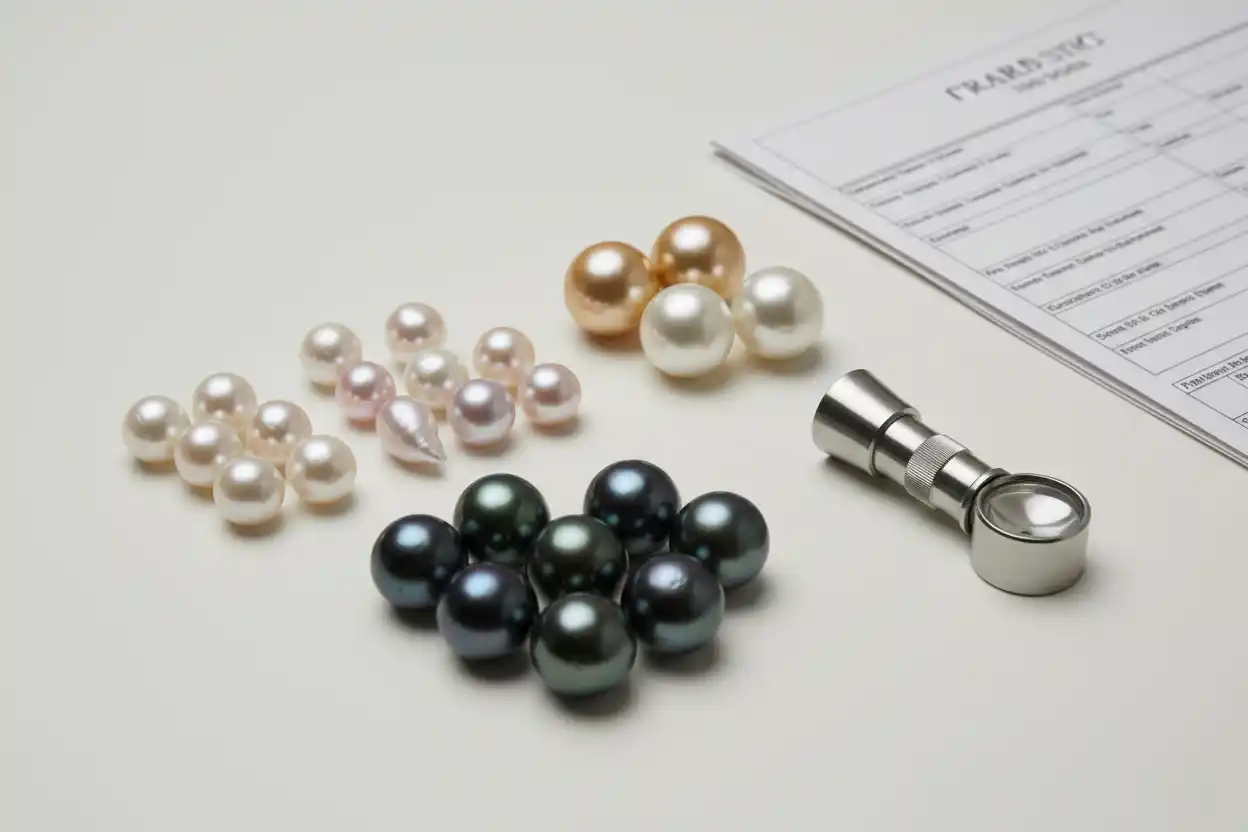
If you want to buy pearl jewelry, identify the pearl type first, then compare luster, surface quality, nacre, size, shape, color, and matching. Cultured pearls are real pearls, not imitations, and they make up most of the modern jewelry market. Freshwater, Japanese Akoya, Tahitian, and South Sea cultured pearls have different typical sizes, colors, production methods, rarity, and price ranges, so comparing them as though they were one product leads to poor buying decisions.
Current retail examples show the scale of the difference. An 8.0 to 8.5 mm freshwater strand can cost roughly $320 to $530 in current listings, while a 7.0 to 7.5 mm AAA Japanese Akoya strand is listed around $2,190. A 9.0 to 11.0 mm AAA Tahitian strand is around $6,190, and a 10.0 to 12.0 mm AAA golden South Sea strand is currently about $10,020. The pearl price therefore depends heavily on pearl type before individual quality differences are considered.
Know Whether You Are Buying Natural or Cultured Pearls
Natural pearls form without deliberate human intervention. Cultured pearls also form inside a living mollusk, but pearl farmers initiate the process through nucleation. Both can be genuine pearls.
Natural pearls are far less common in today’s jewelry market and can command major premiums when their identity, species, origin, size, shape, and quality are important. A seller asking natural-pearl prices should be able to support that description with respected laboratory documentation.
GIA Pearl Identification Reports can determine whether pearls are natural or cultured and whether they formed in saltwater or freshwater environments. This distinction is especially important with antique strands, unusual loose pearls, and expensive collector pieces.
The real vs fake pearl question should therefore distinguish natural pearls, cultured pearls, laboratory-created imitations, coated beads, and other products rather than calling every cultured pearl fake.
Start With Luster
GIA identifies seven pearl value factors: size, shape, color, luster, surface, nacre, and matching. Of these, luster is often considered the most visually important.
High-luster pearls produce bright, sharp reflections. Lower-luster pearls appear softer, hazier, chalkier, or duller. This difference can be obvious even before you notice minor surface marks.
Compare pearls under neutral daylight or bright diffused indoor light. Look at the reflection of a window, lamp, or your own outline on the surface. A high-quality pearl should create a crisp reflection rather than a vague glow.
The pearl quality grading should therefore put substantial emphasis on luster instead of relying only on a seller’s AAA or AAAA label.
Nacre Quality Affects Beauty and Durability
Nacre forms the visible pearl surface. GIA notes that nacre quality is closely tied to luster and durability.
Thin or poor nacre can produce a dull, chalky appearance. On some bead-cultured pearls, the underlying bead may even become visible when the nacre is insufficient.
Good nacre creates greater visual depth and usually supports stronger luster. This is particularly important with Akoya pearls, where bead nucleation and relatively compact sizes make nacre quality a central purchase factor.
Recent GIA updates also place greater attention on visible and subsurface nacre features that can affect durability, including cracks, pits, seams, and irregular surface structures.
Surface Marks Are Normal, but Severity Matters
Pearls grow inside living organisms, so perfectly smooth surfaces are uncommon. Small spots, bumps, wrinkles, or shallow abrasions can be normal.
GIA emphasizes that surface features reduce value more when they are numerous, severe, highly visible, or likely to affect durability. A few small marks near a drill hole may matter much less.
Inspect pearls under normal viewing distance first. A strand that looks clean and luminous without magnification can still be an excellent purchase even if a loupe reveals minor irregularities.
Large pits, cracks, peeling-looking areas, deep abrasions, or severe blemishing deserve more caution, especially when the seller is charging a top-quality premium.
Round Pearls Usually Cost More
Perfectly round pearls are difficult to produce consistently. GIA notes that round is generally the rarest cultured pearl shape and, all else being equal, the most valuable.
Near-round, oval, drop, button, circled, and baroque pearls can cost less, but they can also be beautiful and distinctive. Fine symmetrical drops and artistic baroque shapes have their own collector appeal.
Do not assume that a baroque pearl is low quality merely because it is not spherical. Shape should match the design and your preferences.
For a classic necklace, consistent roundness often carries a premium because the entire strand must be matched carefully.
Matching Is Crucial for Strands and Earrings
A strand should look harmonious rather than assembled from unrelated pearls.
GIA evaluates matching through size, shape, color, luster, surface appearance, and nacre. A well-matched strand requires substantial sorting because dozens of pearls need to look cohesive together.
This is one reason an excellent strand can cost much more than the combined price of ordinary loose pearls.
Matching also matters for earrings. Two individually attractive pearls may look noticeably different when worn together if one has warmer color, lower luster, different overtone, or a different shape.
Look at the whole piece before examining individual pearls.
Freshwater Pearls Offer Accessible Pricing
Freshwater cultured pearls, especially those from China, cover an enormous range from inexpensive fashion strands to highly lustrous, near-round premium pearls.
A current 7.5 to 8.5 mm AAA white freshwater strand is listed around $320, while a comparable AAAA example is around $340 in an active sale listing. Another specialist currently offers an 8.0 to 8.5 mm AAA white freshwater strand around $530.
These examples show why seller grades cannot be compared mechanically across stores. One retailer’s AAAA does not necessarily equal another retailer’s top grade.
Freshwater pearls can offer strong value because many have substantial nacre and are available in white, cream, peach, pink, lavender, and multicolor combinations.
Akoya Pearls Are Known for Crisp Luster
Japanese Akoya pearls are associated with classic white strands, relatively small to medium sizes, strong roundness, and sharp mirror-like luster.
A current AAA 7.0 to 7.5 mm Japanese Akoya strand is listed around $2,190. Larger sizes, better luster, stronger matching, cleaner surfaces, and premium brands can raise the price substantially.
Akoya pearls often show rose, silver, or cream overtones. Personal preference matters, but the best-looking strand should display strong luster consistently from pearl to pearl.
If a seller charges a major premium for Japanese origin or a specialized designation, ask what documentation supports that claim.
Tahitian Pearls Are Not Necessarily Black
Tahitian cultured pearls come primarily from French Polynesia and are produced by the black-lipped oyster.
GIA notes that the term black pearl can be misleading because many Tahitian pearls are actually gray, green, silver, pistachio, copper, or other dark tones. Some display peacock, purple, turquoise, rose, or green orient.
A current AAA 9.0 to 11.0 mm Tahitian strand is listed around $6,190. Current AAAA and unusual-color examples can cost substantially more.
Deep body color does not automatically create the highest value. Luster, overtone, orient, surface quality, roundness, size, and matching remain important.
South Sea Pearls Occupy the Large-Size Luxury Tier
South Sea cultured pearls are produced by large Pinctada maxima oysters and can reach sizes well above typical Akoya pearls.
White and golden South Sea pearls are prized for large size, satiny luster, thick nacre, and natural color. Current 10.0 to 12.0 mm AAA golden South Sea strands are listed around $4,840 to $10,020 depending on retailer and current promotional pricing.
Another current specialist collection lists top 10.0 to 12.0 mm golden and white South Sea strands above $13,000.
These examples demonstrate how strongly seller selection, grade, length, clasp, matching, and retail positioning influence the final jewelry price.
Current Pearl Strand Price Examples
The table below compares current retail asking prices rather than wholesale or resale figures.
| Current pearl jewelry example | Size | Seller quality label | Current asking price |
|---|---|---|---|
| White freshwater strand | 7.5 to 8.5 mm | AAA | $320 |
| White freshwater strand | 7.5 to 8.5 mm | AAAA | $340 sale price |
| White freshwater strand | 8.0 to 8.5 mm | AAA | $530 |
| Japanese Akoya strand | 7.0 to 7.5 mm | AAA | $2,190 |
| Tahitian strand | 9.0 to 11.0 mm | AAA | $6,190 |
| Golden South Sea strand | 10.0 to 12.0 mm | AAA | $10,020 |
These are not universal market prices. Strand length, clasp, retailer, promotional pricing, luster, surface, matching, nacre, roundness, and color can all move the final price significantly.
Seller Grades Are Not Universal
AAA, AAAA, A+, Hanadama, gem quality, premium, and similar terms may appear in pearl listings, but not all belong to one universal international grading scale.
GIA uses its own seven-factor classification system rather than assigning a simple overall AAA grade to every pearl.
This means comparing AAA from one retailer with AAA from another can be misleading. Read the seller’s actual definitions for luster, surface cleanliness, shape, nacre, and matching.
If those definitions are vague, compare photographs, return terms, and independent documentation rather than trusting the letter grade.
Treatment Disclosure Matters
GIA states that pearls may be bleached, dyed, coated, impregnated, or irradiated. Routine bleaching is widespread and is commonly used to improve color uniformity.
Dyeing is more important to disclose because it can create colors that buyers might otherwise assume are natural. Coatings and impregnation can also alter appearance.
A vivid blue, black, pink, green, or golden pearl should not automatically be assumed to have natural body color.
For expensive Tahitian, South Sea, or unusual-color pearls, treatment information can materially affect value. Laboratory testing becomes more useful when natural color is a major part of the price.
Check the Drill Holes
Drill holes provide a practical inspection point because layers and coatings may be easier to see near an opening.
Look for peeling, flaking, obvious color concentration, large chips, or severe damage around the hole.
Good drilling should look clean and controlled rather than rough or oversized.
Do not rely on drill-hole inspection alone to determine authenticity. Sophisticated imitations can look convincing, and high-value pearls deserve professional testing rather than home experiments.
Avoid Destructive Home Tests
The popular tooth test is not a dependable substitute for gemological identification and can abrade delicate surfaces.
Pearl has a Mohs hardness of only about 2.5, so rubbing it against teeth, metal, glass, or other objects creates unnecessary risk.
The gemstone certification process is far more appropriate when natural versus cultured origin, treatment, or rarity affects price.
For ordinary cultured strands, a reputable retailer, clear quality description, strong return policy, and realistic pricing are usually more practical than aggressive home testing.
Care Requirements Should Influence Your Purchase
Pearls are much softer than most faceted gems and can be damaged by acids, perfume, cosmetics, hair products, heat, and abrasion.
GIA recommends putting pearls on after cosmetics and perfume and wiping them with a soft cloth after wear. Warm soapy water can be used for occasional cleaning, but ultrasonic and steam cleaners should be avoided.
A necklace also needs periodic restringing because silk or thread stretches over time.
If you are buying an older strand, inspect both the pearls and the string. A valuable necklace with weak thread may need restringing before regular use.
Think Carefully About Resale
Pearl retail price includes sorting, matching, drilling, stringing, clasps, branding, store margin, and presentation.
Common cultured pearls often resell below original retail because buyers can choose from large amounts of new inventory.
Fine natural pearls, exceptional South Sea strands, important signed jewelry, rare natural-color examples, and historically significant pieces can behave differently.
Whether gemstones hold value depends heavily on what was bought, the original price, documentation, condition, brand, and eventual selling channel.
Personal Meaning Is Separate From Pearl Quality
The pearl meaning includes long cultural associations with purity, elegance, wisdom, status, and celebration. Those traditions can add personal significance without determining commercial grade.
The pearl benefits described in personal traditions are also separate from value assessment. Price should remain tied to identity, pearl type, luster, nacre, surface, shape, size, color, matching, treatment, condition, and documentation.
FAQs
Are cultured pearls real pearls?
Yes. Cultured pearls grow inside living mollusks after human-assisted nucleation. They are genuine pearls, not imitation beads.
Which pearl type is most expensive?
Fine South Sea and Tahitian strands can be expensive, while exceptional natural pearls can reach much higher collector values. Individual quality matters more than type alone.
What is the most important pearl quality factor?
GIA considers luster one of the most important factors because it strongly affects a pearl’s beauty.
Are freshwater pearls good quality?
They can be. Fine freshwater pearls can have excellent luster, thick nacre, attractive shape, and strong matching.
Why do Akoya pearls cost more than many freshwater pearls?
High-quality Akoya strands combine sharp luster, consistent roundness, matching, controlled sizes, and established Japanese production.
Are Tahitian pearls naturally black?
Most are actually gray or other dark tones rather than pure black. Green, peacock, silver, pistachio, and other colors are common.
Why are South Sea pearls expensive?
They grow in large oysters, reach substantial sizes, and fine round examples with strong luster and clean surfaces are difficult to produce.
Are AAA pearl grades universal?
No. Retailer letter grades can differ. Compare the underlying luster, surface, nacre, shape, color, size, and matching.
Can pearls be dyed?
Yes. Pearls can be dyed, coated, irradiated, impregnated, or otherwise processed. Treatment should be disclosed when it affects appearance and value.
How should pearls be cleaned?
Use a soft cloth after wear and occasional warm soapy water. Avoid steam, ultrasonic cleaning, harsh chemicals, and abrasive rubbing.
Conclusion
To buy pearl jewelry confidently, identify the pearl type first and then compare luster, nacre, surface, shape, size, color, and matching. Current strands range from a few hundred dollars for good freshwater pearls to several thousand dollars for fine Akoya and Tahitian strands and well above $10,000 for some South Sea examples. Cultured pearls are genuine, seller grades are not universal, and treatment, documentation, condition, clasp quality, and return terms all deserve attention.