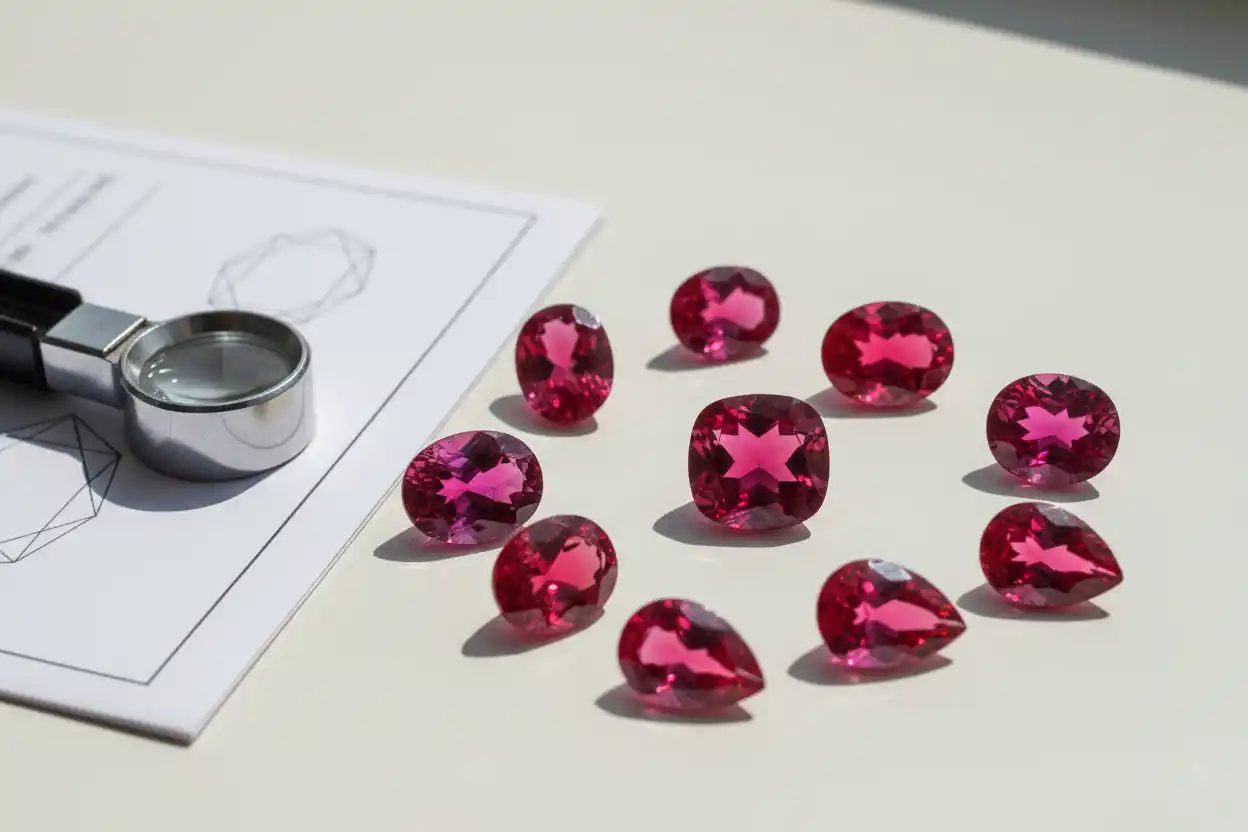
Buy Rubellite: Buyer Priorities, Color, Clarity & Value
To buy rubellite successfully, prioritize rich attractive red-to-pink-red color, brightness, transparency, sensible inclusion tolerance, competent cutting, size, treatment disclosure, and correct identification as tourmaline rather than relying on the word rubellite as though it were a separate mineral species. GIA defines rubellite as a trade name used for pink, red, purplish-red, orangy-red, or brownish-red tourmaline, while acknowledging that some dealers prefer to reserve the term for the stronger red end of the range rather than ordinary pink tourmaline. This lack of a universally rigid boundary makes actual face-up color more important than the label itself. A vivid raspberry-red stone can deserve a substantial premium, whereas weak pink, brownish-red, or excessively dark material should not command top rubellite pricing merely because the seller uses the name.
Color is the leading tourmaline quality factor, and GIA identifies the pink-to-red rubellite category as one of the most sought-after and broadly available commercial colors. Rubellite also requires more realistic clarity expectations than green or blue tourmaline because red and pink material often forms with liquid-rich inclusions, growth tubes, and healed fractures. GIA notes that dealers commonly tolerate some eye-visible inclusions in red tourmaline when the color is strong, while prominent whitish inclusions and surface-reaching features reduce marketability. A buyer should therefore balance clarity against color rather than reject every included stone or accept severe damage simply because vivid rubellite is naturally more included.
Buy Rubellite At a Glance
| Buying Factor | What to Examine | Why It Matters |
|---|---|---|
| Identity | Natural tourmaline correctly sold as rubellite | Ruby, spinel, garnet, glass, and other red stones can resemble it |
| Color | Vivid red, pink-red, raspberry, purplish-red | Color is the main quality factor |
| Brown Modifier | Minimal unattractive brown | Brown can weaken the vivid rubellite appearance |
| Tone | Medium to medium-dark while retaining brightness | Excessive darkness can make the gem look blackish |
| Saturation | Strong lively red or pink-red | Weak saturation reduces the premium |
| Clarity | Some eye-visible inclusions can be acceptable | Rubellite commonly contains more inclusions than green/blue tourmaline |
| Surface-Reaching Fractures | Inspect carefully | They can reduce polish, durability, and value |
| Cut | Even brilliance, color orientation, minimal windowing | Cutting can strengthen or weaken red color dramatically |
| Pleochroism | Face-up color should remain attractive | Tourmaline can show different colors by direction |
| Size | Larger fine stones become more selective | Tourmaline pricing can rise as fine stones become larger |
| Treatment | Ask about heating, irradiation, and fracture filling | Treatments occur in the tourmaline market |
| Color Stability | Treatment history matters | Irradiation-induced color can respond to heat or bright light |
| Origin | Brazil, Madagascar, Afghanistan and other sources | Source can interest collectors but usually ranks below quality |
| Durability | Mohs 7–7.5, fair toughness | Suitable for jewelry but vulnerable to thermal shock |
| Report | Independent identification for major purchases | GIA identifies natural/lab-grown status and detectable treatments |
Rubellite Is a Trade Variety of Tourmaline
Rubellite is not a separate mineral species from tourmaline. GIA lists it among tourmaline’s trade color names and applies the term broadly to pink, red, purplish-red, orangy-red, and brownish-red material while noting disagreement about whether lighter pink tourmaline should qualify. This ambiguity means a buyer should not assume that every seller applies the word identically.
In practice, the strongest rubellite market is centered on stones that look decisively red, raspberry, rich pink-red, or purplish-red rather than weak pastel pink. A buyer comparing prices should therefore look at the gem first and the variety label second.
Strong Red-to-Pink-Red Color Drives the Highest Demand
GIA describes bright pure red tones as among the most valued tourmaline colors and recognizes rubellite as one of the gem’s most sought-after varieties. Fine material can approach the visual range of ruby and pink sapphire, which explains much of rubellite’s appeal as a more accessible large red gemstone.
The best stone should remain visibly red or raspberry rather than becoming muddy brown, dull gray, or nearly black in ordinary lighting. Highly saturated color needs enough brightness to show through the gem rather than being trapped in heavy extinction.
Raspberry and Purplish-Red Can Be Especially Attractive
Rubellite does not need to imitate ruby exactly. Purplish-red, raspberry, wine-red, and strong pink-red stones can have a distinctive identity that separates them from ruby, spinel, and garnet.
A purple modifier can create a lively magenta or raspberry effect, while too much violet can push the gem toward ordinary purple tourmaline. The market boundary is subjective enough that color should be evaluated visually rather than by the descriptive adjective alone.
The Gems Lore rhodolite garnet price guide offers a useful comparison because rhodolite can occupy similar raspberry and purplish-red territory but belongs to an entirely different mineral group with different inclusion and treatment expectations.
Brown Can Reduce Rubellite Appeal
GIA’s rubellite definition includes brownish-red tourmaline, but inclusion in the definition does not mean all brown modifiers are equally desirable. Stones that become strongly brown or brick-like usually lose the vivid red quality buyers associate with top rubellite.
A slightly warm orangy-red stone can still be attractive, particularly when bright and saturated. The discount becomes more significant when brown combines with excessive darkness and weak brilliance.
Tone Must Be Balanced With Saturation
Dark tone can make red appear richer in a static photograph while producing broad black extinction in normal wear. A fine rubellite should therefore carry substantial color without appearing dead.
This balance becomes particularly important in larger stones because extra depth can intensify both red color and darkness. Buyers should compare face-up performance under neutral lighting and rotate the stone slowly to see whether black areas move dynamically or remain fixed across much of the gem.
Rubellite Commonly Has More Inclusions Than Green and Blue Tourmaline
GIA states that pink and red tourmaline often contains more visible inclusions than green-to-blue varieties and explains that tourmaline crystals commonly trap liquid-rich cavities during growth. Thread-like liquid inclusions, growth tubes, healed fractures, and related features can therefore be expected more often in rubellite than in some cleaner tourmaline colors.
This is one reason strict diamond-style clarity grading is inappropriate. A vivid rubellite with modest inclusions can be substantially more valuable than an eye-clean stone whose color is pale or brown.
Some Eye-Visible Inclusions Are Commercially Accepted
GIA specifically notes that dealers usually tolerate some eye-visible inclusions in red tourmaline as long as the color is strong and attractive. This makes rubellite a good example of why gemstone clarity standards must be variety specific.
The buyer should judge how much the inclusion interferes with beauty. A thin healed fissure visible only at certain angles is different from a broad white reflective fracture crossing the center of the table.
Whitish Inclusions Are More Detrimental
GIA notes that prominent whitish inclusions are undesirable in tourmaline even when the color is vivid. They can interrupt transparency, create distracting reflections, and make the gemstone look cloudy or damaged.
Dark color can conceal small liquid inclusions effectively, while pale or bright red stones may reveal them more clearly. The buyer should therefore inspect the gem under diffuse light as well as spotlighting.
Surface-Reaching Fractures Need Particular Attention
GIA explains that surface-reaching inclusions interfere with luster and polish and make tourmalines harder to sell. They can also create practical durability concerns, particularly near the girdle, corners, or prongs where stress concentrates.
This distinction is more important than simply counting inclusions. Several fully enclosed internal features can be less problematic than one large fissure opening at the surface.
Fracture Filling Has Been Used on Rubellite
GIA has documented clarity enhancement of tourmaline using oils and resins and specifically shows rubellite before and after filling, with the treatment reducing the visibility of surface-reaching fissures. This means a cleaner-looking rubellite is not necessarily naturally cleaner, particularly when significant fissures are present.
Fracture filling should be disclosed because it affects value and care. A filled gem can still be beautiful and saleable, but it belongs in a different comparison category from a naturally cleaner untreated stone.
Heating and Irradiation Matter in the Tourmaline Market
GIA identifies heating and irradiation as the two most important tourmaline color treatments. Heat-induced changes are stable and can be undetectable, while irradiation-induced color can fade with exposure to heat or bright light. These treatment realities make unsupported “completely untreated” premiums difficult to accept without evidence, particularly because some processes cannot always be detected afterward.
A seller should disclose known treatment honestly and avoid implying that every natural rubellite is necessarily untreated simply because no obvious evidence is visible.
Treatment Does Not Automatically Make Rubellite Poor Quality
A heated or irradiated tourmaline can retain genuine tourmaline identity and attractive color. The value question concerns disclosure, stability, rarity, and market expectations rather than a simple treated-equals-bad rule.
The more expensive the stone, the more useful an independent report becomes because identification and detectable treatment information reduce uncertainty. GIA’s Colored Stone Identification Report identifies whether submitted tourmaline is natural or laboratory-grown and names detectable treatments, although GIA does not issue an overall tourmaline quality grade.
Cut Quality Has a Major Effect on Rubellite Beauty
GIA advises tourmaline buyers not to compromise on cut because poor cutting makes gems substantially less marketable. For rubellite, pavilion angles, orientation, depth, and pleochroism can determine whether a crystal displays lively raspberry-red color or becomes too dark.
A cutter may choose an elongated emerald, rectangular cushion, oval, pear, round, or custom shape depending on rough morphology. Tourmaline crystals are often elongated, which naturally encourages rectangular cuts, but the finished stone should still return light evenly across most of the face.
Windowing Weakens a Color-Driven Premium
A shallow rubellite can show a large transparent window through the center, causing the background or wearer’s skin to become visible. This reduces saturation precisely where the viewer expects the strongest red.
A deeper stone can restore color but may hide significant carat weight beneath the girdle and increase extinction.
The best value balances strong color with efficient visible dimensions rather than maximizing weight.
Pleochroism Can Help or Complicate Cutting
Tourmaline is strongly pleochroic, meaning different crystal directions can show different color intensity or hue. Skilled orientation allows the cutter to select the direction producing the most attractive face-up red while avoiding excessive darkness.
This is one reason rubellite rough cannot be valued solely through a photograph of the crystal exterior. The finished stone may display a noticeably different balance of pink, red, purple, and brown depending on orientation.
Larger Fine Tourmaline Can Rise Significantly in Per-Carat Value
GIA states that for fashioned tourmalines of similar color and clarity, per-carat prices generally increase as gems move beyond approximately five carats because fine facet-quality rough becomes less available. Rubellite can occur in impressive sizes, so the increase is not a fixed rarity explosion, but fine large stones combining vivid color, transparency, manageable inclusions, and good cutting are genuinely more selective.
A large included dark stone should not receive the same multiplier as a bright clean rubellite merely because both cross a carat threshold.
Brazil Is a Major Rubellite Source
Brazil has long produced substantial tourmaline, and GIA documents the Cruzeiro mine in Minas Gerais as a major source of red and pink tourmaline, including significant quantities of clean rubellite. Brazilian rubellite can therefore be both historically important and commercially significant.
The source name alone should not create a strong premium because Brazil has produced a broad quality range. Color, clarity, cutting, size, and condition remain more important for most jewelry purchases.
Madagascar and Afghanistan Have Produced Fine Red Tourmaline
GIA identifies Madagascar and Afghanistan among sources known for fine red tourmaline. These origins can interest collectors and dealers, particularly when a stone has strong provenance or unusually fine color.
A seller should not infer origin from color alone. Fine red material can come from more than one country, and visual appearance cannot reliably identify a mine.
Pink California Tourmaline Has Historical Importance
California’s tourmaline deposits became famous for pink material, much of which was exported to China during the late nineteenth and early twentieth centuries. GIA notes the historical enthusiasm for pink tourmaline among Chinese consumers and collectors.
Documented antique California material can therefore have provenance value beyond routine loose-gem pricing, particularly when preserved in historic jewelry or mineral specimens.
Rubellite Versus Pink Tourmaline Is Not a Perfectly Fixed Boundary
GIA explicitly notes disagreement within the trade about whether the word rubellite should apply to pink tourmaline or be reserved for redder material. Buyers should therefore be cautious when one seller prices a pale pink stone as rubellite while another labels an almost identical stone pink tourmaline.
The solution is not to argue over the name but to compare actual hue, saturation, tone, clarity, cut, size, and treatment. Stronger red generally attracts more demand regardless of the precise label.
Rubellite Versus Rhodolite Garnet
Rubellite and rhodolite can overlap visually in raspberry and purplish-red colors, but their mineral identities and clarity standards differ. Gems Lore’s buy rhodolite garnet guide explains why rhodolite is generally expected to be eye-clean, while rubellite can retain substantial value despite inclusions when the red color is exceptional.
The Gems Lore rhodolite garnet price guide also illustrates why garnet’s treatment landscape is simpler than the heating, irradiation, and fracture-filling issues present in tourmaline.
Rubellite Versus Ruby
Fine rubellite can approach ruby-like red appearance, but ruby belongs to corundum, has Mohs hardness 9, and follows a much more intense rarity, origin, treatment, and auction market. Gems Lore’s buy ruby guide and ruby price guide provide the appropriate comparison.
Rubellite often allows buyers to obtain a larger vivid red gemstone for substantially less money than fine ruby while retaining strong color and good everyday durability.
Rubellite Versus Red Spinel
Red and pink spinel can also overlap visually with rubellite, but spinel’s inclusion patterns, refractive behavior, durability, and value structure differ. GIA notes that fine red and pink spinel has become increasingly sought after, so identity should never be assumed solely from color.
An independent gemological report becomes useful when a high-value red stone is being sold with limited provenance.
Rubellite Versus Paraíba Tourmaline
Both are tourmalines, but the market premiums arise from different color chemistry and supply. Gems Lore’s buy Paraiba tourmaline guide and Paraiba tourmaline price guide cover copper-bearing electric blue-to-green material, whereas rubellite is valued for strong pink-to-red color.
GIA identifies both as highly desirable tourmaline varieties but notes that exceptional Paraíba occupies its own extreme price class.
Rubellite Versus Indicolite
Gems Lore’s buy indicolite guide and indicolite price guide cover blue tourmaline rather than red. Both varieties share tourmaline’s general durability and growth characteristics, but color demand and inclusion tolerance can differ.
This comparison is useful because GIA notes that pink-to-red tourmaline is generally more included than many green-to-blue examples.
Rubellite Is Durable Enough for Most Jewelry
Tourmaline measures approximately 7–7.5 on the Mohs scale with fair toughness. GIA states that it is generally stable to light and chemicals but warns that high heat can alter color and sudden thermal shock can cause fracturing.
Rubellite is therefore suitable for rings, earrings, pendants, and bracelets when sensible care is used. Highly included stones deserve extra protection because fractures and liquid inclusions can reduce resistance to impact or heat.
Warm Soapy Water Is the Best Cleaning Method
GIA recommends warm soapy water and advises against ultrasonic and steam cleaning for tourmaline. This conservative method is especially appropriate for rubellite because surface-reaching fractures, liquid inclusions, fracture filling, or treatment history may not always be obvious to the owner.
A jeweler performing repair work should know the stone is tourmaline before applying significant heat.
GIA Does Not Grade Rubellite AAA
GIA evaluates tourmaline but does not issue an overall quality grade. Its Colored Stone Identification Report can record weight, measurements, shape, cutting style, color, natural-versus-laboratory-grown status, and detectable treatments. AAA, AAAA, royal rubellite, investment red, or pigeon-red tourmaline are therefore seller-defined descriptions rather than universal laboratory grades.
A useful purchase compares actual color, clarity, cut, size, treatment, condition, and provenance rather than relying on proprietary labels.
Common Red Flags When You Buy Rubellite
Warning signs include weak pink tourmaline priced as elite rubellite solely because of the name, very dark material photographed only under intense lighting, severe whitish inclusions hidden through editing, surface-reaching fractures not shown from the side, fracture filling omitted from disclosure, guaranteed unheated or unirradiated status without a credible basis, Brazilian or Afghan origin inferred only from color, large windows hidden by dark backgrounds, excessive pavilion depth inflating carat weight, ruby comparisons used to imply equivalent rarity, and AAAA presented as an official laboratory grade. GIA’s guidance instead places the emphasis on color, inclusion type, cut, size, treatment, and correct tourmaline identification.
How to Compare Rubellite Listings Fairly
Compare stones by natural tourmaline identity, hue, tone, saturation, red-versus-pink balance, brown or purple modifiers, eye-visible inclusions, whitish fractures, surface-reaching features, fracture filling, heat or irradiation disclosure, cut, windowing, extinction, face-up dimensions, carat weight, origin evidence, condition, laboratory report, setting craftsmanship, and return rights. A vivid Brazilian eight-carat raspberry rubellite, pale pink tourmaline, heavily fractured red stone, fracture-filled gem, rhodolite garnet, ruby, and synthetic red imitation should never be reduced to one generic rubellite price comparison.
Conclusion
To buy rubellite well, prioritize vivid face-up red-to-pink-red color and enough brightness to keep the gemstone lively. GIA describes rubellite broadly as pink, red, purplish-red, orangy-red, or brownish-red tourmaline, while acknowledging that trade opinions differ over where ordinary pink ends and rubellite begins. This makes actual color quality more important than the name printed on the invoice.
Clarity should be judged realistically because red tourmaline commonly contains more visible inclusions than many green or blue tourmalines, and GIA notes that dealers tolerate some inclusions when the color is outstanding. Surface-reaching fissures, prominent whitish inclusions, and fracture filling deserve more scrutiny because they affect appearance, durability, and value.
Treatment and cutting complete the buying picture. Tourmaline may be heated or irradiated, treatment may not always be obvious, and excessive depth or windowing can substantially weaken visual performance. The strongest purchase therefore combines compelling red color, appropriate clarity, lively cut, efficient size, sound condition, transparent treatment disclosure, and a price based on the individual gemstone rather than an undefined rubellite grade.
Frequently Asked Questions
What color qualifies as rubellite?
GIA uses rubellite for pink, red, purplish-red, orangy-red, or brownish-red tourmaline, while noting that some dealers believe lighter pink material should simply be called pink tourmaline.
What rubellite color is usually most desirable?
Strong vivid red, raspberry-red, pink-red, and purplish-red colors with good saturation and enough brightness to avoid black extinction generally receive strong demand. Color is the most important tourmaline quality factor.
Is rubellite the same as ruby?
No. Rubellite is tourmaline, while ruby is chromium-bearing red corundum. They differ in chemistry, hardness, refractive properties, rarity, treatment, and market value.
Is rubellite usually eye-clean?
Not always. GIA states that red and pink tourmalines commonly contain more visible inclusions than green-to-blue varieties and that some eye-visible inclusions are commercially tolerated when color is strong.
Do inclusions always lower rubellite value?
No. Minor inclusions can be acceptable, but prominent whitish inclusions and surface-reaching fractures can reduce transparency, polish, durability, and marketability.
Can rubellite be fracture filled?
Yes. GIA has documented oils and resins used to fill surface-reaching fissures in rubellite and other valuable tourmalines.
Can rubellite be heat treated?
Tourmaline can be heat treated, and GIA notes that heat-related color changes can be stable and undetectable.
Can rubellite be irradiated?
Yes. Irradiation is one of the principal tourmaline color treatments, and GIA notes that irradiation-induced color can fade with heat or bright light.
Where does fine rubellite come from?
Brazil is an important producer, while GIA also identifies Madagascar and Afghanistan as sources of fine red tourmaline.
Does Brazilian origin make rubellite more valuable?
Not automatically. Brazil produces a broad range of qualities, so color, clarity, cut, size, treatment, and condition normally matter more than the country name alone.
Does rubellite become more expensive above five carats?
GIA notes that for fashioned tourmalines of similar color and clarity, per-carat prices generally increase as size moves beyond about five carats because fine facet-quality rough becomes less available. The effect still depends heavily on variety and quality.
How hard is rubellite?
As tourmaline, rubellite measures approximately Mohs 7–7.5 and has fair toughness.
How should rubellite be cleaned?
GIA recommends warm soapy water and advises against steam and ultrasonic cleaning.
Does GIA grade rubellite AAA?
No. GIA evaluates tourmaline but does not assign an overall AAA-style quality grade.
Is rubellite a guaranteed investment?
No. Fine large vivid stones can be collectible, but future value depends on color, size, treatment, condition, provenance, demand, transaction costs, and resale liquidity.