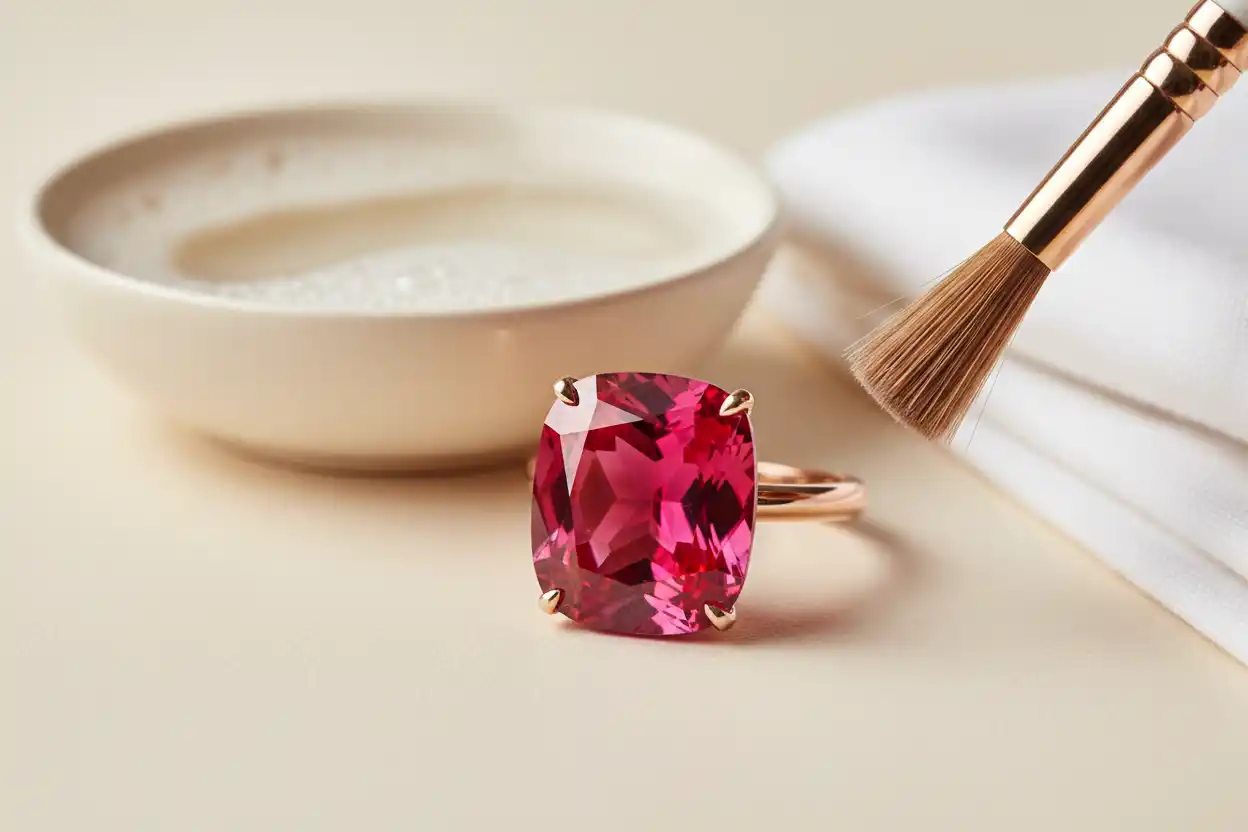
How to Clean Rubellite Jewelry Safely
Rubellite jewelry should be cleaned with lukewarm water, mild liquid soap, and a soft-bristled brush. Ultrasonic and steam cleaners should be avoided because Tourmaline may contain liquid inclusions, internal stress, or surface-reaching fractures that can react badly to vibration, pressure, heat, and sudden temperature changes.
Rubellite has enough surface hardness for many jewelry designs, but it is not as structurally forgiving as Sapphire, Ruby, Spinel, or Diamond. Gentle manual cleaning restores its red-to-pink brilliance without placing the gemstone, treatment, or setting under unnecessary stress.
Why Rubellite Requires Tourmaline-Specific Care
Rubellite is the red, purplish-red, pinkish-red, or raspberry-colored variety of Tourmaline. Fine stones retain a strong red appearance under different lighting rather than shifting toward pale pink or brown.
Its mineralogy, color, sources, and symbolic background belong to the broader Rubellite guide. The larger mineral family is covered in the Tourmaline guide and Types of Tourmaline.
Most Rubellite belongs to the elbaite species, although Tourmaline chemistry varies continuously. It commonly rates approximately 7 to 7.5 on the Mohs scale and has fair toughness.
| Property | Cleaning implication |
|---|---|
| Mineral group | Tourmaline |
| Common species | Elbaite |
| Typical colors | Red, purplish red, raspberry red, or pinkish red |
| Mohs hardness | Approximately 7 to 7.5 |
| Toughness | Fair |
| Cleavage | Indistinct |
| Safest routine cleaning | Lukewarm water, mild soap, and a soft brush |
| Ultrasonic cleaning | Avoid |
| Steam cleaning | Avoid |
| Main risks | Liquid inclusions, fractures, heat, thermal shock, treatments, and setting wear |
The gemstone hardness chart explains why Rubellite resists ordinary scratches better than softer ornamental materials.
However, scratch resistance does not measure resistance to impact or thermal stress. That distinction appears in Gemstone Toughness vs Hardness and Gemstone Cleavage Explained.
Liquid Inclusions and Fractures Matter
Tourmaline commonly grows in fluid-rich pegmatitic environments. Finished stones may contain liquid inclusions, growth tubes, healed fractures, veils, crystals, and fingerprints.
Some of these features are fully enclosed and stable. Others reach the surface or hold fluids that can expand when heated.
An inclusion cannot be removed through cleaning. Likewise, pushing a brush into a visible fissure will not improve clarity and may increase the risk of damage.
Because internal features can be difficult to see without magnification, Rubellite should not be placed into an ultrasonic or steam cleaner merely because it appears eye-clean.
Rubellite Color Is Not Surface Dirt
Rubellite can look noticeably different under daylight, warm indoor bulbs, cool LEDs, or shaded conditions.
A stone may appear raspberry red in daylight but show more purple, pink, or brown under another source. Cleaning removes surface film but cannot change its fundamental hue, tone, saturation, pleochroism, or cutting orientation.
Dark areas may result from extinction or a deep cut rather than dirt. Meanwhile, pale zones can reflect natural color zoning.
Therefore, evaluate the jewel under several neutral lighting conditions before deciding that stronger cleaning is necessary.
Heat and Irradiation Treatments
Tourmaline may be heated or irradiated to improve color. Some Rubellite and pink Tourmaline is irradiated, while heating may reduce unwanted brown or purple components.
Color produced through irradiation can be sensitive to high heat and, in some cases, prolonged intense light.
Routine lukewarm washing does not threaten stable treated color. However, a jeweler should know the treatment history before soldering, retipping prongs, resizing, or applying a torch near the stone.
The broader enhancement categories belong to Gemstone Treatments Explained.
Do not test treatment by exposing Rubellite to heat, strong light, solvents, or scratching.
Inspect the Jewel Before Cleaning
Examine the Rubellite beneath bright, indirect light. Look for loose prongs, movement in the stone, chipped facet edges, thin girdles, open fractures, missing accent stones, and damaged metal.
Rubellite rough can be elongated, so many finished stones are cut as ovals, cushions, emerald cuts, pears, and elongated rectangles. Long sides, corners, and pointed ends deserve close inspection.
Gently touch the stone without twisting it. A click or visible shift indicates that the setting requires repair before washing.
Do not clean a jewel at home when a fissure reaches the surface, the stone moves, or a prong catches against fabric.
Prepare a Safe Cleaning Solution
Fill a shallow bowl with lukewarm water and add a few drops of mild liquid dish soap.
Prepare a second bowl of clean water at approximately the same temperature. Keeping wash and rinse temperatures similar reduces thermal stress.
Use a clean, soft-bristled toothbrush, jewelry brush, or soft makeup brush. Keep a lint-free cloth nearby for drying.
Do not clean over an uncovered drain. A loose accent stone or lightweight earring can disappear during rinsing.
Avoid bleach, abrasive particles, strong acids, aggressive alkaline products, and concentrated degreasers.
Clean Rubellite Gently
Place the jewel briefly in the mild solution or hold it securely over the bowl.
Brush around the crown, girdle, pavilion, gallery, prongs, bezel, and lower setting openings. Residue beneath a transparent Rubellite can make its red color look darker or less lively.
Use minimal pressure near visible inclusions, fractures, corners, and pointed ends.
Do not insert pins or metal tools beneath the gemstone. These can bend prongs, scratch the mounting, or push against the girdle.
A short cleaning period is sufficient. Prolonged soaking offers little benefit and may affect filler, glue, enamel, plating, repairs, or companion gemstones.
Rinse and Dry Without Heat
Rinse the jewelry in the second bowl of clean lukewarm water.
Blot it with a lint-free cloth and allow moisture beneath the setting to evaporate naturally.
Do not use a hair dryer, radiator, heated cabinet, steam jet, hot display lamp, or sunny windowsill.
Once dry, inspect every prong and accent setting again. A raised metal edge or moving stone needs professional attention.
Never Use an Ultrasonic Cleaner
Rubellite should not enter an ultrasonic cleaner.
Vibration can stress liquid inclusions, enlarge fractures, loosen pavé stones, and expose a weakened setting.
Ultrasonic machines may also warm their cleaning solution, creating another risk for inclusion-rich or treated Tourmaline.
The wider machine-safety comparison belongs to Which Gemstones Can Go in an Ultrasonic Cleaner?.
Never Steam Clean Rubellite
Steam combines concentrated heat, pressure, and rapid temperature change.
These conditions may fracture Tourmaline, especially when liquid inclusions or surface-reaching fissures are present. Heat may also affect irradiated color, glue, solder, enamel, and companion stones.
Lukewarm manual cleaning removes ordinary residue without those risks.
Cleaning a Rubellite Ring
Rubellite rings accumulate lotion, sanitizer, soap, and cosmetics around the lower facets.
Brush through the gallery openings without pressing against the girdle. Inspect pointed ends and corner prongs closely.
Remove the ring before household cleaning, exercise, gardening, swimming, bathing, and heavy manual work.
Although the tracker does not assign a dedicated Rubellite ring page, the wider Tourmaline ring guide covers setting profiles and wearability across the family.
Cleaning Rubellite Earrings
Rubellite earrings usually face less impact than rings but collect cosmetics and hair products.
Clean posts, hooks, backs, baskets, and hinges separately. Keep alcohol-based disinfectant on compatible metal fittings and away from the gemstone, filler, coating, glue, and plating.
The wider family styling considerations appear in the Tourmaline earrings guide.
Dry screw backs and push backs completely before storage.
Cleaning a Rubellite Necklace
A Rubellite necklace or pendant may develop residue from perfume, sunscreen, lotion, and skin contact.
Apply cosmetics before putting on the jewel and allow them to dry.
Prevent the chain from rubbing across exposed facets during cleaning and storage. Support a large pendant by its setting.
The Tourmaline necklace guide covers pendant construction and wearing considerations across different Tourmaline varieties.
Cleaning a Rubellite Bracelet
A Rubellite bracelet combines multiple settings with repeated wrist movement and impact.
Support the bracelet while cleaning and work on one section at a time. Inspect every stone, link, hinge, and clasp after rinsing.
Remove it before desk work or activities that repeatedly bring the wrist against hard surfaces.
The broader Tourmaline bracelet guide owns family-wide bracelet construction and buying considerations.
Rubellite Versus Pink Tourmaline
Rubellite and pink Tourmaline overlap in color and mineral composition, but Rubellite is generally reserved for stronger red, purplish-red, or saturated raspberry material.
The tracker’s Pink Tourmaline guide owns the broader pink-color profile.
Cleaning cannot establish whether a seller’s Rubellite designation is commercially justified. That conclusion depends on stable color, tone, saturation, identity, and market convention.
Rubellite Versus Paraíba and Watermelon Tourmaline
Rubellite shares the same family with Paraíba and Watermelon Tourmaline, but their color origins, zoning, inclusions, value factors, and cutting priorities differ.
The sibling physical-care workflows belong to How to Clean Paraiba Tourmaline Jewelry Safely and How to Clean Watermelon Tourmaline Jewelry Safely.
The general family workflow appears in How to Clean Tourmaline Jewelry Safely.
All require protection from high heat, steam, ultrasonic vibration, and abrupt temperature changes.
Buying, Price, and Documentation
The Rubellite buying guide covers stable red color, tone, saturation, clarity, cut, size, treatment, and setting quality.
Market factors belong to the Rubellite price guide.
The broader family context appears in the Tourmaline buying guide and Tourmaline price guide.
A laboratory report may identify Tourmaline species or variety and disclose detectable treatment. The tracker’s gemstone certification guide and How to Read a Gem Lab Report explain those documents.
Rubellite belongs to the Tourmaline family associated with October, covered in the October birthstone guide.
Frequently Asked Questions
1. What is the safest way to clean Rubellite?
Use lukewarm water, mild liquid soap, and a soft brush, then rinse and dry it naturally.
2. Can Rubellite get wet?
Brief washing is normally safe for a sound stone. Avoid prolonged soaking when fractures, filler, glue, coatings, or delicate settings are present.
3. Can Rubellite go in an ultrasonic cleaner?
No. Vibration may damage liquid inclusions, fractures, thin girdles, and weakened settings.
4. Can Rubellite be steam cleaned?
No. Steam introduces heat and thermal shock that can fracture Tourmaline or affect treated color.
5. Is Rubellite commonly treated?
Some Rubellite and pink Tourmaline is heated or irradiated to improve color, although treatment varies among stones.
6. Does treatment change the cleaning method?
Warm-soapy-water cleaning remains appropriate, but treated stones should be protected from high heat and intense light.
7. Is dish soap safe for Rubellite?
A few drops of mild liquid dish soap are suitable. Avoid bleach, abrasives, acids, and aggressive degreasers.
8. Can toothpaste polish Rubellite?
No. Toothpaste can scratch the setting, wear facet edges, and leave residue beneath the gemstone.
9. Why does Rubellite look darker indoors?
Warm lighting, deep tone, extinction, inclusions, or residue beneath the pavilion may reduce brightness.
10. Is Rubellite the same as pink Tourmaline?
Both belong to Tourmaline, but Rubellite generally describes stronger, more stable red-to-raspberry material.
11. How often should Rubellite jewelry be cleaned?
Wipe it after wear and wash it when oils or cosmetics visibly reduce its brilliance.
12. When should Rubellite receive professional care?
Professional care is appropriate for visible fractures, liquid inclusions, loose pavé, high-value stones, thin girdles, or unexplained color changes.
Conclusion
Rubellite’s saturated red color can make surface film and dark pavilion residue especially noticeable. Lukewarm soapy water restores its brightness without exposing liquid inclusions or treated color to heat and vibration. When the stone remains dark after cleaning, its tone, cut, inclusions, and lighting should be evaluated before any stronger method.