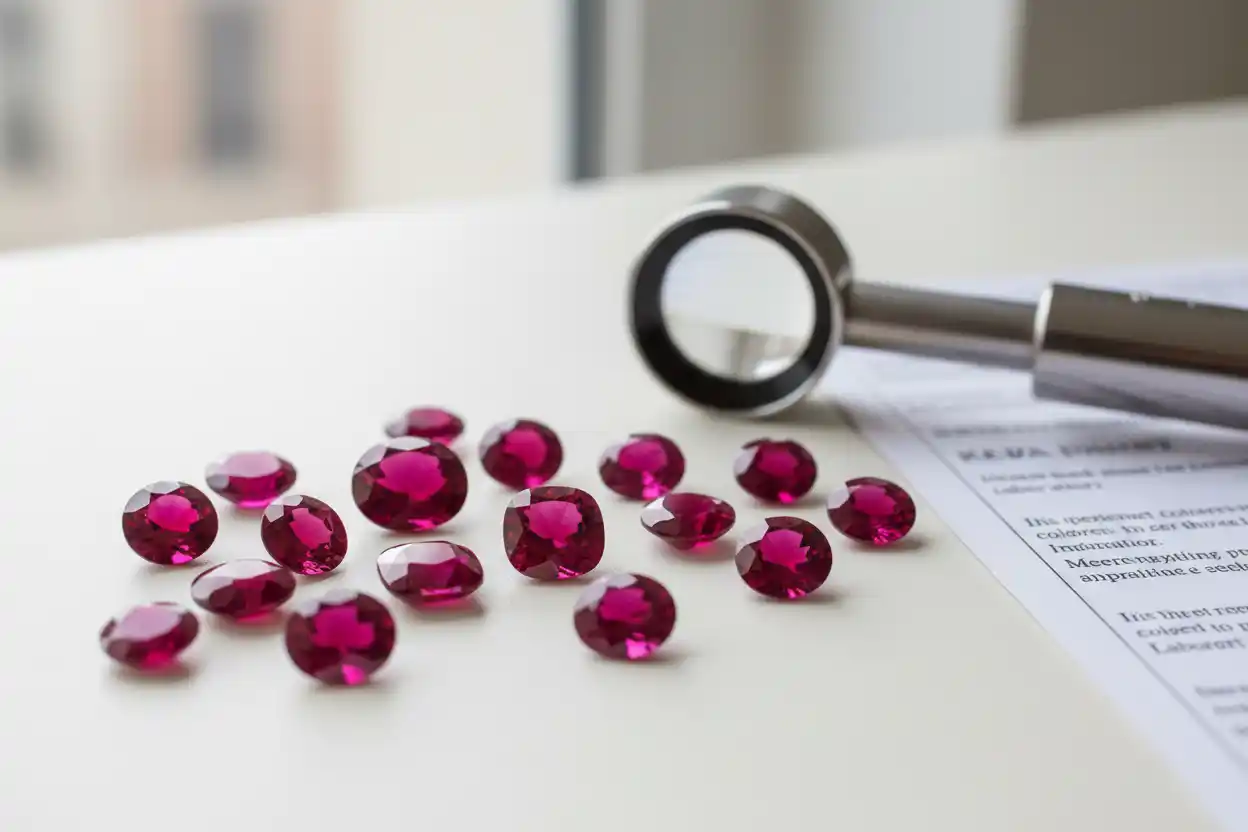
Buy Ruby: Smart Buying Tips & Red Flags
When you buy ruby, begin with identity, color, and treatment rather than carat weight, country name, or a dramatic trade description. Two red stones that look broadly similar in a retailer’s photographs can occupy completely different commercial categories: one may be a fine untreated natural ruby, another a conventionally heated natural ruby, another a heavily lead-glass-filled composite, and another a laboratory-grown ruby. All can contain corundum, yet their rarity, durability implications, documentation needs, and market values can differ enormously.
That makes the decision to buy ruby more evidence-dependent than purchasing many familiar colored gemstones. Ruby is one of the markets where treatment status can alter value substantially, fine stones become much rarer as size increases, geographic provenance can carry a meaningful premium, and terms such as “pigeon blood,” “Burmese,” “AAA,” or “unheated” can sound precise even when the supporting evidence is weak.
A strong buy ruby decision therefore follows a strict hierarchy. Establish whether the material is natural, laboratory-grown, composite, or an imitation; judge whether the color is genuinely attractive; evaluate transparency, inclusions, and cutting; determine what treatments are present; compare visible dimensions with carat weight; and demand proportionately stronger documentation when no-heat status, prestigious origin, unusual size, or exceptional color accounts for a significant part of the asking price.
What Should You Judge First When You Buy Ruby?
The most useful buy ruby hierarchy is identity first, color second, treatment third, clarity and transparency fourth, cut fifth, size sixth, and provenance after the visible fundamentals are established. This order prevents a famous locality or impressive carat number from distracting you from a weak stone.
Ruby is the red gem variety of corundum, composed principally of aluminum oxide and colored mainly by chromium. Its mineralogy, formation, physical properties, fluorescence, inclusions, sources, and cultural associations are covered in ruby meaning. For buying purposes, the central point is that natural ruby, laboratory-grown ruby, conventionally heated ruby, diffusion-treated ruby, glass-filled material, and red imitations should not be treated as interchangeable products.
When you buy ruby, each additional premium should correspond to something visible, testable, or credibly documented. A beautiful heated natural stone can be a better purchase than an unattractive untreated example, while an exceptional untreated natural ruby may justify a much larger premium when its identity and treatment status are independently supported.
Practical Ruby Buying Hierarchy
| Priority | What to establish | Stronger choice | Main red flag |
|---|---|---|---|
| 1 | Identity | Natural ruby clearly distinguished from synthetic or imitation | “Real ruby” used without explaining natural or laboratory-grown origin |
| 2 | Color | Vivid red to slightly purplish red with strong brightness | Brownish, grayish, overly purple, orangy, or excessively dark appearance |
| 3 | Treatment | Specific heat/filling/diffusion disclosure | Vague “enhanced” wording |
| 4 | Transparency | Good light transmission for the quality tier | Opaque or heavily fractured material priced as fine transparent ruby |
| 5 | Inclusions | Acceptable natural features without major structural concern | Serious surface-reaching fractures or extensive filling |
| 6 | Cut | Balanced color and light return | Large window, heavy extinction, severe asymmetry |
| 7 | Dimensions | Useful visible spread for weight | Excessive hidden pavilion weight |
| 8 | Size | Fine characteristics maintained as size increases | Large commercial material priced from weight alone |
| 9 | Provenance | Independent support if origin carries a premium | Country claimed from color alone |
| 10 | Documentation | Report proportionate to price and claims | Appraisal presented as proof of natural origin or treatment |
Use this sequence every time you buy ruby, especially when comparing stones across different retailers. It is far more reliable than attempting to compare proprietary AAA or premium labels.
Color Is the Most Important Visible Quality Factor
Once identity is established, color normally deserves the greatest attention when you buy ruby. Fine material tends toward a strong, vivid red to slightly purplish red with enough saturation to appear rich and enough brightness to avoid looking black or lifeless.
Hue, tone, and saturation work together. Hue describes the dominant color and modifiers, tone describes lightness or darkness, and saturation describes intensity. A ruby can have strong saturation yet still be unattractive if the tone is so dark that large areas lose brightness.
The best buy ruby candidate should remain recognizably red under ordinary neutral-looking illumination. A gemstone that appears vivid only beneath highly concentrated display lights may perform differently once mounted and worn in normal environments.
Do not choose a stone simply because it is the darkest red option. Darkness and quality are not synonyms.
Too Dark Can Be as Problematic as Too Light
An excessively dark ruby may develop broad areas of extinction that look black rather than red. This can result from body color, iron content, cut proportions, orientation, or several factors acting together.
When you buy ruby, rotate the stone rather than assessing one static position. A good gemstone should show an active balance of bright and dark facets as it moves. If most of the face remains closed and nearly black, the stone may have strong color on paper but weak visual performance.
The opposite problem occurs when the color becomes so light that the material approaches the commercial boundary between ruby and pink sapphire. That boundary is not governed by one universal percentage of red, so terminology can vary among markets and laboratories.
This is one reason a buy ruby decision should focus on actual color rather than the name alone.
Ruby Versus Pink Sapphire Deserves Attention
Ruby and pink sapphire are the same mineral species: corundum. The commercial distinction is based primarily on color, with ruby requiring red to be sufficiently dominant.
Because perception and classification conventions can vary, a pale pinkish-red stone described as ruby by one seller could be presented as pink sapphire elsewhere. That does not automatically establish deception, but it can materially affect what you should pay.
When you buy ruby close to that boundary, ask whether the independent laboratory report actually identifies the stone as ruby. A seller’s color description is less persuasive than the terminology used by the laboratory evaluating the exact stone.
Do not pay a substantial ruby premium for pale material solely because the sales page chooses the more valuable name.
“Pigeon Blood” Is a Trade Description, Not a Complete Grade
Few ruby phrases attract more attention than “pigeon blood.” Traditionally, the expression refers to exceptionally desirable vivid red ruby, sometimes with a slight purplish or pinkish component and a glowing appearance.
The problem is that the expression has not been used identically across every seller, market, or laboratory. Different reporting organizations can also apply their own criteria before issuing a special color comment.
When you buy ruby described as pigeon blood, do not let the phrase replace ordinary quality evaluation. Examine the actual hue, tone, saturation, fluorescence, transparency, cut, treatment status, and provenance.
If the description contributes substantially to the price, confirm whether it appears on a respected independent report for that exact gemstone. A retailer-created pigeon-blood label does not carry the same evidentiary weight.
Fluorescence Can Improve Appearance but Does Not Prove Origin
Chromium can cause ruby to fluoresce red, and strong fluorescence can add visual intensity under light containing suitable wavelengths. Low-iron rubies may display especially noticeable fluorescence, while higher iron concentrations can suppress it.
When you buy ruby, fluorescence can therefore be a desirable optical characteristic, but it should not be treated as proof of natural origin, untreated status, or a particular mine.
Laboratory-grown ruby can fluoresce strongly too. Natural rubies from different geological environments can show varying fluorescence, and treatment can alter inclusion structures without creating one simple fluorescence rule that consumers can apply reliably.
Judge fluorescence as part of appearance. Leave authentication and geographic provenance to proper gemological evidence.
Compare Ruby Under More Than One Lighting Condition
Red gemstones are highly sensitive to photographic presentation. Warm lighting can strengthen red or orange components, cool lighting can emphasize purple, and heavy exposure can make a dark stone appear substantially more open.
Before you buy ruby online, ask to see the exact gemstone under neutral-looking illumination and ordinary indoor light. A continuous video is especially useful because it reduces the ability to present only one favorable viewing angle.
Pay attention to the surrounding objects. If white paper appears pink, metal appears strangely warm, or skin tones look unnatural, the color balance may have been manipulated.
The goal is not perfect color reproduction, which screens cannot guarantee. The goal is enough evidence to understand whether the gemstone remains attractive outside a carefully engineered photograph.
Clarity Should Be Judged Differently From Diamond Clarity
Ruby commonly contains inclusions, and completely clean natural stones become increasingly unusual as quality and size rise. Therefore, when you buy ruby, the goal is not necessarily to find a stone that looks internally empty under magnification.
Judge inclusions according to visibility, location, effect on transparency, structural importance, and what they reveal about treatment. Rutile silk, mineral crystals, healed fissures, fingerprint-like features, growth zoning, and other internal characteristics can occur naturally.
A small crystal near the edge may have little effect on beauty. A large whitish fracture beneath the table can materially reduce transparency. A surface-reaching fissure near a corner can create both durability and treatment concerns.
Fine ruby can contain inclusions and still be extraordinarily valuable. What matters is how those inclusions interact with the rest of the stone.
Rutile Silk Can Be Helpful or Harmful
Fine rutile needles are commonly called silk. When present in suitable amounts, silk can diffuse light and give a ruby a softer glowing appearance. Too much silk, however, can reduce transparency and make the stone look hazy.
When you buy ruby, do not automatically interpret visible silk as a defect. Its effect depends on density, orientation, and the overall optical result.
Silk is also important when evaluating treatment. High-temperature heating can alter or dissolve rutile needles, so preserved silk may provide useful evidence to trained gemologists. However, intact silk does not prove that absolutely no heating occurred, because lower-temperature treatment or other processing can still be possible.
Consumers should not turn one inclusion feature into a definitive treatment conclusion.
Surface-Reaching Fractures Matter More Than Minor Internal Features
One of the most important distinctions when you buy ruby is whether a fracture is completely enclosed or reaches the surface.
Surface-reaching fissures can affect durability and may have been filled with glass or another substance to reduce their visibility. They can also create vulnerable zones during setting, repair, cleaning, or impact.
Inspect the table, crown, girdle, and pavilion through close photographs. In a mounted stone, ask for side views whenever the setting allows them.
A heavily fractured ruby can still be sold legitimately when its condition and treatments are accurately disclosed. The problem arises when extensive fractures and filling are hidden behind vague terms such as “clarity enhanced.”
Star Ruby Requires a Completely Different Clarity Standard
Some ruby contains aligned inclusions capable of producing asterism when cut as a cabochon. In this category, the inclusions help create the optical phenomenon, so demanding transparent faceting quality would miss the point.
When you buy ruby with a star effect, judge the body color, star sharpness, completeness of the rays, centering, movement, translucency, dome quality, and treatment.
A strong star should move naturally across the curved surface as the light source or gemstone changes position. It should not simply appear as a stationary reflection.
A six-rayed star is typical for ruby, though unusual optical patterns can occur. Ask for a moving video under a concentrated light source rather than relying on a single photograph.
Cut Quality Is Critical Because Ruby Rough Is Expensive
Fine ruby rough is valuable, so cutters often face a difficult trade-off between maximizing beauty and retaining weight. That economic pressure explains why some stones are deeper, shallower, or less symmetrical than ideal.
When you buy ruby, you should understand the result even if the cutter had good reasons for producing it.
The stone should return light effectively, display its color attractively, and have dimensions appropriate for the weight. A perfectly symmetrical cut is not mandatory, especially in valuable colored material, but obvious deficiencies should affect what you pay.
Color comes first, yet poor cutting can undermine excellent color.
Windowing Can Make Ruby Look Washed Out
A window appears as a pale or transparent area, commonly in the center, where light passes through the pavilion instead of returning toward the viewer.
When you buy ruby, look straight through the table against a neutral background. If you can easily see through a broad central area, the gemstone may be too shallow or otherwise poorly proportioned.
Some small degree of leakage can appear at certain angles in almost any faceted colored stone. A large stationary window dominating the face is different.
Windowing weakens apparent saturation and brilliance, and it should reduce the value relative to a similarly colored stone with stronger light return.
Extinction Can Make a Ruby Look Black
Extinction occurs when portions of the stone return little useful light and therefore look black or nearly black. Some contrast is essential for visual interest, but excessive extinction suppresses the very red color you are paying for.
When you buy ruby, slowly rotate the stone in video. Dark facets should change as the gem moves, creating scintillation. If a large central area remains black across many angles, the cut or tone may be working against the gemstone.
A seller may describe such a stone as deeply saturated. Make sure the richness is genuinely color rather than poor light return.
Pleochroism Influences Ruby Cutting
Ruby can show somewhat different color components in different crystallographic directions, commonly including red to purplish-red and orangy-red appearances.
Cutters often orient the rough to emphasize the more desirable face-up direction while preserving as much valuable weight as practical. That compromise can influence shape, depth, and final color.
When you buy ruby, pleochroism itself is not a defect. The question is whether the finished gemstone presents an appealing and relatively coherent color from the top.
A stone should be judged as cut, not according to an imaginary perfect orientation that might have required sacrificing a large percentage of the rough.
Compare Face-Up Dimensions With Carat Weight
Carat weight measures mass rather than visible size. A deep ruby can retain substantial weight beneath the girdle while appearing surprisingly small from the top.
When you buy ruby, always request millimeter dimensions along with carat weight. Compare length, width, and depth among stones with similar shapes.
This becomes increasingly important as size premiums rise. If two rubies have almost the same visible dimensions but one weighs much more because of a deep pavilion, the heavier stone may not provide proportional visual value.
Hidden weight is understandable in costly rough, but it should still be recognized during the purchase.
Size Premiums Become Serious Only When Quality Survives
Fine natural ruby becomes dramatically rarer as carat weight increases while strong color, transparency, sound clarity, and desirable treatment status are maintained.
That does not mean every large ruby is rare in the same way. Large opaque material, highly fractured corundum, heavily glass-filled material, and laboratory-grown ruby can be readily available in sizes that would be exceptional for untreated fine natural ruby.
When you buy ruby, therefore, never apply the price logic of fine untreated stones to every red corundum simply because the carat figure is large.
The interactions among quality, treatment, size, provenance, and market category are explored in ruby price. Use those factors together rather than estimating value from weight alone.
Heat Treatment Is Common and Can Be Entirely Acceptable
Conventional heating is one of the most important realities to understand when you buy ruby. Many natural rubies have been heated to improve color or transparency, alter silk, or modify inclusion-related appearance.
A properly disclosed heated natural ruby remains natural ruby. Heat treatment does not automatically make a stone poor quality, fake, or unsuitable for fine jewelry.
In fact, a vivid, well-cut, conventionally heated natural ruby can be a much stronger purchase than an unattractive untreated stone.
The value difference becomes substantial when two otherwise comparable high-quality stones differ in documented treatment status. Fine material with credible evidence of no heating can command a significant premium because such stones are scarcer.
“Unheated” Requires Stronger Evidence as the Price Rises
Anyone can write “unheated” in a product description. The question is what supports the statement.
When you buy ruby at a modest price, the economic value of extensive testing may be limited. When no-heat status contributes thousands or substantially more to the asking price, independent laboratory evidence becomes much more important.
A seller stating “no treatment known” is not necessarily making the same claim as an independent laboratory reporting no indications of heating.
Likewise, a visual inspection cannot reliably exclude every form of heat treatment. Professional interpretation can require microscopy, spectroscopy, fluorescence behavior, and examination of heat-sensitive inclusions.
Treat no-heat status as a technical claim rather than a marketing adjective.
Lead-Glass-Filled Ruby Belongs in a Different Value Category
Lead-glass filling is one of the most important treatment issues to understand before you buy ruby. Highly fractured low-grade corundum can be processed so that glass enters the fissures and cavities, dramatically improving apparent transparency.
The resulting product may look surprisingly attractive, especially in photographs, but it is not commercially equivalent to an untreated or conventionally heated natural ruby.
Extensive glass filling can also create durability and repair concerns because the filler may react badly to heat, acids, some jewelry-repair chemicals, and aggressive cleaning.
A low price can make glass-filled ruby reasonable for fashion jewelry when disclosure is complete. A high price based on comparison with fine natural ruby is a different matter entirely.
Learn the Difference Between Heat and Glass Filling
A seller saying that a ruby has been “heat treated” may not have told you enough.
Conventional heat treatment changes the natural corundum through controlled heating. Lead-glass filling introduces another material into fractures and cavities. The visual and commercial consequences differ substantially.
When you buy ruby, ask whether the stone is conventionally heated, heated with fracture healing, glass filled, diffusion treated, or subjected to another process.
The general distinctions among these enhancement categories are explained in gemstone treatments explained.
Specific terminology is important because “treated” covers processes ranging from widely accepted conventional heating to extensive filling that dramatically changes value and care.
Flux-Healed Fissures Need Careful Interpretation
Certain high-temperature treatment processes can promote healing of fissures, sometimes using flux-related materials. This is not identical to simply pumping large fractures full of lead glass, yet the treatment history can still affect how laboratories describe the stone and how buyers value it.
When you buy ruby with a report mentioning residues, healed fissures, or treatment-related substances, read the exact comments rather than reducing everything to “heated.”
The amount and nature of foreign material matter. So does whether fissures are healed or merely filled.
If the report language is unfamiliar and the purchase is substantial, obtain an independent explanation before assuming what the terminology means commercially.
Diffusion Treatment Should Not Be Described as Ordinary Heat
Diffusion treatment uses high temperatures to alter color through movement or introduction of coloring elements. Depending on the process, the color modification can be concentrated near the surface or penetrate more deeply.
When you buy ruby, diffusion-treated material should be distinguished from conventional heating because the commercial market does not value the treatments identically.
Do not rely on old assumptions that every diffusion treatment creates only an ultrathin surface layer. Processes vary, and sophisticated treatment detection can require laboratory equipment.
A seller who knows that diffusion occurred should disclose it specifically rather than saying only that the ruby was heated.
Dyeing and Coating Are Lower-Priority but Relevant Checks
Ruby and ruby-like material can also be dyed or coated in some commercial contexts. Dye can concentrate in fractures and porous areas, while coatings can strengthen or modify apparent surface color.
These treatments are not the first concern when evaluating most fine transparent ruby, but they become more relevant with inexpensive highly fractured material, unusual color concentrations, or suspicious surface effects.
When you buy ruby, look for abrupt changes in color around scratches, facet edges, drill holes, or worn surfaces. Such observations can raise questions but do not prove treatment conclusively.
Never attempt to scrape or chemically strip a valuable gemstone to investigate a coating.
Natural Ruby and Laboratory-Grown Ruby Must Be Separated Clearly
Laboratory-grown ruby is corundum produced through controlled manufacturing rather than geological processes. It shares natural ruby’s essential chemical composition, crystal structure, hardness, refractive behavior, and many optical characteristics.
When you buy ruby, this means a basic hardness test cannot distinguish natural from laboratory-grown material. Neither can vivid red color or strong fluorescence.
Laboratory-grown ruby can be produced by flame fusion, flux growth, hydrothermal methods, and other techniques. Some material shows characteristic growth features, inclusions, or structures, while high-quality synthetics can require expert analysis.
Laboratory-grown ruby can be a beautiful and durable jewelry choice when represented accurately. The problem is natural-origin misrepresentation.
Synthetic Ruby Is Not the Same as an Imitation
The terminology matters. A laboratory-grown ruby is synthetic corundum with the essential properties of ruby. An imitation merely resembles ruby visually while being a different substance.
Red spinel, garnet, glass, red tourmaline, synthetic spinel, and other materials can imitate the broad appearance of ruby.
When you buy ruby, do not let the word synthetic be used as a synonym for fake glass. Equally, do not let a seller call a red imitation “created ruby” if the product is not actually laboratory-grown corundum.
The practical differences among natural, laboratory-grown, treated, and imitation material are covered in real vs fake ruby.
Red Spinel Can Be an Excellent Gem Without Being Ruby
Natural red spinel has been confused with ruby historically because the two can overlap strongly in color. Spinel is a legitimate and potentially valuable gemstone in its own right, but it belongs to a different mineral species.
When you buy ruby, a beautiful red stone should not be identified by color alone. Refractive behavior, density, optical character, inclusions, spectroscopy, and other tests can distinguish corundum from spinel.
The fact that red spinel can be valuable does not excuse mislabeling. You should receive the material represented in the transaction.
Garnet and Glass Can Also Resemble Ruby
Certain red garnets can look convincingly ruby-like in ordinary photographs, especially when color is dark and lighting is warm. Glass can reproduce almost any hue and may be fashioned into transparent faceted stones.
Simple visual clues such as round gas bubbles, flow lines, excessive abrasion, or unusual optical behavior may suggest an imitation, but absence of those clues does not prove ruby.
Do not buy ruby based on a home scratch test, fog test, flashlight trick, or online color comparison. Those methods are too weak for a valuable gemstone decision.
Professional nondestructive examination provides much stronger evidence.
Avoid Destructive Authentication Tests
Ruby is hard, but that does not make destructive testing sensible.
Scratching a polished gem against glass or another mineral can damage facet edges and provides little useful information about natural versus laboratory-grown origin because both natural and synthetic corundum have the same fundamental hardness.
Acids, open flames, hot needles, abrasive powders, and impact tests are even less appropriate. They can damage fillers, coatings, mountings, and the stone itself.
If authenticity matters enough to influence whether you buy ruby, use appropriate gemological testing rather than risking the object.
Geographic Origin Can Matter, but Quality Comes First
Myanmar, Mozambique, Sri Lanka, Vietnam, Tanzania, Madagascar, Afghanistan, and other regions have produced ruby. Certain historic localities carry substantial prestige, particularly when exceptionally fine stones are involved.
However, every deposit produces a quality range. A dark, heavily included ruby does not become fine merely because its origin is prestigious, and a vivid ruby from a newer source does not become inferior simply because it lacks an older locality name.
When you buy ruby, judge color, transparency, cut, treatment, and size before paying for provenance.
Origin should be an additional value factor after the gemstone already performs well.
“Burmese Ruby” Should Be Supported When It Carries a Premium
Myanmar-origin ruby can command significant market premiums, particularly for fine stones with desirable color and treatment status. That makes unsupported origin claims financially important.
When you buy ruby represented as Burmese or from a specific historic district, ask whether a respected laboratory has issued an origin opinion for the exact stone.
Visual appearance alone cannot reliably establish the source. Strong fluorescence, red color, silk, or particular inclusion types can contribute to professional interpretation, but no simple consumer shortcut proves geographic origin.
A seller’s confidence is not the same as independent provenance evidence.
Mozambique Ruby Should Also Be Judged Stone by Stone
Mozambique has become one of the most important sources of ruby and has produced material ranging from low commercial quality to exceptional transparent gems.
When you buy ruby from Mozambique, do not assume the origin implies either superior or inferior quality. Evaluate the exact gemstone.
Fine Mozambique ruby can rival stones from historically prestigious localities in beauty. Conversely, large quantities of heavily fractured commercial material also originate from the region and may undergo extensive treatment.
Country of origin tells you where the stone came from, not how good it is.
Origin Opinions Have Limits
Even sophisticated gemological laboratories cannot guarantee geographic determination for every ruby. Laboratories compare trace chemistry, spectroscopy, inclusion suites, geological characteristics, and reference data, but some deposits overlap.
When you buy ruby whose price depends heavily on origin, read the report wording carefully. “Origin: Myanmar” or another clear conclusion is more useful than a vague seller narrative, but a laboratory may sometimes state that origin cannot be determined.
Do not pressure uncertainty into certainty simply because a country name would increase value.
Seller-Created Grades Are Not Universal
Ruby does not have one worldwide AAA, AAAA, premium, investment, royal, or heirloom grading system comparable with standardized diamond grading.
Retailers may use internal categories consistently, but those grades cannot be compared directly unless their criteria are explained.
When you buy ruby labeled AAAA, ask what that designation means. Does it refer to color, transparency, inclusions, cut, treatment status, origin, or some combination?
Then evaluate each characteristic independently.
A vivid, well-documented ruby does not become better because a seller adds another “A.”
Laboratory Reports Become More Important as Claims Become More Expensive
Not every small commercial ruby needs an individual independent report. Testing costs should make sense relative to the value and uncertainty of the transaction.
However, when you buy ruby of substantial value, a report becomes increasingly important if the price depends on natural origin, no-heat status, prestigious geographic provenance, special color terminology, unusually fine size, or an absence of clarity enhancement.
A strong laboratory report may establish whether the material is natural or laboratory-grown, document detectable treatment, record weight and dimensions, and sometimes provide an origin opinion.
The laboratory is identifying the gemstone. It is not promising that the purchase is financially advantageous.
What Should Trigger a Laboratory Report?
A sensible threshold is not one fixed price because buyer circumstances differ. Instead, ask how much money would be lost if the seller’s most important claim turned out to be wrong.
If you buy ruby represented merely as a modestly priced heated natural stone, a report may be optional when the seller provides strong disclosure and a meaningful return policy.
If you buy ruby because it is supposedly untreated, Burmese, exceptionally rare, or worth a large premium over a similar heated stone, independent evidence becomes much more valuable.
The greater the claim-dependent premium, the stronger the justification for laboratory documentation.
A Laboratory Report Is Not an Appraisal
A gemological report addresses identity and characteristics. An appraisal estimates monetary value for a particular purpose.
When you buy ruby, do not accept an insurance appraisal as proof that the gemstone is untreated, naturally formed, or from a prestigious source unless those conclusions are backed by appropriate testing.
Likewise, an excellent laboratory report does not tell you whether the retail price is fair.
The strongest high-value purchase separates these two functions: establish what the gemstone is, then decide what that specific material is worth in the relevant market.
Match the Report to the Exact Ruby
A genuine report is useful only when it belongs to the exact gemstone you are purchasing.
Compare the report number, weight, measurements, shape, cutting style, color description, photograph where available, and identifying comments. If a loose ruby has been recut since the report was issued, its weight and dimensions may no longer match.
When you buy ruby mounted in jewelry, determine whether the report was issued before or after mounting and whether the identifying data still allow the stone to be matched confidently.
Never accept a report for “another ruby from the same parcel” as evidence about your individual stone.
Actual-Stone Photography Is Essential for Significant Purchases
Stock photography is inadequate when you buy ruby as an individually priced loose gemstone. Color, transparency, cut, zoning, inclusions, and visible size vary too much from stone to stone.
Request a straight face-up image, side profile, pavilion view where practical, and close photographs of important inclusions or fractures. A slowly rotating video should show the actual gemstone moving rather than a montage of disconnected clips.
The face-up view reveals color, windowing, and extinction. The side view reveals depth. The pavilion can expose chips, fracture networks, and hidden condition issues.
Each perspective provides information that a glamour photograph alone cannot.
Ask for Neutral White Balance
Digital processing can materially change a ruby’s appearance. Increased saturation can make ordinary red material look exceptional, while increased brightness can hide darkness and some inclusions.
When you buy ruby online, look at familiar reference objects in the frame. White card, gray background, skin tone, and metal should appear plausible.
If every surrounding object carries a red cast, the ruby may appear stronger than it does in reality. If exposure is so high that facet edges disappear, you may not be seeing the true tone or clarity.
Neutral photography does not need to be unattractive. It simply needs to help you evaluate the stone honestly.
Side and Pavilion Views Reveal Hidden Weight and Treatment Clues
Ruby rough is expensive enough that cutters often retain depth. That makes side views especially important when you buy ruby.
A deep pavilion can increase the carat figure without increasing visible face-up size proportionately. Side views also show whether the girdle is excessively thick, whether the stone has chips, and whether major fractures approach the surface.
In some treated material, fracture networks may be easier to understand from the pavilion than through the crown.
Do not evaluate a valuable stone from a single straight-on photograph.
Return Terms Are Part of Your Inspection Process
A sensible return policy is especially valuable when you buy ruby remotely because screen color cannot perfectly reproduce the stone.
Before payment, check how much inspection time you have, whether removing tags affects return eligibility, whether setting a loose gemstone ends return rights, whether resizing makes jewelry final sale, and who pays insured shipping.
Also determine what happens if an independent examination finds that the stone differs materially from the stated identity or treatment.
A seller making unusually strong no-heat, origin, or rarity claims while providing virtually no return remedy deserves additional caution.
Put Important Claims on the Invoice
If a representation influences the price, preserve it in writing.
When you buy ruby, useful invoice wording can identify the gemstone as natural or laboratory-grown, state known treatments, record carat weight and dimensions, and reference an independent laboratory report.
If the transaction depends on no-heat status or a specific origin, those attributes should appear clearly in the documentation rather than existing only in advertising or conversation.
Precise invoice wording cannot replace laboratory testing, but it establishes exactly what was represented during the sale.
Jewelry Setting Matters Because Ruby Is Hard but Not Unbreakable
Ruby ranks 9 on the Mohs scale, giving it excellent resistance to scratching. It also lacks perfect cleavage, making sound ruby one of the better colored gemstones for rings and other frequently worn jewelry.
However, hardness is not toughness. Ruby remains brittle enough to chip from a concentrated impact, especially at thin girdles, pointed corners, surface-reaching fractures, or heavily treated areas.
When you buy ruby for a ring, examine both the gemstone and setting. Prongs should protect vulnerable points without pressing directly on fractures, while a bezel or protective halo can provide additional edge security.
The durability comparison among major colored gems is explored in sapphire vs emerald vs ruby.
Treatment Can Change Jewelry Durability More Than Mohs Hardness Suggests
A sound untreated or conventionally heated ruby is extremely practical for jewelry. A heavily lead-glass-filled ruby requires a different maintenance mindset despite the corundum component having the same intrinsic hardness.
Glass filler can respond poorly to high heat, certain chemicals, and aggressive repair procedures. A jeweler who assumes every red corundum can tolerate the same treatment may inadvertently damage the piece.
When you buy ruby jewelry, keep treatment documentation with the piece and disclose it before resizing, retipping, soldering, repolishing, or other repair work.
The completed gemstone, not just the underlying mineral, determines safe handling.
Care After You Buy Ruby
For sound untreated natural ruby, conventionally heated ruby, and untreated laboratory-grown ruby, gentle cleaning with lukewarm water, mild soap, and a soft brush is generally appropriate.
More heavily treated material requires additional caution. Glass-filled, fracture-filled, coated, heavily fractured, or assembled stones should not automatically be exposed to heat, harsh chemicals, steam, or ultrasonic cleaning.
Detailed physical maintenance is covered in how to clean ruby jewelry.
Before cleaning any mounted ruby, inspect the prongs, bezel, accent stones, solder joints, adhesives, and other materials because the safest method must suit the whole piece.
Value Trade-Off: Heated Fine Color Versus Unheated Weak Color
One of the most practical decisions when you buy ruby is whether to prioritize appearance or untreated rarity.
Imagine one conventionally heated natural ruby with vivid red color, strong transparency, and excellent cutting, compared with an unheated stone of similar size that is darker, more included, and visually less attractive.
The unheated stone may be scarcer in one respect, but rarity does not automatically make it the better jewelry choice. A buyer interested primarily in beauty may prefer the heated ruby.
A collector specifically seeking untreated material may make the opposite decision.
The correct buy ruby choice depends on what attribute you are actually paying to own.
Value Trade-Off: Better Color Versus Larger Size
Ruby pricing can rise sharply as fine quality survives into larger sizes, which makes size tempting but expensive.
When you buy ruby on a fixed budget, sacrificing some weight to obtain stronger color, better transparency, and more efficient cutting often produces a more attractive gemstone.
A smaller vivid ruby can look dramatically more compelling than a large dark stone with broad extinction.
This principle is particularly important in rings, where face-up dimensions and color are visible while most pavilion weight is hidden in the mounting.
Value Trade-Off: Prestigious Origin Versus Better Stone
A documented prestigious origin can add collector interest and market value, but provenance should not force you to accept inferior appearance.
When you buy ruby for jewelry rather than geographic collecting, compare a beautifully colored stone from one source with a weaker stone from a more famous source and ask what you will actually notice when wearing it.
If the more attractive gemstone costs less because its locality carries a smaller premium, that can be a rational purchase.
Provenance matters most when quality is already strong and the evidence is credible.
Realistic Resale Expectations
Exceptional ruby has an established international collector and auction market, but that does not mean every retail ruby is a liquid investment.
Commercial heated stones, glass-filled material, laboratory-grown ruby, generic jewelry, and poorly documented gems can behave very differently in the secondary market from exceptional untreated stones with outstanding color, size, provenance, and major laboratory documentation.
When you buy ruby, assume that retail markup, jewelry labor, dealer margin, and other transaction costs may not be recovered easily.
Do not accept guaranteed appreciation claims. Even fine gemstones require the right buyer, credible documentation, appropriate sales venue, and market demand.
A Practical Buy Ruby Decision Matrix
| Factor | Strong candidate | Acceptable trade-off | Serious concern |
|---|---|---|---|
| Identity | Natural ruby independently supported | Clearly disclosed laboratory-grown ruby at appropriate price | Vague “real ruby” claim |
| Color | Vivid red to slightly purplish red | Attractive red with moderate modifier | Brown, gray, excessive orange/purple, or near-black appearance |
| Tone | Rich but bright | Slightly light or dark while still lively | Color closes almost completely |
| Clarity | Useful transparency with manageable inclusions | Visible natural inclusions that do not dominate | Severe cloudiness, open fractures, major cavities |
| Cut | Good face-up color and light return | Minor asymmetry due to rough conservation | Broad window or severe extinction |
| Dimensions | Appropriate visible spread | Some additional depth | Major hidden weight |
| Heat | Precisely disclosed | Conventional heat accepted by buyer | “Enhanced” with no explanation |
| Filling | None or clearly disclosed minimal treatment | Glass-filled material at appropriately low price | Extensive filling sold as fine natural ruby |
| Diffusion | Clearly disclosed and priced accordingly | Buyer accepts treatment knowingly | Diffusion described merely as ordinary heat |
| No-heat claim | Independent evidence | Treatment unknown at commercial price | Large untreated premium based only on seller statement |
| Origin | Independent support where relevant | Origin not important to buyer | Expensive locality claim based on color alone |
| Photos | Exact stone, neutral light, multiple angles | Clear actual-stone images | Stock image for an expensive individual gem |
| Documentation | Report matches exact stone | No report for straightforward modest purchase | Appraisal substituted for identity evidence |
| Returns | Meaningful inspection rights | Clear reasonable restrictions | Virtually no remedy despite exceptional claims |
The purpose of this matrix is not to manufacture one universal ruby grade. It is to make every major trade-off visible before you commit money.
Stone-Specific Red Flags When You Buy Ruby
The strongest red flag is not simply a low price. Ruby spans an enormous range of qualities and treatment levels, so inexpensive material can be genuine.
Instead, watch for contradictions.
A large transparent ruby offered inexpensively while being described as natural, untreated, top color, and prestigious-origin material deserves far stronger evidence than ordinary commercial inventory.
Another serious warning is vague treatment language. “Enhanced,” “processed,” “improved,” or “heat enhanced” may conceal important differences between conventional heating, diffusion, extensive glass filling, or other processing.
Be cautious when a seller uses a pigeon-blood label without explaining whether it comes from an independent report, claims geographic origin from appearance alone, or presents proprietary AAAA grades as though they were universal standards.
Other red flags include heavy fractures visible in photographs but no filling disclosure, extreme color differences between images, stock photography for an individually priced stone, refusal to provide dimensions, a report that does not match the ruby, and return terms that make independent inspection effectively impossible.
A Better Way to Buy Ruby
Start your buy ruby comparison by choosing several stones within a similar budget, then temporarily ignore their country names and proprietary grades.
First, compare face-up color under similar lighting. Remove stones that are muddy, brownish, excessively dark, or dependent on intense illumination to show attractive red.
Second, compare transparency and inclusions. Decide whether each feature merely provides natural character or substantially reduces beauty and structural integrity.
Third, compare cutting and dimensions. Look for balanced light return, acceptable symmetry, limited windowing, manageable extinction, and visible size appropriate to the weight.
Only after these fundamentals are strong should you compare treatment status. Conventional heat can be perfectly acceptable, while extensive lead-glass filling or diffusion belongs in a different value category. No-heat status deserves a premium only when the underlying ruby is good enough to justify it and the evidence is appropriate.
Finally, evaluate provenance, laboratory documentation, actual-stone photography, invoice wording, return terms, and setting quality. The broader Buying & Value section provides similar purchasing principles across other materials, but ruby requires unusually careful attention to treatment and documentation because those factors can change value dramatically.
Frequently Asked Questions
What should I judge first when I buy ruby?
Confirm whether the gemstone is natural ruby, laboratory-grown ruby, composite material, or an imitation. After identity, prioritize color, treatment, transparency, inclusions, cut quality, dimensions, and size before paying for provenance or seller-created grades.
What is the best ruby color?
Fine ruby commonly favors vivid red to slightly purplish red with strong saturation and enough brightness to remain lively. A gemstone that is excessively dark, brownish, grayish, orangy, or strongly purple will usually be less desirable than a balanced vivid red stone.
Is pigeon-blood ruby always the best?
No universal rule makes every stone carrying that phrase the best ruby. Different sellers and laboratories can use special color terminology differently. Judge the actual color and require credible documentation when the designation creates a significant premium.
Should ruby be eye-clean?
Not necessarily. Natural ruby commonly contains inclusions, and fine stones can retain substantial value despite visible internal features. What matters is whether inclusions materially reduce transparency, brightness, durability, or overall beauty.
Are inclusions proof that a ruby is natural?
No. Some inclusions can support natural-origin identification when correctly interpreted, but laboratory-grown rubies can contain their own characteristic features and natural rubies can sometimes be unusually clean. Professional analysis considers multiple observations.
Is heated ruby real ruby?
Yes. A conventionally heated natural ruby remains natural corundum. Heating should be disclosed because it affects rarity and value, but it does not automatically make a gemstone fake or undesirable.
Is unheated ruby always worth more?
An otherwise comparable fine unheated ruby can command a substantial premium because untreated high-quality material is rarer. However, an unattractive unheated ruby is not automatically a better purchase than a beautiful conventionally heated stone.
What is lead-glass-filled ruby?
It is heavily fractured corundum whose cracks and cavities have been filled with glass to improve apparent transparency. It can be attractive and inexpensive when disclosed properly, but it should not be valued like a fine untreated or conventionally heated natural ruby.
Is glass-filled ruby durable?
The corundum component is hard, but the glass filler introduces additional vulnerabilities. Heat, certain chemicals, jewelry-repair procedures, and aggressive cleaning can damage filled material, so treatment-aware care is important.
Is diffusion-treated ruby the same as heated ruby?
No. Both processes can involve high temperatures, but diffusion intentionally modifies color through movement or introduction of coloring elements. Diffusion should be disclosed separately rather than being represented only as conventional heating.
Does synthetic ruby count as real ruby?
Laboratory-grown ruby is real synthetic corundum with essentially the same crystal structure and chemical composition as natural ruby, but it has a manufactured rather than geological origin. It should be disclosed clearly and priced accordingly.
How can I tell natural ruby from laboratory-grown ruby?
Simple home tests are insufficient because natural and synthetic corundum share basic hardness and optical properties. Microscopy, spectroscopy, growth features, inclusions, and other laboratory techniques can distinguish origin more reliably.
Can red spinel be mistaken for ruby?
Yes. Red spinel can closely resemble ruby and has historically been confused with it. Spinel is a different mineral species, however, and professional gemological testing can separate the two.
Does strong fluorescence prove a ruby is Burmese?
No. Fluorescence varies with chromium, iron, geological environment, and other factors. Natural rubies from different regions and laboratory-grown rubies can fluoresce, so fluorescence alone does not prove origin.
Is Burmese ruby always more valuable?
No. Origin matters only in combination with quality. Fine rubies with independently documented prestigious provenance can command premiums, but a poor-quality ruby remains poor quality regardless of where it formed.
Is Mozambique ruby good quality?
It can be exceptional. Mozambique produces a broad spectrum ranging from heavily fractured commercial corundum to vivid transparent fine ruby. Evaluate each stone individually instead of using the country as a quality grade.
Can a seller determine ruby origin from color?
Not reliably. Similar colors can occur in multiple deposits, and geographic origin may require advanced laboratory analysis. Even laboratories may occasionally be unable to reach a definitive conclusion.
Do I need a laboratory report when I buy ruby?
A report becomes increasingly important as price and claim complexity rise. Valuable natural rubies, no-heat claims, prestigious origins, exceptional sizes, and special color descriptions are stronger candidates for independent documentation than modest straightforward commercial stones.
Does a laboratory report tell me what a ruby is worth?
No. A gemological report addresses identity, characteristics, treatment, and sometimes origin. An appraisal or market analysis addresses monetary value. The functions should remain separate.
How do I know a laboratory report belongs to the ruby?
Compare the report number, carat weight, dimensions, shape, cutting style, color description, photograph where available, and other identifying details with the exact gemstone.
What photographs should I request before I buy ruby online?
Request images of the exact stone face-up, from the side, and from the pavilion where practical, plus a slowly rotating video under neutral and ordinary lighting. These views reveal color, inclusions, cutting, windowing, extinction, depth, and condition.
Is carat weight the best way to compare rubies?
No. Compare millimeter dimensions as well because deeply cut stones can retain significant hidden weight. Color, transparency, treatment, cut, and visible spread often matter more than the carat figure alone.
Is ruby suitable for a frequently worn ring?
Sound untreated and conventionally heated ruby are excellent ring gemstones because corundum is very hard and lacks perfect cleavage. However, sharp impact can still chip ruby, and heavily filled or fractured material requires more cautious handling.
What is the biggest red flag when I buy ruby?
A major warning is an exceptional natural, untreated, prestigious-origin claim combined with weak documentation, vague treatment language, implausibly low pricing, or photographs that conceal the gemstone’s real color and condition.
Final Buy Ruby Checklist
Before you buy ruby, establish exactly what material you are being offered. Natural ruby, laboratory-grown ruby, conventionally heated ruby, diffusion-treated ruby, lead-glass-filled corundum, composite products, and red imitations occupy different commercial categories even when photographs make them look superficially similar.
Judge color next. Look for an attractive red that remains lively in realistic lighting, with enough saturation to appear rich but enough brightness to avoid closing into black. Treat pigeon-blood terminology as an additional description rather than a substitute for examining the stone.
Evaluate transparency and inclusions according to their visual and structural effect. Natural inclusions can be completely acceptable, while surface-reaching fissures deserve closer attention because they can influence durability and indicate filling. For star ruby, judge the asterism separately because aligned inclusions create the phenomenon.
Study cut performance from several angles. Look for manageable windowing, limited extinction, sensible handling of pleochroism, and face-up dimensions appropriate to the carat weight. Large size should receive a serious premium only when color, transparency, cut, and treatment category remain strong.
Ask for specific treatment disclosure. Conventional heat, diffusion, fissure healing, lead-glass filling, coating, and other modifications should not be collapsed into one vague word. When no-heat status materially increases the price, independent laboratory evidence becomes especially important.
Treat geographic provenance the same way. A famous source can add value, but origin does not replace quality, and appearance alone cannot prove locality. When provenance carries a substantial premium, appropriate independent support should accompany the exact gemstone.
Finally, verify actual-stone photographs, neutral-light video, side and pavilion views, report-to-stone matching, written invoice claims, setting quality, and return terms before committing to a significant purchase.
The strongest way to buy ruby is to pay first for verified identity, compelling color, appropriate transparency, efficient cutting, sound condition, and transparent treatment disclosure. Untreated status, famous origin, exceptional size, special color terminology, and collector rarity should increase the price only after the ruby itself is good enough—and the evidence strong enough—to justify that premium.