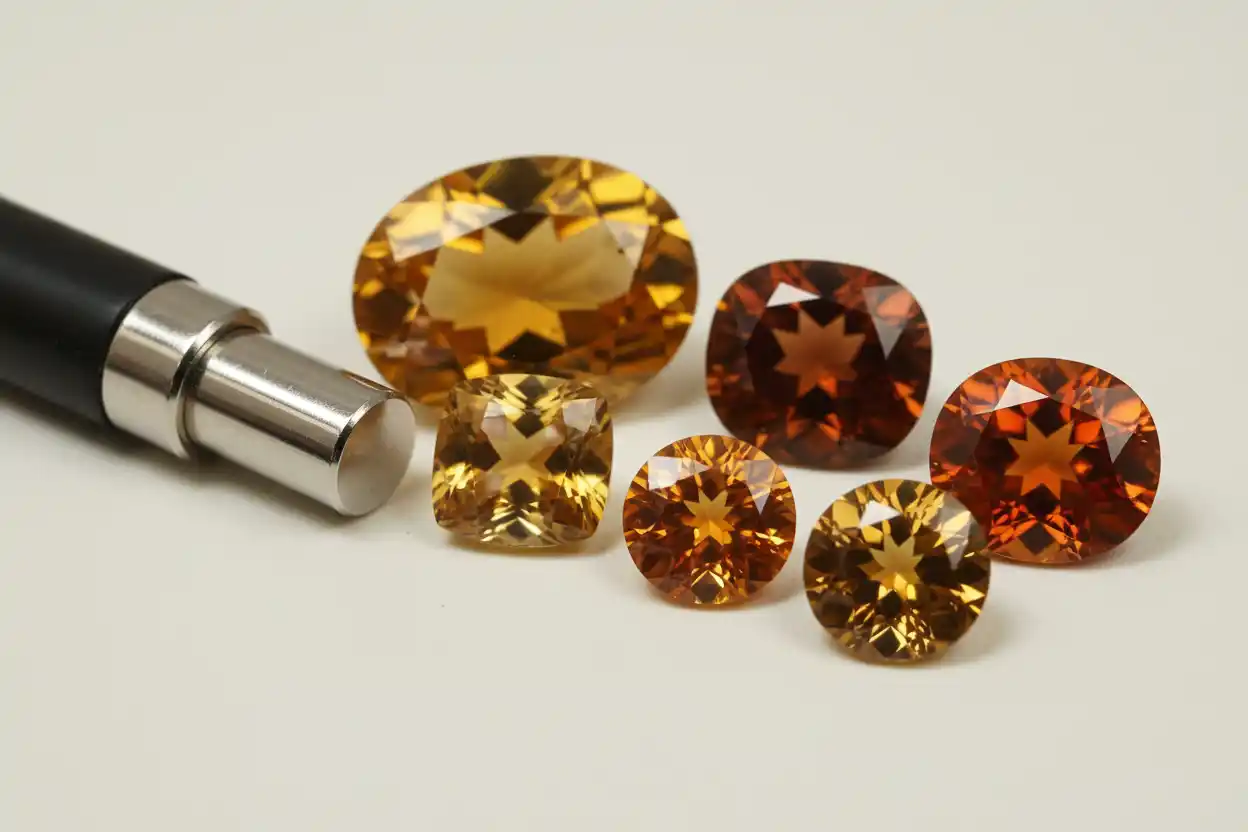
Buy Sphalerite: Smart Buying Tips & Red Flags
When you buy sphalerite, the spectacular rainbow fire should attract your attention, but it should not make the purchase decision for you. Transparent sphalerite combines an unusually high refractive index with extraordinary dispersion, allowing a skillfully cut stone to produce intense flashes of red, orange, yellow, green, blue, and violet, yet the same mineral has a Mohs hardness of only about 3.5–4, brittle tenacity, and perfect cleavage in multiple directions. It is therefore simultaneously one of the most visually dramatic collector gems and one of the least forgiving conventional jewelry stones.
That contradiction should define how you buy sphalerite. A fine stone deserves to be evaluated for identity, color, transparency, cut, polish, dispersion, structural condition, provenance, and documentation before carat weight enters the discussion. A large orange stone can look spectacular in a carefully lit photograph while being badly windowed, heavily fractured, poorly polished, or too vulnerable for the jewelry style a seller recommends.
The best way to buy sphalerite is to treat it primarily as a collector gemstone or precision-cut optical gem rather than as a substitute for diamond, sapphire, garnet, or another durable everyday stone. Fine faceted material can be extraordinary, particularly from deposits known for transparent yellow, orange, and reddish material, but the price should reflect the actual stone rather than generic claims about dispersion or rarity.
What Should You Judge First When You Buy Sphalerite?
A practical buy sphalerite hierarchy begins with identity because several high-dispersion or similarly colored gems can resemble it. After identity, evaluate transparency, body color, cut and polish, structural condition, face-up dimensions, treatment or repair, provenance, documentation, and intended use.
Sphalerite is principally zinc sulfide, commonly written as ZnS or more realistically as (Zn,Fe)S when iron substitutes for zinc. Pure material would be colorless, while natural substitutions contribute to yellow, orange, red, brown, green, gray, and nearly black material. Its mineralogical properties, formation, optical behavior, and broader context are explained in sphalerite meaning.
For the buyer, the essential distinction is between ordinary mineral sphalerite and material transparent enough to facet successfully. Sphalerite is abundant as an important zinc ore, yet transparent gemstone-quality crystals are much less common.
| Priority | What to evaluate | Stronger choice | Main concern |
|---|---|---|---|
| 1 | Identity | Sphalerite established through credible gemological evidence | Color or fire used as the only identification |
| 2 | Transparency | Strong transparent faceting quality | Dense cloudiness or opacity marketed as fine gem material |
| 3 | Color | Attractive yellow, orange, red-orange, brown, or green with brightness | Nearly black tone that suppresses fire |
| 4 | Cut | Strong brilliance and visible dispersion | Large window, severe extinction, poor proportions |
| 5 | Polish | Crisp, reflective facet surfaces | Scratches, polishing lines, rounded facet junctions |
| 6 | Structure | Limited dangerous fractures and sound edges | Open cleavage cracks, major fissures, chipped girdle |
| 7 | Dimensions | Good visible spread for the weight | Excessive depth and hidden weight |
| 8 | Treatment | Clear disclosure of filling, coating, stabilization, or repair | Vague “enhanced” description |
| 9 | Provenance | Supported when locality carries a premium | Country or mine inferred from color |
| 10 | Documentation | Appropriate report for significant stones | Seller card presented as independent proof |
Using this sequence every time you buy sphalerite prevents extraordinary fire from distracting you from weaknesses that directly affect durability and value.
Sphalerite’s Fire Is Exceptional, but Fire Alone Does Not Define Quality
One of the reasons collectors buy sphalerite is its extraordinary dispersion. Dispersion describes how strongly a transparent material separates white light into spectral colors, creating the optical effect commonly called fire.
Sphalerite’s dispersion is around 0.156, several times higher than the commonly quoted figure for diamond. Its refractive index is also extremely high, near 2.37 in typical gem material, which means a properly cut transparent stone can return strong reflections alongside vivid spectral flashes.
However, when you buy sphalerite, do not assume that every stone automatically displays this performance. Dispersion needs transparent material, competent cutting, polished facet surfaces, appropriate lighting, and enough body-color openness for the spectral flashes to remain visible.
A dark brown or blackish stone can possess the same fundamental optical potential while absorbing so much light that very little fire is visible face-up.
The strongest buy sphalerite candidate is not the gem with the highest theoretical dispersion. Every sphalerite shares the material property. The strongest candidate is the stone whose color, transparency, proportions, and polish allow you to see it.
Medium Color Often Shows More Fire Than Extremely Dark Material
Sphalerite can occur in yellow, golden yellow, orange, red-orange, reddish brown, brown, green, and dark iron-rich colors. As iron content generally increases, the material tends to become darker and less transparent.
When you buy sphalerite primarily for brilliance and dispersion, lighter to medium-tone transparent stones often provide the most satisfying visual performance because enough light can enter and return from the gemstone.
A very dark reddish-brown stone can look rich but may suppress rainbow flashes. A pale yellow or vivid orange stone with excellent transparency can appear dramatically more fiery despite having less body-color depth.
Do not confuse darkness with saturation or quality.
A medium-orange gem that remains luminous under ordinary lighting may be a much stronger buy sphalerite choice than a nearly black stone shown under powerful spotlights.
Yellow Sphalerite Should Look Bright Rather Than Washed Out
Yellow sphalerite can range from pale lemon and straw through golden yellow and yellow-orange.
When you buy sphalerite in this range, look for enough saturation to make the body color obvious while maintaining the transparency necessary for dispersion. Extremely pale material may show impressive fire but appear nearly colorless through larger parts of the face.
Conversely, an overly brown-yellow stone can absorb enough light to reduce brilliance.
The best balance depends partly on personal preference. Some collectors prioritize almost diamond-like fire over a pale yellow body color, while others prefer stronger golden color even if the spectral flashes are somewhat less dominant.
The important point is to compare stones under the same lighting rather than assuming the strongest yellow description indicates the finest gem.
Orange and Red-Orange Sphalerite Can Be Especially Striking
Transparent orange and red-orange sphalerite can combine intense body color with spectacular dispersion, producing one of the most recognizable collector-gem appearances.
When you buy sphalerite in vivid orange, examine whether the color remains lively rather than becoming brown or dark through the center. A well-cut stone should preserve visible orange while allowing flashes of contrasting spectral colors to break through the body color.
Pay attention to zoning as well. Sphalerite can show areas of different color intensity related to compositional variation, including pronounced dark and lighter regions.
Interesting zoning can enhance a collector stone when cutting uses it intentionally. Random dark patches that suppress half of the face should be treated differently.
The question is whether the zoning contributes to the design or simply creates uneven optical performance.
Green Sphalerite Is Unusual and Needs Strong Identification
Green sphalerite exists and has been documented, including cobalt-related green material. However, green transparent gemstones have an enormous range of possible identities.
If you buy sphalerite because the stone is an unusual green, require stronger identification rather than assuming the uncommon color itself proves rarity.
Green garnet, tourmaline, sphene, glass, synthetic materials, and other gems can create overlapping appearances. Sphalerite’s extremely high refractive index and dispersion help distinguish it during professional testing, but those properties are not reliably measured by simply looking at a photograph.
Unusual color increases the reason for verification.
Black Sphalerite Is a Different Buying Category
Most sphalerite mined as zinc ore is not transparent gem material. Iron-rich material commonly becomes brown to black and may have submetallic or resinous luster rather than the bright transparent appearance of faceted collector stones.
When you buy sphalerite in dark specimen form, judge it according to mineral-collector criteria rather than transparent-gem criteria.
Crystal habit, luster, associations with calcite, galena, fluorite, pyrite, quartz, or other minerals, locality, condition, matrix aesthetics, and provenance can become more important than transparency.
A large black sphalerite crystal specimen can be genuinely collectible without being equivalent to a fine transparent orange gemstone.
Do not allow rarity claims from one category to inflate the price of another.
Transparency Is More Important Than Carat Weight
One of the biggest mistakes when people buy sphalerite is assuming that the larger stone must be rarer.
Large sphalerite crystals can occur, and substantial faceted gemstones are known. The more difficult combination is attractive color, high transparency, sound enough rough to survive cutting, excellent polish, and proportions that display the material’s dispersion.
A large but cloudy or dark stone therefore belongs to a different quality category from a smaller transparent gem.
When you buy sphalerite, ask whether the extra size preserves the qualities you actually want. If a twenty-carat stone is dark, badly fractured, or heavily windowed while a much smaller gem is bright, transparent, and exceptionally cut, the smaller stone may provide substantially more visual value.
Sphalerite Can Be Naturally Included Without Being Poor Quality
Transparent sphalerite can contain particulate clouds, crystals, fingerprints, growth structures, negative crystals, color zoning, and other internal features.
When you buy sphalerite, moderate inclusions can be accepted when they do not materially reduce transparency or structural stability. Extremely rare collector gems should not be judged according to diamond clarity logic.
However, inclusion tolerance should not become an excuse for poor material.
A small crystal inclusion near the edge may have little effect. A large reflective fracture directly beneath the table can dominate the face and create cleavage-related durability concerns.
Judge inclusions individually rather than simply counting them.
Surface-Reaching Fractures Are Particularly Important
Sphalerite already has brittle tenacity and perfect cleavage, so an existing open fracture deserves more concern than it would in a tougher gemstone.
When you buy sphalerite, inspect the table, crown, girdle, pavilion, culet, and corners for fractures reaching the polished surface.
A fracture near a girdle edge can expand during mounting or impact. A cleavage crack can propagate rapidly because the crystal already contains preferred splitting directions.
The appearance of the crack matters too. A bright reflective fracture may reduce transparency substantially even if it does not currently threaten breakage.
This is why close-up imagery and condition disclosure should be standard for meaningful faceted purchases.
Perfect Cleavage Changes Everything About Sphalerite Ownership
Sphalerite has perfect dodecahedral cleavage, conventionally described as occurring in six directions. This cleavage is one of the primary reasons the mineral is difficult to cut, polish, set, and wear.
When you buy sphalerite, understand that cleavage is not merely an academic property. A sufficiently directed force can cause a crystal to split along a structural plane.
The relationship between scratching and breakage is explained in gemstone toughness vs hardness, but sphalerite is an especially good example because both its softness and its cleavage limit ordinary jewelry use.
A gem can survive careful collection handling for decades and still break from one poorly placed setting force.
That risk should influence how you buy sphalerite before you decide what jewelry design to make.
Mohs 3.5–4 Makes Sphalerite Easy to Scratch
Sphalerite’s approximately 3.5–4 Mohs hardness means many everyday materials can abrade its polished surface more readily than they would quartz, garnet, topaz, sapphire, or diamond.
The broader comparison appears in the gemstone hardness chart.
When you buy sphalerite as a faceted gem, inspect the surface carefully because abrasion can already have reduced the polish, especially in previously mounted stones.
Facet junctions should look reasonably crisp. A soft hazy surface or rounded edges can indicate wear or difficult original polishing.
A scratched sphalerite may be repolished by a specialist, but repolishing can be challenging because every additional lapidary operation introduces cleavage risk.
Polish Quality Is More Important Than Many Buyers Realize
Because sphalerite is soft and cleavage-prone, achieving a crisp high-quality polish requires skill. Poor polishing can leave microscopic lines, scratches, dragged surfaces, uneven luster, and soft-looking facet junctions.
When you buy sphalerite, use enlarged photographs to examine the facet surfaces rather than focusing only on fire.
A high refractive index can create an adamantine-looking surface when polish is excellent. Poor polishing scatters light before it can interact efficiently with the gemstone, weakening brilliance and spectral fire.
This creates an important value hierarchy: a slightly smaller stone with excellent polish can outperform a heavier gemstone with visibly scratched or poorly finished facets.
Cutting craftsmanship is a major component of fine sphalerite value.
Sphalerite Cutting Skill Can Legitimately Create a Premium
Fine sphalerite is difficult to facet because the cutter must manage softness, brittle behavior, multiple perfect cleavage directions, high optical properties, and valuable transparent rough simultaneously.
When you buy sphalerite that has been precision cut, a meaningful premium can therefore be justified by workmanship.
Examine symmetry, facet meet points, polish, pavilion design, crown proportions, and whether the finished stone successfully displays fire without becoming windowed.
An unusual artistic cut can also add collector value when the design is executed successfully.
In sphalerite, the cutter can contribute more to the finished gemstone than buyers accustomed to inexpensive commercial quartz may expect.
Windowing Can Destroy the Optical Advantage
A window appears as a transparent central area where light exits through the pavilion instead of returning toward the viewer.
When you buy sphalerite, windowing is especially disappointing because the mineral possesses extraordinary optical potential. A broad window wastes that potential by allowing you to see through the gem instead of seeing reflected light and dispersion.
Inspect the gemstone face-up against a neutral background. If a large central region makes the background easily visible, the stone is probably too shallow or otherwise poorly proportioned.
A little leakage at certain viewing angles is normal. A broad stationary window should reduce what you are willing to pay.
Excessive Extinction Can Hide the Fire
The opposite problem is extinction, where large parts of the gemstone look very dark because insufficient useful light returns to the viewer.
When you buy sphalerite in brown, reddish-brown, or dark orange colors, this issue becomes particularly important.
Rotate the stone slowly. Dark facets should change position and interact with brighter areas. If much of the gemstone remains black through ordinary movement, the combination of body color and cut may be suppressing the dispersion.
A slightly lighter stone can often show dramatically stronger fire.
Do not allow a seller to describe heavy extinction as simply “deep saturation.”
A Good Cut Must Balance Brilliance and Fire
Sphalerite’s high refractive index and dispersion mean a cutter has considerable optical potential to work with, but there is still a trade-off among brilliance, fire, color preservation, and weight retention.
When you buy sphalerite, look for spectral flashes distributed throughout the stone rather than confined to one small section.
The gemstone should also retain enough white-light brightness that the fire has contrast. A stone showing only dull body color with occasional isolated rainbow reflections is not using the material’s optical properties effectively.
This is one reason rotating video is essential. Still photographs can capture a single spectacular spectral flash that may not represent normal viewing.
Compare Millimeter Dimensions With Carat Weight
Sphalerite has relatively high density, commonly around 4 g/cm³, so it can weigh more than a similarly sized lower-density gemstone.
That means carat weight can mislead buyers about visible size.
When you buy sphalerite, always compare length, width, and depth in millimeters with the weight. A five-carat sphalerite may not look as large face-up as someone accustomed to quartz would expect.
Depth matters as well. A cutter may preserve extra weight below the girdle, producing a high carat figure without proportional visual spread.
Pay for the visible gemstone and optical performance, not merely the number on the scale.
Large Fine Sphalerite Can Be Special, but Size Alone Is Not Enough
Transparent facet-grade sphalerite is unusual enough that large clean stones can be notable, particularly when color, polish, and cutting are also excellent.
When you buy sphalerite in a substantial size, raise your standards rather than lowering them.
Ask whether the stone remains transparent throughout, whether its center is lively, whether fire remains visible, whether fractures threaten stability, and whether the cut avoids unnecessary depth.
A large gemstone should carry a premium because quality survived into size—not simply because more mineral was retained.
The separate sphalerite price guide explains how transparent gem quality, color, cutting, locality, and condition interact with market value.
Spanish Sphalerite Has an Exceptional Gemstone Reputation
Northern Spain, particularly Cantabria and the Áliva area, is strongly associated with some of the finest transparent facet-grade sphalerite known. Material can show yellow, orange, red-orange, reddish, brown, and strongly zoned colors.
When you buy sphalerite represented as Spanish, the provenance can therefore add legitimate collector interest.
However, Spanish origin does not automatically guarantee fine quality. A poorly cut or fractured stone remains compromised even when the rough came from an important deposit.
Likewise, an orange gemstone cannot be assigned to Spain simply because its color resembles known Spanish material.
Provenance should support the premium rather than replace quality evaluation.
Do Not Accept “Spanish Sphalerite” Based on Color Alone
The orange-to-red color range most associated with Spanish faceting material is not a geographic fingerprint.
When you buy sphalerite carrying a Spanish locality premium, ask what connects the stone to the source. Dealer provenance, original parcel records, collection labels, mine information, or traceable rough can provide stronger support than color.
A gemological identification report may establish sphalerite while not necessarily establishing exact mine origin.
That distinction matters because laboratory identity and commercial provenance answer different questions.
Mexico Also Has Important Gem and Specimen Material
Mexico has produced notable sphalerite specimens and gem material, often associated with complex mineral deposits and attractive crystal combinations.
When you buy sphalerite represented as Mexican, evaluate whether the item is being sold primarily as a faceted gemstone or as a mineral specimen.
For a faceted gem, transparency, color, cut, polish, and structural condition remain central. For a specimen, crystal form, associated minerals, matrix, locality, condition, and repairs may carry more weight.
Country names should not collapse those categories together.
Green Locality Claims Require Additional Caution
Green sphalerite has been documented from specific deposits, including cobalt-bearing material from central Africa. Because the color is unusual, locality stories can become especially influential.
When you buy sphalerite with a green color and an exact mine claim, separate three questions:
Is it actually sphalerite?
Is the green color natural?
Is the locality correct?
One observation does not answer all three.
A collector premium should be built on evidence proportional to the rarity claim.
Specimen Sphalerite Should Be Inspected for Repairs
Natural sphalerite crystals are often collected in association with other minerals and matrix. Large clusters can be damaged during mining, trimming, shipping, or preparation.
When you buy sphalerite specimens, inspect attachment points for glue, resin, filler, reconstructed crystals, or repaired matrix.
A professionally repaired specimen can remain highly collectible when the repair is disclosed. A reconstructed piece assembled from unrelated crystals occupies a different category.
Ask whether crystals have been reattached, whether matrix has been stabilized, and whether surfaces were acid cleaned or chemically prepared.
Condition history belongs in specimen valuation.
Acid Cleaning Can Affect a Mineral Specimen
Mineral specimens are sometimes chemically cleaned to remove calcite, iron staining, or other surface material and expose crystals more clearly.
When you buy sphalerite as a specimen, ask about preparation when the piece appears unusually clean or has delicate associated minerals.
The issue is not that every cleaned specimen is undesirable. Professional mineral preparation is normal in many collecting contexts.
The question is whether cleaning altered surface luster, etched associated minerals, destabilized matrix, or removed information relevant to the specimen’s natural state.
Disclosure lets the collector decide whether the preparation is acceptable.
Routine Gem Treatment Is Uncommon
Sphalerite is not a gemstone whose ordinary market depends heavily on heat treatment, diffusion, or irradiation.
When you buy sphalerite, treatment concerns are more likely to involve fracture filling, oil, resin stabilization, surface coating, specimen repair, or misrepresentation than conventional color enhancement.
That does not make treatment questions unnecessary.
The general terminology for filling, coating, stabilization, and other modifications is explained in gemstone treatments explained.
Ask what has been done to the exact gemstone or specimen rather than accepting a generic statement that sphalerite is “normally untreated.”
Fracture Filling Deserves Specific Questions
Surface-reaching fractures can sometimes be filled with oil, resin, polymer, or another substance to reduce their visibility or stabilize the stone.
When you buy sphalerite with significant fractures, ask whether anything has been introduced.
A filled fracture can appear much less reflective than an unfilled one, making the gemstone look cleaner in photographs. The filler may also respond differently to heat, chemicals, or aging.
Because sphalerite is already cleavage-prone, a filled fracture should not be treated as though it restores the mineral to structurally flawless condition.
Disclosure and condition matter more than cosmetic improvement.
Coatings Can Alter Surface Appearance
Sphalerite’s natural luster can be impressive, but surface coatings can potentially modify color, reflectivity, or apparent polish.
When you buy sphalerite with an unusually metallic, iridescent, or intensely colored surface, inspect facet junctions, scratches, girdle areas, chips, and worn sections for abrupt changes.
A coating is not automatically unacceptable when marketed as a decorative treatment. It simply belongs in a different category from an untreated collector gemstone.
Do not scratch the surface deliberately to test it.
Professional microscopy can investigate suspicious surface features without damaging the gem.
Heat Treatment Is Not a Normal Improvement Strategy
High heat is not an ordinary commercial method for improving faceted sphalerite, and the mineral’s softness, cleavage, brittle nature, and sulfide chemistry make casual heating an especially poor idea.
When you buy sphalerite, do not attempt to heat it to test color or treatment.
Heating can cause cracking, oxidation, surface alteration, or other damage without answering the identity question reliably.
The same warning applies during jewelry repair. A jeweler should know that the stone is sphalerite before any torch work occurs nearby.
Synthetic Zinc Sulfide Exists, but Faceted Synthetic Sphalerite Is Uncommon
Zinc sulfide can be produced synthetically for industrial, optical, research, and technological applications. Depending on production conditions, laboratory material may involve sphalerite-type or related crystal structures.
However, synthetic faceted sphalerite is not a dominant mainstream jewelry product.
When you buy sphalerite, the more practical risk is often misidentification with another natural gemstone, glass, or manufactured high-dispersion material rather than encountering a large commercial supply of deliberately grown gem sphalerite.
Still, high-value natural-origin claims deserve appropriate testing because uncommon does not mean impossible.
Sphene Is One of the Most Important Visual Comparisons
Sphene, also called titanite, is another collector gemstone famous for intense dispersion.
Both sphene and sphalerite can show yellow, green, orange, or brownish colors with vivid spectral flashes, making them easy to confuse in photographs.
The optical structures differ significantly. Sphalerite crystallizes in the cubic system and is fundamentally singly refractive, whereas sphene is strongly doubly refractive and can show obvious facet doubling under magnification.
Their hardness, density, chemistry, cleavage, and refractive properties also differ.
When you buy sphalerite, a seller should not identify the stone simply by saying it has stronger-than-diamond fire.
Fire is not a species test.
Zircon Can Also Produce Strong Fire
Natural zircon can show pronounced dispersion, high brilliance, and yellow, orange, brown, or reddish colors.
When you buy sphalerite, zircon is another important comparison because a well-cut stone can create similar rainbow flashes.
Zircon is harder and doubly refractive, while sphalerite is much softer, cubic, and extremely high in dispersion.
A trained gemologist can distinguish them through appropriate optical and physical testing.
Do not use abrasion or scratch tests to separate finished gems.
Cassiterite Can Resemble Dark Sphalerite
Cassiterite can occur in dark brown, reddish-brown, or black material with high luster and substantial optical density.
A faceted dark cassiterite can therefore resemble sphalerite in photographs, particularly when body color suppresses detailed optical observations.
Cassiterite is considerably denser and has different hardness, optical properties, chemistry, and crystal structure.
When you buy sphalerite in a dark collector-gem category, professional identification is especially useful because color provides relatively little diagnostic information.
Garnet Is Another Potential Lookalike
Brown, orange, and red garnets can overlap visually with sphalerite. Some garnets also possess enough dispersion to create noticeable fire.
However, garnets generally have substantially greater hardness and do not share sphalerite’s perfect six-direction cleavage. Their refractive properties, density ranges, spectra, and inclusion characteristics also differ.
When you buy sphalerite, do not assume a vivid orange stone is the rare zinc sulfide mineral simply because it looks unusually brilliant.
Proper identification becomes more important as the price rises.
Glass Can Imitate Color but Not the Complete Property Set
Glass can be manufactured in virtually any yellow, orange, brown, red, or green hue and can imitate a transparent gemstone convincingly in photographs.
Possible glass clues include bubbles, curved flow features, mold-related structures, softer surface wear, or refractive behavior inconsistent with sphalerite. None of these should be treated as universal proof.
When you buy sphalerite, identification should be based on a combination of evidence rather than a single inclusion shortcut.
Glass can look convincing. It does not reproduce sphalerite’s entire combination of refractive index, dispersion, density, cleavage, crystal structure, and natural inclusions.
Do Not Use a Scratch Test
A finished sphalerite is one of the worst gemstones on which to perform a scratch test.
Its hardness is only about 3.5–4, so the test can damage facet surfaces easily. Cleavage also makes forceful handling unnecessarily risky.
When you buy sphalerite, never allow a seller to prove authenticity by scratching the gemstone against another object.
The result would still fail to establish mineral identity conclusively while potentially reducing the value of the item being tested.
Nondestructive gemological methods are superior.
Laboratory Identification Is Worthwhile for Fine Sphalerite
Because transparent sphalerite is a specialist collector gem rather than a commodity jewelry stone, independent identification can make sense at a lower transaction threshold than it might for ordinary quartz.
When you buy sphalerite that is unusually transparent, strongly colored, large, exceptionally cut, or carrying a major provenance premium, a report can materially reduce uncertainty.
Useful documentation can establish the identity of the gemstone, measurements, weight, color description, and other observations within the selected laboratory service.
The role and limitations of independent testing are explained in gemstone certification.
A report is particularly valuable when the seller’s price depends on the stone being sphalerite rather than sphene, zircon, garnet, cassiterite, or glass.
What Should Trigger a Laboratory Report?
Ask what would happen financially if the identification were wrong.
If you buy sphalerite for a modest amount because you simply enjoy a small orange collector stone, extensive testing may not be economically necessary when return terms and seller disclosure are strong.
If you buy sphalerite for a substantial amount because it is represented as exceptional transparent Spanish material, misidentification or false provenance could change the entire purchase rationale.
The larger the claim-dependent premium, the more reasonable independent evidence becomes.
That is a better threshold than applying one fixed price to every gemstone.
A Laboratory Report Is Not an Appraisal
A gemological report identifies material and records relevant characteristics within its service. An appraisal estimates monetary value for a stated purpose.
When you buy sphalerite, do not accept an insurance replacement figure as proof that the gemstone is sphalerite, untreated, Spanish, or collector grade.
Likewise, a respected identification report does not tell you whether the asking price is sensible.
Fine sphalerite remains a thin specialist market where cutting quality, locality, collector demand, condition, and individual optical performance can create wide pricing differences.
Identify first, value second.
Match the Report to the Exact Gemstone
Before you buy sphalerite with documentation, make sure the report actually belongs to the stone.
Compare carat weight, millimeter dimensions, shape, cutting style, color, photograph where supplied, and report number.
If the gemstone was repolished after testing, measurements or weight may have changed slightly. Significant discrepancies should receive an explanation.
A report for another stone from the same parcel does not authenticate the offered gemstone.
Documentation has value only when the connection to the exact object is secure.
Seller-Created Grades Have Little Independent Meaning
AAA, AAAA, museum quality, investment grade, collector grade, master cut, and similar expressions are not universal sphalerite standards.
When you buy sphalerite labeled with a proprietary grade, ask what the label actually measures.
Does it consider transparency, body color, dispersion, polish, cut, fractures, provenance, size, or all of them?
A stone can be beautifully transparent but badly polished. Another can show great fire yet contain a dangerous cleavage crack.
A single letter grade can hide those differences.
Judge the individual characteristics instead.
Actual-Stone Photos Are Essential
Stock images are inadequate when you buy sphalerite as an individually priced collector gemstone.
Two stones of the same weight and general color can differ drastically in transparency, dispersion, zoning, cut, polish, fractures, and condition.
Request face-up photographs, a side profile, pavilion or rear views, and close images of notable inclusions or damage.
Continuous rotating video is especially useful because dispersion changes constantly as the stone moves.
A single photograph can catch one spectacular rainbow flash. Video shows whether the optical performance persists across normal movement.
Ask for Both Diffuse and Point-Source Lighting
Dispersion becomes easiest to see under lighting that creates distinct reflections, while diffuse lighting gives a better idea of body color and transparency.
When you buy sphalerite, ask to see both.
Under diffuse neutral light, judge whether the stone looks clean, bright, and attractively colored without relying on spectral flashes.
Under a smaller stronger light source, examine the fire.
This prevents the seller from using one optical strength to hide another weakness. A stone should not be marketed as vivid orange if ordinary light makes it muddy brown, and it should not be called exceptionally fiery based on one staged flash.
Neutral Backgrounds Help Reveal Windowing
A dark or colorful background can conceal a large window because the body color and reflections become visually complicated.
When you buy sphalerite, request at least one face-up photograph over white or neutral gray.
A window will usually become easier to recognize because the background shows through the center.
This is especially useful with pale yellow and orange stones whose dispersion can distract from proportion problems.
Beauty and technical weakness can exist in the same gemstone. Neutral photography helps separate them.
Side Views Reveal Depth and Cleavage Damage
A straight face-up image cannot show whether the pavilion is excessively deep or whether a fracture approaches the girdle from below.
When you buy sphalerite, side and pavilion views are particularly valuable because the mineral’s cleavage makes structural condition important.
Look for chips near the culet, cleavage cracks, damaged facet edges, thick girdles, and unnecessary pavilion depth.
A high carat number becomes less impressive when much of the weight is hidden beneath a relatively small face.
Previous Jewelry Wear Can Damage Facet Junctions Quickly
Sphalerite is not an ideal secondhand ring stone because ordinary wear can abrade a material this soft.
When you buy sphalerite that has previously been mounted, inspect facet edges carefully. Rounded or fuzzy junctions, scratches across the table, and dull areas can indicate wear.
Repolishing may improve the surface but should be performed only by a lapidary experienced with soft cleavage-prone stones.
The repair itself carries risk.
A previously worn gemstone should therefore be priced according to its present condition rather than how brilliant it may have looked when freshly cut.
Sphalerite Is Better for Collecting Than Everyday Rings
This is one of the most important practical conclusions when you buy sphalerite.
Its low hardness means a ring can scratch quickly, while brittle tenacity and perfect cleavage make hard impact potentially serious. The combination is far less forgiving than sapphire, spinel, chrysoberyl, garnet, or even quartz.
A carefully worn special-occasion ring can be possible with a well-protected stone and an owner who understands the risk, but unrestricted daily wear is difficult to recommend.
Collectors often appreciate sphalerite loose because the gemstone can be viewed from multiple directions and protected from impact.
Pendants and Earrings Are Lower-Risk Jewelry Choices
If you buy sphalerite specifically to wear, pendants and earrings generally expose the gemstone to less abrasion and impact than rings or bracelets.
A pendant can showcase a large fiery stone while reducing desk contact, hand impacts, and repetitive abrasion.
Earrings are similarly protected during ordinary activity.
The setting should still secure the stone without excessive pressure on cleavage-prone areas. A damaged or heavily fractured gemstone can remain vulnerable even in a lower-impact format.
Jewelry type reduces risk; it does not eliminate mineral physics.
Protective Settings Require Specialist Skill
A bezel may appear ideal because it surrounds the edge, yet pushing metal around a cleavage-prone gemstone creates setting pressure. Prongs expose more of the edge but concentrate force at individual contact points.
When you buy sphalerite loose for mounting, choose the jeweler as carefully as the setting style.
The jeweler should inspect the stone for cleavage planes, fractures, thin girdle areas, and vulnerable corners before deciding where pressure can be applied.
A generic setting designed for sapphire may not be appropriate.
Sphalerite’s fragility means craftsmanship during mounting becomes part of ownership risk.
Avoid Tension Settings
A tension setting relies deliberately on substantial pressure to hold a gemstone between metal surfaces.
That approach conflicts with sphalerite’s perfect cleavage and brittle behavior.
When you buy sphalerite for jewelry, favor designs that secure and protect the stone without maintaining intense lateral stress.
Likewise, extremely exposed high settings increase the chance of impact and abrasion.
A rare collector gem does not become more practical merely because a dramatic mounting makes it visible.
Cleaning Should Be Extremely Gentle
Because of low hardness, cleavage, fractures, and possible fillers or specimen associations, conservative cleaning is appropriate.
For a sound faceted gemstone, use a soft lint-free cloth first. If more cleaning is necessary, brief lukewarm water with a very small amount of mild soap can be used carefully, followed by gentle drying.
Avoid abrasive cleaners, stiff brushes, polishing powders, acids, bleach, ammonia, steam, and sudden temperature changes.
Do not soak a fractured or repaired sphalerite unnecessarily.
The goal is to remove fingerprints and surface oil without introducing mechanical or chemical stress.
Ultrasonic Cleaning Is a Poor Choice
Ultrasonic cleaners use vibration, and vibration is a bad combination with perfect cleavage, brittleness, and existing fractures.
When you buy sphalerite jewelry, assume ultrasonic cleaning is inappropriate unless a highly qualified professional examining the exact stone advises otherwise.
The potential benefit is small. Sphalerite can be cleaned gently by hand.
The downside is substantial because vibration can expand an existing fracture or trigger cleavage-related damage.
There is little reason to take that risk.
Steam Cleaning Should Also Be Avoided
Steam combines heat, pressure, and abrupt temperature changes, none of which offers a meaningful advantage for sphalerite.
When you buy sphalerite, keep its future maintenance simple.
A soft cloth and cautious manual cleaning protect both the polished surface and internal structure better than aggressive jewelry-cleaning equipment.
If a stone has been filled, repaired, or glued into an unusual setting, even more conservative care may be required.
Keep Sphalerite Away From Harder Gemstones
Quartz, topaz, garnet, spinel, sapphire, ruby, diamond, and many other jewelry stones can scratch sphalerite.
When you buy sphalerite as a loose collector gem, store it individually in a padded gem container rather than loose in a parcel with harder stones.
The same applies to jewelry storage. A sphalerite pendant should not rub against a diamond ring or sapphire bracelet in one box compartment.
Even metal edges can abrade a soft polished facet surface during repeated movement.
Good storage is essential to preserve a high-quality polish.
Mineral Specimens Need Additional Safety Awareness
Sphalerite is a zinc sulfide ore mineral and can occur with other sulfides and ore-associated elements. Depending on the deposit and specimen, material can include cadmium, lead, arsenic, mercury, or other potentially hazardous elements in sphalerite itself or associated minerals.
When you buy sphalerite as a specimen, treat it as a mineral collection object rather than something to ingest, lick, place in drinking water, or grind casually indoors.
Avoid creating dust through sanding, drilling, cutting, or crushing.
Lapidary processing of ore-associated sphalerite requires appropriate professional dust control, wet methods, eye protection, respiratory protection suited to the hazard assessment, and responsible waste handling.
A polished gemstone presents a very different exposure situation from airborne lapidary dust, but sensible mineral hygiene remains appropriate.
Do Not Make Crystal Water With Sphalerite
Sphalerite should not be placed into drinking water for consumption.
The issue is physical mineral composition rather than spirituality. Sulfide minerals and associated ore material can contain elements or weathering products that do not belong in beverages.
If you buy sphalerite for symbolic or decorative purposes, keep those uses external.
Its optical beauty does not make it food-safe.
Return Terms Matter More Than Generic Seller Reassurance
Because sphalerite is unusual, many buyers have limited firsthand reference for what excellent material should look like.
A meaningful return period therefore becomes part of a rational buy sphalerite decision.
Before ordering, check whether you can inspect the stone under your own lighting, whether professional identification is permitted, whether tags must remain attached, and who pays insured return shipping.
Do not mount or repolish a loose stone before deciding whether to keep it, because alteration commonly ends return rights.
A high-value collector gem with no practical inspection opportunity transfers too much uncertainty to the buyer.
Put Important Claims in Writing
When you buy sphalerite, the sales documentation should identify the material clearly rather than saying only “orange gemstone” or “rare collector stone.”
If the price depends on Spanish provenance, exceptional transparency, no filling, a particular mine, a laboratory report, or unrepaired condition, preserve those representations in writing.
For specimens, repair and restoration disclosure should also be documented.
Written claims do not scientifically prove the stone, but they define what the seller represented and provide a clearer basis if later examination disagrees.
Value Trade-Off: Fire Versus Body Color
One sphalerite may have pale yellow color with extraordinary fire, while another has saturated red-orange color with somewhat less visible dispersion.
Which should you buy sphalerite based on?
There is no universal answer. If spectral fire is your priority, the paler transparent gem may be more satisfying. If body color is the main attraction, the stronger orange stone can be the better choice.
The important point is to evaluate both intentionally.
Do not assume every buyer should maximize one factor.
Value Trade-Off: Transparency Versus Color Saturation
Darkening the body color can make a gemstone look richer while simultaneously reducing light transmission.
When you buy sphalerite, compare whether increased saturation is actually improving the gem or suppressing its optical performance.
A medium yellow-orange stone with exceptional transparency can display far more brilliance than a dark reddish-brown stone.
Because sphalerite’s optical properties are one of its defining attractions, sacrificing too much transparency for darkness can defeat the purpose.
Value Trade-Off: Better Cutting Versus More Carats
Suppose one gemstone is considerably larger but has a window, mediocre polish, and excessive depth, while another is smaller with crisp faceting and spectacular light return.
For most collectors, the smaller stone is the stronger buy sphalerite choice.
Transparent facet-grade material deserves cutting that allows its unusually high dispersion to perform. Extra weight hidden in a deep pavilion has little visual value.
Sphalerite is one of the clearest examples of why a cutter’s skill can matter more than an additional carat figure.
Value Trade-Off: Spanish Provenance Versus Better Stone
Documented Spanish provenance can add real collector interest, particularly for transparent orange or reddish material from famous producing areas.
However, when you buy sphalerite primarily for optical beauty, a better-cut, cleaner gemstone from another source may provide more satisfaction than a weaker stone carrying a prestigious locality.
A locality collector may make the opposite decision.
Both choices are defensible when the objective is clear.
Origin should add context to quality rather than hide deficiencies.
Value Trade-Off: Loose Collector Gem Versus Mounted Jewelry
A loose sphalerite can be examined from every direction, stored securely, protected from abrasion, and enjoyed as a collector object.
Mounted jewelry allows you to wear the fire but introduces setting pressure, impact, scratching, repair, and cleaning risks.
When you buy sphalerite, decide whether wearability or preservation matters more.
For exceptional precision-cut specimens, leaving the gemstone loose may be the most conservative choice.
For jewelry, earrings or pendants usually create a better risk balance than everyday rings.
Realistic Resale Expectations
Sphalerite occupies a specialist collector market rather than a broad mainstream jewelry market.
Fine transparent stones with excellent color, exceptional fire, respected cutting, significant size, documented provenance, and sound condition can attract serious collectors. That does not make every sphalerite easy to resell.
When you buy sphalerite, remember that market liquidity is limited. A rare stone can still take time to sell because relatively few buyers understand the material.
Dealer margins, commissions, laboratory fees, and cutting premiums may not be recovered automatically.
Buy sphalerite for its extraordinary optical behavior and collector interest rather than guaranteed appreciation.
Practical Buy Sphalerite Decision Matrix
| Factor | Strong candidate | Reasonable compromise | Serious concern |
|---|---|---|---|
| Identity | Independent or credible gemological identification | Straightforward modest-value purchase with returns | Identification based only on fire or orange color |
| Transparency | Strong transparent faceting quality | Moderate inclusion with good light transmission | Opaque or cloudy material priced as fine gem |
| Color | Bright yellow, orange, red-orange, brown, or unusual green | Slightly pale or dark but lively | Nearly black tone suppressing optical performance |
| Dispersion | Strong fire visible through movement | Moderate fire with excellent body color | One staged rainbow flash used as entire quality claim |
| Polish | Crisp reflective facets | Minor polish weakness | Scratches, drag lines, rounded facet edges |
| Cut | Strong brilliance and balanced proportions | Minor asymmetry preserving rare rough | Broad window, severe extinction, excessive depth |
| Fractures | Structurally sound stone | Minor enclosed features | Open cleavage crack or major surface-reaching fissure |
| Weight | Good dimensions for carat weight | Some depth justified by optics | Hidden weight used as rarity premium |
| Treatment | Clear filling/coating/repair disclosure | Treatment uncertainty at modest price | Concealed resin, coating, or repair |
| Origin | Traceable provenance if premium is charged | Origin unimportant | Spain or another locality assigned from color |
| Report | Appropriate for expensive collector gem | No report for modest stone | Generic seller card presented as conclusive testing |
| Jewelry use | Loose gem, pendant, earrings, careful occasional use | Protected special-occasion ring | Marketed as carefree everyday ring stone |
| Returns | Real inspection opportunity | Reasonable disclosed restrictions | Expensive final sale with no verification path |
Use this matrix when you buy sphalerite to make sure its extraordinary visual appeal does not overshadow the mineral’s equally extraordinary practical limitations.
Stone-Specific Red Flags When You Buy Sphalerite
One major warning is a seller emphasizing that sphalerite has more fire than diamond while ignoring hardness, cleavage, and brittle tenacity. The optical comparison is interesting, but it does not make sphalerite a practical diamond replacement.
Another red flag is an extremely dark brown or black stone described as superior simply because the color is intense. Dark material can suppress the dispersion that gives transparent sphalerite much of its gem appeal.
Be cautious with large carat figures that are not accompanied by millimeter dimensions. Sphalerite is relatively dense, and deep cutting can retain substantial hidden weight.
Poor polish is another sphalerite-specific concern. Because the mineral is difficult to polish, scratched or dragged facets may significantly reduce brilliance even when the rough itself is excellent.
Also question Spanish, Mexican, or other locality claims based only on color; strong treatment-free claims without any discussion of filling or repairs; stock photographs for individually priced stones; fire shown only beneath theatrical spotlights; and high-value specimens sold without close views of cleavage damage.
Finally, be skeptical of any seller presenting sphalerite as an uncomplicated everyday ring gemstone. Its softness and perfect cleavage make that advice difficult to reconcile with the mineral’s physical properties.
A Better Way to Buy Sphalerite
Begin your buy sphalerite comparison by deciding whether you want a faceted collector gemstone, mineral specimen, or wearable jewel. The appropriate quality hierarchy changes immediately.
For a faceted gemstone, compare transparent stones under similar neutral lighting. Look first at body color and overall brightness, then move the stones beneath a stronger point-like light to compare dispersion.
Next, inspect clarity and structural condition. Accept small inclusions when they do not dominate the face, but treat surface-reaching fractures and cleavage cracks conservatively.
Then evaluate the cut and polish. Look for strong reflections, crisp facets, spectral flashes across multiple parts of the stone, limited windowing, manageable extinction, and good visible spread for the weight.
After the optical fundamentals are secure, investigate filling, coatings, repairs, synthetic or imitation possibilities, and provenance according to the price. Significant transparent stones deserve stronger identification than inexpensive specimens.
If you buy sphalerite for jewelry, make intended use part of the purchase decision. A protected pendant or earrings can showcase the gem with relatively limited wear, while unrestricted everyday ring use creates much greater risk.
Finally, compare actual-stone photographs, video, laboratory documentation, written locality claims, condition disclosure, and return rights. The broader Buying & Value section applies evidence-based purchasing principles across many gemstones, but sphalerite requires an unusually strict balance between optical excellence and physical fragility.
Frequently Asked Questions
What should I look for first when I buy sphalerite?
Confirm the gemstone’s identity, then evaluate transparency, color, cut, polish, fractures, dimensions, and condition. Treatment, provenance, documentation, and intended jewelry use should follow.
Why is sphalerite so fiery?
Sphalerite combines an extremely high refractive index with dispersion around 0.156. A well-cut transparent stone can therefore separate white light into exceptionally strong spectral flashes.
Does sphalerite have more dispersion than diamond?
Yes. Sphalerite’s dispersion is several times stronger than the commonly quoted dispersion of diamond. However, diamond is vastly harder and more durable, so the optical comparison does not make sphalerite a practical substitute.
What color sphalerite is best?
There is no single best color. Transparent yellow, golden, orange, red-orange, reddish-brown, and unusual green material can all be attractive. Medium tones often provide a strong balance between body color and visible fire.
Is orange sphalerite valuable?
Fine transparent orange sphalerite can be desirable, particularly when color, cut, polish, dispersion, condition, size, and provenance align. Orange color alone does not determine value.
Why does some sphalerite look black?
Iron-rich sphalerite can become dark brown to nearly black and lose transparency. Dark material remains genuine sphalerite but belongs to a different quality category from fine transparent faceted gems.
Is Spanish sphalerite better?
Spain is famous for exceptional facet-grade sphalerite, particularly transparent yellow, orange, and reddish material. However, each gemstone still needs to be judged for color, transparency, cut, polish, fractures, and provenance.
Can you identify Spanish sphalerite by color?
No. Color alone cannot prove geographic origin. A locality premium should be supported by credible provenance rather than visual resemblance.
Should sphalerite be eye-clean?
Fine faceted material benefits from strong transparency, but moderate inclusions can be acceptable in a scarce collector gemstone. Large central fractures, dense clouds, or structurally risky inclusions should affect the price.
Does sphalerite have cleavage?
Yes. Sphalerite has perfect dodecahedral cleavage in multiple directions, commonly described as six directions. This significantly increases cutting, setting, and impact risk.
How hard is sphalerite?
Sphalerite ranks only about 3.5–4 on the Mohs scale. Its polished surface therefore scratches and abrades much more readily than quartz, garnet, sapphire, or diamond.
Is sphalerite suitable for rings?
Sphalerite can be mounted in a carefully protected occasional-wear ring, but its low hardness, brittleness, and perfect cleavage make unrestricted daily ring wear risky.
What jewelry is safest for sphalerite?
Pendants and earrings generally expose sphalerite to less impact and abrasion than rings or bracelets. Loose collector storage is even safer for exceptional stones.
Can sphalerite go in a tension setting?
A tension setting is a poor choice because it maintains substantial pressure on the gemstone. Sphalerite’s perfect cleavage makes concentrated stress particularly concerning.
What is windowing in sphalerite?
Windowing is a transparent face-up area where light escapes through the pavilion instead of returning toward the viewer. It reduces brilliance, color, and visible dispersion.
What is extinction in sphalerite?
Extinction appears as dark or black areas where little light returns to the viewer. Excessive extinction can suppress the spectacular fire expected from transparent sphalerite.
Why is sphalerite difficult to polish?
Its low hardness and perfect cleavage make facet surfaces prone to scratching, dragging, and cleavage-related damage during cutting and polishing. High-quality lapidary work therefore adds meaningful value.
Should I pay more for precision-cut sphalerite?
A premium can be reasonable when the craftsmanship visibly improves symmetry, polish, light return, fire, and face-up spread. Cutting skill is particularly important for this difficult mineral.
Is sphalerite usually treated?
Routine heat, irradiation, or diffusion treatment is not central to the sphalerite market. Filling, oil, resin stabilization, coatings, specimen repair, and reconstruction are more relevant disclosure concerns.
Can sphalerite be fracture filled?
Surface-reaching fractures can potentially contain oil, resin, polymer, or other filling material. Significant filling should be disclosed because it affects condition, care, and value.
Can synthetic sphalerite exist?
Synthetic zinc sulfide can be produced, although faceted synthetic sphalerite is uncommon in ordinary jewelry commerce. Important natural-origin claims still deserve proper identification.
What gemstones can look like sphalerite?
Sphene, zircon, cassiterite, garnet, glass, synthetic zincite, and other high-luster or high-dispersion materials can create confusion depending on color and cut.
How can sphalerite be distinguished from sphene?
Sphalerite is cubic and fundamentally singly refractive, while sphene is strongly doubly refractive and belongs to a different crystal system. Their density, hardness, chemistry, cleavage, and optical properties also differ.
Should I use a scratch test on sphalerite?
No. Sphalerite is soft enough that scratch testing can damage it easily, while the result still would not establish identity reliably.
Do I need a laboratory report when I buy sphalerite?
Not every inexpensive stone requires one, but documentation becomes increasingly useful for large, transparent, expensive, unusually colored, precision-cut, or provenance-sensitive material.
Is a gemstone report the same as an appraisal?
No. A gemological report addresses identity and characteristics, while an appraisal estimates monetary value for a stated purpose.
What photographs should I request before buying online?
Request exact-stone face-up photographs, side and pavilion views, close-ups of fractures and facet surfaces, neutral-light images, and rotating video showing the dispersion.
Can sphalerite go in an ultrasonic cleaner?
It is best avoided. Ultrasonic vibration can aggravate fractures or cleavage-related weakness, and gentle manual cleaning provides a much safer alternative.
How should sphalerite be cleaned?
Use a soft cloth and, when necessary for a sound gemstone, brief gentle cleaning with lukewarm water and mild soap. Avoid abrasives, steam, ultrasonic cleaning, harsh chemicals, high heat, and sudden temperature changes.
Is sphalerite safe to handle?
A polished intact gemstone can be handled normally with sensible hygiene. Ore specimens may contain sphalerite and associated minerals bearing potentially hazardous elements, so avoid ingestion and dust generation from cutting, sanding, drilling, or crushing.
Does sphalerite have good resale value?
Fine documented collector gemstones can attract specialist buyers, but sphalerite has a relatively small market. Genuine rarity does not guarantee fast resale or recovery of the original retail price.
What is the biggest red flag when I buy sphalerite?
A major warning is a seller using the stone’s extraordinary dispersion to market it like a durable diamond alternative while ignoring its Mohs 3.5–4 hardness, brittleness, perfect cleavage, and demanding care requirements.
Final Buy Sphalerite Checklist
Before you buy sphalerite, verify the mineral identity rather than assuming strong fire or orange color proves the stone. Sphene, zircon, cassiterite, garnet, glass, and other materials can overlap with portions of sphalerite’s appearance, making proper identification increasingly important as the price rises.
Judge transparency and color next. Fine faceted material should transmit enough light to show strong brilliance and dispersion, while body color should remain attractive without becoming so dark that the gemstone closes up. Yellow, orange, red-orange, brown, and green material can all be desirable when the balance is right.
Inspect inclusions according to their actual effect. Moderate natural features can be acceptable, but surface-reaching fractures, cleavage cracks, chips, and large reflective fissures deserve much greater concern because sphalerite already has perfect cleavage and brittle behavior.
Examine cutting and polishing particularly carefully. The gemstone’s extraordinary optical properties are valuable only when the facets are cleanly polished and proportioned well enough to return light. Look for broad windows, excessive extinction, scratched surfaces, rounded facet edges, poor meet points, and unnecessary hidden depth.
Compare carat weight with millimeter dimensions because sphalerite is relatively dense and deep stones can carry substantial hidden mass. Large size should receive a strong premium only when transparency, color, cut, polish, and structural condition survive with it.
Ask about filling, coatings, stabilization, repairs, and specimen reconstruction rather than focusing only on heat treatment. Routine color enhancement is not the dominant market issue, but surface-reaching fractures and repaired specimens require clear disclosure.
Treat provenance as an additional collector factor rather than proof of quality. Spanish material has an exceptional reputation for facet-grade sphalerite, yet color alone cannot establish Spanish origin, and a famous locality does not compensate for weak cutting or damaged condition.
For meaningful purchases, consider independent identification, match any report to the exact gemstone, and understand that a laboratory report is different from an appraisal. Request neutral-light photographs, rotating video, side and pavilion views, close-ups of the polish and fractures, and return terms that allow careful non-destructive inspection.
Finally, buy sphalerite with realistic expectations about durability. Its spectacular fire is one of the most remarkable effects available in a transparent natural gem, but low hardness, brittleness, and perfect cleavage make preservation more important than unrestricted wear.
The strongest way to buy sphalerite is to pay first for verified identity, high transparency, attractive body color, exceptional cutting and polish, sound condition, clear disclosure, and documentation appropriate to the price. Extraordinary dispersion, large carat weight, famous locality, proprietary grades, and rarity claims should increase value only after the individual gemstone proves that it can display those advantages successfully.