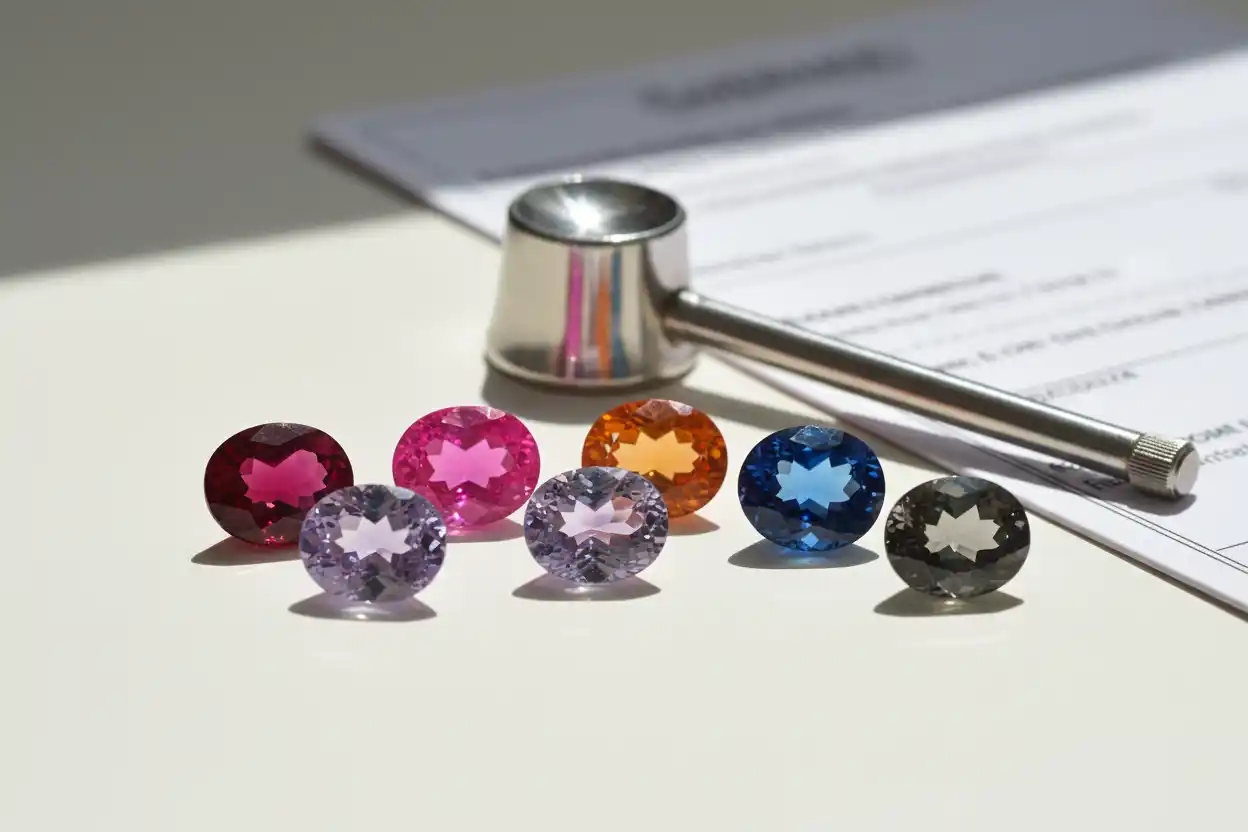
Buy Spinel: What Quality Looks Like, Color, Clarity & Value
To buy spinel intelligently, begin with natural-versus-laboratory-grown identity and then evaluate color, tone, saturation, clarity, cut, size, treatment, condition, and documentation. Spinel is a distinct mineral with the ideal composition MgAl₂O₄, refractive index around 1.718, specific gravity around 3.60, no birefringence, and Mohs hardness 8. GIA identifies red, orange, pink, purple, blue, and black among its principal colors and notes that increasing appreciation of spinel has transformed it from an historically misunderstood ruby look-alike into an important gemstone with strong collector demand. Fine natural spinel can offer intense color, high durability, and comparatively uncomplicated treatment history, but synthetic spinel is widely available and modern diffusion treatments have also appeared in portions of the blue-to-green market, making independent identification increasingly useful for significant purchases.
Buy Spinel At a Glance
| Buying Factor | What to Examine | Why It Matters |
|---|---|---|
| Identity | Natural versus laboratory-grown spinel | Synthetic spinel is widely available |
| Color | Red, cobalt-blue, hot pink, orange, lilac, purple | Color is the strongest quality factor |
| Red Quality | Pure red to slightly purplish red | Traditionally the most desirable range |
| Blue Quality | Intense violet-blue to pure blue | Fine saturated blue is rare |
| Cobalt | Cause of some vivid blue color | Color quality matters more than the word cobalt alone |
| Tone | Bright enough to avoid blackness | Excessive darkness lowers brilliance |
| Clarity | Eye-clean appearance | Visible inclusions reduce value |
| Inclusions | Octahedral negative crystals, fingerprints, needles | Can support natural-character assessment and sometimes produce stars |
| Cut | Brightness, symmetry, weight distribution | Fine rough is scarce and often cut to retain weight |
| Carat Weight | Size considered with color and clarity | Fine red, pink, and blue stones rise sharply above 5 ct |
| Heat Treatment | Rare but possible | Should be disclosed |
| Fracture Filling | Rare clarity enhancement | Changes care and value |
| Diffusion | Blue/green cobalt or nickel diffusion can occur | Important modern treatment issue |
| Durability | Mohs 8, good toughness | Suitable for daily-wear jewelry |
| Report | Natural/lab-grown and detectable-treatment confirmation | Valuable for major purchases |
Red Is the Traditional Benchmark Color
GIA identifies red as the most desirable spinel color overall and describes fine red material as ranging from orangy red to purplish red, with pure red to slightly purplish red of medium-to-medium-dark tone considered the finest range. This is the color category that historically caused spinel to be mistaken for ruby, and fine examples can achieve a vivid glowing appearance that competes visually with corundum while following a different mineralogical and treatment framework. Buyers should look for an open, saturated red that remains lively under normal lighting rather than an overly dark stone whose color becomes blackish whenever it moves away from jewelry spotlights.
The Gems Lore buy ruby guide provides the natural comparison because both gems can occupy pure-red and slightly purplish-red territory. Spinel is softer than ruby but still highly durable, and its mainstream market is generally less treatment intensive. A fine spinel should be bought as spinel rather than as a supposed bargain ruby, because its own rarity, history, and optical character justify independent evaluation.
Fine Cobalt-Blue Spinel Can Be Extremely Desirable
GIA ranks fine cobalt-blue spinel immediately behind red in the general commercial desirability hierarchy and describes the best blue colors as intense violet-blue to pure blue that are neither overly dark nor overly light. Many blue spinels are grayish because iron contributes strongly to the color, making vivid saturated blue comparatively rare. GIA’s buyer guidance also makes an important distinction: cobalt can cause vivid blue, but the market pays primarily for the resulting color rather than the mere presence of cobalt as a trace element. A poorly saturated stone should not receive a giant premium merely because a report detects cobalt, while an exceptionally vivid blue spinel deserves attention even before the buyer studies the detailed chemistry.
Hot Pink and Vivid Orange Can Command Strong Demand
GIA places vibrant hot pink and vivid orange spinel among the commercially important colors after fine red and cobalt-blue material. These stones can display intense saturation and high brilliance without needing to imitate ruby or sapphire, making them increasingly desirable among collectors seeking distinctive colors. A fine pink should look saturated rather than washed out or gray, while orange should remain vivid without becoming muddy brown.
The strongest stones combine clean face-up color with eye-clean clarity and skilled cutting. A five-carat vivid hot-pink spinel can be much more valuable than a larger pale pink stone because fine spinel pricing rewards rarity of exceptional color rather than weight alone.
Lilac, Purple, and Mauve Spinel Can Offer Better Value
GIA notes that mauve, lilac, violet, bluish purple, and lavender spinels can be attractive but generally carry lower demand than fine red, saturated blue, hot pink, or vivid orange material. This creates an appealing value segment for buyers who like cool pastel or purple tones but do not want to pay the strongest rarity premiums.
Lower commercial demand does not mean inferior mineral quality. A clean, bright lilac stone can be exquisitely cut and highly durable while costing less simply because mainstream collectors prioritize other colors.
Black Spinel Is a Different Aesthetic Category
Black spinel is generally opaque and valued for polish, luster, shape, size, and jewelry design rather than transparency and saturated color. GIA includes black among the recognized spinel colors. Buyers should therefore avoid comparing black spinel per carat with vivid transparent red or cobalt-blue material, because they occupy different commercial categories.
A black spinel can be an attractive durable jewelry gem, but its abundance and opacity normally keep it in a more accessible price tier than top transparent colors.
Eye-Clean Clarity Is Highly Desirable
GIA states that spinel with no inclusions visible to the unaided eye is more valuable than material with eye-visible inclusions and that value generally drops as inclusions become more noticeable. This differs from spessartine or rubellite, where visible inclusions receive greater market tolerance. Fine transparent spinel should therefore normally look clean during ordinary viewing, particularly when the asking price reflects top color.
A microscopic inclusion is not automatically negative because natural spinel can display beautiful diagnostic internal structures. The important distinction is whether inclusions interrupt brilliance, dominate the face, or weaken the gemstone structurally.
Natural Spinel Can Contain Attractive Octahedral and Fingerprint Features
GIA’s microscopic research documents well-formed octahedral negative crystals, mineral inclusions, fluid-filled cavities, fingerprint-like patterns, sulfides, rutile, and sphene inclusions in natural spinel. These features can interest collectors and gemologists while also providing evidence relevant to natural origin.
The presence of one familiar inclusion pattern should not replace laboratory identification, particularly because synthetic spinel is common and advanced growth methods exist. Inclusions are pieces of a larger diagnostic picture, not a substitute for comprehensive testing.
Some Inclusions Can Produce Asterism
GIA notes that needle- or plate-like inclusions can cause a star effect in spinel. Star spinel consequently belongs to a phenomenal submarket where bodycolor, star sharpness, centering, mobility, transparency, and cutting orientation become important in addition to ordinary spinel quality.
A vague cross or broad diffuse reflection should not receive the same premium as a crisp centered star. Movement video is especially useful for evaluating phenomenal stones because a still photograph cannot show how smoothly the star travels across the cabochon.
Cut Quality Is Crucial Because Fine Rough Is Scarce
GIA explains that fine spinel rough is scarce enough that cutters frequently use non-standard dimensions to preserve weight rather than forcing material into calibrated commercial sizes. Oval and cushion shapes are particularly common because they can recover weight efficiently, but the final value still depends on brilliance, symmetry, color distribution, windowing, extinction, and polish.
Weight retention is understandable in valuable rough but should not excuse a large dead center or extremely deep pavilion. A slightly lighter spinel that looks larger and brighter face-up can be a stronger purchase than a heavier stone carrying invisible mass below the girdle.
Large Fine Spinel Becomes Much More Expensive
GIA states that per-carat prices rise considerably with size and that availability drops sharply for fine red, pink, and blue spinels above approximately five carats. This is one of the clearest reasons high-quality larger spinel can command substantial premiums despite the variety’s historical reputation as an alternative to ruby or sapphire.
The increase is quality dependent. A ten-carat grayish purple spinel does not belong to the same scarcity category as a ten-carat vivid red or cobalt-blue eye-clean gem, and a large heavily included stone should not receive the same multiplier as a cleaner counterpart.
Natural Versus Laboratory-Grown Identity Is Essential
Synthetic spinel is widely available. GIA explains that flame-fusion synthetic spinel has been produced for more than a century and is commonly used to imitate many natural gems, while flux-grown synthetic spinel also exists in sophisticated forms and colors. This makes unusually clean large inexpensive spinel worth verifying rather than assuming every faceted stone is natural because it has the expected hardness and appearance.
GIA’s Colored Stone Identification Report can determine whether spinel is natural or laboratory-grown and name detectable treatments. For meaningful purchases, the invoice should explicitly state natural spinel rather than using ambiguous wording such as genuine spinel, which may be interpreted differently by inexperienced sellers.
Spinel Is Rarely Treated, but “Never Treated” Is Too Absolute
GIA’s buyer and care guidance describes spinel as rarely treated, while laboratory research documents heat treatment and fracture filling in some stones. Heat can improve clarity in certain included spinels, and fracture filling can reduce the visibility of surface-reaching breaks.
The practical implication is that natural untreated status is common enough that it should not be marketed with the same rarity premium used for no-heat ruby or sapphire. Treatment should nevertheless be disclosed when present because it affects comparability and, in filled stones, care.
Modern Diffusion Treatment Is Important in Blue and Green Spinel
GIA researchers have documented diffusion treatments that introduce color-causing elements into spinel. Cobalt diffusion can create blue coloration, and more recent research identified nickel diffusion producing blue-to-green hues in natural spinel, with high nickel concentrations near stone surfaces and color fading toward the core. This is a significant modern consideration because vivid blue and green colors can carry strong premiums.
The good news for buyers is that GIA reports these treatments as identifiable using gemological and analytical methods. An expensive vivid blue or green spinel therefore deserves independent laboratory confirmation rather than an assumption that intense color must be naturally distributed.
Cobalt Presence Does Not Automatically Define Value
GIA explicitly advises that although cobalt can cause vivid blue color, it is the visible saturated blue that makes a stone valuable rather than the mere analytical detection of cobalt. This distinction protects buyers from marketing that turns trace-element chemistry into a grading shortcut.
A fine cobalt-bearing stone should still be evaluated for hue, tone, saturation, clarity, cut, size, treatment, and condition. A grayish weakly saturated spinel does not become elite solely because laboratory analysis finds some cobalt.
Red Spinel Can Receive Geographic-Origin Reporting
GIA’s Colored Stone Identification & Origin service includes geographic-origin determination for natural red spinel when the evidence supports a conclusion. Origin can interest collectors because historically important deposits in Myanmar, Vietnam, Tanzania, Tajikistan, and other regions have produced notable material, but source should enhance fine quality rather than replace it.
A vivid eye-clean red stone from a less famous locality can be more valuable than a mediocre stone from a prestigious source. Buyers should avoid origin claims based merely on color or seller familiarity.
Vietnam Is Important for Fine Pink and Red Spinel
GIA has documented high-quality pink-to-red spinel production from the Luc Yen region of northern Vietnam and notes that Vietnamese mines continue to produce notable spinel alongside ruby. Fine Vietnamese spinel can therefore carry strong market recognition, particularly when vivid color and good transparency accompany credible provenance.
The source label should still be supported proportionately to price. A dealer’s statement may be sufficient for an affordable stone, while an important collector purchase deserves independent reporting when origin itself contributes significantly to value.
Tanzania Produces Attractive Pink, Orangy Red, Purple, and Blue Material
GIA notes that discoveries in Tanzania brought pinkish and orangy-red spinel to collector attention and that Tanzanian deposits also produce purple and blue hues. This diversity illustrates why one country can supply multiple commercial categories rather than one standardized “Tanzanian grade.”
A buyer should therefore compare the individual gemstone rather than pay for the country name alone.
Spinel Is Highly Suitable for Everyday Jewelry
GIA places spinel at Mohs hardness 8 with good toughness and describes it as durable enough for rings and other jewelry subject to daily wear. This makes spinel significantly more practical than collector gemstones such as sphene, sphalerite, scapolite, or opal.
High heat can cause some colors to fade, so repair professionals should still know what stone they are handling. Under normal wear, however, natural untreated or conventionally handled spinel is one of the stronger choices for a colored gemstone center stone.
Warm Soapy Water Is Always a Safe Cleaning Choice
GIA states that warm soapy water is always safe for spinel, while ultrasonic and steam cleaners are usually acceptable unless fractures create a concern. Fracture-filled stones should receive only warm soapy water or a damp cloth because the filler can change over time. This makes routine ownership relatively straightforward compared with more delicate materials.
When treatment status is uncertain, gentle hand cleaning remains the most conservative option.
Spinel Versus Ruby
Fine red spinel can approach ruby visually, but spinel and ruby are different minerals. Ruby is corundum with Mohs hardness 9, while spinel is MgAl₂O₄ at Mohs 8. Gems Lore’s ruby price guide also shows how fine ruby values depend heavily on heat status, origin, and extreme size scarcity, whereas spinel is usually untreated and follows a different supply curve.
GIA notes that a top-quality five-carat red spinel has historically sold for only a fraction of the equivalent ruby price, although strong modern demand has narrowed portions of that gap. Spinel should therefore be appreciated for its own qualities rather than treated merely as a substitute.
Spinel Versus Sapphire
Blue spinel can resemble sapphire, particularly when highly saturated, but sapphire is doubly refractive corundum at Mohs 9 while spinel is singly refractive and Mohs 8. Gems Lore’s buy sapphire guide explains sapphire’s large heat and diffusion-treatment market, whereas natural spinel is usually less treated.
Modern diffusion-treated blue spinel makes laboratory verification especially useful for expensive blue stones, preventing buyers from assuming the simpler historical spinel treatment picture applies in every case.
Spinel Versus Rhodolite Garnet
Pink, red, and purple spinel can overlap visually with rhodolite garnet, but spinel is harder, normally expected to be eye-clean, and can carry much steeper premiums in fine red, cobalt-blue, and larger high-quality sizes. GIA’s quality guidance specifically notes the strong size increase for fine spinel above five carats.
The Gems Lore rhodolite garnet price guide should therefore be treated as a separate market rather than a substitute price reference.
GIA Does Not Grade Spinel AAA
GIA explicitly states that it evaluates spinel but does not assign an overall quality grade, and that no standardized AAA, AA, or A quality scale exists for spinel. A report can record weight, measurements, shape, cutting style, color, natural-versus-laboratory-grown status, and detectable treatments.
The letters on a retailer’s listing therefore have meaning only within that seller’s own inventory system. Buyers should translate them into actual gem characteristics before making comparisons.
Common Red Flags When You Buy Spinel
Major warning signs include a high-value stone whose invoice does not specify natural spinel, a very clean large red or cobalt-blue stone offered suspiciously cheaply without independent identification, grayish blue material priced as elite cobalt spinel solely because a seller claims cobalt content, vivid blue or green spinel sold without modern diffusion-treatment consideration, fracture filling omitted from disclosure, large central windows hidden by dark backgrounds, exceptional size used as the only justification for a premium, AAAA presented as an official GIA grade, origin claimed solely from color, or synthetic spinel described ambiguously as genuine natural gemstone.
How to Compare Spinel Listings Fairly
Compare spinels only after aligning natural-versus-laboratory-grown identity, color family, hue, saturation, tone, clarity, inclusion visibility, heat or filling treatment, diffusion status for blue or green material, cut, windowing, dimensions, carat weight, origin evidence where relevant, condition, report status, and transaction context. A five-carat vivid red natural spinel, five-carat cobalt-blue spinel, five-carat lavender spinel, diffusion-treated blue stone, flame-fusion synthetic spinel, ruby, sapphire, and rhodolite garnet should never be collapsed into one generic price comparison.
Conclusion
To buy spinel well, prioritize natural origin, exceptional color, eye-clean transparency, skilled cutting, meaningful size, accurate treatment disclosure, and independent documentation proportionate to the value. GIA identifies red as the strongest traditional color category, followed by fine cobalt-blue material and then vibrant hot pink and vivid orange, while also noting that eye-clean spinel commands more than visibly included material. Large fine red, pink, and blue stones become substantially more selective above roughly five carats, so size can create a powerful premium when top quality remains intact.
The market remains relatively treatment-light compared with ruby and sapphire, but heat, fracture filling, cobalt diffusion, and nickel diffusion are documented, particularly making laboratory verification important for expensive blue and green stones. Synthetic spinel is also widely available, which makes explicit natural-origin confirmation essential whenever geological rarity drives the price.
Spinel’s Mohs 8 hardness and good toughness make it one of the more practical fine colored gemstones for daily jewelry. The strongest purchase therefore combines beauty with durability and documentation rather than relying on ruby comparisons, cobalt buzzwords, provenance stories, or seller-created grade letters.
Frequently Asked Questions
What spinel color is most valuable?
GIA identifies red as the most desirable overall, followed by fine cobalt-blue spinel, then vibrant hot pink and vivid orange. Within each category, saturation, tone, clarity, cut, and size determine how high the individual stone ranks.
What is the best red spinel color?
GIA describes pure red to slightly purplish red in medium-to-medium-dark tone as the finest traditional red range. A strong stone should remain vivid rather than becoming brown, gray, or overly dark.
Is cobalt-blue spinel always expensive?
Fine vivid saturated blue can be rare and expensive, but GIA emphasizes that the visible color matters more than simply detecting cobalt. A grayish weakly saturated cobalt-bearing stone does not automatically belong to the highest tier.
Should spinel be eye-clean?
Fine transparent spinel is generally expected to look clean, and GIA states that eye-clean stones are more valuable than those with visible inclusions. Natural inclusions can still be interesting and sometimes produce asterism.
Is spinel usually treated?
Spinel is rarely treated, although heat treatment and fracture filling occur. Modern diffusion treatments also exist in portions of the blue-to-green market.
Can blue spinel be diffusion treated?
Yes. GIA has documented cobalt diffusion and nickel diffusion that create or modify blue and green colors in spinel. Important vivid blue or green stones therefore benefit from laboratory testing.
Can spinel be synthetic?
Yes. GIA describes synthetic spinel as widely available, particularly flame-fusion material, with flux-grown synthetics also known. Synthetic spinel should be disclosed and priced separately from natural material.
Does spinel become much more valuable above five carats?
Fine red, pink, and blue spinels rise sharply in per-carat price as availability drops above about five carats. The premium only applies strongly when color, clarity, and cutting remain fine.
Is Vietnamese spinel valuable?
Vietnam’s Luc Yen region produces high-quality pink and red spinel and has strong collector recognition. Actual value still depends on the individual gem and credible provenance.
Is spinel durable enough for an engagement ring?
Yes. GIA places spinel at Mohs 8 with good toughness and considers it durable enough for daily-wear rings. Sensible protection from hard impacts remains appropriate for any gemstone.
How should spinel be cleaned?
Warm soapy water is always safe. Ultrasonic and steam cleaners are usually acceptable unless fractures are present, while fracture-filled material should receive only gentle cleaning.
Does GIA grade spinel AAA?
No. GIA evaluates spinel but does not issue an overall quality grade, and no universal AAA scale exists.
Can GIA determine spinel origin?
GIA can provide geographic-origin opinions for eligible natural red spinel when the evidence allows. Origin is separate from overall quality and should not replace evaluation of color, clarity, cut, and size.
Is spinel a guaranteed investment?
No. Fine natural spinel can be highly collectible, especially in vivid red, cobalt blue, hot pink, and larger sizes, but appreciation and resale liquidity are never guaranteed.