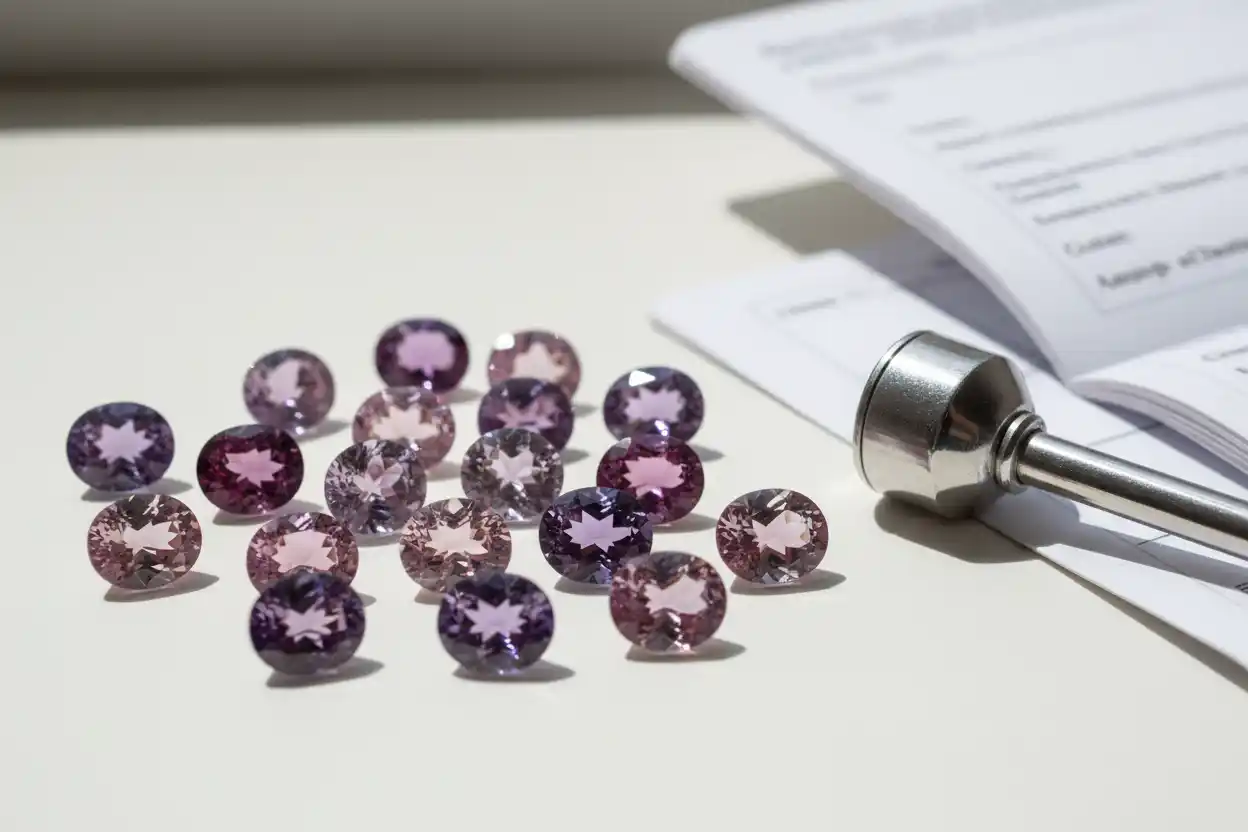
Buy Taaffeite: Smart Buying Tips & Red Flags
When you buy taaffeite, laboratory-confirmed identity should come before color, carat weight, rarity claims, geographic origin, or price. Taaffeite is one of the few gemstones whose market value depends so heavily on proving exactly what the stone is, because pale mauve, lilac, pink, gray, violet, and near-colorless examples can resemble spinel closely, while related members of the taaffeite mineral group can require more advanced testing to separate conclusively.
That makes the decision to buy taaffeite fundamentally different from buying a common transparent gem. A beautiful lavender stone without a credible identification report cannot safely inherit taaffeite pricing merely because a seller says it came from a rare parcel. Conversely, a modest-looking pale gray or mauve gemstone with strong laboratory evidence can possess substantial collector importance precisely because verified taaffeite is so scarce.
The strongest way to buy taaffeite is therefore evidence first, gemstone quality second, rarity premium third. Confirm the exact mineral identity, evaluate color and transparency, inspect inclusions and structural condition, study the cut and face-up dimensions, assess size in the context of genuinely verified stones, then examine treatment, provenance, documentation, return rights, and resale expectations.
At Gems Lore, taaffeite buying decisions are best approached through verifiable mineral identity and observable quality rather than unsupported rarity rankings or dramatic marketplace claims.
What Should You Judge First When You Buy Taaffeite?
When you buy taaffeite, use a quality hierarchy built around identification risk. The first question is not whether the stone is beautiful. It is whether the gemstone has actually been identified as taaffeite rather than spinel, sapphire, another oxide mineral, a related taaffeite-group species, or a manufactured substitute.
The mineral traditionally called taaffeite is now formally known as magnesiotaaffeite-2N’2S, a rare beryllium-magnesium-aluminum oxide. Its composition, mineral structure, discovery, colors, and geological background are covered in taaffeite meaning.
Once identity is secure, color, transparency, clarity, cut, size, and condition become meaningful value factors. Before identification, they describe only an attractive unknown stone.
| Priority | What to establish | Stronger choice | Main red flag |
|---|---|---|---|
| 1 | Exact identity | Independent report specifically identifying taaffeite | Seller rarity claim without strong testing |
| 2 | Natural origin | Natural gemstone clearly established | “Real taaffeite” without natural/lab clarification |
| 3 | Color | Attractive mauve, lilac, pink, violet, gray-violet, or rare stronger color | Muddy or extremely weak color priced as exceptional |
| 4 | Transparency | Clean transparent faceting quality | Cloudy or translucent material priced like fine transparent gem |
| 5 | Clarity | Inclusions that do not dominate appearance or structure | Large surface-reaching fractures |
| 6 | Cut | Balanced brilliance and sensible weight retention | Major window, heavy extinction, excessive depth |
| 7 | Size | Fine characteristics maintained as weight increases | Large weight treated as proof of identity or quality |
| 8 | Treatment | Clear statement of known treatment status | “Untreated” used instead of proving identity |
| 9 | Provenance | Traceable when locality carries a premium | Sri Lankan or Myanmar origin inferred from color |
| 10 | Documentation | Report matches exact stone | Seller certificate or unrelated report |
Use this hierarchy every time you buy taaffeite, because the financial difference between verified taaffeite and a visually similar spinel can be enormous even when both gemstones are attractive.
Taaffeite Identity Is More Important Than Rarity Language
Taaffeite is genuinely rare, but rarity should never be used as evidence that a particular stone is taaffeite.
When you buy taaffeite, phrases such as “one of the rarest gems on Earth,” “collector miracle,” “museum grade,” or “rarer than diamond” should prompt more verification rather than more excitement.
The mineral’s scarcity actually makes misrepresentation easier. Most buyers have never handled a confirmed taaffeite, so they lack a reliable visual reference. A seller can therefore attach the rare name to an ordinary lilac or gray gemstone and depend on rarity folklore to fill the evidence gap.
A defensible buy taaffeite transaction works in the opposite direction. First prove the mineral. Then decide how rare and valuable that particular example is.
Why Taaffeite Was Historically Confused With Spinel
Taaffeite’s discovery itself illustrates the central identification problem. The first recognized example was already faceted and had been considered spinel until its optical behavior showed that something was different.
Spinel crystallizes in the cubic system and is singly refractive. Taaffeite is doubly refractive, although its birefringence is comparatively small and may not produce obvious doubling to an untrained observer.
Their colors can overlap strongly. Both can appear mauve, gray, violet, pink, reddish, or near-colorless, while their refractive properties and densities are close enough that incomplete testing can create confusion.
Before you buy taaffeite, understanding ordinary spinel helps explain why a visual comparison is insufficient.
A beautiful natural spinel remains a legitimate gemstone. It simply should not receive a taaffeite rarity premium unless testing proves the rarer species.
Do Not Try to Identify Taaffeite From Facet Doubling Alone
Because taaffeite is doubly refractive while spinel is singly refractive, buyers sometimes assume they can buy taaffeite confidently by spotting doubled facet edges through a loupe.
That is too simplistic.
Taaffeite’s birefringence is small, and whether doubling is visible depends on stone orientation, magnification, cutting, size, focus, and observer experience. Internal strain or other optical effects can also complicate basic observations in some gemstones.
When you buy taaffeite, double refraction should be treated as a diagnostic direction for a gemologist, not a complete consumer authentication test.
A rare-gem purchase deserves more than one optical clue.
Taaffeite Versus Musgravite Requires Even More Care
Musgravite is closely related to taaffeite and belongs to the same mineral group, but the two are separate mineral species with different structural stacking sequences.
The gemstone historically called musgravite is formally magnesiotaaffeite-6N’3S, while classic taaffeite is magnesiotaaffeite-2N’2S.
Their appearance can overlap substantially. Both may occur in gray, violet, greenish, brownish, near-colorless, and related colors, and routine visual inspection cannot separate them reliably.
The detailed mineral distinction appears in musgravite meaning.
When you buy taaffeite at a substantial price, a report that says only “taaffeite group” may not provide enough specificity if the transaction is priced as one exact species.
A Musgravite Price Should Not Be Applied to Taaffeite Automatically
Rare-gem marketing often places taaffeite and musgravite beside each other in lists of scarce gemstones, which can encourage buyers to assume their values are interchangeable.
They are not.
When you buy taaffeite, value the exact material documented on the report. Do not accept a musgravite valuation merely because the gemstones belong to the same mineral group.
Likewise, a seller should not describe a stone as “taaffeite/musgravite” while charging the stronger premium associated with whichever name sounds more valuable.
Uncertainty should reduce confidence, not increase the price.
What Does Fine Taaffeite Color Look Like?
Most taaffeite is not intensely saturated. Pale mauve, lilac, lavender, grayish violet, pinkish violet, pink, and subdued purple are among the colors most commonly associated with transparent gems.
When you buy taaffeite, this restrained palette is important because sellers sometimes use aggressive saturation editing to make a naturally subtle stone look dramatically violet or pink.
Fine color should be attractive within the material’s realistic range. A medium lilac or pink stone with good transparency may be much more desirable than a dark brownish-purple gem, even if the darker stone initially looks more saturated.
A stronger color can deserve a premium, but only when it remains believable and is accompanied by verified identity.
Pale Color Does Not Mean Low Quality Automatically
Taaffeite differs from gemstones where saturated color dominates nearly every value decision.
Because confirmed gem material is so scarce, a clean near-colorless, pale mauve, or gray-violet taaffeite can remain highly collectible.
When you buy taaffeite, ask whether the pale color is attractive and whether the transparency, cut, size, and documentation compensate for low saturation.
A large, transparent, nearly colorless verified stone may have far greater collector importance than a vividly colored but unverified marketplace listing.
Rarity changes the normal color hierarchy.
Strong Pink and Purple Can Command a Premium
Although subtle colors are common, cleaner pink, purplish-pink, violet, and richer mauve stones can be especially desirable.
When you buy taaffeite in a stronger color, examine hue, tone, saturation, and brightness together. A stone should not become so dark that the color closes into brown or gray.
Ask for video under neutral-looking illumination rather than only photographs taken against black backgrounds or beneath warm spotlights.
The stronger the color premium, the more important it becomes to know that the color displayed online corresponds closely to the stone you will receive.
Rare Red, Blue, and Greenish Taaffeite Need Strong Verification
Taaffeite can occur outside the familiar mauve and pink range, including rare reddish, bluish, greenish, and other unusual examples.
When you buy taaffeite in one of these less familiar colors, do not let rarity terminology replace material identification.
Blue spinel, sapphire, chrysoberyl-related materials, synthetic gemstones, and other transparent stones can create convincing visual overlap. Greenish or red material creates similar problems.
An unusual color should increase the need for laboratory confirmation because a mistake becomes easier to hide behind the claim that the gemstone is exceptionally rare.
Color-Change Taaffeite Is a Specialized Collector Category
Some taaffeite displays a noticeable change in appearance between different light sources, with combinations that can involve greenish, grayish, bluish, violet, or purple tones.
When you buy taaffeite specifically for color change, request continuous video showing the same gemstone transitioning between two controlled lighting conditions.
A seller should not present one green image and one purple image without demonstrating that both belong to the same stone.
Evaluate both color states. A dramatic change between two muddy colors may be scientifically interesting without being aesthetically superior to a stable attractive lilac gem.
Phenomenon strength and color quality should be judged separately.
Transparency Is One of the Strongest Quality Factors
Fine taaffeite is valued primarily as a transparent faceted collector gemstone.
When you buy taaffeite, transparency should therefore receive more weight than it would in an opaque mineral specimen. Heavy milkiness, dense clouds, or widespread fractures can push an otherwise rare stone into a lower commercial tier.
However, transparency does not require microscopic perfection.
A transparent stone may contain identifiable crystals, healed fissures, negative crystals, fingerprint-like inclusions, or other natural features while still returning light effectively.
The question is whether the interior remains open enough for color and brilliance to perform.
Taaffeite Can Contain Natural Inclusions
Documented inclusions in taaffeite include apatite, mica-related minerals, spinel crystals, zircon, negative crystals, healed fissures, and fingerprint-like internal features.
When you buy taaffeite, these inclusions can be scientifically interesting and may contribute to natural-origin interpretation.
However, do not assume that one familiar-looking inclusion proves the mineral identity.
A spinel crystal inside a transparent stone does not automatically make the host taaffeite, and the absence of inclusions does not prove laboratory growth.
Professional identification considers the entire optical, chemical, structural, and microscopic evidence set.
Eye-Clean Taaffeite Deserves a Premium
Because transparent material is scarce, an eye-clean taaffeite with attractive color can command substantial collector interest.
When you buy taaffeite, judge clarity at ordinary viewing distance first. If your attention goes immediately to the gemstone’s color and brilliance rather than to a white fracture or dark crystal, the inclusions may be acceptable.
Then use magnified imagery to determine whether any internal feature creates structural risk.
A minor enclosed crystal is different from a surface-reaching fissure near the girdle.
Clarity should be judged through both beauty and durability.
Surface-Reaching Fractures Should Affect Value
Taaffeite has high hardness, generally around 8–8.5 on the Mohs scale, but hardness does not make a fractured stone indestructible.
When you buy taaffeite, inspect cracks that reach the table, crown, girdle, pavilion, or exposed corners.
A fissure intersecting a thin girdle can create a vulnerability during setting or impact. A large reflective fracture beneath the table can also reduce transparency and brilliance even if the stone remains stable.
The distinction between hardness and resistance to breakage is explained in gemstone toughness vs hardness.
Do not let a high Mohs number distract you from the condition of the exact gemstone.
Taaffeite Is Hard Enough for Jewelry, but Rarity Changes the Risk
With Mohs hardness around 8–8.5, taaffeite resists scratching considerably better than quartz, feldspar, opal, or many collector gems.
When you buy taaffeite for jewelry, however, physical durability is only part of the decision.
A rare gemstone is difficult to replace. A chipped ordinary spinel may be replaceable with a comparable stone, while replacing a specific taaffeite of similar color, dimensions, clarity, and documentation could be extremely difficult.
That replacement problem makes protective setting and careful wear sensible even when the mineral itself is reasonably hard.
A Pendant Can Be Safer Than a Daily Ring
When you buy taaffeite specifically to wear, pendants, earrings, and protected occasional-use jewelry can reduce exposure to impact.
A ring can still be practical when the stone is structurally sound and the mounting is designed intelligently, but frequent hand wear exposes it to countertops, door frames, tools, metal edges, and accidental pressure.
The more irreplaceable the stone, the stronger the case for reducing unnecessary risk.
A collector-grade taaffeite does not need to become a daily ring to demonstrate that it is wearable.
Setting Quality Is Part of the Purchase
A poorly designed mounting can create more risk than ordinary use.
When you buy taaffeite already mounted, inspect whether prongs press against visible fractures, whether corners are protected, whether the stone rattles, and whether the girdle appears chipped beneath the setting.
When you buy taaffeite loose, choose a jeweler comfortable setting rare colored gemstones rather than assuming any diamond-setting technique is automatically appropriate.
The setting should secure the gem while avoiding concentrated force on structural weaknesses.
Cut Quality Matters Despite Extreme Rarity
Rare rough is often cut conservatively to retain weight, which means taaffeite may appear in non-standard shapes, deep pavilions, asymmetrical outlines, and designs optimized around inclusions.
When you buy taaffeite, some compromise is reasonable because preserving rare material can be commercially sensible.
That does not mean every poor cut should be accepted.
A strong gemstone should still return light attractively, present its best color face-up, and have dimensions that make sense for the weight.
Rarity can justify imperfect symmetry. It should not automatically excuse a large dead window.
Windowing Can Reduce an Otherwise Fine Taaffeite
A window is a pale or transparent face-up region where light exits through the pavilion instead of returning toward the viewer.
When you buy taaffeite, examine the center against a neutral white or gray background.
If you can clearly see the background through a broad stationary area, the stone may be too shallow or poorly proportioned.
This problem becomes particularly obvious in pale material because there is little saturation to disguise light leakage.
A slight window can be acceptable in extremely rare rough if the overall stone remains attractive. A dominant transparent center should still influence the price.
Extinction Can Make Mauve and Violet Stones Look Gray or Black
Extinction creates dark face-up regions where little useful light returns.
When you buy taaffeite in stronger purple, violet, brownish, or grayish colors, rotate the gemstone slowly and examine whether dark facets break up as the stone moves.
A healthy cut should show an active pattern rather than a large persistent black region.
Because many taaffeites already have muted colors, excessive extinction can make the gem appear much less lively than the seller’s best photograph suggests.
Compare Face-Up Dimensions With Carat Weight
Carat weight measures mass, not visible size.
When you buy taaffeite, request exact millimeter dimensions because valuable rough is often cut deeply to preserve weight. Two stones with similar face-up measurements can differ substantially in carat weight if one carries a thick girdle or deep pavilion.
The heavier stone may still be worth more if the depth improves color or preserves an exceptional natural gem. However, the extra weight should not be treated as visible size.
A rare gemstone buyer should understand exactly what the carat premium is purchasing.
Size Premiums Rise Sharply in Fine Taaffeite
Verified taaffeite is scarce at ordinary faceted sizes, and fine transparent examples become increasingly notable as weight rises.
When you buy taaffeite above the sizes commonly encountered in collector inventories, verification should become stronger rather than weaker.
Large weight magnifies the financial consequence of misidentification. A supposedly substantial taaffeite without a major laboratory report should therefore be treated as an unidentified gemstone until proven otherwise.
The broader relationship among identity, quality, size, and collector value is explained in taaffeite price.
Size becomes valuable only after identity is secure.
Do Not Apply a Price-per-Carat Number Mechanically
Rare gemstones do not behave like standardized commodities.
When you buy taaffeite, a per-carat figure taken from another stone may be almost meaningless unless the comparison matches identity, color, clarity, size, cut, condition, documentation, and provenance closely.
A small pale included stone and a large clean pink gem are not equivalent merely because both are taaffeite.
Price guides are useful for understanding the market hierarchy, but the individual gemstone should determine the final comparison.
Routine Treatment Is Not the Main Taaffeite Risk
Heat, irradiation, diffusion, and routine clarity enhancement are not established as central commercial practices in the taaffeite market.
When you buy taaffeite, misidentification is usually a much larger concern than standard gemstone treatment.
That does not mean treatments are impossible.
A surface coating could theoretically modify color, while a fracture could contain filler, resin, or another substance. Repair and recutting can also affect condition.
Ask about treatment, but do not let an “untreated” declaration replace proper identification.
Untreated Does Not Mean Authenticated
This distinction deserves emphasis because rare-gem sellers frequently use untreated as a reassurance word.
When you buy taaffeite, the statement “100% natural untreated” actually contains multiple claims.
Is the material genuinely taaffeite?
Did it form naturally?
Has it received any treatment?
These questions require different evidence.
A natural untreated spinel is still spinel. It does not become taaffeite because the seller correctly describes its treatment status.
Authentication always comes first.
Fracture Filling Should Be Disclosed
A surface-reaching fissure can potentially contain resin, polymer, oil, glass-like filler, or another substance designed to make the fracture less visible.
When you buy taaffeite with noticeable fissures, ask specifically whether any filler has been detected or disclosed.
Filling can affect appearance, care, repair procedures, and long-term condition.
Because high-quality taaffeite is so rare, a filled stone might still interest a collector if the treatment is clearly documented. The problem arises when enhanced transparency is presented as natural clarity.
Coatings Are Uncommon but Still Worth Screening
A surface coating can modify the apparent color of almost any faceted gemstone.
When you buy taaffeite with unusually intense color, inspect scratches, facet junctions, girdle areas, and chips for abrupt surface differences.
These observations should prompt professional examination rather than destructive testing.
Do not scrape a rare gemstone in an attempt to prove a coating.
The value of a taaffeite is far too dependent on surface condition to justify an amateur destructive experiment.
Synthetic Taaffeite Is Not the Main Marketplace Threat
Experimental laboratory-created taaffeite-type material can exist, but synthetic faceted taaffeite is not a major routine jewelry category.
When you buy taaffeite, more realistic misrepresentation risks include synthetic spinel, synthetic sapphire, glass, or another natural gemstone sold under the rare name.
This distinction matters because sellers sometimes use “no known synthetic taaffeite market” as though it proves their stone is authentic.
It does not.
A stone can be an imitation without being synthetic taaffeite.
Synthetic Spinel Is a Significant Lookalike
Laboratory-grown spinel has been widely available and can occur in colors that overlap strongly with taaffeite.
When you buy taaffeite in pale pink, lilac, violet, gray, or near-colorless ranges, a visually convincing synthetic spinel can therefore create a much less expensive substitute.
Taaffeite’s double refraction separates it fundamentally from cubic spinel, but a buyer should not rely on photographs to make that distinction.
A serious purchase belongs in a laboratory.
Sapphire and Other Corundum Can Also Resemble Taaffeite
Pale pink sapphire, purple sapphire, near-colorless corundum, and other sapphire colors can overlap visually with taaffeite.
Corundum has different optical properties and higher hardness, making professional separation straightforward when appropriate testing can be performed.
However, mounted jewelry and limited-access stones can make consumer-level evaluation difficult.
When you buy taaffeite, a beautiful lavender appearance should therefore be treated as a quality characteristic only after the material has been confirmed.
Chrysoberyl Can Create Additional Confusion
Chrysoberyl is another hard transparent gem that can occur in pale yellow, greenish, brownish, and related colors.
Its chemistry and optical properties differ from taaffeite, but the mineralogical relationship is historically interesting because taaffeite’s structure has features related to both spinel- and chrysoberyl-type layers.
For buying purposes, that structural relationship does not make the gemstones interchangeable.
When you buy taaffeite, a report should identify taaffeite specifically rather than a broad “rare beryllium gemstone” category.
Home Scratch Tests Are Inappropriate
Taaffeite is hard, but scratching another surface cannot establish its identity.
Spinel, sapphire, chrysoberyl, and several other gems are also hard enough that a scratch test would remain inconclusive while risking permanent damage.
When you buy taaffeite, avoid hardness scratching, hot needles, acid tests, impact tests, flame testing, or improvised chemical experiments.
Rare gemstones should be examined nondestructively.
A Major Laboratory Report Should Be Expected for Meaningful Purchases
Taaffeite is one of the stones where documentation is not merely a luxury added after purchase.
When you buy taaffeite at meaningful value, laboratory confirmation forms part of the gemstone’s commercial credibility.
A useful report should identify the species specifically enough for the price being asked, record measurements and weight, describe color and transparency, and report relevant detectable treatments within the laboratory’s scope.
The wider differences among laboratory services, identification reports, and appraisals are explained in gemstone certification.
For rare taaffeite, the laboratory’s competence with unusual colored stones matters as much as general brand recognition.
Ask Whether the Report Says Taaffeite or Only Taaffeite Group
The wording matters.
When you buy taaffeite, a report that identifies magnesiotaaffeite-2N’2S specifically provides a different level of certainty from a vague document describing the stone as taaffeite-group material.
This becomes particularly important when musgravite or another closely related group member is part of the comparison.
Read the entire conclusion rather than relying on what the seller says the report “basically means.”
The gemstone should be priced according to what the document actually establishes.
Advanced Testing May Be Necessary
Routine refractive-index measurements, specific gravity, polariscope behavior, and microscopy can provide strong evidence, but exact separation among taaffeite-group minerals can require Raman spectroscopy, quantitative chemical analysis, X-ray methods, or comparable advanced techniques.
When you buy taaffeite at a price that depends on exact species, do not be surprised if a serious laboratory uses more than ordinary gemological instruments.
The extreme rarity of the material makes advanced analysis reasonable.
A seller describing sophisticated testing as unnecessary because “an expert can tell by looking” is minimizing the central risk of the transaction.
A Report Is Not an Appraisal
A laboratory report establishes identity and supported characteristics. An appraisal estimates monetary value for a defined purpose.
When you buy taaffeite, do not treat an enormous insurance appraisal as proof of identity.
An appraisal may be based partly on information supplied by the owner or seller. Unless the underlying gemstone identification was established through competent testing, the valuation cannot solve the species question.
Likewise, an excellent laboratory report does not guarantee that the asking price is fair.
First establish what the stone is. Then determine what it is worth.
Match the Report to the Exact Gemstone
A genuine laboratory report provides no protection if it belongs to another stone.
Before you buy taaffeite, compare the report number, weight, length, width, depth, shape, cutting style, color description, and photograph where available with the gemstone being offered.
If the stone has been recut since testing, request an explanation and updated documentation where appropriate.
A seller saying that several stones came from the same parcel does not allow one report to authenticate all of them.
Every high-value taaffeite should be matched to its own evidence.
Verify the Report Independently
When possible, use the issuing laboratory’s own verification system or contact procedure rather than relying on a screenshot supplied by the seller.
Counterfeit or altered paperwork can exist in high-value gemstone markets.
When you buy taaffeite, compare the digital or official record with the physical report and exact stone details.
A valid report number copied from a genuine taaffeite does not prove that the gemstone in front of you is the one described.
Report verification and stone matching are separate steps.
Seller Certificates Should Not Replace Independent Evidence
A retailer can issue its own authenticity card, appraisal, or certificate, but that document represents the seller’s conclusion unless an independent laboratory actually performed the testing.
When you buy taaffeite, ask who identified the gemstone and what methods were used.
A laminated card stating “100% natural rare taaffeite” does not carry the same evidentiary weight as an independent laboratory report from an institution experienced with rare colored gemstones.
The more expensive the purchase, the less reasonable it becomes to let the seller be the sole source of authentication.
Geographic Origin Usually Matters Less Than Identity
Important taaffeite gem material is associated most strongly with Sri Lanka, with additional material reported from Myanmar, Tanzania, and other regions.
When you buy taaffeite, exact mineral identity is generally far more important than country of origin.
A verified Sri Lankan stone and a verified Tanzanian stone are both taaffeite. Their individual color, clarity, size, cutting, and provenance determine the value difference.
An exotic locality claim cannot compensate for an inconclusive species identification.
Sri Lanka Is Historically Central to Taaffeite
Sri Lanka is particularly important because taaffeite was first recognized among faceted stones associated with Sri Lankan gem gravels, where it can occur alongside spinel, sapphire, zircon, chrysoberyl, garnet, and other minerals.
When you buy taaffeite represented as Sri Lankan, the claim is plausible but should still be distinguished from laboratory identity.
Many alluvial gems lose direct connection with their primary host rock, making precise mine-level provenance difficult.
A seller should not charge an outsized Ratnapura or exact-mine premium without traceable evidence.
Country-level context and exact mine provenance are different claims.
Myanmar Taaffeite Can Resemble Sri Lankan Material
Taaffeite has also been documented from Myanmar, including material from the Mogok region.
Colors can include very pale purplish-pink, mauve, grayish, and related tones, overlapping strongly with material from other sources.
When you buy taaffeite represented as Myanmar material, do not treat color as proof of origin.
For many buyers, a strong independent species identification is more commercially important than a speculative locality opinion.
Tanzania Is Another Important Rare-Gem Source
Taaffeite-group material has been recovered from East African gem-bearing environments, including Tanzania.
When you buy taaffeite from this market, remember that similar alluvial parcels can contain spinel and other minerals that are difficult to distinguish visually.
That geological context reinforces the need for laboratory confirmation.
A parcel origin does not authenticate every individual pebble inside it.
China and Other Occurrences Need Gem-Quality Context
Taaffeite-group minerals have been reported from additional geological environments, including material from China.
However, a mineral occurrence does not automatically produce transparent faceting quality.
When you buy taaffeite, distinguish between scientifically identified mineral specimens, translucent material, and transparent gem-quality stones.
A locality may be important mineralogically while contributing very little to the faceted jewelry market.
Provenance Can Add Collector Value
For a rare gemstone, documentation can extend beyond laboratory identity.
Old collection labels, auction records, respected dealer invoices, prior laboratory reports, documented ownership, cutting records, or traceable source information can add useful provenance.
When you buy taaffeite with an important history, preserve those documents with the gemstone.
Do not separate the stone from its labels and reports after purchase.
Rare-gem provenance can be difficult to reconstruct once lost.
Actual-Stone Photography Is Mandatory
Stock photographs are unacceptable for an individually priced taaffeite.
When you buy taaffeite online, request high-resolution photographs of the exact gemstone face-up, from the side, and from the pavilion where practical.
The face-up image shows color, windowing, extinction, and visible inclusions. The side view reveals depth and girdle thickness. The pavilion can expose chips, fractures, poor polish, and hidden inclusions.
A rare-gem listing should document the individual stone rather than represent it with an idealized example.
Ask for Neutral-Light Video
Mauve, pink, violet, and gray gemstones are highly sensitive to camera white balance.
When you buy taaffeite online, request continuous rotating video under neutral-looking illumination and at least one ordinary indoor lighting condition.
A black background can make pale color appear stronger, while warm light can intensify pink or reddish components. Cool lighting can emphasize violet or blue.
You should understand how the stone looks away from the seller’s preferred photographic environment.
Check Whether the Color Is Digitally Oversaturated
Taaffeite often has delicate rather than neon color.
When you buy taaffeite from a listing showing intense electric violet or saturated magenta, examine surrounding objects in the frame.
If white paper looks purple, tweezers carry an unnatural color cast, or skin tones appear heavily altered, the gemstone may also be oversaturated digitally.
Request a second unedited-looking image before accepting a rare-color premium.
Side Views Reveal Hidden Weight
Rare rough encourages cutters to preserve every possible fraction of weight.
When you buy taaffeite, that can produce thick girdles, deep pavilions, and unusual outlines.
These compromises may be perfectly rational, but you should understand them.
A one-carat taaffeite that faces up much smaller than another stone of similar weight may carry considerable hidden depth. Decide whether preserving that weight provides any visual or collector benefit.
Inspect Girdle and Culet Condition Closely
Because replacements are difficult, small chips deserve more attention than they might on an abundant gemstone.
When you buy taaffeite, examine the girdle, corners, culet, and facet junctions through close imagery.
A repaired or recut stone can still be highly desirable, but the condition history should be disclosed.
A chip hidden beneath a prong does not disappear as a value factor simply because the mounting makes it difficult to see.
Return Rights Are Part of the Authentication Method
When you buy taaffeite remotely, a meaningful return period should allow enough time to inspect the stone and, where necessary, obtain an independent second opinion.
Check whether laboratory submission is permitted during the return period, whether tags must remain attached, who pays insured return shipping, and what happens if the identification differs materially from the listing.
Do not mount, recut, polish, or otherwise alter a loose stone before you decide whether to keep it.
An expensive final-sale rare gemstone with no realistic verification path transfers almost all risk to the buyer.
Put Every Important Claim in Writing
When you buy taaffeite, the invoice should identify the gemstone as specifically as the seller is pricing it.
Useful documentation may include:
- Natural taaffeite or magnesiotaaffeite-2N’2S.
- Exact weight.
- Exact dimensions.
- Shape and cutting style.
- Known treatment status.
- Laboratory name and report number.
- Geographic provenance when represented.
- Any known recutting or repair.
- Return and inspection terms.
A vague receipt saying only “rare purple gemstone” offers little protection if the transaction was priced as verified taaffeite.
Seller-Created Grades Mean Very Little Without Definitions
AAA, AAAA, investment grade, museum grade, collector grade, ultra rare, and similar descriptions do not form a universal taaffeite grading system.
When you buy taaffeite with one of these labels, ask what earned it.
Does AAA refer to color? Clarity? Size? Species confirmation? Cut? Provenance?
If the seller cannot define the grade objectively, ignore it.
A verified, attractive taaffeite does not need an invented letter system to establish why it is special.
Rarity Rankings Are a Poor Valuation Tool
Online lists often rank taaffeite among the rarest gemstones in the world.
That broad statement may provide mineralogical context, but it does not tell you the value of the specific stone in front of you.
When you buy taaffeite, compare verified stones of similar quality rather than applying a dramatic rarity ranking.
Rarity without market context can be misleading. A gemstone can be extremely scarce and still have a small buyer pool.
Large Online “Taaffeite” Listings Deserve Extra Skepticism
A large transparent stone sold at a surprisingly modest price should trigger more questions, not a rush to purchase.
When you buy taaffeite, consider whether the size, clarity, color, documentation, and price make sense together.
A multi-carat verified fine taaffeite is an unusual object. If the seller offers several nearly identical large stones with generic certificates and no major laboratory evidence, the inventory pattern itself deserves scrutiny.
Extreme scarcity should not produce unlimited standardized supply.
Price Should Follow Proof
One of the cleanest rules when you buy taaffeite is that price should rise only after confidence rises.
An unidentified lilac gemstone should be valued as an unidentified gemstone.
A stone with a credible independent taaffeite report can enter the taaffeite market.
A particularly fine example with strong color, clarity, size, cutting, and provenance can justify another premium.
This staged approach prevents rarity language from being priced before rarity has been demonstrated.
Value Trade-Off: Stronger Color Versus Better Clarity
Suppose one verified stone has rich pink-violet color with a visible inclusion, while another is nearly eye-clean but pale gray-mauve.
Which should you buy taaffeite?
The answer depends on how distracting the inclusion is and how much you value color.
Because attractive saturation is uncommon, the included stronger-color gem may be the more compelling collector piece when the inclusion is structurally harmless.
If the inclusion is a large central surface-reaching fracture, however, the cleaner stone may provide better overall quality.
Trade-offs should be judged individually.
Value Trade-Off: Better Identification Versus Larger Size
If your budget allows either a smaller taaffeite with strong independent documentation or a larger stone with only a seller-issued certificate, the smaller documented gem is usually the more defensible purchase.
When you buy taaffeite, identity is the foundation of value.
Extra weight attached to uncertainty does not create secure rarity.
A fraction of a carat supported by excellent evidence can be more meaningful than several carats of assumption.
Value Trade-Off: Better Cut Versus More Weight
Because cutters preserve rare rough, deep or asymmetric taaffeite can be reasonable.
However, if two verified stones are otherwise comparable and one shows noticeably better brilliance, face-up spread, and balance, the better-cut gem may offer greater visual value despite weighing less.
When you buy taaffeite, do not allow the scale to override your eyes after identity has been established.
Visible beauty is still part of gemstone quality.
Value Trade-Off: Provenance Versus Face-Up Beauty
A well-documented Sri Lankan stone can carry historical and collector interest, but provenance should not force every buyer to accept poor color or cutting.
When you buy taaffeite for mineralogical collecting, provenance may rank highly.
When you buy taaffeite for jewelry, attractive color, transparency, and cut may matter more.
The correct trade-off depends on why you want the gemstone.
Value Trade-Off: Loose Collector Gem Versus Jewelry
A loose taaffeite can remain in a protective gem box with its documentation, allowing examination from every direction and minimizing wear risk.
A mounted stone can provide more personal enjoyment but introduces setting, impact, cleaning, and loss considerations.
When you buy taaffeite of exceptional rarity, deciding whether to mount it is part of the purchase rather than an afterthought.
A lower-profile pendant or protected occasional-wear piece can provide a good middle ground.
Resale Expectations Should Be Conservative
Taaffeite’s scarcity does not automatically make it a liquid investment.
When you buy taaffeite, remember that the potential resale audience is much smaller than the market for diamond, ruby, sapphire, emerald, or mainstream spinel.
A buyer may insist on a recognized laboratory report, condition documentation, provenance, and possibly independent retesting.
Dealer margins and transaction costs can also be substantial in specialist rare-gem markets.
Fine documented stones may attract collector demand, but no gemstone guarantees appreciation.
A Practical Buy Taaffeite Decision Matrix
| Factor | Strong candidate | Reasonable compromise | Serious concern |
|---|---|---|---|
| Exact species | Report specifically identifies taaffeite | Additional testing pending during return period | Seller identification only |
| Natural origin | Independent confirmation | Modest purchase with strong return rights | “Natural” unsupported by technical evidence |
| Color | Attractive mauve, lilac, pink, violet, gray-violet | Pale but clean and documented | Muddy stone sold on rarity alone |
| Transparency | Transparent faceting quality | Minor haze in otherwise strong gem | Heavy cloudiness priced as fine |
| Clarity | Eye-clean or modest stable inclusions | Visible inclusion with fine color | Large central open fissure |
| Cut | Lively and reasonably spread | Deep/asymmetric cut preserving rare rough | Dominant window or severe extinction |
| Size | Fine quality maintained into meaningful weight | Small verified collector stone | Large undocumented stone |
| Musgravite separation | Exact species conclusion | Advanced testing pending | “Taaffeite/musgravite” used interchangeably |
| Treatment | Clear disclosure | No evidence of routine treatment | “Untreated” used as authenticity proof |
| Provenance | Traceable where premium matters | Country unspecified | Exact locality invented from appearance |
| Report | Independent and matched to exact gem | Reputable retesting planned | Marketplace certificate only |
| Photography | Exact stone, multiple angles, neutral light | Clear but limited imagery | Stock photos or extreme saturation |
| Returns | Allows non-destructive verification | Reasonable restrictions | High-value final sale |
| Resale claim | Specialist-market limitations acknowledged | No financial promises | Guaranteed appreciation |
Use this matrix when you buy taaffeite so that every premium corresponds to a characteristic you can see, verify, or document.
Stone-Specific Red Flags When You Buy Taaffeite
The strongest red flag is a substantial taaffeite price without substantial taaffeite evidence.
If a seller offers a rare multi-carat mauve gemstone but provides only a generic authenticity card, the value foundation is missing.
Another major warning is ambiguous wording such as “taaffeite or musgravite,” especially when the seller charges the stronger premium associated with precise rare-mineral identification. Related minerals are not interchangeable simply because advanced testing is inconvenient.
Be cautious with listings that describe every lilac stone as top color. Taaffeite frequently occurs in subdued shades, but an unattractive gray or brown stone should not receive an exceptional quality premium merely because the mineral is rare.
Large transparent stones offered in repeated quantities deserve additional scrutiny, as do unusually intense purple or red stones shown only in heavily edited photographs.
Other red flags include report numbers that do not match the gemstone, missing millimeter dimensions, an unrelated appraisal presented as laboratory identification, a precise Sri Lankan or Myanmar mine claim without provenance, prominent fractures with no treatment discussion, and a seller refusing independent verification.
Perhaps the most revealing warning is a claim that no laboratory report is necessary because “everyone in the trade can recognize taaffeite.” The history of the gemstone demonstrates the opposite.
A Better Way to Buy Taaffeite
Start your buy taaffeite process by deciding how much identity certainty you require. For any meaningful collector purchase, that should be extremely high.
First, obtain the independent report and read the exact mineral conclusion. Determine whether it identifies taaffeite specifically or only a broader mineral group.
Second, match the report to the stone through weight, dimensions, shape, photograph, color, and report number.
Third, evaluate the actual gemstone. Look at color in neutral lighting, transparency, inclusions, windowing, extinction, polish, girdle condition, and visible face-up dimensions.
Fourth, compare size only after the other quality factors are understood. A large verified clean stone deserves more attention than a small one, but a large unverified stone does not deserve taaffeite pricing simply because the seller supplied a carat figure.
Fifth, investigate treatment and provenance. Routine enhancement is less important than misidentification, yet filling, coatings, repairs, recutting, and color modification should still be disclosed if present.
Finally, examine return rights, invoice wording, insurance practicality, and likely resale audience.
The broader Buying & Value collection applies similar evidence-first principles across many gemstones, but the best way to buy taaffeite is uniquely dependent on exact mineral identification because the name itself carries such a large portion of the value.
Frequently Asked Questions
What should I check first when I buy taaffeite?
When you buy taaffeite, begin with an independent laboratory report identifying the gemstone specifically as taaffeite or magnesiotaaffeite-2N’2S. Color, size, clarity, and provenance should be evaluated only after identity is secure.
Why is taaffeite difficult to buy confidently?
Taaffeite can resemble spinel and other pale colored gems, while closely related taaffeite-group minerals may require advanced analysis to distinguish. That makes laboratory confirmation central to a serious purchase.
Is taaffeite really rare?
Yes. Verified gem-quality taaffeite is extremely uncommon. However, rarity claims should never substitute for identification of the exact stone.
What color taaffeite is best?
Attractive mauve, lilac, pink, violet, purplish-pink, and gray-violet stones are desirable, while stronger clean saturation can command a premium. Because the mineral is so rare, pale but transparent verified stones can still be important.
Is purple taaffeite always more valuable?
No. When you buy taaffeite, color must be considered with transparency, clarity, cut, size, documentation, and condition. A dark muddy purple stone can be less desirable than a clean pale lilac gem.
Is taaffeite the same as spinel?
No. Spinel is a cubic singly refractive magnesium-aluminum oxide, while taaffeite is a different beryllium-bearing oxide and is doubly refractive.
Why was taaffeite mistaken for spinel?
The two can overlap strongly in color, density, refractive properties, and general faceted appearance. Taaffeite’s double refraction provided the classical clue that led to its recognition as a different mineral.
Can I identify taaffeite from double refraction at home?
Not reliably. The birefringence is relatively small, visibility depends on orientation and cutting, and other effects can complicate interpretation. When you buy taaffeite, laboratory testing is safer.
Is taaffeite the same as musgravite?
No. They are closely related members of the taaffeite mineral group but have different structural arrangements and formal species names.
How can taaffeite be separated from musgravite?
Advanced methods such as Raman spectroscopy, chemical analysis, crystallographic techniques, and carefully interpreted optical measurements may be necessary.
Should a report say taaffeite specifically?
For a high-value transaction priced specifically as taaffeite, yes. A vague “taaffeite group” conclusion may not provide enough species-level certainty.
Is eye-clean taaffeite rare?
Yes. Transparent eye-clean material with attractive color is especially desirable. When you buy taaffeite, small harmless inclusions can still be acceptable because overall gem supply is extremely limited.
What inclusions occur in taaffeite?
Documented taaffeite can contain apatite, mica-related minerals, spinel, zircon, negative crystals, fingerprints, healed fractures, and other natural inclusions.
Do inclusions prove taaffeite is natural?
No. Inclusions can support gemological interpretation but cannot establish the entire mineral identity or natural origin by themselves.
How hard is taaffeite?
Taaffeite generally ranks around 8–8.5 on the Mohs scale, giving it good scratch resistance compared with many collector gemstones.
Is taaffeite suitable for a ring?
It can be, particularly when the stone is structurally sound and protected. However, when you buy taaffeite for jewelry, replacement difficulty makes careful setting and wear especially important.
Is taaffeite suitable for an engagement ring?
Physically it can be used, but its rarity, replacement difficulty, and need for careful documentation make it a specialized choice rather than a routine engagement-ring gemstone.
What is windowing in taaffeite?
Windowing is a face-up transparent area where light passes through the pavilion instead of returning effectively. When you buy taaffeite, a large window should normally reduce the price.
What is extinction in taaffeite?
Extinction appears as dark areas where little light returns toward the viewer. Strong extinction can make mauve or violet stones look gray, brown, or nearly black.
Should I buy taaffeite based on carat weight?
No. When you buy taaffeite, identity, color, transparency, clarity, and cut come first. Weight becomes meaningful only after the gemstone has been verified.
Are large taaffeites rare?
Fine verified taaffeites become particularly uncommon as size rises. Large transparent examples therefore deserve strong documentation and careful examination.
Is taaffeite usually treated?
Routine heat, irradiation, and diffusion treatment are not established as major taaffeite-market practices. Misidentification is generally a more important buying risk.
Can taaffeite be fracture filled?
A surface-reaching fissure can potentially contain filler even if filling is not common in the market. When you buy taaffeite with visible fractures, ask for explicit disclosure.
Does synthetic taaffeite exist?
Experimental synthetic material may exist, but laboratory-grown taaffeite is not a major mainstream jewelry product. Synthetic spinel and other lookalikes are more practical misrepresentation risks.
Can synthetic spinel be sold as taaffeite?
It can imitate parts of taaffeite’s appearance, which is why independent gemological identification is important for serious purchases.
Where does taaffeite come from?
Important gem material is associated particularly with Sri Lanka, with documented occurrences from Myanmar, Tanzania, and other geological regions.
Is Sri Lankan taaffeite better?
Not automatically. Sri Lanka has major historical importance, but when you buy taaffeite, the individual gemstone’s identity, color, clarity, size, cut, condition, and provenance matter more than the country name alone.
Can color prove taaffeite origin?
No. Similar colors can occur from different localities, so geographic provenance requires stronger evidence than appearance.
Does taaffeite need a laboratory report?
For any meaningful taaffeite purchase, yes. The rarity premium depends so heavily on exact identity that independent laboratory evidence should normally be considered essential.
Is an appraisal the same as a laboratory report?
No. A laboratory report investigates identity and characteristics. An appraisal estimates monetary value. When you buy taaffeite, an appraisal should not replace gemological identification.
How do I know a taaffeite report belongs to the stone?
Compare report number, carat weight, millimeter measurements, shape, cut, color, photograph, and any identifying observations with the exact gemstone.
What photos should I request before I buy taaffeite online?
Request exact-stone face-up photographs, side and pavilion views, inclusion close-ups, and rotating video under neutral and ordinary indoor lighting.
Is an AAAA taaffeite automatically high quality?
No. AAA and AAAA are not universal taaffeite grades. When you buy taaffeite, ask what the seller’s grade actually measures and judge the underlying characteristics independently.
Is taaffeite a good investment?
Taaffeite is better viewed as a specialist collector gemstone than a liquid financial asset. Rare stones can attract collector demand, but resale and appreciation are never guaranteed.
What is the biggest red flag when you buy taaffeite?
The biggest warning is a large rarity premium without independent species-level identification. A seller certificate, dramatic color, large carat weight, or rarity story cannot replace a credible laboratory report.
Final Buy Taaffeite Checklist
Before you buy taaffeite, make exact identification your first condition of purchase. The gemstone’s value depends too heavily on its rare mineral identity to rely on appearance, seller reputation, color, or a generic certificate.
Read the laboratory report yourself. Confirm that it identifies taaffeite or magnesiotaaffeite-2N’2S specifically enough for the transaction, and investigate further when the wording stops at a broader taaffeite-group conclusion.
Match the document to the exact gemstone through weight, dimensions, shape, cutting style, photograph, color, and report number. Verify the report independently through the issuing laboratory where possible.
Only then evaluate quality. When you buy taaffeite, look for an attractive mauve, lilac, pink, violet, gray-violet, or other legitimate color that remains appealing under ordinary neutral lighting. Strong saturation can command a premium, but subtle color is normal for the species and should not automatically be interpreted as low quality.
Examine transparency and clarity carefully. Natural inclusions are acceptable when they do not dominate the face, but large surface-reaching fractures, severe cloudiness, and structurally risky fissures should reduce value.
Study the cut from multiple directions. Look for useful light return, manageable extinction, limited windowing, sensible weight retention, good polish, and face-up dimensions appropriate to the carat figure. Rare rough can justify unconventional proportions, but it should not make every cutting weakness irrelevant.
When you buy taaffeite in a meaningful size, raise the evidence standard. Large fine stones are scarce enough that a substantial specimen without equally substantial documentation should be treated cautiously.
Ask about treatment, filling, coating, repairs, and recutting while remembering that ordinary treatment is generally a smaller commercial concern than misidentification. An untreated statement does not prove that the stone is taaffeite.
Treat geographic origin as an additional collector factor rather than the foundation of value. Sri Lanka, Myanmar, Tanzania, and other source claims should add context only after mineral identity is secure, and mine-level provenance should receive a premium only when documentation supports it.
Finally, preserve the report, invoice, provenance, photographs, dimensions, and condition records with the gemstone. Rare-gem paperwork can form an important part of future insurability, resale credibility, and collection history.
The strongest way to buy taaffeite is to pay first for independently verified identity, then for attractive color, useful transparency, sound clarity, intelligent cutting, meaningful size, documented condition, and credible provenance. Rarity rankings, huge price-per-carat claims, seller-created grades, famous localities, and dramatic marketplace stories should increase the price only after the exact gemstone has earned that premium through evidence.