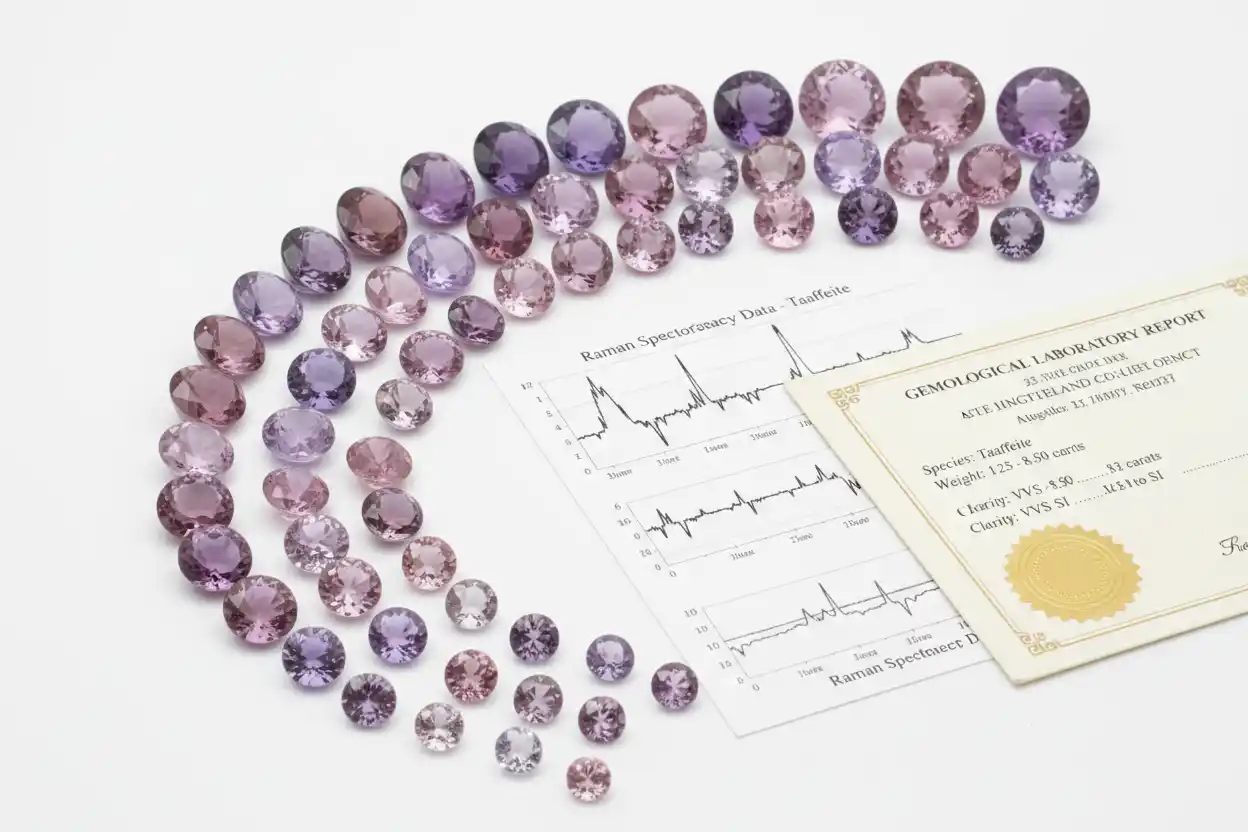
Taaffeite Price Guide: Value and Cost in 2026
Taaffeite prices in 2026 commonly range from approximately $1,000 to $7,500 per carat. Pale, included or very small stones may sit below $2,500 per carat, while saturated mauve, lavender and pink gems with strong clarity commonly reach $3,000 to $8,000 per carat.
Exceptional clean stones with intense color or rare size above one or two carats can reach $10,000 to $15,000 per carat. Taaffeite has an extremely thin collector market, so asking prices vary widely and independent laboratory identification is essential.
Taaffeite Price per Carat in 2026
| Taaffeite quality | Typical characteristics | Approximate 2026 retail price |
|---|---|---|
| Entry collector material | Tiny, pale, grayish, included or weakly cut | $500–$1,500 per carat |
| Good commercial collector grade | Light lavender, pink or violet with moderate clarity | $1,500–$3,500 per carat |
| Fine | Saturated mauve, lavender or pink with high transparency | $3,000–$7,500 per carat |
| Premium | Strong color, excellent clarity, rare one- to two-carat size | $6,000–$12,000 per carat |
| Exceptional collector quality | Intense clean color, important provenance or unusual size | $10,000–$15,000+ per carat |
Because transactions are uncommon, the price of one stone should not be treated as a universal index. A fine one-carat mauve Taaffeite may be worth much more per carat than a pale or included stone of similar weight.
The broader relationship among rarity, quality and market liquidity appears in How Gemstone Prices Are Determined.
What Is Taaffeite?
Taaffeite is a rare beryllium-magnesium-aluminum oxide mineral.
It is historically significant because the first recognized example was already faceted. Richard Taaffe purchased the stone as Spinel in 1945 and noticed that it behaved differently under optical examination.
The mineral’s modern species name may appear as magnesiotaaffeite-2N’2S on technical reports, though Taaffeite remains the familiar gem-trade name.
The completed Taaffeite guide owns the mineral’s composition, discovery history and symbolic traditions.
This article remains focused on current pricing, identification and collector value.
Why Taaffeite Is Expensive
Transparent Taaffeite is exceptionally scarce. Most occurrences yield tiny, included or non-gem material rather than facetable crystals.
The stone also competes with mineral collectors. Rare natural crystals may remain intact instead of being cut into even smaller gemstones.
Identification requires expertise because Taaffeite resembles Spinel and can overlap with other rare oxides.
The market contains few comparable stones at any given time. Therefore, one clean saturated gem can attract several specialist buyers without an equivalent replacement being available.
However, rarity does not create unlimited value. The buyer pool is small, and pale or included Taaffeite may remain difficult to resell.
Taaffeite Color and Value
Taaffeite occurs in colorless, pale pink, lavender, mauve, gray-violet, purple, reddish violet and occasional greenish appearances.
Fine mauve and lavender generally receive the strongest broad demand. Pink and pink-violet stones can also command premiums when saturation and transparency remain high.
Pale gray and near-colorless material relies more heavily on clarity, cut and rarity.
Dark purple does not automatically mean better. Excessive depth can suppress brilliance and make a stone appear nearly black.
Color should remain visible in ordinary reflected light. Backlighting can make a pale or dark gem appear more saturated than it looks during normal viewing.
Lavender and Mauve Taaffeite Prices
Lavender stones with strong clarity commonly range from approximately $2,000 to $8,000 per carat, depending on size.
Mauve material can occupy a similar or slightly higher tier when the stone combines pink, purple and gray components attractively.
Fine one- to two-carat gems may reach $5,000 to $10,000 per carat.
The strongest premium belongs to color that is clearly visible without making the stone dark or muddy.
Trade names such as lilac, rose-mauve and imperial lavender have no standardized grading meaning. The buyer should compare actual stones rather than labels.
Pink and Violet Taaffeite
Pink Taaffeite generally ranges from approximately $1,500 to $8,000 per carat.
Light pink material may remain comparatively accessible within the rare-gem market. Strongly saturated pink or pink-violet stones can rise much higher.
Violet and deep-purple stones often contain stronger color but may suffer from extinction.
A fine stone should show both color and internal light return. Saturation without brilliance does not justify the highest price.
Clarity and Transparency
Fine Taaffeite is transparent and preferably eye-clean or only lightly included.
Possible inclusions include Zircon, Apatite, crystals, fractures, growth features and radiation-related halos.
Minor inclusions may add gemological interest without damaging the face-up appearance.
Dense clouds, black crystals and open fissures reduce value. Structural fractures are particularly important in rare stones because setting or recutting damage can be impossible to replace.
A clean one-carat Taaffeite is considerably rarer than a clean stone of similar size in many mainstream gemstone species.
Cut Quality
Taaffeite rough is rare and often small, encouraging cutters to preserve every possible fraction of a carat.
Ovals, cushions, mixed cuts and irregular shapes are common. Rounds require substantial weight loss and are less frequently encountered.
A shallow pavilion can produce a central window. Excessive depth may hide weight and reduce visible size.
Some proportion compromise is understandable, but a fine collector gem should still display useful brilliance and balanced symmetry.
Dimensions should always be compared with carat weight. A deep one-carat stone may appear smaller than a well-cut 0.80-carat gem.
The complete selection process belongs to the Taaffeite Buying Guide.
Taaffeite Prices by Carat Weight
| Carat weight | Commercial collector quality | Fine quality | Exceptional quality |
|---|---|---|---|
| Under 0.25 ct | $500–$2,000 per carat | $1,500–$4,000 per carat | $3,000–$7,500 per carat |
| 0.25–0.50 ct | $1,000–$2,500 per carat | $2,500–$5,000 per carat | $4,000–$8,000 per carat |
| 0.50–1.00 ct | $1,500–$3,500 per carat | $3,000–$7,500 per carat | $6,000–$12,000 per carat |
| 1.00–2.00 ct | $2,500–$6,000 per carat | $5,000–$10,000 per carat | $8,000–$15,000+ per carat |
| Above 2 ct | Individually evaluated | Rare collector market | Major verification required |
A two-carat Taaffeite is not automatically premium. Color, transparency and cutting must remain fine throughout the larger stone.
An unusually large flawless gem offered at a low price should be treated as a probable misidentification until independently tested.
Sri Lankan Taaffeite
Sri Lanka is the best-known source of faceted Taaffeite.
Many stones enter the market through alluvial gem gravels and were historically mixed with Spinel because of their similar appearance.
Sri Lankan material can appear pink, lavender, mauve, gray-violet or near-colorless.
Fine stones with dependable provenance and strong color can command collector premiums.
Country of origin alone does not establish value. A pale included Sri Lankan stone remains below a fine gem from another confirmed locality.
Tanzanian and Other Taaffeite
Taaffeite-group minerals have also been reported from Tanzania and other metamorphic regions.
Tanzanian stones can occur alongside Spinel and other gems in deposits where visual sorting is difficult.
China has produced lower-grade or mineralogical Taaffeite material, while additional localities remain of specialist interest.
Origin opinions are less commercially standardized than they are for Ruby or Sapphire. Identity normally matters more than country.
A seller should not use an exotic locality claim to compensate for an inconclusive laboratory report.
Taaffeite vs Spinel
Taaffeite was first discovered because a stone sold as Spinel showed double refraction.
Spinel crystallizes in the cubic system and is singly refractive. Taaffeite is doubly refractive.
The two can overlap in pink, lavender, violet and gray colors. They can also have similar-looking inclusions and cutting styles.
Ordinary visual inspection cannot provide a defensible high-value identification.
The completed Spinel guide owns that mineral’s identity, while current color-specific prices appear in the Spinel Price Guide.
A beautiful natural Spinel may be valuable, but it should not receive Taaffeite pricing without conclusive testing.
Taaffeite vs Musgravite
Musgravite is closely related to Taaffeite but has a different crystal structure and composition.
Routine refractive and microscopic testing may not always separate the two conclusively.
Raman spectroscopy, X-ray diffraction or comparable advanced methods may be required.
Musgravite generally commands a stronger rarity premium. Its material context appears in the Musgravite guide, while current prices appear in the Musgravite Price Guide.
A report that states only Taaffeite group is insufficient when the seller is charging specifically for Musgravite or Taaffeite.
Taaffeite vs Other Rare Collector Gems
Taaffeite is often compared with Painite, Serendibite and Grandidierite.
The Painite Price Guide separates inexpensive included material from rare transparent gems.
The Serendibite Price Guide distinguishes opaque black stones from exceptionally scarce transparent blue-green examples.
The Grandidierite Price Guide owns the teal-blue borosilicate market.
Rarity rankings should not replace individual valuation. Each mineral has its own combination of appearance, available supply and collector demand.
Treatment and Synthetic Concerns
Routine heat, irradiation and fracture filling are not established as central practices in the Taaffeite market.
Misidentification is the larger commercial risk.
Synthetic Spinel, Sapphire and other laboratory-created materials can resemble Taaffeite’s color and clarity.
A seller’s untreated statement does not confirm mineral identity. The stone must first be proven to be natural Taaffeite.
The broader rarity context appears in Rarest Gemstones in the World and Most Expensive Gemstones.
These overview pages should not be used as price lists for an individual gem.
Laboratory Certification Is Essential
Every meaningful Taaffeite purchase should have an independent report from a laboratory capable of advanced mineral identification.
Useful methods can include refractive-index testing, birefringence observation, Raman spectroscopy, chemical analysis and X-ray techniques.
The report should state natural Taaffeite or the corresponding mineralogical species name specifically.
A seller-issued certificate or report using only “rare lavender gem” is inadequate.
The Gemstone Certification Labs comparison explains laboratory selection. Buyers should also review How to Read a Gem Lab Report before relying on technical terminology.
Taaffeite Jewelry Prices
Taaffeite jewelry is uncommon because many collectors prefer loose stones that remain easy to test.
| Jewelry type | Broad specialist-market range |
|---|---|
| Gold pendant with a small confirmed stone | $2,000–$8,000 |
| Ring with a 0.25–0.50 ct Taaffeite | $3,000–$12,000 |
| Fine one-carat collector jewel | $8,000–$25,000+ |
| Exceptional designer or provenance piece | Individually evaluated |
The mounting should allow the stone’s measurements and report to remain traceable.
A protective setting is advisable because replacement with an equivalent color and size may be difficult.
Does Taaffeite Hold Its Value?
Fine Taaffeite has genuine collector rarity, but liquidity is limited.
A high-quality stone may retain specialist interest while taking months or years to sell.
Pale, included and poorly cut gems have weaker resale prospects because the small buyer pool concentrates on exceptional examples.
The strongest secondary-market position belongs to clean, saturated, well-cut stones with major laboratory reports and realistic purchase prices.
The broader resale framework appears in Do Gemstones Hold Their Value?.
Price Guide vs Buying Guide
This page owns Taaffeite’s 2026 price bands and commercial value factors.
The buying guide owns detailed report verification, inclusion review and seller questions.
Online buyers should insist on direct laboratory verification and a return period that permits independent testing. The broader process appears in How to Buy Gemstones Online Without Getting Scammed.
The completed Gemstones That Start With T and Crystals That Start With T directories connect Taaffeite with the alphabetical site structure.
The Buying & Value hub connects this guide with certification, rare-gem pricing and resale guidance.
Frequently Asked Questions
1. How much is Taaffeite worth per carat in 2026?
Most verified Taaffeite costs approximately $1,000 to $7,500 per carat. Exceptional clean stones may reach $10,000 to $15,000 per carat.
2. What Taaffeite color is most valuable?
Saturated mauve, lavender, pink-violet and attractive pink generally receive the strongest prices.
3. Why is Taaffeite so rare?
Only a small amount of transparent facetable material has been recovered, and many crystals are tiny or included.
4. How much is a one-carat Taaffeite?
A one-carat stone may cost approximately $3,000 to $10,000. Exceptional examples can cost more.
5. Are Taaffeites above two carats rare?
Yes. Clean, attractively colored gems above two carats are exceptionally uncommon.
6. Is Taaffeite the same as Spinel?
No. Taaffeite is doubly refractive, while Spinel is singly refractive and belongs to a different mineral species.
7. Is Taaffeite the same as Musgravite?
No. They are closely related Taaffeite-group minerals but have different structures and must be separated through advanced testing.
8. Where is Taaffeite found?
Sri Lanka is the best-known faceted source. Additional material has been reported from Tanzania, China and other metamorphic localities.
9. Is Taaffeite normally treated?
Routine treatment is not established as common. Misidentification and synthetic lookalikes create greater concerns.
10. Does Taaffeite need a laboratory report?
Yes. Rare-gem pricing should never be paid without a report specifically identifying natural Taaffeite.
11. Does Taaffeite hold its value?
Fine documented stones may retain collector demand, but resale is slow because the market is extremely small.
12. Is Taaffeite a good investment?
It is a speculative collector gemstone rather than a liquid investment. Identity, quality, purchase price and resale access are critical.
Taaffeite Value Begins With Proof of Identity
Taaffeite gained its place in gemology because it was initially mistaken for Spinel. That same identification risk remains central to its modern market.
In 2026, most credible gems fall between $1,500 and $7,500 per carat. Prices above that level should correspond to exceptional color, clarity, rare size and laboratory evidence—not a rarity claim attached to an unverified lavender stone.