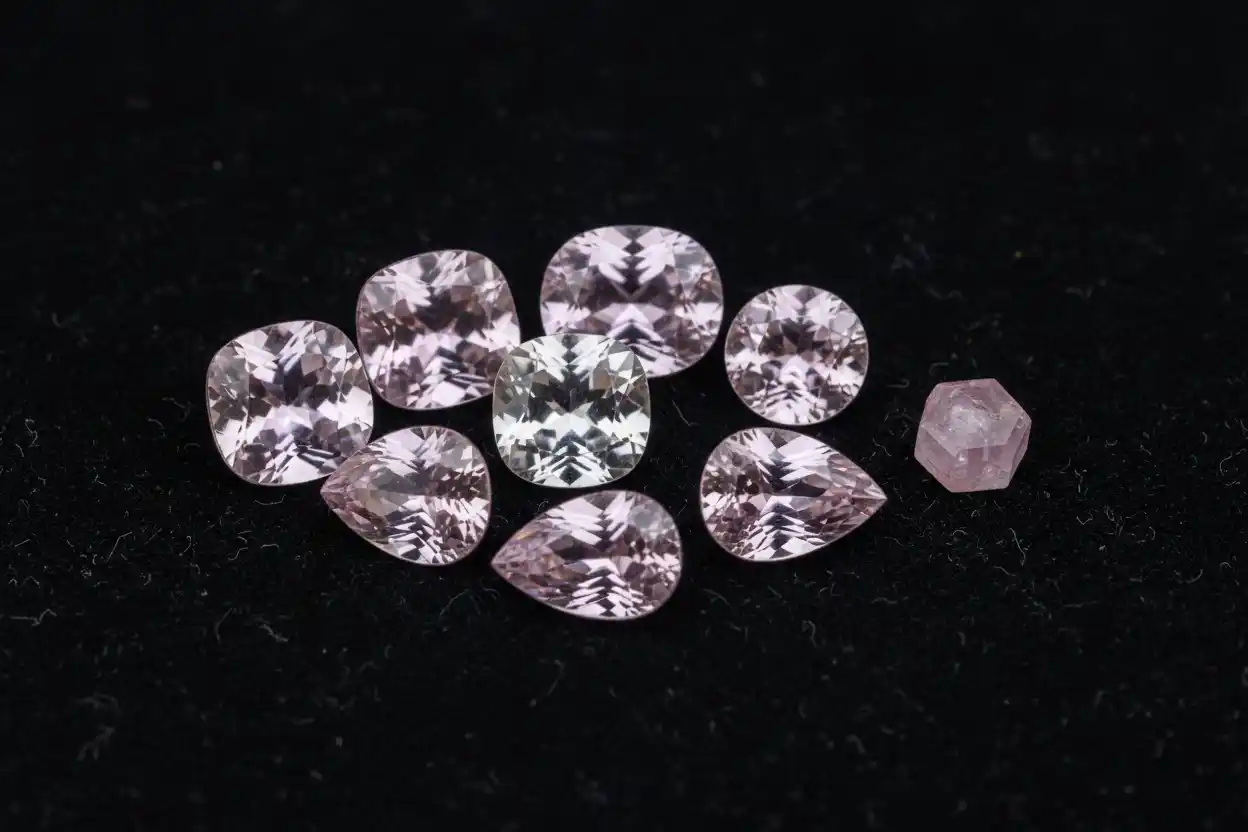
Taaffeite: Meaning, Properties & Symbolism
Taaffeite is an exceptionally rare beryllium-magnesium-aluminum oxide gemstone, officially known in modern mineral nomenclature as magnesiotaaffeite-2N’2S. It is best known for mauve, pink, lilac, violet-grey, and occasionally color-changing gems that can closely resemble spinel.
Its discovery is unique in mineralogy: Taaffeite was first recognized as a new species from an already faceted gemstone. Today, fine examples remain scarce enough that independent laboratory identification is a central part of their market value.
Taaffeite at a Glance
| Property | Taaffeite |
|---|---|
| Composition | Magnesium-aluminum-beryllium oxide, Mg₃Al₈BeO₁₆ |
| Group or type | Taaffeite-group oxide; official species magnesiotaaffeite-2N’2S |
| Color | Colorless, grey, mauve, lilac, pink, purple, red, brown, greenish, bluish, color-change |
| Crystal system or texture | Hexagonal polysomatic structure |
| Habit | Rare tabular or prismatic crystals; more commonly rounded alluvial grains or faceted gems |
| Luster | Vitreous |
| Transparency | Transparent to translucent |
| Mohs hardness | Approximately 8–8.5 |
| Cleavage | Imperfect to indistinct; basal parting may occur |
| Tenacity | Brittle |
| Common uses | Rare faceted collector gems, high jewelry, museum and research collections |
| Primary care concern | Misidentification, brittleness, inclusions, scarcity of replacements, and beryllium-bearing cutting dust |
What Is Taaffeite?
Taaffeite is a rare oxide mineral containing magnesium, aluminum, beryllium, and oxygen. The traditional gem name remains widely used, although the approved mineral name for the classic species is magnesiotaaffeite-2N’2S.
The suffix describes its polysomatic crystal structure—an ordered stacking relationship among structural modules related to spinel-like layers.
Taaffeite belongs to a mineral group that also contains musgravite and several iron- or zinc-bearing members. These related minerals can resemble one another, so laboratory testing may need to determine the exact species rather than stopping at the family name.
Unlike many rare mineral species that are opaque, microscopic, or too fragile for cutting, Taaffeite can be transparent, hard, brilliant, and suitable for jewelry.
Its scarcity places it naturally among the rarest gemstones in the world. It is also included in the crystals that start with T and gemstones that start with T directories.
The Discovery of Taaffeite
In October 1945, Count Edward Charles Richard Taaffe purchased a parcel of faceted stones from a Dublin jeweler. The stones had been sold as spinel.
Taaffe noticed that one mauve gem behaved differently under polarized light. Spinel is cubic and singly refractive, while the unusual stone showed double refraction.
He sent the gem for examination. Chemical and X-ray work later confirmed that it represented a previously unknown mineral containing beryllium, magnesium, and aluminum.
The discovery made Taaffeite the first mineral species initially identified from a cut and polished gemstone rather than from natural crystal rough.
For several years, the source remained uncertain because the original stone had already passed through the gem trade. Additional examples were later found among Sri Lankan alluvial gems.
This history explains why Taaffeite remains closely connected with spinel. Misidentification created its discovery and remains one of the principal risks in the modern market.
Composition and Mineral Nomenclature
The classic Taaffeite species has the formula Mg₃Al₈BeO₁₆. Its structure combines magnesium, aluminum, beryllium, and oxygen in a hexagonal arrangement.
The modern name magnesiotaaffeite-2N’2S distinguishes it from other stacking sequences and compositions within the Taaffeite group.
The traditional name Taaffeite remains acceptable in gemological and commercial use when referring to this species, provided the identification is accurate.
Iron can replace part of the magnesium and influence color. Chromium, manganese, vanadium, zinc, and other trace elements may also occur.
Because the group contains related species, a gem that tests generally as Taaffeite-group material may require Raman spectroscopy, chemical analysis, or advanced crystallography for exact classification.
Taaffeite and Musgravite
Musgravite is a closely related mineral now officially known as magnesiotaaffeite-6N’3S.
The two belong to the same mineral group but have different structural stacking sequences and somewhat different chemical proportions.
Visual appearance cannot separate them reliably. Both can occur in grey, green, purple, brown, colorless, and related shades.
Refractive index, birefringence, specific gravity, spectroscopy, Raman analysis, and trace chemistry help laboratories distinguish them.
Historically, some gems identified as Taaffeite were later reclassified as Musgravite after the Taaffeite-group nomenclature became more precise.
The separate musgravite price page owns Musgravite valuation. Taaffeite should not inherit Musgravite pricing merely because both are rare members of the same group.
How Taaffeite Forms
Taaffeite forms in magnesium- and aluminum-rich metamorphic environments, particularly altered carbonate rocks and skarns.
Limestone or dolostone can react with beryllium-, aluminum-, magnesium-, and fluorine-bearing fluids during high-temperature metamorphism and metasomatism.
Associated minerals may include spinel, phlogopite, fluorite, tourmaline, chrysoberyl, calcite, sapphirine, and other high-grade metamorphic phases.
Natural crystals are extremely uncommon. Most gem material reaches the market as rounded grains recovered from alluvial deposits rather than recognizable crystal specimens.
Weathering releases Taaffeite from its host rock. Rivers then transport and concentrate the dense, durable grains with sapphire, spinel, zircon, garnet, chrysoberyl, and other gems.
The rarity of identified primary crystals makes it difficult to connect every alluvial stone with a specific host deposit.
Important Taaffeite Sources
Sri Lanka is the type locality and historically the most important source. Taaffeite occurs in gem gravels around Ratnapura and related alluvial districts.
Sri Lankan material includes pale mauve, grey, pink, violet, colorless, brownish, and color-changing gems. Most stones are small, though documented examples above 10 carats exist in major research collections.
Myanmar’s Mogok region has produced pink, purplish, mauve, grey, and brownish Taaffeite, along with related Taaffeite-group minerals.
Tanzania has yielded Taaffeite from alluvial gem fields, particularly in areas geologically connected with East African metamorphic belts.
China has produced Taaffeite-group minerals in metamorphosed carbonate and polymetallic environments, including iron-rich members that are not always gem quality.
Additional reported occurrences include Madagascar and Russia, although not every mineral occurrence supplies facetable material.
Origin claims require caution. Color, refractive index, and inclusions may support an interpretation, but many laboratories cannot provide a definitive geographic origin for every Taaffeite.
Taaffeite Colors
Mauve, lilac, pale violet, purplish pink, greyish purple, and pink are the colors most strongly associated with Taaffeite.
Many stones have low saturation and visible grey or brown modifiers. Clean medium pink or lively purple material is far scarcer than desaturated grey-mauve gems.
Colorless, pale green, bluish, reddish, brown, and near-grey examples also occur.
Some Taaffeites display color change, appearing greenish blue, grey-green, violet, or purple under different light sources. The effect depends on selective absorption and the spectral balance of daylight and incandescent illumination.
Trace chromium, iron, manganese, and related elements contribute to color and luminescence. The exact mechanism varies with composition and locality.
Taaffeite naturally overlaps with collections of pink gemstones, but color is insufficient for identification because spinel, sapphire, garnet, and synthetic materials can look nearly identical.
Taaffeite Inclusions
Natural Taaffeite may contain zircon, apatite, spinel, magnesite, feldspar, phlogopite, muscovite, fluid inclusions, fingerprints, healed fractures, and small black or colorless crystals.
Some Sri Lankan stones contain radiation halos around tiny uranium- or thorium-bearing mineral inclusions. The halo records structural damage surrounding the included crystal rather than indicating that the whole gem is dangerously radioactive.
Zircon inclusions may show tension cracks or altered surrounding areas. Fingerprint-like inclusions can preserve healed fractures.
Growth zoning and color concentration may appear under immersion. Pleochroism is usually weak because Taaffeite’s birefringence is low.
Inclusions can support natural origin, but no single feature proves identity. Taaffeite is rare enough that a full combination of optical, spectroscopic, and chemical evidence remains necessary.
How to Identify Taaffeite
Taaffeite’s most famous identifying difference from spinel is double refraction.
Spinel crystallizes in the cubic system and is singly refractive. Taaffeite is uniaxial and produces two refractive indices, although the birefringence is low and facet doubling may be difficult to see.
Taaffeite commonly has refractive indices around 1.716–1.730, depending on composition. Specific gravity generally falls near 3.60–3.62.
These values overlap partly with other gems. Refractive data must therefore be combined with optical character, spectrum, magnification, and chemistry.
A polariscope can reveal double refraction, but internal strain and aggregate effects can complicate interpretation.
Raman spectroscopy can distinguish Taaffeite-group minerals from spinel, chrysoberyl, sapphire, and glass. Advanced chemical analysis may be needed to separate Taaffeite from Musgravite.
The broader how to identify crystals guide explains the testing framework, but any valuable Taaffeite should receive an independent laboratory report.
Taaffeite Versus Spinel
Taaffeite and Spinel can share mauve, pink, grey, purple, red, and colorless appearances. Their refractive indices and specific gravities are also close enough to cause confusion.
The decisive classical distinction is optical character. Spinel is singly refractive, whereas Taaffeite is doubly refractive.
Spinel commonly has an octahedral or modified octahedral crystal habit. Natural Taaffeite crystals are so rare that most gemologists encounter only faceted or alluvial material.
Spinel’s refractive index is generally around 1.718, while Taaffeite presents two readings across a broader range. Nevertheless, one poorly measured reading can be misleading.
Both gems can contain spinel crystals as inclusions because small spinel grains may become trapped inside Taaffeite during growth.
A stone sold as rare Taaffeite should never rely on a seller’s observation of slight facet doubling alone. Laboratory spectroscopy and optical testing are essential.
Taaffeite Versus Chrysoberyl
Chrysoberyl has similar hardness and can occur in yellow, green, brown, colorless, or rare pinkish colors.
Chrysoberyl is orthorhombic and biaxial, while Taaffeite is hexagonal and uniaxial.
Chrysoberyl generally has higher birefringence and a different refractive-index range. Its specific gravity is usually slightly higher.
Cat’s-eye Chrysoberyl also contains oriented inclusions and is normally cut as a cabochon, whereas transparent Taaffeite is usually faceted.
The two minerals can occur in related metamorphic or alluvial environments, so geological association alone cannot separate them.
Other Lookalikes
Purple sapphire, pink sapphire, and pale ruby can resemble saturated Taaffeite. Corundum has higher refractive indices, greater density, and different spectra.
Purple and pink garnets may overlap in color but are singly refractive and generally show different refractive and absorption properties.
Zircon can display strong brilliance and doubling, although its dispersion, refractive index, density, and inclusions differ substantially.
Glass may imitate mauve or pink color but usually has lower hardness, lower density, bubbles, and a single refractive index.
Synthetic Spinel is particularly important because it can be produced in pale pink, lavender, grey, colorless, and blue-green shades.
Rare stones such as Painite, Serendibite, Grandidierite, and Benitoite may appear in the same collector market, but none is a direct visual substitute for every Taaffeite color.
Treatments and Enhancement
No routine commercial treatment is established for Taaffeite. Most stones are expected to be natural in color and untreated.
Heating could theoretically alter color or inclusions, but Taaffeite does not have a treatment market comparable with sapphire, zircon, or topaz.
Surface coatings can change hue or improve apparent saturation. Coating wear may appear at facet edges or scratches.
Oil or resin could enter surface-reaching fractures. Such filling is uncommon but should be disclosed when detected.
A stone described as untreated should ideally have laboratory support when the price depends heavily on rarity and natural color.
No-treatment expectations can create a false sense of security. Misidentification as Taaffeite remains a much greater marketplace risk than undisclosed conventional enhancement.
Synthetic Taaffeite and Imitations
Taaffeite-group compounds can be synthesized for mineralogical and materials research. However, laboratory-grown faceted Taaffeite is not an established mainstream jewelry product.
Synthetic Spinel, synthetic sapphire, cubic zirconia, glass, garnet, and natural Spinel are more likely substitutes.
An imitation may be completely natural but incorrectly named. A pale purple Spinel accompanied by an unofficial card can be marketed as Taaffeite without any deliberate synthetic production.
The lab-grown vs natural gemstones guide explains the differences among synthetic minerals, simulants, and misidentified natural gems.
For Taaffeite, the laboratory report should identify the species specifically rather than use a broad phrase such as “natural rare gemstone.”
Cutting Behavior
Taaffeite is hard enough to polish well, but gem rough is scarce, small, and often irregular.
Cutters frequently prioritize weight retention because every fraction of a carat affects value. This can produce deep pavilions, uneven outlines, off-center culets, or windows.
Precision cutting improves brilliance and symmetry but may remove a substantial percentage of the rough. For rare clean stones, that sacrifice can be economically difficult.
Pleochroism is usually weak, so orientation is generally less color-critical than in iolite or tanzanite. However, color zoning and inclusions still influence the final position.
Brittleness creates a risk around thin girdles and sharp corners. Rounded cushions, ovals, and mixed cuts often provide a better compromise between yield and durability.
Recutting an existing Taaffeite should be approached cautiously. Replacement material of the same size, color, and report status may be impossible to source.
Durability and Jewelry Suitability
A hardness of 8–8.5 gives Taaffeite very good scratch resistance. It ranks above quartz, feldspar, beryl, and many popular colored gems.
Hardness does not make it unbreakable. Taaffeite remains brittle and may contain fractures, stress around inclusions, or imperfect parting.
Pendants, earrings, brooches, and protected rings are all practical for sound stones.
A low-profile bezel or substantial protective shoulders reduce impact risk. Tension settings and exposed sharp-corner designs are less suitable for such a rare gem.
The gemstone hardness chart explains scratch resistance, while gemstone toughness vs hardness addresses the separate question of breakage.
Even though Taaffeite can withstand regular jewelry wear, the cost and difficulty of replacement justify more conservative use than its hardness alone would suggest.
Taaffeite Value and July 2026 Asking Prices
Detailed valuation belongs on the dedicated Taaffeite price page. The market remains too thin for a fixed universal schedule.
As of July 2026, pale, included, small, or commercially cut certified Taaffeite may carry asking prices around $800–$2,500 per carat.
Better pink, mauve, violet, colorless, or lightly included stones commonly appear around $2,500–$7,500 per carat.
Fine clean stones with attractive saturated color, precision cutting, color change, meaningful size, and respected laboratory reports may ask approximately $7,500–$15,000 or more per carat.
Exceptional stones can exceed those levels. Current dealer inventory includes a certified 3.90-carat gem offered at $23,400 total, while specialist inventories extend above $20,000 per stone.
Very low pricing should trigger verification. A supposed one-carat Taaffeite offered for the cost of an ordinary Amethyst or Spinel is unlikely to carry the identity and documentation required by the rare-gem market.
Buying Taaffeite
The dedicated Taaffeite buying guide owns detailed transactional intent.
An independent report is mandatory whenever rarity materially affects price. The report should identify natural Taaffeite or magnesiotaaffeite-2N’2S specifically.
Confirm the laboratory independently using the report number. A seller-created card, appraisal, or verbal guarantee does not provide equivalent evidence.
Ask for weight, dimensions, color under daylight and incandescent light, clarity, cut, treatment status, origin wording, and high-magnification video.
Compare dimensions with weight. A stone can look large in a photograph while carrying excessive hidden depth.
Examine the girdle and facet junctions for chips. Surface-reaching fractures, radiation halos, and internal crystals should be evaluated for durability as well as natural origin.
The general how to buy gemstones online framework covers returns, independent testing, payment protection, and seller language.
Cleaning and Storage
Clean Taaffeite by hand with lukewarm water, mild soap, and a soft brush. Rinse it briefly and dry it with a lint-free cloth.
Avoid harsh acids, bleach, abrasive cleaners, and sudden temperature changes.
A flawless untreated Taaffeite may tolerate ultrasonic cleaning physically, but hand cleaning remains preferable because inclusions, fractures, and rarity increase the consequences of an error.
Steam cleaning is also unnecessary. The jeweler should inspect the stone and review its report before applying heat during repair.
Store Taaffeite separately from diamond, sapphire, ruby, and other very hard gems. A padded individual box protects facet junctions and keeps its documentation together.
Insurance photographs, measurements, report copies, provenance, and invoices should remain organized because documentation forms part of the gem’s practical value.
Taaffeite Meaning and Symbolism
Taaffeite has no established ancient symbolic tradition because it was recognized scientifically only in the twentieth century.
Its discovery among stones thought to be Spinel has inspired modern associations with discernment, curiosity, hidden identity, and noticing details that others overlook.
The gem’s rarity may symbolize individuality without requiring dramatic appearance. Many Taaffeites are subtle mauve, grey, or pale pink rather than intensely saturated.
Color-changing specimens can represent adaptability and the idea that one object may reveal different qualities under changing conditions.
Some contemporary crystal traditions associate Taaffeite with self-knowledge, refined judgment, calm confidence, and valuing evidence over assumption.
These meanings remain personal and spiritual interpretations. Scientific evidence does not show that Taaffeite treats disease, changes brain activity, improves eyesight, or produces guaranteed emotional effects.
Frequently Asked Questions
1. What is Taaffeite’s official mineral name?
The classic gemstone species is officially called magnesiotaaffeite-2N’2S.
2. Why was Taaffeite mistaken for Spinel?
The gems have overlapping colors, similar refractive properties, and related structural features, but Spinel is singly refractive while Taaffeite is doubly refractive.
3. Was Taaffeite really discovered as a cut gemstone?
Yes. Count Richard Taaffe recognized unusual optical behavior in a faceted stone purchased as Spinel in 1945.
4. Which Taaffeite colors are most common?
Pale mauve, lilac, greyish purple, and pink are most familiar, although colorless, greenish, bluish, brown, red, and color-change stones occur.
5. Is Taaffeite rarer than diamond?
Gem-quality Taaffeite is far less commonly encountered in the trade, but unsupported numerical claims such as “a million times rarer” should be treated cautiously.
6. Where does Taaffeite come from?
Important sources include Sri Lanka, Myanmar, and Tanzania, with additional Taaffeite-group occurrences reported elsewhere.
7. Is Taaffeite the same as Musgravite?
No. They belong to the same mineral group but have different structural stacking sequences and official species names.
8. Can Taaffeite be identified with a loupe?
A loupe may reveal natural inclusions, but reliable identification requires optical measurements, spectroscopy, and often advanced laboratory testing.
9. Is synthetic Taaffeite sold commercially?
Experimental synthetic material exists, but laboratory-grown faceted Taaffeite is not a major jewelry product.
10. Is Taaffeite suitable for an engagement ring?
Its hardness is good enough, but brittleness, rarity, and replacement difficulty make a protective setting and careful wear essential.
11. Does Taaffeite receive routine treatment?
No standard treatment is widely established, though coating or fracture filling remains possible and should be tested.
12. What most affects Taaffeite value?
Laboratory-confirmed identity, color, saturation, clarity, size, cutting, treatment status, rarity, and provenance determine value.
For Taaffeite, the laboratory report is part of the gemstone rather than optional paperwork. Without specific identification, a mauve stone may be beautiful, but it has not yet earned one of mineralogy’s rarest names.
Taaffeite contains beryllium as a stable part of its crystal structure. Normal handling and wear of an intact polished gem are not expected to create a meaningful exposure, but cutting, drilling, grinding, or pulverizing rough can release hazardous mineral dust. Use professional wet methods, local exhaust ventilation, sealed eye protection, suitable respiratory protection, and controlled waste handling.