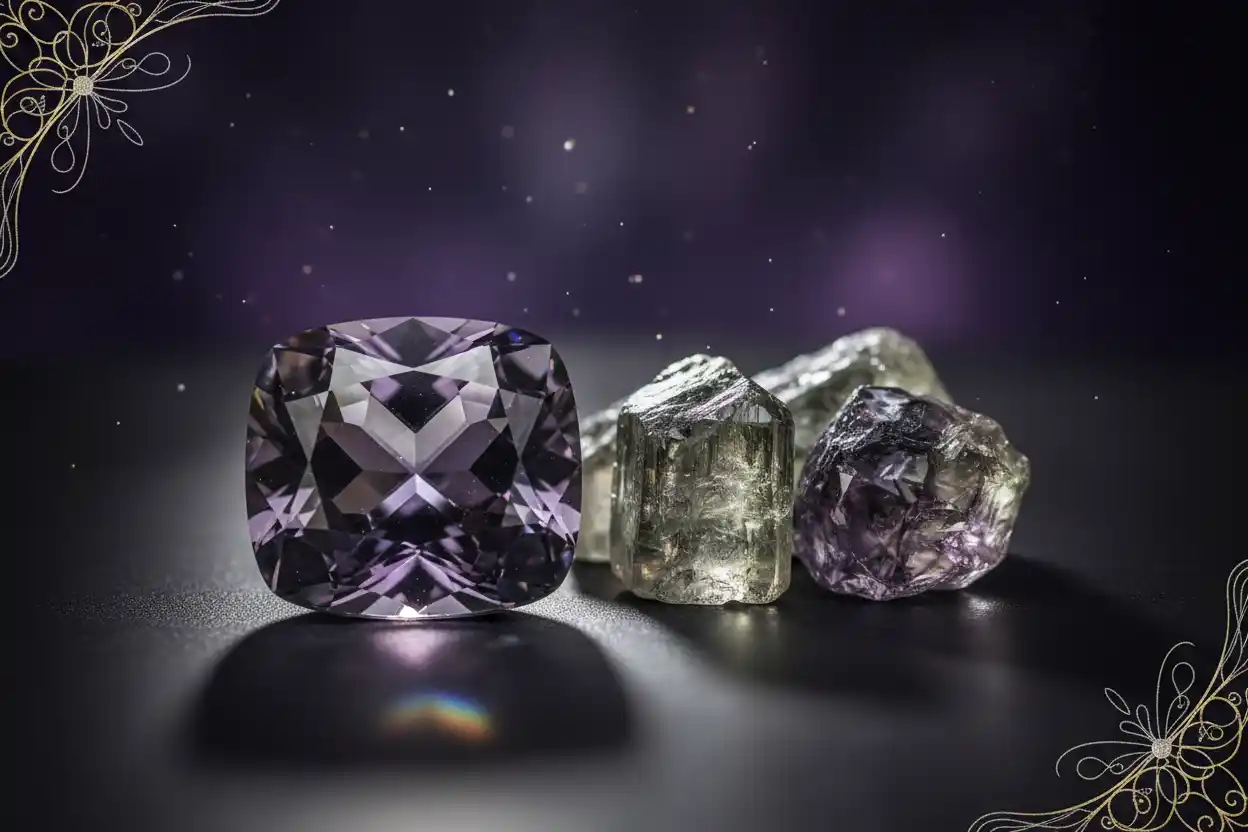
Musgravite: Meaning, Properties & Symbolism
Musgravite is an exceptionally rare beryllium-bearing oxide gemstone from the taaffeite mineral group. Faceted examples usually appear grayish violet, greenish gray, near-colorless, bluish gray, or muted olive rather than displaying the intense saturation associated with ruby or sapphire.
Modern mineral nomenclature calls the species magnesiotaaffeite-6N’3S, while the historic name musgravite remains firmly established in the gem trade. Because its measurable properties overlap closely with taaffeite and several more familiar gemstones, a credible laboratory report is central to any serious musgravite purchase.
Musgravite at a Glance
| Property | Musgravite |
|---|---|
| Accepted mineral name | Magnesiotaaffeite-6N’3S |
| Traditional gem-trade name | Musgravite |
| Material type | Rare oxide mineral and facetable gemstone |
| Mineral group | Taaffeite group |
| Idealized composition | Mg₂BeAl₆O₁₂, with natural iron, zinc, and other substitutions |
| Common colors | Grayish violet, greenish gray, bluish gray, olive gray, pale purple, near-colorless, and brownish gray |
| Crystal system | Trigonal |
| Typical habit | Tabular, platy, short prismatic, or irregular water-worn grains |
| Luster | Vitreous |
| Transparency | Transparent to translucent |
| Mohs hardness | Approximately 8–8.5 |
| Cleavage | Not normally a major jewelry concern; fracture may be conchoidal to uneven |
| Tenacity | Brittle |
| Common uses | Rare-gem collections, faceted stones, occasional high-end jewelry, and scientific specimens |
| Main care concern | Edge chipping, uncertain identification, loss of provenance, and beryllium-bearing cutting dust |
Why the Mineral Name Changed
The name musgravite was introduced for material discovered in the Musgrave Ranges of South Australia. Later structural and nomenclature work placed the mineral within a more precise system based on the stacking sequence of taaffeite-group structural layers.
Under that system, the species is magnesiotaaffeite-6N’3S. The “6N’3S” designation records structural information rather than describing color, quality, or locality.
Gem dealers, collectors, and laboratories still use musgravite because the shorter name remains widely recognized. A careful report may therefore identify a stone as “magnesiotaaffeite-6N’3S, known in the trade as musgravite.”
Musgravite should not be presented as a variety of taaffeite in the same way that ruby is a variety of corundum. The two are separate but closely related members of the taaffeite group, with different structural stacking and symmetry.
Their resemblance is so strong that older collections and parcels labeled taaffeite may contain stones that would now be identified as musgravite after advanced testing.
Chemical Composition and Structure
The idealized musgravite composition is Mg₂BeAl₆O₁₂. Natural stones can contain iron, zinc, manganese, chromium, vanadium, calcium, and other minor substitutions, so laboratories may express the formula more broadly.
Beryllium, magnesium, and aluminum occupy specific positions in an oxide framework. The arrangement produces trigonal symmetry and distinguishes musgravite structurally from the more familiar taaffeite species magnesiotaaffeite-2N’2S.
Trace elements and structural defects influence color. Iron contributes much of the gray, green, brown, and blue-gray appearance, while chromium or vanadium may contribute subtle green or purplish components in some stones.
The colors are usually restrained. Consequently, a transparent neon-red, vivid royal-blue, or strongly saturated emerald-green stone sold cheaply as musgravite deserves immediate skepticism.
Discovery in the Musgrave Ranges
The original mineral was identified from the Ernabella area of the Musgrave Ranges in South Australia during the 1960s. Its name honored the region rather than a person.
The Australian type material occurred in high-grade metamorphic rocks rather than in a commercial gem mine capable of supplying cut stones regularly. Crystals from the type region remain primarily mineralogical specimens.
Facetable musgravite became known later from gem-bearing deposits outside Australia. Small stones from Sri Lanka, Myanmar, Tanzania, Madagascar, and other sources have entered specialized rare-gem markets.
Locality statements require care because many faceted examples originate from secondary deposits. A water-worn grain recovered from gem gravel may not retain an attached host rock that reveals its primary geological source.
Accordingly, a laboratory can identify the mineral species more reliably than it can always verify geographic origin.
How Musgravite Forms
Musgravite forms in unusual aluminum-, magnesium-, and beryllium-rich geological environments. These elements must occur together under conditions that permit the taaffeite-group structure to crystallize.
Known occurrences are associated with high-grade metamorphic rocks, skarns, and gem-bearing metamorphic terrains. Minerals in the surrounding assemblage may include spinel, corundum, sillimanite, phlogopite, garnet, chrysoberyl, and other aluminum-rich phases.
Later erosion can release small crystals from their host rocks. Streams and weathered gravels then concentrate resistant grains alongside sapphire, spinel, chrysoberyl, zircon, and taaffeite.
This shared depositional environment partly explains why musgravite was overlooked. A pale water-worn grain may resemble several more common gems until optical or spectroscopic testing reveals its identity.
Color and Optical Appearance
Most faceted musgravite displays low-to-moderate saturation. Gray is often the dominant component, modified by violet, green, blue, brown, or olive.
Near-colorless material also occurs. In small stones, subtle color can disappear under strong white lighting and return under warmer or more diffuse illumination.
Pleochroism may create slight changes between crystal directions. However, the effect is generally less useful for a buyer than laboratory measurements because cutting orientation and pale color can make it difficult to observe.
Musgravite has sufficient refractive index and polish to produce attractive brilliance. Still, it does not usually show the high dispersion or obvious rainbow fire of diamond or moissanite.
Cut quality becomes especially important because rough is scarce. A cutter may accept an unconventional outline, shallow pavilion, visible inclusion, or minor asymmetry to retain weight.
Musgravite and Taaffeite
Musgravite and taaffeite occupy the same mineral group and can show nearly overlapping refractive indices, density, color, hardness, and inclusions.
Taaffeite commonly appears pink, mauve, lavender, violet, red, blue, gray, or colorless. Musgravite is often described in grayer, greener, or more subdued tones, but color cannot identify either species reliably.
Their principal distinction is structural. Musgravite is trigonal magnesiotaaffeite-6N’3S, whereas the mineral traditionally called taaffeite is hexagonal magnesiotaaffeite-2N’2S.
Standard gemological observations may narrow the possibilities without settling the species. Raman spectroscopy, X-ray diffraction, and carefully interpreted chemical analysis provide stronger separation.
Anyone buying either mineral should treat an unsupported visual identification as provisional. The dedicated taaffeite buying guide explains similar documentation risks in that adjacent market.
Musgravite and Common Lookalikes
Spinel is a frequent source of confusion because it can occur in comparable colors and gem gravels. Spinel is singly refractive and cubic, but its refractive index and appearance can overlap enough to require competent testing.
Sapphire and other corundum varieties may also resemble gray, green, violet, or near-colorless musgravite. Corundum is harder and has different optical properties, although mounted stones can remain difficult to assess with basic instruments.
Taaffeite is the closest natural lookalike. In some cases, even experienced gemologists need spectroscopy or diffraction rather than routine testing.
Synthetic spinel, synthetic sapphire, glass, cubic zirconia, and other inexpensive materials may be sold under the musgravite name. Marketplace certificates do not prove identity when the issuing laboratory lacks an established reputation.
Rare materials such as painite and serendibite are sometimes grouped with musgravite in lists of collector gemstones. However, they have different chemistry, structure, color ranges, and diagnostic properties.
The broader guide to the world’s rarest gemstones provides market context without treating these minerals as interchangeable.
How Laboratories Identify Musgravite
A gemologist begins with measurements such as refractive index, birefringence, optic character, specific gravity, fluorescence, absorption spectrum, and microscopic inclusions.
Musgravite generally has refractive indices around the low 1.72 range, although natural composition produces variation. Its density is commonly near 3.6–3.7.
Those values overlap taaffeite closely and can approach other gemstones. Therefore, matching a refractive-index range from an online table is not sufficient.
Raman spectroscopy can produce a mineral-specific vibrational pattern. X-ray diffraction can then distinguish the different structural stacking and symmetry of taaffeite-group minerals.
Chemical analysis supports the conclusion by measuring magnesium, aluminum, beryllium-related structural relationships, iron, zinc, and other substitutions. However, basic handheld elemental instruments may not measure light elements such as beryllium adequately.
The testing sequence described in how to identify crystals explains why several independent properties must agree before a rare identification becomes credible.
Is Musgravite Durable Enough for Jewelry?
Musgravite’s hardness of approximately 8–8.5 gives it strong resistance to ordinary scratching. It ranks above quartz, feldspar, and many common colored gemstones.
Nevertheless, hardness does not make the gem unbreakable. Musgravite remains brittle, and a sharp blow can chip a girdle, point, corner, or inclusion-reaching surface.
The distinction between scratching and breaking is covered in gemstone toughness versus hardness. The comparative gemstone hardness chart also places it near topaz and below corundum.
A rare musgravite is often more valuable as a documented loose collector stone than as an exposed daily-wear ring. Mounting can hide identifying features, expose the gem to damage, and complicate later laboratory testing.
When used in jewelry, a low-profile bezel or protective halo reduces edge exposure. Pendants and earrings present less impact risk than rings and bracelets.
Any setting should preserve the stone’s report number, dimensions, and weight. Documentation separated from the gem can reduce its future marketability substantially.
Treatments and Synthetic Material
No routine treatment defines musgravite’s appearance. Fine stones are normally valued as naturally colored material.
Reports of heat-altered taaffeite-group material exist in gemological research, but buyers should not assume that every rare stone has been untreated simply because the seller states it.
Fracture filling, surface coating, oiling, resin impregnation, and assembled constructions are possible in principle, especially when a low-value imitation is being misrepresented. A laboratory should examine any high-value stone for evidence of treatment.
Laboratory-grown taaffeite-group materials have been produced for scientific purposes, but synthetic musgravite is not a normal mass-market jewelry product. Misidentified spinel, sapphire, glass, or other substitutes pose a much more realistic buying risk.
The general processes behind coatings, filling, heating, and impregnation are explained in gemstone treatments.
Current Musgravite Asking Prices
A dedicated price guide should own detailed per-carat analysis because the market is exceptionally thin. The ranges below provide only broad retail context for properly identified stones.
| Musgravite product | Broad retail asking range |
|---|---|
| Very small documented stone below about 0.15 ct | Roughly $500–$2,500 total |
| Documented stone around 0.15–0.40 ct | Roughly $1,000–$8,000 total |
| Fine faceted stones below 1 ct | Commonly several thousand to more than $30,000 per carat |
| Exceptional color, clarity, or size near or above 1 ct | Individually priced; total asking prices may reach tens of thousands of dollars or more |
| Mineral specimen from a documented locality | Highly variable according to scientific rarity, form, and provenance |
These figures represent asking prices, not guaranteed transaction values or resale outcomes. Real stones are too scarce for a stable mass-market price chart.
The dedicated musgravite price guide should contain current size-by-size analysis without forcing the meaning page to repeat it.
Extremely cheap multi-carat “musgravite” listings conflict with the established scarcity of verified material. Such offers should be treated as unidentified stones until a respected independent laboratory confirms otherwise.
What Gives Musgravite Value?
Correct identification is the first value factor. A beautiful stone without reliable species confirmation cannot command the same confidence as one documented by an established laboratory.
Size matters sharply because most known faceted musgravites are small. A clean stone above one carat is not merely twice as scarce as a half-carat example.
Color preferences vary. Some collectors favor violet-gray or greenish-gray gems because those colors are characteristic, while others prioritize near-colorless transparency and brilliance.
Clarity also affects value, although inclusions can support natural origin and occasionally provide scientific interest. Eye-visible fractures, surface-reaching cavities, and chips reduce durability.
Cut should balance beauty against weight retention. Symmetry, polish, windowing, extinction, outline, and face-up size all matter, but rare rough may justify nonstandard proportions.
A credible geographic origin can add interest when a laboratory can support it. Nevertheless, species confirmation generally matters more than an unsupported Sri Lankan, Burmese, Tanzanian, or Australian claim.
Finally, documentation must remain transferable. A report from an obscure seller-created “laboratory” adds little, whereas a respected independent report can define the entire transaction.
Buying Musgravite
Begin with the report rather than the color. The document should identify the gemstone as musgravite or magnesiotaaffeite-6N’3S and list measurements consistent with the actual stone.
Confirm the laboratory independently. A website, report-check service, physical address, recognized gemologists, and a history of rare-stone testing carry more weight than a logo on laminated paper.
Compare the report number, weight, dimensions, shape, photograph, and inscription with the offered gem. A valid report for a different stone provides no protection.
Ask whether the price includes permanent possession of the original report. Photocopies and screenshots are inadequate for a major purchase.
Examine the gem under several lighting conditions and magnification. Check girdle chips, polishing lines, fractures, windowing, extinction, and any evidence that the stone has been repaired.
Do not use rarity as a reason to waive a return period. Rare gems require stronger due diligence, not weaker standards.
The dedicated musgravite buying guide owns seller evaluation, laboratory selection, transaction safeguards, and fraud checks.
General warning signs for fabricated certificates, renamed common stones, and misleading photographs appear in how to spot fake crystals.
Musgravite appears in both the crystals beginning with M directory and the gemstones beginning with M directory.
Cleaning and Storage
Clean a loose untreated musgravite with lukewarm water, mild soap, and a soft brush. Rinse carefully and dry it with a lint-free cloth.
Avoid ultrasonic and steam cleaning unless a gemologist has examined the stone for fractures, treatments, and inclusion-related weaknesses.
Store musgravite separately from diamond, sapphire, ruby, and other hard stones. A divided box or padded gem jar protects the girdle and facet junctions.
Do not allow the report, label, stone parcel, and provenance records to become separated. Store digital copies, but retain the original documents.
A mounted stone should receive periodic prong or bezel inspection. Even a minor loosening event creates an outsized loss risk when the gem is difficult to replace.
Musgravite Meaning and Symbolism
Musgravite has little established historical folklore because it was recognized only in the twentieth century and remains unfamiliar outside specialist gem circles.
Modern symbolic interpretations commonly connect it with individuality, discernment, perseverance, and recognizing value that is not immediately obvious.
Its difficult identification can symbolize looking beyond surface resemblance. Meanwhile, its rarity inspires associations with personal uniqueness and deliberate choices rather than mass approval.
Collectors may also connect it with scientific discovery because advanced mineralogical methods were necessary to separate it from closely related taaffeite.
These meanings remain modern, cultural, spiritual, or personal interpretations. Scientific evidence does not show that musgravite produces medical effects, alters energy fields, or guarantees emotional change.
Frequently Asked Questions
Is musgravite still an official mineral name?
The accepted mineral name is magnesiotaaffeite-6N’3S. Musgravite remains the established historic and gem-trade name.
Is musgravite a variety of taaffeite?
No. They are separate but closely related mineral species within the taaffeite group.
What is musgravite made from?
Its idealized composition is Mg₂BeAl₆O₁₂, with natural substitutions involving iron, zinc, and other elements.
What colors can genuine musgravite show?
Documented colors include grayish violet, greenish gray, bluish gray, olive gray, pale purple, near-colorless, and brownish-gray tones.
Where was musgravite discovered?
The original mineral was identified from the Ernabella area of the Musgrave Ranges in South Australia.
Where does facetable musgravite come from?
Small gem-quality stones have been reported from Sri Lanka, Myanmar, Tanzania, Madagascar, and other gem-producing regions.
Can a jeweler identify musgravite with a diamond tester?
No. A handheld tester cannot separate musgravite reliably from taaffeite and every possible lookalike.
How do laboratories distinguish musgravite from taaffeite?
They may combine Raman spectroscopy, X-ray diffraction, chemical analysis, refractive index, density, and microscopic observations.
Is musgravite suitable for an engagement ring?
Its hardness is adequate, but rarity, brittleness, replacement difficulty, and documentation concerns make a protected occasional-wear setting more prudent.
Is synthetic musgravite common?
No. Scientific synthetic material may exist, but commercial fraud is more likely to involve misidentified or imitation stones than a sophisticated synthetic musgravite market.
Why are some online musgravite listings extremely cheap?
Many inexpensive listings are likely misidentified, misleadingly certified, or entirely different materials. Price alone does not prove fraud, but a credible laboratory report is essential.
What makes musgravite so expensive?
Extreme scarcity, small typical sizes, laboratory-confirmation costs, collector demand, color, clarity, cut, condition, and documentation all influence value.
Musgravite is a gemstone for buyers who value verifiable identity as much as visible beauty. Before committing to a rare stone, compare its documentation and transaction terms with other high-value collector materials in the guide to the most expensive gemstones.
Musgravite contains beryllium. A finished intact gem is generally suitable for normal external wear, but cutting, grinding, drilling, or crushing can generate hazardous beryllium-bearing and mineral dust. Use professional wet-working controls, effective local extraction, eye protection, and appropriate respiratory protection; never ingest the material or use it in drinking-water preparations.