Buy Tourmaline: Smart Buying Tips & Red Flags
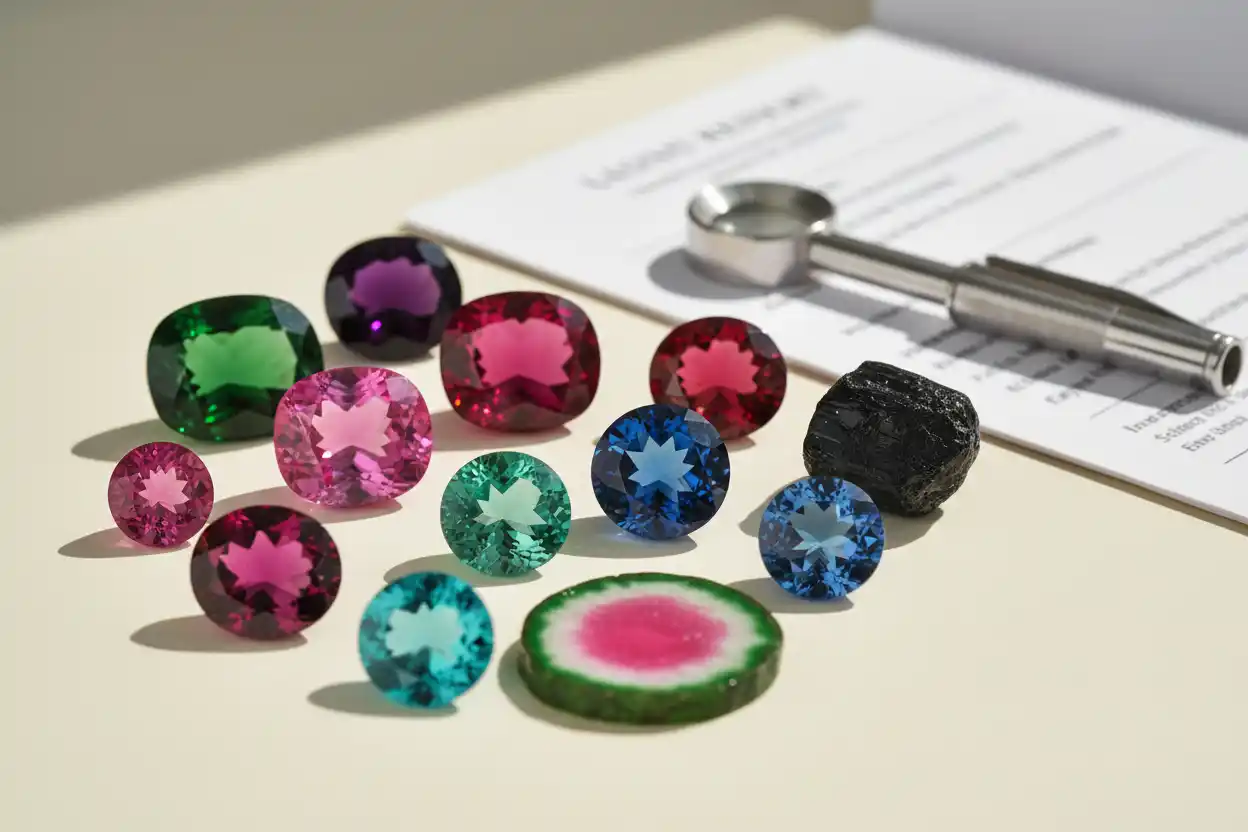
When you buy tourmaline, begin by deciding which tourmaline you are actually shopping for, because the name covers an unusually broad mineral group rather than one gemstone with a single color, chemistry, clarity standard, treatment history, or value hierarchy. A black schorl crystal, clean green faceted stone, strongly included rubellite, copper-bearing Paraiba tourmaline, blue indicolite, watermelon slice, chrome tourmaline, and cat’s-eye cabochon can all be genuine tourmaline while belonging to dramatically different commercial categories.
That diversity is the central challenge when you buy tourmaline. Generic advice such as “choose the clearest stone” can be actively misleading because fine red tourmaline commonly tolerates more inclusions than ordinary green material, while cat’s-eye tourmaline needs aligned inclusions to create its defining optical effect. Likewise, a vivid blue-green gemstone cannot be valued properly until you know whether it is ordinary iron-colored tourmaline, copper-bearing material, treated material, or an imitation.
The strongest way to buy tourmaline is therefore to establish the variety and material identity first, then evaluate color, tone, saturation, transparency, inclusion character, cut orientation, face-up dimensions, treatment, condition, provenance, laboratory documentation, photography, return rights, and jewelry suitability. Carat weight and retailer-created grades should come later.
Tourmaline’s extraordinary range is not a marketing invention. Its crystal structure can accommodate numerous chemical elements, which is why the group produces black, brown, yellow, green, blue, pink, red, violet, colorless, bicolored, tricolored, and concentrically zoned gems. The broader mineralogical framework appears in tourmaline meaning, while the different species and commercial varieties are organized in types of tourmaline.
What Should You Judge First When You Buy Tourmaline?
When you buy tourmaline, do not use one quality hierarchy for every color. First establish the variety or commercial category, then judge the factors that actually control value within that category.
For most transparent faceted stones, color is the largest visible quality factor. Clarity comes next, but the expected clarity changes with the color variety. Cut is particularly important because tourmaline is strongly pleochroic, meaning the cutter’s orientation can make one stone appear bright and open while another from comparable rough becomes almost black in one direction.
| Priority | What to evaluate | Stronger choice | Main concern |
|---|---|---|---|
| 1 | Material identity | Natural tourmaline correctly identified | Color name treated as proof |
| 2 | Variety | Rubellite, indicolite, Paraiba, green, chrome, multicolor, or other category represented accurately | Premium trade term used loosely |
| 3 | Color | Attractive hue, saturation, and tone without excessive darkness | Muddy, gray, brown, or blacked-out color |
| 4 | Transparency | Appropriate to the variety | Heavy cloudiness sold as fine transparent quality |
| 5 | Clarity | Inclusion level appropriate to the color category | Large white or surface-reaching fractures |
| 6 | Cut | Lively face-up appearance and sensible orientation | Windowing, extinction, severe bow tie |
| 7 | Dimensions | Good visible spread for the weight | Deep pavilion and hidden weight |
| 8 | Treatment | Heat, irradiation, filling, or coating disclosed where relevant | Generic “enhanced” wording |
| 9 | Provenance | Supported when origin materially changes value | Country or mine inferred from color |
| 10 | Documentation | Independent evidence for important claims | Seller certificate treated as conclusive proof |
This sequence allows you to buy tourmaline according to the stone in front of you rather than a generic checklist.
Tourmaline Is a Mineral Group, Not One Single Species
Before you buy tourmaline, understand that the name describes a supergroup containing multiple related mineral species.
Transparent jewelry-quality material commonly belongs to elbaite, fluor-elbaite, fluor-liddicoatite, dravite, or uvite-related compositions, while black material is commonly schorl. Chemistry can vary substantially even within stones that look almost identical.
This matters because a commercial color name usually does not establish the exact mineral species. Rubellite, for example, is a red-to-purplish-red trade variety rather than a separate mineral species. Indicolite describes blue tourmaline. Watermelon tourmaline describes a particular color-zoning pattern.
When you buy tourmaline, insist on accurate terminology but do not assume every ordinary jewelry purchase requires full species-level chemical analysis. Species becomes more commercially significant when rare chemistry, provenance, or collector classification affects the price.
Decide Which Tourmaline Category You Want First
A useful way to buy tourmaline is to choose the category before comparing individual stones.
Common categories include:
- Pink tourmaline.
- Rubellite.
- Green tourmaline.
- Chrome tourmaline.
- Indicolite.
- Paraiba and other copper-bearing tourmaline.
- Yellow and orange tourmaline.
- Watermelon tourmaline.
- Bicolor and multicolor tourmaline.
- Cat’s-eye tourmaline.
- Black tourmaline.
- Collector crystals and mineral specimens.
These categories differ so much that direct price-per-carat comparison can become meaningless.
A one-carat fine copper-bearing blue-green gemstone can command far more than a much larger ordinary green tourmaline. A heavily included red rubellite may remain valuable, while the same level of obvious inclusions could substantially reduce demand for a pale green faceted stone.
When you buy tourmaline, category comes before grade.
Color Is Usually the Most Important Quality Factor
Across transparent tourmaline, color generally contributes more to value than any other visible characteristic.
When you buy tourmaline, evaluate three components separately:
Hue describes the basic color family.
Tone describes how light or dark the gemstone appears.
Saturation describes the strength or purity of the color.
Fine material usually combines attractive saturation with enough brightness to prevent the gemstone from becoming muddy or black.
Strong color does not always mean dark color.
A medium-tone vivid green can be significantly more attractive than an extremely dark forest-green stone whose center appears black. Likewise, vivid red rubellite should maintain a recognizable red appearance instead of becoming brown or nearly opaque.
Do Not Confuse Darkness With Saturation
Dark tourmaline is widespread, particularly in green, blue-green, brown, and iron-rich material.
When you buy tourmaline, rotate the gemstone beneath normal reflected light and determine whether the color remains visible.
A dark stone can look impressive beneath powerful jewelry-store lamps because bright reflections cross its surface. Move it away from those lights and the body may appear almost black.
That darkness is not automatically high saturation.
Fine saturation should retain identifiable color.
Pleochroism Makes Tourmaline Unusually Orientation-Sensitive
Tourmaline is commonly strongly pleochroic, meaning the gemstone can show different color strength or hue in different crystallographic directions.
This is one of the most important reasons to buy tourmaline from video rather than still photographs when shopping remotely.
A green crystal may appear bright green across one direction yet extremely dark along its length. Blue material can show similar behavior.
Cutters use orientation strategically. Dark rough may be fashioned so the table lies parallel to the crystal’s long direction, helping create a lighter face-up result. Pale rough can be oriented differently to strengthen apparent color.
When you buy tourmaline, judge the finished face-up appearance rather than assuming orientation is only a technical cutting issue.
Rotating Video Should Be Standard
When you buy tourmaline online, request continuous rotating video of the exact stone.
The movement should reveal:
- Pleochroism.
- Color zoning.
- Windowing.
- Extinction.
- Bow ties.
- Inclusion visibility.
- Surface reflections.
- Cat’s-eye movement where relevant.
- Whether the attractive color survives multiple viewing directions.
A still photograph can show the one angle where the stone looks brightest.
Video reveals the complete optical behavior.
Pink Tourmaline Has a Wide Quality Range
Pink tourmaline can range from pale blush and peach-pink through saturated magenta and reddish pink.
When you buy tourmaline in pink, examine whether the body color remains attractive under neutral lighting. Pale pink stones should look bright rather than washed out, while stronger pinks should avoid excessive brown or darkness.
Clarity expectations are somewhat more forgiving than in many green tourmalines because pink material frequently forms with fluid-rich inclusions.
That does not make every fracture acceptable.
A small internal feature is different from a bright surface-reaching fissure across the table.
Rubellite Needs a Different Clarity Standard
Rubellite is the red-to-pinkish-red or purplish-red tourmaline category prized for stronger saturation.
When you buy tourmaline represented as rubellite, judge whether the color actually deserves that trade term. Fine stones should retain an attractive red character rather than simply being ordinary pale pink tourmaline with an expensive label.
Eye-visible inclusions are relatively common and can be tolerated when color is exceptional.
The critical question is whether the inclusions interfere with transparency, luster, or durability.
A vivid red stone with modest internal features can be a better buy tourmaline choice than a cleaner gemstone whose color is noticeably weaker.
Rubellite Should Not Simply Mean Any Pink Tourmaline
The boundary between pink tourmaline and rubellite is not governed by one universal laboratory color chart.
That creates room for aggressive marketing.
When you buy tourmaline labeled rubellite, inspect whether the stone maintains a saturated red, pinkish-red, or purplish-red appearance rather than turning weak pink under different lighting.
The trade name should correspond to observable color quality.
Do not pay a rubellite premium for a pale stone simply because the invoice uses the word.
Green Tourmaline Should Generally Be Cleaner
Green tourmaline can range from yellow-green and olive through forest green, bluish green, emerald-like green, and very dark green.
When you buy tourmaline in ordinary green faceting quality, transparency and clarity deserve relatively high expectations.
Green material is often available clean enough that conspicuous white fractures, large dark crystals, and heavy clouds should reduce value significantly.
The best green gems combine attractive saturation with enough brightness to avoid a black center.
Dark Green Tourmaline Is Often Overvalued by Beginners
A deep forest-green gemstone can initially look richer than a lighter stone, but excessive absorption may eliminate internal brilliance.
When you buy tourmaline in dark green, look through the center while rotating the stone.
If half the face remains black under ordinary lighting, you are not necessarily looking at elite color. You may be looking at overly dark material or unfavorable orientation.
A brighter green stone can provide significantly more visual life.
Chrome Tourmaline Is a Specialized Green Category
Chrome tourmaline refers to strongly saturated green tourmaline colored mainly by vanadium and chromium, commonly associated with dravite or uvite-group material.
When you buy tourmaline represented as chrome tourmaline, remember that vivid green appearance is essential but does not by itself prove the chemistry.
Other green tourmalines can look similar.
If the chrome designation materially increases the price, laboratory evidence becomes more useful.
Fine chrome material should be strongly green while remaining bright enough to avoid appearing black.
Chrome Does Not Automatically Mean Higher Quality
A gemstone can contain chromium or vanadium and still have mediocre color, poor cutting, or excessive darkness.
When you buy tourmaline with a chrome premium, evaluate the face-up gem first.
A slightly less fashionable green tourmaline with excellent brightness can be more attractive than a technically chrome-bearing stone that is too dark to show its color properly.
Trace chemistry should enhance an already desirable gemstone rather than rescue a weak one.
Indicolite Requires Strong Color Control
Indicolite is the trade name for blue tourmaline, including stones ranging through greenish blue, blue, teal, and related hues.
When you buy tourmaline in blue, pleochroism becomes especially important because one direction can be dramatically darker than another.
Fine indicolite should show a clearly attractive blue or blue-green body color without being so dark that it appears almost black.
Gray modifiers and heavy green components may reduce appeal depending on personal preference and the market category.
Pure-Looking Blue Can Command a Premium
Blue is less common than ordinary green in tourmaline, and attractive medium-tone blue can be highly desirable.
When you buy tourmaline represented as premium indicolite, ask for neutral-light photography because camera white balance can shift teal toward blue easily.
A stone that appears pure blue in one photograph and strongly green in another may be showing genuine pleochroism, inconsistent lighting, or image editing.
Video helps separate these possibilities.
Paraiba Requires a Completely Different Evidence Standard
Paraiba tourmaline belongs to the highest-value segments of the tourmaline market.
The commercial category refers to copper-bearing tourmaline known for vivid blue, greenish blue, bluish green, green, violet, and related colors. Copper is the defining chemical characteristic, commonly accompanied by manganese that influences the final appearance.
When you buy tourmaline marketed as Paraiba, attractive blue-green color alone is not enough.
Copper-bearing tourmaline requires chemical confirmation.
Glass, synthetic spinel, ordinary tourmaline, and other gems can imitate the color.
Paraiba Does Not Automatically Mean Brazil
The original famous material came from Brazil, but copper-bearing tourmaline also occurs in Nigeria and Mozambique.
When you buy tourmaline in the Paraiba category, separate two claims:
Is the gemstone copper-bearing tourmaline?
Where was it mined?
These are not the same question.
Brazilian origin can command an additional premium, particularly in exceptional material, but laboratory origin determination may require advanced trace-element analysis. In some cases, origin can remain inconclusive.
A seller should therefore not assign Brazil, Nigeria, or Mozambique solely from hue.
Brazilian Paraiba Provenance Can Matter Greatly
If you buy tourmaline specifically because it is represented as Brazilian Paraiba material, provenance can contribute substantially to value.
That premium deserves correspondingly strong evidence.
An independent identification and origin report is much more meaningful than a seller statement saying that the color “looks Brazilian.”
Fine Brazilian material can be extremely vivid even in small sizes, while African copper-bearing tourmaline can also achieve remarkable color and larger transparent sizes.
Judge the gemstone first, then the verified origin.
Heat Treatment Is Important in Copper-Bearing Tourmaline
Copper-bearing tourmaline can be heated to modify manganese-related absorption and improve blue-to-green appearance.
When you buy tourmaline in the Paraiba category, heat treatment should therefore be understood rather than treated as an impossible event.
In some material, heat can reduce purplish or pinkish components and reveal stronger blue or green.
Detecting heat in tourmaline can be difficult.
Consequently, a seller should not make an absolute unheated claim unless that conclusion is properly supported.
Paraiba Color Matters More Than Weight Alone
Fine copper-bearing stones can be extraordinarily valuable even in small sizes.
When you buy tourmaline in this category, do not sacrifice vivid color simply to obtain a larger carat figure.
A smaller gem with intense bright blue or blue-green color can be more desirable than a larger pale or gray stone.
The general rule that larger fine gemstones command more per carat still applies, but Paraiba shows particularly clearly why color must come first.
Watermelon Tourmaline Needs a Zoning-Based Quality Method
Watermelon tourmaline normally displays a pink or reddish interior surrounded by green, often with a pale or colorless transition zone.
When you buy tourmaline in watermelon form, decide whether you are buying a transverse crystal slice, longitudinal cut, cabochon, or transparent faceted gem.
A thin slice should be judged for:
- Recognizable pink-green pattern.
- Balance of color zones.
- Structural integrity.
- Polish.
- Natural crystal outline where preserved.
- Fractures.
- Thickness.
- Any repair or stabilization.
A transparent faceted bicolor stone follows a different hierarchy emphasizing color, transparency, and cut.
Perfect Watermelon Patterns Can Be Imitated
A visually ideal pink-center and green-rind pattern should not automatically convince you to buy tourmaline.
Multicolored glass can be manufactured deliberately, while assembled products can imitate natural zoning.
Natural watermelon tourmaline often shows growth relationships between color zones and natural inclusions, but even those clues require context.
For an expensive specimen, standard gemological identification is more reliable than visual pattern recognition.
Bicolor Tourmaline Should Show Both Colors Clearly
Tourmaline commonly develops color zoning as chemistry changes during crystal growth.
When you buy tourmaline as a bicolor or tricolor gemstone, evaluate whether the finished cut actually displays the advertised colors.
A stone described as pink-green bicolor should not contain only a tiny green corner hidden at the pavilion.
The cutter should use the natural zoning as part of the visual design.
Balanced transitions, complementary colors, transparency, and cut symmetry can justify a craftsmanship premium.
Longitudinal and Cross-Section Cuts Show Zoning Differently
Tourmaline crystals grow as elongated prisms, and their color zones can develop along or across the crystal.
A cross-sectional slice can reveal concentric color relationships such as the familiar watermelon pattern.
A longitudinal cut can show stacked or parallel bands.
When you buy tourmaline with unusual zoning, ask how the rough was oriented before cutting.
Understanding the original crystal geometry helps explain why the finished gemstone looks the way it does.
Cat’s-Eye Tourmaline Needs Inclusions
Parallel tube-like inclusions can create chatoyancy when tourmaline is cut as a cabochon.
When you buy tourmaline with a cat’s-eye effect, clarity is no longer about eliminating inclusions because those inclusions create the phenomenon.
Evaluate:
- Sharpness of the eye.
- Centering.
- Mobility.
- Continuity.
- Body color.
- Translucency.
- Dome proportions.
- Surface condition.
A strong eye should move across the cabochon as the stone or light source moves.
Static Photography Is Weak Evidence for a Cat’s Eye
Any polished cabochon can catch a bright surface reflection.
When you buy tourmaline marketed as cat’s-eye material, request continuous video under a concentrated light.
The band should move naturally across the dome.
A diffuse stationary highlight should not receive the premium of genuine strong chatoyancy.
Black Tourmaline Is Usually Schorl
Black tourmaline occupies a completely different market from transparent colored tourmaline.
Most commercial black material is schorl, an iron-rich tourmaline species.
When you buy tourmaline in black, judge crystal form, surface condition, polish, carving quality, durability, provenance, and authenticity rather than transparent-gem clarity.
Opaque black glass, plastic, dyed material, and other dark minerals can imitate polished black tourmaline.
A natural striated prismatic crystal can provide supporting evidence, but crystal-like shape alone is not proof because manufactured material can be molded or cut.
“Lab-Grown Tourmaline” Deserves Strong Scrutiny
True synthetic gem tourmaline is not an established routine commercial gemstone.
When you buy tourmaline from a listing described as lab-created Paraiba, synthetic tourmaline, or laboratory-grown rubellite, ask what the material actually is.
It may be:
- Synthetic spinel.
- Synthetic corundum.
- Glass.
- Cubic zirconia.
- Another manufactured simulant.
A synthetic gemstone should share the essential composition and crystal structure of its natural counterpart. A blue synthetic spinel merely resembling tourmaline is an imitation, not synthetic tourmaline.
Glass Is One of the Most Flexible Tourmaline Imitations
Glass can imitate nearly every tourmaline color, including green, pink, red, blue, teal, black, and multicolored combinations.
When you buy tourmaline, possible glass clues can include round gas bubbles, flow structures, swirled color, fused boundaries, mold marks, or unusual softness.
However, do not depend on one clue.
Natural tourmaline can contain fluid inclusions with gas bubbles, while high-quality glass can be very clean.
Professional refractive and optical testing provides much stronger separation.
The dedicated real vs fake tourmaline guide covers these distinctions in depth.
Synthetic Spinel Is a Common Color Imitation
Synthetic spinel can be produced in blue, green, pink, red, and other colors that overlap strongly with tourmaline.
When you buy tourmaline, standard gemological testing can separate the materials because synthetic spinel is cubic and singly refractive, while tourmaline is trigonal and doubly refractive.
Refractive index and density also differ.
Do not assume that a clean brightly colored stone must be synthetic, however. Natural tourmaline can be exceptionally transparent.
Synthetic Sapphire Can Imitate Red, Pink, and Blue Tourmaline
Synthetic corundum is another possible substitute.
A blue synthetic sapphire can resemble indicolite, while pink or red synthetic sapphire can imitate pink tourmaline or rubellite.
When you buy tourmaline, hardness tests are not the appropriate solution.
Corundum and tourmaline have sufficiently different refractive indices, density, optical properties, and spectra for professional separation without scratching either stone.
Color Alone Is One of the Weakest Authenticity Tests
Tourmaline’s extraordinary color diversity makes visual identification particularly unreliable.
When you buy tourmaline, nearly every hue has one or more plausible natural or manufactured lookalikes.
Blue can overlap with sapphire, aquamarine, zircon, glass, and synthetic spinel.
Green can overlap with emerald, tsavorite, peridot, diopside, glass, and other gems.
Red can resemble ruby, spinel, garnet, or synthetic materials.
Color should determine quality after identity has been established.
It should not establish identity itself.
Pleochroism Is Helpful but Not Proof
Many tourmalines show strong dichroism, which can help during identification.
However, other gemstones can also be pleochroic.
When you buy tourmaline, a visible change between two directions is supportive evidence rather than a complete diagnosis.
Gemologists combine optical character with refractive index, birefringence, density, spectroscopy, microscopy, and other observations.
Growth Tubes Are Important but Not Universal
Tourmaline commonly contains elongated tube-like inclusions running roughly parallel with the crystal’s long axis.
These features can be highly characteristic and may create a cat’s-eye effect when dense and well oriented.
When you buy tourmaline, the presence of growth tubes can support natural origin, but their absence does not make a gemstone fake.
Clean natural material exists.
Likewise, an imitation can contain manufactured internal features.
Fluid Inclusions Need Skilled Interpretation
Tourmaline often forms in fluid-rich geological environments, so liquid-bearing cavities, healed fractures, fingerprints, and multiphase inclusions are common.
When you buy tourmaline, do not apply the internet rule that every bubble proves glass.
A natural fluid inclusion can contain a gas bubble.
The important issue is the shape, setting, surrounding fracture structure, and relationship to the crystal’s growth.
This is why microscopy requires interpretation rather than simple pattern matching.
Surface-Reaching Fractures Should Affect Price
A surface-reaching fissure can reduce brilliance, weaken polish, collect dirt, create a durability risk, and contain filler.
When you buy tourmaline, inspect fractures reaching the crown, table, girdle, pavilion, and pointed corners.
White reflective fissures are particularly distracting.
A highly saturated rubellite or Paraiba stone can still retain strong value despite inclusions, but a major open fracture should not disappear from the pricing conversation merely because the color is exceptional.
Fracture Filling Is an Important Treatment Question
Oil, resin, polymer, or another filler can enter surface-reaching cracks and reduce their visibility.
When you buy tourmaline containing prominent fractures, ask whether filling has been detected or disclosed.
Filled material remains tourmaline, but the treatment can affect:
- Value.
- Transparency.
- Cleaning.
- Heat sensitivity.
- Repair procedures.
- Long-term appearance.
Fracture filling generally deserves more caution than routine low-level heat treatment because the enhancement directly occupies structural breaks.
Heat Treatment Can Modify Tourmaline Color
Heat can modify the color of some tourmaline, including certain dark green, blue, pink, red, and copper-bearing stones.
When you buy tourmaline, do not assume heated material is fake.
A naturally formed gemstone remains natural tourmaline after treatment.
The commercial issue is whether the treatment is disclosed and whether it changes the rarity or stability assumptions behind the asking price.
Irradiation Can Strengthen Pink and Red Color
Irradiation can produce or intensify pink, red, and related colors in suitable tourmaline.
When you buy tourmaline in pink or red, treatment history may therefore matter more when the seller is asking a substantial premium for supposedly natural untreated color.
Some irradiation-related color can be sensitive to heat or strong light.
That does not mean every irradiated tourmaline is unstable.
It means care advice should follow the exact treatment rather than a universal rule.
Color Stability Should Be Part of the Treatment Discussion
If a gemstone’s value depends heavily on unusual vivid color, ask whether that color is known to be stable under ordinary wear.
When you buy tourmaline after irradiation has been disclosed, avoid excessive heat and prolonged intense light unless the seller or laboratory provides stronger material-specific guidance.
Do not attempt to test stability by deliberately heating or exposing an expensive stone.
A destructive experiment provides information only after you have potentially reduced the value.
Coatings and Assemblies Are Less Common but Possible
A thin coating can modify surface color, while assembled products can combine materials to imitate zoning or strengthen appearance.
When you buy tourmaline with suspiciously perfect color concentrated near the surface, examine scratches, facet edges, girdles, chips, and junctions under magnification.
Do not scrape the stone.
An unusual surface effect should trigger professional examination rather than destructive home testing.
Heat Sensitivity Matters During Jewelry Repair
Tourmaline is generally stable in ordinary wear, but high heat can damage the gemstone, alter some treated colors, and expand liquid inclusions or fractures.
When you buy tourmaline jewelry, tell the jeweler exactly what the center stone is before retipping prongs, resizing, soldering, or performing other heat-intensive repairs.
A clean stone can behave differently from a heavily included rubellite or Paraiba gem.
Repair procedures should follow the individual stone’s condition.
Tourmaline Has Useful Hardness but Only Fair Toughness
Tourmaline generally ranks about 7–7.5 on the Mohs scale.
That provides useful resistance to everyday scratching, but the gemstone is brittle and its toughness is commonly considered fair.
When you buy tourmaline for jewelry, do not interpret Mohs hardness as impact resistance.
A heavily fractured red stone, thin watermelon slice, sharp crystal termination, or elongated gem with exposed corners can chip or fracture when struck.
Tourmaline Has No Strong Cleavage, but It Can Still Break
Tourmaline does not have the prominent cleavage problems associated with topaz or tanzanite, which is helpful for jewelry.
However, brittle behavior and internal fractures remain important.
When you buy tourmaline for a ring, inspect the stone itself rather than assuming the absence of strong cleavage makes every specimen durable.
Structural condition can matter more than the mineral’s general property table.
Rings Can Work Well With Sound Tourmaline
A clean, structurally sound tourmaline can work successfully in a ring.
When you buy tourmaline for frequent wear, prioritize:
- Limited surface-reaching fractures.
- A sound girdle.
- Protected pointed corners.
- A secure setting.
- Sensible profile height.
- No obvious filler unless you accept the care limitations.
Highly included rubellite and Paraiba stones can still be mounted, but they deserve more conservative setting pressure.
Pendants and Earrings Give Fragile Tourmaline More Protection
When you buy tourmaline with substantial inclusions, thin zoning, or valuable optical phenomena, earrings and pendants can offer a safer setting environment than rings.
These jewelry types encounter fewer direct blows and less desk or countertop contact.
Large elongated crystals also work particularly well in pendants because the design can preserve their natural proportions without exposing them to constant hand impact.
Long Rectangles Are Common for a Reason
Tourmaline frequently crystallizes as elongated prisms, encouraging cutters to fashion long rectangles, emerald cuts, baguette-like shapes, and elongated cushions.
When you buy tourmaline in one of these forms, the shape itself is not evidence of poor cutting.
It often reflects efficient use of natural rough.
However, long narrow stones can require custom mountings, and their corners can be vulnerable.
Judge the cut for performance and practicality rather than standard dimensions alone.
Cut Orientation Can Change the Color Dramatically
Because tourmaline is strongly pleochroic, the cutter may sacrifice weight to achieve a better face-up color.
When you buy tourmaline, that sacrifice can justify paying more for a smaller stone.
A cutter who orients dark rough intelligently may produce a bright green gem from material that otherwise would face up almost black.
Conversely, pale rough can sometimes be oriented to deepen the color.
The best cut is the one that uses the crystal’s optical properties deliberately.
Windowing Is a Major Cut Weakness
A window appears as a pale or transparent face-up region where light escapes through the pavilion.
When you buy tourmaline, place the stone against a neutral background and inspect the center.
A broad window can weaken:
- Color.
- Brilliance.
- Apparent saturation.
- Face-up value.
This is especially visible in pale pink, light green, and lightly saturated stones.
A little leakage at changing angles is normal. A large stationary window should reduce the price.
Extinction Is Particularly Important in Dark Tourmaline
Extinction appears as black or dead-looking areas where little light returns.
When you buy tourmaline in dark green, indicolite, chrome, or deep red material, rotate the stone and examine how much of the face remains dark.
Strong pleochroism and deep body color can amplify extinction.
A slightly lighter gemstone with superior orientation may provide far more beauty than a heavier dark stone.
Bow Ties Can Affect Elongated Shapes
Ovals, pears, marquises, and elongated cushions can show a bow-tie-shaped dark region through the center.
When you buy tourmaline in these shapes, use video rather than one still photograph.
A mild bow tie can create useful contrast.
A large black stationary band can reduce brilliance substantially.
Compare Millimeter Dimensions With Carat Weight
Carat weight measures mass rather than visible size.
When you buy tourmaline, compare length, width, and depth alongside the weight.
Fine rough can be expensive, so cutters sometimes retain deep pavilions to preserve carats. That can be reasonable when the depth improves color or saves exceptional material.
It becomes a weakness when the added mass produces no visible benefit.
Large Tourmaline Is Not One Rarity Category
Tourmaline crystals can reach substantial sizes, but availability depends strongly on variety and quality.
When you buy tourmaline, a large ordinary green stone does not carry the same rarity as a large fine rubellite, vivid indicolite, or high-quality copper-bearing gem.
The relationship among variety, color, clarity, size, and value is explored separately in tourmaline price.
The relevant question is not “Is this large?”
It is “How difficult is this level of quality to find in this particular variety at this size?”
Fine Size Premiums Should Follow Quality
When fine color and clarity survive into larger stones, per-carat prices can rise sharply.
When you buy tourmaline, do not assume the same increase applies to dark, pale, heavily included, or poorly cut material.
Extra size only multiplies the qualities already present.
If the stone is muddy, a larger muddy stone is still muddy.
Seller-Created Grades Are Not Universal
AAA, AAAA, investment grade, museum grade, neon grade, royal grade, collector grade, and similar terms are not universal tourmaline grading systems.
When you buy tourmaline with one of these labels, ask what the seller actually means.
Does the grade evaluate:
- Color?
- Clarity?
- Cut?
- Variety?
- Copper chemistry?
- Treatment?
- Origin?
- Size?
- All of them?
If the criteria are vague, ignore the grade.
Paraiba, Rubellite, and Indicolite Are Not Laboratory Quality Grades
These terms describe varieties or trade categories rather than one numerical quality tier.
When you buy tourmaline described as rubellite, indicolite, or Paraiba, you still need to judge the quality within that category.
A weak rubellite remains weak rubellite.
A dark indicolite remains dark indicolite.
A copper-bearing stone can be genuine Paraiba-type material yet have pale color or poor cutting.
Identification and quality should never be merged.
Geographic Origin Matters Most in Specific Premium Categories
Brazil, Mozambique, Nigeria, Afghanistan, Pakistan, Madagascar, Namibia, Sri Lanka, Tanzania, and other countries produce gem tourmaline.
When you buy tourmaline in ordinary pink or green, origin usually matters less than visible quality.
Origin becomes more commercially significant for:
- Brazilian Paraiba.
- Historically important collector crystals.
- Famous pegmatite specimens.
- Fine locality-specific rough.
- Mineral collections where provenance is central.
Do not pay a location premium merely because the country has produced famous stones.
Brazil Produces an Extraordinary Variety
Brazil is one of the best-known sources for pink, green, blue, rubellite, multicolored, and copper-bearing tourmaline.
When you buy tourmaline represented as Brazilian, evaluate the exact stone rather than assuming Brazilian means premium.
Brazil produces commercial material and exceptional collector gems.
Country alone is not quality.
Mozambique Is Important for Copper-Bearing and Red Material
Mozambique produces significant copper-bearing tourmaline, rubellite, pink, green, and other colors.
When you buy tourmaline represented as Mozambique Paraiba, chemistry should support the copper-bearing designation, while origin should be separated from the variety claim.
Fine Mozambique copper-bearing stones can achieve remarkable size and clarity.
They should be evaluated on their own merits rather than treated automatically as inferior or equivalent to Brazilian examples.
Nigeria Also Produces Copper-Bearing Tourmaline
Nigeria is another important source of copper-bearing material as well as ordinary colored tourmaline.
When you buy tourmaline with a Nigerian Paraiba claim, remember that laboratory origin work can depend on trace-element chemistry rather than appearance.
A seller cannot determine Nigeria confidently simply because the color seems slightly different from Mozambique or Brazil.
Afghanistan and Pakistan Produce Important Pegmatite Tourmaline
Afghanistan and Pakistan are important sources of pink, green, blue, bicolored, multicolored, and crystal-specimen material.
When you buy tourmaline from these regions, elongated crystals and dramatic zoning can be highly attractive.
Precise valley or mine claims deserve stronger provenance when they materially increase price.
The geological appearance alone does not prove the exact locality.
Madagascar Is Important for Complex Zoning
Madagascar is especially well known for multicolored tourmaline and liddicoatite-related material with striking zoning.
When you buy tourmaline as a collector slice, provenance, color geometry, natural crystal shape, polish, thickness, fractures, and repairs can all affect value.
Do not apply standard faceted-gem clarity rules to a specimen whose entire appeal comes from complex growth zoning.
A Laboratory Report Is Most Valuable When the Claim Changes the Price
Not every small ordinary green or pink tourmaline requires expensive independent testing.
When you buy tourmaline, a report becomes much more useful for:
- Paraiba.
- High-value rubellite.
- Fine indicolite.
- Chrome tourmaline.
- Important color-change material.
- Large multicolored gems.
- Expensive cat’s-eye stones.
- Important geographic-origin claims.
- Unusual treatment claims.
- Material whose identity is uncertain.
The correct threshold follows the cost of being wrong.
GIA Evaluates Tourmaline but Does Not Apply One Universal Grade
A laboratory identification report can determine whether the gemstone is natural or laboratory-grown, record weight and measurements, identify the material, and report detectable treatments within the service.
For qualifying copper-bearing tourmaline, geographic-origin analysis may also be available.
That is different from assigning an AAA or AAAA quality grade.
When you buy tourmaline with a report, use the document for the questions the laboratory actually addressed.
Judge commercial beauty and value separately.
Paraiba Origin Reports Can Be Especially Important
A copper-bearing tourmaline may be identifiable as Paraiba-type material without the country being obvious through normal gemological observation.
When you buy tourmaline with a Brazilian premium, origin analysis becomes particularly valuable.
Trace-element chemistry can often separate Brazilian, Nigerian, and Mozambican material, although some stones may remain inconclusive.
An inconclusive origin is not proof that the stone is fake.
It means the available evidence did not justify a definitive locality conclusion.
Report Versus Appraisal
A laboratory report identifies material and supported characteristics.
An appraisal estimates monetary value for a particular purpose.
When you buy tourmaline, a high appraisal figure does not prove that a stone is Brazilian Paraiba, unheated rubellite, or chromium-bearing green tourmaline.
Likewise, a laboratory report does not establish that the seller’s price is fair.
Authenticate first.
Value second.
Match the Report to the Exact Stone
Before you buy tourmaline with documentation, compare:
- Report number.
- Weight.
- Length.
- Width.
- Depth.
- Shape.
- Cutting style.
- Color description.
- Photograph where supplied.
A report for another gemstone from the same parcel does not identify yours.
This matters especially in expensive Paraiba parcels where visually similar stones can differ in chemistry and origin.
Actual-Stone Photography Is Essential
Tourmaline’s color diversity makes stock imagery particularly unhelpful.
When you buy tourmaline online at a meaningful price, request photographs of the exact gemstone.
A useful image set includes:
- Face-up view.
- Side profile.
- Pavilion or rear view.
- Neutral background.
- Close-up of significant inclusions.
- Close-up of the girdle.
- Continuous rotating video.
For watermelon and multicolor stones, request views that show the complete zoning pattern.
For cat’s-eye material, request moving point-source video.
Neutral Lighting Prevents Color Exaggeration
When you buy tourmaline, inspect at least one image where white or gray objects in the frame look neutral.
Warm lighting can strengthen pink, red, orange, and brown.
Cool lighting can intensify blue and teal.
Dark backgrounds can make saturation appear stronger.
A fine gemstone should remain attractive without an entire photographic environment being adjusted to flatter it.
Ask for More Than One Lighting Environment
Tourmaline can change dramatically between daylight-equivalent and warm indoor lighting because of pleochroism and ordinary color perception.
When you buy tourmaline, request ordinary indoor video in addition to strong directional lighting.
This is particularly useful for:
- Rubellite.
- Indicolite.
- Dark green tourmaline.
- Paraiba.
- Color-change stones.
- Multicolored material.
You should know what the gemstone looks like during normal ownership, not merely in a display case.
Side Views Reveal Hidden Weight and Fractures
When you buy tourmaline, side photography helps answer questions that face-up images cannot.
You can evaluate:
- Pavilion depth.
- Girdle thickness.
- Surface-reaching cracks.
- Uneven color zoning.
- Chips.
- Filler-related features.
- Whether the stone is unusually shallow or deep.
This becomes especially valuable in large fine stones where hidden pavilion weight can materially affect the price.
Pavilion Views Can Reveal Treatment Concerns
A rear view can expose fracture systems, poor polishing, chips, coatings, or color concentrations that the face-up perspective conceals.
When you buy tourmaline with substantial value, ask for the rear of the actual gemstone.
A seller should not be reluctant to show the complete loose stone.
Return Terms Are Part of the Inspection Process
When you buy tourmaline remotely, a sensible return policy gives you the opportunity to compare the delivered gemstone with its online representation.
Before purchasing, determine:
- Whether the exact stone is returnable.
- Whether laboratory examination is permitted.
- Whether tags must remain attached.
- Whether mounting ends return rights.
- Whether resizing jewelry makes it final sale.
- Who pays insured shipping.
- Whether restocking charges apply.
- What happens if treatment or identity differs from the description.
Return rights become especially important for pleochroic and strongly zoned gems because screens cannot reproduce every color accurately.
Put Important Claims in Writing
When you buy tourmaline, preserve the attributes that materially affected the price.
Depending on the stone, the invoice may need to state:
- Natural tourmaline.
- Rubellite.
- Indicolite.
- Copper-bearing Paraiba tourmaline.
- Chrome tourmaline.
- Watermelon tourmaline.
- Known heat treatment.
- Known irradiation.
- Known filling.
- Geographic origin.
- Weight.
- Dimensions.
- Laboratory report number.
The more specific the premium, the more specific the documentation should become.
Care Depends on Treatment and Structural Condition
For most sound tourmaline, lukewarm water, mild soap, and gentle manual cleaning provide a practical approach.
The detailed procedure appears in how to clean tourmaline jewelry.
When you buy tourmaline that is filled, heavily fractured, coated, glued, or unusually included, choose even more conservative cleaning.
Heat and sudden temperature changes deserve particular caution.
Ultrasonic Cleaning Should Not Be the Default
A clean unfilled stone may tolerate more than a fractured rubellite, but there is little reason to make ultrasonic cleaning the standard home method.
When you buy tourmaline, plan on gentle manual cleaning instead.
Vibration can aggravate fissures, particularly in included or filled material.
Steam and High Heat Should Be Avoided
High heat can damage tourmaline, alter some treated colors, and expand liquid inclusions.
When you buy tourmaline jewelry, warn the jeweler before soldering, retipping, resizing, or performing another heat-intensive repair.
A procedure safe for diamond may not be appropriate for a highly included tourmaline.
Value Trade-Off: Better Color Versus Better Clarity
Suppose one rubellite has extraordinary red color with several visible inclusions while another is much cleaner but weaker pink-red.
When you buy tourmaline in rubellite quality, the more included stone may be preferable if the inclusions are not structurally serious and the color difference is substantial.
Now change the comparison to pale green tourmaline.
The cleaner stone may become more desirable because green material is generally expected to have fewer visible inclusions.
This illustrates why one clarity rule does not work across the group.
Value Trade-Off: Smaller Paraiba Versus Larger Ordinary Tourmaline
If your budget permits either a small vivid copper-bearing gem or a much larger ordinary green tourmaline, decide which quality you actually want.
When you buy tourmaline for rarity and electric blue-green color, the smaller Paraiba can be the more meaningful purchase.
When you buy tourmaline for substantial visible size at a moderate budget, the larger ordinary gem may provide greater satisfaction.
Carat weight alone cannot compare them.
Value Trade-Off: Better Cut Versus Extra Weight
Tourmaline’s elongated crystals encourage cutters to retain long shapes and considerable depth.
When you buy tourmaline, a smaller well-oriented stone with strong brightness can outperform a heavier gem suffering from extinction or a large window.
The extra weight should earn its price through visible quality.
Value Trade-Off: Famous Origin Versus Better Gemstone
A documented Brazilian, Afghan, Pakistani, or Madagascan provenance can add collector interest.
When you buy tourmaline for jewelry, however, better color and cutting may matter more to you than origin.
Paraiba is the main category where geographic origin can have a particularly strong direct commercial effect.
For ordinary green or pink material, origin usually ranks much lower.
Value Trade-Off: Untreated Versus Treated
A disclosed heated or irradiated tourmaline can remain beautiful and useful.
When you buy tourmaline, decide whether treatment rarity matters to your objective.
A jewelry buyer may prefer a vivid treated stone with excellent cutting.
A collector may pay more for well-documented untreated color.
Neither priority is inherently wrong when disclosure is accurate.
Value Trade-Off: Loose Gem Versus Finished Jewelry
A loose gemstone allows you to examine the pavilion, fractures, dimensions, zoning, and treatment clues more easily.
Finished jewelry lets you evaluate the complete design but can conceal girdle damage or hidden pavilion weight.
When you buy tourmaline of substantial value, especially Paraiba, rubellite, or indicolite, inspecting the loose stone before mounting can reduce uncertainty.
Practical Buy Tourmaline Decision Matrix
| Factor | Strong candidate | Reasonable compromise | Serious concern |
|---|---|---|---|
| Identity | Natural tourmaline established appropriately | Modest commercial stone with clear disclosure | Color used as the only proof |
| Variety | Trade category matches observable and testable characteristics | Broad color name used honestly | Premium variety name used loosely |
| Color | Attractive saturation and brightness | Muted color priced accordingly | Excessive darkness, brown, or gray sold as top grade |
| Clarity | Appropriate to color variety | Rubellite/Paraiba inclusions balanced by color | Major white or surface-reaching fracture |
| Cut | Lively, well oriented, useful spread | Non-standard shape preserving good rough | Broad window, severe extinction |
| Dimensions | Appropriate for weight | Some depth supporting color | Large hidden pavilion mass |
| Heat | Disclosed where known | Buyer accepts treatment uncertainty at modest value | Unsupported unheated premium |
| Irradiation | Disclosed where relevant | Treated pink/red bought knowingly | Natural-color premium without support |
| Filling | None or clearly disclosed | Minor filling priced accordingly | Significant filler concealed |
| Paraiba | Copper chemistry supported | Copper-bearing stone without origin premium | Neon color treated as proof |
| Paraiba origin | Credible laboratory opinion where price depends on it | Origin not central to purchase | Brazil claimed from appearance |
| Chrome | Chemistry supported when premium is substantial | Fine green bought for appearance | Chrome term used as a marketing grade |
| Photos | Exact stone, neutral light, rotating video | Clear actual-item images | Stock photos or one flattering angle |
| Report | Appropriate to value and claims | No report for ordinary modest stone | Seller certificate presented as independent proof |
| Setting | Sound stone with protected edges | Careful ring wear | Heavily fractured stone in exposed mounting |
| Returns | Meaningful inspection opportunity | Reasonable restrictions | Important gem sold final with no verification path |
Use this matrix when you buy tourmaline to make the stone-specific trade-offs explicit rather than collapsing them into a generic seller grade.
Stone-Specific Red Flags When You Buy Tourmaline
One of the strongest red flags is an expensive blue-green gemstone called Paraiba solely because it has a neon appearance. Copper chemistry, not color alone, defines the premium category.
Another warning is every saturated pink stone being called rubellite. Fine rubellite should possess a convincing red, pinkish-red, or purplish-red character rather than merely being ordinary pink tourmaline with a stronger label.
Be cautious with “chrome tourmaline” when no evidence supports chromium or vanadium-related chemistry and the stone is dark enough to look almost black.
A listing for “lab-grown tourmaline” also deserves scrutiny because true synthetic gem tourmaline is not a routine commercial product.
Other important red flags include:
- Dark green stones described as top saturation while most of the face appears black.
- Paraiba origin assigned visually.
- Brazilian provenance without supporting documentation.
- Watermelon patterns that look suspiciously manufactured or assembled.
- Cat’s-eye claims demonstrated only with one still photograph.
- Large white surface-reaching fractures with no filling discussion.
- Irradiated pink or red color sold as definitively untreated.
- Vivid blue material photographed only under cool lighting.
- Carat weight supplied without dimensions.
- Deep stones with poor face-up spread.
- Seller-created AAAA grades without criteria.
- A generic appraisal used as treatment or origin proof.
- A report whose measurements do not match the gem.
- High-value final-sale terms preventing independent examination.
A Better Way to Buy Tourmaline
Start your buy tourmaline process by identifying the specific variety you want rather than searching the mineral group as though it were one standardized product.
If you want green tourmaline, compare greens with similar tone and clarity expectations. Remove stones that appear almost black, then compare hue, saturation, transparency, and cut.
If you want rubellite, prioritize convincing red color before demanding perfect clarity. Separate harmless internal inclusions from large surface-reaching fissures.
If you want indicolite, use rotating video to evaluate pleochroism and make sure the blue does not disappear into darkness.
If you want Paraiba, make copper-bearing identification central to the transaction and require stronger origin evidence when Brazil, Nigeria, or Mozambique materially changes the price.
If you want watermelon or other multicolored tourmaline, judge the zoning geometry and cut style before comparing carat weight.
Then evaluate every remaining gemstone for windowing, extinction, dimensions, structural condition, treatment, photography, documentation, and return rights.
The broader Buying & Value collection applies the same evidence-first approach across many gemstone purchases, but the most important rule when you buy tourmaline is to resist treating a chemically and visually diverse mineral group as though every color follows one grading formula.
Frequently Asked Questions
What should I check first when I buy tourmaline?
When you buy tourmaline, establish the material identity and exact variety first. Then evaluate color, clarity, cut, dimensions, treatment, condition, provenance, documentation, and jewelry use according to that specific category.
What color tourmaline is most valuable?
Fine copper-bearing Paraiba material can occupy the highest value tier, while vivid rubellite red, fine indicolite blue, and saturated chrome green can also command significant premiums. When you buy tourmaline, quality within the color category matters as much as the color name.
Is tourmaline one mineral?
No. Tourmaline is a supergroup containing multiple related mineral species with variable chemistry.
What is the most common gem tourmaline species?
Much transparent gem-quality pink, red, green, blue, and multicolored tourmaline belongs to elbaite or related species, while other gem material can belong to fluor-liddicoatite, dravite, uvite, and related members.
Is black tourmaline the same as schorl?
Most commercial black tourmaline is schorl, although the tourmaline group contains other species that can also become very dark.
What is rubellite?
Rubellite is saturated red, pinkish-red, or purplish-red tourmaline. When you buy tourmaline under this name, judge whether the actual color justifies the trade designation.
Is all pink tourmaline rubellite?
No. Pale and ordinary pink tourmaline should not automatically be called rubellite.
What is indicolite?
Indicolite is blue tourmaline. Fine material can range from blue-green and teal through stronger blue, often with pronounced pleochroism.
What is chrome tourmaline?
Chrome tourmaline is strongly saturated green tourmaline colored primarily by vanadium and chromium, commonly associated with dravite or uvite-group material.
Is every vivid green tourmaline chrome tourmaline?
No. When you buy tourmaline with a chrome premium, chemistry may need to be confirmed rather than inferred from green color.
What is Paraiba tourmaline?
Paraiba is the trade category for copper-bearing tourmaline, typically showing vivid blue, greenish blue, bluish green, green, violet, or related colors.
Does Paraiba tourmaline have to come from Brazil?
Copper-bearing Paraiba-type tourmaline is also known from Nigeria and Mozambique. When you buy tourmaline with a Brazilian origin premium, geographic origin should be evaluated separately from copper-bearing identity.
How can I know if a tourmaline is Paraiba?
Color alone cannot prove it. Copper-bearing chemistry requires appropriate gemological analysis.
Is Brazilian Paraiba more valuable?
Fine Brazilian material can command substantial provenance premiums, but individual color, clarity, cut, size, treatment, and documentation still matter.
Can laboratories determine Paraiba origin?
In many cases, advanced trace-element analysis can support an origin opinion for Brazil, Nigeria, or Mozambique. Some stones may remain inconclusive.
Is Paraiba tourmaline heated?
Copper-bearing material can be heated to modify manganese-related absorption and improve blue-to-green appearance. Treatment should be considered separately from geographic origin.
Is tourmaline normally treated?
Many tourmalines are sold without treatment, but heat, irradiation, fracture filling, coatings, and other modifications can occur.
Is heated tourmaline fake?
No. A naturally formed tourmaline remains natural tourmaline after heating. Treatment should be disclosed when relevant to value or care.
Can tourmaline be irradiated?
Yes. Irradiation can strengthen pink, red, and related colors in suitable tourmaline.
Can irradiated tourmaline fade?
Some irradiation-related colors can be sensitive to strong light or heat. When you buy tourmaline with disclosed irradiation, follow treatment-specific care rather than assuming every irradiated stone behaves identically.
Can tourmaline be fracture filled?
Yes. Surface-reaching fractures can contain oil, resin, polymer, or other filler intended to reduce their visibility.
Does synthetic tourmaline exist?
True synthetic gem tourmaline is not a routine commercial jewelry product. When you buy tourmaline advertised as lab-grown, ask what the material actually is.
What can imitate tourmaline?
Glass, synthetic spinel, synthetic sapphire, cubic zirconia, plastic, dyed materials, and other natural gemstones can imitate different tourmaline colors.
Can glass imitate Paraiba tourmaline?
Yes. Glass can be manufactured in vivid blue-green colors and can even contain inclusions that appear superficially convincing. Proper testing is necessary for expensive stones.
Do bubbles prove tourmaline is fake?
No. Natural tourmaline can contain fluid inclusions with gas bubbles. Their structure and geological setting must be interpreted properly.
Does real tourmaline have inclusions?
Often, but not always. Growth tubes, fluid inclusions, crystals, fractures, fingerprints, and zoning can occur naturally, while fine material can also be very clean.
What are growth tubes in tourmaline?
They are elongated tube-like internal features commonly aligned roughly with the crystal’s growth direction. Dense aligned tubes can produce a cat’s-eye effect.
Can tourmaline show a cat’s eye?
Yes. Parallel inclusions can create chatoyancy when suitable material is cut as a cabochon.
How do I evaluate cat’s-eye tourmaline?
When you buy tourmaline with chatoyancy, look for a visible, centered, mobile eye that moves naturally under a point-like light source.
What is watermelon tourmaline?
Watermelon tourmaline typically shows a pink or reddish interior surrounded by green, often with a pale zone between them.
Can watermelon tourmaline be fake?
Yes. Glass, assembled material, and other imitations can reproduce pink-and-green zoning. The pattern alone does not prove natural tourmaline.
What is bicolor tourmaline?
Bicolor tourmaline contains two distinct natural color zones created as chemistry changed during crystal growth.
Why is tourmaline often cut into long rectangles?
Natural crystals are commonly elongated prisms. Long rectangular cuts can preserve rough efficiently while also allowing cutters to manage pleochroism.
Why does tourmaline look darker from one direction?
Strong pleochroism and directional absorption can make one crystallographic direction considerably darker than another.
What is windowing in tourmaline?
Windowing is a pale or transparent face-up area caused by inefficient pavilion light return. When you buy tourmaline, a large window should generally reduce the price.
What is extinction in tourmaline?
Extinction creates dark or black areas where little useful light returns. It is particularly important in deeply colored green and blue stones.
Should tourmaline be eye-clean?
It depends on the variety. Green tourmaline is generally expected to be relatively clean, while rubellite and Paraiba can retain strong value with visible inclusions when color is exceptional.
Is large tourmaline rare?
Large crystals exist, but large fine faceting material becomes more valuable when desirable color, clarity, and cut survive into the larger size. The rarity varies strongly by variety.
Should I buy tourmaline based on carat weight?
No. When you buy tourmaline, compare weight with dimensions, color, clarity, cut, and variety. Deep stones can hide considerable mass below the girdle.
Does geographic origin affect tourmaline value?
Usually less than color and quality, except in specialized collector material and premium categories such as Brazilian Paraiba.
Do I need a laboratory report when I buy tourmaline?
Not for every modest commercial stone. When you buy tourmaline with significant Paraiba, rubellite, indicolite, chrome, origin, treatment, or rarity premiums, independent documentation becomes much more useful.
Does a laboratory grade tourmaline AAA?
There is no universal AAA or AAAA tourmaline quality grading system. Seller-created grades should be interpreted through their stated criteria.
Is an appraisal proof that tourmaline is authentic?
No. An appraisal estimates monetary value. Gemological identity, treatment, chemistry, and geographic origin require appropriate examination.
What photographs should I request before I buy tourmaline online?
Request exact-stone face-up photographs, side and pavilion views, neutral-light images, inclusion close-ups, and rotating video. Phenomenal and multicolored stones need additional views showing the complete effect.
Is tourmaline durable enough for rings?
Sound tourmaline generally works well in rings because it has Mohs hardness around 7–7.5 and no strong cleavage. However, brittle behavior and fractures require sensible protection.
Is tourmaline suitable for engagement rings?
It can be, particularly when the stone is clean, structurally sound, and securely set. Highly included rubellite, Paraiba, and thin multicolored slices require more cautious design.
How should tourmaline be cleaned?
Use lukewarm water, mild soap, and gentle manual cleaning for most sound stones. Avoid excessive heat and sudden temperature changes.
Can tourmaline go in an ultrasonic cleaner?
It is safer not to make ultrasonic cleaning the default, particularly for fractured, filled, heavily included, glued, or antique pieces.
Can tourmaline be steam cleaned?
Steam is best avoided because high heat and thermal shock can damage the gemstone or affect certain treatments.
Does tourmaline hold its value?
Fine Paraiba, rubellite, indicolite, chrome tourmaline, exceptional multicolored stones, and important collector gems can attract strong demand. However, resale and appreciation are never guaranteed.
What is the biggest red flag when I buy tourmaline?
The biggest warning is a large premium attached to an unverified variety claim, especially blue-green material called Paraiba without copper analysis, ordinary pink material called rubellite, dark green material called premium chrome tourmaline, or supposed lab-grown tourmaline whose actual manufactured material is never identified.
Final Buy Tourmaline Checklist
Before you buy tourmaline, determine exactly which part of the tourmaline market you are entering. Ordinary green, pink, rubellite, indicolite, chrome, Paraiba, watermelon, cat’s-eye, black, and mineral-specimen material should not be evaluated through one universal hierarchy.
Confirm identity before paying for rarity. Tourmaline is a chemically diverse mineral group, and nearly every one of its colors can be imitated by another natural or manufactured material. Color, pleochroism, inclusions, and zoning provide useful clues, but high-value stones deserve proper gemological evidence.
Judge color according to the specific variety. When you buy tourmaline in ordinary green or blue, avoid excessive darkness and black extinction. When you buy rubellite, prioritize convincing red color even if modest inclusions remain. When you buy Paraiba, make copper-bearing chemistry part of the evidence rather than relying on neon appearance.
Evaluate clarity using variety-specific standards. Pink and red tourmaline often contains more visible inclusions, while green material is generally expected to be cleaner. Surface-reaching fractures deserve particular scrutiny regardless of variety because they can reduce luster, weaken the stone, and contain filling.
Study cutting in motion. When you buy tourmaline, pleochroism makes orientation unusually important, while windowing, extinction, bow ties, excessive depth, and hidden weight can materially change face-up beauty. Compare millimeter dimensions with carat weight rather than paying for mass alone.
Ask specific treatment questions. Heat, irradiation, fracture filling, and less common coatings can affect color, value, stability, and care. An untreated claim should never substitute for material identification.
Raise the evidence standard dramatically for Paraiba. Copper chemistry should be established, and geographic origin should be treated as a separate question when Brazil, Nigeria, or Mozambique changes the price. A laboratory may be able to provide an origin opinion, although some cases remain inconclusive.
Treat trade names such as rubellite, indicolite, chrome tourmaline, and watermelon tourmaline as categories requiring evaluation rather than universal grades. Likewise, ignore AAA and AAAA labels unless their criteria are clearly defined.
When you buy tourmaline online, insist on actual-stone photography for individually priced gems, including neutral-light images, continuous rotating video, side and pavilion views, dimensions, inclusion details, treatment disclosure, and meaningful return rights.
Finally, match jewelry use to the individual stone. Tourmaline provides useful scratch resistance and lacks strong cleavage, but its fair toughness, brittle behavior, liquid inclusions, fractures, and treatment history can make some gems significantly more vulnerable than others.
The strongest way to buy tourmaline is to pay first for correctly represented identity and variety, then for compelling color, appropriate clarity, intelligent cut orientation, useful face-up dimensions, sound structural condition, and clear treatment disclosure. Large carat weight, neon terminology, famous provenance, proprietary grades, and rarity stories should increase the price only after the exact gemstone—and the evidence supporting its claims—has genuinely earned that premium.