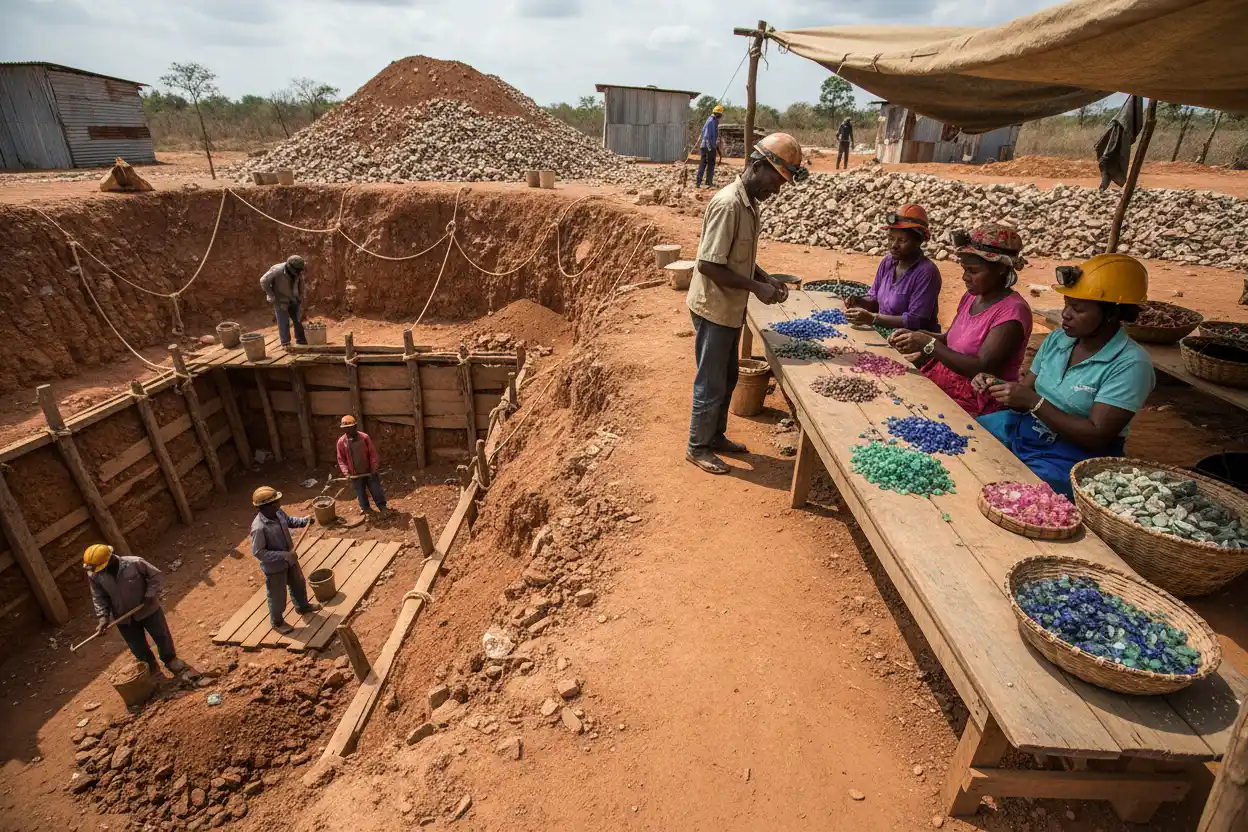
Artisanal Gemstone Mining: Essential Facts, Uses & Symbolism
Artisanal gemstone mining is small-scale, labor-intensive gemstone extraction carried out by individuals, families, informal groups, licensed operators, cooperatives, and small businesses using relatively limited capital and equipment. It can involve little more than hand tools and washing screens, but artisanal gemstone mining can also use pumps, compressors, winches, generators, small excavators, drilling equipment, and organized underground workings while remaining far smaller and less capital-intensive than an industrial mine.
The sector matters because many ruby, sapphire, emerald, tourmaline, garnet, opal, aquamarine, spinel, zircon, and other colored-stone deposits can be worked selectively by small teams. A narrow pegmatite pocket, gem-bearing gravel layer, weathered corundum deposit, or short mineralized zone may produce valuable rough without supporting the enormous fixed costs required for continuous industrial mining.
At the same time, artisanal gemstone mining should not be romanticized as automatically handmade, sustainable, community-friendly, or ethical. Small operations can provide vital income and entrepreneurship, yet miners may also face unsupported shafts, unstable pits, silica-bearing dust, poor ventilation, limited emergency response, weak land rights, child-labor risks, harassment, corruption, informal taxation, environmental damage, and severe disadvantages when negotiating with better-informed buyers.
The opposite assumption is equally misleading. Industrial scale does not automatically guarantee fair labor, responsible land use, environmental protection, community benefit, or transparent sourcing. The meaningful comparison is not small versus large; it is how a particular operation manages people, land, safety, legality, environmental impacts, commercial relationships, and traceability.
Artisanal Gemstone Mining at a Glance
| Feature | Typical Artisanal Gemstone Mining Context | Why It Matters |
|---|---|---|
| Scale | Individual miner to cooperative or small enterprise | Scale alone does not determine ethics or legality |
| Capital | Limited compared with industrial mining | Restricts geological work, safety engineering and rehabilitation capacity |
| Equipment | Hand tools through limited mechanization | Methods vary widely between sites |
| Deposits | Alluvial gravels, weathered zones, veins, pegmatites, narrow mineralized bodies | Selective deposits can suit small-scale extraction |
| Production | Often irregular and discovery-dependent | Income can fluctuate sharply |
| Legal status | Formal, customary, semi-formal or informal | Influences land rights, finance, exports and oversight |
| First sale | Pit buyer, broker, cooperative, exporter or cutter | Market access affects miner bargaining power |
| Traceability | Possible when parcels remain segregated and recorded | Mixing can break mine-level provenance |
| Safety | Highly variable | Pit design, ventilation, water and training matter |
| Environmental impact | Land disturbance, sediment, erosion, water use and abandoned pits | Small sites can create large cumulative effects |
| Social role | Rural employment and local commerce | Benefits depend on access, governance and value distribution |
| Main sourcing question | What can actually be verified? | “Artisanal” is not an ethical certification |
The geology behind these deposits is explained more broadly in how gemstones are formed, because the type of deposit strongly determines whether artisanal gemstone mining is technically realistic.
What Counts as Artisanal Gemstone Mining?
There is no single worldwide production limit, land area, equipment list, or worker count that defines artisanal gemstone mining in every country.
National laws may distinguish artisanal and small-scale operations according to allowable machinery, license area, excavation depth, capital investment, production volume, organizational structure, mineral type, or number of workers.
That creates a spectrum rather than one fixed model.
At one end, artisanal gemstone mining may involve a family washing gem-bearing gravel with hand screens.
At another, an organized cooperative may employ dozens of workers, operate pumps and compressors, maintain underground workings, keep production records, and sell through licensed export channels.
An operation does not stop being small-scale merely because it becomes organized.
Likewise, an informal gemstone rush involving hundreds of people does not automatically become industrial mining simply because many workers arrive at the deposit.
The practical definition should describe the production model rather than imply a moral judgment.
Artisanal Does Not Automatically Mean Ethical
The word “artisanal” has positive associations in many consumer markets because it suggests craft, individuality, handwork, and local production.
Those associations become dangerous when transferred automatically to mining.
Artisanal gemstone mining can be responsible, well-organized, legal, and beneficial to a community.
It can also occur in dangerous pits where workers have weak legal protection, children perform hazardous tasks, environmental damage is unmanaged, and miners receive little information about what their rough is worth.
The label itself proves neither outcome.
A stronger ethical claim requires evidence about how the site operates, who has rights to the deposit, how workers are treated, how hazards are controlled, whether children are protected, how land is rehabilitated, how miners are paid, and whether the gemstone remains traceable after the first sale.
The broader framework for evaluating those claims is covered in ethically sourced gemstones.
Artisanal Gemstone Mining vs. Small-Scale Mining
The words artisanal and small-scale are frequently combined as ASM because the categories overlap substantially.
“Artisanal” often suggests greater dependence on manual labor, simpler equipment, informal organization, and lower capital.
“Small-scale” may include more mechanization, formal licensing, larger teams, pumps, drilling, or processing equipment while remaining much smaller than an industrial operation.
Real mines do not always fit neatly into either category.
A licensed small mine may use an excavator to remove overburden while miners recover gemstones selectively by hand because heavy machinery could destroy valuable crystals.
Another operation may be highly manual but legally organized through a cooperative.
For understanding artisanal gemstone mining, the operating conditions matter more than forcing every site into one semantic box.
Why Gemstones Can Suit Small-Scale Extraction
Colored gemstones differ from many bulk commodities because value may be concentrated in relatively small amounts of material.
A commercial iron mine may need to move enormous quantities of rock continuously.
A gemstone deposit can behave very differently.
One pocket inside a pegmatite may contain valuable tourmaline or aquamarine crystals while nearby rock contains nothing commercially important. A thin gravel horizon may concentrate sapphire or zircon. A ruby-bearing zone may narrow, disappear, then reappear along a geological structure.
That irregularity can favor selective artisanal gemstone mining.
A small team can follow mineralization, wash specific gravels, inspect individual pockets, and modify excavation according to what the deposit reveals.
The same unpredictability also creates financial risk.
A group may remove waste for a long period without finding saleable rough, while another excavation encounters a valuable pocket rapidly.
Primary vs. Secondary Gemstone Deposits
Understanding the deposit helps explain the mining method.
Primary Deposits
A primary deposit keeps the gemstone close to the rock where it originally formed.
Pegmatite aquamarine, tourmaline, topaz, and spodumene are familiar examples of gems that may be extracted directly from hard rock or weathered material associated with their original geological environment.
Artisanal gemstone mining in a primary deposit may require following veins, pockets, fractures, contacts, or mineralized zones through hard rock.
The work can involve drilling, chiseling, controlled excavation, compressors, shafts, or tunnels.
Secondary Deposits
A secondary deposit contains gemstones that were released from their original host rock through weathering and transported elsewhere.
Rivers can concentrate resistant minerals into gravel layers because differences in density and hydraulic behavior sort the sediment.
Sapphire, ruby, spinel, garnet, zircon, diamond, chrysoberyl, and other durable gems can occur in these deposits.
Artisanal gemstone mining in alluvial material commonly involves digging gravel, screening, washing, concentrating heavy minerals, and hand sorting.
Secondary deposits may be easier to excavate than hard rock, but the source of the gemstones can be more difficult to establish because one river system can combine material eroded from several geological sources.
Major Gemstones Produced Through Artisanal Mining
Artisanal gemstone mining contributes to numerous colored-stone supply chains.
Ruby and sapphire deposits across parts of Africa and Asia can involve both small-scale and larger operations.
Emerald supply includes organized mines alongside smaller producers and informal workings.
Tourmaline is particularly compatible with selective mining because productive pegmatite pockets can be localized and irregular.
Aquamarine follows a similar geological pattern in many pegmatite districts.
Garnet, zircon, spinel, chrysoberyl and sapphire can occur in alluvial deposits that are worked through digging, washing and sorting.
Opal mining may involve small underground claims, open cuts, hand excavation, and individual miners following narrow productive horizons.
Tanzanite provides another example where relatively confined geology can support a mixture of mining scales.
The gemstone-specific purchase questions remain different. A buyer comparing ruby quality can use the ruby buying guide, while mine-level labor or traceability claims still require separate evidence.
How Artisanal Gemstone Mining Works
Although every deposit is different, artisanal gemstone mining commonly moves through five broad stages: finding promising ground, removing overburden or host material, concentrating or exposing gemstones, sorting rough, and making the first sale.
The technical sophistication can vary dramatically within each stage.
Prospecting and Local Geological Knowledge
Formal exploration can involve satellite imagery, geological mapping, geochemistry, geophysics, drilling, trenching, and sophisticated three-dimensional modeling.
Most artisanal gemstone mining operations cannot finance that level of exploration.
Miners may instead rely on exposed crystals, float material, known mineral indicators, river gravels, old workings, changes in rock type, pegmatite structures, traditional knowledge, and information spreading from nearby discoveries.
Experienced miners can develop exceptionally detailed practical knowledge of a deposit.
However, local expertise does not remove geological uncertainty.
Without drilling or systematic mapping, miners may spend substantial effort following a structure that does not contain a commercially useful continuation.
Improving access to geological information can therefore increase both productivity and safety.
Excavating Alluvial Gem Deposits
Alluvial artisanal gemstone mining usually begins by identifying gravel layers that may have concentrated dense and durable minerals.
Overburden is removed until potentially productive gravel is exposed.
The material may then be carried, screened, washed, sluiced, or concentrated before workers sort the remaining heavy fraction.
Water management becomes important immediately.
Poorly controlled washing can increase sediment downstream, alter drainage, damage riverbanks, or create conflict with farmers and households that use the same water.
Better site planning can reduce these impacts without requiring industrial-scale infrastructure.
Mining Pegmatite Gemstones
Pegmatites can produce tourmaline, aquamarine, topaz, spodumene, feldspar, quartz and several collector minerals.
Gem pockets may be extremely localized.
Heavy uncontrolled blasting can destroy crystals worth more intact than as broken fragments, so selective artisanal gemstone mining can provide a genuine technical advantage in some pegmatite environments.
Miners may follow changes in feldspar, quartz, mica, alteration zones, cavities, or accessory minerals that suggest a promising pocket.
Once a cavity is reached, careful hand extraction can preserve crystal terminations and matrix specimens that would be destroyed by aggressive mechanical excavation.
This does not mean hand mining is automatically safer.
Deep narrow tunnels, unstable weathered pegmatite, insufficient ventilation, water ingress, and poorly supported workings can create serious hazards.
Mining Corundum Deposits
Ruby and sapphire can occur in primary rock, weathered deposits, and secondary gravels.
Artisanal gemstone mining methods therefore vary considerably.
In alluvial deposits, miners may wash gravel and sort dense concentrates.
In hard-rock or weathered primary deposits, excavations may follow corundum-bearing zones through altered rock.
Ruby and sapphire rough must then be separated by color, transparency, fracture condition, crystal size, silk, zoning, and expected cutting yield.
That first quality judgment can have enormous financial consequences.
The material-specific factors are explored in the sapphire buying guide rather than being determined by mining method alone.
Sorting Rough Gemstones
Sorting is one of the highest-value skills within artisanal gemstone mining.
Rough gemstones rarely reveal their finished value immediately.
A dark piece of sapphire may become bright after orientation and cutting.
A transparent tourmaline crystal may contain an internal fracture that destroys most usable yield.
A pale-looking crystal might hide stronger color along one direction.
A heavily included emerald may still cut an attractive small stone.
Sorters consider color, transparency, size, crystal shape, fractures, zoning, surface features, possible treatments, and expected cutting recovery.
The value of knowledge becomes obvious here.
A miner who cannot distinguish common material from exceptional rough may sell too cheaply.
A buyer who overestimates cutting yield can lose money.
Neither side can eliminate uncertainty completely.
The First Sale
The first sale may happen beside the mine, in a nearby village, through a local buying office, at a cooperative, through a traveling broker, or after transportation to a regional trading center.
Immediate liquidity matters enormously.
A miner may know that waiting for several competing offers could produce a better price but still need cash immediately for food, equipment, debt, wages, transport, or further excavation.
That time pressure affects bargaining power.
Artisanal gemstone mining therefore cannot be understood through geology alone.
Finance and access to markets shape what happens to the gemstone after it leaves the ground.
Why Rough Gemstone Pricing Is Difficult
A polished gem has measurable dimensions, visible color, established cut, and a much clearer idea of its final appearance.
Rough contains uncertainty.
The buyer must estimate how much material will disappear during sawing and cutting, which orientation preserves color, whether hidden fractures extend internally, whether the shape permits an efficient finished stone, and whether treatment will change appearance.
The seller faces the same questions but may have less access to gemological training and downstream market information.
This information imbalance can create unfair bargaining even when no one commits an explicit fraud.
Transparent weighing, competitive buying, basic gemology education, access to price information, and independent opinions on exceptional stones can improve negotiations.
The wider downstream economics are explained in how gemstone prices work.
Where the Retail Price Goes
Consumers sometimes see a gemstone selling for many times the amount reportedly paid to the miner and assume the entire difference became dealer profit.
That interpretation is incomplete.
Rough may lose a substantial percentage of its weight during cutting.
Transport, security, taxes, licensing, brokerage, export compliance, laboratory testing, treatment, cutting labor, financing, insurance, inventory, jewelry manufacturing, marketing, and retail operations can all add cost and risk.
A dealer may also hold an unusual gemstone for a long period before finding a buyer.
None of these costs proves that the miner received a fair share.
The correct question is not whether retail exceeds mine price.
It is whether each commercial stage adds legitimate value and whether the miner had transparent weights, meaningful buyer choice, understandable terms, and enough market information to negotiate fairly.
Artisanal Gemstone Mining as a Livelihood
Artisanal gemstone mining supports more than the people physically digging.
A productive area can generate work for transporters, food sellers, tool suppliers, mechanics, pump operators, sorters, traders, guards, cutters, accommodation providers, equipment renters, and local merchants.
Mining can also supplement farming.
Some households move between agriculture and mineral production according to income opportunities, weather, local discoveries, or seasonal labor demands.
The economic benefit can be significant in remote regions with few wage-paying alternatives.
That dependence is exactly why careless sourcing policies can create unintended harm.
A company that abruptly refuses all artisanal production may remove legitimate income without improving conditions underground.
Responsible purchasing should distinguish between situations where disengagement is necessary and situations where improvement, formalization, monitoring, and remediation can produce better results.
Informality Is Not One Thing
Informal artisanal gemstone mining may involve deliberate evasion of law, but it can also reflect a regulatory system that miners cannot realistically access.
Possible barriers include expensive permits, distant government offices, overlapping land claims, unclear customary rights, inaccessible cadastral information, unrealistic environmental requirements, complex tax rules, lack of banking access, and productive areas already licensed to larger operators.
This does not make unlawful mining automatically acceptable.
It explains why enforcement alone may fail.
When legal production is practically impossible for small miners, activity can continue outside the system with weaker safety oversight, poorer traceability, lower tax collection, and less opportunity for technical support.
What Formalization Actually Means
Formalization should not be reduced to handing a miner a registration card.
Effective artisanal gemstone mining formalization can involve legal access to viable land, understandable licensing, affordable fees, clear site boundaries, safety training, appropriate environmental rules, finance, cooperative structures, banking access, market information, transparent buying channels, child-labor prevention, grievance systems, and legitimate export pathways.
The requirements need to match the scale of the operation.
Imposing the same engineering, reporting, and financial obligations used for a multinational open-pit mine can exclude small miners rather than improve them.
At the same time, “small-scale” should never become an excuse for ignoring fundamental worker safety, hazardous child labor, coercion, or serious environmental damage.
The goal is a workable legal pathway with real performance improvements.
Mining Rights and Land Access
Land rights can be among the most difficult issues in artisanal gemstone mining.
A government mining license may overlap with customary land use, agriculture, grazing, community territory, conservation areas, or claims held by another mining company.
A gem rush can also attract newcomers rapidly, creating conflict with residents who used the land before gemstones became valuable.
Responsible governance needs to establish who can mine, who owns or uses the surface land, how compensation works, how access routes are managed, and what happens after mining ends.
A legal license answers only part of that problem.
Community rights and practical land use still matter.
Safety in Artisanal Gemstone Mining
The most immediate hazards in artisanal gemstone mining often involve ground stability rather than the gemstone itself.
Pit and Shaft Collapse
Unsupported pit walls, vertical shafts, weathered rock, loose overburden, poorly designed pillars, and underground openings can fail suddenly.
Ground that appears stable can change after water infiltration or continued excavation.
Basic geological and engineering support can save lives.
Ventilation
Underground artisanal gemstone mining can create poor airflow, especially where compressors, generators, drilling, or blasting are used.
Ventilation affects dust, exhaust gases, heat, humidity, and oxygen availability.
A narrow tunnel is not safe simply because it was dug manually.
Silica-Bearing Dust
Many gemstone deposits occur in quartz-rich or silicate rocks.
Drilling, crushing, dry cutting, or blasting can create respirable dust.
Chronic silica exposure is a serious occupational concern and should not be dismissed because the operation is small.
Dust suppression, wet drilling, ventilation, appropriate respiratory protection, and reduced dry processing can materially improve conditions.
Water
Groundwater and surface runoff can flood shafts, weaken walls, increase collapse risk, and trap workers.
Pumps need enough capacity and backup planning for the actual site.
A pump is not merely production equipment; in some underground settings it is part of the safety system.
Machinery
A small mine may use improvised winches, generators, compressors, vehicles, pumps, electrical systems, and drilling equipment.
Poor guarding, damaged cables, inadequate maintenance, and untrained operation can turn modest machinery into major hazards.
Emergency Response
Remote artisanal gemstone mining sites may be far from hospitals, reliable roads, rescue teams, communications, or emergency vehicles.
That changes the meaning of a relatively ordinary injury.
A fracture, deep cut, crush injury, or breathing problem that would receive rapid treatment in a city can become life-threatening when transport takes much longer.
Basic first aid, communication, evacuation planning, trained workers, rescue equipment, and safe access routes therefore matter even at very small sites.
Child Labor in Gemstone Mining
Hazardous child labor is one of the most serious risks connected with informal mining.
Children should not work underground, handle explosives, carry dangerous loads, operate hazardous equipment, work in unstable pits, or perform tasks that expose them to dust and other serious risks.
The issue requires precision.
A child living in a mining community is not automatically a child laborer.
Likewise, a child occasionally present near a family enterprise is not necessarily performing prohibited hazardous work.
Assessment should consider age, task, working hours, hazards, school attendance, economic dependence, coercion, and applicable law.
Prevention also cannot stop at removing a child from a pit.
If a household depends on that income, sustainable remediation may require education access, social protection, childcare, safer adult employment, and alternative income opportunities.
Women in Artisanal Gemstone Mining
Women participate across artisanal gemstone mining, including digging, washing, sorting, trading, financing, food provision, transport, processing, cutting, administration, and cooperative management.
Their roles can be undercounted when official statistics record only license holders or pit owners.
Women may also be concentrated in lower-paid parts of the supply chain even when their sorting and processing work materially affects gemstone value.
Common structural barriers can include weaker land rights, reduced access to productive ground, less credit, limited equipment ownership, exclusion from higher-value negotiations, inadequate sanitation, harassment, violence, childcare burdens, and low representation in decision-making organizations.
A formalization program that registers only existing male claim holders can unintentionally make inequality worse.
Inclusive artisanal gemstone mining should examine who owns rights, controls money, receives training, negotiates sales, and participates in decisions.
Cooperatives: Opportunity and Risk
A cooperative can improve artisanal gemstone mining by combining production and bargaining power.
Members may share pumps, safety equipment, transport, geological information, bookkeeping, marketing, licensing costs, and access to professional buyers.
Pooling parcels can also create enough volume to negotiate directly with exporters or cutters rather than selling immediately to the first available broker.
However, a cooperative label does not guarantee good governance.
Leaders can manipulate weights, control access to buyers, favor relatives, exclude women, hide financial records, or create compulsory selling arrangements that reduce member choice.
Strong cooperatives need transparent rules, accessible accounts, meaningful member participation, grievance procedures, accountable leadership, and understandable payment systems.
Environmental Effects of Artisanal Gemstone Mining
Artisanal gemstone mining may use less heavy machinery than an industrial operation, yet numerous small sites can produce substantial cumulative impacts.
Land Disturbance
Gemstone pits remove vegetation and soil.
If excavations are abandoned without backfilling or stabilization, they can create dangerous holes, interfere with farming, collect stagnant water, redirect runoff, and erode surrounding ground.
A small pit may seem minor.
Hundreds of pits across a mining district are not.
Erosion and Sediment
Washing gem-bearing gravel can release large amounts of fine sediment.
Sediment can cloud streams, alter riverbeds, affect aquatic habitat, block irrigation channels, and move downstream beyond the mine itself.
Simple settling ponds, controlled washing areas, staged drainage, and better spoil placement can reduce some of these effects without requiring industrial-scale infrastructure.
Water Competition
Artisanal gemstone mining may require water for washing, pumping, drilling, camp use, or dust suppression.
That water may be needed simultaneously by households, livestock, agriculture, and ecosystems.
Responsible site planning should therefore consider both water quality and water availability.
A clean process can still create community conflict if it consumes water that nearby users depend on.
Vegetation and Access Roads
New discoveries often create rapid movement of people and equipment.
Vegetation may be cleared for pits, camps, roads, timber supports, fuel, and waste areas.
Damage can spread beyond the excavation itself.
Roads alter drainage, increase erosion, and make previously remote areas accessible to additional extraction.
Waste and Fuel
Colored-stone artisanal gemstone mining generally differs from artisanal gold mining because gemstone recovery usually does not require mercury amalgamation.
That does not make the operation chemically or environmentally impact-free.
Fuel, lubricants, batteries, discarded equipment, household waste, explosives, and other materials can still contaminate a site.
Waste rock can block drainage or create unstable slopes.
Environmental assessment should follow the actual process rather than borrowing every risk from another mineral sector.
Rehabilitation
Rehabilitation means leaving the site safer and more functional after extraction.
Depending on the location, this can involve backfilling pits, reshaping waste piles, stabilizing slopes, restoring drainage, replacing topsoil, replanting vegetation, securing underground openings, and preventing standing-water hazards.
Artisanal gemstone mining can struggle with rehabilitation because income is unpredictable and miners may not hold long-term land rights.
If workers expect eviction or believe another group will immediately reopen a filled pit, they have little incentive to invest scarce capital in restoration.
Formalization and environmental management therefore need to work together.
Artisanal Mining Is Not the Same as Gold Mining
Many discussions of ASM are dominated by artisanal gold mining.
That can distort how artisanal gemstone mining is understood.
Gold processing may involve mercury or other chemical hazards that are not normally part of colored-stone recovery.
Gemstones are typically extracted through digging, washing, hand sorting, selective hard-rock mining, or mechanical concentration.
The absence of mercury is important.
It does not remove risks involving collapse, silica-bearing dust, sediment, water, land disturbance, equipment, labor, or unsafe underground workings.
Each gemstone deposit requires its own risk assessment.
Traceability in Artisanal Gemstone Mining
Mine-to-market traceability is possible, but it becomes much harder after parcels are mixed.
A workable artisanal gemstone mining record system can begin at extraction with site identity, miner or cooperative details, parcel description, rough weight, and first buyer.
Each commercial transfer then needs documentation linking the physical parcel to the record.
Cutting introduces an additional challenge because rough weight becomes several smaller polished stones plus cutting loss.
Records should reconcile what entered the workshop with what emerged.
The traceability chain can include mine or cooperative, first buyer, exporter, cutter, laboratory, wholesaler, manufacturer, and retailer.
The system only works when the physical gemstones remain connected to the documentation.
Blockchain Does Not Solve Physical Mixing
Digital records can strengthen supply-chain administration.
They can make transactions easier to audit and harder to alter later.
However, no database can preserve artisanal gemstone mining provenance if an undocumented sapphire is added physically to a recorded parcel.
The technology records what someone entered.
It does not independently prove that the physical gemstone beside the record is the same one extracted from the claimed location.
Physical segregation, tamper controls where appropriate, weight reconciliation, independent oversight, and commercial documentation remain necessary.
Traceability technology is a tool.
It is not a substitute for chain-of-custody discipline.
Geographic Origin vs. Mine Traceability
A gemological laboratory may sometimes provide a geographic-origin opinion for selected colored stones.
That can be commercially important.
It is not the same as proving artisanal gemstone mining provenance.
A laboratory may determine that a sapphire’s properties are consistent with material from a particular country or geological region without knowing the exact mine, miner, working conditions, payment terms, or commercial route.
Those questions require supply-chain records.
The distinctions between material identification, treatment findings, origin opinions, and other report functions are covered in gemstone certification.
Mine-level provenance is a commercial documentation question layered on top of gemology.
Treatments Happen After Mining
Mining history and treatment history should also be kept separate.
A sapphire may be responsibly extracted and later receive undisclosed diffusion treatment.
An emerald from a poorly documented mine can nevertheless receive completely accurate oil-disclosure after cutting.
Aquamarine can be heated after export.
Ruby can undergo heat treatment or fracture filling somewhere far from the mine.
The general terminology in gemstone treatments explained helps separate heat, oil, filling, impregnation, irradiation, diffusion, dye and coating.
Responsible sourcing does not excuse poor treatment disclosure.
Accurate treatment disclosure does not prove responsible mining.
Both questions matter independently.
How Artisanal Gemstone Mining Affects Gem Supply
Colored-gem markets can change rapidly after a new artisanal gemstone mining discovery.
A previously scarce color or size range may suddenly enter the trade.
Dealers travel toward the producing area.
New buying centers appear.
Cutters experiment with the rough.
Laboratories study inclusions and trace elements.
Government agencies may introduce new licensing or export rules.
Prices may rise initially because of excitement, fall as production expands, and change again if the deposit becomes less productive.
A gemstone rush can also create migration, land conflict, housing pressure, security concerns, and local inflation.
The commercial excitement surrounding a new source therefore represents only one part of the story.
Mine Origin and Gemstone Value
Origin can influence gemstone value, particularly when a locality has an established reputation.
However, the economic premium paid at retail does not necessarily flow back automatically to artisanal gemstone mining communities.
A cutter may purchase rough through several intermediaries.
The polished stone may later receive a laboratory origin opinion that increases confidence or marketability.
A retailer can then emphasize the source in marketing.
Whether the original miner received additional value depends on how much provenance remained attached to the rough and how much bargaining power existed at the first sale.
Transparent mine-to-market systems can potentially preserve more of that story.
When Direct-from-Miner Buying Helps
Buying directly from miners can shorten a supply chain.
It may allow miners to retain more of the final value and give buyers better information about extraction conditions.
However, “direct from the miner” is not automatically proof of responsible artisanal gemstone mining.
The buyer still needs to ask whether the miner had legal or recognized rights to the deposit, whether workers were safe, whether children performed hazardous labor, whether landowners or communities agreed to extraction, and whether environmental responsibilities were addressed.
A direct relationship can improve transparency.
It does not replace due diligence.
What Responsible Sourcing Means
Responsible artisanal gemstone mining sourcing should be risk-based rather than label-based.
A credible buyer tries to understand who extracted the material, under what legal or customary authority, what major labor and safety risks exist, how environmental impacts are managed, how payments are made, whether vulnerable groups are excluded or exploited, and how the parcel remains identifiable through the supply chain.
The objective is not to demand a fantasy of zero impact.
Mining physically changes land.
Commercial supply chains contain risk.
The meaningful question is whether relevant risks are identified, reduced, monitored, and addressed honestly.
When Disengagement Can Make Things Worse
A zero-tolerance purchasing rule sounds simple.
Its consequences can be complicated.
If a legitimate artisanal gemstone mining community depends heavily on mineral income, abrupt disengagement can reduce household earnings while leaving the underlying safety or governance problem unchanged.
Production may continue but move toward less transparent buyers.
For remediable problems, engagement can sometimes support safer pits, legal access, child-labor prevention, transparent payments, environmental controls, and improved traceability.
There are also circumstances where trade should be suspended or ended because serious abuses cannot be mitigated adequately.
Responsible due diligence distinguishes between those situations rather than applying one automatic response.
What Consumers Can Realistically Verify
A retail consumer normally cannot inspect an overseas artisanal gemstone mining site personally.
The realistic task is to evaluate the quality of the seller’s evidence.
A seller making a mine-level claim should be able to explain whether the stone is traceable to a mine, cooperative, region, or only a country.
They should distinguish physical chain-of-custody documentation from a gemological origin opinion.
They should explain what labor and environmental risks were assessed and where uncertainty remains.
The consumer safeguards in how to buy gemstones online remain important even when the sourcing story sounds compelling.
A convincing narrative should never replace a clear description, return policy, treatment disclosure, and evidence supporting important claims.
Questions Worth Asking a Seller
Rather than asking only “Is this ethically mined?”, ask questions that can produce specific answers.
Ask how far the gemstone can actually be traced.
Ask who mined it or which cooperative supplied it.
Ask whether the site was licensed or operating under another recognized legal framework.
Ask how worker-safety risks were evaluated.
Ask whether hazardous child labor was assessed.
Ask how the seller knows the parcel remained segregated.
Ask whether the evidence applies to that specific gemstone, a parcel, a supplier, or the company generally.
Ask what remains unknown.
A limited but specific answer is more trustworthy than an absolute claim unsupported by records.
Artisanal Gemstone Mining Red Flags
The phrase “artisanal mined” deserves scrutiny when it appears without additional evidence.
Claims become weaker when the seller treats artisanal production as proof of sustainability, says every small mine is environmentally harmless, promises that all profits go directly to miners, uses a laboratory origin report as proof of working conditions, or claims mine-level traceability without explaining the chain of custody.
Another warning sign is certainty where the supply chain is obviously fragmented.
A responsible seller can acknowledge what is unknown.
Transparency includes limitations.
Artisanal Gemstone Mining and Symbolism
The word “artisanal” has acquired symbolism in the consumer market that extends well beyond its technical mining meaning.
It can suggest craftsmanship, independence, community, local knowledge, small-scale entrepreneurship, and a closer relationship between producer and material.
Those associations can be meaningful when they describe reality.
They become misleading when the symbolism replaces evidence.
A hand-dug gemstone is not automatically more ethical than a mechanically mined one.
A cooperative is not automatically democratic.
A small operation is not automatically environmentally gentle.
Likewise, artisanal gemstone mining should not be reduced to images of hardship that erase miner skill, entrepreneurship, geological knowledge, and economic agency.
At Gems Lore, the most useful symbolism around artisanal gemstone mining comes from respecting the human knowledge and labor behind a gemstone while refusing to turn poverty, informality, or manual work into marketing decoration.
The Skill Behind Artisanal Gemstone Mining
Experienced miners can develop highly specialized knowledge.
They may recognize subtle changes in host rock, feldspar texture, gravel composition, alteration, crystal fragments, water behavior, or structural direction that indicate where productive ground may continue.
Sorters learn how rough shape, transparency, fractures, color zones, and surface features affect potential yield.
Local traders develop knowledge of market preferences and cutting centers.
This expertise should not be confused with formal geological or gemological analysis, but it should not be dismissed either.
Artisanal gemstone mining often survives precisely because people adapt detailed practical knowledge to deposits that are too irregular for standardized bulk extraction.
Artisanal Gemstone Mining Uses
The most obvious use of artisanal gemstone mining is supplying rough material for jewelry, collector gems, carvings, beads, mineral specimens, and decorative objects.
Its economic uses are broader.
It can create rural income where few other cash-generating industries exist.
It can support local trade and transport.
It can enable small businesses and cooperatives.
It can preserve highly selective extraction techniques where aggressive bulk mining would destroy delicate crystals or produce excessive waste.
It can also create pathways into cutting, polishing, jewelry manufacturing, mineral dealing, tourism, and other higher-value activities when local infrastructure and skills develop.
Those benefits are potential outcomes rather than guarantees.
Adding Value Near the Mine
One persistent artisanal gemstone mining challenge is that the highest-value activities often occur elsewhere.
Rough leaves a producing region.
Cutting happens abroad.
Laboratory documentation is added later.
Jewelry manufacturing and retail occur in distant markets.
Local communities may therefore participate primarily in the lowest-margin stage.
Developing cutting or sorting capacity locally can retain more value, but that strategy is not automatically simple.
Gem cutting requires equipment, training, reliable electricity, financing, market access, gemstone knowledge, and enough consistent production to support a business.
Forcing every stone to be cut locally can also reduce value if specialist cutting expertise exists elsewhere.
The goal should be competitive local capability rather than artificial restrictions that create a new disadvantage.
A Practical Responsible-Sourcing Framework
A useful artisanal gemstone mining assessment can be organized around seven questions.
| Area | Core Question |
|---|---|
| Legal access | Does the miner or group have lawful or credibly recognized rights to work the deposit? |
| Worker safety | Are collapse, ventilation, dust, water, equipment and emergency hazards being controlled? |
| Labor rights | Are coercion, hazardous child labor, discrimination and harassment addressed? |
| Community rights | Are land use, access, compensation and grievances handled fairly? |
| Environment | Are erosion, water, waste, vegetation and rehabilitation managed realistically? |
| Commercial fairness | Are weights transparent, payments documented and miners able to understand or compare offers? |
| Traceability | Can the physical parcel be linked to reliable records through trading and cutting? |
No single certificate answers all seven.
That is why responsible artisanal gemstone mining is a process rather than a sticker.
Frequently Asked Questions
What is artisanal gemstone mining?
Artisanal gemstone mining is relatively small-scale, labor-intensive extraction carried out with limited capital and varying levels of mechanization. Operations can range from individual miners and family teams to organized cooperatives and licensed small enterprises.
Is artisanal gemstone mining legal?
It can be. Some operations hold formal licenses, some work through cooperatives or legally recognized small-scale systems, some operate under customary arrangements, and others are informal or unlawful. Legal status must be assessed for the specific site.
Is artisanal gemstone mining ethical?
Not automatically. Artisanal gemstone mining can provide valuable livelihoods and operate responsibly, but the label alone does not prove worker safety, fair pay, environmental management, legal access, or protection from child labor.
Is artisanal gemstone mining better than industrial mining?
Neither model is automatically better. Small operations may use less heavy machinery and support local livelihoods, while larger operations may have more engineering, monitoring, finance and traceability capacity. Actual performance matters more than scale alone.
Which gemstones come from artisanal gemstone mining?
Ruby, sapphire, emerald, tourmaline, aquamarine, garnet, opal, spinel, zircon, chrysoberyl, tanzanite and many other colored stones can enter the market through artisanal or small-scale production.
Why are colored gemstones suited to artisanal gemstone mining?
Many deposits are irregular, localized or selectively valuable. A small pocket or gravel layer can contain commercially important gemstones even when the surrounding material would not justify industrial-scale extraction.
Does artisanal gemstone mining always use hand tools?
No. Small operations can use pumps, compressors, drilling equipment, winches, generators and limited earth-moving machinery while remaining artisanal or small-scale under local definitions.
Is artisanal gemstone mining the same as artisanal gold mining?
No. The sectors share some labor, legal and safety challenges, but colored gemstones are generally recovered through digging, washing, sorting and selective extraction rather than mercury-based gold processing. Risks should be evaluated by mineral and mining method.
What are the main safety risks?
Important risks include pit or tunnel collapse, poor ventilation, silica-bearing dust, flooding, unsafe machinery, blasting, falls, electrical hazards, and delayed emergency care at remote sites.
Is child labor a problem in artisanal gemstone mining?
It can be, particularly in informal mining environments. Hazardous mining work is inappropriate for children, and responsible sourcing needs to assess actual tasks, age, school attendance, hazards, working hours and economic dependence.
What role do women have in artisanal gemstone mining?
Women can work as miners, washers, sorters, traders, financiers, transporters, cutters, food providers and cooperative leaders. Their participation may be undercounted when official records focus only on claim holders or pit owners.
Can artisanal gemstone mining damage the environment?
Yes. Possible impacts include vegetation loss, erosion, sediment, altered drainage, water competition, abandoned pits, fuel contamination, waste rock and habitat disturbance. Numerous small sites can create significant cumulative effects.
Does artisanal gemstone mining use mercury?
Colored-gem extraction normally does not require the mercury amalgamation associated with artisanal gold processing. The absence of mercury does not eliminate other occupational and environmental risks.
What is mining formalization?
Formalization is the process of bringing miners into workable legal, safety, environmental, financial and commercial systems. Effective formalization involves more than registration and should provide realistic access to rights, support and compliant markets.
Why do artisanal miners sometimes receive little compared with retail prices?
Rough gemstone valuation is uncertain, miners may need immediate cash, and they may have fewer buyer options or less gemological information. Additional value and cost are also added through cutting, transport, taxes, treatment, laboratory work, financing, jewelry production and retail.
Are gemstone cooperatives automatically responsible?
No. Cooperatives can improve bargaining, finance, safety and traceability, but poor governance can still create exclusion, opaque accounts, unfair selling arrangements or abuse of authority.
Can artisanal gemstones be traced to a mine?
Yes, when production is recorded and the parcel remains physically segregated through buying, export and cutting. Traceability becomes much harder after undocumented material is mixed.
Does a gemstone laboratory report prove the mine?
Usually not. A laboratory may identify a gemstone, detect treatment and sometimes provide a geographic-origin opinion. Mine-level chain of custody normally requires commercial documentation that begins near extraction.
Does blockchain prove responsible artisanal gemstone mining?
No. A blockchain can preserve records but cannot guarantee that the original information was correct or that undocumented gemstones were never mixed into the parcel.
Should buyers avoid all artisanal gemstones?
No. Blanket avoidance can harm legitimate mining livelihoods without necessarily improving conditions. Responsible buyers should look for credible due diligence, traceability, safer mining, workable formalization, fair commercial access and effective remediation.
What does “artisanal mined” actually prove?
By itself, very little beyond a claim about production scale or method. It does not automatically establish legality, ethical labor, environmental responsibility, fair payment, traceability or community benefit.
How can consumers support better artisanal gemstone mining?
Favor sellers that make specific sourcing claims, explain what they can trace, assess labor and environmental risks, disclose limitations honestly, maintain treatment and identity transparency, and support improvement rather than using “artisanal” as an unsupported marketing adjective.
Artisanal gemstone mining is a diverse production system rather than a single ethical category. It can preserve selective mining skills, supply important portions of the colored-gem trade, create livelihoods, support local businesses, and make deposits economically useful that would never justify a large industrial mine. The same sector can also contain dangerous excavation, weak bargaining power, hazardous child labor, unequal access for women, land conflict, environmental degradation and broken traceability when miners lack rights, capital, information, technical support or accountable markets.
The strongest approach is therefore neither romanticization nor blanket rejection. Responsible artisanal gemstone mining depends on workable legal access, safer engineering, labor protections, inclusive governance, environmental management, transparent weights and payments, realistic opportunities for miners to improve their position in the value chain, and documentation that follows gemstones after they leave the ground. When those elements can be demonstrated, the word “artisanal” describes a production model with human skill and economic importance rather than functioning as an unsupported promise about ethics.