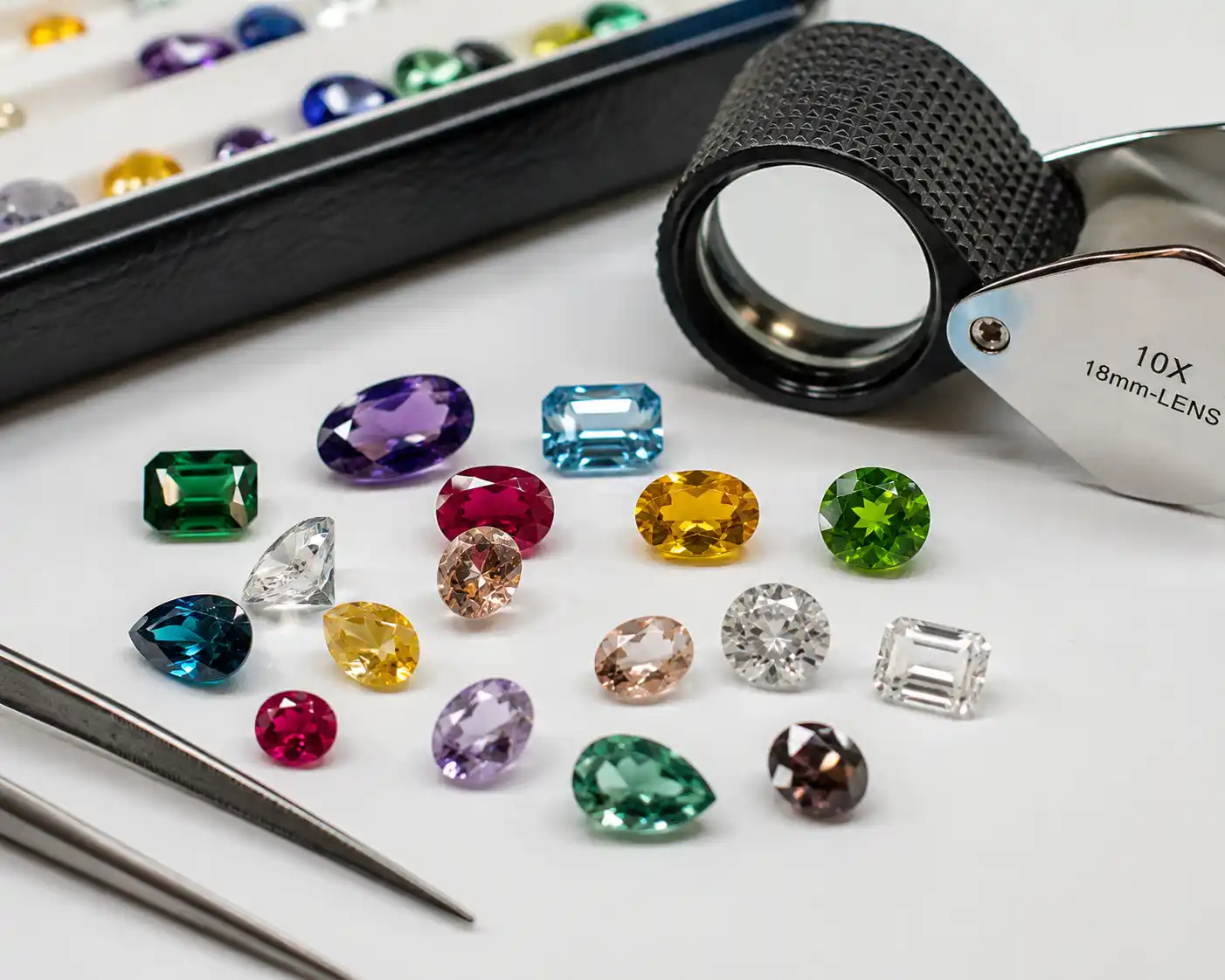
How to Buy Gemstones Online Without Getting Scammed
Buying gemstones online gives consumers access to more colors, origins and price levels than most local stores can stock. It also removes the ability to handle the stone, compare its color under different lights and question the seller in person.
A safe online purchase therefore depends on evidence. The listing should identify the material accurately, disclose whether it is natural or laboratory grown, explain detectable treatments, provide realistic images and dimensions, state the return terms and allow payment through a method that offers buyer protection.
This page owns general online seller verification, checkout risk and fraud prevention. Stone-specific buying pages should apply these principles to the treatments, imitations and quality factors of one particular gemstone.
Online Gemstone Buying Checklist
| Check | What a credible listing should provide |
|---|---|
| Seller identity | Business name, working contact details and consistent history |
| Gem identity | Mineral species or accepted gem variety |
| Origin category | Natural, laboratory-grown, imitation or composite |
| Treatment | Clear disclosure of known enhancement |
| Weight and size | Carat weight plus millimeter dimensions |
| Photography | Multiple neutral-light images and preferably video |
| Condition | Chips, fractures, cavities and repairs disclosed |
| Laboratory report | Independent report when value or risk justifies it |
| Report verification | Number searchable through the issuing laboratory |
| Return policy | Written inspection period and refund conditions |
| Payment | Credit card or another protected payment method |
| Shipping | Tracking, suitable packaging and insurance where needed |
| Final comparison | Price checked against equivalent stones, not merely similar colors |
Start With the Seller, Not the Gemstone
An attractive photograph can distract buyers from the more important question: who is taking the payment?
A legitimate seller should provide a consistent business identity, working email or phone contact and clear terms of sale.
Search the business name together with terms such as complaints, scam, fraud, fake gemstones and refund.
Do not rely only on reviews displayed on the seller’s own website. Check whether comments across independent platforms show a consistent history.
A new business is not automatically fraudulent. However, an expensive purchase requires more evidence when the website, social account and business identity appeared recently.
Warning signs include:
- No identifiable business or responsible person
- Communication limited to disappearing messages
- Pressure to pay immediately
- Constant claims that another buyer is waiting
- Refusal to provide additional photographs
- Payment requested through gift cards or cryptocurrency
- Different business names on the website, invoice and payment account
- A return address that is withheld until after purchase
- Copied photographs found on unrelated seller pages
A professional seller should answer reasonable questions without treating verification as an insult.
Confirm What Material Is Being Sold
A listing should use a recognized mineral or gemstone name.
Vague phrases such as natural crystal, rare healing stone, rainbow gem or genuine mineral do not provide enough information.
Ask whether the item is:
- Natural
- Laboratory grown
- Imitation
- Reconstituted
- Dyed
- Coated
- Filled
- Stabilized
- A doublet or triplet
- A multi-mineral rock sold under a trade name
The distinction between natural and manufactured equivalents is explained in Lab-Grown vs Natural Gemstones.
A laboratory-grown ruby is real corundum but not naturally mined ruby. Red glass is an imitation rather than laboratory-grown ruby.
These categories should not be combined under a phrase such as genuine gemstone.
Read the Entire Product Description
The headline is usually marketing. The disclosure often appears lower on the page.
Read the material, treatment, measurements, shipping and return sections before paying.
A seller may title an item “natural emerald ring” while stating elsewhere that the central stone is created emerald, hydrothermal emerald or green quartz.
Words such as enhanced, stabilized, reconstructed, simulated, created and composite have specific commercial implications.
The complete enhancement terminology appears in Gemstone Treatments Explained.
Do not assume untreated because the description is silent. Ask directly and save the seller’s written answer.
Require Both Carat Weight and Measurements
Carat weight does not show how large a gemstone will look.
A deep stone can carry substantial hidden weight below the girdle.
The listing should provide length, width and depth in millimeters.
For cabochons, carvings and mineral specimens, request overall dimensions and weight in grams when appropriate.
Compare the stated measurements with the scale shown in photographs.
A seller who claims an enormous gemstone but avoids providing dimensions creates unnecessary uncertainty.
Evaluate Images Critically
Gemstone photographs are easy to manipulate unintentionally or deliberately.
Color changes with the light source, camera white balance, surrounding background, screen and editing.
A trustworthy seller should provide multiple views rather than one perfect hero image.
Look for:
- Daylight-equivalent photographs
- Neutral white or gray backgrounds
- Video showing movement
- Front, back and side views
- Close-ups of inclusions and fractures
- Images of the actual stone rather than a representative example
- A ruler, caliper or hand for scale
- Photographs before and after setting when relevant
Oversaturation can turn pale blue into vivid neon color.
Dark backgrounds can strengthen weak opal play-of-color.
Wet rough can appear clearer and more colorful than it will after drying.
Backlighting may hide an opaque or heavily included center.
Ask which image most closely represents the unaided-eye appearance indoors.
Be Cautious With Stock and Artificially Generated Images
A listing for a one-of-a-kind natural gemstone should show the exact item.
If the same inclusion pattern appears in several separate listings, the seller may be using one stock photograph.
Computer-generated or heavily retouched imagery can create perfect symmetry, impossible transparency and repeated internal patterns.
Ask for a short video with the seller rotating the stone beside a handwritten note containing the date or your name.
This step is especially useful for high-value purchases made through social media or private messaging.
Check the Price Against the Correct Market
A price is meaningful only when compared with similar material.
A natural unheated sapphire cannot be compared directly with flame-fusion synthetic sapphire.
A solid Australian opal cannot be compared with an assembled triplet.
A Type A jadeite bangle belongs to a different market from dyed quartzite.
The framework in How Gemstone Prices Are Determined explains how identity, color, clarity, cut, size, treatment, origin and documentation interact.
A very low price can indicate:
- Laboratory-grown material disclosed poorly
- A different mineral with similar color
- Strong treatment
- Composite construction
- Low quality
- Stolen photographs
- Non-delivery fraud
A high price is not proof of authenticity. Scammers can charge premium prices to make an imitation appear credible.
Understand Seller-Created Grades
Labels such as AAA, AAAAA, collector grade, museum grade and investment grade are not universal colored-gemstone standards.
One seller’s AAA can be another seller’s commercial grade.
Ask for observable evidence instead:
- Color description
- Transparency
- Inclusion visibility
- Cut quality
- Measurements
- Treatment
- Origin report
- Condition
- Laboratory conclusion
A quality label without measurable information has little comparison value.
Verify Laboratory Reports Independently
A photograph of a laboratory report is not enough.
Fake and altered reports circulate alongside genuine report numbers copied from other stones.
Use the issuing laboratory’s official verification system.
Compare:
- Report number
- Gemstone identity
- Natural or laboratory-grown conclusion
- Treatment statement
- Weight
- Measurements
- Shape
- Cutting style
- Color
- Photograph
- Date
- Geographic-origin opinion when included
The report details must match the actual stone.
A report for a 2.01-carat oval sapphire does not support a 3.20-carat cushion sapphire merely because both are blue.
The different report types and laboratories are compared in Gemstone Certification Labs Compared, while How to Read a Gem Lab Report explains the document line by line.
Know What a Report Does Not Prove
A laboratory report normally addresses gemological identity and treatment.
It may provide an origin opinion for selected materials.
It does not necessarily prove:
- Legal ownership
- Ethical sourcing
- Purchase price
- Future value
- Investment performance
- Seller honesty
- Setting quality
- Exact mine
- That the stone has not been switched since testing
The gemstone must be matched physically with the report.
A sealed package, microscopic inscription or distinctive inclusions can make matching easier, but buyers should still examine the object.
Understand Common Online Gemstone Scams
Misidentified Stones
A cheaper material is sold under the name of a more valuable gem.
Examples include glass sold as obsidian, dyed howlite sold as turquoise and green quartz sold as emerald.
Hidden Laboratory-Grown Origin
A laboratory-grown gem is described only as real, genuine or certified.
Undisclosed Treatments
The stone’s color or clarity depends on dye, filling, diffusion, coating or impregnation that the seller does not reveal.
Composite Construction
A thin natural layer is attached to backing or a transparent cap.
The construction methods are explained in Gemstone Doublets and Triplets.
Report Switching
A genuine laboratory document is paired with a different lower-quality stone.
Non-Delivery
The seller accepts payment and either disappears or provides unusable tracking information.
Bait and Switch
The delivered gemstone differs substantially from the listing photographs.
Artificial Urgency
The buyer is pressured to send a non-refundable payment before performing verification.
Fake Escrow
The seller directs the buyer to a fraudulent website presented as an independent escrow service.
Use Protected Payment Methods
A credit card generally offers stronger dispute rights than irreversible payment methods.
Avoid paying an unfamiliar seller through:
- Gift cards
- Cryptocurrency
- Cash mailed to an address
- Friends-and-family transfers
- Unprotected bank wires
- Payment outside the marketplace’s system
A legitimate dealer may accept wire transfers for established high-value transactions, but the buyer should verify the business independently before sending irreversible funds.
Do not allow a seller to move a marketplace purchase off-platform merely to avoid fees. Doing so can remove the platform’s buyer protection.
Save the invoice, listing, messages, payment confirmation, tracking information and return terms.
Read the Return Policy Before Paying
A return policy should explain:
- Inspection-period length
- When the period begins
- Whether the item must remain unset
- Whether laboratory testing is permitted
- Who pays return shipping
- Required insurance
- Restocking fees
- Refund timing
- Exclusions for sale or custom items
- Whether international taxes and duties are refundable
A policy saying returns accepted without further detail is inadequate.
For a high-value loose stone, the inspection period should provide enough time for independent verification.
Ask whether the return remains valid when a recognized laboratory identifies undisclosed treatment or a different material.
Do not cut, polish, resize, mount or alter the gemstone during the return period.
Understand Shipping Responsibilities
High-value stones should use tracked delivery and appropriate insurance.
Confirm whether the package requires a signature.
The seller should package loose stones so they cannot strike each other or escape from a parcel.
International purchases may involve customs declarations, duties, taxes and delays.
A falsely low customs declaration can create insurance problems if the package is lost.
Record the unboxing of an expensive shipment in one continuous video. Show the sealed package, label, opening process and item condition.
This record can help when the package is empty, damaged or contains the wrong stone.
Inspect the Gemstone Immediately
Once the package arrives, compare the item with the listing and report.
Check:
- Weight and measurements
- Color under neutral light
- Transparency
- Inclusions
- Chips and surface scratches
- Drill holes
- Glue lines
- Coatings
- Filled fractures
- Setting security
- Report correspondence
A loupe can reveal obvious problems, but it cannot replace professional identification.
The basic observation process appears in How to Identify Crystals.
Do not perform destructive scratch, acid or heat tests on a returnable item.
Stone-Specific Online Warning Signs
Citrine
Much commercial citrine is heated amethyst. That treatment is accepted when disclosed, but it should not be sold as rare untreated natural citrine.
The detailed distinction appears in Real vs Fake Citrine.
Emerald
Emerald commonly contains clarity enhancement. Ask whether the filler is oil, resin or another substance and whether the degree is minor, moderate or significant.
See Real vs Fake Emerald.
Jade
A listing should identify jadeite or nephrite and disclose bleaching, polymer impregnation and dye.
The main authenticity risks appear in Real vs Fake Jade.
Opal
Ask whether the stone is solid, doublet, triplet, hydrophane, smoked, dyed, filled or matrix material.
See Real vs Fake Opal.
Ruby
Low-cost transparent ruby may be synthetic or extensively lead-glass filled.
The main checks appear in Real vs Fake Ruby.
Sapphire
Ask about heat, diffusion, filling, synthetic origin and color stability.
Turquoise
Dyed howlite, magnesite, plastic, reconstituted material and stabilized low-grade turquoise are common.
Dye, Coating and Surface Enhancement
Color concentrated in cracks, drill holes and surface pits can indicate dye.
The complete visual warning signs appear in How to Spot Dyed Crystals.
A coating may show wear along facet edges or areas touched by a setting.
Oil and wax can temporarily deepen rough and polished stones.
Do not use solvents at home to test a purchased gem. Solvents can damage the stone, setting and return eligibility.
Instead, request written treatment disclosure or independent testing.
Ethical and Responsible Sourcing Claims
A country name does not prove ethical extraction.
Ask what evidence supports statements such as conflict-free, fair trade, artisanal, mine direct or ethically sourced.
Useful evidence can include mine or cooperative identification, documented supply-chain relationships, export records, third-party programs and transparent limitations.
A seller who acknowledges what cannot be verified may be more credible than one making absolute ethical claims without documentation.
The broader subject belongs to Ethically Sourced Gemstones.
Marketplaces and Social-Media Sellers
A marketplace’s review score should not replace gemstone evidence.
Read negative reviews to identify repeated patterns involving wrong items, delayed refunds or fake documentation.
Social-media accounts can display impressive followers while lacking a stable business identity.
Follower count, verified badges and engagement can be purchased or manipulated.
Use the platform’s own checkout and dispute system where possible.
Private sellers should provide verifiable identification, dated images and a written invoice.
For expensive stones, use an established laboratory, appraiser or gemologist before the return deadline.
What to Do When the Gemstone Is Misrepresented
Contact the seller in writing and state the specific mismatch.
Provide photographs, measurements and laboratory findings where available.
Request the remedy allowed by the return policy.
If the seller refuses and the purchase was made by credit card or through a protected marketplace, begin a dispute promptly.
Preserve all records.
Report fraudulent websites and sellers through the relevant consumer-protection, marketplace and payment channels.
Do not return an expensive gem without tracking, insurance and written return authorization.
Frequently Asked Questions
1. Is it safe to buy gemstones online?
Yes, when the seller provides clear identity, treatment, dimensions, realistic images, return rights and protected payment. Risk rises when important details are withheld.
2. What is the safest payment method?
A credit card usually provides stronger fraud and dispute protection than irreversible payment methods.
3. How can I verify an online gemstone seller?
Check the business identity, independent reviews, contact details, sales history, return policy and whether listing photographs appear elsewhere online.
4. Should every gemstone have a laboratory report?
No. Reports are most useful when the stone is valuable, commonly treated, difficult to identify or sold with a natural-origin or geographic-origin premium.
5. Does certified mean the gemstone is valuable?
No. A report can confirm identity and treatment without stating that the gemstone is high quality or worth the asking price.
6. How can I spot edited gemstone photos?
Compare multiple views, request neutral-light video and look for oversaturation, crushed shadows, repeated backgrounds and inconsistent color between images.
7. Are cheap gemstones always fake?
No. Many natural gemstones are inexpensive. However, a price far below the normal range for the claimed quality requires stronger verification.
8. Can I trust seller grades such as AAA?
Treat them as internal marketing categories unless the seller defines measurable standards. They are not universal colored-stone grades.
9. What should a gemstone return policy include?
It should state the inspection period, refund conditions, shipping responsibility, fees, exclusions and whether independent testing is allowed.
10. How do I know whether the stone matches its report?
Compare weight, dimensions, shape, cutting style, color, photograph and distinctive inclusions, then verify the report through the laboratory.
11. Should I buy gemstones through social media?
Only with strong verification and protected payment. Do not send irreversible funds to an unknown account based on photographs alone.
12. What should I do if I receive a fake gemstone?
Document the mismatch, contact the seller in writing, use available return or payment-dispute procedures and preserve the listing, messages and transaction records.
Online gemstone buying becomes safer when every claim is treated as something to verify rather than something to assume. The strongest purchase is supported by a traceable seller, accurate material description, treatment disclosure, realistic imagery, independent documentation when justified and a written return path if the evidence does not match the listing.