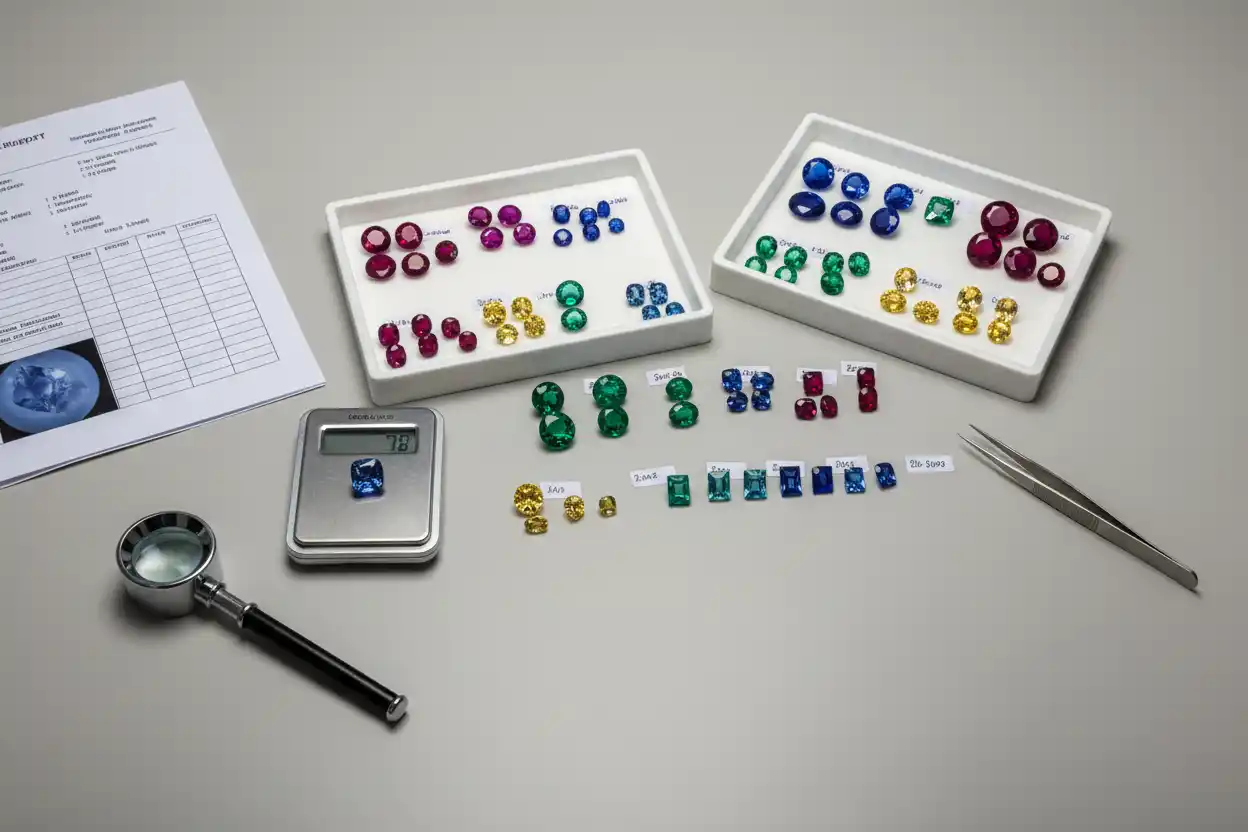
How Gemstone Prices Are Determined: A Complete Value Guide
Gemstone prices are determined by more than carat weight or a familiar grade such as “AAA.” The final amount reflects the gem’s identity, color, clarity, cut, size, rarity, treatment, origin, laboratory documentation, market demand and the type of transaction in which it is being sold.
Unlike standardized commodities, colored gemstones do not have one universal price list that applies to every stone. Two gems of the same mineral, weight and stated color can differ dramatically because one has stronger saturation, a better cut, fewer damaging inclusions, more desirable origin or more credible documentation.
This guide provides the universal valuation framework for the Buying & Value hub. Individual price guides should apply this framework to the quality ranges, treatments and market conditions of one specific gemstone.
Gemstone Pricing at a Glance
| Pricing factor | What buyers should examine | Typical effect on value |
|---|---|---|
| Identity | Natural, laboratory-grown, imitation, composite or incorrectly named | Establishes the correct market category |
| Variety | Commercial and mineral variety within the species | Rare varieties may command substantial premiums |
| Color | Hue, tone, saturation, zoning and stability | Often the strongest colored-stone value factor |
| Clarity | Type, position and effect of inclusions | Depends heavily on the gemstone species |
| Cut | Proportions, symmetry, polish, windowing and extinction | Determines beauty and face-up performance |
| Carat weight | Weight considered with face-up dimensions | Fine large gems can rise sharply per carat |
| Treatment | Heat, oil, filling, diffusion, dye, coating or irradiation | Accepted treatments vary by material |
| Origin | Geographic source supported by evidence | Important only for certain gems and qualities |
| Rarity | Geological scarcity and market availability | Raises value only when buyer demand also exists |
| Durability | Hardness, cleavage, toughness and stability | Influences practical jewelry demand |
| Laboratory report | Identity, treatment and sometimes origin | Reduces uncertainty but does not set a selling price |
| Market conditions | Fashion, supply, discoveries and economic demand | Can change pricing without changing the gem |
| Transaction type | Wholesale, retail, auction, appraisal or resale | The same stone can have several legitimate values |
Price, Cost and Value Are Not the Same
The words price, cost and value are often treated as synonyms, but they describe different concepts.
Price is the amount requested or paid in a specific transaction. A dealer’s asking price, an auction result and a private resale offer may all differ.
Cost is what the seller spent to acquire, cut, test, insure, transport and market the gemstone. It may include import duties, laboratory fees, photography, platform commissions and business overhead.
Value is an informed estimate of what the gem is worth within a defined market and purpose. Retail replacement value, fair-market value and liquidation value are not interchangeable.
A gem purchased for $2,000 does not automatically have a resale value of $2,000. The original price may include retail service, financing costs, advertising, brand premium and a seller’s operating margin that a secondary-market buyer will not reimburse.
There Is No Universal Colored-Gemstone Grading System
Diamonds benefit from widely adopted terminology for color, clarity, cut and carat weight. Colored gemstones are more complicated because each mineral has different ideal colors, inclusion tolerances, cutting challenges and treatment practices.
An inclusion that severely lowers the value of an aquamarine may be expected in emerald. A dark tone that makes one sapphire undesirable may produce an attractive appearance in another gem species.
Therefore, a seller’s “AAA,” “AAAAA,” premium or investment grade is not a universal laboratory grade. Such labels usually reflect the seller’s own inventory system.
Comparisons should use observable facts: body color, transparency, inclusions, dimensions, treatment, origin evidence, cut performance and laboratory conclusions.
The role and limitations of independent reports are examined in Gemstone Certification Labs Compared.
Gemstone Identity Comes First
A value estimate is meaningless until the material has been identified accurately.
A natural ruby, laboratory-grown ruby, lead-glass-filled ruby, red spinel and red glass may look similar in a photograph while belonging to completely different price categories.
The first distinction should establish whether the item is:
- A natural gemstone
- A laboratory-grown equivalent
- A treated natural gemstone
- An imitation made from another material
- A composite such as a doublet or triplet
- A trade-named rock or mineral with uncertain composition
The construction risks associated with assembled stones belong to Gemstone Doublets and Triplets.
Once the material is identified, it can be compared with stones from the correct market rather than with everything that shares its color.
Color Usually Drives Colored-Gemstone Value
Color is frequently the most important factor in a transparent colored gem.
However, color includes several components rather than a single label such as red, blue or green.
Hue
Hue is the principal color and any modifying color. A sapphire may be blue, violetish blue, greenish blue or grayish blue.
A desirable modifier depends on the species and current market preferences.
Tone
Tone describes how light or dark the color appears.
An overly light gemstone may lack visual impact, while an overly dark stone can look black except under intense illumination.
The ideal tone usually allows the viewer to recognize a rich body color without losing brightness.
Saturation
Saturation describes color intensity or purity.
Strong saturation generally adds value when the stone remains bright. Gray, brown or muddy modifiers commonly reduce broad market demand.
Color Distribution
Even color is often desirable, yet certain varieties are valued specifically for zoning. Watermelon Tourmaline, ametrine and parti-colored sapphire depend on controlled color transitions.
Unattractive zoning can leave one side pale and the other excessively dark.
Color Stability
A vivid hue may be less valuable when it fades under light, heat or ordinary wear.
Color stability matters particularly in gemstones whose appearance can be changed by irradiation, unstable color centers, surface coatings or absorbed substances.
Clarity Must Be Judged by Gemstone Type
Clarity measures the visibility and effect of inclusions, fractures and surface features.
The same clarity standard cannot be applied to every gemstone.
Eye-clean aquamarine, topaz and tourmaline are widely available, so obvious inclusions often reduce their value.
Fine emerald commonly contains visible inclusions. A transparent emerald with attractive color can remain valuable despite a garden-like internal appearance.
Rubellite, Paraíba Tourmaline and red beryl may also receive greater inclusion tolerance because clean material with vivid color is rare.
The most damaging clarity features usually include:
- Open fractures reaching the surface
- Cavities affecting polish or structural integrity
- Large inclusions beneath the table
- Cloudiness that weakens transparency
- Cleavage cracks or stress fractures
- Inclusions that threaten durability during setting
An inclusion can sometimes increase interest. Cat’s-eye, star and trapiche effects rely on organized internal structures.
The important question is not merely whether inclusions exist, but whether they damage beauty, identification, durability or long-term stability.
Cut Controls the Beauty You Actually See
Cut refers to more than the outline of the gemstone.
A well-cut gem coordinates depth, angles, symmetry, polish and orientation so light returns through the crown and the body color looks attractive.
Windowing
A window is a transparent or washed-out area through the center of a stone.
It develops when pavilion angles allow light to pass through instead of returning to the viewer.
A large window makes a gemstone look weak and may reveal the wearer’s skin or setting beneath it.
Extinction
Extinction appears as black or excessively dark areas that do not return light.
Some extinction is unavoidable in strongly pleochroic or deeply saturated gems, but poor orientation can make it dominate the face-up appearance.
Symmetry
Uneven outlines, off-center culets and misaligned facets can reduce visual balance.
Free-form gemstones do not need perfect conventional symmetry, but the design should still look intentional.
Polish
Scratches, polishing drag, rounded facet junctions and abrasions reduce brilliance.
Weight Retention
Cutters sometimes preserve carat weight at the expense of beauty. A deep stone may weigh more but appear smaller from above.
The buyer should compare face-up dimensions as well as carat weight.
Why Carat Price Increases With Size
Carat is a unit of weight equal to 0.2 grams.
A gemstone’s total price is often calculated as:
Price per carat × carat weight
However, price per carat is rarely constant across all sizes.
Large fine-quality crystals are less common than small crystals. As a result, a five-carat stone may cost more than five times the price of a comparable one-carat stone.
This increase is called a size premium.
The size premium becomes stronger when the material is both rare and in demand. Fine ruby, sapphire, emerald, alexandrite and Paraíba Tourmaline can rise sharply when quality remains strong at larger weights.
Common quartz, topaz and laboratory-grown materials may show a much smaller premium because large clean rough is more available.
Size does not rescue poor quality. A large dark, windowed or heavily fractured stone can remain less valuable than a smaller attractive gem.
Carat Weight and Visible Size Differ
Two gemstones with the same carat weight can have different face-up dimensions because minerals have different densities.
A one-carat sapphire generally appears smaller than a one-carat quartz gem of a similar cut.
Depth also changes visual size. A deeply cut stone hides more weight below the girdle.
Consumers should therefore compare:
- Carat weight
- Length and width
- Total depth
- Face-up area
- Girdle thickness
- Cut proportions
Carat weight is objective, but it does not tell the buyer how large the gem will look after setting.
Treatments Can Change Value Dramatically
Gemstone treatment is not automatically deceptive. Many accepted enhancements improve color, clarity or durability.
The important issues are disclosure, stability and the effect on rarity.
Common treatments include:
- Heating
- Irradiation
- Oil or resin filling
- Lead-glass filling
- Lattice diffusion
- Dyeing
- Bleaching
- Impregnation
- Surface coating
- Fracture filling
- Stabilization
The complete definitions belong to Gemstone Treatments Explained.
Heat-treated sapphire can remain valuable because heat is widely accepted and the underlying corundum is natural.
An unheated sapphire of comparable beauty may receive a premium because untreated fine color is less common.
A lead-glass-filled ruby belongs to a much lower market category because much of its apparent transparency depends on extensive filling.
Oil treatment is expected in many emeralds, yet the quantity and type of filler affect value.
A coating that supplies nearly all visible color is less durable and generally less valuable than comparable natural body color.
Treatment should be considered within the norms of the specific gemstone rather than through a universal untreated-is-always-better rule.
Natural and Laboratory-Grown Gemstones Occupy Different Markets
A laboratory-grown gemstone has essentially the same crystal structure and chemical identity as its natural counterpart.
It is not an imitation merely because it was manufactured.
However, laboratory growth removes much of the geological scarcity that supports natural-gem pricing.
Lab-grown sapphire, ruby, emerald and diamond can provide excellent color and clarity at substantially lower prices.
Natural stones usually receive stronger rarity and provenance premiums, especially in the collector and high-jewelry markets.
The practical comparison belongs to Lab-Grown vs Natural Gemstones.
Buyers should decide whether they value natural origin, visual appearance, durability, budget efficiency, rarity or resale recognition. One category is not automatically correct for every purpose.
Geographic Origin Matters Only in Certain Markets
A country-of-origin opinion can increase value when the market has a documented preference for material from a particular deposit.
Examples include Kashmir sapphire, Burmese ruby, Colombian emerald, Brazilian Paraíba Tourmaline and Australian black opal.
Origin premiums are not automatic.
A weak ruby from a famous country does not become more valuable than a superb ruby from another source merely because of its passport.
Origin adds the most value when:
- The gem is already high quality
- The locality has a recognized historical reputation
- Supply is genuinely limited
- An independent laboratory supports the origin opinion
- Buyers actively pay more for that source
Origin opinions are scientific conclusions based on available evidence, not guarantees of the exact mine.
Rarity Alone Does Not Create Value
Some minerals are extraordinarily rare but have little jewelry demand, limited durability or unattractive appearance.
A gemstone becomes expensive when rarity combines with beauty, market awareness, collector interest, wearable durability and purchasing power.
The Rarest Gemstones in the World are therefore not automatically listed in the same order as the most expensive gemstones.
Demand can make a moderately rare gem more valuable than a mineral known from only a few localities.
Rarity should be separated into:
- Geological rarity
- Gem-quality rarity
- Size rarity
- Treatment rarity
- Market availability
- Provenance rarity
- Consumer demand
A species may be common as opaque mineral grains but rare as clean facetable rough.
Durability Affects Commercial Demand
A gem that survives regular wear has a wider jewelry market than one limited to display or occasional pendants.
Mohs hardness measures resistance to scratching, as explained in the Gemstone Hardness Chart.
It does not measure resistance to breaking. The distinction appears in Gemstone Toughness vs Hardness.
Cleavage can allow a hard mineral to split under a sharp blow. The structural issue is covered in Gemstone Cleavage Explained.
Durability affects value most strongly when consumers expect daily-wear rings or bracelets.
A fragile collector gem can remain expensive because of rarity, but its buyer pool is smaller and its setting options are limited.
Laboratory Reports Reduce Uncertainty
A respected gemological report can identify the material, distinguish natural from laboratory-grown origin and disclose detectable treatments.
Some reports also provide geographic-origin opinions.
A report does not create beauty or rarity. A poorly colored gemstone does not become fine merely because it has paperwork.
Reports can nevertheless improve marketability by reducing uncertainty, especially for:
- Ruby
- Sapphire
- Emerald
- Alexandrite
- Jade
- Paraíba Tourmaline
- Natural pearls
- Fine opal
- Rare faceted gems
- Stones sold with untreated or origin premiums
Low-cost common gems may not justify the testing fee.
The report number should be verified through the issuing laboratory, and the measurements and image should match the actual stone.
Market Demand Changes Prices
Gem markets respond to discoveries, mine closures, fashion, celebrity exposure, social media, economic conditions and supply-chain disruption.
A new deposit can increase supply and lower scarcity premiums.
A mine closure can strengthen demand for documented old material.
Color preferences also change. Teal sapphires, salt-and-pepper diamonds and included gemstones have moved from niche categories into broader markets at different times.
Temporary popularity should not be confused with permanent investment value.
The risks and selection criteria belong to Best Gemstones for Investment.
Wholesale, Retail and Resale Values
Wholesale Price
Wholesale pricing reflects transactions among cutters, dealers, manufacturers and retailers.
It may require quantity purchases, trade credentials or repeat business.
Retail Price
Retail price includes the services and costs required to sell to the final consumer.
These can include showroom expenses, photography, returns, warranties, staff, marketing, financing and after-sales support.
Auction Price
Auction results depend on competition at a particular moment.
A strong result can reflect provenance, publicity and two determined bidders. A weak result may reflect poor presentation or limited attendance.
Fair-Market Value
Fair-market value estimates the amount a willing buyer and willing seller might agree upon under ordinary conditions.
Replacement Value
Insurance replacement value estimates what it may cost to replace the item through an appropriate market.
It is often higher than resale value.
Liquidation or Resale Value
A dealer purchasing the stone for resale must account for risk, testing, inventory time and profit margin.
Therefore, a resale offer can be considerably below a previous retail purchase price without proving fraud.
Jewelry Settings and Brand Premiums
A gemstone’s loose value should be separated from the value of its setting.
Precious metal weight, craftsmanship, design complexity, condition and accompanying diamonds all affect the finished-jewelry price.
A signed piece from a recognized jewelry house may command a substantial brand and provenance premium.
That premium does not mean the central gemstone itself has the same loose-stone value.
Conversely, removing an important gem from a signed historical mounting can reduce the value of the complete object.
How Major Gemstone Markets Apply the Framework
The universal factors remain the same, but their importance changes by material.
In the Diamond Price Guide, standardized color, clarity and cut grades play a major role.
The Ruby Price Guide must emphasize red color, treatment, origin and fluorescence.
The Sapphire Price Guide gives greater weight to hue, tone, treatment, origin and size.
The Emerald Price Guide accounts for green color, transparency and the extent of clarity enhancement.
The Opal Price Guide focuses on body tone, brightness, pattern, play-of-color and stability.
The Tourmaline Price Guide must separate common colors from rare copper-bearing and fine red or blue material.
The Jade Price Guide requires correct nephrite-versus-jadeite identification, treatment classification, texture and translucence.
The Pearl Price Guide uses luster, surface, shape, size, nacre and matching rather than faceted-gem criteria.
The Zircon Price Guide considers color, heat treatment, facet abrasion and structural condition.
A Practical Gemstone Valuation Process
A careful buyer can evaluate a gemstone in the following order:
- Confirm the material’s identity.
- Establish natural, laboratory-grown, imitation or composite status.
- Record treatments and their stability.
- Evaluate color in neutral and warm lighting.
- Inspect clarity and durability risks.
- Judge cut, windowing, extinction and face-up size.
- Compare the stone with examples of the same species, treatment and quality.
- Consider origin only when it is supported and commercially relevant.
- Verify any laboratory report.
- Compare prices across the same transaction level.
- Separate loose-gem value from setting and brand value.
- Decide whether the price fits the intended use, not merely the seller’s rarity claim.
Common Gemstone Pricing Mistakes
A frequent error is comparing only carat weight. A larger stone can be less attractive and less valuable.
Another mistake is treating every inclusion as a defect without considering the gemstone species.
Consumers also overpay when they assume a laboratory report is an appraisal, when they mistake an asking price for a completed sale, or when they compare retail listings with dealer purchase offers.
Unsupported origin claims, dramatic trade names and seller-created grades can create artificial premiums.
Finally, buyers often pay for rarity without confirming demand. A mineral can be scarce yet difficult to resell.
Frequently Asked Questions
1. Who determines gemstone prices?
The market determines prices through transactions among miners, cutters, dealers, manufacturers, retailers, collectors and consumers. Laboratories provide gemological information but do not set the selling price.
2. Is there an official gemstone price list?
No universal list covers every colored gemstone. Trade guides and auction databases can provide references, but each stone still requires individual evaluation.
3. What is the most important factor in gemstone value?
For most transparent colored stones, color is the leading factor. Identity, treatment, cut, clarity, size and market demand remain essential.
4. Why do larger gemstones cost more per carat?
Fine large crystals are less common than small ones. Price per carat rises when quality remains high as size increases.
5. Does a laboratory report increase gemstone value?
A report reduces uncertainty and can support origin or untreated premiums. It does not improve a weak gemstone’s actual color, clarity or cut.
6. Are untreated gemstones always more valuable?
Not always. An attractive treated stone can be worth more than a poor untreated stone. However, comparable fine untreated gems often receive scarcity premiums.
7. Why is retail price higher than resale value?
Retail pricing includes selection, testing, marketing, returns, warranties and operating costs. A resale buyer must leave room for risk and future profit.
8. Does geographic origin always matter?
No. Origin matters mainly for certain high-quality gemstones whose famous sources receive documented market premiums.
9. Are laboratory-grown gemstones worthless?
No. They have manufacturing, cutting and jewelry value. Their prices are generally lower because production reduces geological scarcity.
10. Does hardness determine price?
No. Hardness influences wearability, but beauty, rarity and demand can make a softer gemstone more valuable than a harder one.
11. Can gemstones be good investments?
Some exceptional stones preserve or increase value, but liquidity, authenticity, transaction costs and changing demand create substantial risk.
12. How can I know whether a gemstone price is fair?
Compare stones with the same identity, treatment, size, color, clarity, cut and documentation. Use multiple sellers and completed-market evidence rather than one asking price.
A fair gemstone price begins with correct classification. Once the buyer knows what the material is, how its appearance was produced and how it compares with stones in the same market category, the price becomes easier to evaluate and unsupported rarity claims lose much of their power.