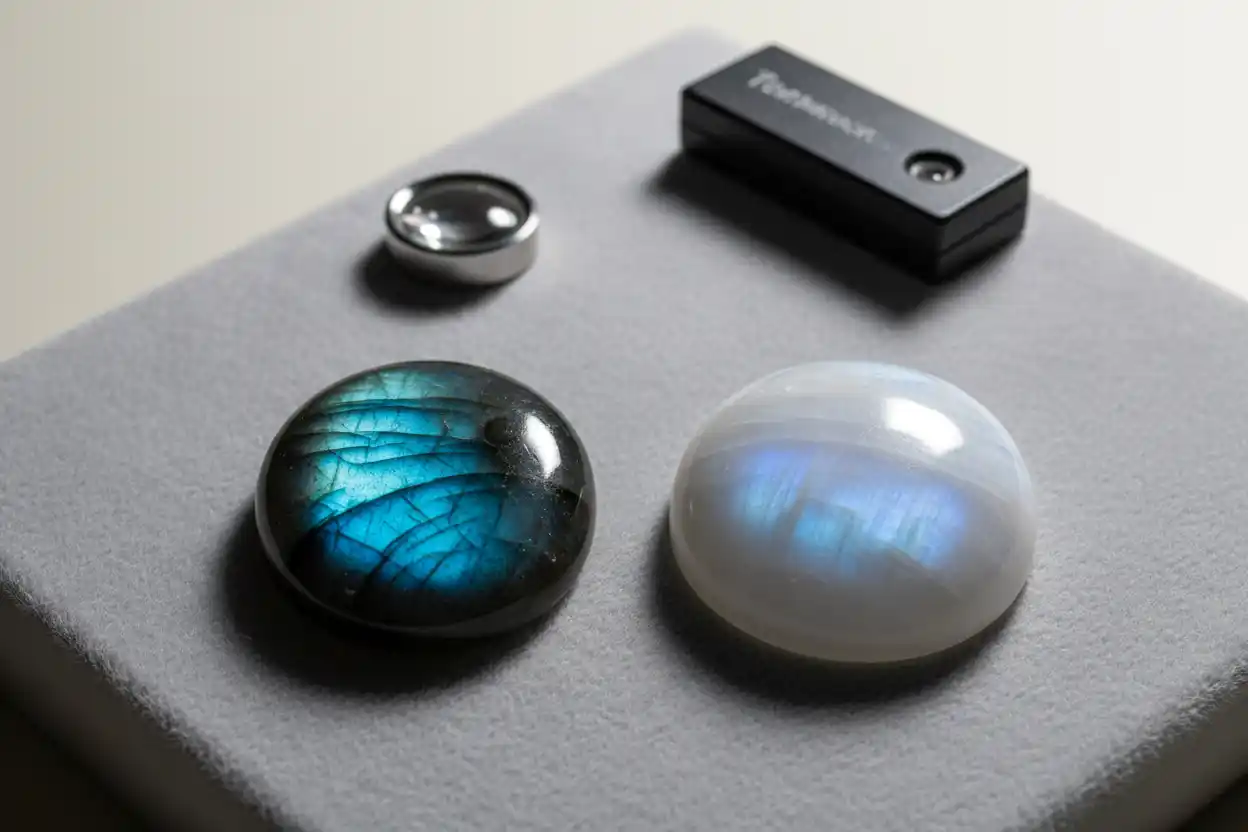
Labradorite vs Moonstone: Key Differences & How to Choose
The labradorite vs moonstone comparison is more complicated than putting a dark flashing feldspar beside a pale glowing one. Both belong to the feldspar family, both can display moving optical phenomena created by microscopic internal structures, both commonly appear as cabochons, and both sit around the same general region of the Mohs scale. Yet they are not simply two colors of one gemstone. Labradorite belongs to the calcium-sodium plagioclase series, while conventional moonstone is associated with exsolved alkali feldspar material whose characteristic phenomenon is adularescence. Their refractive indices, density, internal textures, appearance, value factors, and trade terminology differ enough to make proper identification useful.
The most obvious difference is the phenomenon. Labradorite is famous for labradorescence: broad, often saturated flashes of blue, green, gold, orange, violet, or several spectral colors that can appear abruptly as the stone moves. Conventional moonstone is prized for adularescence: a softer white, silver, or blue sheen that appears to float or billow beneath the surface. GIA attributes both effects to microscopic feldspar intergrowth structures, but their textures and optical expression are different.
There is one major naming trap. Material sold as rainbow moonstone is commonly transparent labradorite, not conventional moonstone in the strict mineralogical sense. GIA explicitly identifies rainbow moonstone as labradorite despite the accepted trade name. This article therefore uses “moonstone” for conventional moonstone unless rainbow moonstone is specifically named. That distinction is essential to making a useful comparison within Identification.
Labradorite vs Moonstone at a Glance
| Property | Labradorite | Conventional Moonstone |
|---|---|---|
| Mineral family | Feldspar | Feldspar |
| Main feldspar group | Plagioclase | Alkali feldspar / cryptoperthitic moonstone material |
| Approximate composition context | Labradorite range roughly An50–An70 | Potassium-sodium feldspar intergrowth |
| Typical body color | Gray, dark gray, pale green, colorless, bluish | Colorless, white, gray, peach, brown, green |
| Main phenomenon | Labradorescence | Adularescence |
| Typical phenomenon appearance | Broad saturated spectral flash | Soft floating white, silver, or blue glow |
| Common flash colors | Blue, green, gold, orange, violet, multicolor | White, silver, blue; other colors possible |
| Refractive-index range | About 1.554–1.573 | Common orthoclase reference about 1.518–1.526 |
| Specific gravity context | Around 2.70 for typical labradorite | Around 2.58 for orthoclase moonstone reference |
| Mohs hardness | About 6–6.5 | About 6–6.5 |
| Cleavage | Perfect feldspar cleavage | Two cleavage directions |
| Toughness | Requires impact protection | GIA rates moonstone poor in toughness |
| Common cut | Cabochon, slab, bead, carving | Cabochon; faceting also used in transparent material |
| Main buying priority | Flash intensity, coverage, orientation | Sheen color, transparency, centering, viewing range |
| “Rainbow moonstone” | Usually this material when transparent and iridescent | Trade name can misleadingly suggest this category |
| Best for high-impact rings? | Possible with protection, but not ideal | Possible with care, generally more vulnerable |
| Visual inspection always conclusive? | No | No |
Mindat places labradorite in the plagioclase series with an albite-to-anorthite ratio corresponding to approximately An50–An70, hardness 6–6.5, perfect cleavage, and refractive indices from about 1.554 to 1.573. GIA’s conventional moonstone reference gives hardness 6–6.5, RI approximately 1.518–1.526 and specific gravity about 2.58.
Identity: The Difference Starts With Feldspar Chemistry
Labradorite is an intermediate plagioclase feldspar. Its chemistry lies between sodium-rich albite and calcium-rich anorthite, with labradorite occupying a calcium-rich intermediate range. The crystal system is triclinic, and polysynthetic albite twinning is characteristic of plagioclase. Mindat reports labradorite as biaxial positive with maximum birefringence around 0.008–0.010.
Moonstone is more complicated because the trade name historically emphasizes the phenomenon rather than one perfectly fixed composition. Conventional gemological descriptions commonly associate moonstone with orthoclase and albite intergrowths. More detailed modern GIA research describes true moonstone’s characteristic moonlight-like iridescence as arising from cryptoperthitic alkali feldspar textures, while also noting that the commercial name has sometimes been applied loosely to other light-colored feldspars.
This is similar to the identification principle behind Jadeite vs Nephrite: two materials can occupy one familiar commercial category while remaining mineralogically distinct enough that precise naming matters.
“Rainbow Moonstone” Is the Biggest Source of Confusion
If you place dark Madagascan labradorite beside conventional pale moonstone, the comparison can look straightforward. The problem begins when transparent white labradorite with blue or multicolored iridescence is marketed as rainbow moonstone.
GIA states that rainbow moonstone is transparent labradorite, despite the moonstone trade name.
Consequently:
Conventional moonstone vs labradorite is a legitimate comparison between different feldspar categories.
Rainbow moonstone vs labradorite may instead be a comparison between two commercial presentations of labradorite.
That naming issue resembles the distinction addressed in Jade vs Jadeite, where trade vocabulary and exact mineral identity cannot safely be treated as interchangeable.
Visual Clue 1: Labradorite Usually Produces a More Saturated Flash
Classic gem labradorite often has a gray or dark body and suddenly returns intense blue, green, gold, orange, violet, or multicolored light. GIA calls this phenomenon labradorescence and attributes it to interference from thin internal lamellar structures developed during feldspar exsolution.
The effect can be dramatic enough that a stone appears nearly ordinary gray from one direction and intensely blue or green from another.
Moonstone usually produces a more diffuse phenomenon. The adularescent light appears to float beneath the surface and can move smoothly as the stone is tilted. It is commonly white, silvery, or blue rather than a sharply saturated spectral panel.
This contrast is useful but not absolute. Some light labradorites show softer effects, while exceptional moonstone can display striking electric-blue sheen.
Visual Clue 2: The Optical Motion Is Different
Labradorescence often appears as a sheet, patch, or broad directional flash. As the viewing angle crosses the correct orientation, the color can switch on quickly and then disappear.
Moonstone’s adularescence more often behaves like a luminous cloud moving beneath the cabochon. GIA describes it as a billowing or rolling sheen generated as light is scattered between microscopic feldspar layers.
A useful observational distinction is therefore:
Labradorite: stronger directional spectral flash.
Moonstone: softer internal floating sheen.
Do not turn this into an absolute one-photo test. Photography, cutting orientation, lighting, and trade naming can blur the difference.
The same caution applies in color-based comparisons such as Larimar vs Turquoise: appearance should start the investigation, not end it.
Visual Clue 3: Body Color Helps, but Does Not Prove Identity
Dark gray material with bright blue-green flash strongly suggests familiar commercial labradorite.
Colorless or nearly colorless material with blue floating sheen strongly suggests fine conventional moonstone.
However, labradorite can also be transparent or pale, and moonstone can occur with gray, peach, green, brown, or other body colors.
Body color therefore has moderate identification value but weak proof value.
It becomes particularly unreliable with rainbow moonstone, because the transparent pale material is commonly labradorite.
Original Same-Lighting, Same-Scale Comparison Protocol
A useful labradorite vs moonstone image comparison should eliminate photographic advantages before interpreting the stones.
| Control | Method | Why it matters |
|---|---|---|
| Scale | Use similar face-up dimensions | Stops a larger stone from dominating |
| Shape | Prefer comparable cabochons | Reduces shape-driven optical differences |
| Background | Neutral matte gray | Prevents color casts |
| Diffuse illumination | Same daylight-balanced source | Shows body color |
| Directional light | Same point source and angle | Reveals phenomenon |
| Camera exposure | Lock exposure | Prevents one stone looking artificially brighter |
| White balance | Lock it | Prevents exaggerated blue |
| Peak-angle photo | Record strongest phenomenon | Shows maximum optical performance |
| Off-angle photo | Record body color | Prevents hero-image bias |
| Rotation sequence | Rotate through the same arc | Compares how broadly the effect remains visible |
| Scale marker | Include millimeter ruler | Provides actual dimensions |
| Editing | No selective saturation or clarity enhancement | Keeps the comparison defensible |
The most useful result is not one spectacular photograph but a sequence showing both stones from neutral through peak optical orientation.
This evidence-first approach also applies to Lapis Lazuli vs Sodalite, where uncontrolled lighting can exaggerate similarities or differences.
Optical Data: A Stronger Separation Than Color Alone
The refractive-index difference can be useful when suitable transparent or translucent material allows testing.
| Optical property | Labradorite | Conventional orthoclase moonstone reference |
|---|---|---|
| RI | ~1.554–1.573 | ~1.518–1.526 |
| Birefringence | ~0.008–0.010 | ~0.005–0.008 |
| Optical character | Biaxial | Biaxial |
| SG | Commonly around 2.70 | About 2.58 |
| Main phenomenon | Labradorescence | Adularescence |
| Crystal-group context | Plagioclase | Alkali feldspar |
Mindat provides the broader labradorite RI range, while GIA gives orthoclase moonstone values of approximately 1.518–1.526 and SG 2.58.
These values overlap far less than the stones’ hardness values, making optical testing more useful than scratch testing.
A similar principle is central to Kyanite vs Sapphire: non-destructive optical and physical measurements are more informative than judging color names.
Do Not Use Scratch Testing to Separate Them
Both materials sit around Mohs 6–6.5, so hardness does not provide a clean separation. More importantly, scratching a finished gem damages the property you are trying to evaluate.
A scratch test may tell you that a surface is softer than quartz or harder than another reference material, but it will not reliably distinguish two feldspars whose hardness overlaps.
Use non-destructive measurements and structural observations instead.
Specific Gravity Can Support the Identification
Typical labradorite is denser than conventional orthoclase moonstone. GIA’s feldspar data place labradorite around SG 2.70, while its moonstone reference gives about 2.58 for orthoclase moonstone.
That difference can become useful in loose stones when hydrostatic weighing or another appropriate SG method is available.
It is not a useful test for mounted gems.
Actual feldspar composition can also vary, so a single density result should be interpreted together with RI, optical behavior, twinning, and other evidence.
Labradorescence and Adularescence Have Different Internal Origins
Both phenomena ultimately depend on fine-scale feldspar intergrowths, but the nanotextures are not identical.
GIA describes labradorite’s phenomenon as arising from highly regular nanoscale exsolution lamellae in plagioclase. The periodic structures interfere with visible light strongly enough to return saturated spectral colors.
Moonstone’s softer phenomenon arises from fine alkali-feldspar intergrowth textures that scatter and interfere with light differently, producing the characteristic desaturated moonlight-like sheen.
So although both are “layer effects,” labradorescence should not simply be described as stronger adularescence.
They are recognized as different phenomenal expressions.
Rainbow Moonstone Complicates Phenomenon Terminology
GIA’s general consumer material acknowledges the trade use of “rainbow moonstone” for transparent labradorite showing multicolored adularescence-like effects. More detailed mineralogical research cautions that broad use of the moonstone name for light-colored iridescent plagioclase has created terminology confusion.
For a buyer, the safest questions are:
What is the actual feldspar?
What phenomenon is present?
Is “moonstone” being used mineralogically or as a trade name?
This same separation between trade appearance and material identity is useful in Moissanite vs Cubic Zirconia, where similar visual roles do not make the materials equivalent.
Treatments: Labradorite Can Be Copper Diffused
The familiar blue-green labradorescence of ordinary labradorite is not produced by dye or coating. It comes from the stone’s internal feldspar structure.
However, treatment can affect some plagioclase feldspar sold in the broader gem market. GIA documents copper diffusion in feldspar, including labradorite, as a method capable of substantially changing body color. It also notes that such treatment can be extremely difficult to detect conclusively without qualified laboratory analysis.
This issue is most relevant when unusual transparent red, green, or otherwise strongly body-colored plagioclase is being sold with claims about natural color.
It should not be used to imply that ordinary dark gray labradorite with blue flash is routinely diffusion treated.
Moonstone Is Not Commonly Treated, but Verify Unusual Material
GIA describes moonstone as generally not treated in ordinary trade.
That makes treatment a less central buying issue than phenomenon quality, body color, clarity, cut, and fractures.
Nevertheless, no gemstone category is immune to imitation, coating, assembly, or misleading naming. An unusual high-value specimen should be judged by what is actually present rather than by the assumption that “moonstone is never treated.”
The identification principle is similar to Malachite vs Azurite: normal material expectations are useful, but they are not a substitute for examining the individual object.
Durability: Neither Stone Is a Sapphire Substitute
Labradorite and moonstone share the fundamental durability limitations of feldspar.
Labradorite is about Mohs 6–6.5 and has perfect cleavage.
Moonstone is also Mohs 6–6.5. GIA rates its toughness as poor and notes that it has two cleavage directions that make it vulnerable to chipping or breaking from impact.
Therefore, neither should be selected for heavy daily impact simply because the polished surface initially looks durable.
Their scratch resistance is adequate for many jewelry applications but substantially below sapphire or diamond.
Is Labradorite More Durable Than Moonstone?
There is no simple species-wide winner that makes one safe for abuse and the other fragile.
Moonstone has a particularly clear GIA warning for poor toughness and cleavage. Labradorite also has perfect cleavage and should be protected from impact. Individual stone thickness, fractures, cabochon geometry, inclusions, and setting design can matter more than a small difference in general toughness terminology.
A thick, structurally sound labradorite cabochon in a protective bezel may survive more practical wear than a thin, fractured moonstone.
A sound moonstone pendant may outlast an exposed labradorite ring.
The format of the jewelry matters.
That same hardness-versus-toughness distinction is useful in Kunzite vs Morganite, where durability cannot be reduced to a single Mohs number.
Original Durability Matrix
| Wear situation | Labradorite | Moonstone | Better practical choice |
|---|---|---|---|
| Pendant | Good with normal care | Good with normal care | Tie |
| Earrings | Good | Good | Tie |
| Occasional ring | Acceptable with protective setting | Acceptable with protective setting | Depends on specimen |
| Daily exposed ring | Higher risk of abrasion/cleavage | High risk of abrasion/cleavage | Neither ideal |
| Bracelet | Needs protection from repeated knocks | Needs protection from repeated knocks | Neither has a clear advantage |
| Beads | Watch drill holes and impact | Watch drill holes and impact | Tie |
| High-impact work | Remove jewelry | Remove jewelry | Neither |
| Loose-stone storage | Store separately | Store separately | Tie |
| Ultrasonic cleaning | Avoid as conservative practice | GIA says avoid | Neither |
| Steam cleaning | Avoid as conservative practice | GIA says avoid | Neither |
| Warm soapy water | Appropriate conservative method | GIA recommended | Both |
The important conclusion is not that the stones are unusable. Both have long histories in jewelry. They simply benefit from thoughtful design and maintenance.
Care: Moonstone Has the Clearest Conservative Rule
GIA recommends warm soapy water for moonstone and advises against ultrasonic and steam cleaning because of poor toughness, cleavage, and sensitivity to high heat or sudden temperature changes.
Labradorite lacks the same dedicated GIA consumer-care page, but its feldspar hardness and perfect cleavage justify a similarly conservative routine. A soft cloth, mild soap, lukewarm water, gentle brushing if needed, and careful drying avoid introducing unnecessary mechanical or thermal stress.
Do not use harsh cleaning as a test of authenticity.
The setting, adhesives, metals, and any associated gemstones may impose additional restrictions beyond the feldspar itself.
Heat and Sudden Temperature Change
Moonstone can fracture when exposed to high heat or abrupt temperature changes.
Labradorite’s cleavage and feldspar structure also support avoiding unnecessary thermal shock.
This matters during jewelry repair. A bench jeweler should know what the center stone is before soldering or applying heat near the setting.
Neither stone benefits from a durability experiment simply because it is relatively inexpensive.
Value: Labradorite and Moonstone Reward Different Appearance Qualities
GIA identifies moonstone’s main quality factors as body color, the color and orientation of the sheen, clarity, cut, and size. The most highly favored conventional moonstone combines a nearly colorless transparent-to-semitransparent body with vivid blue adularescence that is centered and visible through a broad range of viewing angles.
Labradorite value is more strongly associated with labradorescence intensity, coverage, color range, viewing angle, cut orientation, body contrast, condition, size, and in some specialty material provenance such as Finnish spectrolite.
This creates a fundamental difference in buying logic:
Moonstone: transparency and floating blue sheen can be major premiums.
Labradorite: saturated flash coverage and dramatic structural color can be major premiums.
The visual phenomenon should be evaluated in realistic movement, not only at the seller’s strongest photographic angle.
Larger Does Not Automatically Mean Better
Fine moonstone becomes scarcer in larger sizes when excellent transparency and blue sheen are held constant, so high-quality larger specimens can command stronger premiums.
Labradorite can occur in large masses, making sheer size a weaker rarity factor. A large piece with weak phenomenon can remain relatively inexpensive.
For both stones, visual quality should therefore be normalized before comparing carat weight.
A smaller stone with better optical orientation can provide a more convincing finished jewel.
Which Is Usually More Expensive?
There is no universal answer because both categories contain inexpensive commercial material and higher-quality specialty stones.
Fine conventional moonstone with exceptional transparency, electric-blue centered adularescence, broad viewing range, and substantial size can command a considerable premium because that quality combination is uncommon.
Ordinary labradorite is abundant and can be inexpensive, but exceptional full-face multicolor labradorescence, fine spectrolite, unusual transparent material, designer cutting, or documented provenance can increase value significantly.
The fairest comparison is not “price per carat across all feldspar.”
It is quality-normalized labradorite versus quality-normalized moonstone for the use you actually want.
Original Decision Matrix
| Your priority | Better starting choice | Why |
|---|---|---|
| Dramatic blue-green spectral flash | Labradorite | Labradorescence is typically stronger and more saturated |
| Soft floating blue-white glow | Moonstone | Adularescence creates the characteristic billowing effect |
| Dark statement stone | Labradorite | Dark gray body with bright flash is common |
| Nearly colorless ethereal appearance | Moonstone | Fine conventional moonstone excels here |
| Multicolor structural effect | Labradorite | Gold, green, orange, blue, violet combinations are common in fine material |
| Broad “moonlit” sheen | Moonstone | The phenomenon is its defining aesthetic |
| Finest transparency | Moonstone often prioritized | Transparency is a major quality factor in top moonstone |
| Lower-cost large statement cabochon | Often labradorite | Large cutting material is widely available |
| High-impact everyday ring | Neither ideal | Both are feldspar with cleavage |
| Pendant | Either | Lower impact makes both practical |
| Matching earrings | Either | Pair matching and phenomenon orientation matter |
| Mineralogical specimen interest | Depends | Labradorite composition/phenomenon vs alkali-feldspar moonstone textures |
| Finnish spectrolite provenance | Labradorite | Spectrolite is a labradorite specialty |
| You specifically want “rainbow moonstone” | Verify first | It is commonly transparent labradorite |
| You want the easiest one-photo identification | Neither | Trade naming and directional phenomena can mislead |
The matrix deliberately avoids declaring a universal winner because the two gems appeal to different visual priorities.
Decision Case 1: You Want the Strongest Color Flash
Choose labradorite first.
Its labradorescence can generate saturated blue, green, gold, orange, violet, and multicolored reflections. GIA describes the phenomenon as broad flashes of spectral color produced by internal lamellar structures.
A moonstone can have spectacular blue sheen, but the overall effect is normally softer and more cloudlike.
If intense color movement is the priority, labradorite better matches that aesthetic.
Decision Case 2: You Want a Soft Blue Glow
Choose conventional moonstone.
Fine moonstone is valued for an almost transparent body carrying a mobile blue sheen. GIA specifically identifies vivid blue adularescence centered over the cabochon and visible from a wide range of angles as highly desirable.
If you prefer a floating internal light rather than a sharply switching spectral flash, moonstone is the better starting point.
Decision Case 3: You Want a Daily-Wear Ring
Neither is the safest first choice if the ring will receive repeated knocks.
Moonstone has poor toughness and cleavage. Labradorite has perfect cleavage and similar hardness.
If you still want one, prioritize:
a thick sound cabochon;
a protective bezel or similarly guarded setting;
minimal exposed edge;
no major fractures;
a lifestyle that permits removing the ring during physical work.
The decision should then be driven by the better individual stone and setting rather than the species name.
Decision Case 4: You Want Earrings or a Pendant
Either can work very well.
Earrings and pendants generally encounter fewer direct impacts than rings and bracelets, allowing their optical phenomena to become the primary decision factor.
Labradorite gives stronger spectral drama during movement.
Moonstone offers a subtler floating sheen.
A matched pair needs consistent optical orientation, because two stones with the same dimensions can flash at different angles.
Decision Case 5: The Listing Says “Rainbow Moonstone”
Do not assume the material is conventional moonstone.
GIA identifies rainbow moonstone as transparent labradorite.
If the distinction affects your purchase, ask whether the gem has actually been identified as labradorite.
The trade name itself can be legitimate while remaining mineralogically imprecise.
This is similar to other identification problems discussed in Moonstone vs Opal, where a visually phenomenal gem still needs the correct material name.
Decision Case 6: The Seller Says Blue Flash Proves Moonstone
That claim is insufficient.
Labradorite commonly produces strong blue labradorescence, and transparent labradorite is often sold as rainbow moonstone.
The character of the phenomenon, body appearance, optical measurements, and actual feldspar identity need to be considered.
Blue alone cannot establish moonstone.
Decision Case 7: The Seller Says Multicolor Flash Proves Labradorite
Multicolor saturated flash strongly supports labradorite in an appropriate feldspar, but material identity still matters.
Trade terms and other iridescent feldspars can complicate visual assessment.
If the stone is valuable or the classification matters scientifically, use optical measurements rather than making the conclusion entirely from video.
A comparison like Lab Diamond vs Moissanite illustrates the broader rule: proving appearance is not the same as proving material identity.
Decision Case 8: You Want the Better Value
Define what “value” means first.
For dramatic size and strong flash per unit of spending, ordinary labradorite often has an advantage because attractive large cutting material is readily available.
For the specific combination of high transparency, colorless body, vivid centered blue sheen, and large size, fine moonstone can become comparatively scarce and expensive.
Neither price should be evaluated solely from weight.
Original Buyer Decision Scorecard
Score each candidate from 1 to 5 on the attributes you personally value.
| Attribute | Labradorite Candidate | Moonstone Candidate |
|---|---|---|
| Phenomenon intensity | ||
| Phenomenon coverage | ||
| Useful viewing angle | ||
| Body color | ||
| Transparency | ||
| Cut orientation | ||
| Polish | ||
| Fracture condition | ||
| Setting protection | ||
| Size for intended jewelry | ||
| Price relative to comparable stones | ||
| Confidence in identification |
Do not total the scores until you decide which categories actually matter.
For example, transparency should carry greater weight for someone buying fine moonstone, whereas multicolor flash coverage might matter much more for a labradorite collector.
Lab Limits: What a Photograph Can Tell You
Photographs can provide useful evidence about:
body color;
phenomenon color;
flash or sheen coverage;
cabochon shape;
surface polish;
major fractures;
apparent transparency.
Photographs cannot reliably establish exact RI, specific gravity, chemical composition, treatment status, or feldspar classification in every case.
They are particularly weak when only one optimized angle is shown.
Lab Limits: What Standard Gemological Testing Can Do
A refractive index in the labradorite range can separate many plagioclase specimens from conventional orthoclase moonstone. Density can add another supporting difference, particularly in loose material.
Polarized-light examination and twinning can provide additional feldspar information.
Microscopy can reveal cleavage, structural textures, inclusions, and evidence relevant to the phenomenon.
These methods are stronger together than separately.
Lab Limits: When Visual Comparison Is Insufficient
Visual comparison is insufficient when:
the stone is transparent and sold as rainbow moonstone;
the phenomenon is weak or atypical;
the asking price depends on exact feldspar identity;
unusual body color raises treatment questions;
the seller makes a high-value provenance claim;
the stone does not fit standard visual expectations.
Copper diffusion in some plagioclase material can also be difficult to identify conclusively without qualified laboratory analysis.
The appropriate conclusion in an ambiguous case is “further testing needed,” not a forced identification.
Lab Limits: What Testing Cannot Decide
Gemological testing can determine physical properties and may establish whether the feldspar is labradorite, moonstone material, another feldspar, or something else.
Testing cannot decide whether you prefer a spectral blue flash or a cloudy blue glow.
It cannot determine whether subtle moonstone feels more elegant than dramatic labradorite.
It cannot promise resale appreciation.
It cannot convert spiritual symbolism into measurable mineral properties.
A laboratory answers material questions.
The buyer answers aesthetic ones.
Common Misunderstandings
The first misconception is that labradorite and moonstone are the same gemstone in different colors. Both are feldspars, but their composition and characteristic optical structures differ.
A second is that every pale blue-flashing feldspar is moonstone. Transparent labradorite is commonly sold as rainbow moonstone.
A third is that labradorescence and adularescence are simply two words for the same phenomenon. They describe different characteristic feldspar effects.
A fourth is that labradorite is always dark. It can also be pale, transparent, greenish, colorless, or otherwise different from familiar gray commercial material.
A fifth is that moonstone must always be white. GIA documents green, peach, brown, gray, and other body colors.
A sixth is that stronger blue automatically means moonstone. Labradorite can display exceptionally intense blue.
A seventh is that rainbow moonstone is a separate mineral species. It is commonly transparent labradorite under a trade name.
An eighth is that hardness 6–6.5 makes both safe for rough daily ring wear. Cleavage and toughness remain important.
A ninth is that labradorite’s flash is a coating. Labradorescence is generated by internal feldspar structures.
A tenth is that visual preference determines mineral identity. A stone can be beautiful under the wrong trade name.
How to Choose Between Labradorite and Moonstone
Choose labradorite if you want a gemstone whose character can change dramatically as it moves, especially if you enjoy saturated blue, green, gold, orange, or multicolored flashes against a darker body.
Choose moonstone if you prefer a subtler, floating internal glow, particularly the classic nearly transparent material with blue adularescence.
For rings, give more weight to setting protection and individual fractures than to the name.
For pendants and earrings, let the phenomenon dominate the choice.
For collecting, demand precise terminology and provenance when labels such as rainbow moonstone or spectrolite materially affect price.
For expensive stones, use measurements rather than appearance alone.
The same disciplined comparison principle supports other Gems Lore decision pages such as Malachite vs Azurite and Kunzite vs Morganite: visual preference is valid, but material claims should remain testable.
Gems Lore’s material-first approach is described on About, while the Disclaimer defines the limits of educational identification and value discussion. General site communication is available through Contact, and information submitted through site features is governed by the Privacy Policy.
Frequently Asked Questions
What is the main difference between labradorite and moonstone?
Labradorite is a plagioclase feldspar best known for labradorescence, while conventional moonstone is an alkali-feldspar phenomenal gem known for adularescence. Their composition, RI, density, internal textures, and optical appearance differ.
Is labradorite a type of moonstone?
Labradorite is a separate feldspar category. However, transparent labradorite is commonly sold under the trade name rainbow moonstone, which creates substantial naming confusion.
Is rainbow moonstone actually labradorite?
Yes, the material commonly sold as rainbow moonstone is transparent labradorite according to GIA.
Is moonstone always orthoclase?
Traditional gemological descriptions emphasize orthoclase-albite moonstone, but modern feldspar research shows the terminology is more complicated and relates to fine exsolved alkali-feldspar textures. The trade also applies moonstone wording to other iridescent feldspars, which is why exact identification matters.
What is labradorescence?
Labradorescence is broad directional structural color caused by interference involving fine internal lamellae in labradorite. Blue is common, but green, gold, orange, violet, and other colors can occur.
What is adularescence?
Adularescence is the soft billowing light associated with moonstone. It results from light interacting with microscopic feldspar intergrowth structures.
Which is more colorful?
Labradorite generally shows more saturated and varied spectral colors. Moonstone more commonly produces white, silver, or blue floating sheen.
Which is more transparent?
Fine conventional moonstone is often prized for semitransparent to nearly transparent material. Familiar commercial labradorite is commonly translucent to opaque, although transparent labradorite also exists.
Which is harder?
They are broadly similar. Labradorite is about Mohs 6–6.5, and moonstone is also approximately 6–6.5.
Which is tougher?
Moonstone is specifically rated poor in toughness by GIA. Labradorite also has significant cleavage vulnerability, so neither should be treated as an impact-resistant gemstone.
Which is better for a ring?
Neither is ideal for repeated heavy impact. A structurally sound stone in a protective setting can still work, but ring design and lifestyle matter more than choosing labradorite solely over moonstone or vice versa.
Which is better for earrings?
Both work well because earrings generally experience relatively little impact. Choose according to whether you prefer labradorescent flash or adularescent glow.
Which is better for pendants?
Both are good candidates. Pendants protect feldspar better than exposed rings while allowing the stone to move through changing light.
Is labradorite denser than moonstone?
Typical labradorite has SG around 2.70, while GIA gives approximately 2.58 for conventional orthoclase moonstone.
Can a refractometer separate labradorite and moonstone?
It can be very useful because typical labradorite RI values are significantly higher than conventional orthoclase moonstone values. Exact testing still requires suitable surfaces and competent interpretation.
Can I identify them from color alone?
No. Both materials can vary significantly in body color, and transparent labradorite marketed as rainbow moonstone particularly complicates visual identification.
Does blue flash prove moonstone?
No. Blue is one of the most characteristic colors of labradorescence.
Does rainbow flash prove labradorite?
It strongly suggests labradorite when the feldspar and phenomenon are compatible, but an exact identification should not rely only on one photograph.
Is labradorite treated?
Ordinary labradorescence is a natural structural phenomenon, not a coating. However, GIA has documented copper diffusion used to alter the body color of some labradorite and related plagioclase material.
Is moonstone treated?
Moonstone is generally not treated in ordinary commerce, according to GIA, though unusual stones should still be evaluated individually.
How should moonstone be cleaned?
GIA recommends warm soapy water and advises against steam and ultrasonic cleaners because of its cleavage and poor toughness.
How should labradorite be cleaned?
A conservative method is lukewarm water, mild soap, gentle handling, and careful drying. Its feldspar cleavage argues against aggressive mechanical or thermal cleaning.
Which stone is usually more valuable?
It depends on quality. Fine transparent moonstone with strong centered blue sheen can command a significant premium, while exceptional labradorite with broad vivid labradorescence or credible specialty provenance can also be valuable.
What makes fine moonstone valuable?
GIA emphasizes nearly colorless body color, high transparency, vivid blue adularescence, centered sheen, broad viewing range, good cutting, and size.
What makes fine labradorite valuable?
Strong phenomenon intensity, broad coverage, attractive color, useful viewing range, excellent orientation, polish, condition, size, and credible provenance when relevant are major factors.
Should I choose labradorite or moonstone?
Choose labradorite for stronger spectral drama and moonstone for a softer floating glow. If the stone will be worn in a ring, evaluate durability and setting quality first; if exact mineral identity affects price, verify the material rather than relying only on the trade name.