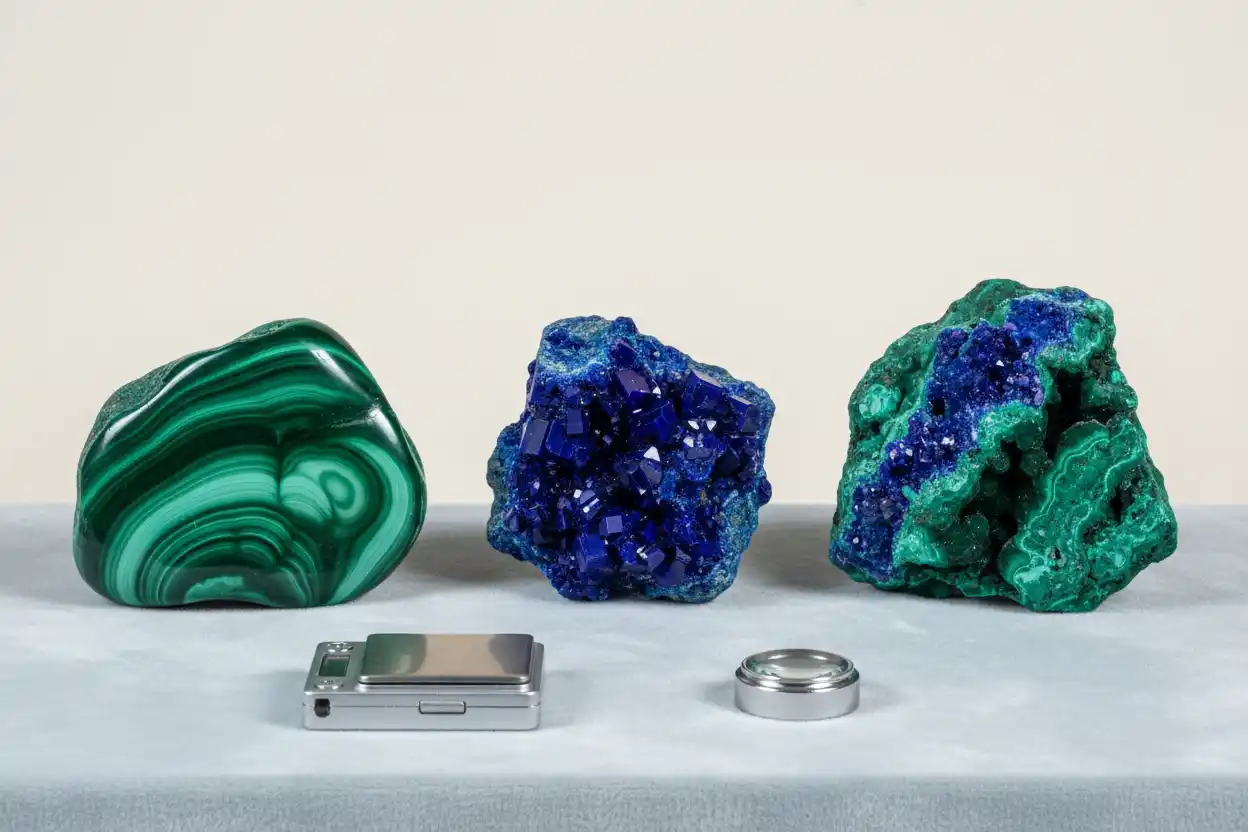
Malachite vs Azurite: Differences and Identification
Malachite and Azurite are closely related copper minerals that often form together in the oxidized portions of the same ore deposits. Their strong green and blue colors make them easy to separate in classic specimens, yet mixed material, altered crystals, compressed blocks and polished cabochons can complicate identification.
Malachite is a green copper carbonate hydroxide with the formula Cu₂(CO₃)(OH)₂. Azurite is a blue copper carbonate hydroxide with the formula Cu₃(CO₃)₂(OH)₂. Both crystallize in the monoclinic system and rank approximately 3.5–4 on the Mohs scale, but their crystal habits, optical properties, density and behavior in ornamental material differ.
The full Malachite guide owns Malachite’s geology, history and symbolism, while the Azurite guide covers the blue mineral independently. This page focuses on distinguishing them without duplicating those broader guides.
Malachite vs Azurite at a Glance
| Property | Malachite | Azurite |
|---|---|---|
| Chemical formula | Cu₂(CO₃)(OH)₂ | Cu₃(CO₃)₂(OH)₂ |
| Mineral class | Copper carbonate hydroxide | Copper carbonate hydroxide |
| Crystal system | Monoclinic | Monoclinic |
| Typical color | Bright, dark or blackish green | Pale to intense azure, royal or very dark blue |
| Streak | Pale green | Pale blue |
| Mohs hardness | 3.5–4 | 3.5–4 |
| Typical density | Near 4.0 | Near 3.77 |
| Transparency | Translucent in thin areas to opaque | Transparent to translucent; massive material may appear opaque |
| Common luster | Vitreous, silky, earthy or dull | Vitreous to subadamantine |
| Common habit | Banded, fibrous, botryoidal, mammillary and stalactitic | Crystalline, tabular, prismatic, rosette, botryoidal and massive |
| Common ornamental use | Cabochons, beads, inlay and carvings | Collector specimens, pigment and occasional cabochons |
| Main visual clue | Green banding and concentric growth | Intense blue crystals or massive blue areas |
| Main care concern | Scratching, chemicals and treatment stability | Brittleness, cleavage, scratching and alteration |
The Most Obvious Difference Is Color
Malachite is green. Its shades range from pale grass green through rich medium green to almost blackish green. Dense ornamental material often shows several shades arranged in straight, curved, cellular or concentric bands.
Azurite is blue. Fine crystals may display intense azure, royal blue, indigo or exceptionally dark blue that appears almost black until strong light reaches an edge.
Color is an excellent first observation when the specimen is untreated and contains one dominant mineral. It becomes less decisive when Malachite and Azurite occur together, when Azurite has partly altered to Malachite or when reconstructed material combines blue and green particles.
Dyed howlite, glass, resin and compressed copper-mineral products may also imitate either appearance. Consequently, color should begin the identification process rather than end it.
The broader Green Gemstones guide places Malachite among other green ornamental materials, while Blue Gemstones provides the equivalent context for Azurite.
Chemical Composition
Both minerals contain copper, carbonate and hydroxyl groups, but their proportions differ.
Malachite contains two copper atoms for each carbonate group in its simplified formula. Azurite contains three copper atoms and two carbonate groups.
That distinction changes their crystal structures and the way they interact with light. It also explains why they are separate minerals rather than blue and green varieties of one species.
The Copper guide explains the element’s relationship with Malachite, Azurite, cuprite, Chrysocolla and other copper minerals. Copper creates the intense color in both stones, but the exact structural environment determines whether the mineral appears green or blue.
Crystal Habit
Crystal habit is one of the strongest differences in natural specimens.
Malachite commonly forms as radiating fibers. These fibers create rounded botryoidal surfaces, mammillary masses, stalactites, silky crusts and concentric internal banding.
Large transparent Malachite crystals are uncommon. Most cut material comes from dense fibrous masses rather than individual crystals.
Azurite more readily forms recognizable crystals. They may be tabular, prismatic, wedge-shaped, lenticular or arranged in rosettes. Well-developed specimens can show sharp faces and a strong glassy luster.
Azurite can also occur as earthy, botryoidal, stalactitic or massive material, so a lack of visible crystals does not prove Malachite. Nevertheless, a cluster of sharply formed deep-blue crystals strongly favors Azurite.
Banding vs Crystalline Texture
Polished Malachite is famous for its internal bands.
The bands record successive layers of fibrous mineral growth. A cross-section through a rounded or stalactitic mass can produce bull’s-eye circles, while another cutting direction reveals waves, stripes or feathered designs.
Azurite generally does not produce the same extensive light-and-dark green-style banding. Massive material may show blue zoning, granular texture, veins or associations with other minerals.
A blue-and-green cabochon can be natural Azurite-Malachite. Its blue areas should not be described as blue Malachite, and the green sections are not merely color variation within Azurite.
The complete relationship with Chrysocolla, Cuprite and Calcite also matters because several minerals can coexist within one copper-deposit specimen.
Streak Color
Streak refers to the color of finely powdered mineral left on an unglazed porcelain plate.
Malachite produces a pale-green streak. Azurite produces a pale-blue streak.
This difference can support identification in expendable rough material. It should not be tested on polished gems, jewelry, carvings, historical objects or valuable mineral specimens because the process removes material and leaves a permanent damaged area.
A streak from a mixed specimen may vary according to which mineral contacts the plate. Coating, resin and contamination can also affect the result.
Professional or collector identification should prioritize non-destructive observations whenever possible.
Hardness Does Not Separate Them
Both minerals rank approximately 3.5–4 on the Mohs scale.
Therefore, a scratch test cannot reliably distinguish Malachite from Azurite. It will damage either mineral without producing a useful separation.
The Gemstone Hardness Chart places both below quartz, topaz, sapphire and diamond. Ordinary abrasive dust may dull their surfaces, while harder jewelry can scratch them directly.
The guide to Gemstone Toughness vs Hardness explains why equal hardness does not mean identical durability. Azurite’s brittleness and cleavage often make well-formed crystals especially fragile, while compact Malachite masses may be more cohesive but remain soft and chemically sensitive.
Density
Malachite is generally denser than Azurite.
Dense Malachite commonly has specific gravity close to 4.0, while Azurite is commonly near 3.77. The difference is measurable but too small for dependable identification by hand.
A large porous Malachite specimen may feel lighter than expected, while dense Azurite crystals can feel substantial. Matrix, resin, backing, trapped air and mixed minerals further complicate weight comparisons.
Hydrostatic weighing can provide useful supporting evidence for loose, untreated material. It should be interpreted with microscopy and other observations rather than used as the only test.
Transparency and Luster
Azurite can be transparent or translucent in fine crystal edges and small crystals. Its luster commonly appears vitreous to subadamantine, giving well-formed crystals a bright, glassy surface.
Malachite is usually opaque in ornamental material, although thin fibers and rare crystals can transmit light. Fibrous surfaces may have a silky luster, while compact polished stone can appear vitreous.
Earthy specimens of either mineral may look dull.
A transparent deep-blue crystal strongly supports Azurite, whereas a polished opaque green cabochon with fibrous banding strongly supports Malachite.
Refractive Properties
Both minerals have high refractive indices, but standard readings can be difficult because most jewelry material is opaque, curved or aggregate.
Malachite’s principal indices span a broad high range, while Azurite’s readings also sit well above the limits of many conventional gem refractometers.
The ranges overlap enough that an approximate over-the-limit reading does not provide a simple at-home distinction.
Advanced optical observations, Raman spectroscopy or X-ray diffraction offer stronger results when the material’s identity genuinely matters.
The Gemstone Certification guide explains when professional testing is proportionate to the item’s value.
How Azurite Changes Into Malachite
Azurite and Malachite form in oxidized copper deposits under related but not identical chemical conditions.
Changes in carbon dioxide activity, water chemistry and environmental stability can favor Malachite. As a result, Azurite may partly or completely alter into green Malachite.
The altered material can retain the original Azurite crystal shape. This creates a pseudomorph: Malachite has replaced the blue mineral while preserving part of its external form.
A specimen may therefore show blue Azurite cores surrounded by green Malachite, green rims around blue crystals or a mostly green crystal shape with small surviving blue areas.
This relationship is one reason the minerals occur together so frequently. It does not mean that all Malachite began as Azurite.
Azurite-Malachite and Mixed Material
Natural mixed material is commonly called Azurite-Malachite or azurmalachite.
The name describes an intergrowth rather than a separate mineral species. Each color should retain its own mineral identity.
Fine specimens may show sharp blue crystals on green botryoidal Malachite. Cut material may contain blue patches, green bands and pale matrix in one cabochon.
The visual combination can be attractive, but mixed material often contains fractures, pores and differences in hardness or texture. Stabilization with resin is therefore possible.
A seller should disclose whether the stone is naturally intergrown, compressed from mineral fragments or manufactured from resin.
Treatments and Compressed Material
Malachite may be waxed, resin-filled, coated, dyed or reconstructed. The full treatment boundary belongs to How to Spot Treated or Synthetic Malachite.
Azurite is less commonly used in conventional jewelry, yet porous or mixed material can also be impregnated, stabilized or compressed.
Commercial blocks have been made by compressing Azurite and Malachite fragments and then filling the material to improve cohesion. The finished product can contain genuine mineral while no longer representing one naturally solid piece.
Treatment does not automatically make a cabochon undesirable. The description and price should reflect its construction.
The Real vs Fake Malachite guide owns the broader Malachite imitation workflow. Buyers seeking blue specimens should also use Where to Buy Real Azurite rather than relying on color alone.
Malachite, Azurite and Sodalite
Massive Azurite may be confused with Sodalite, Lapis Lazuli, dyed howlite or blue glass.
The direct Sodalite vs Azurite guide owns that separate distinction.
Sodalite commonly has lower density, white calcite veining and no expected green Malachite alteration. Lapis Lazuli may contain pyrite and a multi-mineral granular texture.
Dark-blue color by itself cannot establish Azurite, especially in polished opaque beads.
Jewelry Suitability
Malachite is the more common jewelry material because dense banded masses can be cut into cabochons, beads and inlay.
Azurite crystals are generally too brittle and cleavage-prone for routine jewelry. Massive mixed material can be used in pendants or protected cabochons, but construction and stabilization require careful disclosure.
The Malachite Earrings guide and Malachite Necklace guide cover the safest common formats.
Both minerals should remain away from acids, ammonia, abrasive cleaners, heat, steam and ultrasonic vibration.
Confirmed Malachite should follow How to Clean Malachite Jewelry Safely. Collector Azurite should usually be dusted gently rather than washed aggressively.
Value and Buying Context
Malachite value depends heavily on banding, cutting, surface quality, natural solidity, treatment and workmanship. The Malachite Buying Guide and Malachite Price Guide own those questions.
Azurite value often centers on crystal form, luster, color, locality, associated minerals and specimen condition rather than wearable durability.
A sharp Azurite crystal cluster from a documented classic locality may be far more valuable than a large polished Malachite cabochon. Conversely, an exceptional bookmatched Malachite object may exceed ordinary earthy Azurite.
Comparing the minerals only by weight or color ignores their different collector and jewelry markets.
Safe Identification Process
Begin by documenting the color, streak-like surface markings, crystal form, banding, transparency, matrix and reverse.
Use magnification to look for Malachite fibers, Azurite crystal faces, resin, bubbles, repeated artificial patterns or compressed fragments.
Measure weight and dimensions if the specimen is loose. A professional may calculate density and use Raman spectroscopy or X-ray diffraction to identify each mineral phase.
The broader How to Identify Crystals guide explains why several independent observations should support the conclusion.
Do not use acid, scratching, flame, hot needles, bleach, acetone or household chemical tests. Copper carbonates and their treatments can be damaged permanently.
Frequently Asked Questions
1. Are Malachite and Azurite the same mineral?
No. They are related copper carbonate hydroxides with different chemical formulas, structures, colors and optical properties.
2. Why are Malachite and Azurite found together?
Both form as secondary minerals in oxidized copper deposits under related chemical conditions.
3. Can Azurite turn into Malachite?
Yes. Azurite can partly or completely alter into Malachite when environmental conditions favor the green mineral.
4. Is blue Malachite real?
Blue areas in mixed material are usually Azurite or another associated mineral rather than a blue variety of Malachite.
5. Is green Azurite possible?
Azurite itself is blue. Green areas generally indicate Malachite, another mineral or alteration.
6. Which mineral is harder?
Their hardness overlaps at approximately 3.5–4, so hardness cannot separate them reliably.
7. Which mineral is denser?
Malachite is generally denser, commonly near 4.0 compared with Azurite near 3.77.
8. Which one forms better crystals?
Azurite more commonly forms sharp visible crystals. Malachite is better known for fibrous, botryoidal and banded masses.
9. What is Azurite-Malachite?
It is a natural or commercial mixture containing both blue Azurite and green Malachite, not a separate mineral species.
10. Can either stone be reconstructed?
Yes. Fragments may be compressed or combined with resin, particularly in ornamental mixed material.
11. Can I use a scratch or acid test?
No. Those tests damage both minerals and may harm fillers, coatings or settings.
12. When is professional testing necessary?
Testing is useful for valuable specimens, historical objects, treatment disputes, unusual mixed material or unsupported locality claims.
Malachite and Azurite are best understood as geological partners rather than color variants. The green bands of Malachite and blue crystals of Azurite record closely related stages of copper-deposit weathering, while partial alteration can preserve both within one specimen. Their colors begin the identification, but crystal habit, streak, density, structure and mineral-phase testing provide the reliable separation.