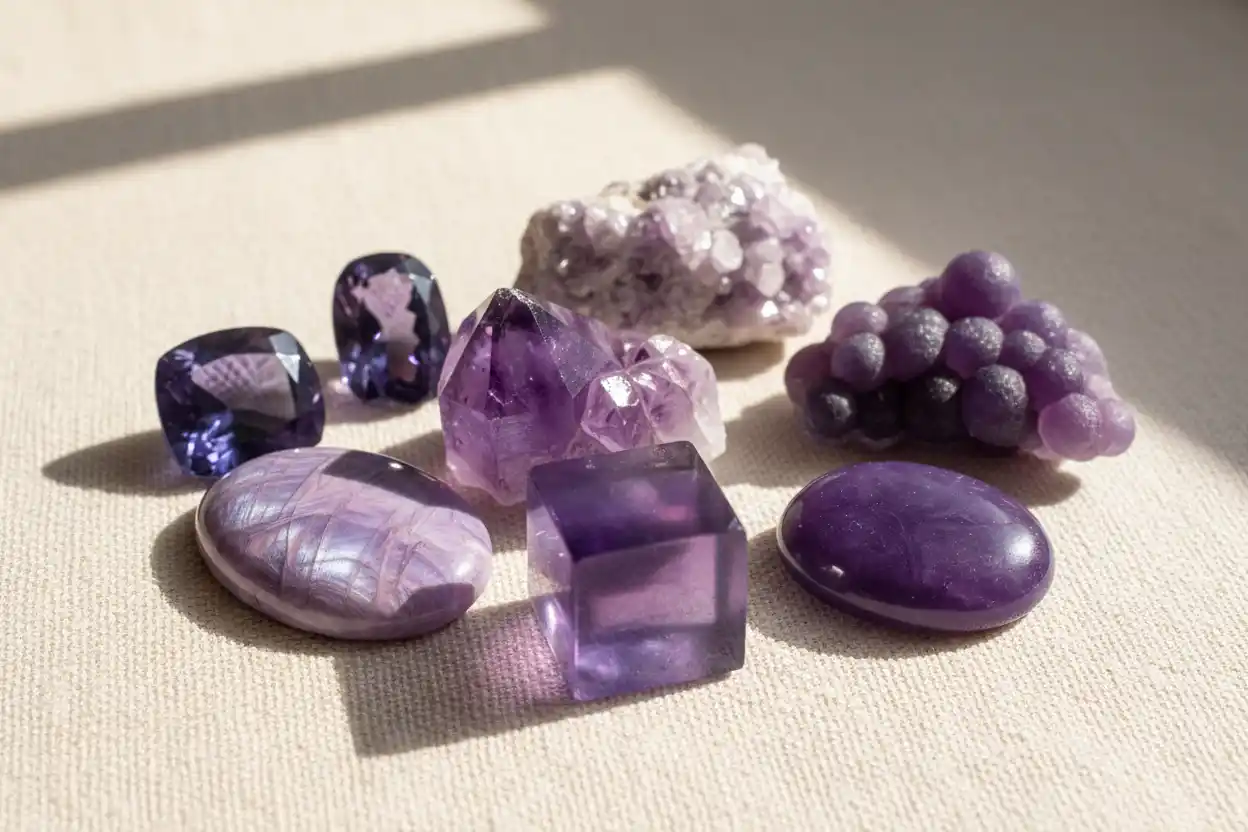
7 Best Purple Crystals: Powerful Meanings & Positive Everyday Uses
Purple crystals are traditionally associated with reflection, imagination, wisdom, creativity, intuition, perspective, and purposeful calm. The color range stretches from pale violet and lilac through grape purple, reddish violet, blue-violet, and almost black-purple, while the stones themselves differ dramatically in geology and durability.
Amethyst, charoite, sugilite, purple fluorite, lepidolite, iolite, and purple sapphire provide seven distinct interpretations of purple. Amethyst and sapphire can work well in frequently worn jewelry, while fluorite and lepidolite are better protected. Charoite and sugilite provide opaque patterned color, and iolite changes noticeably with viewing direction. Their symbolism can support personal reflection, creativity, or goal-setting when it is treated as a personal practice rather than a demonstrated therapeutic effect.
Amethyst for Reflection, Clear Priorities, and Deliberate Choices
Amethyst is the most recognizable purple crystal and belongs to the quartz family. Its colors range from pale violet to strongly saturated purple and purplish red, sometimes with visible zoning within one crystal. Quartz hardness of 7 makes amethyst practical for rings, pendants, earrings, beads, and decorative specimens.
Traditional amethyst healing properties commonly focus on reflection, restraint, mental clarity, and approaching decisions calmly. These associations can work particularly well when the stone is used as a physical reminder to slow down rather than react immediately.
A small amethyst beside a planner can represent reviewing priorities before committing to more work. A ring or pendant might symbolize a decision to maintain a particular habit. In meditation, a polished amethyst can simply provide a stable visual or tactile point of attention.
Amethyst is reasonably durable, but prolonged exposure to intense light can fade some stones. Abrupt temperature changes can also cause fracturing, and steam cleaning is best avoided. Warm soapy water is a straightforward cleaning method.
The appeal of amethyst comes partly from the fact that the stone works in both spiritual and geological settings. Even without symbolic use, crystal points, geodes, color zoning, and quartz growth structures provide substantial visual interest.
Charoite for Change, Creativity, and Accepting Uncertainty
Charoite is one of the most distinctive purple ornamental stones because it commonly displays swirling patterns of violet, lavender, white, black, and gray. Fibrous structures can produce a silky or flowing appearance across a polished surface, making each cabochon or palm stone visually individual.
Traditional charoite healing properties often emphasize adapting to change, creative problem-solving, courage, and continuing forward when a situation feels unfamiliar. Those ideas suit a stone whose patterns appear to move across the surface.
Charoite works especially well as a symbolic object during periods of transition. A palm stone can accompany journaling about what is changing, what remains under your control, and which next step is realistic. A pendant can carry the same meaning without requiring any claim that the stone itself changes circumstances.
Its durability is adequate for many jewelry uses, but charoite is not as resistant to abrasion as quartz or sapphire. Rings should receive more protection, particularly when the stone contains natural weak areas or prominent veining.
The strongest charoite pieces usually display appealing purple with lively fibrous patterns rather than dull gray-brown areas dominating the face. Treatment disclosure and accurate identification matter for expensive stones because unusual purple products can sometimes be confused in retail settings.
Sugilite for Individuality, Personal Boundaries, and Creative Identity
Sugilite ranges from pale lavender through violet, magenta, reddish purple, and deep grape tones. Fine examples can be strongly saturated, and some pieces show black, gray, or lighter purple areas within the stone.
The traditions associated with sugilite healing properties often focus on individuality, personal values, creative identity, and maintaining emotional boundaries. These themes make sugilite particularly suitable for people who want a stone to represent remaining authentic without becoming isolated from others.
A pendant or polished stone can be connected with a concrete behavior such as expressing a preference clearly, declining an unnecessary commitment, or setting aside regular time for creative work.
Sugilite jewelry should be handled with more care than sapphire or quartz. Quality can vary from relatively compact polished stone to pieces containing numerous veins or associated minerals, so physical condition matters when selecting rings or bracelets.
Its rarity and distinctive color also mean that convincing lookalikes deserve attention. Buyers paying a significant premium should choose sellers who can identify the stone clearly rather than relying only on an intense purple appearance.
Purple Fluorite for Organization, Study, and Seeing Structure in Complex Problems
Purple fluorite can range from delicate violet to deep purple and commonly occurs in cubes or octahedral forms. Color zoning is frequent, and some crystals combine purple with green, blue, yellow, or colorless areas.
Traditional purple fluorite healing properties commonly emphasize organization, learning, mental clarity, perspective, and breaking complex ideas into smaller parts. The stone’s geometric crystal forms make these themes visually fitting.
A fluorite cube on a study desk can serve as a reminder to organize one problem at a time. A polished stone can be used during planning sessions when the intention is to separate facts, assumptions, and possible actions.
Fluorite’s physical limitations are important. It ranks about 4 on the Mohs scale and has perfect cleavage, so it scratches and chips far more easily than amethyst or sapphire. A crystal specimen that appears solid can fracture after a relatively modest impact.
Protected display is often the best use. Pendants can work when worn carefully, but exposed everyday rings are much more vulnerable. Some fluorite colors can also fade after prolonged strong light exposure, so valuable specimens are better kept away from continuous direct sun.
Lepidolite for Gradual Transition, Patience, and Reflective Routines
Lepidolite is a lithium-bearing mica that often occurs in lilac, lavender, pink-purple, and gray-violet shades. Its layered structure can produce a pearly or sparkling appearance, particularly when small mica flakes catch the light.
Traditional lepidolite healing properties frequently emphasize patience, adjusting to change, emotional steadiness, and allowing transitions to happen gradually rather than forcing immediate resolution.
The symbolism works particularly well when tied to a routine. Lepidolite beside a journal can represent tracking slow progress, while a palm stone can be used during a quiet pause before deciding how to respond to a difficult situation.
Because mica splits readily along its layers, lepidolite is not an ideal hard-wearing ring stone. Carvings, palm stones, pendants, specimens, and protected beads are generally more practical.
Its lithium content sometimes leads to exaggerated wellness claims. The presence of an element within a mineral does not mean handling the stone delivers a therapeutic dose or produces the medical effects of a pharmaceutical compound containing that element.
Iolite for Perspective, Direction, and Flexible Thinking
Iolite commonly appears blue-violet, violet-blue, gray-blue, or purplish and is strongly pleochroic. This means one gem can display noticeably different colors depending on the direction from which it is viewed.
That optical property gives iolite an especially natural symbolic connection with perspective. Traditional iolite healing properties commonly include direction, self-awareness, examining several viewpoints, and navigating uncertainty.
A faceted iolite can be rotated during reflection to make the idea literal: the object remains the same while the visible color changes according to viewpoint. This can become a simple reminder that an unfamiliar problem may look different after gathering more information.
Iolite offers better jewelry durability than fluorite or lepidolite, but it still requires protection from strong blows because cleavage can create weaknesses. Pendants, earrings, and carefully worn rings are all possible.
Cutting also affects its appearance because the cutter must orient the rough to display the most desirable blue-violet color rather than a dull gray or near-colorless direction.
Purple Sapphire for Commitment, Wisdom, and Durable Everyday Symbolism
Purple sapphire is purple corundum and can range from reddish violet to bluish violet, lavender, and strongly saturated royal purple. Sapphire ranks 9 on the Mohs scale, has excellent toughness, and lacks cleavage, making it far more durable for daily jewelry than most other purple stones.
Traditional sapphire healing properties often emphasize wisdom, sincerity, loyalty, discipline, and long-term commitment. Purple sapphire adds a reflective or creative color association while retaining the durability expected from corundum.
This makes it particularly suitable for meaningful jewelry intended to be worn often. An engagement ring, anniversary piece, or personal ring can carry symbolism related to a promise, long-term goal, or personal principle while remaining physically suited to frequent use.
Natural sapphire can be heat treated, and treatment disclosure matters when value is significant. Laboratory-grown sapphire also exists and has the same essential crystal structure and chemistry as natural sapphire, but geological origin changes rarity and market value.
For a buyer focused primarily on symbolism, either natural or laboratory-grown sapphire can serve as a personal object. For a high-value purchase, identity and treatment status should be understood clearly.
Purple Crystal Meanings: Reflection, Creativity, and Perspective Without Fixed Rules
Purple has long been associated with status, ceremony, imagination, contemplation, and unusual visual richness. Modern crystal traditions add themes of intuition, wisdom, creativity, and inner reflection, which helps explain why very different purple stones often receive overlapping meanings.
Each stone can still represent something more specific. Amethyst suits deliberate reflection, charoite adaptation, sugilite individuality, fluorite organization, lepidolite patience, iolite perspective, and sapphire commitment.
The traditions around crystals for intuition become most useful when intuition is understood as reflective judgment rather than supernatural certainty. A stone can encourage you to pause, gather information, notice your reactions, and consider previous experience before making a choice.
Purple crystals can also be connected with creative routines. A charoite or sugilite stone beside art supplies can represent protecting creative time, while fluorite on a desk can symbolize organizing a complicated project before starting.
Purple Crystal Jewelry Requires Different Care Across the Seven Stones
Purple sapphire provides the highest resistance to scratching and is the easiest choice for frequent ring wear. Amethyst is also practical because quartz ranks 7 on the Mohs scale, although it should still be protected from harder gems and extreme heat.
Iolite can work in regular jewelry with sensible protection. Charoite and sugilite are better suited to somewhat gentler use, especially when natural veining creates weak areas.
Fluorite and lepidolite need the most protection. Fluorite scratches easily and has perfect cleavage, while lepidolite’s mica structure separates readily along layers. Both are safer as protected pendants, display pieces, palm stones, or occasional-wear items than heavily exposed rings.
The crystal hardness chart helps explain why stones that share nearly identical purple colors can behave very differently during wear.
Store soft specimens separately from sapphire, quartz, and other harder gems. Gentle cleaning also reduces unnecessary risk when the exact treatment or structural condition of a stone is uncertain.
Simple Everyday Uses for Purple Crystals
A purple crystal can be incorporated into daily life without complex rules. Amethyst beside a planner can represent deliberate priorities. Fluorite near study notes can symbolize organization, while charoite can accompany a journal during a period of change.
Jewelry offers another straightforward approach. Purple sapphire can represent a lasting commitment, sugilite individuality, and iolite willingness to consider another perspective.
Meditation can remain focused on the sensory experience of the stone. Notice its weight, temperature, shape, color changes, or surface pattern while returning attention to breathing. The object supports the routine as a cue rather than acting as a treatment.
Avoid using stones as replacements for professional medical or mental health care. Purple color and personal symbolism can support meaningful reflective habits without requiring claims that go beyond available evidence.
Conclusion
Purple crystals combine rich color with traditions centered on reflection, creativity, wisdom, perspective, patience, and commitment. Amethyst, charoite, sugilite, purple fluorite, lepidolite, iolite, and purple sapphire each provide a distinct combination of appearance, durability, and symbolism. Choosing well means matching the stone to a specific personal purpose while respecting the hardness, cleavage, stability, and care requirements that determine how it should be worn or handled.
FAQs
What do purple crystals traditionally symbolize?
Purple crystals are commonly associated with reflection, imagination, wisdom, intuition, creativity, perspective, and purposeful calm.
Which purple crystal is most durable?
Purple sapphire is the most durable choice in this group, with Mohs hardness 9, excellent toughness, and no cleavage.
Is amethyst suitable for everyday jewelry?
Yes. Amethyst has Mohs hardness 7 and good toughness, making it practical for many jewelry styles with normal care.
Why does iolite change color when rotated?
Iolite is strongly pleochroic, meaning it can display different colors when viewed from different crystal directions.
Is purple fluorite suitable for a daily ring?
It is not ideal. Fluorite is relatively soft and has perfect cleavage, making it vulnerable to scratches, chips, and fractures.
Does lepidolite contain lithium?
Yes. Lepidolite is a lithium-bearing mica, but handling the stone does not provide a therapeutic lithium dose.
Is purple sapphire always natural?
Natural purple sapphire exists, but laboratory-grown sapphire is also available. Identification matters when geological origin affects the purchase.
Which purple crystal is commonly associated with change?
Charoite and lepidolite are frequently connected with transition and adaptability traditions, while iolite is often associated with perspective and direction.
Can purple crystals improve intuition or mental health?
They can serve as personal prompts within reflective routines, but they do not provide established medical or psychological treatment.
Crystal meanings and wellness associations are traditional or personal practices, not established medical treatments.