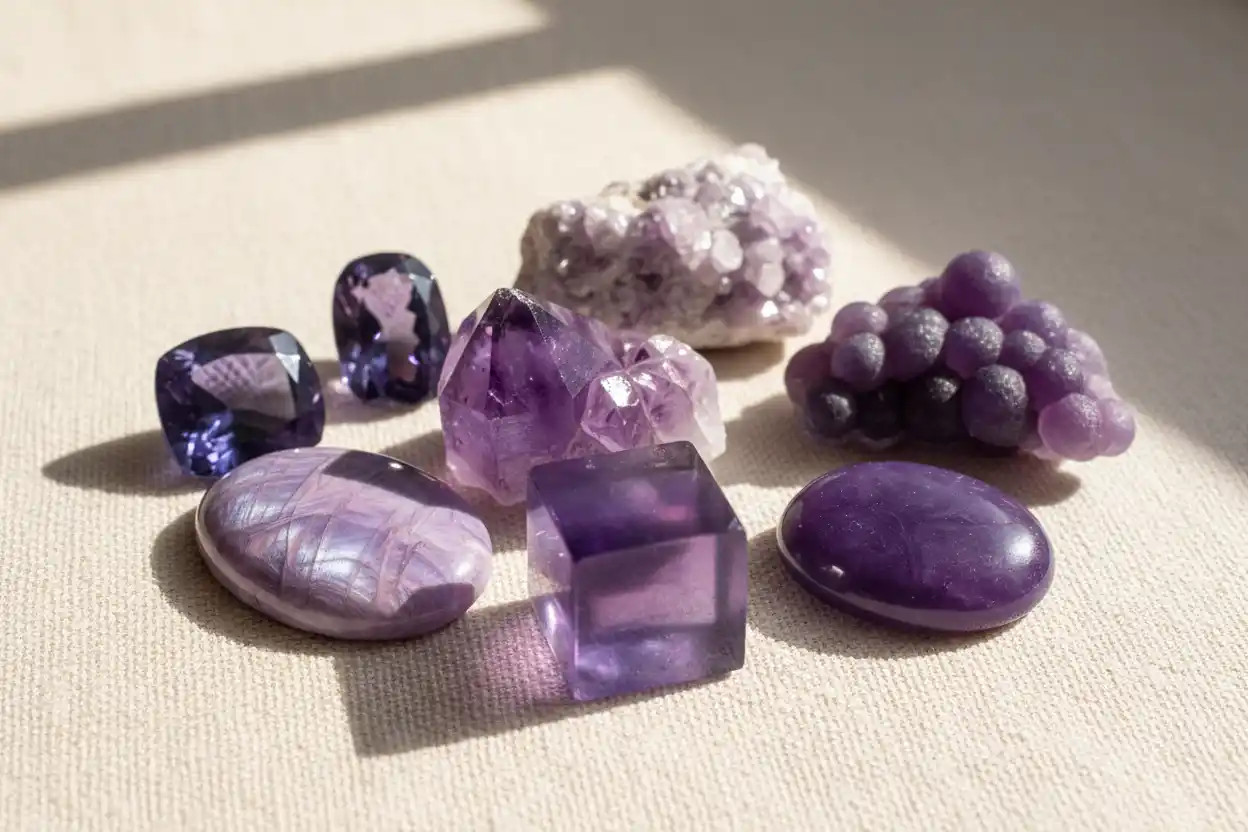
Purple Crystals: Meanings, Uses and Complete List
Purple crystals include transparent quartz, soft cubic fluorite, fibrous ornamental stones, lithium-bearing mica and rare faceted gems. Their shared color does not make them one mineral family, nor does it give them identical care requirements or scientifically proven energetic effects.
Across historical symbolism and contemporary crystal practice, purple is commonly associated with reflection, imagination, spiritual inquiry, dignity and the ability to step back from immediate reactions. A stone can serve as a meaningful meditation focus or reminder of an intention, but it does not diagnose illness, awaken psychic abilities or guarantee spiritual insight.
This guide focuses on purple crystals as objects used in belief-based practices, meditation and collections. Readers comparing mineral identity, hardness, treatments and jewelry suitability should use the separate purple gemstones guide. Those selecting a durable center stone should use purple gemstones for engagement rings.
Purple Crystals at a Glance
| Purple crystal | Typical appearance | Common symbolic association | Important physical concern |
|---|---|---|---|
| Amethyst | Transparent pale lilac to deep purple quartz | Clarity, restraint and reflection | Prolonged intense light and high heat |
| Purple fluorite | Transparent or translucent purple cubes and octahedra | Focus, organization and discernment | Very soft with perfect cleavage |
| Charoite | Swirling lilac, violet and black fibrous patterns | Transformation and accepting change | Ornamental material with cleavage |
| Sugilite | Opaque violet, purple and magenta | Compassion and emotional boundaries | Variable composition and imitation risk |
| Lepidolite | Lilac, pink-purple or silvery mica flakes | Transition, rest and letting go | Very soft and easily split |
| Iolite | Transparent violet-blue to gray-blue crystal | Direction, self-trust and perspective | Cleavage and impact sensitivity |
| Tanzanite | Transparent blue-violet or violet-blue zoisite | Transition and deliberate communication | Softer, cleavage-sensitive ring stone |
| Kunzite | Pale pink-violet spodumene | Receptivity and gentle affection | Cleavage and possible light fading |
| Grape agate | Purple botryoidal chalcedony-like aggregates | Community and gradual progress | Rounded aggregates can chip |
| Hackmanite | Pale violet to deep purple, sometimes color-changing | Adaptability and hidden potential | Photochromic behavior varies |
| Purpurite | Matte violet to reddish-purple masses | Confidence and independent action | Soft, brittle surface material |
| Ametrine | Purple and yellow quartz zoning | Balancing reflection with action | Heat and prolonged intense light |
| Purple sapphire | Transparent violet to purple corundum | Loyalty and disciplined purpose | Treatment disclosure |
| Purple spinel | Transparent lilac to intense violet spinel | Renewal and vitality | Natural versus synthetic identity |
| Purple scapolite | Transparent lavender to violet | Purpose and long-term direction | Cleavage and limited availability |
The meanings in this table are traditional or contemporary interpretations rather than measurable properties of the minerals.
Why Purple Crystals Share Similar Meanings
Purple sits visually between the warmth of red and the coolness of blue. Cultural traditions have connected it with ceremony, status, contemplation and spiritual authority, partly because strong purple dyes and pigments were historically difficult to produce.
Modern crystal practices translate those associations into themes of meditation, intuition and inner awareness. However, the materials themselves remain chemically unrelated. Amethyst is quartz, fluorite is calcium fluoride, lepidolite is a lithium-rich mica, and iolite is cordierite.
Consequently, a purple color can help organize a symbolic collection, but it should not replace correct mineral identification. Each stone needs its own expectations for water, sunlight, impact and jewelry wear.
Amethyst
Amethyst is the best-known purple crystal. It is the purple variety of quartz and occurs in geodes, crystal points, clusters, banded material and transparent faceting rough.
Contemporary practices associate amethyst with reflective judgment, calm attention and maintaining perspective when emotions or impulses feel strong. A grounded intention might involve waiting before making an expensive purchase, reviewing facts before responding or creating a regular meditation routine.
Its symbolism has historical connections with restraint and sobriety, but amethyst does not prevent intoxication or treat addiction. The stone can support a reminder, while meaningful change depends on behavior and appropriate professional help.
Some amethyst can fade after prolonged exposure to intense light. Display specimens away from strong direct sunlight, and do not use high-heat rituals.
Purple Fluorite
Purple fluorite commonly forms cubes, octahedra, interpenetrating twins, stepped crystals and color-zoned masses. Purple may occur alone or alongside green, blue and colorless bands.
Its orderly crystal forms have encouraged symbolic associations with organization, discernment and arranging complex information into a usable structure. Students and professionals sometimes place it near a workspace as a reminder to separate evidence from distraction.
Fluorite is physically delicate. Its hardness is only 4, and it has perfect cleavage. A point, cube or octahedron can split or chip from a fall that would leave quartz undamaged.
Water, rough brushing and temperature changes are unnecessary for symbolic cleansing. Keep fluorite on a stable surface rather than in a pocket with keys or harder stones.
Charoite
Charoite is an ornamental mineral known for swirling lilac, violet, black and white patterns. Its fibrous structures can produce areas of silky movement when polished.
The mineral is associated with the Murun massif in Russia, and its limited geological occurrence helps distinguish it from generic dyed purple rock.
Contemporary symbolism connects charoite with accepting change, integrating unfamiliar experiences and acting despite uncertainty. A practical use might involve writing down which parts of a transition can be controlled and which must be observed before a decision is possible.
Charoite should not be mistaken for sugilite, dyed howlite or purple glass. Pattern alone may suggest identity, but important pieces deserve informed examination.
Sugilite
Sugilite can appear lavender, violet, magenta, reddish purple or nearly black. Much jewelry-grade material is opaque and may occur with manganese-rich matrix minerals.
Modern crystal traditions associate sugilite with compassion, emotional protection and maintaining empathy without absorbing every problem around the wearer.
A grounded interpretation focuses on boundaries. Caring about another person does not require solving every consequence of their choices or tolerating repeated harmful behavior.
Sugilite can be imitated by dyed stones, composites and manufactured materials. Vivid uniform purple at an unusually low price should prompt careful seller questions.
Lepidolite
Lepidolite is a lithium-bearing mica that commonly appears lilac, pink-purple, gray-purple or silvery.
Its layered structure allows it to split into thin sheets. That softness and cleavage make it better suited to specimens, carvings and protected pieces than to hard-wearing jewelry.
Because it often occurs in lithium-rich pegmatites alongside quartz, feldspar and tourmaline, lepidolite has a visually complex geological context.
Crystal practitioners associate it with transitions, rest and releasing routines that have become unhelpful. The lithium present in the mineral does not make holding lepidolite equivalent to taking a pharmaceutical lithium compound.
Iolite
Iolite is the transparent gem variety of cordierite. It can display violet-blue, blue, gray and nearly colorless appearances from different directions because of strong pleochroism.
That directional color has inspired symbolism involving navigation, perspective and seeing a problem from more than one angle.
A practical iolite intention might involve listing the same situation from the viewpoints of several people before responding. The gemstone does not reveal hidden facts, but it can represent a commitment to broader perspective.
Iolite is harder than fluorite or lepidolite, yet its cleavage makes it vulnerable to sharp blows. Treat loose crystals and faceted stones carefully.
Tanzanite
Tanzanite is the blue-to-violet gem variety of zoisite associated with a restricted mining area in Tanzania.
It is strongly pleochroic, and cutters orient the rough to emphasize blue, violet or a mixture. Most market material has been heated to develop the familiar blue-violet appearance.
Modern symbolism associates tanzanite with major transitions, thoughtful speech and translating insight into understandable language.
Because the stone is less robust than sapphire or spinel, it is better suited to protected jewelry and deliberate handling. Its scarcity and treatment history are gemological issues, not evidence of stronger metaphysical power.
Kunzite
Kunzite is pink-to-violet spodumene. It may show a delicate lilac or violetish-pink color that is strongest along selected crystal directions.
Contemporary practices connect it with receptivity, affection and allowing emotion without surrendering discernment.
Kunzite has perfect cleavage and poor toughness. In addition, its color may fade after prolonged intense light exposure. It should not be kept permanently in a sunny window or used in outdoor charging rituals.
Its softness of appearance should not be confused with physical resilience.
Grape Agate
Grape agate is a trade name for botryoidal purple aggregates commonly composed of chalcedony.
The rounded clusters resemble bunches of grapes, although each sphere develops through mineral growth rather than biological formation.
Symbolically, the grouped forms are associated with community, cooperation and progress created by many small actions. A grounded intention might involve contributing one consistent task to a shared project.
The rounded surfaces can chip if dropped, and the trade name does not mean the material is conventional banded agate.
Hackmanite
Hackmanite is a variety of sodalite known in some specimens for reversible photochromism, often called tenebrescence. The color may deepen after ultraviolet exposure and fade gradually under other lighting.
This unusual behavior has encouraged symbolism involving adaptability, hidden qualities and responding to changing conditions.
Not every specimen shows dramatic color change, and repeated high-intensity exposure is unnecessary. The stone’s scientific optical response should not be converted into claims that it reveals secrets or predicts future events.
Purpurite
Purpurite is a manganese phosphate mineral recognized by violet, purple or reddish-purple surfaces.
Its exterior can be earthy, matte or powdery rather than glassy. Some specimens owe their best color to weathered surfaces, so aggressive polishing may remove the appearance buyers expect.
Modern symbolism connects purpurite with independent action, speaking directly and rejecting unnecessary social pressure.
Because it is soft and brittle, it works better as a display specimen than as an everyday pocket stone.
Ametrine
Ametrine combines purple amethyst and yellow citrine color zones within one quartz crystal.
Its two-color appearance encourages symbolic associations with balancing reflection and action. Purple may represent consideration, while yellow represents implementation.
A practical practice can involve dividing a page into “what requires more thought” and “what can be acted on now.”
Ametrine remains quartz rather than a fused combination of two separate crystals. Strong color boundaries and cutting orientation affect its appearance.
Purple Crystals and the Crown Chakra
Purple and violet stones are often assigned to the crown chakra in modern crystal systems. Within that framework, they may symbolize spiritual inquiry, perspective and a sense of connection beyond immediate concerns.
The broader crown chakra crystals guide compares purple, violet, white and colorless stones associated with this symbolic center.
Chakras are spiritual concepts, not anatomical structures. Headaches, neurological symptoms and confusion should not be diagnosed as chakra blockages.
Purple Crystals and the Third Eye Chakra
Dark blue-purple and indigo stones are frequently linked with the third eye chakra, whose contemporary themes include insight, imagination and discernment.
The third eye chakra crystals guide owns the complete stone roundup.
A grounded practice should distinguish intuition from certainty. A feeling may signal that something deserves attention, but decisions still benefit from evidence and qualified advice.
Purple Crystals for Intuition and Meditation
Purple stones appear frequently in the crystals for intuition guide and crystals for meditation guide.
For meditation, choose a stable specimen that can be placed safely rather than held in an uncomfortable position. Notice its color, texture and structure, then return attention to breathing.
After the session, translate any useful reflection into one practical action. The crystal serves as an anchor for attention rather than a source of guaranteed messages.
How to Cleanse Purple Crystals Safely
The general crystal-cleansing guide describes symbolic methods, but purple minerals vary too widely for one physical method to fit all of them.
Amethyst and quartz tolerate gentle water cleaning better than lepidolite, fluorite or porous ornamental materials. Kunzite and some amethyst require caution around prolonged intense light.
Consult the sunlight-sensitive crystal guide and crystal water-safety guide before using environmental rituals.
Sound, quiet reflection and placement on a clean dry cloth avoid many material risks.
Combining Purple Crystals
Purple crystals can be combined symbolically when their intentions remain clear. Amethyst and fluorite may represent reflection with organization, while charoite and lepidolite may symbolize transition with rest.
The crystals-not-to-combine guide explains that many warnings concern conflicting goals or physical hardness rather than proven energetic danger.
Store soft stones separately even when they are used together. Quartz can scratch fluorite, lepidolite and softer ornamental materials.
Choosing a Purple Crystal
Begin with mineral identity and intended use. A display specimen, pocket stone, meditation object and ring center require different physical properties.
Next, choose a symbolic theme that can be translated into behavior. “This stone will make me psychic” creates an untestable promise. “I will pause and check evidence before trusting an assumption” creates a usable intention.
The healing-crystals beginner’s guide provides a broader framework for using crystals without replacing medical, psychological or practical support.
Frequently Asked Questions
1. What do purple crystals symbolize?
They are commonly associated with reflection, intuition, imagination, spiritual inquiry, dignity and mental perspective.
2. What is the most common purple crystal?
Amethyst is the most widely recognized and commercially available natural purple crystal.
3. Which purple crystal is best for meditation?
Amethyst is a practical choice because it is widely available and physically more durable than fluorite, lepidolite or purpurite. Personal comfort remains more important than a universal ranking.
4. Which purple crystal is associated with intuition?
Amethyst, iolite, fluorite and labradorite-related traditions are often used for intuition symbolism. None has been proven to create psychic ability.
5. Are purple crystals connected to the crown chakra?
Many modern systems connect violet and purple stones with the crown chakra, though these assignments vary by tradition.
6. Can purple crystals help with anxiety?
No crystal has been scientifically proven to treat anxiety. A stone may accompany breathing, journaling or another coping strategy but should not replace qualified care.
7. Can purple crystals go in water?
Some tolerate brief contact, while fluorite, lepidolite, porous materials and unknown treated stones may be damaged. Identify the mineral first.
8. Do purple crystals fade in sunlight?
Some can. Kunzite and certain amethyst colors are particularly relevant, while dyed or irradiated materials may behave differently.
9. Can I combine amethyst and purple fluorite?
Yes, symbolically. Store them separately because quartz is harder and can scratch fluorite.
10. Is charoite the same as sugilite?
No. They are distinct minerals with different structures, patterns, localities and gemological properties.
11. Is lepidolite safe to use as a pocket stone?
It is soft and splits easily, so a polished piece may deteriorate when carried with coins, keys or harder crystals.
12. Do darker purple crystals have stronger energy?
There is no scientific evidence that saturation determines spiritual strength. Darker color may affect rarity or appearance, depending on the mineral.
Purple crystals offer a useful lesson in separating color from identity. A cubic fluorite, fibrous charoite, mica-rich lepidolite and transparent amethyst can support similar symbolic themes while behaving very differently in the hand, in water and in sunlight. Choose the mineral with enough knowledge to protect it, then connect its meaning with an action you can actually practice.
Purple crystal meanings, chakra assignments and healing claims belong to cultural, spiritual or contemporary belief systems. Crystals do not diagnose, prevent or cure medical or mental-health conditions and should not replace professional care.