Where to Buy Real Rainbow Fluorite and Avoid Colored Glass
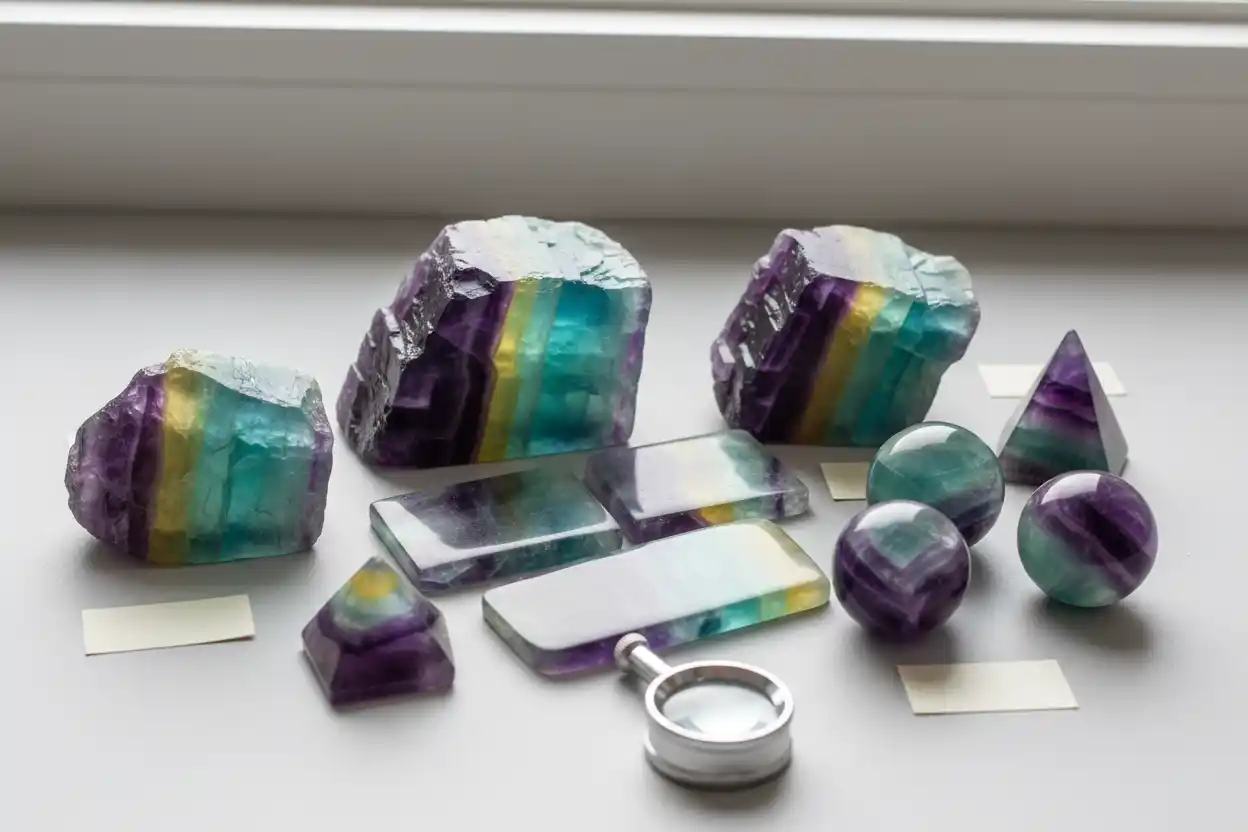
Real Rainbow Fluorite contains two or more prominent natural colors, commonly purple, green, blue, yellow and colorless zones. Its bands may form nested cubic layers, broad stripes, phantoms, clouds or flowing patterns revealed after cutting and polishing.
The name is commercial rather than mineralogical. A stone does not need every visible-spectrum color to qualify. In practice, purple-and-green material with clear zoning dominates the retail market.
Natural Rainbow Fluorite can look surprisingly artificial because its colors may be vivid, sharply separated and arranged in regular geometric layers. Nevertheless, buyers may also encounter colored glass, laminated resin, dyed fractures, reconstructed carvings, coated material and heavily edited photographs.
The Rainbow Fluorite meaning and properties guide covers identity and traditional symbolism. This buying guide focuses on multicolor zoning, cutting orientation, treatment, sellers, lookalikes, durability and value without duplicating the general Fluorite buying guide.
Rainbow Fluorite Is Naturally Zoned Fluorite
Fluorite is calcium fluoride, CaF2, and crystallizes in the cubic system.
Its wide range of colors can reflect structural defects, radiation history, trace components and rare-earth-related optical centers. Changes in growth conditions can cause one zone to differ from the next.
The types of Fluorite guide organizes the main colors and habits. The Fluorite color guide explains color terminology without replacing treatment analysis.
Within one crystal, color may follow successive cube faces. A cross-section can therefore display nested squares or angular bands.
Massive material may show broader, less geometric stripes because the cut passes through several intergrown crystals or growth zones.
Rainbow Does Not Mean Seven Colors
Commercial Rainbow Fluorite may contain only purple, green and clear zones.
Other combinations include:
- Purple and blue
- Purple and yellow
- Green and blue
- Green, purple and yellow
- Clear, green and purple
- Blue-green, purple and white
- Yellow, green and violet
A stone containing one small secondary band may still be sold as a dominant-color Fluorite rather than Rainbow Fluorite.
The name is most useful when multiple colors contribute clearly to the object’s visual identity.
Choose the Product Form Before Shopping
| Rainbow Fluorite product | Best source | Main buying concern |
|---|---|---|
| Zoned crystal specimen | Specialist mineral dealer | Natural growth zoning, cleavage and repairs |
| Matrix cluster | Fine-mineral dealer | Glued crystals, reconstruction and locality |
| Banded rough | Lapidary supplier | Color depth, cleavage and usable pattern |
| Slab | Experienced lapidary dealer | Band orientation, filler and treatment |
| Sphere | Specialist carving retailer | Full pattern coverage, glass and hidden fractures |
| Tower or freeform | Stone seller with exact-item video | Repaired tip, color editing and resin |
| Carving | Skilled lapidary seller | Weak projections, assembly and coating |
| Cabochon | Independent cutter | Pattern placement, backing and durability |
| Bead strand | Established supplier | Dyed fractures, glass and drill-hole failure |
| Faceted collector gem | Rare-gem dealer | Color orientation, cleavage and identity |
| Jewelry | Jeweler familiar with Fluorite | Protected setting and realistic wear advice |
For rough, pattern depth matters most. For a sphere or carving, the entire rotation matters because the best bands may occupy only one side.
Where to Buy Genuine Rainbow Fluorite
Specialist mineral dealers
Natural zoned cubes, phantoms and clusters are best purchased from mineral dealers.
Request dimensions, weight, locality, condition, associated minerals and repair history.
Ask for photographs from every direction. A front view may show dramatic purple-green zoning while the reverse reveals cleavage, glue or an incomplete crystal.
Natural color bands should relate plausibly to crystal growth rather than cross the object as a flat surface print.
Lapidary suppliers
Request dry images of rough and slabs.
Water and oil deepen colors, improve apparent transparency and hide scratches. Therefore, dry views are necessary for judging condition and true saturation.
Ask whether the same parcel has produced successful spheres or carvings. Fluorite’s cleavage can divide a colorful block before the intended object is completed.
Determine whether bands continue through the material or exist only near a surface.
Gem and mineral shows
Shows allow comparison with colored glass, Amethyst, Rainbow Moonstone, Rainbow Obsidian and laminated resin.
Rotate the piece under neutral light. Natural zoning should remain inside the stone and change in apparent width as the viewing angle changes.
Use a loupe to inspect cleavage, dye concentrations, coatings and assembly seams.
Do not scratch the material. Fluorite is too soft and fragile for destructive retail tests.
Established online sellers
The online gemstone buying guide explains seller identity, payment protection and return policies.
Request a continuous neutral-light rotation rather than several isolated glamour images.
Ask whether the seller changed saturation, white balance or contrast. Purple and green are particularly easy to exaggerate digitally.
A white background shows color accurately, while a black background reveals transparency and fractures. Both are useful.
Independent cutters
A cutter may understand which orientation produced the strongest bands.
Ask to see the slab or rough before cutting when purchasing a premium cabochon.
Request disclosure of resin, oil, backing and repaired fractures.
What Genuine Rainbow Fluorite Looks Like
Natural Rainbow Fluorite can be transparent, translucent or opaque.
Color zones may be sharply defined or diffuse. Some are only a few millimeters wide, while others occupy most of a sphere or slab.
Nested cubic zones commonly form angular purple, green and clear bands. Massive material can display straighter stripes, curved transitions or irregular clouds.
White-looking areas may be colorless Fluorite made cloudy by inclusions and fractures rather than a separate mineral.
The luster is vitreous. Flat internal cleavage reflections are common.
Natural zoning should have depth. A band seen at the front should shift or change shape as the stone turns.
Rainbow Fluorite Versus Purple Fluorite
Purple Fluorite is dominated by lavender, violet or blue-purple color.
Rainbow Fluorite contains enough contrasting green, blue, yellow or clear zoning to create a distinctly multicolored appearance.
The completed guide to buying Purple Fluorite owns Amethyst confusion, violet-color treatment and purple-specific quality.
A sphere with one thin green line may remain more accurately described as Purple Fluorite with green zoning.
Rainbow Fluorite Versus Green Fluorite
Green Fluorite is dominated by mint, grass green, emerald-like or blue-green coloration.
The completed guide to buying real Green Fluorite covers Prehnite, Green Calcite, Prasiolite and green-glass confusion.
When purple and green areas contribute equally, Rainbow Fluorite becomes the more useful commercial name.
Rainbow Fluorite Versus Yellow Fluorite
Yellow Fluorite ranges from pale lemon to golden and brownish yellow.
Yellow zones can add strong contrast to purple and green bands.
A mostly yellow crystal with one purple edge should remain in the Yellow Fluorite market, while a multi-band carving may qualify as Rainbow Fluorite.
Rainbow Fluorite Versus Amethyst
Amethyst is purple quartz and can contain white bands, particularly in Chevron Amethyst.
Fluorite is softer, cleavable and cubic. Its purple-green zoning is also inconsistent with ordinary Amethyst.
The dedicated Fluorite versus Amethyst guide provides the complete comparison.
A multicolored sphere should not be identified solely through band color because glass, quartz and Fluorite can all be carved into similar forms.
Rainbow Fluorite Versus Rainbow Moonstone
Rainbow Moonstone is generally a white-to-colorless Labradorite that displays blue or multicolored labradorescence.
Its rainbow effect moves as light reflects through feldspar layers. It is not composed of fixed purple and green body-color bands.
The future Rainbow Moonstone buying guide owns glass, coating, feldspar identity and optical quality.
Rainbow Fluorite’s colors remain in fixed zones even though their brightness changes with lighting.
Rainbow Fluorite Versus Rainbow Obsidian
Rainbow Obsidian is volcanic glass with directional internal iridescence.
Its body is usually dark, and spectral bands appear only at favorable angles.
Fluorite commonly has a lighter transparent-to-translucent body with permanently visible color zones.
The future Rainbow Obsidian buying guide owns cutting orientation, coatings and natural-glass provenance.
Rainbow Fluorite Versus Multicolored Glass
Manufactured glass can contain colored layers, swirls and sharp boundaries.
Round bubbles, flow lines, mold seams and conchoidal chips support glass. However, bubble-free glass remains possible.
Natural Fluorite should show octahedral cleavage, cubic growth relationships and the correct refractive properties.
A laminated glass object may show perfectly flat color layers and straight adhesive seams.
The fake-crystal buyer’s guide provides wider glass and composite checks.
Natural Zoning Versus Dye
Dye can enter pale Fluorite along fractures, cleavage and cavities.
Artificial color may produce purple, green, blue or pink lines that follow cracks rather than growth faces.
Natural color bands commonly relate to cubic geometry and continue through unbroken crystal.
However, natural mineral staining can also follow fractures, so one colored crack is not conclusive.
Inspect several layers under magnification and request treatment disclosure.
Irradiation and Multicolor Treatment
Radiation can create or alter Fluorite color centers. Heat and light can also change some colors.
Artificial irradiation applied uniformly may affect different pre-existing zones differently, but treatment history can be difficult to reconstruct.
A laboratory may confirm Fluorite and characterize its color centers without proving that every zone developed naturally.
Sellers should disclose known irradiation or heat treatment rather than relying on the assumption that multicolor zoning cannot be altered.
“Candy” and Heat-Altered Fluorite
Some commercial Fluorite is intentionally heated or exposed to strong light to modify purple and green colors toward pink, orange, pale yellow or nearly colorless tones.
These products may be marketed under decorative names such as candy-colored Fluorite.
The base mineral can remain genuine, but the altered appearance should not be represented as rare untreated Rainbow Fluorite.
Ask whether the dealer or upstream supplier intentionally changed the color.
Coatings and Metallic Films
A clear coating may enhance polish, while colored films can add blue, purple or iridescent effects.
Inspect high points, scratches, drill holes and the reverse for peeling or color loss.
Natural zoning lies inside the Fluorite. A surface film follows the outer polish.
Aura-style metallic coating should always be disclosed.
Resin, Filling and Reconstructed Objects
Large spheres and carvings may contain resin-filled cleavage cracks.
Separate pieces can also be joined to create a thicker banded object.
Inspect the full edge for straight seams, adhesive bubbles and abrupt pattern mismatch.
Crushed Fluorite fragments may be suspended in resin and molded. Such products contain natural mineral but are not one solid stone.
The gemstone treatments guide explains filling, impregnation and composite construction.
How to Evaluate Rough
Request dry photographs from every side and at least one sawn or polished window.
Determine whether the most attractive bands continue deeply enough for the intended cut.
Inspect cleavage planes crossing the color pattern. A large block can split into smaller pieces during grinding.
Ask whether sample pieces from the parcel have survived carving without extensive filling.
How to Evaluate Slabs
Compare both faces and every edge.
Bands should move and change naturally through the slab rather than remaining at one surface depth.
A quality slab provides enough pattern for several deliberate cuts rather than one narrow colorful corner.
Look for resin, oil and straight assembly seams.
How to Judge Spheres
A sphere should be shown through a complete rotation under one stationary white light.
Evaluate total pattern coverage, not only the display face.
Large flat internal reflections may be natural cleavage, but broad resin-filled cracks should reduce price.
Check the area beneath the stand for cavities, seams and pale unfinished sections.
How to Judge Towers and Carvings
Most Rainbow Fluorite towers are carved rather than naturally crystallized.
The cutter should use the bands intentionally, but a pointed tip crossing cleavage can break easily.
Inspect thin projections, repaired points and color-matched filler.
A carving whose colors remain only on its surface may be coated or painted.
Buying Cabochons and Faceted Stones
Cabochons can emphasize bands while avoiding the severe cutting challenges of full faceting.
Inspect the back for backing, resin and color continuity.
Faceted Rainbow Fluorite is uncommon because several colors, cleavage and low hardness complicate orientation and polishing.
A multicolored faceted stone should receive independent identification if its price is substantial.
Buying Beads and Jewelry
Beads are vulnerable around drill holes. Ask for close-up photographs of fractures, dye and resin.
Natural strands should show variation in band width and color order. Identical layer patterns in every bead can indicate glass or laminated material.
The gemstone hardness chart, gemstone cleavage guide and toughness-versus-hardness guide explain why Fluorite needs protective use.
Pendants and earrings are more practical than rings and bracelets.
Locality and Provenance
Multicolored Fluorite is mined in China, Mexico, England, Spain, Morocco, Pakistan, the United States and other regions.
Certain deposits are known for distinctive band sequences, crystal habits and associated minerals.
Nevertheless, a pattern cannot prove a mine. Classic-locality premiums require labels, supplier records or a documented collection chain.
The ethical crystal sourcing guide provides questions about mining, labor and provenance.
Price and Value
Common banded rough, towers and small spheres are affordable. Fine transparent zoning, complete crystals, unusual color combinations and documented localities can command higher prices.
Value factors include:
- Number and balance of colors
- Band definition
- Transparency
- Crystal form
- Pattern coverage
- Structural condition
- Cutting orientation
- Polish
- Treatment
- Repairs
- Locality and provenance
A smaller sphere with balanced purple-green-clear bands may be more desirable than a large object with one colorful face and a heavily fractured reverse.
The gemstone pricing guide explains how cutting yield, quality and documentation affect price.
Questions to Ask the Seller
Ask whether the stone is natural-color Rainbow Fluorite and which colors occur in it.
Request disclosure of dye, irradiation, heat, light alteration, coating, resin, filling and assembly.
For rough, ask for dry photographs and polished windows. For slabs, request both faces and edges.
For spheres, towers and carvings, obtain a continuous neutral-light rotation.
Ask for the locality and the basis for that claim. Finally, confirm a return policy that allows magnified and gemological inspection.
Professional Identification
Refractive index, specific gravity, optic character and microscopy can identify Fluorite and separate it from glass, quartz and resin.
Raman spectroscopy and X-ray diffraction confirm mineral identity.
Microscopy can trace color zoning, dye-filled fractures, coatings, resin and assembly seams.
Laboratory conclusions about natural versus artificial radiation may remain cautious because related defects can form through both processes.
Cleaning and Storage
Clean Rainbow Fluorite with a soft dry cloth or a barely damp cloth followed by immediate drying.
Avoid soaking fractured, filled, coated or glued objects. Do not use steam or ultrasonic cleaning.
The completed Fluorite cleansing and charging guide offers non-destructive options for traditional practices.
Store the stone away from harder gems and direct sunlight. Protect points, edges and sphere surfaces from impact.
Frequently Asked Questions
1. Is Rainbow Fluorite naturally occurring?
Yes. Fluorite commonly develops natural zones of purple, green, blue, yellow and colorless material.
2. Does it need every rainbow color?
No. The trade name usually applies when two or more colors create a clearly multicolored appearance.
3. What creates the color bands?
Changes in growth conditions, structural defects, radiation history and trace components can produce different color centers.
4. Are sharp purple-and-green bands natural?
They can be. Natural Fluorite often develops sharply separated zones parallel to cubic growth faces.
5. Can Rainbow Fluorite be dyed?
Yes. Dye can enter fractures and cleavage, although natural zoning generally follows crystal growth more coherently.
6. Can it be irradiated or heated?
Yes. Radiation, heat and strong light can alter some Fluorite color centers.
7. Is Rainbow Fluorite the same as Rainbow Moonstone?
No. Moonstone displays moving feldspar labradorescence, while Fluorite has fixed colored zones.
8. Is Rainbow Fluorite the same as Rainbow Obsidian?
No. Obsidian is volcanic glass with directional iridescence over a dark body.
9. Can glass imitate Rainbow Fluorite?
Yes. Colored or laminated glass can imitate bands, spheres and carvings.
10. Can Rainbow Fluorite contain resin?
Yes. Cleavage cracks may be filled, and separate fragments can be assembled.
11. Is it suitable for daily jewelry?
Generally, no. Mohs hardness 4 and perfect cleavage make rings and bracelets vulnerable.
12. What is the biggest warning sign in a listing?
Be cautious when every band is perfectly flat and identical, or when intense colors appear only in edited photographs with no neutral-light rotation.
Buy the Bands That Continue Through the Stone
The strongest Rainbow Fluorite purchase shows natural color depth, coherent growth zoning and a condition report that accounts for every cleavage crack.
The rainbow crystals guide, rainbow gemstones guide, R crystal directory and R gemstone directory provide wider comparisons. Choose the piece whose multicolor pattern remains credible from the front, back and edges.
Safety note: Fluorite should not be ingested, burned or intentionally heated. Cutting, grinding and drilling can create mineral dust and should use professional wet methods, effective extraction and suitable eye and respiratory protection.