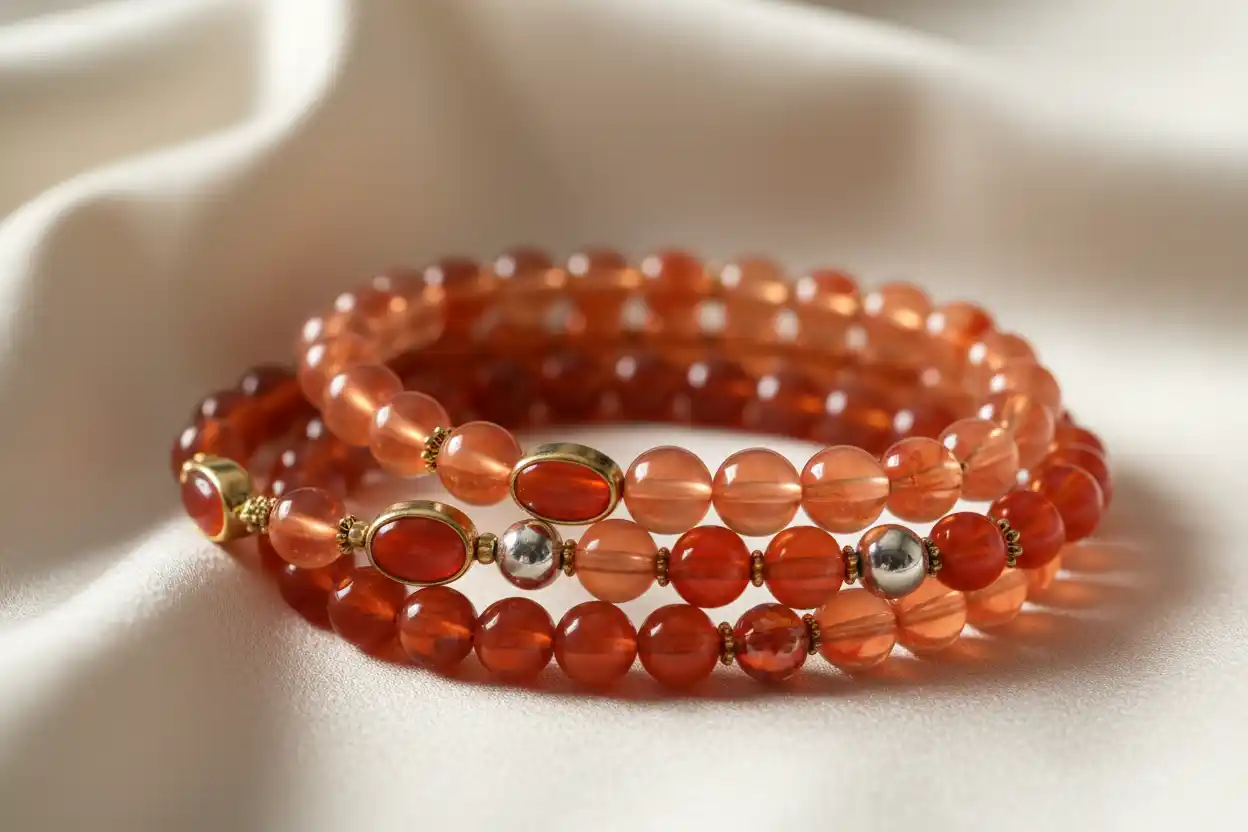
Carnelian Bracelet: Styles, Fit & Buying Guide
A carnelian bracelet combines the warm orange-to-red color of chalcedony with a jewelry format that experiences far more movement, impact, perspiration, desk contact, and hardware stress than a pendant or pair of earrings. That makes choosing a carnelian bracelet less about finding the darkest beads and more about balancing gemstone quality with wrist fit, bead diameter, drilling, stringing, clasp security, metal quality, treatment disclosure, and the way the bracelet will actually be worn.
Carnelian itself is a translucent orange, red-orange, or reddish-brown variety of chalcedony within the quartz family. It generally has good practical toughness, no easy cleavage in the conventional gemological sense, and hardness around 6.5–7, which makes a carnelian bracelet reasonably suitable for regular wear. However, bracelets repeatedly strike desks, keyboards, countertops, doorframes, watches, and other jewelry, so even durable chalcedony can accumulate surface scratches, edge chips, damaged drill holes, and weakened stringing when the construction is poor.
Treatment also deserves attention because heating and dyeing are both encountered in carnelian and related chalcedony. A treated carnelian bracelet can still contain genuine natural stone, but a seller should distinguish naturally colored material, heated chalcedony, dyed material, reconstructed components, glass, and resin rather than placing everything under a vague “natural crystal” description.
The best carnelian bracelet therefore starts with three questions: is the material represented accurately, does the bracelet fit the wrist correctly, and is the construction appropriate for repeated hand movement? Once those practical points are satisfied, bead style, metal color, symbolism, and personal preference can guide the rest of the choice.
Carnelian Bracelet at a Glance
| Feature | What to Look For |
|---|---|
| Gem material | Carnelian, a warm-colored chalcedony |
| Composition | Primarily SiO₂ |
| Typical color | Honey orange, orange, red-orange, reddish brown |
| Transparency | Usually translucent to nearly opaque |
| Mohs hardness | About 6.5–7 |
| Cleavage | None in the conventional gemological sense |
| Toughness | Generally good |
| Common bracelet forms | Stretch beads, clasped beads, chain stations, cabochon links, wrap bracelets, charm bracelets |
| Common bead sizes | About 4–12 mm, with larger sizes available |
| Common treatments | Heating and dyeing |
| Main authenticity concerns | Dyed chalcedony, dyed agate, glass, resin, misleading color claims |
| Main construction concerns | Elastic fatigue, drill-hole damage, weak clasps, plated spacers, rough bead edges |
| Best fit | Comfortable movement without sliding excessively over the hand |
| Safest cleaning | Brief warm water, mild soap, soft cloth; construction and treatment permitting |
| Main wear concern | Repeated impact and abrasion from hand-level use |
| Symbolic themes | Motivation, creativity, confidence, purposeful action |
The broader carnelian meaning profile covers the gemstone’s mineral identity and symbolic traditions in more depth, while this guide focuses specifically on bracelet construction, fit, wear, and buying decisions.
Why Carnelian Works Well in Bracelets
Carnelian is particularly well suited to beads and cabochons because chalcedony has a fine microcrystalline structure that can take a smooth polish without the prominent cleavage planes found in minerals such as moonstone, fluorite, or topaz. A carnelian bracelet can therefore survive ordinary movement better than many softer or more cleavable crystal bracelets, provided the beads are structurally sound and the stringing or setting is reliable.
The stone also works visually in bracelets because translucent orange material changes appearance as the wrist moves. Thin edges can glow bright orange in transmitted light, while thicker beads may look reddish brown or deep red-orange from another angle. This changing appearance is normal and can give a carnelian bracelet more depth than uniformly opaque beads.
Carnelian is not indestructible, though. Quartz-family hardness primarily concerns scratch resistance, while toughness concerns resistance to chips and breaks. The distinction in gemstone toughness vs hardness is especially important for bracelets because wrist jewelry experiences repeated impact that earrings and necklaces usually avoid.
What Is a Carnelian Bracelet Made From?
A genuine carnelian bracelet should use beads, cabochons, tablets, carvings, or other components made from carnelian or carnelian-bearing chalcedony.
Carnelian is composed primarily of:
SiO₂ — silicon dioxide
Its orange-to-red coloration is associated largely with finely distributed iron-bearing compounds within the chalcedony.
Commercial pieces may also contain:
- Sterling silver.
- Gold.
- Gold-filled metal.
- Stainless steel.
- Brass.
- Copper.
- Gold-plated components.
- Silver-plated components.
- Elastic cord.
- Nylon thread.
- Silk or synthetic beading thread.
- Wire.
- Leather.
- Spacer beads.
- Charms.
- Clasps.
- Adhesives.
When buying a carnelian bracelet, the stone is only one part of the product. A bracelet with excellent gemstone beads but weak elastic or poor-quality plated spacers may fail long before the carnelian itself shows serious wear.
Carnelian Bracelet Styles
A carnelian bracelet can be built in several fundamentally different ways, and each construction has its own strengths and weaknesses.
Stretch Carnelian Bracelet
The stretch carnelian bracelet is the most common form. Round or shaped beads are drilled and threaded onto elastic so the bracelet can pass over the hand without a clasp.
Advantages include:
- Easy on-and-off use.
- No clasp to operate.
- Clean continuous bead appearance.
- Broad range of bead sizes.
- Easy resizing by restringing.
The main weakness is elastic fatigue.
Repeated stretching, heat, chemicals, water, skin oils, and age can eventually reduce elasticity. A carnelian bracelet may look perfect immediately before the cord breaks, so string condition deserves regular inspection.
Clasped Bead Carnelian Bracelet
A clasped carnelian bracelet uses beads strung on wire, cord, or thread and closes with a lobster clasp, toggle, box clasp, hook, or another mechanism.
This design can feel more refined and allows the bracelet to include:
- Metal spacers.
- Pearls.
- Other gemstones.
- Decorative findings.
- Extension chains.
- Fixed sizing.
A good clasped carnelian bracelet should flex naturally without exposing excessive wire between beads.
If the bracelet is too tightly strung, repeated bending can stress drill holes and hardware.
Carnelian Chain Bracelet
A chain-style carnelian bracelet may position individual cabochons, beads, or drops at intervals along a metal chain.
This style usually feels lighter than a full bead strand and can show more metal.
Its durability depends strongly on:
- Jump-ring closure.
- Solder quality.
- Link thickness.
- Stone setting.
- Bail or connector strength.
The gemstone receives less bead-to-bead abrasion, but the chain itself becomes a central wear component.
Carnelian Cabochon Link Bracelet
Cabochon-link bracelets use polished carnelian stones mounted individually in metal frames and connected by hinges or links.
A well-designed carnelian bracelet of this type can provide excellent protection because bezels shield the stone edges while allowing articulation around the wrist.
Inspect:
- Bezel security.
- Hinge movement.
- Solder joints.
- Link wear.
- Cabochon fractures.
- Backing.
- Treatment disclosure.
Cabochon bracelets often require more metalwork than bead bracelets, so craftsmanship can contribute substantially to price.
Carnelian Wrap Bracelet
A wrap carnelian bracelet uses beads stitched or threaded along leather or cord and wraps several times around the wrist.
This style creates a larger visual presence without requiring unusually large beads.
The gemstone may be durable, but leather and thread need separate care. Repeated soaking, showering, or exposure to cosmetics can shorten the life of the non-stone components.
Carnelian Charm Bracelet
A charm-style carnelian bracelet uses small carnelian drops, beads, or carved pieces suspended from chain.
The moving charms can strike one another repeatedly.
Inspect attachment loops carefully because the weakest open jump ring can determine whether a charm stays attached.
Beaded Carnelian Bracelet: What Matters Most
The classic bead bracelet looks simple, but several manufacturing details determine quality.
A good carnelian bracelet should have beads that are:
- Smoothly polished.
- Evenly drilled.
- Free from sharp hole edges.
- Reasonably matched where matching is intended.
- Structurally sound.
- Comfortable against skin.
- Free from obvious glue residue.
- Securely strung.
Natural color variation is not a defect.
In fact, a carnelian bracelet may show pale orange, red-orange, brown-red, cloudy, and more translucent beads within the same strand.
The important question is whether the variation appears intentional and attractive rather than being hidden by misleading product photography.
Carnelian Bracelet Bead Sizes
Bead diameter strongly changes both appearance and fit.
| Bead diameter | Typical visual effect | Wear considerations |
|---|---|---|
| 4 mm | Delicate and lightweight | Easy to stack; small drill holes require good stringing |
| 6 mm | Subtle everyday size | Comfortable for many wrists |
| 8 mm | Balanced medium size | One of the most versatile options |
| 10 mm | Noticeably substantial | Requires more inside circumference for comfort |
| 12 mm | Bold statement | Greater weight and reduced wrist flexibility |
| Larger than 12 mm | Oversized look | Heavy; may interfere with desk work |
An 8 mm carnelian bracelet and a 12 mm carnelian bracelet can have the same nominal overall length while fitting very differently because larger beads project farther inward toward the wrist.
This is why outside circumference alone can be misleading.
Why Bead Size Changes Fit
Imagine a bracelet made from small beads arranged around a circle.
Much of the circumference remains close to the cord.
Now increase bead diameter substantially.
The centers of the beads remain on the stringing path, but the inner surfaces of the beads project farther toward the wrist. This reduces usable interior space.
Therefore, a carnelian bracelet with large beads often needs more total length than a bracelet made with small beads for the same wrist.
This is one of the most important reasons not to buy solely from labels such as “small,” “medium,” or “large.”
How to Measure Your Wrist for a Carnelian Bracelet
Use a flexible measuring tape and wrap it around the wrist where you intend to wear the bracelet.
Keep the tape comfortably against the skin without pulling tightly.
If a flexible tape is unavailable, use non-stretch string, mark the overlap, and measure it against a ruler.
Record the actual wrist circumference.
Then choose the amount of ease according to preferred fit.
A practical starting point is:
| Desired fit | Approximate added ease |
|---|---|
| Snug | About 0.25 in / 0.6 cm |
| Comfortable | About 0.5 in / 1.3 cm |
| Loose | About 0.75–1 in / 1.9–2.5 cm |
These figures are starting ranges, not universal rules.
Large beads, rigid constructions, prominent spacers, and personal anatomy can require more room.
The Best Carnelian Bracelet Fit
A properly fitted carnelian bracelet should move slightly without sliding constantly over the hand.
For a typical comfortable fit:
- You should be able to insert a finger beneath the bracelet without forcing it.
- The beads should not leave persistent indentations.
- The bracelet should not roll excessively around the wrist.
- The clasp should not pull under continuous tension.
- Large beads should not restrict wrist flexion.
A carnelian bracelet that is painfully tight is not improved by being aesthetically attractive.
Comfort is part of jewelry quality.
Stretch Bracelet Fit
Stretch bracelets need enough opening circumference to pass over the hand, yet excessive looseness causes the strand to swing and strike surrounding objects.
The ideal carnelian bracelet should stretch over the hand without requiring aggressive pulling.
Do not judge elastic size only while the bracelet is stretched.
The resting fit around the wrist is what determines comfort.
If a seller provides only total bead count and no recommended wrist size, ask for the inside circumference or the intended wrist range.
Clasp Bracelet Fit
A clasped carnelian bracelet does not need to stretch over the hand, so the sizing can be more precise.
An extension chain is useful when:
- The bracelet is a gift.
- Wrist size is uncertain.
- Seasonal fit changes are expected.
- The wearer likes both snug and loose placement.
However, a long extension chain can dangle and catch.
Choose enough adjustability to be useful without adding excessive loose metal.
Carnelian Bracelet for Small Wrists
Small wrists often suit:
- 4 mm beads.
- 6 mm beads.
- 8 mm beads.
- Fine chain stations.
- Smaller cabochons.
Large beads are still possible, but the bracelet may need fewer beads and more careful proportioning.
Do not assume a smaller wrist requires pale or delicate carnelian.
Strong red-orange color can look excellent in small-scale designs.
Carnelian Bracelet for Larger Wrists
A larger wrist may suit 8–12 mm beads comfortably, but bead diameter should still reflect lifestyle.
Someone who types frequently may prefer lower-profile 8 mm beads even if 12 mm beads fit physically.
A good seller should size the carnelian bracelet according to measured wrist circumference rather than simply adding random beads until the strand “looks large enough.”
Round Carnelian Beads
Round beads are the most common choice because they move smoothly against one another and distribute contact evenly.
A round-bead carnelian bracelet works especially well when:
- The drilling is centered.
- Bead diameter is consistent.
- Polish is smooth.
- Holes are not chipped.
- Elastic tension is appropriate.
Perfectly identical color is not necessary.
Natural variation can create more visual depth.
Faceted Carnelian Beads
Faceted beads create more sparkle because flat surfaces reflect light directly.
Carnelian does not have the high brilliance of diamond or zircon, so facets mainly create surface flashes rather than intense dispersion.
Check facet edges carefully.
Poorly cut faceted beads can have sharp corners that rub neighboring beads, cutting into elastic or producing uncomfortable edges.
A faceted carnelian bracelet should still feel smooth during wrist movement.
Nugget and Freeform Carnelian Bracelets
Nugget beads emphasize natural-looking variation and irregular shapes.
They can create an attractive casual carnelian bracelet, but poor-quality nuggets may contain:
- Thin edges.
- Sharp corners.
- Uneven holes.
- Deep pits.
- Weak fracture zones.
Run a finger around the entire bracelet.
Anything that scratches the finger lightly may become much more irritating during continuous wear.
Chip Carnelian Bracelets
Chip bracelets are inexpensive and widely available.
They can be attractive, but they generally expose more sharp edges and irregular drill areas than rounded beads.
A low-cost carnelian bracelet made from chips should still have:
- Rounded enough edges for comfortable wear.
- No needle-like fragments.
- Secure stringing.
- Consistent drill quality.
- No loose broken chips.
Do not assume “natural shape” justifies rough finishing.
Jewelry should be wearable.
Carnelian Bracelet Color
Carnelian color ranges widely.
Typical shades include:
- Pale honey orange.
- Warm orange.
- Burnt orange.
- Red-orange.
- Rust red.
- Reddish brown.
- Deep brown-red.
A good carnelian bracelet does not need to be dark red.
In fact, lighter translucent orange beads can produce more attractive glow when backlit.
Choose according to whether you prefer:
- Bright transparency.
- Deep saturation.
- Earthy brown-red.
- Uniform matching.
- Natural variation.
Color quality is partly aesthetic rather than one absolute ranking.
Translucency Matters
One of carnelian’s most characteristic features is translucency.
Hold a bead against a bright white light and rotate it.
Many genuine carnelian beads develop a warm glow through thinner edges or across substantial portions of the stone.
This does not prove authenticity by itself, but it helps distinguish typical carnelian appearance from strongly opaque red jasper.
The direct carnelian vs red jasper comparison explains why transparency is useful while still having limitations.
A carnelian bracelet containing naturally deeper beads may appear almost opaque until backlit.
Uniform Color: Good or Suspicious?
Uniform color is not automatically suspicious.
High-quality bead manufacturers can match natural material carefully.
However, an extremely uniform carnelian bracelet deserves closer examination when:
- Every bead is identical.
- Color is unusually vivid.
- Drill holes contain concentrated pigment.
- Cracks look darker than surrounding stone.
- The color resembles artificial red-orange plastic.
- The seller refuses treatment questions.
Uniformity should trigger curiosity, not an automatic accusation of dye.
Heat Treatment in Carnelian
Heating is one of the most important treatments to understand.
Iron-bearing chalcedony can develop or intensify warm orange-to-red coloration through heating. This practice is well established in the broader agate and carnelian trade.
A heated carnelian bracelet can still be made from natural chalcedony.
The relevant disclosure is:
natural stone, heat-treated color
rather than simply “fake.”
Treatment categories and their effect on disclosure are covered in gemstone treatments explained.
If untreated status is important to you, ask for evidence rather than assuming it from appearance.
Dyed Carnelian Bracelets
Dyeing can create or strengthen orange, red, or brown coloration in chalcedony and agate.
A dyed carnelian bracelet may show pigment concentrated:
- Around drill holes.
- Along fractures.
- Inside porous zones.
- Near bead surfaces.
- In bands that absorb dye differently.
These signs are suggestive rather than conclusive.
Natural iron staining can also concentrate in irregular areas.
Do not use solvents, bleach, acids, or destructive tests on finished jewelry simply to investigate color.
Does Treatment Make a Carnelian Bracelet Bad?
No.
Treatment quality and disclosure matter more than an automatic treated-versus-untreated judgment.
A well-made heated carnelian bracelet can be attractive, durable, and fairly priced.
A dyed bracelet can also be suitable fashion jewelry when represented honestly.
The problem arises when:
- Dyed material is sold at a premium as untreated.
- Glass is sold as natural carnelian.
- Resin is represented as chalcedony.
- Treatment is deliberately hidden.
- Spiritual claims are used to justify a price unrelated to material quality.
Buy the product category knowingly.
Natural Carnelian Bracelet
A seller describing a carnelian bracelet as “natural” should clarify what the term means.
Natural geological origin does not automatically mean untreated.
A useful description distinguishes:
- Natural, untreated carnelian.
- Natural, heated carnelian.
- Natural, dyed chalcedony.
- Natural stone with resin or coating.
- Composite material.
- Imitation.
The phrase “100% natural crystal” without treatment information does not answer enough questions for a high-value purchase.
Carnelian Bracelet Authenticity
Home identification should focus on several consistent features rather than one trick.
Natural carnelian commonly shows:
- Chalcedony-like translucency.
- Internal cloudiness.
- Variable orange-to-red color.
- Fine texture.
- Good polish.
- Natural irregularity.
- No perfectly spherical gas bubbles.
- No obvious molded seams.
None of these features alone proves authenticity.
Professional analysis can separate natural chalcedony, glass, resin, and other materials much more reliably.
Glass Imitations
Orange-red glass can imitate carnelian surprisingly well.
Potential clues include:
- Round gas bubbles.
- Flow-like internal features.
- Very uniform transparency.
- Mold seams.
- Extremely consistent bead appearance.
However, natural chalcedony can contain rounded-looking inclusions and polish artifacts.
Do not reject a carnelian bracelet based on one apparent bubble seen through a phone camera.
Use several observations together.
Resin and Plastic Imitations
Resin may be lighter, warmer to the touch initially, easier to scratch, or more perfectly molded than natural chalcedony.
Yet touch-based testing is weak because temperature depends on room conditions and bead size.
A convincing imitation can fool casual observation.
For an inexpensive fashion carnelian bracelet, visual screening may be enough.
For an expensive piece, independent gemological confirmation makes more sense than destructive experimentation.
Carnelian Bracelet Versus Red Jasper Bracelet
Carnelian and red jasper overlap in warm red colors but differ noticeably in typical transparency.
Carnelian is usually translucent.
Red jasper is characteristically opaque.
A carnelian bracelet therefore tends to glow more strongly when light reaches thin sections, while a red jasper bracelet usually looks more solid and earthy.
Both belong broadly to silica-rich chalcedony-related materials, and both receive iron-related coloration.
The difference should be based on the complete material, not simply whether one bead is “redder.”
Carnelian Bracelet Versus Orange Agate Bracelet
Carnelian belongs to the chalcedony family, and boundaries between carnelian and agate can become commercially blurry.
Agate is typically defined by visible banding or structural layering.
Carnelian is usually more uniformly orange-to-red.
A banded orange stone may reasonably be described as carnelian agate or orange agate depending on its appearance and trade usage.
The exact label matters less than honest material and treatment description.
Carnelian Bracelet Metal Choices
Metal affects both appearance and wear.
Yellow Gold
Yellow gold emphasizes the warm orange and red tones in a carnelian bracelet.
High-karat gold provides rich color but can be softer.
Lower-karat alloys may provide greater hardness depending on composition.
Rose Gold
Rose gold creates a particularly warm monochromatic effect with orange-red carnelian.
The visual combination can be attractive, although metal-allergy considerations depend on the exact alloy.
White Gold
White gold creates stronger contrast and can make red-orange carnelian appear brighter.
Some white-gold jewelry receives rhodium plating, which may need maintenance as the surface wears.
Sterling Silver
Sterling silver is a common and accessible choice.
A silver carnelian bracelet provides strong warm-cool contrast.
Tarnish is normal surface chemistry and should not be confused with gemstone deterioration.
Stainless Steel
Stainless steel can provide strong mechanical durability at an accessible price.
Its cooler neutral appearance works well with saturated orange-red beads.
Plated Metals
Gold-plated and silver-plated findings can look attractive initially but may wear through at high-contact points.
Bracelets experience substantial friction, so plating quality matters more here than in many earrings.
Ask what base metal lies beneath the plating.
Nickel and Metal Sensitivity
A person can tolerate carnelian perfectly while reacting to the bracelet hardware.
If metal sensitivity is a concern, ask the seller for the actual alloy rather than accepting vague terms such as:
- Hypoallergenic.
- Jewelry metal.
- Premium alloy.
- Gold tone.
- Silver tone.
Those phrases may describe appearance rather than composition.
Gemstone identity and metal compatibility are separate questions.
Carnelian Bracelet Clasps
Clasp quality is particularly important because the wrist moves constantly.
Lobster Clasp
A lobster clasp provides secure spring-loaded closure and works well with chain or strung designs.
Check that the lever opens smoothly and closes fully.
Toggle Clasp
Toggle clasps are easy to operate and decorative.
However, the bar must be sufficiently longer than the ring opening to resist accidental release.
An overly loose bracelet may increase the chance of the toggle moving into an unfavorable position.
Box Clasp
A well-made box clasp can provide a neat, secure finish in more formal bracelets.
Inspect the locking mechanism and any safety catch.
Magnetic Clasp
Magnetic clasps provide convenient closure but can separate under pulling force more easily than some mechanical clasps.
They should be chosen for convenience with an understanding of the design’s retention strength.
Stretch Cord Quality
Elastic is often the least visible component of a carnelian bracelet but one of the most important.
Poor elastic can:
- Stretch permanently.
- Fray at bead holes.
- Become brittle.
- Lose rebound.
- Break at knots.
Inspect the spaces between beads.
If the cord appears fuzzy, flattened, cracked, discolored, or stretched, restringing is advisable.
Do not wait until the bracelet breaks and scatters beads.
Why Drill Holes Matter
A carnelian bracelet bead experiences concentrated stress at the drill hole.
Poor drilling can create:
- Chips.
- Radial fractures.
- Sharp edges.
- Misaligned holes.
- Thin weak walls.
- Abrasion against cord.
Look closely at the bead nearest the knot or clasp because it may experience greater tension.
A beautiful bead with a damaged hole can become the structural weak point of the entire bracelet.
Spacer Beads and Hardware
Metal spacers can improve appearance, but each spacer changes the contact pattern.
A rough-edged spacer can scratch adjacent carnelian over time.
Check that spacer edges are smooth and that decorative components do not cut into elastic.
Heavy spacers also change bracelet balance.
If one metal charm constantly pulls the carnelian bracelet around the wrist, the piece may feel less comfortable than a visually similar design with better weight distribution.
Stacking a Carnelian Bracelet
Carnelian bracelets are commonly stacked with watches, bangles, or other gemstone bracelets.
The main risk is abrasion.
Harder materials can scratch carnelian.
Metal edges can also strike bead surfaces repeatedly.
For frequent stacking:
- Keep sharp metal away from polished beads.
- Avoid hard-edged watches rubbing continuously against carnelian.
- Check for surface wear.
- Separate valuable bracelets when storing.
- Remove pieces before high-impact activity.
A stacked look may be fashionable, but every additional bracelet increases contact.
Carnelian Bracelet With Other Gemstones
Carnelian pairs visually with:
- Onyx.
- Smoky quartz.
- Citrine.
- Red jasper.
- Tiger’s eye.
- Clear quartz.
- Garnet.
- Pearl.
- Lapis lazuli.
The combination should still be evaluated physically.
A pearl-and-carnelian bracelet needs pearl-level chemical care.
A carnelian bracelet mixed with softer minerals should be stored according to the most vulnerable material.
Do not assume all beads share carnelian’s durability.
Carnelian Bracelet Symbolism
Traditional and modern carnelian symbolism commonly includes:
- Motivation.
- Courage.
- Creativity.
- Confidence.
- Eloquence.
- Initiative.
- Purposeful action.
A carnelian bracelet can make these themes especially convenient because it remains visible during ordinary tasks.
Someone might use the bracelet as a reminder to:
- Begin a delayed project.
- Practice before a presentation.
- Make a difficult but necessary call.
- Return to creative work.
- Complete the next defined task.
The gemstone does not biologically create motivation or courage.
Its symbolic role can be behavioral.
Why a Bracelet Works as a Symbolic Reminder
A carnelian bracelet moves with the hand and is seen repeatedly during the day.
That makes it suitable as a visual cue.
For example, connect the bracelet with one specific question:
What is the next responsible action?
Each time you notice the stone, return to that question.
This makes carnelian symbolism concrete.
The carnelian bracelet does not guarantee success, productivity, creativity, confidence, wealth, attraction, or protection.
It simply becomes a reminder associated with chosen behavior.
Carnelian Bracelet and Chakra Traditions
Modern crystal practices commonly associate carnelian with the sacral chakra and sometimes the root chakra.
These associations are spiritual rather than anatomical.
A carnelian bracelet may therefore be worn symbolically for themes such as creativity, emotional expression, initiative, or grounded action.
There is no established evidence that wearing carnelian around the wrist physically alters reproductive organs, hormones, circulation, fertility, digestion, or other physiological systems.
Symbolism should remain separate from medical claims.
Does a Carnelian Bracelet Have Healing Properties?
There is no established clinical evidence that wearing a carnelian bracelet treats illness.
Claims involving:
- Fertility.
- Sexual function.
- Circulation.
- Hormones.
- Pain.
- Depression.
- Anxiety.
- Metabolism.
- Energy levels.
- Immune function.
should not be presented as scientifically demonstrated effects of chalcedony.
A carnelian bracelet can accompany meditation, reflection, or a personal wellness routine.
It should not replace appropriate healthcare.
Which Wrist Should You Wear a Carnelian Bracelet On?
There is no gemological requirement to wear a carnelian bracelet on one particular wrist.
Some spiritual traditions assign symbolic receiving and giving roles to the left and right sides, but these interpretations vary and are not scientifically established.
Choose the wrist based on:
- Comfort.
- Dominant-hand activity.
- Watch placement.
- Workplace tasks.
- Existing jewelry.
- Personal symbolism.
For practical durability, the less active wrist may expose the bracelet to fewer impacts.
That can matter more than symbolic side rules.
Can You Wear a Carnelian Bracelet Every Day?
Yes, a sound carnelian bracelet can be suitable for regular wear.
Carnelian has enough hardness and generally useful toughness for everyday jewelry.
However, daily wear increases cumulative contact.
Remove the bracelet before:
- Heavy lifting.
- Gym equipment.
- Contact sports.
- Construction work.
- Gardening.
- Aggressive cleaning.
- Swimming.
- Showering.
- Mechanical work.
The purpose is not to treat carnelian as fragile.
It is to avoid unnecessary abrasion and protect the string, clasp, metal, and treatment.
Can You Shower With a Carnelian Bracelet?
It is better to remove a carnelian bracelet before showering.
Solid untreated carnelian can generally tolerate brief clean-water exposure reasonably well, but a finished bracelet includes additional materials.
Shower exposure can affect:
- Elastic.
- Thread.
- Metal plating.
- Glue.
- Dye.
- Soap buildup.
- Drill holes.
- Clasp surfaces.
The wider crystal water-safety guidance distinguishes a mineral surviving a brief rinse from finished jewelry being appropriate for repeated soaking.
Can You Sleep With a Carnelian Bracelet?
You can physically sleep in some smooth bracelets, but removing a carnelian bracelet before bed usually reduces strain on elastic and prevents pressure against the wrist.
Large beads can become uncomfortable when trapped beneath the arm.
Charms and metal spacers can press into skin.
A symbolic carnelian bracelet does not need continuous overnight contact to retain personal meaning.
Place it somewhere safe and wear it again after waking.
Can You Exercise With a Carnelian Bracelet?
Remove it for most gym and athletic activity.
A carnelian bracelet can strike:
- Dumbbells.
- Barbells.
- Machines.
- Benches.
- Floors.
- Other equipment.
Sweat also accumulates around drill holes and hardware.
Elastic can be pulled aggressively during repeated wrist flexion.
The stone may be durable enough to survive many workouts, but there is little advantage in exposing jewelry to unnecessary mechanical stress.
How to Clean a Carnelian Bracelet
For a straightforward bracelet made from sound carnelian and water-compatible hardware:
- Prepare lukewarm water with a small amount of mild soap.
- Dampen a soft cloth or very soft brush.
- Clean the bead surfaces gently.
- Work carefully around drill holes and metal.
- Rinse briefly if the construction allows.
- Pat dry with a soft cloth.
- Allow the bracelet to dry completely before storage.
Avoid prolonged soaking, particularly when treatment, elastic, glue, thread, or metal construction is uncertain.
Avoid Harsh Chemicals
Do not clean a carnelian bracelet with:
- Bleach.
- Strong acids.
- Aggressive alkaline cleaners.
- Abrasive powder.
- Metal polish applied across the stone.
- Unknown solvents.
Even when carnelian itself resists a chemical reasonably well, dye, adhesive, elastic, plating, and other components may not.
Care should follow the entire object.
Ultrasonic Cleaning
Ultrasonic cleaning is generally unnecessary for a carnelian bracelet.
Sound untreated chalcedony may tolerate more cleaning stress than many delicate gems, but a bracelet can contain:
- Internal fractures.
- Dye.
- Glue.
- Metal spacers.
- Elastic.
- Thread.
- Mixed stones.
Manual cleaning provides enough benefit without creating additional uncertainty.
Steam Cleaning
Steam should also be avoided as a routine method.
Rapid heat can affect treatments, elastic, adhesive, and some jewelry hardware.
A carnelian bracelet does not need high-temperature cleaning to restore ordinary polish.
Warm water and gentle wiping are sufficient.
How to Store a Carnelian Bracelet
Store the bracelet separately in a soft pouch or divided jewelry compartment.
Do not allow harder gems such as sapphire, ruby, topaz, or diamond to rub repeatedly against the carnelian.
For stretch bracelets:
- Do not store them stretched around oversized display stands.
- Keep them flat or loosely circular.
- Avoid strong heat.
- Inspect elastic periodically.
For chain or clasp designs, close the clasp before storage so loose chain cannot tangle around neighboring jewelry.
Sunlight and Carnelian Bracelets
Normal daylight exposure during wear is not generally a major concern for ordinary natural carnelian.
However, prolonged intense sunlight can affect some dyes, coatings, elastic, and jewelry components.
There is no practical reason to leave a carnelian bracelet in strong direct sunlight for extended symbolic “charging.”
If sunlight has personal meaning, a shorter indirect exposure avoids unnecessary heat.
How to Evaluate Carnelian Bracelet Quality
A useful buying assessment considers six areas:
1. Material Identity
Is it actually carnelian or carnelian-bearing chalcedony?
2. Color
Do you like the orange, red-orange, or reddish-brown appearance under ordinary lighting?
3. Translucency
Does the stone display the warm internal glow characteristic of carnelian?
4. Bead or Cabochon Quality
Are polishing, drilling, and shaping clean?
5. Construction
Are elastic, clasp, wire, thread, and metal appropriate for repeated wear?
6. Disclosure
Does the seller explain treatment, metal, sizing, and material clearly?
A carnelian bracelet that performs well across these categories is usually a stronger purchase than one marketed mainly through symbolic promises.
What Makes a Carnelian Bracelet Valuable?
Value depends on far more than bead count.
Important factors include:
- Attractive natural-looking color.
- Strong translucency.
- Large matched beads.
- Precision cutting.
- Smooth polish.
- Clean drilling.
- Unusual carvings.
- Natural versus treated status.
- Metal quality.
- Handmade construction.
- Secure clasp.
- Design originality.
- Condition.
- Provenance where relevant.
A simple elastic carnelian bracelet made from common commercial beads should not be priced like fine gold jewelry merely because the seller attaches spiritual claims.
Craftsmanship and material should explain the price.
Large Carnelian Beads
Larger beads require more usable rough and can command higher prices when color and translucency remain attractive.
However, large size also exposes flaws more clearly.
Inspect large beads for:
- Internal fractures.
- Surface pits.
- Dye concentration.
- Poor polish.
- Off-center holes.
- Excessive weight.
- Cracks radiating from drill holes.
A 14 mm carnelian bracelet is not automatically higher quality than an 8 mm version.
It is simply larger.
Matching Quality
Some carnelian bracelets are intentionally uniform.
Others celebrate variation.
For a matched bracelet, evaluate consistency in:
- Diameter.
- Shape.
- Color family.
- Transparency.
- Polish.
- Hole position.
One dramatically dark or pale bead may distract when uniformity is the design goal.
For mixed-tone bracelets, variation should still look balanced rather than random.
Actual-Stone Photos Matter
If buying a higher-priced carnelian bracelet online, request photographs of the exact piece.
Stock photographs can hide variation in:
- Redness.
- Brown undertones.
- Translucency.
- Bead matching.
- Matrix.
- Drill quality.
- Hardware.
Ask for images under neutral light rather than only warm lighting, which can make orange and red stones appear more saturated.
A short rotating video can show translucency and overall matching particularly well.
Seller Disclosure Checklist
Before buying a carnelian bracelet, a strong listing should answer:
- Is the gemstone natural chalcedony?
- Has it been heated?
- Has it been dyed?
- Has it been resin treated?
- What is the bead diameter?
- What wrist size does it fit?
- What is the inside circumference?
- What stringing material is used?
- What metal is used?
- Is the metal plated?
- What clasp type is used?
- Are photographs of the exact bracelet shown?
- What is the return policy?
The broader where to buy carnelian guidance is useful when seller credibility and material disclosure matter more than jewelry style alone.
Carnelian Bracelet Buying Red Flags
Be cautious when:
- Every bracelet is labeled untreated with no supporting basis.
- Vivid orange-red color looks identical across every listing.
- Treatment questions are ignored.
- “Natural” is used as though it means untreated.
- The seller cannot provide wrist sizing.
- Bead diameter is omitted.
- Metal is described only as “gold color.”
- Elastic quality is not mentioned on expensive pieces.
- Stock photos substitute for the actual bracelet.
- Drill holes show obvious cracking.
- Glue is visible.
- Metal spacers have rough edges.
- Color concentrates heavily around holes.
- Glass is sold as carnelian.
- Dyed agate is sold at an untreated premium.
- Medical or financial guarantees dominate the listing.
- “AAA,” “AAAA,” or similar grades are used without defined criteria.
A strong carnelian bracelet should make sense as jewelry before it makes sense as symbolism.
Carnelian Bracelet Price Versus Quality
An inexpensive carnelian bracelet can be perfectly satisfactory when it uses commercial beads and straightforward elastic construction.
Higher prices become more reasonable when the piece includes:
- Larger fine-color beads.
- Exceptional translucency.
- Carved beads.
- High-quality gold or silver.
- Labor-intensive hand construction.
- Custom sizing.
- Unusual design.
- Verified untreated status where meaningful.
- Designer craftsmanship.
Price should not rise dramatically only because the seller describes the bracelet as “activated,” “high vibration,” or guaranteed to attract success.
Those claims do not change the gemological material.
Does a Carnelian Bracelet Need a Lab Report?
Most ordinary carnelian bracelets do not justify individual laboratory reports.
The stone is generally accessible enough that the cost of testing may exceed the value of the bracelet.
Independent analysis becomes more reasonable when:
- The piece is unusually expensive.
- Untreated status creates a large premium.
- The stone may be glass.
- A rare provenance claim affects price.
- An antique piece has substantial value.
- A designer bracelet contains high-value metal and exceptional stones.
For ordinary bead jewelry, good seller disclosure and a strong return policy are usually more useful.
Carnelian Bracelet as a Gift
A carnelian bracelet can make an attractive gift because the warm color works with casual and formal jewelry.
Before buying, consider:
- Wrist size.
- Bead size preference.
- Metal color.
- Stretch versus clasp preference.
- Whether the person stacks bracelets.
- Work environment.
- Sensitivity to metal.
- Interest in symbolism.
- Preferred color saturation.
An 8 mm stretch carnelian bracelet may be ideal for one wearer and feel too bulky to another.
Fit makes the gift personal.
Carnelian Bracelet for Everyday Work
For desk-based work, lower-profile beads usually interfere less with typing and mouse use.
A 6–8 mm carnelian bracelet often feels easier around a keyboard than a strand of large 12–14 mm beads.
Watch which wrist you use for the mouse.
Repeated bead contact with a hard desk edge can create wear.
A soft desk mat may reduce impact, although removing the bracelet during long typing sessions is another simple option.
Carnelian Bracelet for Formal Jewelry
A gold or sterling-silver carnelian bracelet with polished cabochons can create a more formal appearance than a conventional elastic bead strand.
Look for:
- Secure bezels.
- Refined links.
- Consistent stone orientation.
- Smooth underside.
- Comfortable articulation.
- Strong clasp.
- Appropriate metal weight.
Formal construction can add significant value because metalwork and setting quality become as important as the stone.
Carnelian Bracelet Versus Carnelian Necklace
A bracelet receives substantially more impact than a carnelian necklace.
That difference changes buying priorities.
For a necklace, bail size, chain length, pendant weight, and how the stone hangs are central.
For a carnelian bracelet, wrist fit, bead diameter, clasp security, drilling, elastic, articulation, and desk contact matter more.
The gemstone is the same.
The jewelry form changes the decision.
Frequently Asked Questions
What is a carnelian bracelet?
A carnelian bracelet is wrist jewelry containing beads, cabochons, carvings, or other elements made from carnelian, an orange-to-red variety of chalcedony.
Is a carnelian bracelet suitable for everyday wear?
Yes. Carnelian has hardness around 6.5–7 and generally good toughness, making it suitable for regular wear when the bracelet is well constructed.
Is a carnelian bracelet easy to scratch?
Carnelian has useful scratch resistance but can still be scratched by harder gemstones and abrasive materials. Bracelets experience more surface contact than earrings or necklaces.
Can a carnelian bracelet break?
Yes. Carnelian is durable but brittle enough to chip or fracture under strong impact, while elastic, cord, clasps, and drill holes can also fail.
What is the best bead size for a carnelian bracelet?
Around 6–8 mm suits many everyday designs, while 10–12 mm creates a more substantial look. The best size depends on wrist circumference, comfort, and personal style.
Are 8 mm carnelian bracelets comfortable?
For many wearers, 8 mm beads provide a good balance between visual presence and wrist flexibility.
Are 10 mm carnelian bracelets too large?
Not necessarily. They are more noticeable and heavier than 6–8 mm beads, so accurate sizing becomes more important.
How should a carnelian bracelet fit?
A carnelian bracelet should move slightly without squeezing the wrist or sliding constantly over the hand.
How do I measure my wrist for a carnelian bracelet?
Measure around the wrist with a flexible tape where the bracelet will sit, then add an appropriate amount of ease based on whether you prefer snug, comfortable, or loose wear.
Why do large beads need a longer bracelet?
Larger beads project farther inward, reducing usable interior circumference. A bracelet made from large beads often requires additional total length for the same wrist.
Is a stretch carnelian bracelet good?
Yes, when high-quality elastic and smooth drill holes are used. Elastic should be inspected periodically for fraying and permanent stretching.
Is a clasped carnelian bracelet better than elastic?
Neither is universally better. Clasps provide precise sizing and longer-term restringing options, while elastic offers convenience.
What clasp is best for a carnelian bracelet?
Lobster and well-made box clasps provide secure practical options, while toggles and magnetic clasps have different convenience and retention trade-offs.
What color should a real carnelian bracelet be?
Natural carnelian can range from honey orange through vivid orange and red-orange to reddish brown.
Should carnelian beads be translucent?
Carnelian is typically translucent to nearly opaque. Many genuine beads glow orange-red around thinner areas when backlit.
Why does my carnelian bracelet look brown indoors?
Thick or deeply colored carnelian can appear brown-red in ordinary reflected light and become brighter orange when illuminated through the stone.
Is dark red carnelian better?
Not automatically. Color quality is partly personal preference. Strong translucency and attractive warm orange may be just as desirable as deep red.
Can carnelian be heat treated?
Yes. Heat can intensify warm iron-related coloration in chalcedony.
Can a heated carnelian bracelet still be natural?
Yes. The starting stone can be natural chalcedony even though its color has been enhanced by heat.
Can carnelian be dyed?
Yes. Dyeing occurs in chalcedony and agate and should be disclosed when relevant.
Does dye make a carnelian bracelet fake?
Not necessarily. Dyed natural chalcedony is still natural stone material, but its introduced color should be described accurately.
How can I spot dyed carnelian beads?
Look for suspicious color concentrations around fractures, drill holes, or porous areas, while remembering that visual clues cannot always prove treatment.
Is carnelian the same as red jasper?
No. Carnelian is generally translucent orange-to-red chalcedony, while red jasper is characteristically opaque.
Is carnelian the same as agate?
Both belong to the chalcedony family. Agate generally displays visible banding, while carnelian is usually more uniformly warm colored.
Can glass imitate a carnelian bracelet?
Yes. Orange and red glass can resemble carnelian, especially in polished beads.
Does real carnelian have bubbles?
Typical rounded gas bubbles are more characteristic of glass, but natural inclusions can sometimes look bubble-like. One feature alone should not determine identity.
Is a carnelian bracelet good for men?
Yes. Carnelian bracelets are not limited by gender. Bead size, metal, color, and overall design should reflect personal preference.
Is a carnelian bracelet good for women?
Yes. Carnelian works in delicate, medium, and statement bracelet designs regardless of gender.
Which wrist should I wear a carnelian bracelet on?
There is no gemological requirement. Choose the wrist based on comfort, activity, watch placement, and personal symbolic preference.
Can I wear a carnelian bracelet every day?
Yes, but remove it during rough physical activity, swimming, aggressive cleaning, and other situations that expose the bracelet to unnecessary impact or chemicals.
Can I shower with a carnelian bracelet?
It is better to remove it. Carnelian may tolerate brief water contact, but elastic, thread, dye, plating, glue, and soap residue create additional concerns.
Can I swim with a carnelian bracelet?
Removing it before swimming is recommended because pool chemicals, saltwater, impact, and wet stringing can affect the complete piece.
Can I sleep with a carnelian bracelet?
You can, but removing it usually reduces pressure on the wrist and stress on elastic or hardware.
Can I exercise with a carnelian bracelet?
It is better to remove it during gym or sports activity because hard equipment and repeated wrist movement can damage the stone or stringing.
How do I clean a carnelian bracelet?
Use a soft cloth and, when the construction permits, brief lukewarm water with mild soap. Dry the bracelet completely.
Can I use an ultrasonic cleaner on a carnelian bracelet?
Manual cleaning is generally safer because bracelets may contain treatment, elastic, glue, mixed stones, or vulnerable hardware.
Can I steam clean a carnelian bracelet?
Steam is unnecessary and can create risks for treatments, adhesives, elastic, and other components.
Can I use vinegar on carnelian?
There is no practical reason to use vinegar on finished carnelian jewelry. Mild soap and water are safer for routine cleaning.
How should I store a carnelian bracelet?
Store it separately in a soft pouch or compartment away from harder gemstones that can scratch the surface.
Can carnelian bracelets fade?
Natural color is generally reasonably stable, but dye, coatings, elastic, and some treatments may respond differently to prolonged strong light or chemicals.
Can I stack a carnelian bracelet with other bracelets?
Yes, but harder gemstones, watches, and sharp metal edges can scratch or chip carnelian through repeated contact.
What metals look best with carnelian?
Yellow gold and rose gold emphasize warmth, while sterling silver, white gold, and stainless steel create stronger contrast.
Is sterling silver good for a carnelian bracelet?
Yes. Sterling silver is a common and attractive choice when the construction is solid and the wearer tolerates the alloy.
Is gold-plated metal durable in bracelets?
Plating can wear over time because bracelets receive substantial friction. Ask about base metal and plating quality.
What makes a high-quality carnelian bracelet?
Strong material identity, attractive color, useful translucency, good polish, clean drilling, reliable stringing, comfortable fit, durable hardware, and honest treatment disclosure all matter.
Is an expensive carnelian bracelet worth it?
It can be when price reflects superior stones, precious metal, craftsmanship, design, or documented rarity. Spiritual marketing alone does not justify a large premium.
Does a carnelian bracelet need certification?
Most ordinary bead bracelets do not require laboratory documentation. Testing is more relevant when the piece is unusually valuable or an untreated claim carries a substantial premium.
What does a carnelian bracelet symbolize?
Modern and historical carnelian symbolism commonly includes motivation, confidence, creativity, courage, eloquence, and purposeful action.
Does a carnelian bracelet increase energy?
There is no established scientific evidence that wearing carnelian increases physiological energy.
Can a carnelian bracelet improve confidence?
The stone does not biologically create confidence. It can function as a symbolic reminder to prepare, participate, and take deliberate action.
Can a carnelian bracelet attract money or success?
There is no evidence that carnelian changes financial probability or guarantees professional success.
Does a carnelian bracelet have healing properties?
No medical healing effect has been scientifically established from ordinary wear. Crystal symbolism should not replace healthcare.
Is a carnelian bracelet associated with a chakra?
Modern crystal traditions most commonly associate carnelian with the sacral chakra and sometimes the root chakra. These are spiritual associations rather than anatomical effects.
Final Carnelian Bracelet Buying Checklist
Before buying a carnelian bracelet, confirm the gemstone identity first. Carnelian should be represented as chalcedony rather than through vague terms such as “energy stone” or “natural crystal” alone.
Check the color in ordinary lighting and, where possible, transmitted light. Genuine carnelian commonly ranges from honey orange through orange-red to reddish brown, with translucency often becoming more apparent at thinner edges.
Ask whether the material has been heated, dyed, coated, stabilized, or otherwise treated. Treatment does not automatically make a carnelian bracelet undesirable, but disclosure should match the price.
Choose bead diameter according to wrist size and lifestyle. Smaller beads generally feel lighter and more flexible, while large beads create stronger visual presence but require greater inside circumference.
Measure the wrist rather than relying solely on small, medium, or large labels.
Inspect drill holes for chips and fractures.
Check elastic for fraying or excessive tension.
For clasped bracelets, examine the clasp, jump rings, wire, thread, and extension chain.
For metal-set carnelian, inspect bezels, links, hinges, and solder joints.
Ask for the actual metal composition rather than accepting phrases such as “gold tone.”
Review photographs of the exact bracelet whenever price or natural variation matters.
Confirm return terms.
Finally, choose the carnelian bracelet you actually enjoy wearing. Deep red is not automatically better than bright orange, large beads are not automatically better than small ones, and an untreated claim is not automatically more important than good polish, secure construction, comfortable fit, and honest representation.
Final Thoughts on Choosing a Carnelian Bracelet
A carnelian bracelet works well as everyday gemstone jewelry because carnelian combines attractive warm color with the useful durability of chalcedony. Its hardness around 6.5–7, generally good toughness, and lack of easy cleavage give it a practical advantage over many softer or more structurally vulnerable crystal materials, yet the bracelet format still exposes it to repeated impact and abrasion.
That makes construction critical.
For stretch bracelets, elastic quality, bead-hole condition, and fit matter more than decorative packaging. For clasped bead strands, flexibility, clasp security, and wire or thread quality become central. For cabochon-link designs, bezel construction, hinges, solder joints, and metal quality can contribute as much to long-term performance as the carnelian itself.
Sizing deserves equally careful attention. A comfortable carnelian bracelet should move slightly without squeezing the wrist or sliding excessively across the hand. Larger beads require more interior space, so two bracelets with identical external lengths can fit differently when their bead diameters differ.
Color should be judged with similar nuance. Carnelian can be honey orange, orange-red, rust red, or reddish brown, and lighter translucent stones can be just as attractive as darker material. Heating and dyeing occur within the commercial market, so a strong seller should describe treatment rather than implying that every warm-colored bead is automatically untreated.
Authenticity cannot be reduced to one home trick. Translucency, internal texture, color distribution, drill-hole appearance, gas bubbles, polish, and seller disclosure all contribute to the assessment. When the piece is valuable enough that material identity matters financially, professional testing is preferable to scratching, chemicals, or other destructive experiments.
Care should follow the complete piece rather than the stone alone. Carnelian can handle gentle cleaning, but elastic, thread, glue, plating, clasps, and mixed gemstones may be more sensitive. Removing a carnelian bracelet before showers, swimming, gym activity, rough work, and aggressive cleaning protects both the gemstone and its construction.
Symbolically, a carnelian bracelet is commonly associated with motivation, confidence, creativity, courage, and purposeful action. Those themes can make the bracelet personally meaningful, especially when it is used as a visible reminder to begin a task, practice a skill, communicate clearly, or follow through on a goal. They should remain symbolic rather than being presented as medical, financial, or predictive effects.
The best carnelian bracelet therefore succeeds in two ways at once: it is accurately represented as gemstone jewelry, and it is built well enough to fit comfortably and survive the way the wearer actually uses their hands.
For other gemstone bracelet, necklace, setting, and jewelry-construction topics, the verified Jewelry & DIY collection provides the wider practical context.