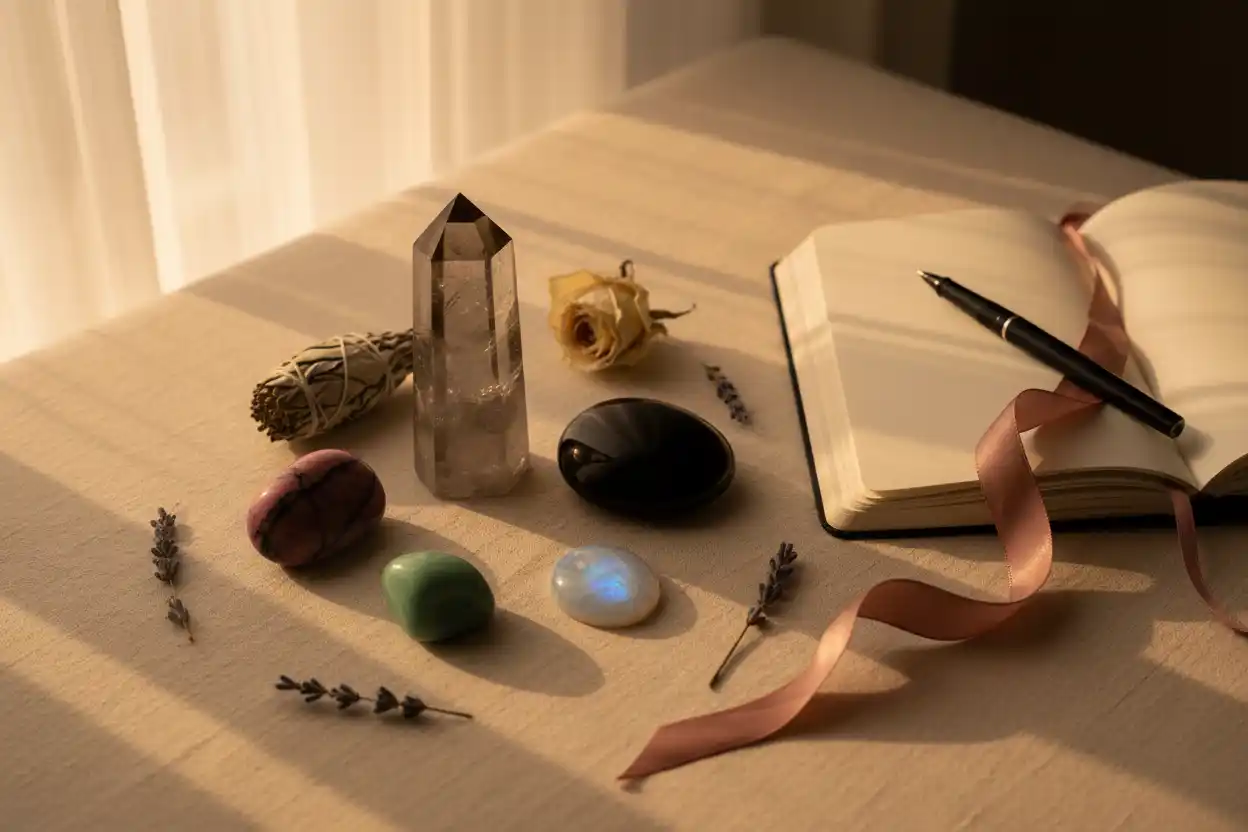
11 Best Crystals for Letting Go: Positive Meanings & Powerful Everyday Uses
Crystals for letting go can serve as personal reminders to release habits, expectations, resentment, unfinished stories, or attachments that no longer support the life you want to build. They cannot erase memories, end grief instantly, remove trauma, or make difficult emotions disappear. Their most practical role is symbolic: connect a stone with an action such as setting a boundary, clearing an old reminder from your space, writing an unsent letter, accepting what cannot be changed, or directing attention toward the next useful step.
Smoky quartz, black obsidian, Apache tears, moonstone, lepidolite, rose quartz, rhodonite, amethyst, labradorite, malachite, and clear quartz offer eleven distinct themes for this process. Some fit reflection, others grief, boundaries, transition, compassion, or changing perspective. Letting go does not always mean forgetting. It often means deciding that a past event will no longer control every present choice.
Smoky Quartz and Black Obsidian for Releasing Mental Loops and Facing What Is Real
Smoky quartz is gray-brown to nearly black quartz traditionally associated with grounding, practical thinking, and returning attention to the present. Its subdued color makes it a natural symbolic choice when the mind keeps circling the same event without producing a useful next step.
The traditions around smoky quartz healing properties can be translated into a simple practice: separate what happened from what you are continuing to predict because of it. A relationship ending is one event. Assuming every future relationship will end the same way is a conclusion layered onto that event.
A smoky quartz stone beside a journal can symbolize returning to observable facts. What is still under your control? What practical decision needs to be made? What part of the situation exists only as a repeated mental argument that cannot change the past?
Black obsidian carries a more direct traditional association with truth, reflection, and confronting uncomfortable patterns. The symbolism connected with black obsidian healing properties can fit situations where letting go requires admitting something that has been difficult to accept.
That might mean acknowledging that a friendship has changed, a plan failed, a boundary was repeatedly ignored, or an old goal no longer fits who you are. Acceptance is not approval. It is recognizing reality clearly enough to decide what comes next.
Obsidian is volcanic glass and can form extremely sharp edges when broken, so polished pieces are safer for frequent handling.
Apache Tears and Moonstone for Grief, Transition, and Accepting Change Gradually
Apache tears are rounded forms of obsidian commonly associated in crystal traditions with grief, remembrance, and emotional transition. Their dark glassy appearance gives them a quieter visual character than many brightly colored stones.
Traditional Apache tears healing properties can provide symbolism during periods of loss, but a stone cannot shorten grief or make mourning follow a predictable timetable. Grief can involve sadness, anger, relief, confusion, numbness, and moments of normality that appear unexpectedly.
A small polished Apache tear can accompany journaling about what has been lost and what remains meaningful. The goal is not to remove the memory but to create a way of holding it that does not require constant avoidance.
Moonstone brings a different perspective. Its floating sheen changes with movement, and traditional symbolism often connects it with cycles, transitions, and adapting to circumstances that evolve over time.
The themes surrounding moonstone healing properties can fit letting go when the process is gradual. Some attachments loosen through repeated small choices rather than one dramatic decision.
Moonstone is softer than quartz and has cleavage, so pendants and protected palm stones generally tolerate use better than exposed rings.
Lepidolite and Amethyst for Moving Through Change Without Forcing Instant Closure
Lepidolite is a lithium-bearing mica that commonly appears lilac, lavender, pink-purple, or gray-violet. Traditional symbolism frequently connects it with transition, patience, and adjusting to change.
The ideas within lepidolite healing properties can be useful when someone understands intellectually that a change is necessary but still feels emotionally attached to the old situation.
A lepidolite stone can symbolize giving yourself permission to adapt gradually. Ending a habit, changing work, leaving a relationship, or moving to a new place may create a period where the old identity has ended but the new one does not yet feel familiar.
The lithium in lepidolite does not provide a therapeutic effect through normal handling. Its significance here is symbolic, and mica also requires gentle care because its layers split easily.
Amethyst is purple quartz traditionally associated with reflection, restraint, and deliberate choices. The traditions around amethyst healing properties fit letting go when the challenge is resisting the urge to reopen something that has already been decided.
An amethyst stone can represent not sending the message, not checking the account, not restarting an argument, or not returning to a habit that repeatedly creates the same outcome.
That pause can be powerful because letting go often depends less on one emotional breakthrough than on choosing not to reinforce the old attachment every day.
Rose Quartz and Rhodonite for Letting Go Without Abandoning Self-Respect
Rose quartz is traditionally associated with compassion, affection, and emotional gentleness. Its symbolism can help distinguish letting go from self-punishment.
The traditions around rose quartz healing properties can represent responding to yourself with kindness after disappointment or regret. Letting go of a past mistake does not require pretending it never happened. It can mean accepting responsibility, repairing what can be repaired, learning from it, and refusing to turn one event into a permanent identity.
Rhodonite adds a stronger boundary theme. It commonly appears pink with black manganese-oxide markings and is traditionally associated with emotional balance, accountability, and reconciliation.
The symbolism surrounding rhodonite healing properties can be useful when letting go involves another person. Forgiveness, when personally meaningful, does not require renewed contact. Compassion does not require returning to an unsafe or repeatedly harmful relationship.
A rhodonite stone can symbolize the idea that emotional closure and practical boundaries can exist at the same time.
Labradorite and Malachite for Changing Perspective and Breaking Repeated Patterns
Labradorite often looks gray until light reveals blue, green, gold, or multicolor flashes. Its changing appearance has made it strongly associated with transformation, imagination, and viewing circumstances differently.
Traditional labradorite healing properties can fit the moment when an old story needs to be reconsidered. Perhaps a failed project also clarified what kind of work you actually want. A difficult relationship may have revealed which boundaries were missing. A rejected opportunity might have pushed attention toward a different direction.
Reframing does not mean inventing a positive interpretation for everything. It means allowing an event to have more than one consequence.
Malachite, with its vivid green bands and swirling patterns, is commonly linked with change and recognizing recurring behavior. Traditional malachite healing properties can symbolize identifying the loop that keeps an unwanted attachment active.
That loop may involve repeatedly checking for updates, revisiting old conversations, returning to a place that triggers the same behavior, or maintaining contact that prevents distance from forming.
Polished malachite is suitable for ordinary external handling, but dust and powders should not be inhaled or ingested.
Clear Quartz for Choosing What Comes After Letting Go
Clear quartz is traditionally associated with clarity, intention, and focus. Those ideas become especially useful because letting go creates space, but space alone does not determine what replaces the old attachment.
The symbolism around clear quartz healing properties can support a forward-looking question: What do I want to give more attention to now?
That might be a relationship that is healthy, a skill you want to develop, a financial goal, physical activity, creativity, travel, education, or simply a calmer daily routine.
A clear quartz point beside a written goal can mark that shift from removal toward direction.
Without a new focus, people sometimes return to familiar patterns simply because those patterns occupy the empty space. Letting go becomes more sustainable when something worthwhile starts receiving the attention that was previously consumed by the old situation.
Letting Go Does Not Mean Pretending Something Never Mattered
People often interpret letting go as forgetting, becoming indifferent, or proving that an event no longer hurts. That standard can make the process harder than it needs to be.
A relationship can have mattered deeply and still need to end. A goal can have been important and still become unsuitable. Grief can remain present without controlling every day.
The traditions around crystals for emotional healing fit this distinction when the stones are treated as reminders of reflection rather than tools for deleting emotions.
The useful question is often not, “Why do I still care?” but, “What do I want this experience to mean for the choices I make now?”
That shift allows memory and forward movement to coexist.
A Letting-Go Ritual Should Lead to a Concrete Change
Symbolic rituals can be meaningful when they support a real decision. Write down the habit, expectation, resentment, or attachment you want to loosen. Then identify one behavior that currently keeps it active.
If repeated checking is the problem, remove the shortcut or mute the account. If an object triggers an unwanted routine, move it out of the immediate environment. If a conversation never reaches resolution, decide whether a boundary or period of distance is needed.
The crystal can mark the commitment. Smoky quartz might mean return to the present. Amethyst might mean do not reopen the loop. Labradorite can mean consider another perspective.
A ritual without behavioral change may feel significant for an evening while leaving the original pattern untouched.
When Letting Go Requires Professional or Social Support
Some experiences are difficult to move through alone. Trauma, prolonged grief, abusive relationships, severe anxiety, depression, compulsive behavior, or recurring patterns that significantly disrupt daily life may need more than journaling and symbolic objects.
The traditions around crystals for inner peace can remain part of a personal routine, but stones should not replace counseling, medical care, legal support, trusted relationships, or other appropriate help.
Letting go should also never be used as pressure to remain silent about harm. Sometimes the constructive next step is not acceptance but reporting, seeking protection, setting a boundary, or asking for assistance.
There is no correct emotional timetable. Progress can include periods of sadness, anger, or uncertainty without meaning that the process has failed.
Conclusion
Crystals for letting go can symbolize release, transition, compassion, boundaries, perspective, and choosing a new direction. Smoky quartz, black obsidian, Apache tears, moonstone, lepidolite, rose quartz, rhodonite, amethyst, labradorite, malachite, and clear quartz each offer a different traditional theme that can support reflection. Their practical value comes from connecting those meanings with real changes in attention, behavior, boundaries, and daily routines.
FAQs
Which crystals are traditionally associated with letting go?
Smoky quartz, black obsidian, Apache tears, moonstone, lepidolite, amethyst, rhodonite, and several other stones are commonly connected with release and transition traditions.
Can a crystal make me forget someone?
No. Crystals cannot erase memories or attachment. They can serve as reminders to maintain boundaries and redirect attention toward the present.
Which crystal is associated with grief and release?
Apache tears are commonly associated with grief, remembrance, and emotional transition.
Which crystal can symbolize breaking an old pattern?
Malachite and black obsidian are often linked with change, self-reflection, and recognizing recurring patterns.
Is rose quartz useful for letting go?
Rose quartz can symbolize self-compassion, which may be helpful when letting go involves regret, disappointment, or self-blame.
Which crystal is linked with major life transitions?
Moonstone, lepidolite, and labradorite are commonly associated with change and adaptation traditions.
Does letting go mean forgiving someone?
Not necessarily. A person can stop investing attention in an old conflict while still maintaining firm boundaries or deciding not to resume contact.
Can crystals replace therapy after trauma or a difficult loss?
No. Crystals can have personal symbolic value, but trauma, severe grief, or persistent emotional distress may require appropriate professional support.
What is a simple way to use a letting-go crystal?
Connect one stone with one action, such as journaling, removing a trigger, maintaining a boundary, or redirecting attention toward a new goal.
Crystal meanings and emotional associations are traditional or personal practices, not established mental health treatments.