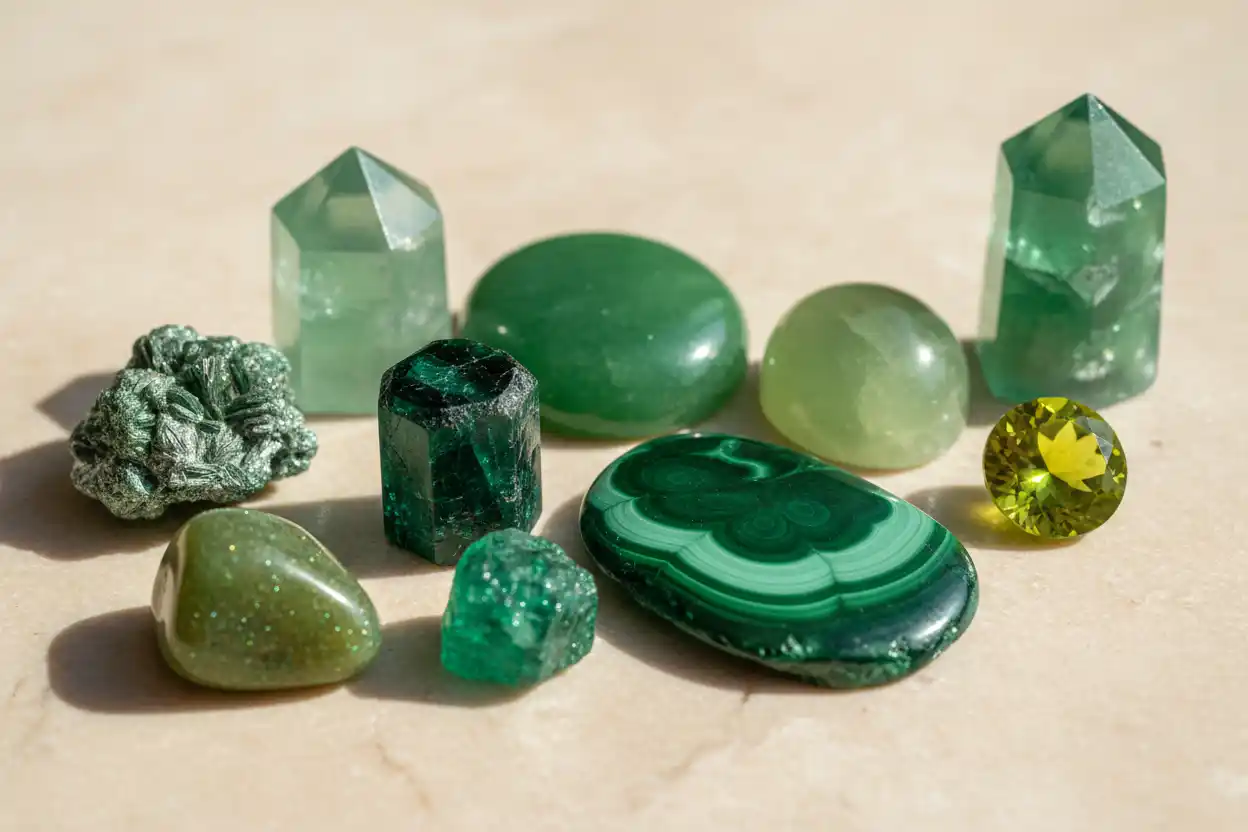
Green Crystals: Meanings and Complete List
Green crystals include everything from sparkling aventurine and transparent emerald to banded malachite, translucent prehnite and vivid green fluorite. Some are true mineral crystals, while others are rocks, microcrystalline materials or ornamental stones grouped under the broader commercial term “crystals.”
In modern color symbolism, green is commonly associated with growth, renewal, balance, nature and abundance. Crystal traditions often extend those themes into heart-chakra, prosperity and emotional-healing practices, although these meanings remain symbolic beliefs rather than scientifically established effects.
Green Crystals at a Glance
| Green Crystal | Material | Typical Appearance | Common Symbolic Theme |
|---|---|---|---|
| Green Aventurine | Quartz-rich material | Green with subtle shimmer | Opportunity, growth |
| Emerald | Beryl | Transparent vivid green | Renewal, wisdom |
| Jade | Jadeite or nephrite | Smooth green, often translucent to opaque | Harmony, longevity |
| Malachite | Copper carbonate | Banded bright and dark green | Transformation, boundaries |
| Green Calcite | Calcite | Pale translucent green | Renewal, reflection |
| Green Fluorite | Fluorite | Transparent to translucent green | Organization, discernment |
| Chrysoprase | Chalcedony | Apple-green translucent material | Renewal, openness |
| Moss Agate | Chalcedony | Clear to white with green dendritic inclusions | Nature, gradual growth |
| Prehnite | Calcium-aluminum silicate | Pale green, often translucent | Preparation, reflection |
| Peridot | Olivine | Transparent yellow-green | Renewal, optimism |
| Tsavorite | Grossular garnet | Bright transparent green | Vitality, confidence |
| Green Tourmaline | Tourmaline | Transparent green | Growth, balance |
| Fuchsite | Chromium-bearing mica | Sparkling pale to rich green | Recovery, perspective |
| Prasiolite | Green quartz | Transparent pale green | Clarity, renewal |
| Green Onyx | Trade material, commonly chalcedony/calcite context | Banded or even green | Steadiness, confidence |
| Epidote | Epidote | Pistachio to dark green | Growth, awareness |
| Dioptase | Copper silicate | Intense emerald-green crystals | Emotional symbolism, insight |
| Serpentine | Serpentine-group material | Yellow-green to deep green | Grounding, renewal |
This is a practical list of major green materials encountered in crystal collecting rather than every mineral species capable of appearing green.
What Does the Color Green Symbolize?
Green is visually linked with vegetation, spring and new growth.
For that reason, modern color symbolism commonly associates it with:
renewal, development, balance, fertility of ideas and connection with nature.
Crystal traditions often add abundance, luck and heart-centered symbolism.
Those meanings are cultural or personal.
The presence of green color does not establish that a mineral changes health, mood or financial circumstances.
A useful way to approach green-crystal symbolism is to treat each stone as a cue for a behavior or reflective question.
Green Aventurine
Green Aventurine is a quartz-rich material containing reflective mineral inclusions, commonly green chromium-bearing mica.
Its subtle sparkling effect is known as aventurescence.
Modern crystal traditions frequently call it the “stone of opportunity” and connect it with luck, growth and abundance.
A grounded interpretation is to let it represent noticing and acting on genuine opportunities rather than expecting the stone to alter probability.
Emerald
Emerald is the green variety of beryl and one of the world’s historically important gemstones.
Fine emerald displays saturated green to bluish-green color.
Unlike many inexpensive crystal-shop materials, emerald can also be a major fine-jewelry gemstone.
Traditional symbolism often involves renewal, wisdom, loyalty and growth.
Its green color makes the connection with renewal intuitive, although those associations remain separate from emerald’s measurable gemological properties.
Jade
Jade refers to two distinct gem materials: jadeite and nephrite.
Both are known for exceptional toughness and have been carved into tools, ceremonial objects, jewelry and artworks for thousands of years.
Green is the best-known jade color, although jade occurs in several others.
Cultural symbolism is particularly rich and varies between regions and historical traditions.
Common modern themes include harmony, prosperity, continuity and longevity.
These meanings should be understood in their cultural context rather than reduced to generic “crystal energy.”
Malachite
Malachite is a copper carbonate mineral recognizable by its bands and concentric patterns in light and dark green.
It is relatively soft and is generally used for cabochons, beads, carvings and decorative objects.
Modern crystal traditions often associate malachite with transformation and personal boundaries.
Its bold layered patterns make it a natural visual metaphor for change.
Because malachite contains copper, physical care and dust exposure during cutting are different issues from spiritual symbolism; polished jewelry should simply be handled according to proper material-care practices.
Green Calcite
Green Calcite is a pale green variety of calcite.
At Mohs 3, it is much softer than quartz.
Its gentle translucent appearance has made it popular for decorative specimens and meditation collections.
Modern symbolism commonly emphasizes release, renewal and emotional reflection.
Because calcite scratches easily and reacts with acids, its softness should be remembered when green stones are stored together.
Green Fluorite
Green Fluorite can range from pale mint through richer emerald-like green.
Fluorite is famous for well-formed crystals, fluorescence in some specimens and perfect cleavage.
At Mohs 4, it is relatively soft.
Crystal traditions commonly connect green fluorite with organization, clarity and discernment.
A grounded reflective use might involve sorting information into what is relevant, uncertain and unnecessary.
The mineral does not scientifically improve concentration.
Chrysoprase
Chrysoprase is an apple-green variety of chalcedony colored primarily by nickel-related components.
Fine material can be translucent with a remarkably even green appearance.
Modern crystal symbolism often associates chrysoprase with renewal, openness and compassion.
Because it belongs to the microcrystalline quartz family, it differs from emerald and jade despite superficial color similarities.
Moss Agate
Moss Agate is a chalcedony material containing green dendritic or moss-like inclusions.
Despite its name, it may lack the regular banding expected in classic agate.
Its visual resemblance to vegetation has made it one of the most obvious stones for symbolism involving nature and slow growth.
A practical use is to connect it with patience.
Plants develop through repeated small processes rather than one dramatic event, making moss agate a useful metaphor for gradual progress.
Prehnite
Prehnite commonly appears pale yellow-green to apple-green and may be translucent.
It can occur in botryoidal, crystalline and massive forms.
Modern crystal traditions frequently associate prehnite with preparation, reflection and creating order.
The symbolism can be translated into a simple question:
What can I prepare now instead of worrying about later?
That interpretation gives the stone a practical reflective role.
Peridot
Peridot is gem-quality olivine and is one of the relatively few gemstones whose characteristic color is naturally green.
Its appearance typically ranges from yellow-green to richer green.
Peridot is August’s traditional modern birthstone and has a long jewelry history.
Modern symbolism commonly involves renewal, optimism and releasing resentment.
Those interpretations belong to tradition rather than a medical or psychological effect.
Tsavorite Garnet
Tsavorite is a vivid green variety of grossular garnet.
Unlike many opaque crystal-shop materials, fine tsavorite is a transparent faceted gemstone capable of intense color and brilliance.
It is also durable enough for many jewelry formats.
Contemporary symbolism often links green garnets with confidence, vitality and growth.
Tsavorite can therefore appeal equally to collectors interested in gemology and people interested in green-color symbolism.
Green Tourmaline
Tourmaline occurs in a remarkable range of colors, including many shades of green.
Green tourmaline may range from yellowish green to deep bluish or forest green.
Some crystals are strongly pleochroic, meaning color appears different along different viewing directions.
Modern crystal traditions commonly associate green tourmaline with balance, growth and heart-centered themes.
Its symbolism varies because “green tourmaline” can include several different visual varieties within the broader tourmaline group.
Fuchsite
Fuchsite is chromium-bearing muscovite mica.
Its green color and glittering flaky structure make it easy to recognize in many specimens.
It is considerably softer than green aventurine, even though tiny fuchsite inclusions frequently help give aventurine its color.
Modern symbolic traditions often connect fuchsite with recovery, perspective and learning when to help without taking responsibility for everything.
This can be translated into practical boundary-setting rather than a healing guarantee.
Prasiolite
Prasiolite is green quartz.
It is often marketed as “green amethyst,” although prasiolite is the preferred gemstone name once the quartz is green.
Much commercial material is produced by heating or irradiation of suitable quartz material.
Its transparent pale green appearance differs from the opaque sparkle of aventurine.
Modern symbolism commonly emphasizes clarity, renewal and measured growth.
Green Onyx
Green Onyx is a trade term that requires care because commercial usage can vary.
Materials sold under the name may be chalcedony-family material or other banded ornamental stones, and treatment may be involved.
Its popularity comes largely from even or banded green color.
Modern symbolic traditions commonly connect it with confidence, steadiness and emotional balance.
Accurate material identification should come before metaphysical interpretation.
Epidote
Epidote commonly appears pistachio green, yellow-green or dark green.
Well-formed crystals can be striking, although much material is collected as specimens rather than mainstream fine jewelry.
Its modern symbolism frequently centers on growth, awareness and recognizing repetitive patterns.
A grounded practice could involve identifying one habit that produces an unwanted result and selecting a specific alternative behavior.
Dioptase
Dioptase produces some of the most vivid natural green crystals in mineral collecting.
Its intense emerald-like color comes from copper.
However, dioptase is relatively soft and has perfect cleavage, making fine crystals far more suitable for collections than rough daily jewelry wear.
Modern metaphysical traditions connect it with emotional awareness and compassion.
Collectors may appreciate it entirely for its extraordinary mineral color without attaching any symbolic meaning.
Serpentine
Serpentine refers to a mineral group that appears in shades ranging from yellow-green to deep green.
Massive serpentine is frequently carved and polished.
Some commercial materials are sold under jade-like trade names, which can cause confusion with true jade.
Modern crystal symbolism often centers on grounding, renewal and connection with nature.
Again, those associations do not change its actual mineral identity.
Green Crystals and the Heart Chakra
Green is the color most commonly associated with the heart chakra in modern chakra systems.
Consequently, emerald, green aventurine, jade, malachite, chrysoprase and several other green stones appear frequently in heart-chakra practices.
The connection is symbolic.
Chakras are spiritual frameworks rather than scientifically established anatomical structures.
A practical heart-centered exercise might use a green stone while reflecting on:
compassion, boundaries, reciprocity or communication within relationships.
The useful part is the reflection, not a claimed physiological energy transfer.
Green Crystals for Growth
Green aventurine, moss agate, epidote and jade are among the stones most commonly associated with growth.
Instead of asking which stone has the “strongest growth energy,” define what growth means.
It might mean:
developing a skill, becoming more consistent, recovering from a setback or changing how you respond to a recurring situation.
Once that is defined, the stone becomes a symbolic reminder of the chosen direction.
Green Crystals for Prosperity
Green aventurine, jade and emerald appear frequently in prosperity traditions.
There is no evidence that these gemstones create money or guarantee financial success.
Prosperity symbolism becomes more grounded when connected to behaviors such as:
finishing useful work, saving consistently, learning a valuable skill or evaluating opportunities carefully.
The gemstone can represent the intention, while financial outcomes remain dependent on real-world decisions and circumstances.
Green Crystals for Meditation
Different textures create different meditation experiences.
A smooth jade or aventurine palm stone provides tactile focus.
A fluorite cube or emerald crystal provides visual geometry.
A malachite cabochon offers complex patterns.
Choose the object that helps sustain attention.
Observe it for several minutes and notice color, surface, structure and changes under light.
No claim about invisible energy is needed for a mineral specimen to function as a meaningful meditation object.
How to Choose a Green Crystal
Start with identity.
A green stone might be quartz, fluorite, copper carbonate, feldspar, garnet, tourmaline or a completely different material.
Next, consider intended use.
A soft fluorite specimen can be excellent for display yet unsuitable for rough jewelry wear. Tsavorite may work beautifully as a faceted ring gemstone but cost far more than green aventurine.
Finally, choose symbolism only after you know what the material actually is.
That order keeps mineralogy and spiritual interpretation from becoming confused.
Frequently Asked Questions
1. What are the most popular green crystals?
Green aventurine, emerald, jade, malachite, green fluorite, green calcite, chrysoprase, moss agate, prehnite and peridot are among the best-known.
2. What do green crystals symbolize?
Modern traditions commonly associate green with growth, renewal, balance, abundance, nature and heart-centered themes.
3. Which green crystal is associated with luck?
Green aventurine is one of the stones most commonly described as a luck or opportunity crystal. That association is symbolic rather than scientifically demonstrated.
4. Which green crystal is associated with prosperity?
Green aventurine, jade and emerald frequently appear in prosperity traditions, although no gemstone guarantees financial results.
5. Which green crystals are associated with the heart chakra?
Green aventurine, jade, emerald, malachite and chrysoprase are commonly used in modern heart-chakra traditions.
6. Which green crystal is best for growth symbolism?
Moss agate, green aventurine and epidote are especially common choices because their modern symbolism strongly emphasizes development and renewal.
7. What is the brightest green crystal?
Dioptase can produce extraordinarily vivid emerald-green crystals, while tsavorite and emerald provide intense transparent green in gem-quality material.
8. Are all green crystals naturally green?
No. Many are naturally green, but commercial stones may also be dyed, coated, heated or otherwise treated.
9. Is jade a crystal?
Jadeite and nephrite are mineral materials with crystalline structures, although commercial “jade” terminology is often broader and can include imitations.
10. Is malachite safe to wear?
Polished malachite jewelry can be worn normally with appropriate care. Cutting or grinding rough malachite requires different precautions because mineral dust should not be inhaled.
11. Can green crystals heal anxiety or physical illness?
There is no reliable evidence that green crystals treat medical or psychological conditions. They can be used as personal objects during meditation or reflection.
12. How do I choose the right green crystal?
Identify the material accurately, consider durability and intended use, then choose the appearance or symbolic theme that has personal meaning for you.
Conclusion
Green crystals include materials from many different geological families. Aventurine combines quartz with reflective mica, emerald belongs to beryl, jade includes jadeite and nephrite, malachite is a copper mineral, while tsavorite belongs to the garnet group.
Their shared color creates a visual theme, not a shared mineral identity.
Modern spiritual traditions commonly connect that color with growth, renewal, abundance and the heart chakra. Those ideas can be meaningful when they are treated as symbolism rather than medical, financial or supernatural guarantees.
For collectors, the strongest approach is therefore to begin with geology and then add personal meaning. Know what the stone is, understand how it should be handled and let its symbolism serve as a reminder of actions or values you genuinely want to cultivate.
Disclaimer: Green-crystal healing, prosperity, chakra and metaphysical associations are cultural, spiritual or personal traditions rather than scientifically established effects. Crystals should not replace professional healthcare, mental-health care, financial guidance or practical decision-making.