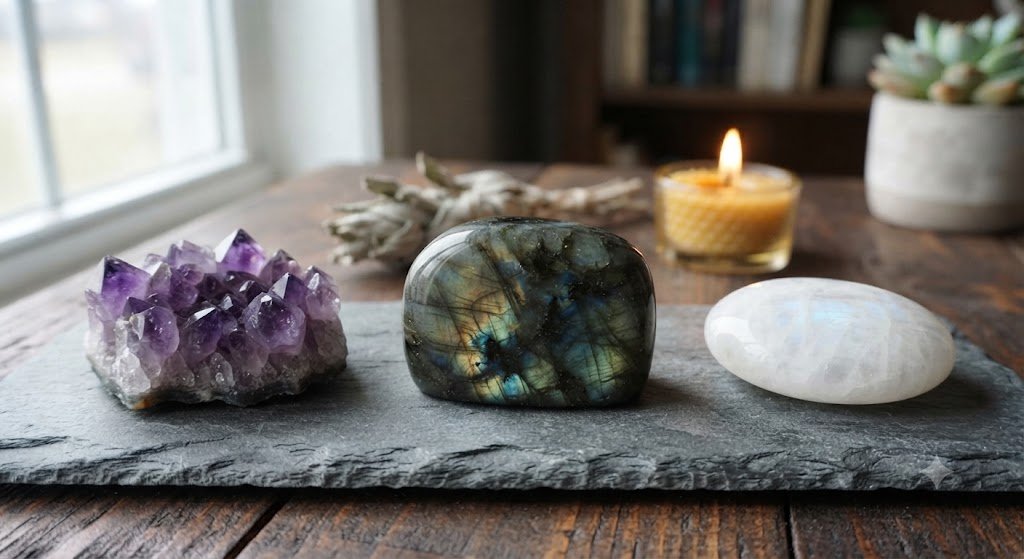
11 Best Crystals for Intuition: Positive Meanings & Powerful Everyday Uses
Crystals for intuition are traditionally used as symbols of reflection, pattern recognition, self-awareness, careful observation, and trusting conclusions that emerge after experience has been considered. They cannot provide supernatural certainty, reveal hidden facts, predict the future, or guarantee that an instinctive feeling is correct. Their most practical role is to slow a decision down enough for you to notice what you already know, distinguish evidence from assumption, and examine why a particular option feels right or wrong.
Amethyst, labradorite, moonstone, lapis lazuli, sodalite, iolite, fluorite, clear quartz, black obsidian, azurite, and apophyllite offer eleven distinct approaches to intuition symbolism. Some emphasize reflection, others changing perspective, organizing information, noticing inconsistencies, or becoming more honest about personal motives. Used carefully, these stones can support journaling and decision routines without turning intuition into fortune-telling or replacing evidence.
Amethyst, Sodalite, and Clear Quartz for Quiet Reflection and Clearer Decisions
Amethyst is purple quartz traditionally associated with reflection, restraint, perspective, and thoughtful choices. These themes fit intuition because many apparently instinctive judgments improve when a person pauses long enough to separate the first emotional reaction from the information behind it.
Traditional amethyst healing properties can be used as a reminder to delay a decision when there is no need to answer immediately. Sit with the question, write down the strongest reasons for each option, and notice whether the feeling changes once the situation is described clearly.
Intuition often includes knowledge that has not yet been put into words. Someone experienced in a profession may sense that a proposal contains a problem before identifying the exact flaw because years of pattern recognition are working quickly. The feeling becomes more useful when the underlying clues are examined instead of being treated as unquestionable truth.
Sodalite is a deep blue stone commonly associated with logic, truthfulness, and organizing thought. The traditions around sodalite healing properties make it a useful symbolic counterbalance to the idea that intuition must oppose analysis.
A sodalite stone beside a journal can represent checking whether an instinct is supported by observable information. What happened? What pattern have you seen before? Which assumption are you making? What evidence would change your mind?
Clear quartz adds symbolism around focus and intention. Traditional clear quartz healing properties can support defining the decision itself before trying to interpret an intuitive response. A vague question creates vague answers. A clear question makes it easier to see which facts and values actually matter.
Labradorite and Moonstone for Perspective, Change, and Uncertain Situations
Labradorite is a feldspar known for labradorescence, the flashes of blue, green, gold, orange, or other colors that can appear when the viewing angle changes. Its shifting appearance has made it strongly associated with transformation, imagination, and seeing circumstances from another perspective.
The themes around labradorite healing properties fit decisions where the first interpretation may not be the only one. A labradorite stone can serve as a cue to ask what changes if the situation is viewed from another person’s position or under a different assumption.
This approach does not require abandoning your original judgment. It simply tests whether it remains convincing after another perspective is considered.
Moonstone is another feldspar gem whose appearance changes with movement. Its adularescence creates a floating sheen across the stone, and traditional symbolism often connects it with cycles, transition, and adaptation.
Traditional moonstone healing properties can be applied when intuition concerns a changing situation rather than a fixed one. A decision that was correct several months ago may deserve reconsideration if responsibilities, relationships, finances, health, or available information have changed.
Moonstone can symbolize allowing a conclusion to evolve rather than treating consistency as a requirement to ignore new evidence.
Both labradorite and moonstone have feldspar cleavage and deserve protection from sharp impacts, especially in frequently worn rings.
Lapis Lazuli and Iolite for Personal Truth and Choosing a Direction
Lapis lazuli is a blue rock composed mainly of lazurite with varying amounts of calcite, pyrite, and other minerals. Its long cultural history has contributed to traditional associations with wisdom, truth, dignity, and self-knowledge.
The symbolism connected with lapis lazuli healing properties can support intuitive decisions where social pressure is strong. Sometimes uncertainty comes less from not knowing what you prefer and more from worrying about how other people will judge the choice.
A lapis stone can symbolize asking what you would decide if nobody were watching. That does not mean responsibilities to others should be ignored, but it can reveal whether your own values have disappeared from the decision.
Iolite commonly appears blue-violet and can show noticeably different colors from different viewing directions because of strong pleochroism. Its historical nickname as a navigation-related stone has contributed to symbolism around direction, independence, and finding a path through uncertainty.
Traditional iolite healing properties can support decisions involving several reasonable options. A stone beside a written comparison can symbolize choosing direction after enough information has been gathered rather than waiting for impossible certainty.
Some choices remain uncertain even after careful analysis. Intuition may then help identify which uncertainty you are more willing to accept.
Fluorite and Azurite for Patterns, Complexity, and Better Questions
Fluorite can occur in purple, green, blue, yellow, clear, and multicolor zoning and commonly forms highly geometric crystals. Traditional symbolism often emphasizes organization, learning, and bringing structure to complicated information.
The themes within fluorite healing properties can make intuition more useful when the problem contains too many moving parts. Instead of asking how you feel about the entire situation, divide it into separate questions.
If considering a job, for example, salary, workload, location, growth, management, stability, and personal interest may each deserve individual attention. A vague sense of discomfort may become understandable once one factor is isolated.
Azurite is a vivid blue copper mineral traditionally associated with insight, awareness, and deep reflection. The symbolism around azurite healing properties can support asking better questions rather than searching for mystical answers.
What information are you avoiding because it would complicate the decision? Which explanation feels convenient rather than convincing? What would you advise someone else in the same situation?
Azurite is relatively soft and contains copper. Polished stones are suited to ordinary external handling, but powders and homemade drinking preparations should be avoided.
Black Obsidian for Recognizing Bias, Fear, and Repeated Patterns
Black obsidian is natural volcanic glass with a glossy dark surface. Traditional symbolism commonly connects it with truth, self-examination, and confronting patterns that are uncomfortable to acknowledge.
The ideas around black obsidian healing properties can be useful when an intuitive feeling may actually be fear, habit, or a repeated assumption.
Suppose an opportunity immediately feels wrong. That reaction may reflect genuine warning signs, but it might also come from fear of change or memories of an unrelated earlier experience. A black obsidian stone can symbolize investigating the source rather than automatically obeying or dismissing the feeling.
Ask when the reaction first appeared, what specific feature triggered it, and whether similar feelings have been accurate in comparable situations.
This keeps intuition accountable without assuming it is useless.
Obsidian can form extremely sharp edges when broken, so smooth polished pieces are safer for frequent handling than damaged raw fragments.
Apophyllite for Observation Without Turning Reflection Into Prediction
Apophyllite commonly forms clear, white, green, or pale crystals with strong glassy luster. Traditional symbolism often connects it with awareness, insight, and contemplative practices.
The themes associated with apophyllite healing properties can fit quiet observation when the goal is to notice thoughts without immediately treating every thought as a message.
A short reflective session might involve placing the stone nearby, writing the question, sitting quietly for several minutes, and then recording whatever concerns, preferences, or possibilities came to mind.
The important step comes afterward: examine those ideas. Which are supported by evidence? Which reveal a value or fear? Which need more information?
Apophyllite is relatively soft and has perfect cleavage, so crystal clusters are better protected on a shelf or desk than carried loosely.
Intuition Is More Reliable When Experience and Evidence Support It
Intuition is often described as knowing without knowing how, but many intuitive judgments come from fast pattern recognition. Experience can allow the mind to notice subtle cues before conscious reasoning has fully explained them.
That does not make intuition infallible. Familiarity, bias, fear, wishful thinking, recent experiences, and incomplete information can all influence what feels intuitively true.
The traditions around crystals for clarity become useful when clarity means testing an instinct against reality.
Ask what evidence supports the feeling, what contradicts it, and what additional information would be useful. A good intuitive signal often becomes stronger when examined rather than collapsing under basic questions.
High-stakes decisions involving health, safety, finances, legal issues, or other serious consequences deserve more than intuition alone. Qualified advice and reliable evidence remain essential.
Distinguish Intuition From Anxiety, Impulse, and Wishful Thinking
Intuition can feel immediate, which makes it easy to confuse with other fast reactions. Anxiety may repeatedly predict danger without strong evidence. Impulse can create urgency around something you want now. Wishful thinking can make a preferred outcome feel more likely simply because you want it to happen.
A crystal routine can help by slowing the process.
Amethyst can symbolize waiting. Sodalite can mean check the logic. Black obsidian can mean examine the motive. Labradorite can mean consider another perspective.
The traditions around crystals for inner peace can support a calmer decision environment, but calmness itself does not prove that a conclusion is correct.
The aim is not to eliminate emotion. It is to understand how emotion is influencing the judgment.
A Simple Intuition Practice Should Produce Questions, Not Certainty
Choose one stone and one decision. Write the question clearly, then record your immediate response before analyzing it. Next, write down the facts that support that response and the facts that challenge it.
Consider what someone with an opposing view might notice. Identify any missing information. Then decide whether the choice needs to be made now or whether waiting would improve the decision.
A stone can mark each stage of that routine, but it should not be used as a yes-or-no oracle. Picking a crystal from a bag, interpreting its color, or waiting for a supposed energetic signal does not establish facts about the future.
The strongest intuition practice increases self-awareness while keeping reality checks intact.
Conclusion
Crystals for intuition can symbolize reflection, perspective, pattern recognition, truthfulness, direction, organization, and careful self-examination. Amethyst, labradorite, moonstone, lapis lazuli, sodalite, iolite, fluorite, clear quartz, black obsidian, azurite, and apophyllite each offer a different traditional theme. Their practical value comes from slowing decisions down, improving questions, and helping you examine what lies behind an instinctive response rather than treating intuition as guaranteed knowledge.
FAQs
Which crystals are traditionally associated with intuition?
Amethyst, labradorite, moonstone, lapis lazuli, iolite, azurite, and several other stones are commonly associated with intuition and insight traditions.
Can crystals improve intuition?
There is no established evidence that crystals directly increase intuitive ability. They can serve as prompts for reflection and careful observation.
Which crystal can symbolize clear intuitive decisions?
Amethyst, sodalite, and clear quartz are commonly associated with reflection, organization, and clarity.
Is labradorite associated with intuition?
Yes. Labradorite is traditionally linked with imagination, transformation, and changing perspective.
Can intuition predict the future?
Intuition can sometimes reflect experience and pattern recognition, but it does not provide reliable supernatural knowledge of future events.
How can I tell intuition from anxiety?
Examine the specific evidence behind the feeling, whether the same fear appears repeatedly across unrelated situations, and whether the judgment changes after calm reflection.
Which crystal can symbolize personal truth?
Lapis lazuli is commonly associated with truthfulness, wisdom, and self-knowledge.
Should I use crystals to make medical or financial decisions?
No. High-stakes decisions should rely on appropriate evidence and qualified advice rather than crystal interpretations.
What is a practical way to use an intuition crystal?
Use it beside a journal while recording your initial impression, supporting facts, opposing evidence, and any information still needed.
Crystal meanings and intuition associations are traditional or personal practices, not established methods for predicting events or obtaining hidden information.