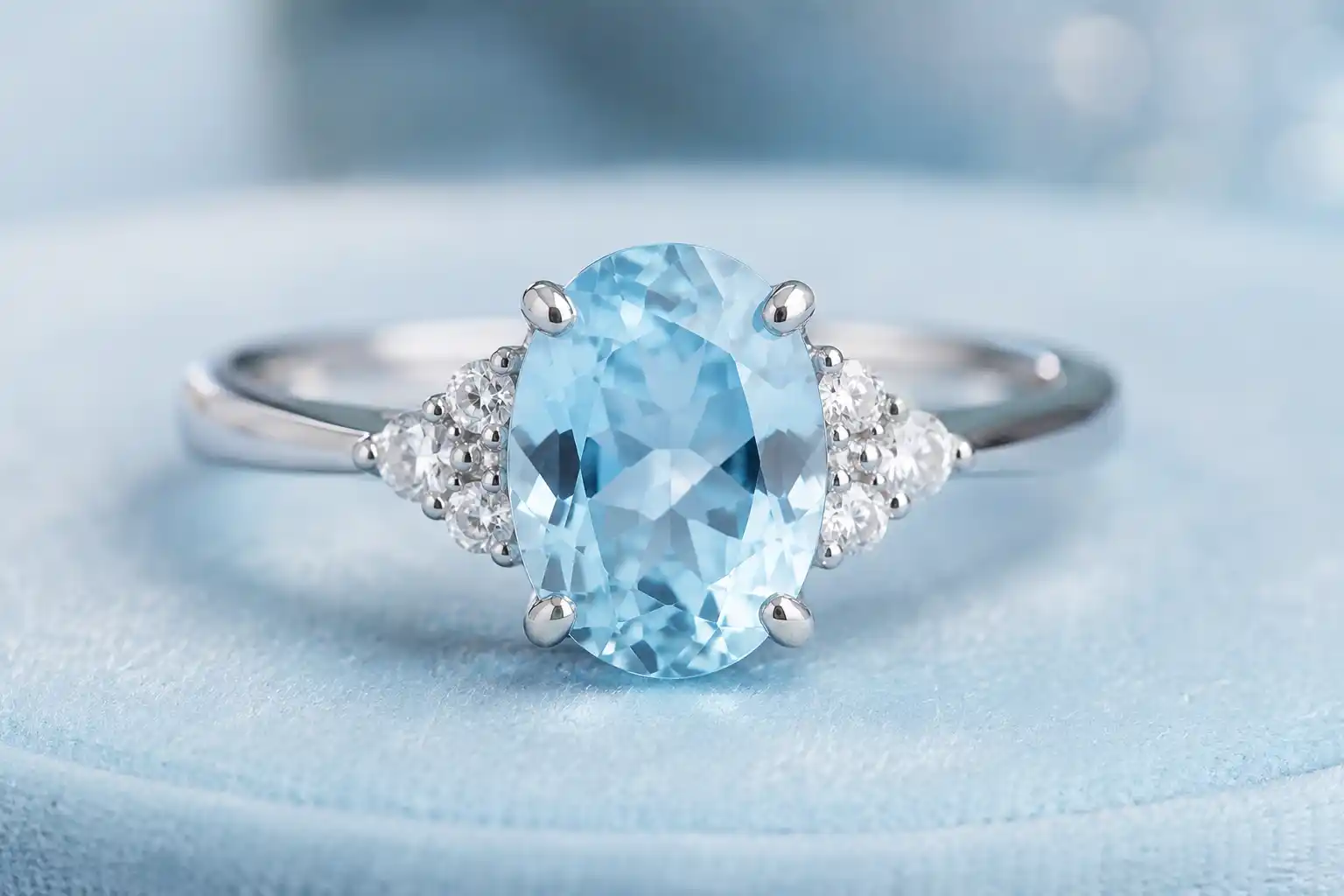
Aquamarine Ring: Styles, Settings & Buying Guide
An aquamarine ring combines transparent blue-to-greenish-blue beryl with enough hardness for practical jewelry, but the hand exposes a gemstone to far more abrasion, impacts, pressure, lotion, soap residue, and accidental contact than earrings or most pendants receive. Aquamarine ranks about 7.5–8 on the Mohs scale and generally has good jewelry durability, yet the success of an aquamarine ring depends heavily on setting height, girdle protection, prong condition, stone shape, shank strength, fit, treatment history, and how frequently the ring will be exposed to demanding activities.
That makes ring selection more specific than simply choosing the bluest stone within a budget. A large pale aquamarine can look dramatic in a cocktail ring, a medium oval can work beautifully in a low bezel, an emerald cut can create a clean architectural design, and a smaller stone can be recessed into a signet-style mounting for greater protection. Each design places different stresses on the aquamarine ring, so style and durability should be considered together.
The gemstone itself also needs careful evaluation. Fine aquamarine is normally transparent, relatively clean, attractively cut, and blue or greenish blue, while heating is commonly used to reduce greenish or yellowish components. Seller-created descriptions such as “AAA” do not represent a universal grading system, and color names or famous-source claims should never replace clear information about gemstone identity, treatment, dimensions, condition, and setting quality.
Aquamarine Ring at a Glance
| Feature | What Ring Buyers Should Know |
|---|---|
| Gemstone | Aquamarine, blue to greenish-blue beryl |
| Composition | Be₃Al₂Si₆O₁₈ |
| Mohs hardness | About 7.5–8 |
| Toughness | Generally good |
| Cleavage | Poor to indistinct |
| Common cuts | Oval, emerald, cushion, round, pear and specialty cuts |
| Practical settings | Bezel, semi-bezel, substantial prongs, recessed and low-profile designs |
| Common ring styles | Solitaire, halo, three-stone, cocktail, signet and cluster |
| Main gemstone concern | Repeated abrasion and concentrated impacts |
| Main setting concern | Worn prongs, exposed girdles and excessive height |
| Common treatment | Heating |
| Typical clarity | Often eye-clean in fine faceted stones |
| Main fit issue | Rotation from a heavy center or loose shank |
| Safest routine cleaning | Lukewarm water, mild soap and a soft brush |
| Buying priority | Match the stone and setting to the intended wear |
The wider aquamarine meaning guide covers the mineral’s identity, formation, symbolism, color chemistry, and general uses. This guide focuses on the decisions created specifically by wearing aquamarine on the hand.
Is Aquamarine Good for Rings?
Yes. Aquamarine is sufficiently hard and durable for many ring designs when the stone is mounted properly and worn with realistic care.
Its Mohs hardness of about 7.5–8 means aquamarine resists scratches better than quartz, feldspar, apatite, fluorite, opal, turquoise, and many ornamental stones. That places it comfortably within the range of gemstones used successfully in conventional jewelry.
Still, aquamarine is not sapphire or diamond.
Harder gemstones can scratch it, and a sufficiently strong impact can chip an exposed edge or facet junction. Rings also encounter more repeated surface contact than necklaces and earrings because the hands constantly interact with furniture, handles, tools, clothing hardware, bags, and other objects.
The gemstone hardness chart provides useful context for those differences.
An aquamarine ring intended for frequent wear therefore benefits from lower settings, protected corners, substantial metalwork, and a center stone whose fractures and girdle condition have been examined carefully.
Aquamarine Ring vs. Aquamarine Engagement Ring
A general aquamarine ring and an aquamarine engagement ring can use the same gemstone, but the design assumptions are different.
A cocktail ring, right-hand ring, fashion ring, heirloom piece, or occasional statement ring may be worn selectively, allowing taller profiles, larger stones, unusual cuts, and more delicate settings.
An aquamarine engagement ring is normally selected with much more intensive long-term wear in mind, so setting height, band compatibility, sizing flexibility, center-stone protection, and future repair become especially important.
For a general aquamarine ring, the most useful question is simpler:
How will this particular ring actually be worn?
Someone who intends to wear a large aquamarine only for dinners and formal events can reasonably choose a design that would be unnecessarily vulnerable for constant hand use.
Aquamarine Ring Styles Compared
| Ring Style | Main Advantage | Main Aquamarine-Specific Concern |
|---|---|---|
| Solitaire | Highlights one center stone | Exposed girdle and prong wear |
| Full bezel | Strong perimeter protection | Heavy metal can visually reduce pale color |
| Semi-bezel | Combines protection and openness | Uncovered edges remain vulnerable |
| Halo | Adds contrast and visual scale | Many small settings require maintenance |
| Three-stone | Creates a balanced wider design | Side stones can expose center edges or crowd fingers |
| Cocktail ring | Accommodates large aquamarines | Height, rotation and impact exposure |
| Signet-style | Low, smooth and protective | Deep settings can reduce light return |
| Cluster | Creates scale from smaller gems | Matching and cleaning are more complex |
| Band | Lower profile and repeated color | Small stone replacement and resizing can be difficult |
These are not interchangeable decorative labels. Each aquamarine ring style changes how the stone meets impacts, how the ring balances on the finger, and how easily the setting can be maintained.
Solitaire Aquamarine Ring
A solitaire aquamarine ring places nearly all visual attention on one gemstone.
Because aquamarine can occur in large transparent crystals, even a simple solitaire can produce substantial presence without requiring a halo or complicated side stones.
The center should sit securely but not unnecessarily high.
A tall basket increases leverage whenever the ring catches on clothing or strikes another object. A lower basket usually reduces snagging while still allowing enough space beneath the aquamarine for cleaning.
Four-prong settings expose more of the gemstone, which can make pale aquamarine look larger and lighter.
Six-prong settings add additional points of retention, particularly around round or suitable oval centers.
The prongs themselves matter more than the number.
Six extremely thin, worn prongs do not create a secure aquamarine ring merely because six are present.
Full-Bezel Aquamarine Ring
A bezel surrounds most or all of the gemstone’s perimeter with metal.
For an aquamarine ring intended for frequent wear, this is one of the most practical setting styles because the metal shields the girdle from many direct side impacts and creates a smooth profile that catches less readily on clothing.
A bezel can also protect the pointed end of a pear, corners of an emerald cut, or thinner girdle sections.
The trade-off is visual.
Aquamarine is frequently light in tone, so an excessively heavy metal rim can make a modest stone look smaller or visually muted.
A narrow, even bezel with an open back can preserve more apparent size and provide cleaning access while retaining useful protection.
The metal should follow the individual gemstone precisely. Uneven pressure over a surface-reaching fracture can create a structural weakness rather than improving security.
Semi-Bezel Aquamarine Ring
A semi-bezel protects selected portions of the aquamarine while leaving other edges more exposed.
This can create an attractive balance between a modern open appearance and useful mechanical protection.
The exposed sections deserve careful orientation.
If the ring receives most side impacts from particular directions, placing the least protected part of the gemstone exactly along those directions defeats much of the purpose.
A semi-bezel aquamarine ring also needs adequate metal thickness around the protected portions. Very thin decorative arcs may look like a bezel without providing substantial impact protection.
Halo Aquamarine Ring
A halo surrounds the center aquamarine with smaller gemstones, frequently diamonds or another colorless material.
The contrast can increase visual scale and create stronger brightness around a pale blue center.
A low integrated halo can also protect portions of the aquamarine’s perimeter.
However, a halo aquamarine ring contains many more individual settings than a solitaire, and every small accent stone introduces another prong or bead that can loosen.
Cleaning becomes more important as well.
Soap, lotion, skin oils, and debris can collect between the center stone and halo, gradually reducing brightness.
Very pale aquamarine should be evaluated in the completed halo rather than as a loose stone. Bright white accent diamonds can sometimes make an extremely pale center appear less saturated by comparison.
Three-Stone Aquamarine Ring
Three-stone designs can combine a central aquamarine with diamonds, sapphires, smaller aquamarines, or other complementary gems.
Diamond side stones create strong brilliance and color contrast.
Aquamarine side stones create a unified blue composition, although smaller stones may look paler than the center because aquamarine color often becomes more noticeable through larger volumes of material.
Width matters.
Oversized side stones can make an aquamarine ring uncomfortable between neighboring fingers, while side settings that project too far can strike adjacent rings.
The mounting should also prevent hard diamond edges from making unnecessary direct contact with the aquamarine center.
Aquamarine Cocktail Ring
Aquamarine is particularly suited to cocktail rings because large transparent stones are available in many shapes.
Broad cushions, long emerald cuts, ovals, fantasy cuts, and substantial pears can all create dramatic designs.
A cocktail aquamarine ring does not need to imitate the engineering of a low-profile frequent-wear ring because the intended use is often more selective.
Even so, balance matters.
A large gemstone set on a very narrow shank can rotate constantly toward the side of the finger. The setting may also feel unstable because most of the weight sits high above a small metal base.
A somewhat wider shank distributes weight more effectively.
High cocktail settings should also be checked from the side. A beautiful face-up view can conceal a pavilion that projects deeply enough to press into the finger or make the ring unnecessarily tall.
Signet and Recessed Aquamarine Rings
A signet-style aquamarine ring can place a small or medium stone close to the finger inside substantial surrounding metal.
Flush, gypsy, recessed-bezel, and similar construction styles reduce snagging and can provide excellent protection for frequent wear.
This approach works especially well for geometric, minimalist, and unisex designs.
There is a trade-off with pale aquamarine.
If a gemstone sits very deeply inside solid metal, less light reaches the pavilion and the blue may appear weaker.
The setting should therefore protect the gem without burying it so completely that transparency and color disappear.
Cleaning access is another consideration. Lotion and debris can accumulate beneath a deeply recessed transparent stone if the back is completely inaccessible.
Aquamarine Cluster Ring
A cluster aquamarine ring creates visual presence through several smaller stones rather than one large center.
This can produce flowers, geometric arrangements, domes, asymmetrical designs, or repeated blue patterns.
Matching becomes important when the design is supposed to appear uniform.
Small aquamarines should coordinate in hue, tone, face-up size, and brightness.
A cluster made from pale calibrated stones may look much lighter than a solitaire using a larger gem, even when all material is genuine aquamarine.
Maintenance also increases because a cluster contains many more small settings and spaces where residue can accumulate.
If one aquamarine is lost, replacing it convincingly requires matching color, dimensions, and cutting to its neighbors.
Aquamarine Band Rings
Small aquamarines can be arranged across part or all of a ring band.
Half-set designs usually allow more resizing flexibility because part of the shank remains plain.
Full-set bands create continuous color but can be much more difficult to resize because gemstones and settings extend around the circumference.
Stone replacement is another concern.
If the original aquamarines have a particular pale blue or greenish-blue tone, finding one calibrated replacement that disappears naturally into the sequence can be surprisingly difficult.
For a band-style aquamarine ring, ask about future servicing before assuming the design can be altered easily.
Choosing Aquamarine Color for a Ring
Aquamarine naturally ranges from pale greenish blue through blue-green to stronger blue.
Commercial demand often favors a relatively clean blue appearance with useful saturation, although personal preference remains important.
A ring creates a special color challenge because skin, metal, surrounding stones, and lighting all influence the appearance.
A pale aquamarine in white metal may produce an intentionally icy look.
The same stone in yellow gold can appear more distinctly blue because the warm metal creates stronger contrast.
A medium-blue aquamarine surrounded by bright diamonds may look softer than it did loose because the colorless halo establishes a more brilliant visual reference.
Evaluate the entire aquamarine ring rather than choosing the center stone independently from the design.
Aquamarine Color Under Different Lighting
An aquamarine ring can appear different under cool retail lighting, ordinary indoor light, diffuse natural light, and photographic flash.
This is normal.
The problem arises when marketing photographs depend on one highly favorable setup to create a color that the gemstone rarely displays in ordinary wear.
Video is particularly useful when buying an aquamarine ring online because movement shows whether the blue remains convincing as the lighting angle changes.
Avoid judging color from one dark-background photograph.
Pale material can look dramatically stronger against black than it does against skin.
Heat-Treated Aquamarine Rings
Heating is common in aquamarine and generally reduces greenish or yellowish components, leaving a cleaner blue appearance.
A heated aquamarine ring still contains genuine aquamarine.
The treatment is widely accepted, but known enhancement should still be disclosed so the buyer understands what is being purchased.
Heating should not be confused with fracture filling.
A fracture-filled stone contains material introduced into surface-reaching breaks, which can have different cleaning and repair limitations.
The dedicated treated aquamarine guide separates routine heating from less common enhancements, laboratory-grown material, and treatment-detection limitations.
Aquamarine Ring Clarity
Fine faceted aquamarine is generally expected to appear eye-clean because relatively transparent rough is available.
That does not mean microscopic inclusions make an aquamarine ring poor quality.
A small enclosed crystal, tube, or internal feature may have almost no effect on beauty or durability.
Surface-reaching fractures deserve greater attention.
A fracture positioned directly beneath a prong, near a vulnerable corner, or along a thin girdle can become more important when the ring receives impact.
For an expensive aquamarine ring, examine the center stone from several directions before mounting when possible.
A setting can hide chips or fractures that later become important during repair.
Aquamarine Cut Quality
Aquamarine’s transparency makes cutting defects relatively obvious.
A shallow stone may show a window through the center, allowing the viewer to see the finger or setting beneath it.
A very deep stone can hide significant weight below the girdle without adding equivalent face-up size.
Neither problem is fixed by having a high carat number.
When comparing two aquamarine rings, look at the center stone’s length and width in millimeters alongside its weight.
A slightly lighter stone with better spread, balanced proportions, and stronger light return can produce a much more impressive ring.
The same principle helps when evaluating the broader factors behind aquamarine price.
Oval Aquamarine Ring
Oval cuts are popular because they create substantial face-up spread and have no sharp corners.
They work in solitaire, halo, bezel, and three-stone settings.
Look for balanced shoulders and even symmetry.
An oval that becomes extremely narrow may look pinched, while a very broad oval loses much of the elongated character.
Bow-tie darkness can appear through the center of elongated brilliant cuts.
A small moving bow tie is not automatically a problem, but a broad dark band that dominates the stone under most lighting weakens the appearance.
Emerald-Cut Aquamarine Ring
Emerald cuts suit aquamarine particularly well because clean transparent material can support long step facets.
The cut creates broad flashes rather than intense scintillation and gives the ring a geometric, architectural appearance.
Clarity and windowing become especially easy to see.
A poorly cut emerald aquamarine may look like a transparent blue pane.
Corner protection also matters. The clipped corners reduce the sharpness of a true rectangle, but the stone still benefits from carefully positioned prongs or bezel sections.
An emerald-cut aquamarine ring usually looks best when the setting reinforces the clean geometry instead of crowding the stone with irregular metalwork.
Cushion Aquamarine Ring
Cushion cuts combine a square or rectangular outline with softened corners.
This shape is mechanically convenient because it avoids the pronounced points found in pears or marquises.
Cushion faceting varies widely.
Some aquamarines display large broad flashes, while others use more fragmented brilliant patterns.
Neither is universally better.
The important qualities are even brightness, pleasing symmetry, sufficient blue color, and proportions that do not hide unnecessary weight beneath the setting.
Pear-Shaped Aquamarine Ring
Pear-shaped aquamarine creates a strong directional look and can make a gemstone appear visually large.
The point is the main vulnerability.
A V-prong, partial bezel, or another purpose-built protective element is preferable to leaving the tip fully exposed.
The pear should also be symmetrical.
One shoulder that is much fuller than the other can make the entire aquamarine ring look tilted even when the stone is set straight.
A high-set pear is particularly vulnerable because the point can catch on clothing and receive direct blows.
Round Aquamarine Ring
Round aquamarine provides symmetry, straightforward setting options, and no pointed corner.
It works especially well in six-prong solitaires, bezels, halos, and low-profile designs.
Round cutting may sacrifice more rough than shapes that follow aquamarine’s naturally elongated crystal habit, which is one reason elongated cuts are especially common.
Still, a well-proportioned round aquamarine ring can be an excellent choice when balance, setting security, and a traditional outline matter more than maximizing finished weight.
Fantasy and Custom Cuts
Aquamarine’s availability in clean, larger rough makes it popular with specialist cutters who create concave, freeform, shield, kite, geometric, and fantasy designs.
These cuts can be visually exceptional.
They can also create new setting problems.
Sharp projections, thin tips, deep carved areas, or unusual girdles may require a custom mounting rather than a standard commercial setting.
Before buying a fantasy-cut aquamarine ring, confirm that the mounting was designed for that particular stone instead of forcing an unusual gemstone into a generic basket.
Replacement can also be difficult because an identical custom-cut stone may not exist if the original is lost or badly damaged.
Ring Setting Height
Setting height changes both appearance and risk.
A tall aquamarine ring can look dramatic and allow a large center to dominate the design, but height also increases leverage during impacts and creates more opportunities to snag clothing.
Low settings generally work better for frequent wear.
The stone should not sit so low that its pavilion presses painfully into the finger or becomes impossible to clean.
The best profile provides enough clearance for the gemstone and setting structure without lifting the center farther above the hand than necessary.
Prong Condition
Prongs wear gradually.
A secure aquamarine ring can become unsafe long before the center stone visibly moves.
Look for prongs that appear thin, flattened, lifted, crooked, or noticeably different from their neighbors.
If the ring begins catching fabric more often, a prong may have shifted.
A stone that clicks when touched requires immediate attention.
Do not test looseness aggressively by pushing the aquamarine from side to side. Gentle inspection is sufficient, and a jeweler can evaluate the mounting without adding unnecessary stress.
Shank Strength
A large aquamarine requires a shank capable of supporting the setting.
Extremely thin bands can twist under repeated use, particularly when a large center or heavy halo makes the top of the aquamarine ring much heavier than the lower shank.
A substantial band does not need to look bulky.
Tapering can create a delicate appearance near the gemstone while retaining enough metal where strength and future sizing matter.
Inspect the bottom of a pre-owned ring especially carefully because that part of the shank often receives the greatest gradual wear.
Why Aquamarine Rings Spin
A top-heavy aquamarine ring can rotate repeatedly toward the side or palm.
Common causes include a large gemstone, tall setting, narrow band, loose fit, or a finger that is considerably narrower below the knuckle.
A large cocktail ring may spin even when its nominal size is correct.
Possible solutions include modest sizing adjustment, a wider shank, sizing beads, or changes to the setting profile.
Making the ring painfully tight is not a good solution.
Comfort, circulation, and the ability to remove the ring still matter.
Choosing the Correct Ring Size
Ring sizing depends on more than one numerical measurement.
Wide bands usually feel tighter than narrow ones.
A large aquamarine setting may require a more stable fit than a lightweight plain band.
Knuckle size can also complicate the decision because a ring must pass over the knuckle while remaining secure lower on the finger.
When buying an aquamarine ring online, use a properly measured ring size rather than estimating from another person’s general body size.
If the design is difficult to resize, accurate initial sizing becomes even more important.
Resizing an Aquamarine Ring
Many straightforward aquamarine solitaire rings can be resized within reasonable limits.
Complex designs can be more difficult.
Pavé extending around most of the shank, full-set bands, tension-style mountings, unusual metalwork, and intricate engraving can all restrict resizing.
The aquamarine may also need to be removed during significant work so it is not exposed unnecessarily to heat or mechanical stress.
Ask about resizing before purchase rather than assuming every aquamarine ring can be altered substantially later.
Metal Choices for Aquamarine Rings
White Gold
White gold creates a cool background that blends naturally with blue aquamarine.
Many white-gold rings use rhodium plating to create a brighter surface, and that finish can wear gradually.
Yellow Gold
Yellow gold creates strong warm contrast and can make pale aquamarine appear more distinctly blue.
It also works well for vintage-inspired and high-contrast designs.
Rose Gold
Rose gold introduces a pink-toned contrast that can make icy aquamarine look softer and more distinctive.
Platinum
Platinum is naturally white, dense, and commonly used for substantial fine-jewelry settings.
Its weight can become noticeable in a large aquamarine ring, but it also provides a strong structural foundation when the design is engineered well.
Metal should be chosen for construction, comfort, maintenance, and appearance rather than gemstone color alone.
Aquamarine Ring vs. Blue Topaz Ring
Blue topaz is one of the most common aquamarine lookalikes.
Both can appear pale blue or stronger blue, but they are different minerals.
Topaz has hardness 8 and perfect cleavage, while aquamarine belongs to the beryl family and has different optical properties, density, and treatment patterns.
Commercial blue topaz is also widely treated to produce its familiar color.
The direct aquamarine vs blue topaz comparison explains the measurable differences and identification limits.
For ring buyers, the important point is simple: do not pay an aquamarine price merely because a blue stone looks like aquamarine in a photograph.
Natural, Laboratory-Grown, and Imitation Aquamarine
Natural aquamarine formed through geological processes.
Laboratory-grown aquamarine is manufactured beryl with the relevant material identity but a different origin.
Imitations are different materials altogether.
Blue glass, synthetic spinel, topaz, apatite, and other stones can reproduce aspects of aquamarine’s appearance.
Small mounted stones can be particularly difficult to identify visually because the setting hides useful surfaces and measurements.
The real vs fake aquamarine guide explains why nondestructive gemological testing is more reliable than scratch tests, heat tests, or other damaging home methods.
Seller-Created Grades
Terms such as “AAA,” “AAAA,” “premium,” or “investment grade” should not determine what you pay for an aquamarine ring.
There is no universal aquamarine quality scale represented by those labels.
Evaluate the center stone directly.
Look at color, transparency, cutting, face-up dimensions, inclusions, condition, known treatment, and whether the stone is natural or laboratory grown.
Then inspect the ring.
Metal fineness, setting construction, shank dimensions, accent stones, craftsmanship, sizing, and repairability all contribute to the finished value.
A high seller-created grade cannot correct a large window, poor setting, or weak shank.
Buying an Aquamarine Ring Online
Online listings should provide enough information to evaluate both gemstone and mounting.
For the center aquamarine, look for:
- carat weight
- millimeter dimensions
- treatment disclosure
- natural or laboratory-grown origin
- neutral-light photographs
- face-up and side views
- visible clarity and condition
For the ring itself, check:
- metal fineness
- setting type
- profile height
- shank width
- ring size
- resizing limits
- accent-stone identity
- return terms
Video is particularly useful because an aquamarine ring can look dramatically different when it moves. Video reveals color consistency, windowing, extinction, setting height, and whether a large center dominates the ring unnaturally.
Does an Aquamarine Ring Need a Laboratory Report?
Most ordinary aquamarine rings do not require an independent laboratory report.
Documentation becomes more useful when a substantial premium depends on natural origin, claimed lack of treatment, unusual provenance, exceptional color, laboratory-grown versus natural distinction, or uncertainty about gemstone identity.
Aquamarine does not have one universal consumer quality-grading system equivalent to diamond grading.
An identification report can clarify material and treatment characteristics without automatically assigning the gemstone a retail value.
For routine commercial jewelry, trustworthy disclosure and a strong return policy may be more important than expensive documentation.
Aquamarine Ring Value
Finished ring value combines gemstone quality with jewelry construction.
The aquamarine contributes color, clarity, size, cut, treatment, and condition.
The mounting contributes precious-metal content, accent stones, design, fabrication, setting labor, finish, and brand positioning.
This is why two rings containing similarly sized aquamarines can have very different prices.
A well-built low-profile platinum ring with a strong blue center may reasonably cost far more than a light silver ring containing a larger but pale commercial stone.
Price comparisons should involve genuinely similar jewelry rather than center-stone carat weight alone.
Pre-Owned Aquamarine Rings
Pre-owned rings can offer good value when condition is understood.
Inspect:
- worn or rebuilt prongs
- thinned shank
- old solder repairs
- replacement side stones
- chips on the aquamarine girdle
- scratches and facet wear
- changed sizing areas
- loose pavé
- distorted bezels
- worn plating
A replacement aquamarine may not match the original design perfectly.
That does not automatically make the ring undesirable, but restoration history should be reflected in the description.
Older closed-back settings also require conservative cleaning because the construction may include components that would not be used in a straightforward modern mounting.
Frequent Wear vs. Occasional Wear
An aquamarine ring intended for frequent wear should prioritize low profile, protected edges, substantial prongs or bezel construction, secure fit, and straightforward maintenance.
An occasional-wear ring can prioritize dramatic scale, tall architecture, delicate openwork, or unusual cutting because the gemstone spends much less time exposed to ordinary hand contact.
The same aquamarine can therefore be appropriate in one setting and unnecessarily vulnerable in another.
Do not judge the gemstone separately from the wear pattern.
When to Remove an Aquamarine Ring
Remove an aquamarine ring before activities involving heavy impacts, abrasive materials, tools, or strong household chemicals.
Strength training can trap a ring against hard metal equipment.
Gardening introduces grit capable of abrading both gem and metal.
Household cleaning can expose the setting to aggressive chemicals and create impact against sinks or counters.
Swimming adds another loss risk because fingers can change size and jewelry may catch on equipment.
Removing the ring for high-risk tasks is simpler than relying on gemstone hardness to protect every component.
Aquamarine Ring and Other Rings
Stacking can expose aquamarine to harder gemstones.
Diamond, ruby, and sapphire can scratch aquamarine when their exposed edges rub directly against it.
Two rings can also wear each other’s metal settings even when the gemstones never touch.
If an aquamarine ring is worn beside another band, check where the two pieces contact.
A small gap or compatible profile can reduce abrasion, while poorly matched settings may grind against each other continuously.
How to Clean an Aquamarine Ring
For most stable aquamarine rings, lukewarm water, mild soap, and a soft brush provide the safest routine cleaning method.
Inspect the setting first.
If the stone moves, a prong appears lifted, the bezel is distorted, or an accent stone is loose, repair should come before cleaning.
Brush gently beneath the aquamarine, where skin oil, lotion, soap film, and debris commonly collect.
Transparent stones can lose substantial brightness when the pavilion becomes coated even though the gemstone itself remains completely undamaged.
Rinse carefully and dry with a soft cloth.
Heat and aggressive chemicals are unnecessary.
Ultrasonic and Steam Cleaning
Some uncomplicated aquamarines in sound settings may tolerate ultrasonic or steam cleaning, but those methods should not become automatic.
Liquid inclusions, fractures, rare fracture filling, weakened settings, antique construction, adhesives, or sensitive companion gemstones can make mechanical vibration or heat inappropriate.
Warm soapy water remains the conservative option when the treatment history or internal condition is uncertain.
That method is sufficient for most routine aquamarine ring care.
Storing an Aquamarine Ring
Store aquamarine separately from harder gemstones.
Diamond, sapphire, ruby, and topaz can scratch aquamarine if pieces rub together inside a jewelry box.
A padded individual compartment or soft pouch works well.
Do not place several rings loose in one small container where prongs, shanks, and gemstones repeatedly strike one another.
Close ring boxes carefully so tall settings are not compressed by the lid.
For large cocktail rings, confirm that the compartment has enough height to accommodate the center stone without pressure.
Aquamarine Ring Symbolism
Aquamarine traditionally carries associations with clear communication, courage, calmness, loyalty, and adaptation, themes influenced strongly by its blue-to-greenish-blue color and historical relationship with maritime symbolism.
An aquamarine ring keeps the gemstone visible on the hand, which can make those associations easy to connect with a personal routine.
Someone might use the ring as a reminder to pause before reacting, communicate a boundary clearly, ask a question instead of assuming the answer, or approach a difficult change deliberately.
These are symbolic interpretations.
Aquamarine does not scientifically regulate emotion, guarantee loyalty, protect relationships, or control another person’s behavior.
At Gems Lore, an aquamarine ring is most meaningful when its symbolism reflects an intention the wearer chooses to practice, while the gemstone itself is judged through real durability, identification, treatment, and construction considerations.
Frequently Asked Questions
Is an aquamarine ring suitable for frequent wear?
Yes. Aquamarine has hardness around 7.5–8 and generally good jewelry durability. Frequent-wear rings benefit from a protective setting, secure fit, and removal during activities involving heavy impact or abrasive materials.
What is the best setting for an aquamarine ring?
A full bezel provides strong perimeter protection, while low six-prong settings, semi-bezels, recessed mountings, and well-designed halos can also work effectively. The best choice depends on the gemstone shape and intended wear.
Are aquamarine rings easy to scratch?
Aquamarine is fairly resistant to scratches but is not immune. Sapphire, ruby, diamond, topaz, and other harder materials can abrade it.
Can aquamarine chip?
Yes. A strong concentrated impact can chip an edge, point, girdle, or facet junction even though aquamarine generally performs well in jewelry.
Is a bezel better than prongs for aquamarine?
A bezel provides greater perimeter protection and reduced snagging. Prongs expose more of the gemstone and can create a lighter appearance. Neither is universally better; wear pattern should determine the choice.
Is a four-prong aquamarine ring secure?
It can be when the prongs are substantial, correctly placed, and maintained. Four prongs expose wider sections of the girdle than a six-prong design.
Is an aquamarine cocktail ring practical?
Yes for selective wear. Large aquamarines work particularly well in cocktail rings, but tall settings and heavy centers are less suitable for demanding hand activity.
Why does my aquamarine ring spin?
A large center, tall mounting, narrow shank, loose size, or substantial difference between knuckle and finger-base size can make the ring top-heavy and prone to rotation.
Which aquamarine cut is best for rings?
Oval, cushion, round, emerald, and pear cuts can all work well. Rounded shapes avoid vulnerable points, while pear tips and step-cut corners deserve stronger protection.
Is emerald-cut aquamarine durable?
The material has the same basic aquamarine durability regardless of cut, but emerald-cut corners and girdle sections should be protected appropriately by the setting.
Why does my aquamarine look almost colorless?
Aquamarine naturally occurs in pale tones, and smaller stones often show less obvious color. Lighting, cutting, setting metal, skin, and photographic conditions also influence perceived saturation.
Is greenish-blue aquamarine genuine?
Yes. Greenish-blue is a natural aquamarine color. Heating is frequently used to reduce green or yellow components when a cleaner blue appearance is desired.
Is heated aquamarine real?
Yes. Heating commonly modifies aquamarine color while leaving the material genuine beryl. Known treatment should still be disclosed.
What does AAA aquamarine mean?
There is no universal AAA grading standard for aquamarine. The term usually represents a seller’s internal quality description and should not replace examination of color, clarity, cut, dimensions, treatment, and condition.
Can a lab-grown aquamarine be used in a ring?
Yes. Laboratory-grown aquamarine can function as jewelry material, but its manufactured origin should be disclosed clearly rather than represented as natural.
Can blue topaz look like aquamarine in a ring?
Yes. Their color ranges can overlap, but the minerals have different optical properties, density, cleavage, treatments, and chemistry. Color alone does not establish identity.
Does an aquamarine ring need certification?
Not necessarily. Independent identification becomes more useful when substantial value depends on natural origin, unusual treatment claims, provenance, or uncertainty about the gemstone’s identity.
Can an aquamarine ring be resized?
Many straightforward designs can be resized, but full-set bands, extensive pavé, tension settings, and complex multi-stone rings may have significant limitations.
Can I stack aquamarine with a diamond ring?
Yes, but avoid direct repeated rubbing between exposed diamond surfaces and aquamarine because diamond can scratch it. The metal settings should also be checked for contact wear.
What is the safest way to clean an aquamarine ring?
Lukewarm water, mild soap, and a soft brush are appropriate for most stable pieces. Inspect the setting first and use more conservative care when fractures, filling, antique construction, or loose components are present.
What should I prioritize when buying an aquamarine ring?
Prioritize attractive color under realistic lighting, competent cutting, sound gemstone condition, a setting matched to intended wear, secure prongs or bezel work, comfortable fit, adequate shank strength, treatment disclosure, clear gemstone identity, and practical resizing or repair options.
An aquamarine ring can combine substantial transparent blue color with useful jewelry durability, but its quality is determined by more than the center stone. Rings expose aquamarine to repeated contact that necklaces and earrings largely avoid, so the strongest designs protect vulnerable edges, control setting height, use enough metal to remain structurally stable, fit the finger properly, and allow realistic cleaning and future repair. When color, cut, shape, treatment, setting, shank, fit, and intended wear are evaluated together, an aquamarine ring can remain both visually distinctive and physically appropriate for the role it is expected to perform.