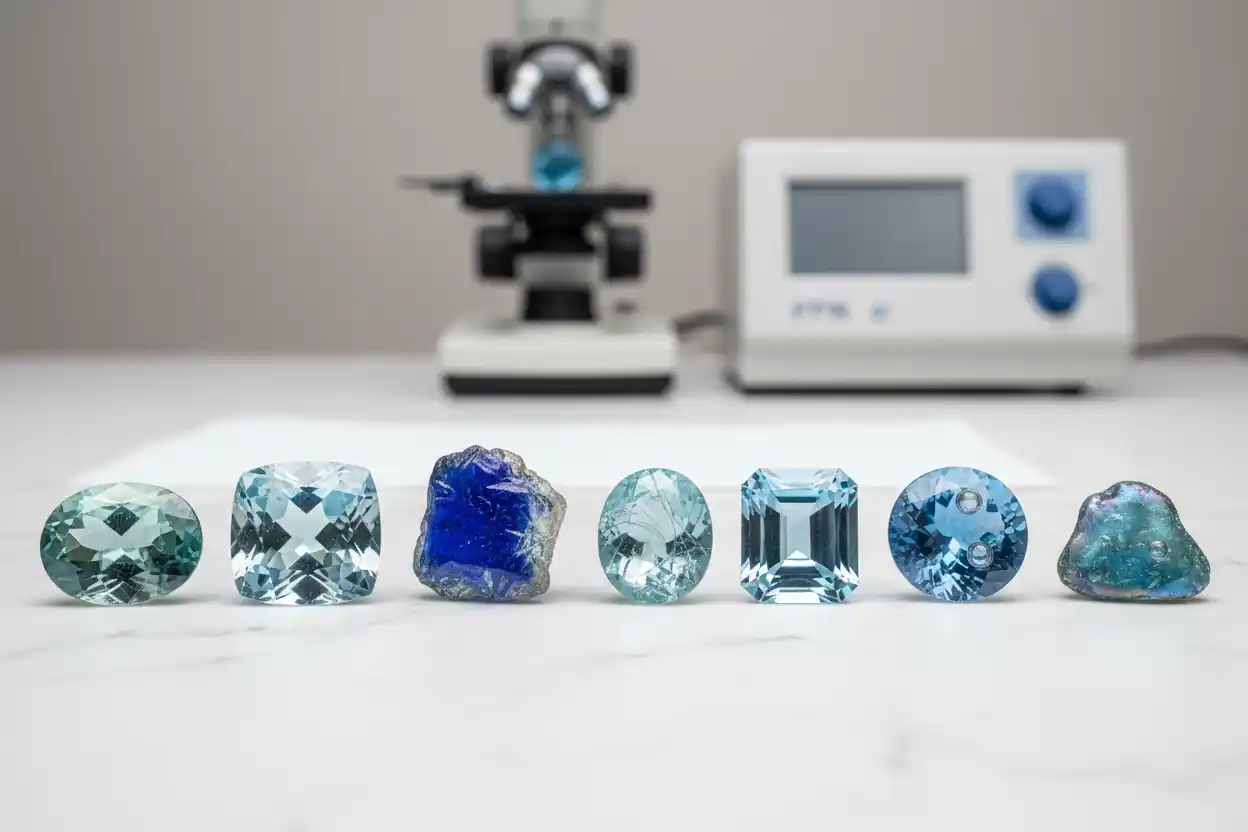
How to Spot Treated or Synthetic Aquamarine
Aquamarine is the greenish-blue to blue variety of beryl. Most commercial stones are naturally formed crystals whose color has either remained untreated or been modified through heat to reduce green and yellow components.
Heat treatment is accepted and generally stable, but it is not the only process buyers may encounter. Aquamarine can also contain polymer-filled fractures, while unusually dark blue beryl may owe its color to irradiation rather than the iron-related mechanism associated with ordinary Aquamarine. Coatings, dye, backing, and composite construction occur less routinely but still require consideration.
Hydrothermal synthetic blue beryl presents a different challenge. Because it reproduces beryl’s crystal structure and basic composition, its hardness, refractive index, density, and ordinary appearance can overlap natural Aquamarine closely.
A reliable examination therefore begins by confirming beryl, then distinguishes natural from laboratory-grown origin, and finally evaluates heat, irradiation, filling, coating, and construction as separate questions.
Aquamarine treatment categories at a glance
| Product category | What it is | Common evidence | Correct description |
|---|---|---|---|
| Natural-color Aquamarine | Naturally formed greenish-blue or blue beryl | Beryl properties and natural inclusions | Natural Aquamarine |
| Heat-treated Aquamarine | Natural beryl heated to reduce green or yellow | Purer blue color; altered inclusions may occur | Heated natural Aquamarine |
| Maxixe-type blue beryl | Beryl colored by radiation-induced centers | Very dark blue, distinctive pleochroism and spectrum | Irradiated or naturally irradiated blue beryl |
| Polymer-filled Aquamarine | Natural stone with resin in surface-reaching fractures | Flash effects, relief lines, bubbles, polymer spectrum | Filled natural Aquamarine |
| Coated Aquamarine | Natural or artificial stone with a blue surface film | Edge wear, peeling, surface-only color | Coated gemstone |
| Dyed pale beryl | Pale or fractured beryl with introduced color | Dye in cracks, drill holes, cavities, and surface pits | Dyed beryl |
| Hydrothermal synthetic Aquamarine | Laboratory-grown blue beryl | Synthetic growth structures, trace chemistry, spectroscopy | Synthetic Aquamarine |
| Blue glass or synthetic Spinel | Different material used as an imitation | Bubbles, flow lines, single refraction, different measurements | Aquamarine simulant |
| Composite Aquamarine | Several bonded components | Join line, adhesive, backing, or different layers | Assembled gemstone |
What natural Aquamarine is
Aquamarine belongs to the beryl mineral species, whose ideal composition is Be₃Al₂Si₆O₁₈. Emerald, Morganite, Heliodor, Goshenite, and red beryl belong to the same species but receive separate variety names because of their colors and trace elements.
The wider mineral family appears in Beryl: Meaning, Properties & Symbolism, while Aquamarine’s geology, appearance, and general characteristics belong to Aquamarine: Meaning, Healing Properties & Uses.
Aquamarine commonly forms in granitic pegmatites, where crystals can become exceptionally large, transparent, and well developed. For that reason, a large clean stone is not automatically synthetic or glass.
Natural material usually ranges from pale greenish blue through slightly greenish blue to medium blue. Darker saturated stones exist but are less common, especially when the color remains attractive rather than gray or overly dark.
The tracker’s Types of Aquamarine page owns the distinctions among pale, deep-blue, greenish, cat’s-eye, included, and locality-associated material.
Heat treatment is common
Most commercial heat treatment aims to remove yellow or green components and produce a purer blue.
Aquamarine’s color is associated mainly with iron in different oxidation states and structural positions. Heating commonly reduces the visible contribution from ferric iron while preserving the ferrous-iron-related blue.
The result may shift from greenish blue or blue-green toward cleaner blue. A stone that looked slightly sea-green before treatment can appear more traditionally Aquamarine blue afterward.
Heated Aquamarine remains naturally formed beryl. The treatment changes color rather than replacing the gemstone or creating a composite.
The treatment is normally stable under ordinary light and wear. However, this stability does not mean the stone should be exposed to uncontrolled high heat during jewelry repair.
Can heat treatment be detected?
Detecting heat in Aquamarine is not always straightforward.
Some heated stones show changes in fluid inclusions. Heating around the temperatures commonly used for color modification may cause gas or liquid phases to escape from surface-connected inclusions, leaving empty cavities or microcracks.
Crystals or tubes may also show stress damage, decrepitation, or altered internal features after excessive heating. These observations can support a treatment conclusion, but no one feature appears in every heated Aquamarine.
A clean gemstone may contain too few inclusions for microscopic evidence. Likewise, some natural inclusions can resemble heat-related damage.
For many commercial stones, a laboratory may confirm Aquamarine while remaining cautious about whether heat can be proven definitively.
The broader terminology separating heat from filling, coating, irradiation, and synthesis appears in Gemstone Treatments Explained.
Heat and the unheated premium
An unheated Aquamarine claim may appeal to collectors who prefer naturally greenish or blue-green beryl.
However, treatment status should not be inferred from hue alone. Untreated material can be blue, while heated material can retain a green component if the starting chemistry or treatment conditions did not remove it completely.
A seller’s statement that all greenish Aquamarine is untreated is therefore unreliable.
The Aquamarine Buying Guide owns the broader balance among color, clarity, cut, treatment, size, and seller documentation. Value differences belong to the Aquamarine Price Guide.
Maxixe-type irradiated beryl
Not every strongly blue beryl should be described as Aquamarine.
Maxixe-type beryl receives intense blue color from radiation-induced color centers rather than Aquamarine’s ordinary iron-related blue mechanism. Natural radiation can produce this color in some geological material, while artificial irradiation can create comparable effects in suitable beryl.
The color may appear deep navy, cobalt-like, or unusually saturated. Strong pleochroism can show deep blue in one direction and nearly colorless or paler color in another.
Some Maxixe-type colors can fade after prolonged light or heat exposure. Stability varies with the exact defect structure and treatment history.
Because the material is still beryl, hardness and refractive index may overlap Aquamarine. UV-visible-NIR spectroscopy provides a much stronger distinction by identifying the radiation-related absorption pattern.
An unusually dark blue stone should not receive a fine-Aquamarine premium until Maxixe-type color has been excluded.
Polymer-filled Aquamarine
Surface-reaching fractures can be filled with polymer to reduce their visibility and improve apparent clarity.
Under magnification, filled fractures may show blue, orange, purple, or yellow flash effects when the stone is tilted. Relief lines can appear where the filler meets the beryl, while bubbles or partially filled areas may remain visible.
Some polymer-filled fractures fluoresce chalky white under long-wave ultraviolet light. However, fluorescence varies, and a negative reaction does not prove the absence of filler.
FTIR spectroscopy can detect organic absorption related to the polymer. This provides stronger evidence than fluorescence alone.
A filled Aquamarine remains natural beryl if the host crystal formed naturally, but the treatment changes durability and care. Heat, solvents, ultrasonic vibration, and jewelry-repair procedures can damage or discolor the filler.
The GIA-documented care distinction is reflected in How to Clean Aquamarine Jewelry Safely.
Oil, wax, and other fillers
Oil and wax may reduce the visibility of surface-reaching fissures, although polymer produces a more durable and commercially significant filling.
Oil can dry, migrate, or collect dust. Wax can soften under heat and may be removed during cleaning or repolishing.
A fracture may appear less reflective after filling because the introduced substance reduces the optical contrast between the crack and the surrounding beryl.
The original fracture remains present. Filling does not restore the crystal structure or convert a heavily fractured gemstone into an internally sound one.
Coated Aquamarine
A pale gemstone can receive a thin blue coating to deepen color or make it appear more evenly saturated.
The material beneath the coating may be Aquamarine, colorless beryl, quartz, Topaz, glass, synthetic Spinel, or another transparent stone.
Possible clues include blue color concentrated on the pavilion, worn facet junctions, peeling, colorless chips, scratches through a film, or stronger color beneath protected prongs.
Some modern coatings are extremely thin and cannot be identified through casual inspection. Surface analysis, Raman spectroscopy, or chemical testing may be required.
A coated natural beryl core remains beryl, but its apparent color is treatment-created and may be vulnerable to abrasion or repolishing.
Dye
Dyeing is not as central to the Aquamarine market as heat, but pale or fractured beryl can absorb introduced blue color.
Dye commonly follows surface-reaching cracks, tubes, cavities, drill holes, and damaged edges. A colored concentration that behaves like liquid penetration is more suspicious than natural crystallographic zoning.
Stable dye may not bleed during washing. A negative cloth or water test therefore proves little.
Do not use acetone, bleach, alcohol, or acids on jewelry. These substances can damage dye, coating, filler, adhesive, or metal without establishing the complete identity.
Hydrothermal synthetic Aquamarine
Synthetic Aquamarine can be grown hydrothermally in hot pressurized solutions.
The process reproduces crystalline beryl, so the finished material can have Aquamarine’s refractive index, density, hardness, birefringence, and pleochroism.
Hydrothermal material may show seed-related structures, chevron or zigzag growth lines, internal growth zoning, metallic particles, unusual inclusions, or features connected to the growth vessel.
Not every synthetic stone displays obvious inclusions. Clean material may require trace-element analysis and spectroscopy.
The broader difference between mined and laboratory-created gems appears in Lab-Grown vs Natural Gemstones.
Natural versus synthetic chemistry
Natural Aquamarine commonly contains trace elements and channel constituents inherited from its geological environment.
Hydrothermal synthetic blue beryl can have different concentrations of iron, alkalis, chlorine, or transition metals depending on the manufacturer’s recipe and growth method.
UV-visible-NIR and mid-infrared spectroscopy examine color-producing absorptions and water-related channel features. Chemical analysis then supports the distinction through trace-element patterns.
Microscopy, chemistry, and spectroscopy work best together. One inclusion or one chemical value should not carry the full conclusion.
Blue glass
Blue glass can imitate Aquamarine in beads, faceted stones, carvings, and inexpensive jewelry.
Possible clues include smooth round gas bubbles, curved flow lines, mold seams, surface dimples, conchoidal chips, and rounded facet junctions.
High-quality glass may contain no visible bubbles. Meanwhile, natural Aquamarine can contain fluid inclusions with gas phases, so the examiner must study the complete cavity.
The broader material distinction belongs to Glass vs. Crystal.
Synthetic Spinel and other lookalikes
Synthetic Spinel can be manufactured in pale or vivid blue shades. It is singly refractive and occupies different refractive-index and density ranges from beryl.
Blue Topaz can overlap strongly in color, particularly after irradiation and heat. The direct practical comparison appears in Aquamarine vs Blue Topaz, while the broader mineral distinction belongs to Aquamarine vs Topaz.
Blue Apatite may imitate saturated Aquamarine but has lower hardness, different refractive properties, and weaker durability. Its focused comparison appears in Apatite vs Aquamarine.
Sapphire, Zircon, Tourmaline, glass, and coated stones can also overlap. The completed Real vs Fake Aquamarine page owns the broad mineral-identity workflow, while this page remains focused on treatment and synthesis.
Why hardness tests fail
Aquamarine ranks approximately 7.5–8 on the Mohs scale.
Hydrothermal synthetic Aquamarine has the same hardness because it is beryl. Topaz and Sapphire are harder, while quartz, glass, and Apatite are softer, but destructive scratching provides incomplete and risky evidence.
A scratch can chip a facet, damage a polished surface, expose filler, or harm the setting. It cannot establish natural growth, heat treatment, or irradiation.
The correct progressive sequence appears in How to Identify Crystals.
Professional laboratory testing
A laboratory normally begins by confirming beryl through refractive index, birefringence, specific gravity, pleochroism, and spectrum.
Microscopy can reveal natural inclusions, synthetic growth features, filled fractures, coating, and dye.
UV-visible-NIR spectroscopy distinguishes ordinary iron-related Aquamarine from Maxixe-type radiation-induced color. FTIR detects polymer filling and examines channel water or other growth-related features.
X-ray fluorescence, laser-ablation analysis, or related methods measure trace chemistry and help separate natural from synthetic blue beryl.
The general consumer warning signs appear in How to Spot Fake Crystals, but an important natural-versus-synthetic conclusion requires specialist testing.
Reports and buying safeguards
A laboratory report is worthwhile when the stone is strongly colored, unusually clean, sold as unheated, represented as a special mine or locality, or priced according to natural origin.
The completed Gemstone Certification Labs Compared explains report providers. Use How to Read a Gem Lab Report to match the weight, dimensions, photograph, identity, treatment comments, and report number to the exact stone.
Before ordering from an unfamiliar seller, follow How to Buy Gemstones Online Without Getting Scammed.
Aquamarine’s calendar context appears in March Birthstone: Aquamarine’s Meaning, Color & History, but a birthstone label should never replace treatment and origin disclosure.
Frequently Asked Questions
1. Is most Aquamarine heat treated?
A substantial portion of commercial Aquamarine is heated to reduce green or yellow components and produce a purer blue.
2. Is heated Aquamarine still natural?
Yes. The crystal formed naturally, while heat modified its color.
3. Can heat treatment be detected?
Sometimes altered inclusions or microcracks support detection, but clean or mildly heated stones can be difficult to classify conclusively.
4. Is greenish Aquamarine always unheated?
No. Color depends on chemistry, treatment conditions, and orientation. Heated material can retain green, while untreated material can appear blue.
5. What is Maxixe-type beryl?
It is blue beryl whose color comes from radiation-induced centers rather than the ordinary iron-related Aquamarine mechanism.
6. Can Maxixe-type color fade?
Some Maxixe-type blue colors can weaken after prolonged light or heat exposure.
7. Can Aquamarine be fracture filled?
Yes. Polymer can reduce the visibility of surface-reaching fractures and improve apparent clarity.
8. How does polymer filling look?
It may produce flash effects, relief lines, bubbles, partially filled areas, or unusual ultraviolet fluorescence.
9. Is synthetic Aquamarine real beryl?
It is laboratory-grown crystalline beryl but is not naturally mined. Its origin must be disclosed.
10. Can a refractometer separate natural and synthetic Aquamarine?
No. Their ordinary refractive properties overlap because both are beryl.
11. Can blue glass imitate Aquamarine?
Yes. Glass can reproduce pale blue color and high clarity but differs in structure, hardness, density, and optical character.
12. When should Aquamarine receive laboratory testing?
Testing is advisable when natural origin, strong blue color, unheated status, polymer filling, Maxixe-type color, or purchase price creates a meaningful difference.
Conclusion
Aquamarine’s main commercial treatment is heat, which commonly changes greenish-blue beryl into a cleaner blue. The treatment is normally stable and does not remove the stone from the natural-beryl category.
More complex cases involve radiation-induced Maxixe-type color, polymer-filled fractures, coatings, dye, composites, and hydrothermal synthetic blue beryl.
The correct sequence confirms beryl first, then evaluates natural or laboratory origin, color mechanism, and foreign substances. Microscopy, UV-visible-NIR spectroscopy, FTIR, and trace-element analysis provide a stronger answer than color, hardness, or visual clarity alone.