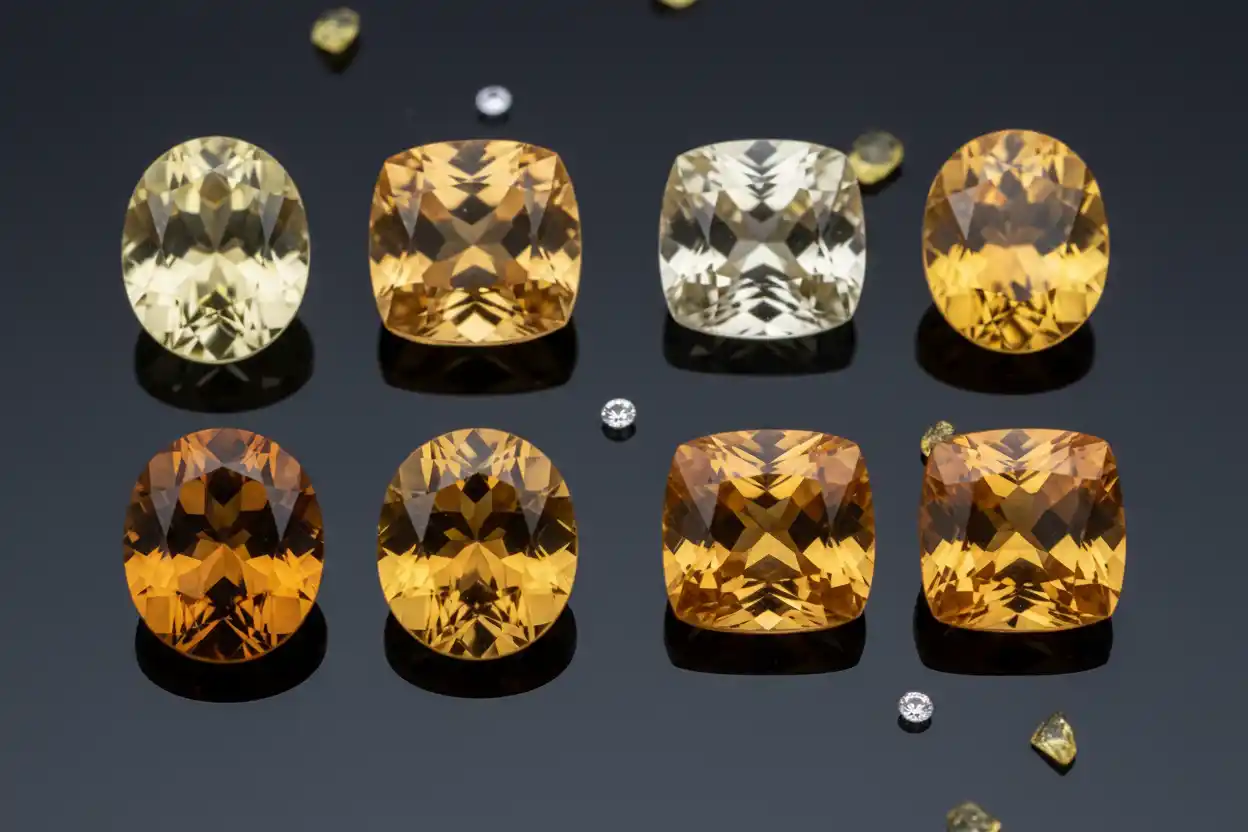
Citrine vs Yellow Topaz: Key Differences & Buying Guide
Citrine vs yellow topaz is a deceptively difficult visual comparison because both gemstones can appear transparent, bright, and nearly identical in pale yellow, golden yellow, honey, or yellow-orange colors, yet they are fundamentally different minerals with measurable differences in density, refractive index, crystal structure, hardness, cleavage, optical character, treatment history, and long-term wear behavior. Citrine is the yellow variety of crystalline quartz and is composed predominantly of silicon dioxide, SiO₂, whereas yellow topaz is topaz, a fluorine- and hydroxyl-bearing aluminum silicate commonly represented by the idealized formula Al₂SiO₄(F,OH)₂. Their shared color is therefore a superficial resemblance rather than evidence of a close mineralogical relationship. Within Gems Lore’s Identification references, that distinction matters because color photographs may suggest an identity, while conventional gemological measurements can separate the materials much more reliably.
For buyers, the differences extend well beyond a laboratory label. Citrine is lighter, slightly softer, usually much less expensive, widely available in large transparent sizes, and generally straightforward to use in many jewelry designs. Yellow topaz is harder, substantially denser, commonly displays a higher refractive index, and has perfect basal cleavage that introduces a different kind of mechanical vulnerability despite its greater scratch resistance. Fine natural-color topaz can also occupy a considerably higher market tier than ordinary commercial citrine. Neither gemstone is universally better; the useful choice depends on whether the priority is size, budget, surface durability, collector interest, treatment documentation, or the particular demands of a jewelry setting.
Citrine vs Yellow Topaz at a Glance
| Property | Citrine | Yellow Topaz |
|---|---|---|
| Mineral identity | Yellow variety of quartz | Topaz mineral species |
| Simplified composition | SiO₂ | Al₂SiO₄(F,OH)₂ |
| Crystal system | Trigonal | Orthorhombic |
| Typical color | Pale yellow, golden, smoky yellow, orange-yellow, brownish yellow | Pale yellow, golden yellow, honey, orange-yellow, brownish yellow |
| Mohs hardness | About 7 | 8 |
| Specific gravity | About 2.65 | Commonly around 3.5–3.6 |
| Refractive index | About 1.544–1.553 | Commonly about 1.61–1.64, varying with composition |
| Optical character | Uniaxial | Biaxial |
| Cleavage | No true cleavage | Perfect basal cleavage |
| Typical transparency | Transparent to translucent | Transparent to translucent |
| Market size availability | Large clean stones are relatively common | Large stones occur, but fine color and quality can command stronger premiums |
| Important treatment issue | Heat-treated amethyst is extremely common in the citrine market | Heating, irradiation-related color modification, and coatings can occur depending on material and trade context |
| General jewelry profile | Good durability with moderate abrasion resistance | Better scratch resistance but cleavage requires thoughtful setting and repair practices |
| Best identification evidence | RI, SG, optic testing, microscopy | RI, SG, optic testing, microscopy |
The most useful differences are not the ones most obvious in photographs. Specific gravity separates the two strongly, refractive-index ranges do not overlap under normal circumstances, and topaz has perfect cleavage whereas quartz does not. These properties make identification comparatively straightforward when an unmounted stone can be tested properly, even though the same two gems may remain frustratingly similar in an online listing.
Mineral Identity: Quartz Versus Topaz
Citrine belongs to the quartz family, sharing its mineral identity with amethyst, smoky quartz, rock crystal, and other crystalline quartz varieties. The yellow color defines the citrine variety but does not create a separate mineral species. Quartz has a trigonal crystal structure, a Mohs hardness near 7, relatively low density for a transparent gemstone, and no true cleavage. Those characteristics help explain why citrine can be cut into large faceted stones economically and why it performs reasonably well in jewelry without requiring the same cleavage precautions as topaz.
Yellow topaz belongs to an entirely different mineral species and crystallizes in the orthorhombic system. Its structure contains aluminum, silicon, oxygen, fluorine, and hydroxyl in proportions that can vary enough to influence properties such as density and refractive index. Topaz is harder than quartz at Mohs 8, but it possesses perfect cleavage parallel to its basal plane. This creates an important distinction between hardness and toughness: topaz resists scratching better than citrine, yet a sufficiently sharp impact oriented unfavorably can split or chip it along cleavage more readily than its hardness number might suggest.
Readers who have encountered the related aquamarine vs topaz comparison will recognize the same identification principle. A trade name or color resemblance should never substitute for mineral species, because species determines the measurable properties that ultimately settle the comparison.
Visual Clues Under the Same Lighting
A well-cut yellow topaz may appear somewhat more lustrous and optically dense than citrine because its refractive index is higher, causing stronger bending and reflection of light at polished facet surfaces. Citrine can still be highly brilliant, particularly when expertly cut, so a lively stone should not automatically be assumed to be topaz. Facet design, pavilion depth, polishing quality, lighting geometry, and color saturation can create larger apparent differences than mineral identity alone.
Yellow topaz may also appear to carry more visual “weight” or depth of color in some cuts, but this is not a diagnostic rule. Citrine occurs in saturated golden and reddish-orange hues, while yellow topaz can be extremely pale. A pale stone can belong to either species, and an intense honey or golden color cannot establish topaz. Photography further weakens color-based identification because white balance, warm display lighting, exposure, background choice, and saturation adjustments can shift both materials toward nearly identical hues.
The same-light requirement is therefore essential to any useful side-by-side photograph. Both stones should be photographed simultaneously on the same neutral background, at approximately the same face-up dimensions, under the same light source and camera settings. Without those controls, apparent differences in brilliance or color may belong to photography rather than geology. This is similar to the discipline required when evaluating aquamarine vs blue topaz, where overlapping color makes uncontrolled photographs particularly unreliable.
Optical Properties Give a Much Clearer Answer
Refractive index is one of the most effective conventional tests for citrine vs yellow topaz because the two ranges are comfortably separated. Quartz typically measures around 1.544 to 1.553, while topaz generally falls around the low 1.61s into the mid-1.64 range depending partly on fluorine-to-hydroxyl composition. A correctly obtained refractometer reading can therefore distinguish ordinary citrine from topaz much more confidently than visual comparison.
Optic character provides another meaningful distinction. Quartz is uniaxial, meaning its optical behavior is organized around one optic axis, whereas topaz is biaxial and has two optic axes. A trained gemologist using a polariscope and appropriate supporting observations can use this difference alongside refractive index to strengthen identification. Neither test requires guessing from color.
Both stones are doubly refractive, and their birefringence values can be of similar general magnitude, so simply seeing doubling is not sufficient. The diagnostic value comes from the complete property pattern. This is why comparison methods need to be tailored to the materials involved rather than copied mechanically from unrelated pairs such as carnelian vs red jasper, where translucency and texture play a much larger practical role.
Density Is One of the Easiest Differences to Understand
Yellow topaz is substantially denser than citrine. Citrine has a specific gravity around 2.65, while topaz commonly falls approximately around 3.5 to 3.6, with composition causing some variation. If two loose gemstones have essentially the same external dimensions and cut proportions, the topaz should therefore weigh considerably more.
The reverse is equally useful for shoppers: if a five-carat citrine and a five-carat yellow topaz are cut to comparable proportions, the citrine will normally occupy more physical volume and may look larger face-up. Carat is a unit of mass, not visible size. Buyers who choose stones primarily from carat numbers can therefore receive a noticeably different visual footprint from what they expected.
An experienced gemologist may develop an intuitive sense that a loose topaz feels unusually heavy, but subjective heft should not be treated as a definitive home test. Shape, mounting, cut depth, and expectations can mislead the hand. Hydrostatic specific-gravity measurement is stronger evidence when performed correctly.
Hardness Favors Topaz, but Cleavage Changes the Durability Story
Topaz is harder than citrine, ranking 8 on the Mohs scale compared with quartz at about 7. In ordinary jewelry use, this gives topaz better resistance to scratching and facet-edge abrasion. A topaz worn regularly can therefore retain crisp polished surfaces better than comparable citrine under similar abrasive exposure.
However, topaz’s perfect basal cleavage introduces a vulnerability that citrine does not share. Cleavage means the crystal structure can split relatively readily along particular crystallographic planes when force is applied in an unfavorable direction. A hard strike during setting, repair, accidental impact, or careless ultrasonic handling can therefore cause serious damage even though the material scores highly on a hardness scale.
Citrine lacks true cleavage and generally breaks through conchoidal or uneven fracture instead. That does not make it tougher under every possible impact, but it means its mechanical risk profile is different. The most accurate conclusion is therefore not “topaz is more durable because 8 is higher than 7,” but that topaz provides superior scratch resistance while demanding more attention to cleavage during setting, repair, and hard impacts.
An Original Decision Matrix
| Your priority | Citrine is usually the stronger choice when… | Yellow topaz is usually the stronger choice when… |
|---|---|---|
| Maximum visible size for budget | A large transparent yellow stone is the main goal | You accept a smaller or more expensive stone for topaz identity |
| Low purchase cost | You want attractive yellow color without a large material premium | Higher material value fits the budget |
| Scratch resistance | Moderate resistance is sufficient | Better resistance to routine abrasion is important |
| Impact simplicity | You prefer a gem without perfect cleavage | The design and setting adequately protect topaz from cleavage-related damage |
| Large statement cuts | You want broad cushions, fantasy cuts, or oversized gems economically | You specifically value large topaz and accept the resulting price |
| Collector interest | You collect quartz varieties or documented natural-color citrine | You collect fine topaz, distinctive natural colors, or documented specimens |
| Treatment sensitivity | Clear disclosure on citrine’s color origin is available | Clear disclosure on topaz color treatment is available |
| Routine ring wear | You accept eventual quartz surface wear and use a protective design | Scratch resistance is a priority and the setting protects cleavage planes |
| Simple replacement | Widely available commercial material is desirable | Material identity and rarity matter more than replacement cost |
| Resale expectations | You understand common citrine is broadly supplied | Fine topaz may have a stronger collector market, although resale is never guaranteed |
This framework deliberately focuses on ownership rather than prestige. A buyer who wants a large bright yellow pendant may gain little practical benefit from paying substantially more for topaz, while someone purchasing a long-term ring may appreciate topaz’s harder surface provided the setting and jeweler account for cleavage. The better stone depends on the decision being solved.
A similar choice-first approach is useful in aventurine vs jade and fluorite vs amethyst, because physical suitability can matter more than which material sounds rarer or more expensive.
Citrine Treatments and Color Origin
A large proportion of commercial citrine is produced by heat-treating suitable amethyst or other quartz material. Heating changes iron-related color centers within the quartz and can convert purple material into yellow, golden, orange, or brownish-orange colors. The resulting material remains genuine quartz, but the color origin has been modified by human treatment.
This distinction matters most when a seller charges a premium for naturally occurring citrine color. Calling the stone “natural” can be ambiguous because the underlying quartz may be naturally mined even when its color was subsequently altered. Buyers who care about treatment should ask specifically whether the yellow color is naturally occurring and whether heating, irradiation, coating, or another modification has been disclosed.
General treatment terminology and its implications are explained more fully in gemstone treatments explained. Treatment itself is not evidence that a gemstone is fake; inaccurate or incomplete disclosure is the more important commercial concern.
Yellow Topaz Treatments Need Their Own Context
Yellow and orange topaz can occur naturally, but topaz is also a gemstone with a significant treatment history. Heating may modify certain natural colors, while irradiation followed by heat is particularly important in producing many commercially familiar blue topaz colors. Surface coatings can additionally create colors that do not originate throughout the bulk crystal. Because treatment methods vary by desired result, a yellow topaz should be evaluated according to the actual claim being made rather than assuming every topaz undergoes the same process.
A very attractive yellow stone is not automatically treated, and a pale stone is not automatically untreated. Appearance alone has limited power to establish a thermal or irradiation history. Microscopic features may sometimes support an interpretation, while advanced spectroscopy or other laboratory methods can become necessary when treatment status materially affects value.
This is particularly relevant when sellers use premium names for warm yellow, orange, pinkish-orange, or reddish topaz. Trade terminology should not substitute for treatment disclosure, species identification, or credible origin information.
Can a Photo Reliably Separate Citrine From Yellow Topaz?
Not consistently. A carefully photographed pair may reveal tendencies in luster, facet reflections, apparent depth, or inclusion style, but the overlap is too great for a confident species determination in many stones. A photograph cannot communicate specific gravity directly, cannot provide a refractive-index measurement, and usually does not preserve enough optical information to establish uniaxial versus biaxial character.
Photographs become even less reliable when the comparison involves stones from separate sellers. One listing may use daylight-balanced photography while another uses warm LEDs; one may increase saturation and clarity digitally; one stone may be shallow and bright while the other is deep and dark. Those differences can easily overwhelm subtle mineralogical visual cues.
For identification, photographs should therefore be considered preliminary evidence. This same limitation appears in comparisons such as clear quartz vs selenite, even though those materials usually have more obvious physical differences. Images can narrow possibilities, but measurement is stronger.
Microscopic Clues Can Help, but They Are Not Universal
Citrine may show fluid inclusions, two-phase inclusions, healed fractures, negative crystals, mineral inclusions, growth features, or relatively clean interiors depending on the source and quality. Heat-treated quartz may sometimes show features associated with its starting material or treatment history, but no single inclusion should be used as a universal treatment test.
Topaz can contain liquid inclusions, two-phase inclusions, channels, included crystals, cleavage-related features, and growth structures of its own. In some specimens, the inclusion scene may strongly support topaz identification; in others, an eye-clean faceted stone offers very little information under routine magnification.
Microscopy is therefore strongest when combined with basic measurements. Refractive index can establish the mineral family, while magnification can then investigate treatment, natural characteristics, filling, coating, or other questions. This prevents an observer from trying to make one ambiguous inclusion carry the entire identification.
Gemstone Certification: When It Becomes Worthwhile
A routine commercial citrine may not economically justify an independent laboratory report because the testing fee can represent a large proportion of the stone’s value. A higher-priced yellow topaz, especially one carrying premiums for unusual natural color, exceptional quality, geographic provenance, lack of treatment, or collector significance, can make documentation considerably more worthwhile.
The gemstone certification reference explains why an identification report and an appraisal should not be confused. A laboratory can identify mineral species and may characterize detectable treatments or origin when its methods support those conclusions, but it does not automatically determine whether the retailer’s asking price is fair.
The stone must also match the report. Weight, measurements, photographs, identifying features, and report numbers should be checked rather than assuming that a certificate image shown beside a listing necessarily belongs to the gemstone being offered.
Laboratory Limits
Routine testing can separate quartz from topaz very efficiently, yet some secondary questions are more difficult. Species identification is usually straightforward because their refractive indices, density, and optical characters differ, while determining treatment history can require more specialized observations. Geographic origin can be still more challenging and should never be asserted merely because color resembles material associated with a famous locality.
A mounted stone can restrict testing because a setting may conceal the pavilion, prevent direct refractometer contact, obstruct inclusion scenes, or make accurate hydrostatic weighing impossible. A gemologist may still be able to identify the stone through a combination of observations, but responsible reporting includes the limitations created by the setting.
Manufactured constructions can introduce another complication. A gemstone that presents one material at the surface may contain joined components, making the principles discussed in gemstone doublets and triplets relevant whenever an unexpected boundary, adhesive layer, or assembled structure is observed. Composite construction should be demonstrated through evidence rather than assumed merely because a stone looks unusual.
Which Gem Has Better Brilliance?
Yellow topaz generally has the higher refractive index, giving it the potential for stronger surface reflections and a more pronounced vitreous luster than quartz. In a controlled comparison between well-cut stones of similar color, topaz may therefore appear somewhat brighter or optically richer.
Cut quality can completely change the experience, however. A poorly proportioned topaz with a large window may look less lively than a precisely cut citrine with excellent light return. Likewise, a very dark topaz can suppress brightness, while a lighter citrine may appear more open and sparkling. Mineral refractive index establishes potential; the cutter determines how effectively that potential is used.
This is why brilliance should not be used as a one-step identification method. It is a quality and appearance factor whose expression depends on much more than species.
Which Gem Looks Larger for the Same Carat Weight?
Citrine generally looks larger because quartz is less dense than topaz. A carat always represents the same mass, but a lower-density material needs more volume to reach that mass. Consequently, a five-carat citrine usually occupies noticeably more physical space than a comparably proportioned five-carat topaz.
Cut proportions still matter. A shallow topaz can have a broad face-up spread, while a deep citrine may hide substantial weight below the girdle. Millimeter dimensions are therefore the best purchasing comparison when visible size matters.
For shoppers building a statement piece around maximum visible yellow color, this density difference gives citrine an important economic advantage. More face-up area can often be obtained for less money.
Value Differences
Commercial citrine is generally inexpensive because quartz is abundant, large clean crystals are available, and treated material supplies a considerable part of the market. Fine natural-color citrine, precision cutting, unusual collector specimens, documented provenance, or particularly attractive colors can command premiums, but the material generally remains accessible compared with many traditional precious gems.
Yellow topaz spans a broader value range. Ordinary pale or commercial yellow material can be reasonably affordable, while exceptional natural-color stones, certain prized warm colors, fine clarity, large well-cut gems, important provenance, and desirable collector specimens may command substantially higher prices. Treatment status can materially affect where a stone sits within that market.
The key valuation mistake is assuming that species alone determines quality. A poorly cut topaz with unattractive color is not automatically a better purchase than a superbly cut citrine. Conversely, a large citrine should not be priced like fine topaz simply because both stones are golden. Compare actual color, cutting, clarity, treatment, dimensions, evidence, and market context.
Jewelry Wear: Rings, Pendants, Earrings, and Bracelets
For pendants and earrings, both stones can perform very well because these jewelry forms typically receive less direct impact and abrasion than rings. Citrine’s lower price can make it especially attractive for larger drops, matched stones, or bold statement cuts, while yellow topaz can provide stronger surface hardness and a more premium material choice when the design supports the cost.
Rings create a more complicated tradeoff. Topaz’s hardness offers better resistance to accumulated scratches, but its cleavage makes severe impacts and careless setting work more consequential. Citrine scratches more readily over long wear yet lacks topaz’s perfect cleavage. A protective bezel, partial bezel, substantial prongs, or other thoughtful design can improve the security of either stone.
Bracelets receive repeated contact with desks, tables, doors, and adjacent components, making both abrasion resistance and impact protection relevant. Whichever material is chosen, setting design should reflect the real exposure pattern rather than assuming a hardness number alone predicts survival.
Care Differences
Both gemstones can usually be cleaned gently using lukewarm water, mild soap, and a soft brush when their treatment history and jewelry construction allow it. The entire object matters: adhesives, coatings, fracture filling, delicate accent stones, antique construction, or compromised settings may require more conservative care than the center gemstone would suggest on its own.
Topaz deserves particular caution around sudden mechanical stress because of cleavage. Steam, aggressive ultrasonics, hard impacts, and careless repair procedures should not be treated casually, especially when the stone’s treatment and internal condition are unknown. Citrine is generally uncomplicated as quartz but can still chip, scratch, or fracture and should not be exposed to unnecessary thermal shock.
Neither gemstone needs harsh chemicals, deliberate heating, scratching, or impact testing for home authentication. Identification should rely on non-destructive gemological methods.
Which Should You Choose for a Ring?
Choose citrine when a larger visible stone, moderate budget, warm yellow color, and easy replacement matter more than maximum resistance to surface scratching. A thoughtful protective setting can make citrine a satisfying ring stone, particularly for occasional or mindful wear.
Choose yellow topaz when better scratch resistance, topaz identity, stronger collector interest, or higher-end material positioning justifies the additional expense. The setting and jeweler should account for cleavage, especially in a ring intended for frequent use.
For a very expensive topaz purchase, treatment disclosure and independent identification carry greater financial importance than they typically do for ordinary commercial citrine.
Which Should You Choose for a Pendant or Earrings?
Citrine often provides exceptional visual scale for pendants and earrings because large transparent stones are accessible and the lower-density quartz can spread well at a given carat weight. These lower-impact jewelry positions also reduce the practical significance of its lower hardness.
Yellow topaz makes sense when the wearer specifically prefers topaz, values its optical appearance, wants greater resistance to surface abrasion, or is buying a finer gem for reasons beyond visible size. Because cleavage-related impact is less likely in many pendant and earring designs than in rings, these forms can also be excellent ways to wear fine topaz.
The decision in either case should follow the design and intended use, not a generalized hierarchy of gemstone prestige.
Common Buying Mistakes
One common mistake is paying a topaz-level price for citrine because the seller uses vague terms such as “precious yellow stone,” “golden gem,” or an impressive locality story without providing mineral identification. Another is assuming that every yellow topaz is naturally colored and untreated simply because topaz can occur naturally in yellow. Neither conclusion follows from appearance.
A second mistake is comparing equal carat weights without checking dimensions. Since topaz is denser, the stones will not usually have equal visual size. Buyers seeking a large centerpiece should compare millimeter measurements, while buyers comparing value should normalize for species, color, cut, clarity, treatment, and documentation.
A third is treating any laboratory-looking card as conclusive. The credibility of the issuing laboratory, the tests performed, and the match between the report and gemstone all matter.
How Citrine vs Yellow Sapphire Helps Clarify the Choice
Buyers sometimes place yellow topaz, yellow sapphire, and citrine into one visual category because all three can occupy similar golden colors. The citrine vs yellow sapphire comparison shows why that approach breaks down: quartz, topaz, and corundum differ markedly in density, refractive index, hardness, treatment patterns, and market position.
Yellow topaz occupies something of a mechanical middle ground between the other two in hardness, but its cleavage makes a simple numerical ranking misleading. Quartz is softer without perfect cleavage, topaz is harder with pronounced cleavage, and sapphire is harder still without topaz’s same basal-cleavage issue. The intended jewelry use therefore matters as much as the Mohs number.
Frequently Asked Questions About Citrine vs Yellow Topaz
Is yellow topaz the same as citrine?
No. Citrine is yellow quartz, whereas yellow topaz is a separate mineral species composed of aluminum silicate containing fluorine and hydroxyl. They can look similar but have different physical and optical properties.
How can I tell citrine from yellow topaz?
The strongest routine differences include refractive index and specific gravity. Citrine generally has an RI around 1.544–1.553 and SG near 2.65, while yellow topaz usually has a substantially higher RI and SG around the mid-3.5 range. Professional testing is more reliable than visual comparison.
Which is harder, citrine or yellow topaz?
Yellow topaz is harder at Mohs 8 compared with citrine at about 7. However, topaz also has perfect basal cleavage, so greater hardness does not mean it is immune to impact damage.
Which is more expensive?
Yellow topaz, particularly fine natural-color material with attractive color and appropriate documentation, can command substantially more than ordinary commercial citrine. Actual value still depends on quality, treatment, size, cut, provenance, and seller context.
Can citrine and yellow topaz have exactly the same color?
Their color ranges overlap strongly, so two stones can appear extremely similar in photographs or even in person. Color is not a reliable species test.
Which gemstone looks larger at the same carat weight?
Citrine usually looks larger because quartz is less dense than topaz. Compare millimeter dimensions rather than carat weight when face-up size is important.
Is citrine usually treated?
A substantial amount of commercial citrine is heat-treated quartz, commonly produced from suitable amethyst. Naturally colored citrine also exists, so buyers concerned about color origin should seek explicit treatment disclosure.
Is yellow topaz treated?
Yellow and orange topaz can occur naturally, but topaz may also undergo treatments depending on the desired color and material. Heating, irradiation-related processes, and surface coatings are among treatment issues that can arise in the broader topaz market. A seller should disclose known treatments.
Which is better for everyday jewelry?
It depends on the jewelry type. Yellow topaz offers greater scratch resistance, while citrine lacks topaz’s perfect cleavage and is inexpensive to replace. For frequently worn rings, setting design and wear habits are important for either material.
Can I identify them from an online photo?
Not reliably in every case. Controlled photography may suggest differences, but photographs cannot directly provide refractive index, specific gravity, or optic character. When identity affects the price materially, gemological testing is the better approach.
Citrine vs Yellow Topaz: Which One Makes More Sense?
Citrine makes the strongest case when visible size, affordability, abundant transparent material, warm yellow color, and straightforward quartz jewelry are the main priorities. Its lower density means a given carat weight can provide greater physical volume, and its broad availability allows buyers to focus heavily on cutting and color without paying primarily for rarity. It is softer than topaz but remains sufficiently durable for many jewelry applications when treated sensibly.
Yellow topaz makes more sense when the buyer specifically values topaz identity, greater scratch resistance, stronger optical properties, collector potential, or finer natural-color material. Its perfect cleavage means it should not be treated as mechanically indestructible simply because it is harder, and higher-value examples justify closer attention to treatment and documentation.
The decisive citrine vs yellow topaz differences are therefore measurable rather than symbolic: quartz and topaz have distinct density, refractive index, crystal structure, cleavage behavior, and market characteristics. Once those properties are matched to budget, design, wear pattern, and the strength of the seller’s evidence, two nearly identical yellow stones become much easier to choose between.
Gems Lore explains its authorship and editorial context on the About page, while the Disclaimer clarifies why general identification information cannot certify a gemstone that has not been examined. Questions, corrections, or supporting documentation can be submitted through Contact, and information about how site data is handled is available in the Privacy Policy.