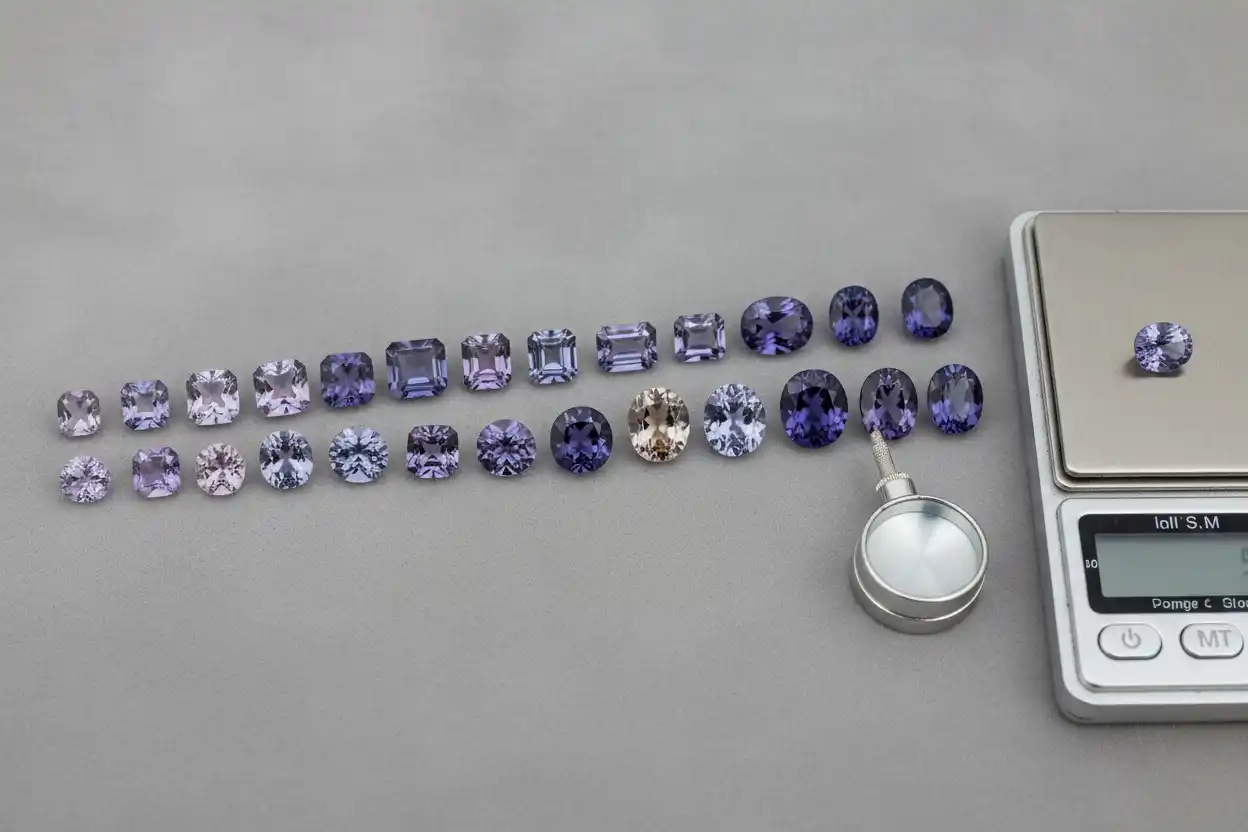
Iolite Price: Cost, Value Factors & Buying Tips
The useful question is not simply “What is the iolite price per carat?” but “What exactly is being priced, under what assumptions, and how comparable is it with another stone?” Iolite is gem-quality cordierite, and its market value is unusually sensitive to face-up color because the material is strongly pleochroic. A stone can show attractive violet-blue in one direction and paler, yellowish, grayish, or nearly colorless appearances in others. GIA identifies vivid violet to blue as the most valued color range, notes that commercial-quality iolite can show a grayish component, and emphasizes that cutting orientation is important because the cutter must position the stone to display its best color through the table.
That makes price comparison less mechanical than dividing a listing price by carat weight. Two 2-carat iolites may differ substantially in value if one is bright, saturated, well oriented, eye-clean, and competently cut while the other looks gray, dark, windowed, or weakly colored when viewed face-up. GIA also notes that fine faceted iolites above 5 carats are relatively rare, but larger size alone does not create quality; a larger stone with poor orientation or weak color can remain less desirable than a smaller, better-cut gem.
This page focuses specifically on iolite market value, price methodology, and comparison limits. Broader purchasing decisions belong in the dedicated buy iolite guide, while the Buying & Value category places this price discussion alongside other valuation topics.
Iolite Price at a Glance
| Question | Practical answer |
|---|---|
| What is usually being priced? | A loose faceted stone, cabochon, bead lot, specimen, or finished jewelry item. These should not be compared as if they were equivalent. |
| What usually matters most? | Face-up color, pleochroic orientation, clarity, cut quality, size, condition, treatment disclosure, and retail context. |
| Is there one reliable iolite price per carat? | No. Current listings and completed marketplace sales show a wide spread because quality, seller type, condition, and documentation vary sharply. |
| Does larger always mean more expensive per carat? | No. Fine stones over 5 carats can be scarcer, but size only adds value when color, cut, clarity, and condition remain strong. |
| Is untreated iolite automatically rare? | No. GIA states that iolite is not typically treated, so “untreated” should be understood as common market context rather than an automatic premium. |
| Can a lab give iolite an official quality grade? | GIA evaluates iolite but does not grade it. Its identification report can describe the material and detectable treatments. |
| Should origin claims command a premium by themselves? | Not without evidence. Seller-stated origin is not the same as an independent laboratory origin determination. |
What Is Actually Being Priced?
A loose faceted iolite is the cleanest unit for price comparison because weight, measurements, color description, treatment disclosure, and cut can often be examined directly. Cabochons, beads, carvings, phenomenal stones, rough, mineral specimens, and finished jewelry belong to different pricing contexts. A faceted transparent violet-blue stone should not be compared with a heavily included bead strand simply because both are sold by carat, and a collector specimen should not be reduced to a faceted-gem price-per-carat formula because matrix, crystal form, provenance, aesthetics, and specimen condition can dominate its value.
Finished jewelry introduces even more non-gemstone cost. The price of an iolite bracelet, iolite earrings, iolite necklace, or iolite ring can include precious metal, fabrication, matched stones, setting labor, brand positioning, design, overhead, and retail service. Dividing a jewelry price by the gemstone carat weight and calling the result the “iolite price per carat” produces a distorted figure because much of the item’s cost may have nothing to do with the loose stone itself.
For the same reason, maintenance and durability costs should be considered separately from gem value. Iolite has distinct cleavage and only fair toughness despite a Mohs hardness around 7 to 7.5, so jewelry design and wear conditions matter. Practical maintenance belongs in the iolite jewelry cleaning guide and engineering considerations belong in the iolite setting and wear reference, rather than being folded into a loose-stone price claim.
The Quality Bands That Matter More Than a Generic Price Chart
A useful iolite quality framework starts with observable traits rather than invented “AAA,” “AAAA,” or similar seller grades. GIA does not issue a quality grade for iolite, so those commercial labels are seller-defined and cannot be assumed to mean the same thing across businesses. A commercial-grade faceted stone may appear pale, grayish, dark, poorly oriented, visibly included, chipped, or windowed. A stronger retail stone will usually show a more attractive violet-blue face-up color, reasonable brightness, clean appearance at normal viewing distance, and a cut that manages pleochroism without sacrificing too much light return. A fine stone moves beyond basic acceptability: stronger saturation, pleasing tone, good transparency, minimal distracting inclusions, balanced proportions, and careful orientation become more important.
At the exceptional end, size and optical phenomena can matter, but only in the right context. GIA notes that fine faceted iolite above 5 carats is relatively rare, and that properly oriented inclusions can produce cat’s-eye or aventurescent stones that may appeal to collectors. Those phenomena are not defects when they are the intentional source of the gem’s visual effect, while random inclusions in an otherwise transparent faceted stone generally reduce desirability. The distinction is important because two sellers can both call an iolite “included,” yet one may be describing a damaged or low-clarity faceted gem and the other a deliberately cut phenomenal specimen.
Color is especially difficult to reduce to a single label. Iolite’s strong pleochroism means photography, light source, camera white balance, tilt angle, and cutting orientation can materially change what a buyer sees. The deeper explanation of this behavior belongs in the iolite optical properties and color behavior guide, while the cutting consequences are covered in the iolite cutting, orientation, and polish reference. For pricing, the practical rule is simpler: compare face-up appearance under comparable lighting, not just the seller’s color adjective.
A Documented Iolite Price Sample
The table below is an anonymized comparison sample built from publicly visible listings and completed marketplace sales. It is not a universal price chart. Asking prices show what sellers request, not what buyers necessarily pay; completed sales show a transaction price but may involve lower-grade material, auction dynamics, damage, limited documentation, or other conditions that make the result unsuitable as a benchmark for fine retail stones. Seller descriptions are treated as claims unless independently verified.
| Source type | Observed item | Price status | Total price | Approx. price/ct | Quality assumptions and limitations |
|---|---|---|---|---|---|
| Specialist retailer A | 0.28 ct violet iolite, baguette, VS-SI | Asking | $11.16 | $39.86/ct | Small calibrated-style faceted stone; seller clarity description used as stated; color not independently standardized. |
| Specialist retailer B | 1.09 ct violet-blue round | Asking | $45.00 | $41.28/ct | Seller-stated violet-blue color; no cross-seller standardized grade assumed. |
| Specialist retailer B | 1.77 ct violet-blue cushion | Asking | $55.00 | $31.07/ct | Larger than the previous example but lower per-carat ask, illustrating that size alone does not set the rate. |
| Specialist retailer C | 1.61 ct oval | Asking | $161.00 | $100.00/ct | Higher-priced specialist retail context; exact visual quality must be judged from the individual stone, not price alone. |
| Specialist retailer C | 3.79 ct cushion | Asking | $1,182.00 | $311.87/ct | High asking price within the same retailer’s inventory; not proof of a general market rate or completed sale. |
| Marketplace auction D | 1.03 ct bluish-violet oval | Completed sale | $4.25 | $4.13/ct | Auction result; seller description and quality claims were not independently laboratory-verified. |
| Marketplace auction D | 1.72 ct bluish-violet oval | Completed sale | $3.25 | $1.89/ct | Auction result with limited comparability to specialist retail inventory. |
| Marketplace auction D | 3.52 ct bluish-violet pear | Completed sale | $17.50 | $4.97/ct | Completed auction price, not a fine-gem benchmark. |
| Marketplace auction D | 3.69 ct bluish-violet oval | Completed sale | $21.50 | $5.83/ct | Seller disclosed SI1 transparency plus a small chip/crack, no certification, and untreated status; damage and sales channel materially limit comparability. |
The sample demonstrates why a single headline number can mislead. Current specialist retail asking prices in this small dataset range from roughly $31 to more than $300 per carat, while the observed completed auction examples are much lower. That does not mean the “true” iolite price is the average of those figures. The sources are selling different stones through different channels with different presentation standards, return policies, overhead, condition, documentation, and buyer audiences. The correct conclusion is that market context has to be controlled before a price-per-carat figure becomes meaningful.
It also shows why a high asking price is not evidence of a high market value by itself. A retailer can ask $300 per carat, but unless comparable stones are actually changing hands near that level, the listing is only one data point. Conversely, a low auction result does not establish the value of a fine, well-oriented, eye-clean stone if the sold example is chipped, poorly cut, weakly documented, or presented to a bargain-oriented marketplace audience. Asking prices and completed transactions answer different questions and should remain separate.
How to Compare Iolite Prices Properly
The most defensible comparison begins by narrowing the sample before calculating anything. Compare loose faceted stones with loose faceted stones; compare similar weight ranges; separate calibrated small stones from individually selected large stones; note whether color is violet-blue, grayish blue, brownish, pale, or unusually dark; and record whether the stone appears eye-clean, visibly included, chipped, windowed, extinct, or strongly asymmetrical. Only after those filters should price per carat be calculated as total stone price divided by carat weight. The arithmetic is simple; deciding whether the stones belong in the same comparison set is the difficult part.
Next, normalize the commercial terms. A listed price may exclude shipping, tax, customs charges, laboratory fees, or setting costs. A sale price can also be temporary, negotiated, discounted, or generated by an auction with only a few bidders. Lots introduce another complication because total carat weight can hide uneven quality among individual stones. A 10-carat lot containing many small commercial stones is not equivalent to a single 10-carat fine gem. The same caution applies to photographs: one seller may use diffuse daylight and another intense directional lighting, making color and brilliance appear more different than the stones would look side by side.
Finally, record uncertainty rather than forcing precision. A useful comparison note might say “seller-stated untreated, violet-blue, eye-clean, no independent report reviewed” instead of treating those claims as proven. If inclusion details are important to a price decision, the iolite microscope inclusion notebook provides the appropriate identification-focused context. If the question is what iolite is mineralogically rather than what it costs, the iolite meaning reference separates the material’s identity and cultural interpretation from market pricing.
Why Cut Orientation Can Change Iolite Value
Iolite’s pleochroism means the cutter is not merely deciding shape and symmetry; orientation determines which directional color dominates face-up. GIA describes iolite as strongly pleochroic and notes that a cutter must orient it carefully so the best color is visible through the table. Poor orientation can leave an otherwise clean stone looking washed out, gray, yellowish, or excessively dark from the normal viewing position. That is why a technically clean stone can still be inexpensive if its visual presentation is weak.
Cut quality also interacts with yield. Preserving extra weight is not always economically useful if it produces a thick, windowed, or poorly oriented gem. A lighter stone with a better face-up color and balanced proportions can be more desirable than a heavier stone cut mainly to retain carat weight. Price-per-carat comparison therefore works best after visual cut quality is judged, not before.
This is one reason photographs from a single angle are inadequate for strong price conclusions. A rotating video under neutral lighting can reveal whether the attractive color persists across modest changes in orientation, but laboratory analysis may still be required when identity or treatment certainty matters.
Treatment and the Meaning of “Untreated”
Iolite occupies a different treatment context from many blue gemstones. GIA states that iolite is rarely treated and describes its natural blue-to-violet color as a selling point. This means “untreated” should not automatically be priced as an exceptional rarity. A seller can legitimately disclose that a stone is untreated, but the disclosure should not be converted into an unsupported premium merely because the word sounds valuable.
Treatment status still matters because buyers should know what they are purchasing. A laboratory identification report can help establish whether a stone is natural or laboratory-grown and disclose detectable treatments. GIA specifically states that it evaluates iolite but does not grade it, so a report is evidence about identity and detectable treatment—not an official “AAA” quality certificate or a guarantee that the retail price is fair.
The practical pricing implication is straightforward: first value the observable stone—color, orientation, clarity, cut, size, condition—then use treatment evidence to confirm whether the seller’s description is accurate. Do not add a large premium solely because an ordinary untreated iolite is marketed with dramatic language.
Size Effect: When Carat Weight Matters and When It Does Not
Carat weight matters because fine large iolite becomes less common. GIA reports that fashioned stones from about 1 to 10 carats occur in the market, while fine faceted iolites over 5 carats are relatively rare. In a like-for-like comparison, that scarcity can support a higher per-carat price for a genuinely fine large gem.
But “like-for-like” is the key condition. A 6-carat stone with gray face-up color, a deep belly, an obvious window, edge damage, or distracting inclusions does not become fine merely because it crosses a size threshold. The documented sample above even shows specialist retail listings where a smaller stone can have a higher or lower per-carat ask than a larger one, underscoring that sellers price the whole quality package rather than weight alone.
For buyers, the safest approach is to compare stones within a reasonably narrow size band first. If a larger stone carries a steep premium, verify that color, cut, clarity, and condition justify the difference rather than assuming rarity by weight.
Origin Claims: Useful Provenance, Not Automatic Value
Iolite occurs in multiple geological settings and localities, so seller-stated origin can provide provenance or collector interest. The geology behind those occurrences is discussed separately in the iolite formation and deposit geology guide. For a price page, the key issue is evidence: a country name in a listing is a seller claim unless supported by documentation appropriate to that claim.
GIA’s current colored-stone services make an important distinction. Its standard Colored Stone Identification Report can identify material and disclose detectable treatments, but its Identification & Origin Report is offered only for a specified group of gemstones, and iolite is not on that eligibility list. Therefore, a phrase such as “Tanzanian iolite” or “Afghan iolite” should not be interpreted as a GIA-style country-of-origin determination simply because it appears next to a certificate or a seller grade.
Origin can still influence a buyer’s interest when provenance is traceable, but it should not outrank observable gem quality. If two stones are otherwise comparable, documented provenance may matter to a collector; if one stone has clearly superior color and cut, an unsupported origin claim should not automatically make the weaker stone more valuable.
Retail Context Explains Much of the Price Spread
Specialist gemstone retailers, marketplace sellers, auction sellers, wholesalers, jewelry brands, and private dealers operate with different cost structures. A specialist retailer may include professional photography, individual measurements, return rights, customer service, inventory holding costs, gemological screening, and longer selling periods. An auction listing may prioritize rapid turnover and accept a lower final price. Neither channel automatically proves that a stone is better or worse, but the sales model changes the price that can reasonably be expected.
The documented sample reflects this effect clearly. Small faceted specialist-retail stones were listed around the low tens of dollars per stone, while another specialist inventory included individual iolites priced in the hundreds or above a thousand dollars. Completed marketplace auctions for several bluish-violet stones closed far lower on a per-carat basis. Those figures should not be blended into one average because they represent different commercial environments and, in at least one sold example, disclosed damage.
The same caution applies to specimens and collector material. Surface condition, matrix integrity, labels, locality documentation, and conservation can matter more than faceted-gem metrics. Those issues are treated in the iolite specimen conservation record rather than being forced into a jewelry-gem pricing model.
Example Comparisons: What the Numbers Do and Do Not Tell You
Consider the two specialist-retail examples at approximately $39.86 and $41.28 per carat. Their unit prices are close, but that does not establish equal quality. One listing describes a small violet baguette with a VS-SI clarity label, while the other describes a larger violet-blue round without an equivalent standardized clarity scale. The correct conclusion is only that their observed asking prices are similar on a per-carat basis; further visual and documentary comparison is required before deciding whether they are truly comparable.
Now compare the 3.79-carat specialist-retail cushion asking $1,182 with the 3.69-carat completed marketplace auction at $21.50. Their weights are remarkably close, yet the observed prices differ by more than fiftyfold. That is not evidence that one seller is necessarily correct and the other wrong. The marketplace stone carried a disclosed small chip/crack and no certification, while the higher-priced stone was positioned in a specialist retail environment. Without side-by-side color, clarity, cut, condition, and documentation, the price gap is a warning against weight-only comparisons, not a ready-made valuation formula.
A third lesson comes from the completed auctions themselves: transaction evidence can be valuable, but it must be filtered. A low auction result proves that a particular item sold at that price under those conditions. It does not prove that a bright, eye-clean, precision-oriented iolite with stronger documentation should sell at the same level.
A Practical Iolite Price Method
A defensible iolite valuation can be expressed as a sequence rather than a fixed chart: identify the product type; verify weight and dimensions; evaluate face-up color and pleochroic orientation; assess clarity and condition; judge cut quality; note treatment disclosure; separate seller-stated origin from laboratory evidence; classify the sales channel; then compare several genuinely similar stones. After that, calculate observed price per carat and look for a cluster rather than relying on one outlier.
The method becomes stronger when both asking and completed-sale evidence are available. Asking prices show current retail positioning and inventory expectations. Completed sales show what at least one buyer actually paid, but auction results can be unusually low or high and may reflect defects, weak presentation, or a thin bidder pool. The goal is not to force both datasets into one number; it is to understand why they differ and determine which comparison set resembles the stone being evaluated.
For expensive purchases, documentation should scale with the financial risk. GIA’s Colored Stone Identification Report can identify iolite, state whether it is natural or laboratory-grown, and list detectable treatments, but GIA does not grade iolite. A laboratory report therefore supports identity and disclosure, not a guaranteed market value.
Pricing Claims That Deserve Extra Scrutiny
Terms such as “AAA,” “investment grade,” “museum grade,” “Kashmir-like,” “sapphire quality,” or “rare untreated” can sound precise while lacking a consistent industry definition for iolite. Because GIA does not grade iolite, a seller’s letter grade is not an independent laboratory grade. Likewise, an “origin certificate” should be read carefully to determine who issued it and exactly what conclusion it makes. A report can be authentic yet still not provide the type of origin determination a buyer assumes.
Price claims also deserve scrutiny when a seller uses a large crossed-out “original price” to make the current price look unusually favorable. The relevant number is the amount buyers actually pay for comparable material, not an anchor price that may never have represented typical transactions. Similarly, a high appraisal figure should not be confused with a guaranteed resale value.
Iolite should not be presented as a financial investment with promised appreciation, liquidity, or returns. Gemstone resale markets are fragmented, spreads can be wide, and retail markups may not be recoverable. Buy iolite for its gemological and aesthetic qualities, not because a seller guarantees future profit.
Corrections and Price-Sample Limits
Online gemstone inventories change. Listings sell, prices move, discounts appear, descriptions are edited, and photographs may not be color-calibrated. The sample on this page should therefore be read as a documented snapshot of observable market evidence, not a permanent tariff. Where a source clearly shows a completed sale, it is labeled as such; where a source only shows an offered price, it remains an asking price.
If a referenced listing later changes or a calculation is found to be wrong, the appropriate correction is to update the affected figure, preserve the distinction between asking and sold evidence, and avoid silently converting seller claims into laboratory facts. Gems Lore’s broader editorial approach and scope are described on the About page.
The central rule remains stable even when individual prices change: iolite value should be compared through documented quality assumptions and sales context, not through a single unsupported price-per-carat claim.
Frequently Asked Questions
How much is iolite worth per carat?
There is no single reliable iolite price per carat. The current documented sample on this page shows specialist retail asking prices ranging from roughly the low tens to several hundred dollars per carat, while several completed marketplace auctions closed much lower. Those figures are not directly interchangeable because color, cut, clarity, condition, documentation, seller type, and sales format differ. The best estimate comes from several comparable stones rather than one broad range.
What color iolite is most valuable?
GIA identifies vivid violet to blue as iolite’s most valued color range. Because iolite is strongly pleochroic, face-up orientation matters: a stone that looks gray, pale, yellowish, or overly dark from the normal viewing position may be less desirable even if another viewing direction shows stronger blue.
Does untreated iolite cost more?
Not automatically. GIA states that iolite is rarely treated, so untreated status is common enough that it should not by itself justify a dramatic premium. Treatment disclosure still matters because buyers should know what they are purchasing.
Are large iolites much more expensive?
Fine iolites over 5 carats are relatively rare, so size can support a premium when color, clarity, cut, and condition are also strong. A large grayish, poorly oriented, windowed, or damaged stone may still be worth less per carat than a smaller fine stone.
Does a GIA report tell me the quality grade of an iolite?
No. GIA states that it evaluates iolite but does not grade it. A Colored Stone Identification Report can identify the material, describe characteristics, determine natural versus laboratory-grown status, and disclose detectable treatments.
Can a certificate prove that iolite came from a specific country?
Not necessarily. GIA’s current Identification & Origin Report service lists specific eligible gemstones, and iolite is not among them. A country named by a seller should therefore be treated as provenance information or a seller claim unless supported by an appropriate independent method.
Why can two iolites of the same weight have very different prices?
Because weight is only one variable. Face-up color, pleochroic orientation, clarity, cut precision, windowing, damage, treatment disclosure, documentation, seller overhead, return terms, and sales channel can all change the observed price. The documented examples on this page show similarly sized stones with dramatically different prices, which is exactly why weight-only comparison is unreliable.
Is iolite a good investment?
Iolite can be an attractive gemstone purchase, but no seller can responsibly guarantee investment returns. Retail gemstone prices do not ensure future resale value, and transaction costs, dealer margins, liquidity, condition, and changing demand can all affect what a stone can later sell for.