Orange Gemstones: Names, Meanings and Uses
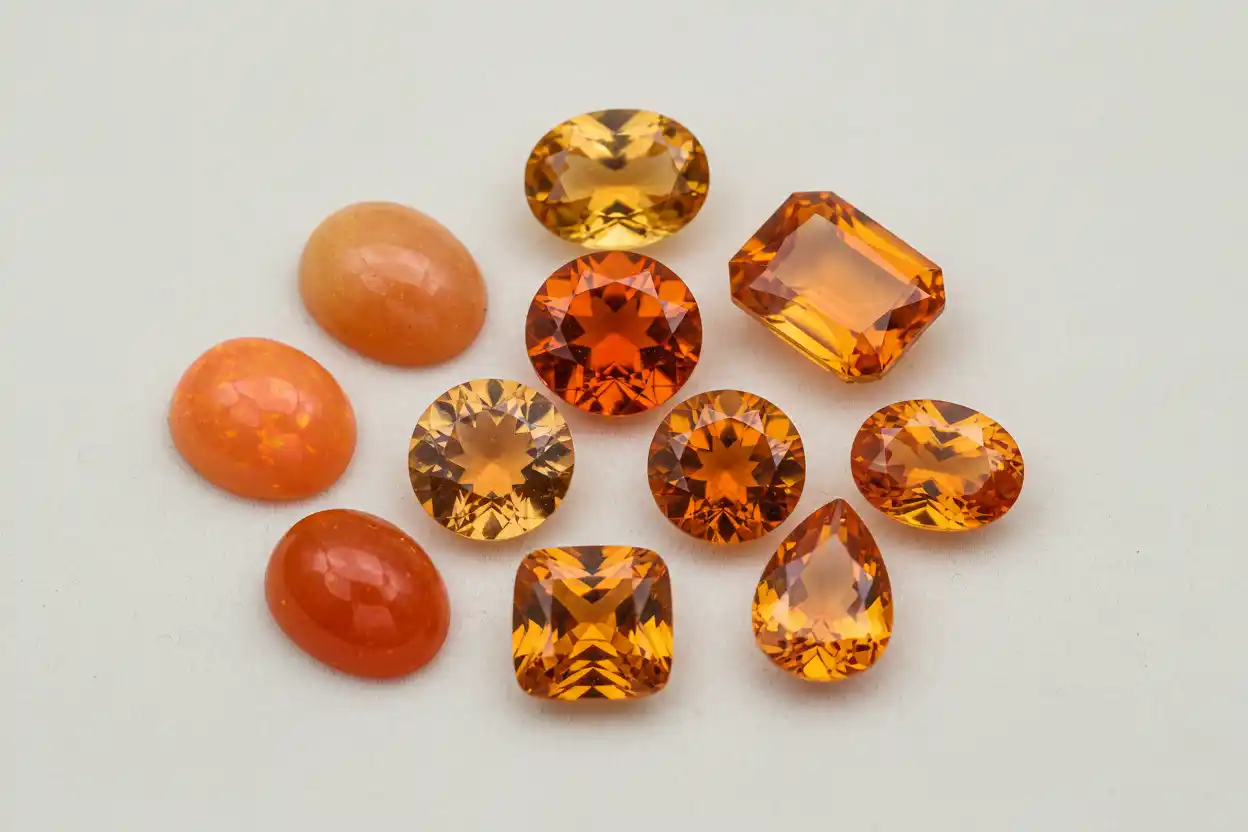
Orange gemstones occupy the transition between yellow’s brightness and red’s visual intensity. Their colors range from pale peach and honey through vivid mandarin, pumpkin, flame orange, reddish orange and deep burnt tones.
These stones do not belong to one mineral family. Orange can appear in Garnet, Sapphire, Opal, Quartz, Topaz, Tourmaline, Spinel, Zircon, feldspar, chalcedony and organic gem materials. Consequently, two gems with a similar color may differ substantially in hardness, brilliance, treatment, rarity and suitable jewelry use.
Modern symbolism connects orange with creativity, sociability, confidence, warmth and deliberate action. However, those associations come from color traditions rather than scientifically demonstrated gemstone energy.
The sibling Orange Crystals guide covers collector pieces, meditation stones and softer minerals. This article focuses more closely on gem-quality materials, faceted stones, cabochons and jewelry choices.
Orange Gemstones at a Glance
| Gemstone | Material identity | Typical orange range | Mohs hardness | Common jewelry use |
|---|---|---|---|---|
| Spessartite Garnet | Manganese-rich Garnet | Mandarin to reddish orange | 6.5–7.5 | Rings, earrings and pendants |
| Fire Opal | Hydrated silica | Yellow-orange to red-orange | 5–6.5 | Protected rings and pendants |
| Citrine | Quartz | Golden to reddish orange | 7 | All jewelry with normal care |
| Imperial Topaz | Topaz | Golden orange to orange-pink | 8 | Earrings, pendants and protected rings |
| Orange Sapphire | Corundum | Yellowish orange to vivid orange | 9 | Everyday rings and bracelets |
| Sunstone | Feldspar | Peach, orange and coppery red | 6–7 | Pendants, earrings and careful rings |
| Carnelian | Chalcedony | Orange to red-brown | 6.5–7 | Beads, cabochons and carvings |
| Hessonite Garnet | Grossular Garnet | Honey to cinnamon orange | 6.5–7.5 | Rings, beads and pendants |
| Orange Spinel | Spinel | Peach to vivid reddish orange | 8 | Rings and fine faceted jewelry |
| Orange Tourmaline | Tourmaline | Peach, orange and brownish orange | 7–7.5 | Rings, earrings and pendants |
| Orange Zircon | Zircon | Golden orange to reddish orange | 6–7.5 | Earrings and protected rings |
| Fire Agate | Chalcedony with iron-oxide layers | Brown-orange with iridescence | 6.5–7 | Cabochons and rings |
| Amber | Fossilized resin | Honey to reddish orange | 2–2.5 | Pendants, earrings and beads |
| Yellow Topaz | Topaz | Yellow to golden orange | 8 | All jewelry with impact protection |
| Peach Moonstone | Feldspar | Cream, peach and orange-pink | 6–6.5 | Earrings, pendants and protected rings |
What Causes Orange Color in Gemstones?
Orange may result from trace elements, structural defects, microscopic inclusions or treatment.
Manganese contributes strongly to the orange of Spessartite Garnet. Iron-related processes create yellow, orange and brown tones in Quartz, chalcedony, Topaz and several other materials. Chromium and iron can contribute to orange-pink Sapphire, while copper and iron-rich inclusions produce the glittering appearance of some Sunstones.
Heating, irradiation, diffusion and coating can also create or modify orange. Much Citrine begins as Amethyst and becomes yellow to orange through heat. Sapphire may be heated or diffusion treated, while some Zircon and Topaz colors are treatment related.
A gem’s color therefore cannot establish its identity or treatment status by itself.
1. Spessartite Garnet
Spessartite Garnet is one of the most recognizable transparent orange gemstones.
Its color ranges from yellowish orange and mandarin through reddish orange. Manganese is a major part of its composition and gives the gem much of its characteristic warmth.
Fine stones can combine strong saturation with lively brilliance. Inclusions vary by source and may include needles, crystals or irregular internal features.
Spessartite is durable enough for rings, although surface-reaching fractures require protection. Its relatively high refractive index gives it stronger sparkle than Citrine or Carnelian.
Symbolically, the gem is associated with ambition, enthusiasm and taking constructive action. Those meanings work best as personal reminders rather than promises of success.
The dedicated Spessartite Garnet Price Guide owns current valuation.
2. Fire Opal
Fire Opal is defined mainly by yellow, orange or red bodycolor.
Some stones show play-of-color, but many valuable Fire Opals do not. Transparent material is often faceted, while translucent examples are commonly cut into cabochons.
Mexico is strongly associated with the variety, although orange and red Opal occurs in other regions.
The gemstone is softer and more brittle than Garnet or Sapphire. Heat, abrupt temperature changes, porosity and internal fractures can affect durability.
Its visual intensity has encouraged meanings involving creativity, passion and confidence. Nevertheless, Fire Opal cannot medically increase energy, fertility or motivation.
The Fire Opal Buying Guide owns the complete quality and treatment workflow.
3. Citrine
Citrine is yellow-to-orange Quartz.
Its colors include pale yellow, golden yellow, honey orange, reddish orange and brownish orange. Large clean stones are widely available.
Natural Citrine is comparatively uncommon. Much commercial material is heated Amethyst, and very dark burnt-orange clusters with pale bases usually belong to that treated category.
Citrine ranks 7 on the Mohs scale and has good toughness, making it suitable for most jewelry. Strong heat and abrupt temperature changes should still be avoided.
Modern symbolism connects Citrine with optimism, confidence and abundance. It cannot produce income, but it may serve as a reminder to budget, work or complete a financial task.
4. Imperial Topaz
Imperial Topaz is a valuable warm-color Topaz category.
Accepted colors commonly include golden orange, orange-pink, pinkish orange and related tones. However, trade definitions vary, and not every yellow or orange Topaz qualifies for the name.
Topaz ranks 8 for hardness but has perfect cleavage. A sharp impact can split the stone even when its polished surface remains resistant to scratches.
Fine natural color receives a premium, making treatment and laboratory documentation important for valuable stones.
Symbolically, Imperial Topaz is linked with purpose, confidence and self-worth. The stone can mark an achievement, although it does not guarantee authority or career advancement.
5. Orange Sapphire
Orange Sapphire is corundum whose color may range from yellowish orange to vivid pure orange and reddish orange.
It ranks 9 on the Mohs scale, has excellent toughness and no cleavage. This makes it one of the strongest choices for frequently worn orange rings and bracelets.
Heat treatment is common in Sapphire. Diffusion, irradiation-related color changes and laboratory growth must also be considered.
Orange Sapphire should not automatically be described as Padparadscha. Padparadscha requires a qualifying balance of pink and orange rather than orange alone.
The broader Sapphire gemstone guide owns corundum identity and treatment context.
6. Padparadscha Sapphire
Padparadscha is a rare pink-orange Sapphire category rather than simply another name for orange Sapphire.
Its color occupies a narrow transition between pink and orange. Laboratories may differ slightly in interpretation, and important stones should receive independent documentation.
A Padparadscha gem that appears strongly yellow, brown, red or purple may fall outside the accepted range even when a seller uses the trade name.
The complete color boundary belongs to Padparadscha Sapphire Color Meaning and Symbolism.
Its lotus-inspired symbolism includes harmony, creativity and warmth. These meanings are cultural interpretations rather than measurable properties of corundum.
7. Sunstone
Sunstone is feldspar that may appear pale peach, orange, red-orange, green or multicolored.
Some stones contain reflective copper or hematite inclusions that create aventurescence. Other transparent examples show clean bodycolor with little visible sparkle.
Oregon Sunstone can contain copper and may display strong orange, red, green or color-zoned appearances. Commercial feldspar from other sources may have different inclusion types and market expectations.
Sunstone has cleavage and requires protection from sharp blows.
Its name and warm appearance encourage symbolism involving independence, confidence and vitality. Those meanings do not make it physically related to the Sun.
8. Carnelian
Carnelian is orange-to-red-brown chalcedony.
It is usually translucent and fashioned into beads, cabochons, carvings, seals and broad polished tablets rather than brilliant faceted stones.
Iron compounds create its warm color. Heating and dye can strengthen or even out the appearance.
Carnelian offers practical hardness and good toughness for affordable everyday jewelry.
The stone has a long history of symbolic use and is now associated with courage, motivation and creative action. Its durability and accessible price often make it a more practical choice than fragile orange collector minerals.
9. Hessonite Garnet
Hessonite Garnet is an orange-to-brown variety of Grossular Garnet.
Its colors are frequently described as honey, cinnamon, amber or reddish brown. Many stones show a roiled internal appearance that helps distinguish them from cleaner Spessartite or Citrine.
Hessonite is suitable for rings and other jewelry when major fractures are absent.
Within South Asian astrological traditions, the gem is associated with Rahu. That planetary interpretation belongs to cultural belief rather than gemological evidence.
Its softer, earthier orange is useful for people who prefer subdued color over vivid mandarin saturation.
10. Orange Spinel
Spinel can occur in peach, orange, red-orange and pink-orange colors.
Fine orange Spinel is less common than red, pink or lavender material. Its hardness of 8 and good toughness make it appropriate for rings and frequent jewelry wear.
Spinel is not routinely treated to the same extent as Sapphire, although heating and filling can occur. Laboratory-grown Spinel and other synthetic materials are common imitation concerns.
Bright clean examples can show strong brilliance without needing a large carat weight.
Orange Spinel symbolizes vitality and individuality in modern gemstone traditions, although the color does not produce a physical energy effect.
11. Orange Tourmaline
Tourmaline can produce peach, orange, yellow-orange and brownish-orange gemstones.
Orange is less common than pink, green or blue in the Tourmaline market. Some stones show pleochroism, color zoning or combinations of orange with pink and yellow.
Tourmaline ranks around 7–7.5 and is suitable for most jewelry, although heavily included stones require protection.
Heat, irradiation and filling may affect selected material.
Its varied color has led to meanings involving expression, creativity and emotional warmth.
12. Orange Zircon
Zircon occurs naturally in yellow, brown, orange, red and other colors.
Orange Zircon can show intense brilliance and dispersion, producing more spectral fire than many similarly colored gems.
The material is relatively hard but can be brittle and prone to abrasion along facet edges. Earrings and pendants provide safer use than high exposed rings.
Heat treatment is common in Zircon and may alter color. Some treated colors can change with prolonged intense light.
Zircon is a natural mineral and should not be confused with Cubic Zirconia.
13. Fire Agate
Fire Agate is chalcedony containing thin iron-oxide layers that create iridescent flashes.
Its base may appear brown, orange or reddish, while the optical effect can include red, gold, green and other colors.
The cutter must follow the internal layers carefully. Grinding too deeply can remove the fire permanently.
Fire Agate is durable enough for cabochons and protected rings.
Modern symbolism connects it with resilience and confidence, reflecting the bright optical layers appearing within a darker host.
14. Amber
Amber is fossilized plant resin rather than a mineral.
Its colors include pale yellow, honey, orange, cognac and reddish brown. Inclusions, flow features and age can add collector value.
Amber is lightweight, soft and sensitive to heat, alcohol, perfume and household chemicals.
It works best in earrings, pendants and carefully worn beads.
Symbolically, Amber represents warmth, memory and connection with the past. Its organic origin makes that association especially intuitive, but the material does not preserve or transmit personal memories.
15. Yellow and Golden Topaz
Yellow Topaz ranges from pale yellow through golden and yellow-orange colors.
It should be distinguished from Citrine, Yellow Sapphire and glass, all of which can occupy a similar visual range.
Topaz offers strong scratch resistance but requires protection from cleavage-related breakage.
A golden stone may be sold as Imperial Topaz without meeting a recognized quality threshold. The seller should explain the color, treatment and basis for the terminology.
Its symbolism includes confidence, clarity and achievement.
16. Peach Moonstone
Peach Moonstone is feldspar with cream, peach, orange-pink or beige bodycolor.
The best examples show a soft internal sheen rather than faceted brilliance.
Moonstone is softer and more cleavable than Sapphire, Garnet or Quartz. Earrings and pendants provide safer wear than exposed rings or bracelets.
The stone is associated with receptivity, calm and emotional reflection.
Its peach appearance should not be confused with Padparadscha Sapphire, Morganite or transparent orange Tourmaline.
Orange Gemstones by Color Direction
Pale peach gemstones include Spinel, Tourmaline, Moonstone, Morganite and selected Sapphire.
Vivid pure orange is most strongly represented by Spessartite Garnet, Fire Opal, Sapphire and selected Zircon.
Golden-orange stones include Citrine, Topaz, Hessonite and Amber.
Reddish-orange options include Spessartite, Fire Opal, Carnelian, Spinel and some Sapphires.
The Yellow Gemstones guide covers the lighter boundary, while Red Gemstones addresses the opposite side of the spectrum. The Pink Gemstones guide includes peach and orange-pink transitional stones.
Choosing an Orange Gemstone for Jewelry
For unrestricted frequent-ring wear, orange Sapphire provides the strongest general durability. Spinel and Garnet are also practical when the stones are sound and well set.
Citrine, Carnelian and Fire Agate offer accessible options with good everyday usefulness.
Topaz requires more impact protection because of cleavage. Tourmaline and Sunstone need consideration of inclusions and directional breakage.
Opal, Amber and Peach Moonstone work better in earrings and pendants or carefully worn protected rings.
A gemstone should be selected by its actual physical properties rather than the shared orange color.
Treatments and Disclosure
Heating is common in Citrine, Sapphire, Zircon, Topaz and Carnelian.
Diffusion can alter Sapphire color. Dye may affect chalcedony and porous materials, while coating can produce orange or iridescent appearances on glass and gemstones.
Laboratory-grown Sapphire, Spinel and Quartz may imitate natural orange gems.
Treatment does not automatically make a stone unsuitable. It should be reflected in the description, price and care instructions.
Significant purchases should include documentation from an appropriate laboratory. The Gemstone Certification guide explains what reports establish.
Buying Orange Gemstones Online
Follow How to Buy Gemstones Online Without Getting Scammed.
Request video of the exact stone under neutral daylight-equivalent and ordinary indoor lighting. Orange colors can look more saturated under warm lamps.
Confirm material identity, treatment, dimensions, weight, return terms and whether photographs have been heavily edited.
For transparent stones, inspect windowing, extinction, inclusions and color zoning. For cabochons, inspect the polish, bodycolor, fractures and backing.
A trade name such as mandarin, sunset, cognac or Imperial is not a substitute for mineral identity.
Orange Gemstone Meanings
Orange gemstones commonly symbolize creative movement, confidence, warmth and social openness.
The meanings vary with tone. Pale peach is often interpreted as gentle optimism, vivid orange as enthusiasm and dark burnt orange as endurance.
These associations can support personal rituals or gifting intentions. They do not establish medical, psychological or financial effects.
An orange ring can mark a new project, a Garnet pendant can celebrate achievement, and a Carnelian bracelet can serve as a reminder to begin rather than postpone.
The significance comes from the person and occasion, not a measurable force created by color.
Frequently Asked Questions
1. What is the most valuable orange gemstone?
Fine Padparadscha Sapphire, vivid orange Sapphire, exceptional Spessartite Garnet and rare orange Spinel can command high prices. Individual quality and treatment matter more than the color name alone.
2. Which orange gemstone is best for an everyday ring?
Orange Sapphire offers the strongest general durability. Spinel and Garnet are also practical choices.
3. What is the brightest orange gemstone?
Fine Spessartite Garnet is known for vivid mandarin-to-reddish-orange color and strong brilliance.
4. Is Fire Opal always iridescent?
No. Fire Opal is defined by yellow-to-red bodycolor and may or may not show play-of-color.
5. Is Citrine naturally orange?
Natural Citrine exists, but much commercial orange Citrine is heat-treated Amethyst.
6. Is Padparadscha an orange Sapphire?
It is a Sapphire with a qualifying mixture of pink and orange. Pure or strongly yellowish orange generally belongs to another Sapphire category.
7. Which orange gemstone is most affordable?
Carnelian, commercial Citrine, common Sunstone and Amber are widely available at accessible prices.
8. Are orange gemstones commonly treated?
Yes. Heat, irradiation, diffusion, dye and coating occur in different materials.
9. What gemstone resembles an orange Diamond?
Orange Zircon, Sapphire, Spinel and Spessartite can show strong brilliance, but none has Diamond’s composition or optical properties.
10. Is Amber a gemstone?
Amber is an organic gem material formed from fossilized plant resin rather than a mineral crystal.
11. Do orange gemstones have healing powers?
No scientifically established healing effect comes from orange color. The stones may still carry personal or cultural symbolism.
12. How should orange gemstones be cleaned?
Care must follow the individual material. Sapphire and Garnet are durable, while Opal, Amber, Topaz and Moonstone need more conservative handling.
Orange gemstones form a visual category rather than a mineral family. Manganese-rich Garnet, hydrated Opal, copper-bearing feldspar, treated Quartz and fossilized resin can share one color while behaving very differently. Choosing well means identifying the material first and allowing symbolism to follow the gem rather than replace its physical reality.
Orange-gemstone meanings involving creativity, fertility, confidence, energy, healing and abundance are cultural, spiritual or personal interpretations rather than scientifically established effects.