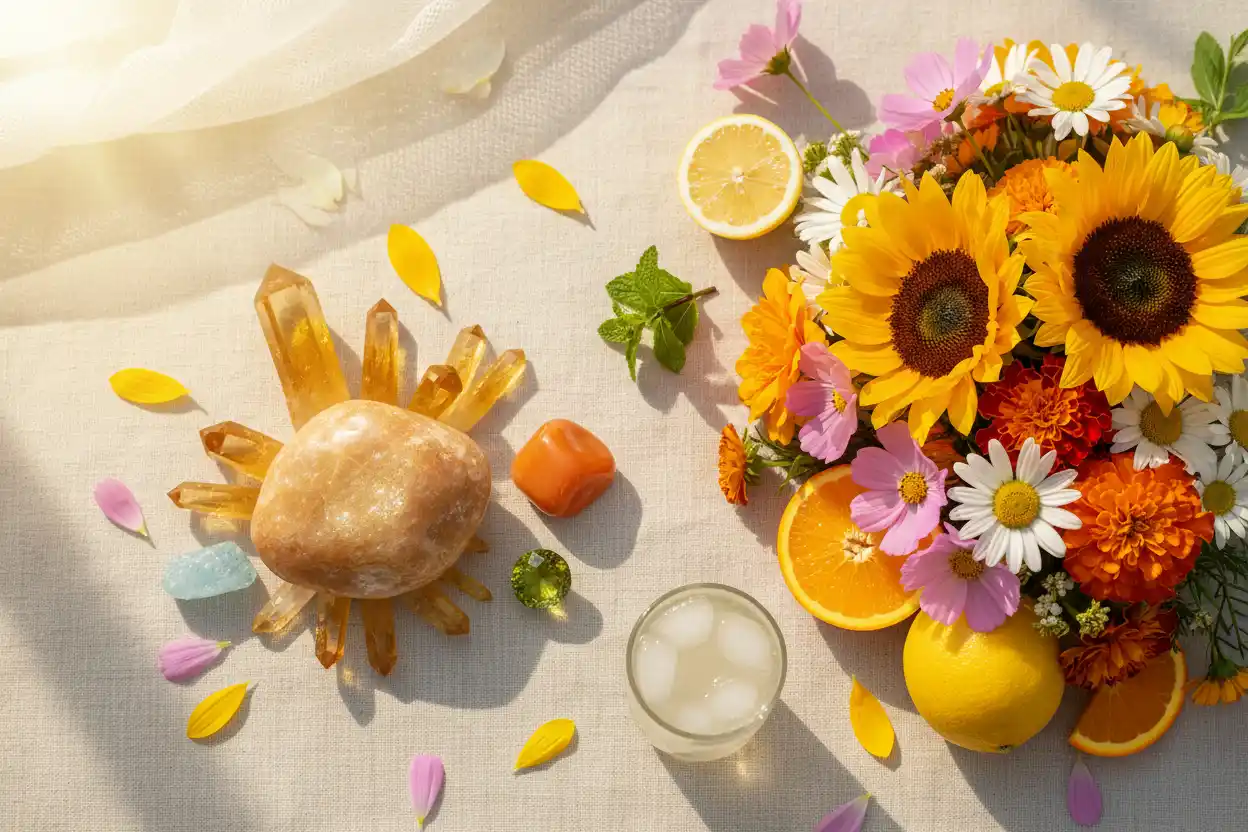
15 Vibrant Crystals for Summer Passion & Radiant Joy
Crystals for summer naturally lean toward bright orange, red, yellow, green and blue because those colors echo long daylight, warm landscapes, vegetation, water and outdoor activity. A seasonal crystal collection can therefore feel energetic without requiring claims that gemstones physically increase vitality, alter mood or absorb sunlight as a therapeutic force. The strongest summer symbolism comes from visible color, geological character and the habits or memories a person intentionally connects with each stone.
The 15 choices in this guide are sunstone, carnelian, citrine, ruby, peridot, tiger’s eye, aquamarine, turquoise, amber, garnet, red jasper, spinel, fire opal, orange calcite and clear quartz. They vary dramatically in hardness and durability. Ruby is extremely durable at Mohs 9, aquamarine ranks 7.5 to 8, citrine is Mohs 7, while amber is only about 2 to 2.5 and requires much gentler handling.
Summer crystal use can stay simple. Sunstone might represent confidence before an event, aquamarine can symbolize keeping a clear head during travel, carnelian may represent creative action and amber can evoke memory, warmth and long sunlight. The meaning comes from the connection between the object and the person’s intention, not from a proven energetic transfer between gemstone and body.
15 Vibrant Crystals for Summer
- Sunstone for confidence and radiant optimism.
- Carnelian for creative momentum and bold action.
- Citrine for joy, gratitude and warm abundance symbolism.
- Ruby for passion and resilient commitment.
- Peridot for fresh summer growth.
- Tiger’s eye for confidence with practical judgment.
- Aquamarine for travel, water and calm communication.
- Turquoise for traditional journey and protection symbolism.
- Amber for sunlight, memory and preservation.
- Garnet for enduring passion and determination.
- Red jasper for steadiness during busy seasons.
- Spinel for color, resilience and renewed enthusiasm.
- Fire opal for individuality and creative intensity.
- Orange calcite for playful color and experimentation.
- Clear quartz for simplicity and focused intention.
Sunstone, Carnelian and Citrine Capture Summer Light Without Needing “Solar Energy” Claims
Sunstone is almost impossible to separate visually from summer imagery. It belongs to the feldspar family and can show glittering aventurescence caused by reflective inclusions. GIA places sunstone roughly between 6 and 7.2 on the Mohs scale depending on feldspar variety and notes that its cleavage gives it poor toughness, so protected jewelry designs are preferable to exposed rings. Modern traditions often describe sunstone benefits in terms of joy, confidence or leadership, but the gemstone does not generate literal sunlight inside the body. Its bright appearance simply makes optimism a natural symbolic interpretation.
Carnelian contributes translucent orange and reddish-orange color that resembles sunset, heated earth and summer fruit. It is a chalcedony variety and has been used for beads and carved objects for thousands of years. A summer association with action or creativity works because the warm color feels visually active, not because carnelian has been shown to increase metabolism, stamina or sexual energy.
Citrine adds yellow to golden-orange quartz. At Mohs 7 with good toughness, it is practical for most jewelry, although abrupt temperature changes can fracture it and intense prolonged light may fade some stones. The traditions around citrine benefits are often framed as abundance or manifestation. For summer, gratitude and enjoyment are more grounded interpretations than promising financial gain.
Ruby, Garnet and Red Jasper Represent Different Types of Summer Passion
Ruby is the strongest physically among these red choices. It is corundum with Mohs hardness 9, excellent toughness and no cleavage, making it one of the best natural colored gemstones for jewelry exposed to regular wear. Its vivid red color has encouraged centuries of symbolism involving passion, courage and vitality, and the themes found in ruby benefits can be meaningful when they are framed as history and personal interpretation rather than medical effects.
Garnet offers a more varied family. Depending on type, garnet hardness ranges from about 6.5 to 7.5, and colors can extend far beyond red into orange, green, purple and other hues. A red garnet can represent persistence and commitment, making it a good counterbalance to summer’s more spontaneous symbolism. Passion does not have to mean acting impulsively; it can also mean continuing to care about something after initial excitement fades.
Red jasper brings a more opaque and earthy appearance. Its rusty red color gives it a grounded personality compared with transparent ruby or garnet. For a busy summer filled with travel, social events or outdoor activity, that visual weight can symbolize maintaining routine and responsibility rather than constantly seeking stimulation.
Peridot, Tiger’s Eye and Spinel Add Color Without Repeating the Same Message
Peridot is particularly suitable for summer because its yellow-green to green color resembles fresh vegetation under strong sunlight. It ranks about 6.5 to 7 and has fair to good toughness, so it is wearable but should be protected from hard impacts and harsh cleaning. GIA recommends warm soapy water and advises against ultrasonic or steam methods. The themes in peridot benefits can be interpreted as freshness and positive momentum without claiming that the gemstone detoxifies the body or changes digestion.
Tiger’s eye offers golden-brown chatoyancy, an optical band of reflected light that seems to move across a polished surface. GIA describes tiger’s-eye as quartz containing fibrous structures that create this distinctive sheen. Symbolically, the changing band can represent attentive observation, making tiger’s eye a useful reminder to combine summer confidence with judgment rather than treating courage as recklessness. The ideas behind tiger’s eye benefits are strongest when understood this way.
Spinel adds the greatest color flexibility of the three, appearing in vivid red, pink, orange, purple, blue and other shades. Its Mohs hardness of 8 and good toughness make it practical for jewelry, while the color range means it can match nearly any summer palette. Instead of assigning one fixed spiritual meaning to every spinel, the wearer can use color personally: red for intensity, pink for affection, blue for composure or orange for creative enthusiasm.
Aquamarine and Turquoise Bring Water and Travel Into Summer Symbolism
Summer often means travel, beaches, lakes and longer time outdoors, which makes blue stones especially appropriate.
Aquamarine is beryl with Mohs hardness 7.5 to 8 and good jewelry durability. GIA recommends warm soapy water and notes that heat exposure should be avoided. Its sea-blue appearance and long maritime associations make it a natural symbol for travel, calmness and clear communication. Aquamarine benefits can therefore provide traditional symbolism without implying that the gemstone prevents accidents or controls anxiety.
Turquoise creates a very different blue. It is opaque to semi-translucent rather than faceted and historically accumulated extensive travel and protective lore across different cultures. That history can make a turquoise pendant meaningful during summer travel, but the stone itself should never be treated as a substitute for real safety precautions.
Turquoise is also softer and more chemically sensitive than aquamarine. Cosmetics, oils and chemicals can affect some stones, particularly porous or treated material. Someone wearing turquoise at the beach or pool should therefore remember that symbolic association with water does not mean the gemstone should be exposed casually to saltwater, chlorine, sunscreen or heat.
Amber and Fire Opal Offer Summer Warmth Through Very Different Gemological Stories
Amber is not a mineral crystal. It is fossilized tree resin, often yellow, orange or reddish brown, and its inclusions can preserve evidence of ancient ecosystems. GIA describes it as a natural time capsule and places its hardness at only 2 to 2.5, with poor toughness. That makes amber particularly appropriate for symbolism involving memory, preserved moments and long summers rather than physical energy.
Its softness also means beach-style wear requires caution. Sand, harder gemstones and rough surfaces can scratch amber easily, while heat and strong chemicals can cause damage. Warm mild soapy water is the safest cleaning method. The themes around amber benefits are therefore better treated as historical and symbolic rather than therapeutic.
Fire opal brings warmth through bodycolor rather than preserved resin. Its yellow, orange or red appearance can feel highly energetic, and some examples also display play-of-color. As an opal, however, it requires greater care than ruby or quartz. A summer jewelry design should protect the stone from hard impacts, high heat and sudden temperature changes.
Orange Calcite and Clear Quartz Support Playfulness and Simplicity
Not every summer stone needs to carry ancient symbolism. Orange calcite is useful precisely because its warm color feels playful and experimental. It is much softer than quartz and should be treated accordingly, which makes polished display pieces more practical than exposed everyday rings.
Clear quartz brings the opposite visual message. Rather than adding more color, it can represent simplicity during a season that sometimes becomes overscheduled. A clear quartz point on a desk might simply mark the one priority someone wants to keep visible while travel, social activity and changing routines compete for attention.
This kind of use is psychologically straightforward. Objects can act as cues. The stone does not need to amplify energy or program the environment to serve as a reminder.
A Practical Summer Crystal Comparison
| Summer stone | Scientific identity | Approx. Mohs hardness | Summer symbolic theme |
|---|---|---|---|
| Sunstone | Feldspar | About 6–7 | Confidence and sunlight |
| Carnelian | Chalcedony | 6.5–7 | Creative action |
| Citrine | Quartz | 7 | Joy and gratitude |
| Ruby | Corundum | 9 | Passion and resilience |
| Peridot | Olivine | 6.5–7 | Freshness and growth |
| Tiger’s eye | Quartz | About 7 | Confidence and judgment |
| Aquamarine | Beryl | 7.5–8 | Travel and communication |
| Turquoise | Copper aluminum phosphate | 5–6 | Journey symbolism |
| Amber | Fossilized resin | 2–2.5 | Memory and warmth |
| Garnet | Garnet group | 6.5–7.5 | Commitment and determination |
| Red jasper | Chalcedony/quartz | 6.5–7 | Steadiness |
| Spinel | Spinel | 8 | Resilience and color |
| Fire opal | Hydrated silica mineraloid | 5–6.5 | Creativity and intensity |
| Orange calcite | Calcite | 3 | Playfulness |
| Clear quartz | Quartz | 7 | Focus and simplicity |
The hardness differences are substantial. Ruby can tolerate far more routine abrasion than amber or calcite, while sunstone’s cleavage creates impact vulnerability despite moderate surface hardness. Summer jewelry should therefore be chosen according to actual durability instead of color alone.
Summer Sunlight Can Damage Some Gems Rather Than “Charge” Them
Leaving every crystal in direct sunlight because summer is associated with solar energy is not good gem care. Citrine can fade after prolonged intense exposure, amber may darken or experience treatment-related color changes, and high heat is not recommended for sunstone.
Heat inside parked cars, on windowsills or near outdoor glass can become much stronger than people expect. Thermal shock is also a concern for several gemstones, particularly those with fractures or cleavage.
The guidance in can crystals go in the sun is therefore more useful than a universal “charging” rule. Bright indirect light and sensible storage protect a collection better than prolonged direct exposure.
Use Summer Crystals as Reminders for Real Activities
A summer crystal practice becomes more useful when each stone is linked to something concrete. Aquamarine beside a travel checklist can symbolize calm preparation, while carnelian near art supplies can mark creative time. Sunstone may accompany a written confidence goal before a social event, and red jasper can sit near a training plan as a reminder of consistency.
The action matters more than the object.
If a stone helps someone remember to call a friend, finish a project, spend time outdoors or prepare carefully for travel, the symbolism has served a real purpose. That is very different from claiming that the mineral itself produces joy, energy or protection.
Conclusion
Crystals for summer work best as colorful symbols of passion, joy, travel, creativity and confidence rather than as sources of medically or scientifically established energy. Sunstone, carnelian and citrine capture summer warmth; ruby, garnet and red jasper represent passion with different levels of intensity; peridot, tiger’s eye and spinel add freshness and color; aquamarine and turquoise connect naturally with travel and water; while amber, fire opal, orange calcite and clear quartz contribute memory, creativity, playfulness and focus. Their physical properties vary widely, so safe cleaning and storage should always follow the actual gemstone rather than a universal crystal ritual.
FAQs About Crystals for Summer
Which crystal is best for summer joy?
Sunstone and citrine are especially popular because their warm yellow and orange colors naturally evoke sunlight and optimism. Their joyful meanings are symbolic rather than proven psychological effects.
Which summer crystal is best for confidence?
Carnelian, tiger’s eye and ruby are commonly associated with courage or confidence. A person may use them as visual reminders, but there is no scientific evidence that wearing them directly changes self-confidence.
Which crystals are good for summer travel?
Aquamarine and turquoise have long travel associations, particularly aquamarine’s maritime history. Those meanings are cultural and symbolic and should never replace normal travel safety planning.
Can summer crystals be left in direct sunlight?
Not universally. Citrine may fade after prolonged intense light, amber can darken or undergo color changes, and some feldspars such as sunstone should be protected from excessive heat.
Which summer stone is most durable for jewelry?
Ruby is the strongest choice in this group for frequent wear. It ranks Mohs 9, has excellent toughness and no cleavage.
Is amber really a crystal?
No. Amber is fossilized tree resin and is an organic gem rather than a mineral crystal. The word crystal is being used here in the popular collecting sense.
Do summer crystals increase physical energy?
There is no established scientific evidence that gemstones increase physical stamina, metabolism or biological energy. They can still serve as personal symbols of enthusiasm and activity.
Disclaimer:
Passion, joy, confidence, protection, manifestation, healing and energetic meanings associated with summer crystals reflect folklore, modern spiritual traditions and personal symbolism rather than established medical or psychological effects. Crystals should not replace healthcare, safety planning or evidence-based decision-making.