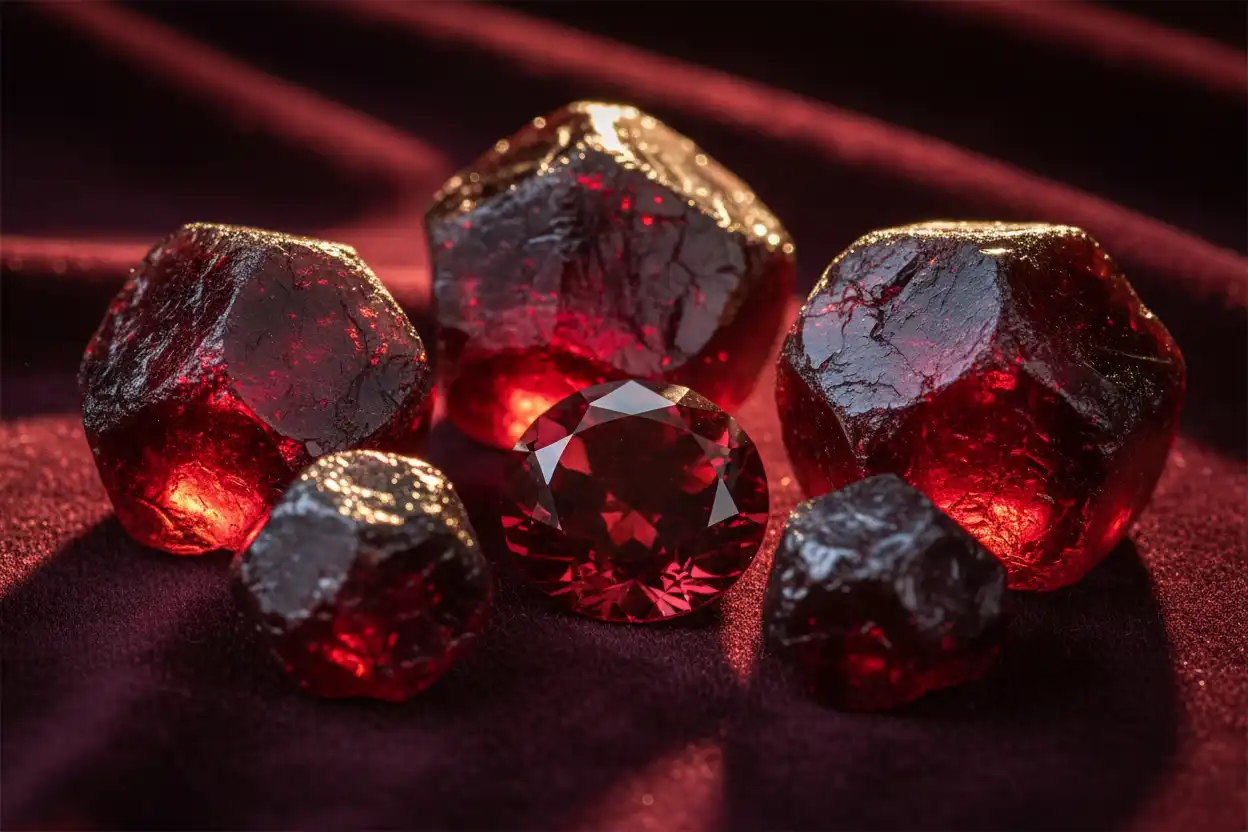
Almandine Garnet Meaning: Mineral Facts & Symbolism
Almandine garnet is the iron-rich aluminum garnet species with the ideal chemical formula Fe₃Al₂(SiO₄)₃. It commonly appears deep red, brownish red, purplish red, wine red, or so dark that a thick specimen looks almost black until strong light passes through it. Its familiar red appearance comes primarily from iron within the garnet structure rather than from a surface coating or an added pigment.
Understanding almandine garnet meaning begins with that mineral identity. Almandine belongs to the wider garnet group, whose members share a related crystal structure but differ substantially in chemistry, color, occurrence, optical properties, and gem value. Natural almandine also commonly mixes compositionally with pyrope and spessartine, so many red garnets lie somewhere between ideal end-member formulas rather than matching a chemically pure textbook composition.
The measurable mineral comes first. Historical associations and modern symbolism can then be discussed separately, without treating beliefs about strength, grounding, protection, or vitality as physical properties of the stone.
The broader garnet meaning guide explains the mineral family as a whole, while types of garnet separates almandine from pyrope, spessartine, grossular, andradite, and other garnet materials.
Almandine Garnet Identity at a Glance
| Property | Almandine garnet |
|---|---|
| Mineral group | Garnet |
| Mineral species | Almandine |
| Ideal composition | Fe₃Al₂(SiO₄)₃ |
| Principal chemical character | Iron-aluminum silicate |
| Crystal system | Isometric, also called cubic |
| Common colors | Deep red, brownish red, purplish red, red-violet, very dark red |
| Typical luster | Vitreous on gem-quality material |
| Mohs hardness | About 7–7.5 |
| Specific gravity | High for a common silicate gem; composition can shift measured values |
| Optical behavior | Isotropic in ideal structure; anomalous strain effects can sometimes appear |
| Cleavage | No prominent gemologically important cleavage |
| Common compositional relationships | Pyrope–almandine and almandine–spessartine solid solutions |
| Common uses | Faceted gems, cabochons, beads, carvings, mineral specimens |
| Possible phenomenon | Asterism in suitably included and oriented material |
| Identification caution | Red color alone cannot establish almandine |
The ideal formula is useful for classification, but real natural garnets rarely behave as perfectly pure chemical end members. Magnesium can substitute into an iron-rich stone toward pyrope composition, while manganese can contribute toward spessartine. Because garnet chemistry forms continuous or extensive solid-solution relationships, refractive index, density, color, and other measurable properties can shift between specimens.
That is why a red garnet should not be called almandine solely because it looks dark red.
How Almandine Garnet Forms
Almandine is especially associated with metamorphic rocks. It develops when pre-existing rocks containing suitable amounts of iron, aluminum, and silica recrystallize under elevated temperature and pressure. Schists and gneisses are particularly familiar hosts, and well-formed almandine crystals can occur as conspicuous red-brown porphyroblasts embedded within lighter mica-rich or quartz-rich rock.
The mineral is useful beyond gemology because garnet chemistry can record changing metamorphic conditions during crystal growth. A single crystal may develop compositional zoning from its core toward its rim as the surrounding rock responds to temperature, pressure, and chemical changes.
For a collector, this means an almandine crystal embedded in matrix is not merely a decorative object. It can preserve evidence of the geological environment in which the host rock recrystallized.
Almandine can also occur in pegmatitic and related geological environments, and durable garnet grains can survive weathering after their original host rock breaks down. Erosion may release the dense crystals, which can then become concentrated in sediments.
A loose rounded garnet found in sediment therefore records at least two stages: initial crystallization in rock followed by weathering and transport.
The detailed geological interpretation of garnet should be kept distinct from surface appearance. A photograph showing a red crystal in mica schist can support a metamorphic context when the specimen provenance is known, but a loose faceted gem cannot be assigned a formation environment merely from its color.
Why Almandine Is Red
Iron is central to almandine’s identity and color. Ferrous iron occupies structural positions within the garnet lattice and absorbs portions of visible light, producing the deep red to red-violet appearance associated with the species.
The exact face-up color is nevertheless controlled by more than the word “iron.”
Chemical mixing with pyrope, spessartine, or other garnet components can modify hue. Iron concentration and oxidation-related effects influence absorption. Crystal thickness changes how much light travels through the material. Inclusions alter transparency. Cutting determines how much light returns to the viewer rather than being absorbed inside the gemstone.
This explains a common almandine observation: a rough crystal or deeply cut gem may appear almost black against a dark background but reveal a pronounced wine-red color when illuminated strongly from behind.
That does not mean the stone changes color. It means its relatively strong absorption makes optical path length important.
For this reason, an attractive faceted almandine should be judged by how it looks face-up under realistic illumination, not by the bright cherry-red color obtainable only with a powerful light held directly behind it.
The wider garnet quality and grading guide explains why excessive darkness is an important quality issue across red garnets.
Almandine, Pyrope, and Rhodolite Are Not Interchangeable Names
The close chemical relationship among red garnets creates one of the most persistent naming problems.
Ideal almandine is iron-rich:
Fe₃Al₂(SiO₄)₃
Ideal pyrope is magnesium-rich:
Mg₃Al₂(SiO₄)₃
Natural stones can contain substantial proportions of both components. A specimen may therefore be described compositionally as pyrope-almandine or almandine-pyrope depending on which component dominates and how a particular laboratory or publication presents the analysis.
Rhodolite complicates the terminology further because rhodolite is a recognized gem trade variety generally associated with attractive pinkish-red, raspberry, purple-red, or similar pyrope-almandine material. It is not a separate mineral species equivalent to almandine.
This matters when interpreting almandine garnet meaning because a seller’s name should not quietly become a mineralogical conclusion. A visually attractive purple-red garnet may belong somewhere within the pyrope-almandine compositional system without being a near-pure almandine end member.
The rhodolite garnet ring guide shows how that mixed material behaves in a jewelry context, but the mineral identity should remain distinct from ordinary dark-red almandine.
Diagnostic Characteristics of Almandine
A preliminary almandine identification can use several mutually supporting observations. No one observation is sufficient in every case.
Isometric Optical Character
Garnets crystallize in the isometric system and are normally singly refractive. Under crossed polarizers, an ideal garnet should remain dark as it rotates rather than showing the regular blinking expected from many doubly refractive gemstones.
Natural garnets can sometimes show anomalous double-refraction effects caused by strain or structural complexities. Such behavior should not automatically disqualify a garnet identification.
Relatively High Refractive Index
Almandine tends to have a relatively high refractive index compared with many familiar transparent gems. Because natural garnets form compositional mixtures, measured values should be interpreted as part of a property set rather than matched against one rigid number.
Very high readings can also approach or exceed the practical range of standard gemological refractometers in iron-rich material.
High Density
Almandine is relatively dense. Pure mineral reference data place the ideal end member at a high specific gravity, while natural gem specimens can differ because their chemistry contains pyrope, spessartine, or other components.
Density can therefore support identification but should not be used as a stand-alone species test.
Characteristic Absorption
Iron-rich almandine produces a recognizable absorption pattern that can be useful when examined spectroscopically. Spectroscopy becomes particularly valuable when visually similar red materials need to be separated without destructive testing.
Microscopic Features
Natural almandine may contain mineral crystals, rutile needles, zircon, quartz, graphite, healed fractures, feathers, tubes, or other internal features depending on locality and geological history.
An inclusion is evidence only when it is interpreted in context. A black crystal does not prove almandine, and a clean-looking stone does not rule it out.
What a Photograph Can Tell You About Almandine
Photographs are excellent for documenting a specimen but weak for proving species on their own. Dark red color occurs in numerous gemstones and manufactured materials, while camera processing can make a brownish stone appear more saturated than it does in person.
A useful photo record should therefore answer observable questions rather than pretending to perform laboratory identification.
| Photo observation | What it can support | What it cannot establish |
|---|---|---|
| Deep red to red-violet body color | Compatibility with almandine appearance | Species identity |
| Dodecahedral or related garnet crystal form | Garnet may be plausible in a crystal specimen | Exact garnet composition |
| Red transmission through thin edges | Shows strong absorption and underlying red body color | Natural origin |
| Visible mica-rich matrix | May be consistent with metamorphic occurrence | Exact locality |
| Dark crystal becoming red in transmitted light | Documents optical thickness effects | Treatment status |
| Star on a cabochon | Indicates oriented reflective inclusions | Almandine without further testing |
| Surface-reaching fracture | Documents condition | Cause or treatment |
| Included transparent faceted stone | Preserves visible inclusion evidence | Natural versus synthetic origin by itself |
| Seller label stating “almandine” | Records the seller’s description | Independent identification |
| Locality written on an old specimen card | Provides provenance evidence worth preserving | Guaranteed mine origin without supporting chain of custody |
This distinction between observation and conclusion is one of the most useful habits in mineral collecting.
A Practical Almandine Specimen Evaluation Checklist
When examining an almandine candidate, record the specimen before attempting to classify it.
Start with context. Photograph the entire crystal, matrix, and any existing label. Record weight and dimensions. Preserve old handwritten or printed labels even when they contain outdated terminology because they may retain provenance information that cannot be reconstructed later.
Describe color rather than naming the mineral from color. Note whether the specimen is brownish red, wine red, purplish red, red-violet, or nearly black in reflected light. Then observe whether thin edges transmit red when illuminated.
Look for crystal morphology. Well-developed garnets may show dodecahedral, trapezohedral, or modified forms, although broken, rounded, massive, or faceted specimens may provide little useful morphology.
Record transparency honestly. Opaque mineral specimens, translucent cabochons, and transparent faceting rough belong to different practical categories even when their dominant composition is almandine.
Inspect inclusions without naming them prematurely. Photograph needles, crystals, fractures, color zoning, and unusual textures through a loupe or microscope if available. Identification of an inclusion should be treated as a separate analytical problem.
Separate provenance from appearance. A locality claim should come from documentation, a trustworthy collecting record, or defensible analytical work—not from resemblance to online photographs.
Use non-destructive testing first. Refractive index, optical behavior, density, spectroscopy, and microscopy are preferable to scratch, flame, acid, or other destructive home tests.
The purpose of this checklist is not to turn a photograph into a laboratory report. It creates a disciplined evidence record so that later testing has context.
Names and Claims That Need Qualification
Historical and commercial terminology can make almandine sound simpler than it is.
| Name or claim | Responsible interpretation |
|---|---|
| “Almandine garnet” | A mineral-species identification that should be consistent with garnet chemistry and gemological properties |
| “Red garnet” | A color description that could refer to almandine, pyrope, mixtures, or other garnets |
| “Rhodolite” | A gem trade variety generally within the pyrope-almandine compositional range, not a separate mineral species |
| “Carbuncle” | Historical terminology for fiery red gemstones, especially red garnets; not a precise modern species name |
| “Oriental garnet” | Obsolete or potentially misleading terminology that should not replace a mineral identification |
| “Healing garnet” | A symbolic or metaphysical expression, not a scientific property |
| “Natural garnet” | Indicates natural origin only when supported; it does not specify which garnet species |
| “Untreated garnet” | A treatment statement, not proof of species or locality |
| “Collector-grade” | A commercial description unless criteria are explicitly stated |
| “Almandine from a famous locality” | A provenance claim requiring documentation rather than visual resemblance |
The old term carbuncle is particularly important historically because it was used broadly for glowing or fiery red stones. A historical text using that word cannot automatically be translated into “almandine” under modern mineralogical classification.
Ruby, spinel, pyrope, and almandine can overlap strongly in historical descriptions because earlier observers did not have refractometers, spectroscopy, chemical analysis, Raman instruments, or modern species definitions.
Where the Name Almandine Comes From
The modern mineral name is associated with Alabanda in present-day Turkey, an ancient center connected with gem cutting and trade. Mineralogical references credit the name’s formal historical usage to the tradition linking the material with that locality.
The important nuance is that the history of the name is more secure than many stories attached to individual ancient red gemstones.
A red stone described in an old text, painting, inventory, or piece of jewelry cannot reliably be called almandine merely because almandine was historically known. Before modern gemological analysis, ruby, spinel, pyrope, almandine, glass, and other red materials could be grouped or mislabeled under broad color-based terms.
Responsible almandine garnet meaning therefore distinguishes documented mineral history from romantic attribution.
Almandine Garnet Meaning in Symbolic Traditions
Modern symbolic interpretations commonly connect almandine with endurance, grounded determination, courage, commitment, stability, and persistence. The deep red color encourages associations with strength and sustained effort, while the mineral’s geological occurrence in metamorphic rocks provides an intuitive metaphor for stability under changing conditions.
Those associations can be meaningful without being physical properties.
A person might use almandine as a reminder to finish difficult work rather than abandon it when enthusiasm decreases. Someone else may associate the red color with commitment in a relationship, personal discipline, or the determination to recover from a setback.
That is symbolism: the human assigns meaning to the object.
The mineral itself does not scientifically transmit perseverance, increase courage, stabilize emotions, attract money, alter relationships, or modify biological energy.
This distinction allows almandine garnet meaning to remain culturally and personally useful without turning metaphor into an unsupported mechanism.
Grounding and Protection Claims
“Grounding” is one of the most common words attached to dark red stones. In spiritual practices, it generally refers to feeling centered, present, practical, or connected with one’s immediate surroundings.
There is no established gemological test for grounding energy, nor is grounding a measurable mineral property analogous to refractive index, density, hardness, or chemical composition.
Used responsibly, an almandine could serve as a physical cue during a grounding routine: hold the stone, observe its weight and color, identify what is happening in the immediate environment, and return attention to a concrete task. The useful action comes from the reflective practice, not from a demonstrated force emitted by the crystal.
Protection symbolism should be treated similarly. Historical or spiritual associations with protection do not show that an almandine prevents accidents, illness, financial loss, violence, or other harm.
The site’s disclaimer provides the broader boundary for symbolic and informational material.
Does Almandine Garnet Have Healing Properties?
There is no established scientific evidence that almandine garnet treats medical conditions by being worn, carried, placed on the body, kept nearby, or used in crystal rituals.
Its iron content should not be confused with nutritional iron. Iron locked inside a stable silicate mineral lattice is not equivalent to an iron supplement, and wearing an iron-bearing garnet does not provide a medically useful dose of iron.
Likewise, red color does not demonstrate effects on blood circulation, fertility, hormones, metabolism, immunity, or other biological systems.
Someone may still value almandine in meditation, reflective practice, religious or cultural ritual, or as a personal symbol of perseverance. Those experiences should be described as personal or traditional uses rather than therapeutic mineral effects.
Almandine and Other Red Garnets
Almandine sits within a chemically connected group rather than an isolated category.
Pyrope can overlap strongly in red appearance, and many natural gems contain both iron-rich almandine and magnesium-rich pyrope components. Rhodolite occupies part of this mixed compositional landscape and often has a brighter raspberry or purplish character.
Other garnets move much farther away visually. Spessartine can be orange, while grossular and andradite varieties include yellow, orange, and green gems.
This diversity is why types of garnet is a better starting point than assuming every red garnet is almandine.
For jewelry buyers, garnet rings provide the family-level setting context, while the mineral definition on this page remains focused specifically on almandine.
Safe Ownership and Handling
Almandine’s hardness of roughly 7–7.5 gives it useful scratch resistance for many jewelry applications. It generally lacks the strong cleavage vulnerability of gems such as topaz, but it remains brittle enough to chip or fracture under sufficiently sharp impact.
Those two statements are compatible. Hardness measures resistance to scratching; it does not mean a gemstone cannot break.
Thin girdles, pointed corners, cavities, and surface-reaching fractures deserve additional protection. A dark stone also benefits from keeping its surfaces clean because oils and residue can reduce light return and make an already deep color appear even darker.
The specific cleaning procedure belongs in how to clean garnet jewelry rather than being repeated here.
For a frequently worn ring, the garnet ring guide explains how setting height, exposed edges, and daily impact affect practical wear. Bright pyrope-almandine material behaves somewhat differently visually, which is why dedicated rhodolite jewelry pages such as rhodolite garnet earrings, rhodolite garnet necklaces, and rhodolite garnet bracelets keep those design decisions separate.
What Almandine Garnet Meaning Should—and Should Not—Tell You
A sound description of almandine contains two clearly labeled stories.
The mineralogical story says that almandine is an iron-aluminum garnet with an ideal composition of Fe₃Al₂(SiO₄)₃, an isometric crystal structure, high density, approximately 7–7.5 hardness, characteristic iron-related red coloration, and extensive compositional relationships with other garnets. It occurs widely in metamorphic rocks and can preserve useful information about the geological conditions in which those rocks developed.
The cultural story says that people have interpreted deep red garnets as symbols of endurance, commitment, courage, groundedness, protection, and persistence. Those ideas are historically and personally meaningful interpretations rather than laboratory measurements.
Keeping those stories separate is the clearest way to understand almandine garnet meaning.
The stone does not need a medical or supernatural claim to be interesting. Its chemistry links apparently different red garnets into a continuous mineral system, its iron controls an unusually deep optical character, its crystals record metamorphic processes, and its historical identity shows why color-based gemstone names need caution.
For broader mineral references, explore the Gemstone Guides. Nearby material-first references include albite meaning, alunite meaning, amber meaning, and the separate discussion of agate color meaning.
Information about how Gems Lore handles mineral, historical, and symbolic material is available on the About page, and questions or corrections can be submitted through Contact.