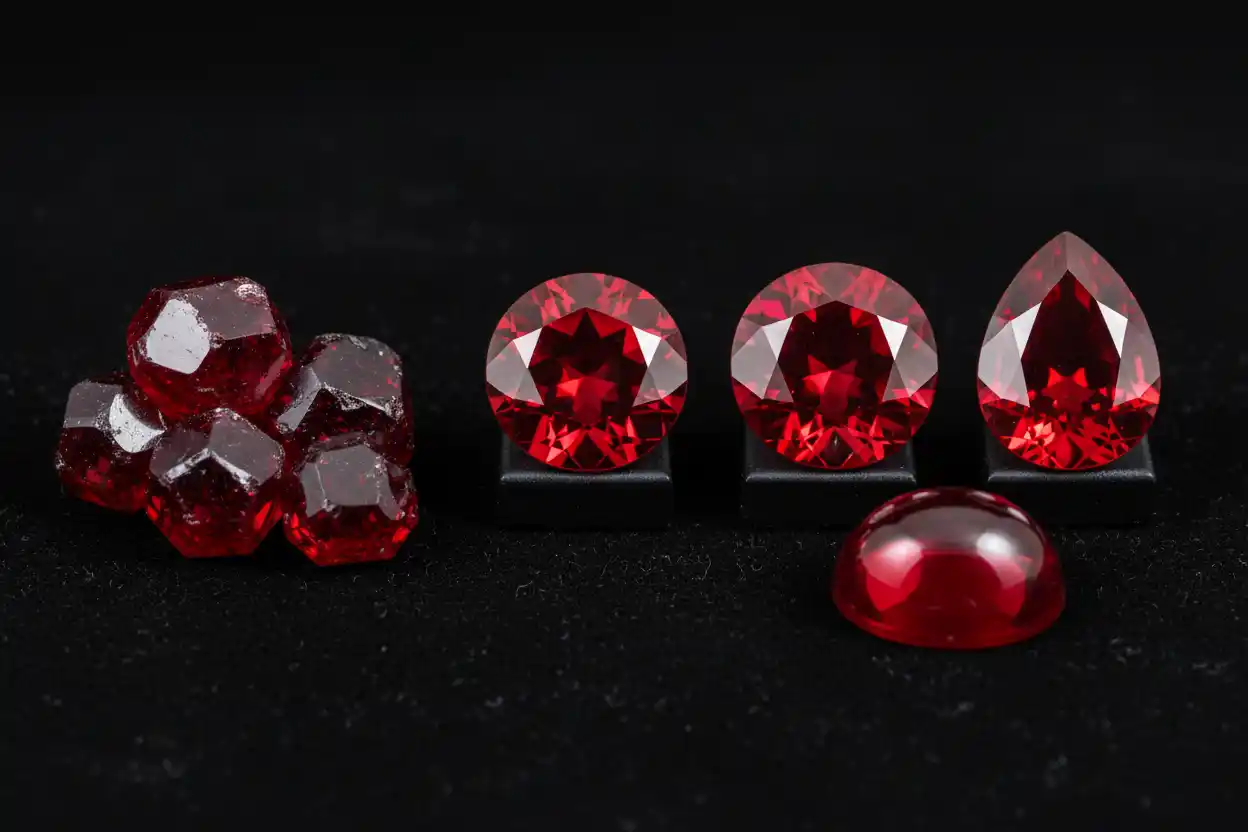
Pyrope Garnet: Meaning, Properties & Symbolism
Pyrope is the magnesium-rich member of the garnet mineral group, with the ideal formula Mg₃Al₂(SiO₄)₃. Its name comes from Greek words associated with fire and the eye, reflecting the deep red, crimson, purple-red, and orange-red colors that made it one of Europe’s most familiar historic garnets.
Pure end-member pyrope is uncommon in nature. Most gemstones contain meaningful proportions of almandine, spessartine, grossular, or chromium-bearing garnet components, so the boundary between pyrope, pyrope-almandine, rhodolite, chrome pyrope, and mixed red garnet often requires chemical analysis.
Pyrope Garnet at a Glance
| Property | Pyrope Garnet |
|---|---|
| Material type | Magnesium aluminum garnet mineral and gemstone |
| Ideal composition | Mg₃Al₂(SiO₄)₃ |
| Mineral group | Garnet group |
| Common colors | Deep red, blood red, crimson, orange-red, purple-red, pink-red, brown-red, and near-black red |
| Crystal system | Cubic |
| Typical habit | Dodecahedral, trapezohedral, rounded, granular, massive, and water-worn crystals |
| Luster | Vitreous to resinous |
| Transparency | Transparent to opaque |
| Mohs hardness | Approximately 7–7.5 |
| Cleavage | None |
| Tenacity | Brittle |
| Fracture | Conchoidal to uneven |
| Specific gravity | About 3.58 for pure pyrope; commonly higher in iron-rich natural mixtures |
| Optical character | Isotropic and singly refractive |
| Common uses | Faceted gemstones, cabochons, beads, rings, earrings, necklaces, bracelets, mineral specimens, and geological indicator grains |
| Main care concern | Over-dark cutting, edge chipping, internal fractures, species mislabeling, and confusion with almandine, rhodolite, ruby, and spinel |
Pyrope within the Garnet Group
Garnet is a group of related minerals that share the same fundamental cubic structure while varying in chemistry.
The parent Garnet guide owns the group-level history, general symbolism, shared structure, and broader jewelry use.
Pyrope represents the magnesium-aluminum end member. Almandine Garnet replaces much of the magnesium with iron, while Spessartite Garnet is manganese rich.
The calcium-dominant branch includes grossular, andradite, and uvarovite. Those minerals can produce orange, yellow, colorless, brown, and green gems that look very different from conventional red pyrope.
Natural garnets frequently sit between ideal end members. Consequently, a polished stone may be described as pyrope-almandine rather than chemically pure pyrope.
The complete compositional and color framework belongs on types of Garnet.
Why Pure Pyrope Is Uncommon
The ideal pyrope formula describes a chemical endpoint rather than the composition of every stone sold under the name.
Iron readily substitutes for magnesium, shifting the material toward almandine. Manganese introduces a spessartine component, while calcium and chromium can connect pyrope with other garnet substitutions.
Many red commercial stones contain enough magnesium to be called pyrope-dominant but still show substantial almandine.
This chemical mixing changes density, refractive index, color, absorption spectrum, and geological significance.
A seller may use pyrope as a convenient trade label for a deep-red garnet without establishing whether magnesium is the dominant divalent element.
For an ordinary inexpensive stone, that simplified description may have limited financial effect. However, chemical testing becomes important when a seller claims rare chrome pyrope, Bohemian origin, unusual color change, or a premium end-member composition.
What Causes Pyrope’s Red Color?
Ideal pure pyrope would be colorless. Natural red color develops mainly through iron, chromium, and sometimes vanadium.
Ferrous iron contributes red, orange-red, purple-red, and brownish absorption. Increasing iron content can deepen the stone and shift its chemistry toward almandine.
Chromium can create a purer, more vivid red or pink-red color. Chromium-rich pyrope from mantle environments may resemble fine ruby when viewed in strong transmitted light.
Vanadium contributes to certain pink, purple, and color-changing stones. Its absorption can alter the balance between red and blue transmission under different light sources.
A stone containing too much iron may appear almost black because little light returns through the crown.
Cutters therefore need to consider tone as carefully as hue. A lighter thin stone can look brighter than a larger deeply saturated piece.
The wider relationship between red, purple, orange, and green garnet symbolism belongs on the Garnet color guide.
Pyrope-Almandine Garnet
Pyrope and almandine form an extensive solid-solution series.
As iron replaces magnesium, specific gravity and refractive index generally rise. Color may shift from bright crimson or purple-red toward darker red, brown-red, and nearly black.
Most conventional red garnets in jewelry contain both components.
Gemologists may describe a stone as pyrope-almandine when neither endpoint alone communicates its chemistry accurately.
The commercial name rhodolite is commonly applied to attractive purple-red or raspberry pyrope-almandine garnet with a lighter tone than typical dark red garnet.
However, not every pyrope-almandine stone qualifies visually as rhodolite. Dark brown-red material remains ordinary mixed garnet even if its chemistry falls within a similar range.
Pyrope and Rhodolite
Rhodolite Garnet is a trade variety rather than a separate mineral species.
Its composition is usually dominated by pyrope and almandine, with possible spessartine and other components.
Rhodolite typically displays raspberry, rose-red, purple-red, pinkish purple, or wine-red colors.
Traditional pyrope is often darker, more purely red, orange-red, or crimson.
The commercial boundary depends on appearance rather than one internationally fixed chemical percentage.
Therefore, a seller should not use rhodolite automatically for every purple-red pyrope mixture. Conversely, a laboratory may identify a rhodolite jewel simply as natural garnet or pyrope-almandine because trade-variety naming falls outside the report’s scope.
Chrome Pyrope
Chrome pyrope contains chromium substituting for aluminum.
The most familiar material occurs as small red-to-purple grains associated with mantle-derived peridotite, kimberlite, lamproite, and related ultramafic rocks.
Fine chrome pyrope can show vivid red, pink-red, or purple-red color. Nevertheless, many crystals are too small, dark, fractured, or included for significant faceting.
Arizona “ant-hill garnets” are famous examples. Ants excavating underground galleries carry small garnet grains to the surface, where people collect them from the loose soil around the mound.
These stones can show bright red color because their small dimensions allow light to pass through material that would appear too dark in a larger cut.
Chrome-rich mantle garnets also play an important geological role in diamond exploration. Certain chemical compositions indicate pressure and temperature conditions associated with diamond-bearing mantle environments.
Finding chrome pyrope does not guarantee diamonds. Instead, geologists use its chemistry alongside other indicator minerals and regional evidence.
Pastel, Pink, and Color-Changing Pyrope
Pyrope is not limited to dark red.
Tanzania and East Africa have produced pale pink, purplish pink, pastel, and color-changing pyrope-rich garnets containing chromium and vanadium.
Some stones look pinkish purple under daylight-equivalent illumination and warmer pink, red, or purple under incandescent light.
Other mixed pyrope-spessartine garnets can shift between blue-green, gray-green, purple, and red depending on their trace-element chemistry.
These unusual colors occupy a specialist collector market and should not be grouped with ordinary red pyrope pricing.
A color-change claim requires comparison under standardized light sources. Two photographs edited with different white balance do not establish a genuine optical phenomenon.
Pyrope and Umbalite Garnet
Umbalite Garnet is a trade name associated with pink, rose, purple, and raspberry garnets from Tanzania’s Umba Valley region.
Its composition can involve pyrope, almandine, and spessartine in varying proportions.
Some Umbalite stones are pyrope dominant, while others sit closer to a different mixed composition.
The geographic trade name does not define one exact formula. Laboratory analysis remains necessary when the specific garnet components affect value.
Geological Formation
Pyrope forms under relatively high-pressure conditions in magnesium-rich rocks.
It is a major garnet in Earth’s mantle, where it occurs in peridotite and eclogite.
Mantle fragments can reach the surface as xenoliths carried rapidly upward by kimberlite, lamproite, basalt, and related magmas.
Pyrope also develops during high-grade metamorphism of magnesium-rich rocks.
Serpentinite, granulite, garnet peridotite, and ultrahigh-pressure metamorphic rocks can contain crystals ranging from microscopic grains to exceptional large specimens.
The presence of pyrope helps geologists estimate pressure, temperature, and mineral reactions during burial and uplift.
Some pyrope-bearing rocks have travelled from mantle depths or deep continental collision zones before erosion exposed them at the surface.
Important Pyrope Localities
The Czech Republic, particularly the historic Bohemian region, is famous for small deep-red pyropes used in tightly set nineteenth-century jewelry.
South Africa, Botswana, Lesotho, and Tanzania produce mantle-derived garnets from kimberlites, peridotites, and related deposits.
Mozambique has supplied red, purple-red, and pyrope-almandine gems, including material that overlaps rhodolite.
Arizona produces small chrome pyropes associated with the San Carlos volcanic and mantle-rock environment.
Sri Lanka’s gem gravels contain pyrope-rich red and mixed garnets transported from their original host rocks.
Myanmar, Madagascar, Norway, Russia, Pakistan, Australia, and several additional regions also yield pyrope or pyrope-rich garnets.
Precise origin cannot usually be established through red color alone. Chemical trace-element analysis and inclusion study may narrow possibilities but can still leave an inconclusive result.
The wider locality framework appears in where Garnet is found.
Bohemian Garnet
Bohemian garnet is a historical geographic and jewelry term most strongly associated with small pyrope gems from the Czech lands.
The stones are commonly deep red and cut into small rounds or rose cuts.
Because larger pyrope can become too dark, traditional Bohemian jewelry often uses dense clusters of small stones that return more red light.
Antique pieces may combine genuine Czech pyrope with almandine, glass replacements, later repairs, and mixed-age settings.
The phrase Bohemian style does not guarantee Czech-mined garnet. Modern reproductions can use garnets or glass from other sources.
An antique appraisal should assess the gems, metal, construction, age, repairs, and provenance together.
Pyrope versus Ruby and Red Spinel
Pyrope can resemble ruby and red spinel, particularly in small stones.
Ruby is doubly refractive, pleochroic, substantially harder, and has different chromium-related spectra.
Spinel is cubic and singly refractive like garnet, but its refractive index, density, spectrum, inclusions, and chemistry differ.
Garnet commonly shows characteristic absorption bands associated with iron and other elements.
Dark red pyrope may also show stronger extinction than a well-cut ruby or spinel.
The dedicated Ruby, Garnet, and Spinel comparison owns the full non-destructive identification process.
How to Identify Pyrope Garnet
The first step is confirming that the stone belongs to the garnet group.
Garnet is singly refractive and normally remains dark in a polariscope, although strain can create anomalous reactions.
Pyrope’s refractive index begins near 1.714 for the ideal end member and rises as iron, manganese, and other components increase.
Specific gravity also increases from the pure pyrope value near 3.58 toward heavier mixed garnets.
Pyrope lacks cleavage and has a conchoidal-to-uneven fracture.
Under magnification, stones may contain rounded crystals, needles, fingerprints, growth features, zircon halos, or other inclusions.
Absorption spectroscopy helps identify iron-, chromium-, and vanadium-related features.
Raman spectroscopy confirms garnet structure, while quantitative chemistry determines whether the stone is pyrope dominant.
The practical testing framework in how to identify real Garnet helps separate garnet from glass, synthetic spinel, ruby, and assembled imitations.
Durability and Jewelry Suitability
Pyrope’s hardness of approximately 7–7.5 provides good resistance to ordinary wear.
Its position appears on the gemstone hardness chart.
The mineral has no cleavage, which reduces the risk of splitting along one preferred plane.
Nevertheless, it remains brittle. A sharp impact can chip a girdle, facet junction, or pointed corner.
The difference between hardness and breakage resistance is explained in gemstone toughness versus hardness.
Sound pyrope works well in rings, earrings, pendants, bracelets, necklaces, and brooches.
Dark stones benefit from open-backed settings that admit more light. However, an overly deep pavilion can retain weight while making the gem look nearly black.
Low-profile bezels protect frequently worn rings, while prongs should avoid pressure against surface-reaching fractures.
Cutting Pyrope Garnet
Color and tone control cutting decisions.
A dark crystal may need a shallow design or smaller finished size so enough light returns through the crown.
Cutters must balance brightness against windowing. Excessive shallowness creates a transparent dead area in the center.
Bright chrome pyrope and pastel material can accept deeper cuts because their tone is lighter.
Rounds and ovals are common because they manage weight and brightness efficiently.
Cushions, pears, marquises, step cuts, and precision designs are also possible.
Small Bohemian-style stones may receive rose cuts with a flat base, especially when intended for closed or clustered antique settings.
Treatments and Imitations
Most Pyrope Garnet is sold without routine heat or irradiation treatment.
Unlike many sapphires, topazes, or quartzes, garnet color usually reaches the market in its natural state.
Fracture filling can occur in damaged stones, while surface coatings may create stronger color, iridescence, or an imitation of another gem.
Glass-filled or assembled products can imitate red garnet jewelry.
Synthetic garnet materials exist for optical and industrial use, including compositions that do not occur as natural gemstone species. These products should be identified by their actual synthetic material rather than sold vaguely as lab-created pyrope.
Glass, synthetic spinel, ruby, red zircon, and other garnets remain more common substitutes.
Treatment processes and disclosure terminology are explained in gemstone treatments.
Current Pyrope Garnet Asking Prices
Pyrope pricing overlaps ordinary red garnet, rhodolite, chrome pyrope, pastel garnet, and color-changing mixed garnet markets.
| Pyrope product | Broad July 2026 retail asking range |
|---|---|
| Small rough or inexpensive specimen | About $5–$30 |
| Standard commercial red faceted pyrope | About $5–$30 per carat |
| Bright clean red or purple-red material | About $20–$100 per carat |
| Fine chrome pyrope | About $50–$200 per carat |
| Fine Bohemian or documented locality stone | About $50–$300 per carat, depending strongly on size and provenance |
| Pastel, pink, or unusual mixed pyrope | About $75–$300 per carat |
| Fine color-changing or exceptional collector gem | About $200–$750 per carat or more |
| Antique Bohemian garnet jewelry | Determined mainly by age, setting, condition, authenticity, and matching |
These are broad asking-price ranges rather than appraisals or guaranteed transaction values.
Ordinary dark-red garnet can be inexpensive even when the seller calls it pyrope. Fine color, brightness, clean appearance, and reliable identification create the premium.
Detailed size and quality segmentation belongs on the Garnet price guide.
What Gives Pyrope Garnet Value?
Color is the strongest factor.
The most attractive conventional stones show lively crimson, red, purple-red, or orange-red without excessive brown or black extinction.
Clarity matters because red pyrope and pyrope-almandine are generally expected to appear eye clean.
Cut quality controls brightness, symmetry, extinction, windowing, and face-up size.
Large bright stones are less common than small dark gems. However, size alone does not create value when the stone appears black.
Chrome content, pastel color, or genuine color change can create a collector premium.
Documented Bohemian, Arizona, Tanzania, Mozambique, or another locality may add interest when supported properly.
Treatment disclosure, surface condition, chips, fractures, and laboratory identification complete the valuation.
Buying Pyrope Garnet
Ask whether pyrope describes a laboratory-confirmed composition or a general red-garnet trade label.
View the stone under daylight-equivalent and warm indoor lighting. Dark stones can look vivid beneath intense display lamps and nearly black elsewhere.
Inspect the center for extinction and the girdle for chips.
Request dimensions alongside carat weight. A deep stone may hide weight below the setting.
For chrome, pastel, or color-changing material, obtain a report from a laboratory capable of quantitative garnet chemistry.
Do not pay a Bohemian premium without credible Czech provenance or an antique-jewelry assessment.
The broader seller, return-policy, cut, and report checks belong on the Garnet buying guide.
Pyrope is indexed through the crystals beginning with P directory and the gemstones beginning with P directory.
Cleaning and Storage
Clean Pyrope Garnet with lukewarm water, mild soap, and a soft brush.
Rinse thoroughly and dry it with a lint-free cloth.
Ultrasonic cleaning may be acceptable for a sound untreated stone, but it should be avoided when fractures, filling, coatings, antique settings, or weak repairs are present.
Steam creates unnecessary thermal stress and is not needed for routine care.
Store garnet separately from sapphire, ruby, diamond, and other harder gems.
Remove rings before heavy manual work, exercise, gardening, and household cleaning.
Complete jewelry instructions appear in how to clean Garnet jewelry.
Pyrope Garnet Meaning and Symbolism
Red garnets have carried symbolism across ancient Mediterranean, European, Middle Eastern, Asian, African, and Indigenous jewelry traditions.
However, historical objects were not always chemically separated into pyrope, almandine, and other modern species.
Modern Pyrope symbolism commonly emphasizes vitality, determination, courage, commitment, and sustaining effort through a difficult period.
Its deep red color supports associations with warmth, passion, protection, and purposeful action.
Mantle-derived pyrope inspires a geological metaphor involving pressure, depth, and material transported from beneath Earth’s visible surface.
Bohemian garnet jewelry adds themes of heritage, continuity, and craftsmanship passed between generations.
Pyrope is also connected with Garnet’s role as the traditional January birthstone, which is covered in the January birthstone guide.
These meanings remain cultural, artistic, personal, or spiritual interpretations. Scientific evidence does not show that Pyrope Garnet treats illness, changes circulation, increases fertility, or guarantees courage.
Frequently Asked Questions
Is pyrope a separate garnet mineral?
Yes. Pyrope is the magnesium-aluminum garnet species with the ideal formula Mg₃Al₂(SiO₄)₃.
Is natural pyrope chemically pure?
Rarely. Most natural stones contain iron, manganese, calcium, chromium, or other garnet components.
What gives pyrope its red color?
Iron produces much of the red-to-brown-red color, while chromium and vanadium can create vivid red, pink, purple, or color-changing effects.
Is pyrope the same as almandine?
No. Pyrope is magnesium rich, while almandine is iron rich. Many commercial red garnets are mixtures of both.
Is rhodolite a type of pyrope?
Rhodolite is generally a purple-red pyrope-almandine trade variety rather than pure pyrope.
What is chrome pyrope?
It is chromium-bearing pyrope, commonly associated with mantle-derived ultramafic rocks and kimberlite indicator-mineral assemblages.
Do chrome pyropes prove that diamonds are present?
No. Their chemistry may indicate favorable mantle conditions, but they are only one part of diamond exploration evidence.
What are Arizona ant-hill garnets?
They are small chrome-rich pyrope grains carried to the surface by ants while excavating nests.
Is Bohemian garnet always pyrope?
Historic Bohemian garnet is strongly associated with Czech pyrope, but jewelry can contain replacements, mixed garnets, or glass and should be assessed individually.
Is pyrope suitable for everyday rings?
Yes, when the stone is sound and protected reasonably. It has good hardness and no cleavage but can still chip after impact.
Is Pyrope Garnet normally treated?
Most material is untreated. Filling, coating, assembly, and substitution can still occur.
What makes Pyrope Garnet valuable?
Bright natural color, limited extinction, clarity, cut, size, unusual chemistry, color change, locality, condition, and reliable identification determine value.
Pyrope is best understood as the magnesium-rich foundation behind several familiar red and purple garnet categories. Its closest compositional comparison remains almandine, while its most important commercial overlap is rhodolite.