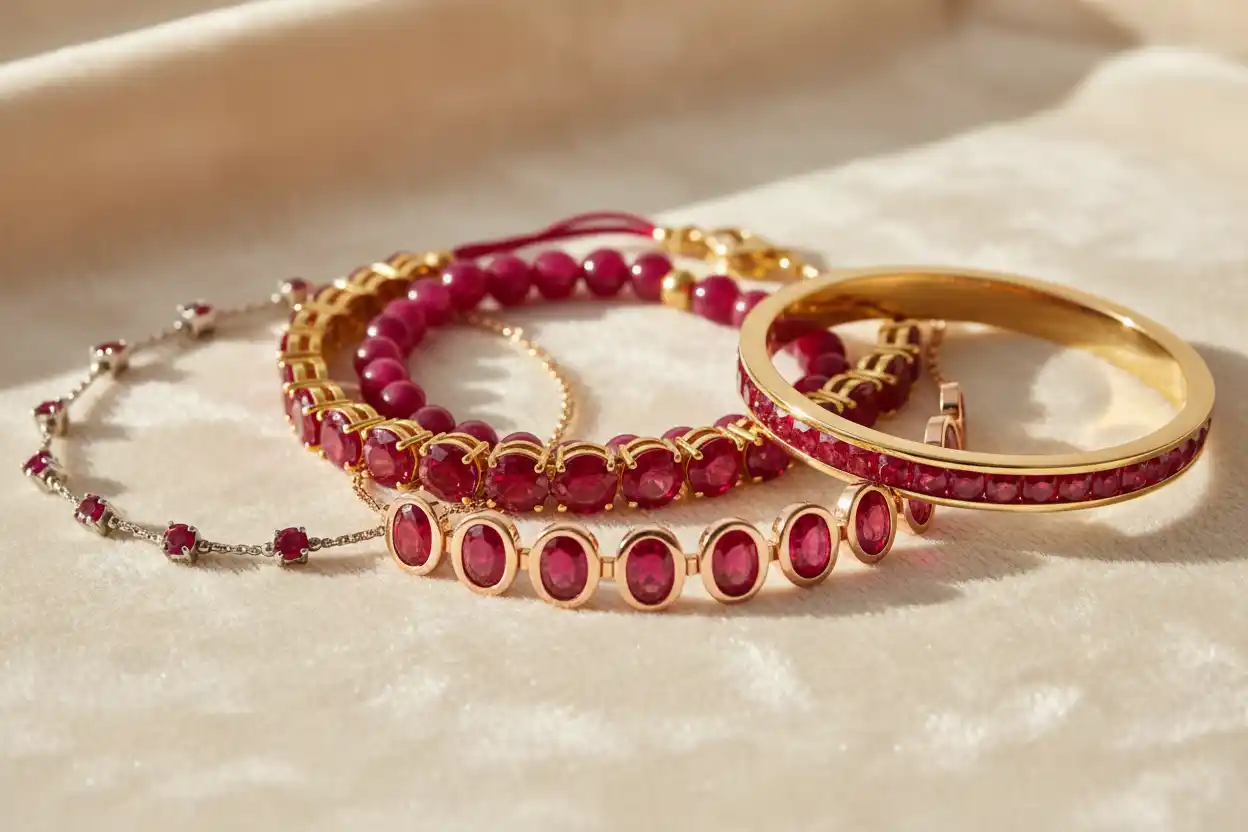
Ruby Bracelets: Styles, Quality, Sizing and Buying Guide
A ruby bracelet places one of the most durable colored gemstones on the wrist, where saturated red can remain visible through constant movement. Fine ruby ranges from vivid red to slightly purplish red, while commercial bracelets also include pinkish, orangish, brownish, dark-red and opaque material.
Ruby is the red variety of corundum and ranks 9 on the Mohs scale. That hardness makes it highly resistant to ordinary scratching, but it does not make every ruby bracelet equally durable. Large fractures, glass filling, exposed girdles, weak links and worn clasps can create more practical risk than the corundum itself.
Bracelet quality therefore depends on three connected factors: the ruby material, the setting or stringing system and the bracelet’s fit. A secure, well-matched bracelet of moderately sized stones will usually wear better than a heavier design built around poorly supported gems.
For ruby’s geology, symbolism and general properties, see the ruby meaning guide. Loose-stone quality and seller evaluation are covered in the ruby buying guide, while market factors remain in the ruby price guide.
Ruby Bracelets at a Glance
| Bracelet type | Visual effect | Practical strength | Main concern |
|---|---|---|---|
| Tennis bracelet | Continuous line of faceted rubies | Elegant, flexible and highly visible | Many individual links and settings require inspection |
| Bezel-set bracelet | Smooth metal-framed stones | Strong edge protection and reduced snagging | Closed metal can darken deep stones |
| Station bracelet | Rubies spaced along a chain | Lightweight and suitable for layering | Fine chain can twist, stretch or break |
| Bangle | Structured circular form | Keeps stones oriented on top of the wrist | Accurate fit and hinge security |
| Cuff | Open, architectural design | Easy to put on and visually bold | Repeated bending can fatigue the metal |
| Cluster bracelet | Groups of small stones | Strong color from modest gem sizes | Shared prongs and trapped residue |
| Beaded bracelet | Continuous ruby or corundum beads | Casual, symbolic and accessible | Drill holes, cord wear and uncertain quality labels |
| Charm bracelet | One or several ruby accents | Personalized and easy to combine | Moving charms may strike one another |
| Multi-row bracelet | Dense red color and formal presence | Statement appearance | Weight, comfort and complex maintenance |
| Ruby-and-diamond bracelet | High contrast and brilliance | Classic fine-jewelry look | Diamond can abrade exposed ruby surfaces if settings rub |
Why Ruby Works Well in Bracelets
Ruby is one of the hardest gemstones used regularly in jewelry. It resists surface abrasion better than quartz, garnet, tourmaline, emerald, opal and most ornamental stones.
Corundum also lacks perfect cleavage. It does not split readily along one weak structural direction in the way topaz or tanzanite can.
Nevertheless, ruby can chip under a sharp blow, especially where a girdle is thin or a fracture reaches the surface. Bracelets receive repeated contact with desks, doorframes and other objects, making setting height and stone condition important.
The wider distinction between scratch resistance and impact resistance is explained in Gemstone Toughness vs Hardness. Ruby’s relative position among jewelry materials appears in the gemstone hardness chart.
Natural Ruby, Lab Ruby and Ruby Imitations
A natural ruby formed geologically.
A laboratory-grown ruby is manufactured corundum with essentially the same composition, crystal structure, hardness and refractive properties. It can perform very well in a bracelet and usually offers stronger color or larger matched stones for a lower price.
An imitation only resembles ruby. Red glass, synthetic spinel, garnet and other materials may be used in ruby-colored bracelets.
The real-versus-fake ruby guide explains how natural ruby, lab-grown ruby, glass-filled products and simulants differ.
For manufactured corundum specifically, use the lab ruby meaning guide, lab ruby buying guide and lab ruby price guide.
A seller should state the material clearly rather than using created ruby, ruby gemstone or simulated ruby without explanation.
Ruby Tennis Bracelets
A tennis bracelet uses a flexible line of individually set rubies.
Round stones are common because they can be calibrated and linked consistently. Ovals and cushions create more visible color but need greater space and more complex settings.
Each link should articulate smoothly. Stiff links concentrate stress, while extremely loose links can twist and expose the settings to impact.
Inspect every ruby from the side. The stones should sit level rather than leaning at different angles.
A box clasp with a secondary safety latch is preferable for a valuable tennis bracelet. The clasp should close with positive resistance rather than relying on friction that has weakened through wear.
Because a tennis bracelet contains many components, periodic professional inspection is essential even when the rubies themselves remain undamaged.
Bezel-Set Ruby Bracelets
A bezel surrounds all or part of the ruby’s girdle with metal.
This setting protects edges and creates a smooth surface that catches less readily on sleeves.
Full bezels suit active wearers, although they can make dark rubies appear even deeper if the pavilion receives little light.
An open-backed bezel preserves more brightness and allows easier cleaning.
Partial bezels expose more of the stone while protecting selected sides. Their security depends on precise metal contact and a sufficiently thick frame.
Bezel-set station or tennis bracelets are among the most practical choices for regular wear.
Ruby Station Bracelets
A station bracelet places individual rubies at intervals along a chain.
The open space makes each stone distinct and keeps the piece lighter than a continuous line bracelet.
Bezel stations are particularly effective because they remain smooth against the wrist. Prong-set stations admit more light but can catch on loose fabric.
The chain should connect symmetrically to both sides of each setting. An uneven station may flip and show its back repeatedly.
Fine chains need to be proportionate to the combined stone weight. Several large stations can distort a chain that was designed only for a light pendant.
Ruby Bangles
A bangle maintains a structured circular or oval form.
Rubies may be bezel-set, channel-set, pavé-set or arranged in a central cluster.
A hinged bangle is easier to fit closely than a slip-on design. The hinge should move without sideways looseness, and the clasp should include a safety mechanism when the bracelet is valuable.
Rigid construction keeps the principal stones on top of the wrist, making a small number of fine rubies visually effective.
A bangle should not rotate so freely that its stones strike the underside of desks and tables.
Ruby Cuffs
A cuff has an opening that allows it to pass over the side of the wrist.
Ruby cuffs often use cabochons, bezel-set faceted stones or pavé accents across the upper surface.
The metal should flex only enough for normal use. Repeatedly bending a cuff open and closed can create fatigue cracks.
A cuff that must be forced onto the wrist is too small or poorly shaped.
Wide cuffs can feel warm and restrictive in hot weather, while narrow cuffs may turn easily if they carry a heavy ruby cluster.
Ruby Bead Bracelets
Ruby beads range from opaque commercial corundum to transparent fine material.
Most affordable strands contain opaque or translucent stones with visible mineral inclusions, fractures and color variation. Some may consist of ruby in matrix rather than pure red corundum throughout.
Transparent faceted ruby beads are significantly more expensive and may be treated.
Inspect drill holes for chips, whitening and fractures. The hole should not cut through a weak cavity or large filled fissure.
Knotted construction reduces bead-to-bead impact. Elastic bracelets are convenient, but their cord eventually stretches and should be replaced before failure.
Dark-red beads should not be identified as ruby from color alone. Garnet, glass, dyed quartz and composite products can look similar.
Ruby Charm Bracelets
A ruby charm offers birthstone color without requiring a full gemstone line.
Cabochons, small faceted drops and engraved or symbolic charms are common.
The connecting ring should be soldered or mechanically secured. An open jump ring can spread if the charm catches on clothing.
Moving charms can collide. Keep ruby away from exposed diamond edges, which are harder and can abrade the corundum over time.
A charm bracelet should be comfortable enough that the ruby does not swing beneath the wrist continually.
Ruby Cluster Bracelets
Clusters combine several small rubies into floral, geometric or abstract groups.
They can provide vivid color at a lower price than a bracelet using equivalent large stones.
Matching remains important. One pale pinkish stone in a deep-red cluster may interrupt the design unless the variation is intentional.
Shared prongs reduce visible metal but may secure two or more neighboring stones. Damage to one shared support can therefore loosen multiple rubies.
Open galleries allow cleaning from the back, which is important because residue collects beneath compact clusters.
Choosing Ruby Color
Color is the most important visual quality factor.
Fine ruby commonly displays vivid red to slightly purplish red. The color should remain visible in ordinary indoor light rather than appearing black except under a spotlight.
Very dark stones can look attractive in large polished surfaces but may lose life in small bracelet settings.
Pinkish-red material may be classified as ruby or pink sapphire depending on saturation, laboratory standards and market practice.
Orangish-red and brownish-red rubies are often more affordable. Their suitability depends on the desired appearance rather than one universal ideal.
Bracelet stones should match in hue, tone and saturation. Natural variation is acceptable in artisanal or antique designs, but a formal tennis bracelet should show a controlled progression.
The types of ruby guide explains color, star, locality and commercial varieties.
Clarity and Transparency
Ruby commonly contains inclusions.
Mineral crystals, healed fissures, silk and color zoning can occur in natural stones. Laboratory-grown material has its own growth-related features.
Inclusions become a quality concern when they reduce transparency, create gray areas or threaten durability.
A bracelet stone does not need to be flawless. Small stones are viewed collectively, so consistent brightness often matters more than microscopic clarity.
Surface-reaching fractures deserve particular attention because they may contain glass or another filler and can weaken exposed areas.
Ruby Cut Quality
Good cutting allows ruby to return red light rather than appearing dark or transparent through the center.
Deep cuts may preserve weight but create extinction. Shallow cuts can create windowing.
Round and oval mixed cuts are common. Cushions show broad flashes, while pears and marquises require protected points.
Matching across a bracelet involves more than carat weight. Tables, outlines, depth and face-up dimensions should be consistent.
A well-cut smaller ruby can look more vivid than a heavier stone with poor proportions.
Carat Weight and Millimeter Size
Carat measures weight rather than visible dimensions.
Ruby is relatively dense, so it can look smaller than a lower-density gemstone of equal weight.
In a bracelet, millimeter dimensions, stone count and total length provide a clearer picture of visual coverage.
The carat-versus-millimeter chart explains how gemstone density changes face-up size.
A seller should state whether the advertised carat weight represents all rubies combined or one principal stone.
Measuring Bracelet Size
Measure the wrist where the bracelet will rest.
A tennis bracelet should move slightly without turning constantly. Beaded bracelets need extra length because the beads occupy interior space.
| Fit | Practical result |
|---|---|
| Close | Minimal movement and lower impact risk |
| Comfortable | Slight drape without sliding over the hand |
| Relaxed | Easier layering but more movement |
| Loose | Greater snagging and loss risk |
Internal circumference is more useful than generic small, medium or large labels.
A bracelet should not compress the wrist or leave deep marks.
Clasp Security
Lobster clasps suit light chain and station bracelets.
Box clasps are common in tennis bracelets and should be reinforced with a side safety or figure-eight latch.
Toggle clasps are decorative but depend on sufficient bar length and tension. They may open when the bracelet becomes slack.
Magnetic clasps can assist wearers who have difficulty with small mechanisms, but they may separate during a strong pull and can be unsuitable around certain medical devices.
The clasp should operate repeatedly without sticking or feeling loose.
Choosing the Metal
Yellow gold emphasizes ruby’s warmth.
Rose gold can soften pinkish or purplish-red stones.
White gold and platinum create stronger contrast and often make red appear more vivid.
Sterling silver provides an accessible option but tarnishes and is generally softer than gold or platinum.
Metal sensitivity should also be considered. Some white-gold alloys contain nickel.
Ask for the exact metal fineness, total bracelet weight and whether plated surfaces will require future renewal.
Matching Ruby With Diamonds
Diamond accents increase brilliance and create strong white-red contrast.
However, diamond is harder than ruby. The stones should not be arranged so their girdles rub directly during articulation.
Channel walls, prongs or metal spacers should keep the gems separated.
Diamond pavé also adds many small settings that need periodic inspection.
A ruby-and-diamond bracelet should be evaluated as a mechanical system rather than only by total gemstone weight.
Natural Ruby Versus Lab Ruby Bracelets
Natural ruby usually carries a higher rarity premium.
Lab ruby can provide a more uniform color, larger sizes and cleaner matched sets at a lower cost.
Both are corundum and offer excellent scratch resistance.
The choice depends on origin preference, budget, disclosure and intended symbolism rather than physical durability alone.
A lab-grown bracelet should be sold explicitly as laboratory-grown ruby. Its price should not be based on claims of natural geological rarity.
Cleaning instructions for manufactured material appear in How to Clean Lab Ruby Jewelry.
Heat Treatment and Glass Filling
Heat treatment is common in ruby and can improve color or clarity.
A conventionally heated natural ruby remains natural corundum.
Extensive fracture filling with lead-rich or other glass creates a different durability boundary. Filler can be damaged by acids, heat and jewelry repair.
Under magnification, filled fractures may show flash effects and bubbles.
The treated ruby guide explains heating, diffusion, filling and synthetic material in detail.
The broader gemstone treatments guide provides disclosure terminology across gemstone types.
Buying a Ruby Bracelet
Begin with construction and treatment disclosure.
Ask whether the stones are natural, laboratory-grown, heated, diffusion-treated, fracture-filled or composite.
Check color under neutral and warm light. Inspect matching, surface condition, prongs, links and clasp operation.
Request the bracelet’s internal circumference, total gemstone weight, individual stone dimensions, metal fineness and total metal weight.
A significant natural-ruby bracelet may justify an independent report or a group analysis supported by invoices and laboratory documentation.
The gemstone certification guide explains laboratory options, while How to Read a Gem Lab Report helps match a document to the jewelry.
For remote purchases, follow How to Buy Gemstones Online and preserve enough of the return period for independent inspection.
Birthstone and Symbolic Wear
Ruby is July’s traditional birthstone.
Its historical symbolism includes vitality, courage, devotion, status and protection.
The July birthstone guide explains its calendar history, while July birthstone jewelry covers gift formats.
A bracelet may represent a birthday, anniversary or personal commitment.
Symbolism should remain personal and should not be presented as a medical effect or a guarantee of success in relationships.
Coordinating Ruby Jewelry
A ruby earring can repeat the color near the face without adding more wrist weight.
A ruby necklace creates a separated focal point, while a ruby ring produces a stronger coordinated set.
A ruby engagement ring can be paired with a slender station bracelet for formal events.
Exact color matching across separate pieces is not always necessary. Repeating metal, cut style or general red tone often creates enough visual unity.
Cleaning and Storage
Warm water, mild soap and a soft brush are suitable for untreated and conventionally heated ruby.
Glass-filled, dyed or uncertain material requires more cautious cleaning.
The complete procedure appears in How to Clean Ruby Jewelry.
Remove the bracelet before exercise, household cleaning, swimming and manual work.
Store it flat in a fabric-lined compartment. Fasten the clasp and keep the rubies away from diamonds and other harder materials.
Have prongs, links and clasps checked whenever the bracelet catches, twists unusually or develops visible movement.
Frequently Asked Questions
1. Is ruby suitable for a bracelet?
Yes. Ruby’s hardness and lack of perfect cleavage make it one of the strongest colored-gemstone options, although settings and treatments still matter.
2. Which ruby bracelet style is most durable?
A low bezel-set bracelet provides excellent edge protection and reduces snagging.
3. Are natural ruby bracelets always expensive?
Fine transparent natural ruby can be costly, but opaque, included, small, heated and laboratory-grown options cover much broader budgets.
4. Is lab-grown ruby suitable for bracelets?
Yes. It is corundum with the same basic hardness and can provide well-matched stones at a lower price.
5. Is heated ruby fake?
No. A heated ruby remains natural ruby, although treatment should be disclosed.
6. Are glass-filled ruby bracelets durable?
They require significantly more care because the filler can be damaged by heat, acids, repair and aggressive cleaning.
7. How should a ruby tennis bracelet fit?
It should move slightly without sliding over the hand or rotating continually.
8. Does total carat weight show bracelet quality?
No. Color, treatment, matching, cut, setting security and metal construction are equally important.
9. Can ruby be worn beside diamond bracelets?
Yes, but the settings should prevent direct girdle-to-girdle rubbing.
10. How often should a ruby bracelet be inspected?
Inspect it regularly at home and seek professional checking whenever a prong catches, a link stiffens or the clasp changes feel.
11. Can ruby bracelets go in an ultrasonic cleaner?
Only untreated, heat-treated or diffusion-treated stones in sound settings may be suitable. Filled or fractured material should not be cleaned ultrasonically.
12. What does a ruby bracelet symbolize?
Ruby is traditionally associated with vitality, courage, devotion and July birthstone identity, but it does not guarantee medical or relationship outcomes.
A strong ruby bracelet combines saturated color with engineering suited to the wrist. Secure links, correctly supported stones, a dependable clasp and full treatment disclosure matter more than an unsupported quality grade. When those elements are handled well, ruby offers exceptional durability and a red color that remains visible through movement.
Ruby is indexed in Crystals That Start With R and Gemstones That Start With R.