Precious vs Semi Precious Stones: 12 Major Differences & Meanings
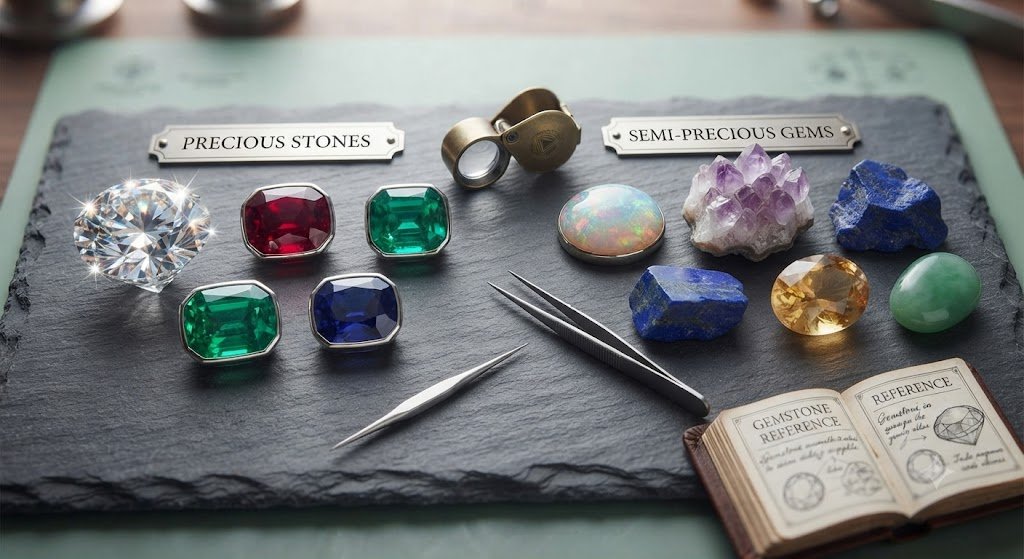
Precious vs semi precious stones is a traditional way of dividing gemstones, but it is not a reliable scientific ranking of quality, rarity or value. In popular jewelry language, diamond, ruby, sapphire and emerald are most commonly placed in the precious category, while most other gems are described as semi precious. Older references have used somewhat different lists, sometimes including stones such as opal or topaz among precious gems, which shows that the boundary has never been completely universal. The U.S. Geological Survey likewise describes precious and semiprecious as conventional gemstone categories based on qualities such as beauty, durability and rarity rather than as mineralogical classes.
Modern gemology evaluates a stone through its actual species or variety, natural or laboratory-grown origin, treatment, color, clarity, cut, weight, durability, rarity, provenance and market demand. A fine alexandrite, Paraíba tourmaline, spinel or other traditionally “semi precious” gem can be rarer and more expensive than many examples of traditionally precious stones. The old labels therefore describe convention better than they describe an individual gemstone’s quality. Professional gemological discussion has challenged the term “semi-precious” for decades because it can imply an inferior status that the stone itself may not deserve. A historical GIA discussion records an international jewelry-trade decision in 1938 to discard the term.
The most useful way to understand precious vs semi precious stones is therefore historical and practical rather than hierarchical. The categories can explain familiar jewelry vocabulary, but buyers should judge each gem according to its individual gemological characteristics and documented treatment or origin.
12 Major Precious vs Semi Precious Stones Differences
- Precious and semi precious are traditional trade labels, not mineral species.
- Diamond, ruby, sapphire and emerald are the best-known precious group.
- The exact historical boundary has varied between sources.
- Semi precious does not automatically mean common or inexpensive.
- Precious does not automatically mean rare or high quality.
- Market price depends on individual quality, rarity and demand.
- Hardness does not determine the category by itself.
- Treatments can strongly affect either group’s value.
- Laboratory-grown origin is separate from precious or semi precious naming.
- Gem reports identify species and treatment rather than relying on these labels.
- Spiritual meanings belong to individual gemstone traditions, not the category itself.
- Modern buying decisions are stronger when based on gemological facts instead of the old split.
The Traditional Precious Group Is Familiar but Not Scientifically Fixed
In contemporary popular use, the four gems most often called precious are diamond, ruby, sapphire and emerald. Diamond is native carbon. Ruby and sapphire are both varieties of corundum. Emerald is the green variety of beryl. Even within this small traditional group, the stones do not share one chemical composition, crystal system, hardness, geographic origin or pricing model.
That fact is important because precious vs semi precious stones sounds more scientifically uniform than it really is. The classification groups gemstones according to historical prestige rather than mineralogical relationship.
Older terminology also varied. The U.S. Geological Survey page on gemstone terminology includes diamond, corundum, beryl, topaz and opal among stones generally classed as precious, while historical GIA definitions emphasized the more familiar diamond, ruby, sapphire and emerald grouping.
When different respected sources can draw the boundary differently, the term clearly cannot function as a precise mineral classification.
“Semi Precious” Does Not Mean Low Value
One of the largest problems with precious vs semi precious stones terminology is the implication that everything outside the traditional precious group must be less valuable. Real gemstone markets do not work that way.
Alexandrite can command extraordinary prices when it combines strong color change, attractive hue, transparency, size and natural origin. Fine spinel has become highly sought after, especially in exceptional reds, pinks, blues and cobalt-bearing colors. Paraíba-type tourmalines can command dramatic premiums for vivid copper-bearing blue to green color. Fine jadeite, rare garnets and collector gems can also reach values that make the word semi precious sound particularly misleading.
The range of factors behind alexandrite price demonstrates why rarity and optical quality matter more than the old label. An exceptional alexandrite does not become less rare because historical convention puts it outside the familiar four precious gemstones.
The reverse is equally important. A small, heavily included, poorly cut or heavily treated ruby can be inexpensive compared with a fine example of another gem species. Calling the ruby precious does not guarantee exceptional quality.
The International Gem Society similarly notes that fine gems traditionally called semiprecious can exceed the price of low-quality diamonds, illustrating why the classification has little practical value for modern valuation.
Precious Stones Are Not Automatically Rarer
Rarity operates at several levels. A mineral species can be geologically uncommon, yet fine gem-quality examples may be even rarer. A familiar species can be abundant overall but exceptionally rare in a certain color, size, clarity, treatment state or locality.
Diamond provides a useful example. It is traditionally precious, but commercial diamond production supplies enormous numbers of stones across a wide quality range. Large, high-color, high-clarity natural diamonds can be exceptionally rare, while small commercial diamonds are not comparable in rarity.
Corundum is another example. Ruby and sapphire share the same mineral species, yet particular natural colors, sizes and treatment states differ enormously in rarity.
Meanwhile, traditionally semi precious gems can have extremely restricted occurrences. Some collector stones come from only a few known localities or rarely occur in clean facetable crystals.
Precious vs semi precious stones therefore cannot answer the question “Which is rarer?” without naming the exact gem, quality and geological occurrence being compared.
Value Depends on More Than the Category Name
Gemstone value is built from interacting factors such as color, transparency, clarity, cut, carat weight, durability, natural or laboratory-grown origin, treatment, geographic provenance, rarity and current market demand.
For ruby, intense desirable color and high transparency can carry major premiums, while evidence of significant treatment may reduce value. The factors shaping ruby price are therefore far more informative than the word precious by itself.
Spinel provides the opposite lesson. Traditionally placed outside the precious group, fine spinel can be expensive when its color, transparency, size and rarity are exceptional. The variables behind spinel price show why an old category label cannot replace stone-specific valuation.
This is also why whether gemstones hold value depends on purchase price, quality, documentation, liquidity, rarity and resale demand rather than whether a seller calls the stone precious or semi precious.
A poorly documented purchase at an inflated retail price can perform badly in resale regardless of category.
Hardness Does Not Separate Precious from Semi Precious Stones
A common misunderstanding is that precious stones are hard while semi precious stones are soft. Mohs hardness does not support that rule.
Diamond is Mohs 10, ruby and sapphire are Mohs 9, and emerald is approximately 7.5 to 8. Those figures are high, but several traditionally semi precious gems also have substantial hardness. Topaz is Mohs 8, spinel is about 8, many garnets are around 6.5 to 7.5, and quartz varieties such as amethyst are Mohs 7.
At the same time, hardness measures scratch resistance rather than overall toughness. Emerald can contain fractures and may require more cautious handling than its hardness number suggests. Jadeite can have exceptional toughness despite being softer than diamond.
The precious vs semi precious stones division therefore does not function as a durability chart.
| Feature | Traditionally precious stones | Traditionally semi precious stones |
|---|---|---|
| Common examples | Diamond, ruby, sapphire, emerald | Amethyst, garnet, tourmaline, spinel, aquamarine, peridot and many others |
| Scientific category | No | No |
| Mineralogical uniformity | None | None |
| Guaranteed high value | No | No |
| Guaranteed rarity | No | No |
| Guaranteed durability | No | No |
| Treatments possible | Yes | Yes |
| Laboratory-grown counterparts possible | Yes for some | Yes for some |
| Individual quality still matters | Always | Always |
The table makes the central weakness of the classification clear. Nearly every commercially important decision must still be made at the individual-gem level.
Treatment Can Matter More Than the Precious Label
Treatments occur in both traditional categories. Ruby and sapphire are commonly heated. Emerald is frequently filled with oils or resins to reduce the appearance of fractures. Diamonds can undergo clarity or color treatments. These processes differ greatly in permanence, detectability and influence on value.
Traditionally semi precious stones also receive treatments. Topaz may be irradiated and heated to produce blue color. Turquoise can be stabilized or dyed. Quartz varieties can be heated, irradiated or coated. Some gems are fracture filled or diffusion treated.
A treated precious gemstone can therefore be less valuable than a fine untreated gem outside the traditional precious group. Treatment disclosure often matters more to a knowledgeable buyer than category terminology.
The important questions are what the stone is, whether it formed naturally, whether it has been treated, what treatment was used and whether the seller disclosed it accurately.
Natural vs Laboratory-Grown Is a Separate Question
Precious vs semi precious stones should not be confused with natural vs synthetic gemstones. A laboratory-grown ruby is still synthetic corundum with the essential chemistry and physical properties of ruby, but it does not have natural geological origin. The same principle applies to laboratory-grown sapphire, emerald and diamond.
Natural origin and historical precious status answer different questions.
Likewise, a laboratory-created version of a gemstone does not automatically become an imitation. In gemology, a synthetic counterpart has essentially the same chemical composition, crystal structure and physical properties as the natural gem. An imitation only resembles another gemstone without sharing its essential identity.
This distinction is more precise and useful than calling everything “real” or “fake.”
Gemstone Certification Focuses on Identity, Origin and Treatment
A serious gemological laboratory does not need the precious vs semi precious stones distinction to identify a specimen. Laboratory work focuses on observable and measurable properties such as refractive index, spectroscopy, microscopy, trace-element chemistry, inclusions, fluorescence and crystal structure.
Depending on the stone and laboratory service, a report may state species or variety, natural or laboratory-grown origin, detectable treatments and sometimes geographic-origin opinions.
This makes gemstone certification especially useful when a purchase depends on claims that significantly affect value. A report identifying “natural sapphire, heated,” for example, communicates far more than a jewelry tag saying only “precious gemstone.”
Documentation also reduces confusion created by trade names. Marketing language can sound prestigious while revealing very little about mineral identity or treatment.
Beauty Is Not Reserved for One Category
The historic classification sometimes encourages the idea that precious stones are inherently more beautiful. Beauty is not a mineralogical measurement and varies according to personal preference, culture, fashion and individual gem quality.
Opal can display spectral play-of-color that diamond does not. Alexandrite can change dramatically between lighting conditions. Labradorite can produce vivid labradorescence. Moonstone can show adularescence. Fine tourmaline occurs across an extraordinary color range. Garnet includes reds, greens, oranges and color-change varieties.
Diamond, ruby, sapphire and emerald have their own exceptional optical qualities, but their historical prestige does not make the visual phenomena of every other gemstone inferior.
This is one reason contemporary jewelry designers use an enormous range of stones rather than limiting serious design to the traditional precious four.
The Historical Labels Can Still Be Useful in Ordinary Conversation
Although scientifically weak, precious vs semi precious stones remains familiar language. A jeweler may use it as shorthand, a shopper may search with it, and historical books frequently depend on the distinction.
The problem begins only when the terms are interpreted as guarantees. “Precious” should not be read as automatically rare, untreated, investment-grade or superior. “Semi precious” should not be interpreted as cheap, common or low quality.
Historical GIA discussion shows that objections to the term “semi-precious” are not new. An account of international trade nomenclature records that the term was formally rejected by a major jewelry organization in 1938 because of the problems it created.
Modern gem buyers can therefore understand the terminology without allowing it to control valuation.
Meaning and Symbolism Depend on the Individual Gem
The word precious itself carries symbolism. It implies esteem, rarity and importance, which helped diamond, ruby, sapphire and emerald become associated with royalty, status, romance and ceremonial jewelry.
Individual gemstones developed much richer traditions. Ruby has been linked symbolically with passion and vitality, sapphire with wisdom and loyalty, emerald with renewal and love, and diamond with endurance and commitment. Other gems carry equally extensive symbolic traditions, including amethyst, turquoise, garnet, jade, opal and tourmaline.
These meanings do not arise scientifically from whether a stone is labeled precious or semi precious. They develop through history, religion, folklore, trade, jewelry customs and modern spiritual practice.
A traditionally semi precious stone can therefore carry greater personal or cultural meaning for someone than a diamond or ruby.
Rarity, Quality and Provenance Matter More to Collectors
Collectors usually become more specific as their knowledge increases. Instead of asking whether a stone is precious or semi precious, they may ask whether a ruby is heated, whether an emerald contains significant fracture filling, whether an alexandrite shows strong color change, whether a sapphire’s locality claim is credible, or whether a tourmaline contains copper.
Those questions reveal the actual qualities that influence desirability.
Provenance can matter when a gem comes from a historically important locality, but geographic origin should not automatically determine quality. Fine and poor stones can occur within the same mining region.
The same applies to rarity. A rare mineral can produce unattractive specimens, while a relatively abundant gem species can yield exceptional stones that are genuinely difficult to replace.
Buying Decisions Should Start With the Gem, Not the Label
When comparing precious vs semi precious stones for purchase, first identify the exact gemstone. Then consider whether it is natural or laboratory-grown, whether treatment is present, how strong the color is, whether the transparency and inclusions suit that species, whether the cut is competent, and whether the price reflects the actual quality.
For an important purchase, independent documentation can matter more than the category written on a retailer’s display.
Buyers should also be skeptical of language suggesting that a stone is an “investment” simply because it belongs to the precious group. Gem resale markets are specialized, transaction costs can be significant, and many retail purchases do not appreciate predictably.
A fine gem should first be purchased because its quality, identity, documentation and price make sense for the buyer.
Conclusion
Precious vs semi precious stones is a traditional jewelry classification rather than a scientific hierarchy. Diamond, ruby, sapphire and emerald are most commonly called precious today, but historical sources have used different boundaries, and many gems outside that group can be exceptionally rare, valuable and beautiful. Hardness, rarity, treatment, natural origin and quality must all be evaluated separately. For modern buyers, knowing the exact gemstone and its documented characteristics provides far more useful information than relying on the precious or semi precious label.
FAQs About Precious vs Semi Precious Stones
What are the four traditional precious stones?
Diamond, ruby, sapphire and emerald are the four gemstones most commonly described as precious in modern popular jewelry terminology. Historical lists have not always been identical, however, which is one reason the category should be understood as convention rather than a strict scientific classification.
Are semi precious stones less valuable?
No. Some stones traditionally called semi precious can command extremely high prices when they are rare and exceptional. Fine alexandrite, Paraíba tourmaline, spinel and certain garnets can exceed the value of many lower-quality stones from the traditional precious group.
Is diamond always more valuable than a semi precious stone?
No. Diamond prices vary enormously according to size, color, clarity, cut, natural or laboratory-grown origin and other factors. A small commercial diamond can be worth far less than an exceptional example of a rare gemstone traditionally placed in the semi precious category.
Is emerald harder than every semi precious gemstone?
No. Emerald is approximately Mohs 7.5 to 8, while topaz is Mohs 8 and spinel is also around 8. Hardness alone neither defines the precious category nor establishes overall durability.
Why is ruby precious but spinel traditionally semi precious?
The distinction reflects historical trade, prestige and naming traditions rather than a mineralogical rule. In fact, red spinel was historically confused with ruby in famous jewels before modern gemology separated the two species. Fine spinel can be exceptionally rare and valuable.
Do professional gemologists use precious and semi precious as quality grades?
No universal gemological grading system treats those terms as quality grades. Professional identification focuses on the actual gemstone species or variety, natural or synthetic origin, treatment and measurable quality characteristics.
Can a precious gemstone be treated?
Yes. Ruby and sapphire may be heated, emerald may be fracture filled, and diamonds can receive certain color or clarity treatments. Treatment disclosure can strongly influence value even though the stone remains within a traditionally precious category.
Are pearls precious or semi precious?
Pearl demonstrates the inconsistency of the terminology particularly well. Some historical systems have treated pearl as precious, while others reserve the classic precious label for diamond, ruby, sapphire and emerald. Pearl is also organic rather than a mineral crystal, reinforcing why modern identification works better with exact gem names.
Is opal a precious stone?
Different historical sources classify opal differently. Some older systems include it among precious gems, while the familiar four-stone popular definition does not. Rather than arguing over the label, gemologists identify the specimen as opal and evaluate its type, play-of-color, body tone, pattern, stability and treatment.
Which category is better for engagement rings?
Neither category automatically determines suitability. Durability, personal preference, setting protection, treatment, replacement difficulty and budget matter more. Sapphire, ruby and diamond are durable choices, while several stones traditionally called semi precious can also work well when their physical properties and setting are appropriate.
Do precious stones have stronger spiritual meanings?
There is no scientific basis for ranking spiritual power according to precious or semi precious status. Gemstone meanings come from historical, cultural and modern symbolic traditions associated with individual stones rather than from this commercial classification.
Should I avoid the term semi precious?
You can understand and use it when discussing traditional jewelry terminology, but it should not be interpreted as a statement that a stone is inferior. Naming the exact gemstone usually communicates more useful information about identity, rarity, treatment, durability and value.
Disclaimer:
Spiritual, energetic and symbolic meanings associated with gemstones reflect historical traditions, cultural beliefs and personal practice rather than established medical or psychological effects. The labels precious and semi precious do not determine healing power, spiritual strength or health benefits and should not replace gemological identification or professional healthcare.