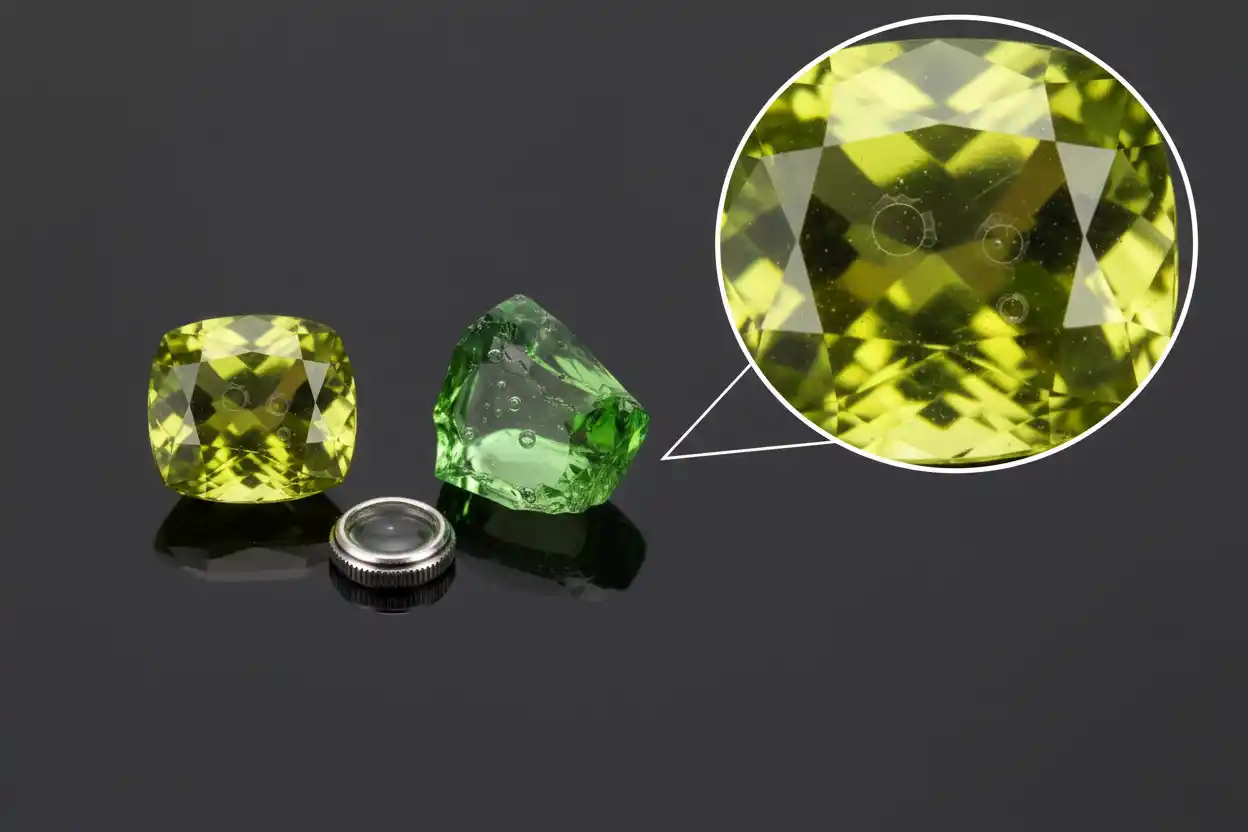
Real vs Fake Peridot: How to Tell the Difference
Real peridot has a distinctive combination of yellowish-green color, strong double refraction, relatively high density and recognizable gemological properties. However, appearance alone is not enough to confirm authenticity because green glass, synthetic spinel and other manufactured materials can be colored to resemble peridot.
The strongest identification clues are refractive index, specific gravity and birefringence. Natural peridot normally falls around refractive index 1.65–1.69 and specific gravity near 3.34, while its unusually strong double refraction can make pavilion facet edges appear doubled when viewed through the gemstone.
Certain inclusions, especially disk-shaped “lily pads,” can support natural origin, but they are not present in every peridot. Likewise, a perfectly clean stone is not automatically fake.
Real vs Fake Peridot at a Glance
| Feature | Natural Peridot | Common Imitations |
|---|---|---|
| Material | Mg-Fe olivine | Glass, synthetic spinel, synthetic forsterite and other green simulants |
| Typical color | Yellowish green to grass green | Almost any green can be manufactured |
| Refractive index | About 1.65–1.69 | Depends on imitation |
| Specific gravity | Around 3.34 | Often different from peridot |
| Mohs hardness | 6.5–7 | Varies |
| Birefringence | Strong, about 0.035–0.038 | Glass and synthetic spinel do not show the same peridot doubling |
| Typical visual clue | Doubled pavilion facet edges | Often absent |
| Natural inclusions | Lily pads, crystals, healed fractures and other mineral inclusions | Bubbles, curved growth features or artificial growth structures may occur depending on material |
| Color treatment | Rare | Color is easily manufactured in simulants |
| Heat treatment | Not known as a routine peridot enhancement | Not relevant to glass simulants |
| Best confirmation | RI, SG, microscopy, spectroscopy when needed | Laboratory testing |
What Is Real Peridot?
Peridot is the gem variety of magnesium-rich olivine.
Its chemistry is commonly written approximately as:
(Mg,Fe)₂SiO₄
Olivine forms a solid-solution series between magnesium-rich forsterite and iron-rich fayalite.
Gem peridot lies toward the magnesium-rich part of that series while containing enough iron to produce its characteristic yellow-green to green color.
Unlike gemstones whose color depends mainly on tiny amounts of an unrelated trace element, peridot’s iron is part of the mineral’s basic chemistry.
This is why peridot naturally remains within a relatively narrow green color family.
The broader Peridot: Meaning, Properties & Symbolism article owns the general mineral profile, formation and symbolism rather than repeating those topics here.
What Counts as Fake Peridot?
“Fake peridot” can mean several different things.
The most straightforward example is a simulant—a material that looks like peridot but is chemically something else.
Common gem simulants can include:
green glass and synthetic spinel.
Synthetic materials manufactured in suitable green colors can be convincing enough for inexpensive jewelry.
A second category involves synthetic olivine-family material.
Synthetic forsterite has been produced commercially for technical applications and can occur in colors resembling peridot.
True synthetic peridot has also been grown experimentally.
However, synthetic peridot has historically been far less significant in ordinary jewelry commerce than simple simulants such as glass or synthetic spinel.
Therefore, the average buyer is generally more likely to encounter a green imitation than a sophisticated laboratory-grown peridot.
Fake Does Not Mean Treated
Treatment and imitation are different concepts.
A natural gemstone can be treated while remaining the same mineral.
An imitation is a different material represented as though it were peridot.
Peridot is unusual because routine appearance-enhancing treatment is relatively uncommon.
GIA notes that no peridot is known to be routinely heated to improve its appearance.
Therefore, advertising ordinary peridot as:
“unheated”
does not necessarily indicate a rare premium feature.
Some fractured gems may receive filling, so treatment disclosure can still matter.
However, the treatment market is much less complicated than it is for sapphire, ruby or topaz.
Real Peridot Color
Natural peridot is fundamentally a green gemstone.
Its range commonly includes:
yellow-green, olive green, grass green and slightly brownish green.
Fine-quality stones tend to show stronger, purer green with less obvious brown.
Smaller gems frequently appear more yellowish.
Large stones can sometimes display richer green saturation.
Because iron produces the color intrinsically, untreated peridot does not naturally occur in the broad rainbow of colors seen in minerals such as sapphire or tourmaline.
If a seller offers:
bright blue peridot, vivid red peridot or purple peridot,
the identification should be questioned immediately.
Is Dark Green Peridot Real?
It can be.
Peridot color varies with iron content, thickness and locality.
Some natural stones are darker than the familiar bright yellowish green.
However, excessive darkness or strong brown generally reduces desirability in conventional gem-quality grading.
A dark green color alone therefore does not prove either authenticity or quality.
Gemological testing remains necessary when the stone’s identity matters.
Does Real Peridot Change Color?
Normal peridot is not known as a dramatic color-change gemstone.
Its appearance can shift somewhat under different lighting because all colored gemstones interact with light sources differently.
Nevertheless, a stone that transforms dramatically from green to red, purple or another unrelated hue should not be identified as ordinary peridot merely from the seller’s description.
The Best Visual Clue: Double Refraction
One of peridot’s most useful identifying characteristics is its strong birefringence.
GIA gives a birefringence range around:
0.035–0.038
That is high enough to create visible doubling.
When you look through a properly oriented faceted peridot with magnification, you may see two images of pavilion facet junctions.
In other words, a single facet edge on the far side of the gemstone can appear doubled.
GIA specifically highlights this “seeing double” effect as a characteristic feature of peridot.
How to Look for Doubled Facet Edges
Use a 10× loupe.
Look through the crown toward the pavilion facets on the opposite side of the stone.
Slowly rotate the gem.
If the viewing direction is favorable, certain facet junctions may appear as two parallel lines rather than one.
The effect can be striking once you know what to look for.
However, several cautions matter.
Not every orientation shows obvious doubling.
Small stones can be harder to evaluate.
Poor cutting may make the effect difficult to interpret.
Therefore, failure to see doubling does not prove the gemstone is fake.
Why Glass Usually Looks Different
Glass is singly refractive.
It does not produce the same strong birefringent doubling expected from peridot.
Manufactured glass can still reproduce peridot’s color extremely well.
Therefore, a green stone that looks convincing face-up might reveal a very different optical response under magnification.
Glass also commonly has different:
refractive index, density and hardness.
Those properties allow a gemologist to separate it from peridot quickly.
Can Bubbles Mean the Stone Is Glass?
Round gas bubbles can be an important clue for manufactured glass.
A perfectly rounded bubble suspended inside an otherwise uniform green material should raise suspicion.
However, “any bubble means fake” is too simplistic.
Natural gemstones can contain fluid inclusions and negative crystals that may appear rounded under casual inspection.
Peridot can also contain complex internal features.
Therefore, the shape, distribution and surrounding inclusion structure must be examined rather than simply searching for anything bubble-like.
Lily-Pad Inclusions in Peridot
Peridot is famous for inclusions often called lily pads.
These are disk-like or circular fracture features that can form around small crystals or inclusions.
Under magnification, they can resemble:
round transparent disks, halos or tiny lily pads floating inside the gemstone.
GIA repeatedly documents lily-pad inclusions as characteristic features of natural peridot.
When clearly developed, they are strong evidence that you are examining natural olivine material.
However, they are not present in every stone.
Does Every Real Peridot Have Lily Pads?
No.
This is one of the most important identification cautions.
Natural peridot can contain many inclusion types, and some fine stones are nearly inclusion-free.
GIA has documented peridot containing:
chromite, chromian spinel, fluid inclusions, serpentine, biotite-phlogopite, olivine and other minerals.
Some stones show classic lily pads.
Others do not.
Therefore:
lily pads can support natural origin, but their absence does not prove an imitation.
Black Inclusions Can Be Natural
Tiny dark crystals can occur naturally in peridot.
Chromite and other dark mineral inclusions are documented.
These may appear under magnification as:
black dots, dark crystals or irregular opaque features.
Visible dark inclusions may lower gem value, but they are not inherently evidence of a fake stone.
In fact, a naturally included peridot can sometimes be easier to authenticate microscopically than an extremely clean stone.
Fake Peridot Can Be Perfectly Clean
One common misconception is:
“Real gemstones always contain inclusions.”
That is incorrect.
Fine natural peridot can be eye-clean.
Likewise, manufactured glass or synthetic spinel may also appear clean.
Clarity therefore cannot confirm authenticity by itself.
A flawless-looking stone needs the same objective testing as an included one when its identity is uncertain.
Synthetic Spinel Imitating Peridot
Synthetic spinel is one of the recognized materials used to imitate peridot.
It can be manufactured in a wide variety of colors and has historically been common in imitation birthstone jewelry.
A green synthetic spinel may visually reproduce the yellow-green tone of peridot while having completely different gemological properties.
For example, spinel is singly refractive.
Peridot is strongly doubly refractive.
A refractometer also separates the materials because their optical constants differ.
Therefore, color matching alone does not make synthetic spinel difficult for a trained gemologist to identify.
Green Glass Imitating Peridot
Glass is another common peridot simulant.
It is inexpensive to manufacture and can be colored to almost any desired shade.
Green glass can therefore reproduce:
olive, lime or grass-green peridot colors.
Under magnification, glass may reveal:
gas bubbles, flow structures or other manufactured features.
Its RI and density will also differ from natural peridot.
Consequently, glass can fool visual inspection but usually does not survive standard gemological testing.
Synthetic Forsterite vs Peridot
Synthetic forsterite deserves separate treatment because it is mineralogically much closer to peridot than glass or spinel.
Forsterite is the magnesium end member of the olivine series:
Mg₂SiO₄
Peridot is magnesium-rich olivine containing iron.
Synthetic forsterite has been manufactured commercially, particularly for technological and laser applications.
Chromium-bearing synthetic forsterite can develop colors that resemble peridot.
Because it belongs to the same olivine structural family, it can be a more sophisticated imitation than glass.
Gemological and spectroscopic testing may be necessary to distinguish unusual samples.
Does Synthetic Peridot Exist?
Yes, true synthetic peridot has been grown experimentally.
GIA published research describing synthetic peridot that closely resembled natural material.
However, the research emphasized its experimental nature rather than describing a major commercial synthetic-peridot jewelry industry.
That distinction matters.
The theoretical existence of synthetic peridot does not mean most inexpensive peridot jewelry contains laboratory-grown peridot.
Common simulants remain a more realistic concern for ordinary buyers.
Real Peridot Refractive Index
GIA lists peridot’s refractive-index range approximately as:
1.65–1.69
Because olivine chemistry varies with iron content, individual readings can differ within the range.
A refractometer measurement provides a powerful identification tool.
A green gemstone whose RI lies far outside the expected peridot range is not ordinary peridot.
This is one of the reasons laboratory testing is considerably more useful than internet color comparisons.
Real Peridot Specific Gravity
Typical peridot has a specific gravity around:
3.34
Research on different deposits shows that natural variation occurs.
Iron content and inclusions can shift density somewhat.
Nevertheless, a properly measured SG far away from the expected olivine range is a warning that the material may be something else.
Hydrostatic density testing works best on loose gemstones.
A mounted stone cannot be weighed accurately for SG without accounting for the jewelry setting.
Peridot Hardness
Natural peridot ranks approximately:
6.5–7 on the Mohs scale.
This makes it suitable for jewelry but more vulnerable to scratching than sapphire, topaz or diamond.
Hardness can help mineral identification in a laboratory or on expendable rough material.
It should not be used as a destructive home test on a finished gemstone.
The Gemstone Hardness Chart places peridot within the wider durability scale.
Do Not Scratch-Test Your Peridot
Online advice sometimes suggests scratching an unknown stone against glass, quartz or metal.
That is poor practice for a finished gemstone.
A scratch test can:
damage facet surfaces, chip edges and reduce polish.
It can also be misread if the tester confuses a streak of transferred material with an actual scratch.
Professional identification relies on nondestructive measurements whenever possible.
Can a Diamond Tester Identify Peridot?
A basic diamond tester is not designed to authenticate peridot.
Most simple testers measure thermal conductivity to help distinguish diamond from many other materials.
They do not provide the refractive-index, birefringence or density information needed to separate peridot reliably from every green simulant.
A generic “not diamond” reading tells you almost nothing about whether the gemstone is peridot.
Is Peridot Magnetic?
Peridot contains iron, and olivine’s magnetic response can vary with composition.
However, casual magnet tests are not a dependable consumer authentication method.
Stone size, iron concentration, jewelry metal and magnet strength can all affect the result.
A weak or absent response therefore does not prove fake peridot.
Likewise, attraction does not independently prove authenticity.
Use standard gemological properties instead.
Does Real Peridot Glow Under UV Light?
UV fluorescence is not one of the best routine peridot authenticity tests.
Many peridots are inert under ultraviolet radiation, but individual material and inclusions can complicate observations.
A stone’s UV reaction should therefore be considered secondary evidence.
RI, SG, birefringence and microscopy provide much more useful identification information.
Peridot vs Emerald
Emerald is one of the natural green gemstones that can occasionally be confused with peridot, particularly in inexpensive jewelry photographs.
They belong to completely different mineral families.
Emerald is beryl.
Peridot is olivine.
The dedicated Peridot vs Emerald comparison owns that two-gem identification problem rather than duplicating the entire distinction here.
In general, peridot tends toward a more yellowish green, while fine emerald commonly displays a cooler green to bluish green.
Color alone still cannot confirm either material.
Peridot vs Prasiolite
Prasiolite is green quartz.
It can overlap visually with pale peridot, although it usually has a more subdued or grayish green appearance.
Quartz and peridot differ strongly in:
refractive index, birefringence and density.
The Prasiolite vs Peridot article handles that comparison specifically.
The important authenticity lesson is that a genuine natural green gemstone can still be incorrectly sold as peridot.
A mislabeled natural stone is not glass, but it is still not authentic peridot.
Fake Peridot vs a Mislabeled Natural Gem
“Fake” covers several situations in casual use.
A green glass stone presented as peridot is a simulant.
Synthetic spinel sold as natural peridot is another simulant.
A genuine green quartz or other natural gem incorrectly labeled peridot is a misidentified material.
Laboratory-grown peridot, if encountered, would be synthetic rather than an imitation because it shares the essential peridot composition and structure.
These distinctions matter because:
natural, synthetic, treated and imitation are not interchangeable terms.
Is Cheap Peridot Automatically Fake?
No.
Peridot is not uniformly rare.
Commercial-quality smaller stones are widely available.
A modest price can therefore be completely reasonable.
Large, strongly colored and clean material commands more.
The Peridot Price Guide covers those value factors separately.
Suspicion should arise when the seller’s claims are inconsistent—for example:
a very large, intensely colored, supposedly exceptional natural gem at a price that would normally correspond to inexpensive costume jewelry.
Price is a warning signal, not a laboratory test.
Does Real Peridot Have a Perfect Green Color?
Not necessarily.
Most natural peridot contains a noticeable yellow component.
Fine material can approach a rich grass green, while lower-quality material may be:
pale, olive, yellowish or brownish green.
An extremely uniform neon green can still be genuine, but highly artificial-looking color should encourage closer inspection.
Do not reject a stone solely because it looks unusually good.
Measure it.
Is “Unheated Peridot” More Valuable?
Usually, that phrase should not command a premium by itself.
GIA specifically notes that peridot is not known to be heated routinely to improve appearance.
Therefore, advertising a gemstone as “unheated peridot” can be technically true while offering little meaningful differentiation from ordinary natural peridot.
More important questions include:
Is it actually peridot?
Is it natural?
Is it fracture filled?
What are its color, clarity, cut and size?
Can Peridot Be Fracture Filled?
Peridot treatment is uncommon, but fractures may sometimes be filled.
A filler can improve apparent clarity.
This matters because filler material can have different durability or cleaning requirements from the host gemstone.
GIA recommends conservative care for fracture-filled peridot.
Therefore, treatment history becomes relevant even though heating is not a standard peridot enhancement.
The How to Clean Peridot Jewelry Safely guide keeps physical care separate from this authenticity workflow.
How to Check a Peridot at Home
Begin with nondestructive observations.
First, examine the color in neutral daylight.
Natural peridot generally stays within yellow-green to green.
Next, use a 10× loupe.
Look for:
doubled pavilion facet junctions, lily-pad inclusions, natural mineral crystals or healed fracture features.
Also inspect for suspicious perfectly spherical gas bubbles that might suggest glass.
Then evaluate the seller’s disclosure.
If a significant stone has no clear mineral identification, origin documentation or return policy, the uncertainty becomes part of the purchasing decision.
The Peridot Buying Guide covers that purchase process in greater detail.
What Home Tests Cannot Prove
No single visual home test proves authenticity in every case.
You cannot establish natural origin conclusively by:
color alone, price, a loupe, UV light, weight in the hand or online photographs.
Even the famous lily-pad inclusion is not universal.
Sophisticated synthetics or unusual natural materials may require laboratory analysis.
Home testing is best used to identify obvious inconsistencies and decide whether professional testing is warranted.
Professional Peridot Identification
A gemologist may combine several observations:
| Test | Expected Natural Peridot Result |
|---|---|
| Refractive index | Approximately 1.65–1.69 |
| Birefringence | Approximately 0.035–0.038 |
| Specific gravity | Around 3.34, with natural variation |
| Hardness | 6.5–7 |
| Optical appearance | Strong double refraction |
| Color | Yellowish green to grass green |
| Microscopy | May show lily pads, crystals, fluid inclusions or other natural features |
| Spectroscopy | Iron-related absorption consistent with olivine |
| Advanced testing | Raman or chemical analysis when necessary |
A confident identification comes from the properties agreeing with one another.
One convenient clue should not override contradictory laboratory data.
When Should You Get a Laboratory Report?
Professional testing makes the most sense when:
the gemstone is large or expensive, the seller claims an unusual origin, the stone is unusually clean, the color is atypical, or synthetic origin would materially affect value.
For inexpensive earrings containing small commercial peridots, a full laboratory report may cost more than the stones.
In that case, purchasing from a reputable seller with clear disclosure and a return policy may be more practical.
Frequently Asked Questions
1. How can I tell if peridot is real?
Look for the correct yellow-green color range, strong facet doubling under magnification and natural inclusion features. For reliable confirmation, measure refractive index and specific gravity.
2. What is the refractive index of real peridot?
GIA gives a typical peridot refractive-index range of approximately 1.65–1.69.
3. What is the specific gravity of peridot?
Typical gem peridot is around specific gravity 3.34, although composition and inclusions can cause natural variation.
4. Does real peridot have bubbles?
Natural peridot can contain fluid-related inclusions, but perfectly rounded gas bubbles may suggest glass. Bubble appearance must be interpreted carefully because not every round-looking inclusion indicates an imitation.
5. Do all real peridots have lily-pad inclusions?
No. Lily pads are characteristic natural features but are not present in every peridot. Some fine natural stones can be extremely clean.
6. Why do facet edges look doubled in peridot?
Peridot has strong birefringence. Light splits into two rays inside the gemstone, which can make pavilion facet junctions appear doubled through certain viewing directions.
7. Can glass imitate peridot?
Yes. GIA lists manufactured glass among materials commonly used to imitate peridot because glass can be produced in convincing yellow-green colors.
8. Can synthetic spinel imitate peridot?
Yes. GIA notes that synthetic spinel is commonly manufactured in colors that imitate various gemstones, including peridot.
9. Does synthetic peridot exist?
Yes, true synthetic peridot has been produced experimentally. Synthetic forsterite, a closely related olivine material, has also been manufactured and can resemble peridot.
10. Is most peridot heat treated?
No. GIA states that peridot is not known to be routinely heated to improve its appearance, so “unheated” is generally not a meaningful premium claim.
11. Is cheap peridot usually fake?
No. Smaller commercial peridot can be relatively affordable. Price should be evaluated together with size, color, clarity, cutting and seller disclosure.
12. What is the safest way to confirm valuable peridot?
Have the gemstone examined by a qualified gemologist or gemological laboratory. RI, SG, microscopy and advanced spectroscopy can distinguish natural peridot from common imitations without damaging the stone.
Conclusion
Real peridot is easier to identify gemologically than color alone might suggest.
Its characteristic properties include a refractive index around 1.65–1.69, specific gravity near 3.34, Mohs hardness 6.5–7 and unusually strong birefringence of roughly 0.035–0.038.
That birefringence produces one of peridot’s most useful visual clues: doubled pavilion facet edges.
Natural stones may also contain lily-pad fractures, dark mineral crystals, fluid inclusions and other internal features, although none of these appears in every genuine gemstone.
The most common authenticity mistake is treating any attractive green stone as peridot. Glass and synthetic spinel can imitate its color, while synthetic forsterite presents a more mineralogically sophisticated lookalike. True synthetic peridot exists experimentally but is not the everyday market concern that simple green simulants are.
For an inexpensive stone, magnification and seller disclosure may be enough to decide whether further testing is worthwhile.
For an important gemstone, rely on measurable properties rather than assumptions.
Color suggests peridot. Refractive index, density, birefringence and microscopy confirm it.