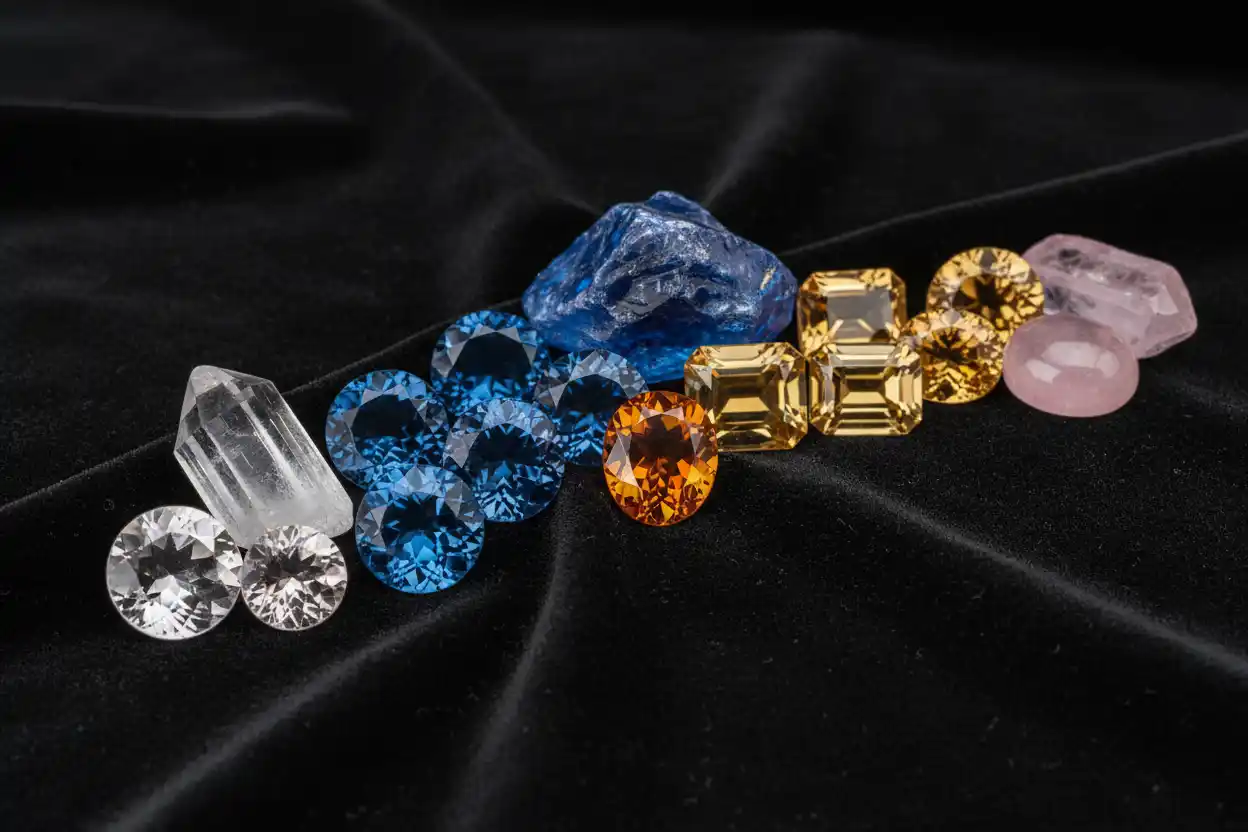
Topaz Meaning, Properties, Colors, Value and Care
Topaz is an aluminum fluorosilicate valued for exceptional clarity, substantial crystal size and a color range extending from colorless and pale blue to yellow, pink, orange, red and brown. Although its Mohs hardness of 8 makes the surface relatively resistant to scratching, perfect basal cleavage gives the mineral a hidden structural weakness that must be considered during cutting, setting and daily wear.
Pure topaz is colorless. Structural defects, trace elements, natural radiation and gemstone treatments create the colors encountered in jewelry and mineral collections.
Topaz at a Glance
| Property | Topaz |
|---|---|
| Mineral class | Nesosilicate |
| Chemical formula | Al₂SiO₄(F,OH)₂ |
| Crystal system | Orthorhombic |
| Common colors | Colorless, blue, yellow, golden, brown, orange, pink, red, green and multicolored |
| Crystal habit | Elongated prisms with striated faces and complex terminations |
| Luster | Vitreous |
| Transparency | Transparent to translucent |
| Refractive indices | Approximately 1.609–1.643 |
| Birefringence | Approximately 0.008–0.011 |
| Optical character | Biaxial positive |
| Specific gravity | Approximately 3.49–3.57 |
| Mohs hardness | 8 |
| Cleavage | Perfect basal cleavage |
| Tenacity | Brittle |
| Common cuts | Oval, pear, cushion, emerald, round and fantasy cuts |
| Main care concern | Cleavage damage, thermal shock and undisclosed color treatment |
What Is Topaz?
Topaz is a distinct mineral species composed of aluminum, silicon, oxygen, fluorine and hydroxyl. It does not belong to the quartz, beryl or corundum families, even though transparent topaz can resemble citrine, aquamarine or sapphire after cutting.
The balance between fluorine and hydroxyl varies among deposits. This variation affects refractive index, density and some other physical properties, although all qualifying material remains topaz.
Large crystals are possible because topaz commonly grows in open pegmatite pockets and cavities where mineral-rich fluids have enough room to form well-developed prisms. Transparent crystals weighing many kilograms exist, but large size alone does not make ordinary colorless or blue material rare.
The full range of commercial and mineralogical varieties appears in Types of Topaz, while this parent page retains the mineral’s core identity, formation, durability and symbolism.
How Topaz Gets Its Color
Topaz is allochromatic, meaning its essential chemical formula does not require a visible color.
Color develops through structural defects, trace-element substitutions and trapped electrons produced by natural or artificial radiation.
Chromium contributes to many pink, red and violet-purple colors. Yellow, brown and blue shades are more strongly associated with atomic-scale defects and color centers.
Heating and irradiation can modify those defects. Consequently, two topaz gems with similar color may have very different histories.
The relationships among hue, traditional meaning and market terminology are explored in Topaz Color Meaning and Symbolism.
Topaz Colors and Varieties
Colorless and White Topaz
Colorless material is the purest visual expression of the species and is commercially called White Topaz.
It is abundant, available in large sizes and frequently used as an affordable colorless jewelry stone. However, it has less brilliance and dispersion than diamond, moissanite or white sapphire.
Colorless topaz also provides much of the starting material used to manufacture blue topaz through irradiation and heat.
Blue Topaz
Natural pale-blue topaz exists, but most vivid blue topaz in modern jewelry has been irradiated and heated.
Sky Blue generally describes a pale, bright blue. Swiss Blue is more saturated, while London Blue is darker and commonly has a gray or green modifier.
These names are commercial descriptions rather than formal mineral varieties.
Treated blue material is abundant and normally affordable. A seller should not imply that a vivid blue stone is rare natural-color topaz without strong laboratory evidence.
Yellow and Golden Topaz
Yellow Topaz ranges from pale straw and lemon to golden yellow and yellow-brown.
Some older trade descriptions use precious topaz or sherry topaz for warm yellow, brownish-yellow and orange material.
Ordinary golden topaz should not be represented automatically as Imperial Topaz.
Imperial Topaz
Imperial Topaz occupies the high-value orange, pinkish-orange, reddish-orange, pink and red portion of the market.
Many specialists look for a visible red or pink component rather than accepting plain yellow or golden color.
Ouro Preto in Brazil is the classic source.
Because the Imperial boundary is partly commercial, a laboratory may describe the exact color instead of certifying the marketing term.
Pink and Red Topaz
Natural pink and red topaz are rare.
Chromium contributes to many of these colors, and the finest stones can command high prices.
Some pink topaz is produced by heating suitable yellow, orange or brown material. Coated colorless topaz can also imitate pink.
Treatment disclosure is especially important when a substantial natural-color premium is requested.
Mystic and Coated Topaz
Mystic Topaz is usually colorless topaz coated with a thin metallic or dielectric film.
The coating creates green, blue, pink, purple and rainbow reflections.
It sits close to the surface and can scratch, peel or be removed during repolishing.
Mystic Topaz is genuine topaz beneath the coating, but its multicolored appearance is manufactured.
How Topaz Forms
Topaz forms in fluorine-rich igneous and hydrothermal environments.
During the late stages of granite crystallization, fluorine, water and rare elements concentrate in the remaining melt and fluid. These evolved materials enter pegmatites, fractures and open cavities.
Topaz then crystallizes beside quartz, feldspar, mica, tourmaline, beryl, fluorite and tin-bearing minerals.
It also forms in cavities within rhyolite. Gas-rich volcanic processes create openings where vapor and mineral-bearing fluid deposit crystals after the surrounding rock cools.
Hydrothermal alteration can produce topaz in greisen, a quartz- and mica-rich rock associated with tin and tungsten deposits.
Weathering releases resistant crystals from host rock. Streams may transport and round them into alluvial gravels.
Important Sources
Brazil is the dominant commercial source. Minas Gerais produces colorless, blue-treatment rough, yellow, brown, pink and Imperial material.
Pakistan produces fine colorless, pale-yellow and pink crystals from northern pegmatites. Some occur on white albite with quartz or mica.
Sri Lanka supplies waterworn topaz from alluvial deposits, including colorless, yellow, brown and blue material.
Nigeria produces large transparent crystals suitable for faceting.
Russia and Ukraine have yielded important colorless, blue and pink crystals, including large etched specimens from the Volyn pegmatite.
Mexico is known for rhyolite-hosted topaz, while Utah produces colorless-to-sherry crystals from volcanic cavities.
Namibia, Madagascar, Myanmar and several additional countries contribute to the commercial and collector markets.
Origin should be supported by documentation because appearance alone rarely proves locality.
Topaz Inclusions
Gem-quality topaz is often eye-clean. Therefore, visible inclusions can affect faceted value more strongly than they do in many tourmalines or emeralds.
Natural features include two-phase fluid inclusions, healed fractures, negative crystals, growth tubes and included minerals.
Long channels may align with the crystal’s growth direction.
Broad reflective planes can represent cleavage rather than ordinary inclusions. These features deserve careful inspection because they may threaten durability.
Glass imitations may contain rounded gas bubbles and flow lines. Synthetic corundum and cubic zirconia can be extremely clean, so the absence of inclusions does not prove topaz.
Topaz Treatments
Treatment is central to the modern topaz market.
Colorless topaz is routinely irradiated and heated to produce stable blue shades. Commercial blue topaz should generally be assumed treated unless reliable evidence indicates otherwise.
Heating can modify yellow, brown, orange and pink colors. Suitable chromium-bearing material may become pink after treatment.
Surface coatings create Mystic Topaz and other artificial colors.
Fracture filling and oiling are less common than in emerald or heavily included gems, but they remain possible.
The full detection and disclosure discussion belongs to Treated Topaz.
A treated stone is not necessarily fake. It remains natural topaz when the original mineral formed geologically, but the enhancement affects rarity, value and care.
Synthetic Topaz and Imitations
Laboratory-grown topaz has been produced for research, but it has little mainstream jewelry presence because natural colorless material is plentiful.
Most substitutions are not synthetic topaz. They are glass, quartz, cubic zirconia, synthetic sapphire or another transparent gem.
Citrine has historically been sold under misleading names such as quartz topaz, Madeira topaz and Spanish topaz. These materials are quartz rather than topaz.
The consumer checks in Real vs Fake Topaz focus on species verification, coatings and misleading trade terminology.
Topaz Versus Citrine
Citrine is yellow quartz with a hardness of 7 and specific gravity near 2.65.
Topaz is harder and much denser. It also possesses perfect basal cleavage, whereas quartz has no cleavage.
Their refractive indices and optical characters differ.
The confusion persists because both occur in yellow, golden and brown colors and because historical traders used topaz-like names for quartz.
The complete buying comparison appears in Citrine vs Yellow Topaz.
Topaz Versus Aquamarine
Aquamarine is blue-to-greenish-blue beryl.
Its density is substantially lower than topaz, while its hardness is similar but slightly lower.
Aquamarine lacks topaz’s perfect basal cleavage and often shows a longer, cleaner blue-green color.
Most vivid blue topaz is treated and considerably less expensive than fine aquamarine.
The differences are covered in Aquamarine vs Topaz and Aquamarine vs Blue Topaz.
Identifying Real Topaz
A gemologist expects a specific gravity near 3.5 and refractive indices around 1.609–1.643.
The stone is biaxial positive and moderately birefringent.
Hardness 8 supports identification but should never be tested destructively on finished jewelry.
Basal cleavage may appear as broad flat reflective features. Deliberately striking or splitting a stone to test cleavage is inappropriate.
Raman spectroscopy confirms mineral identity, while ultraviolet-visible and infrared spectroscopy provide information about color centers and treatment.
Microscopic examination can reveal natural inclusions, coatings and fracture filling.
Cutting Topaz
Topaz crystals are frequently elongated, so ovals, pears and emerald cuts preserve rough efficiently.
Brilliant and mixed cuts improve sparkle in pale material. Step cuts emphasize color and clarity, while fantasy cutting adds interest to large affordable crystals.
The cutter must orient perfect basal cleavage carefully. Pressure in the wrong direction can split the rough during sawing, faceting or polishing.
An overly shallow pavilion creates a window. An excessively deep cut hides weight beneath the setting and makes the gem appear small face-up.
Color zoning also affects orientation. A cutter may position a rich orange or pink area where it contributes most strongly to the finished appearance.
Hardness, Cleavage and Durability
Topaz measures 8 on the Gemstone Hardness Chart, giving it strong resistance to ordinary scratching.
However, hardness does not measure resistance to breaking. The distinction is explained in Gemstone Toughness vs Hardness.
Topaz is brittle and has perfect basal cleavage. A sharp blow can split a gem even when its polished surface looks flawless.
The structural risk appears in greater detail in Gemstone Cleavage Explained.
Pendants and earrings provide safer wear than exposed rings and bracelets. Ring stones should sit low and receive protection around corners and girdles.
Topaz Jewelry
A Topaz Ring can tolerate regular careful wear, but it should be removed during exercise, cleaning, gardening and manual work.
Topaz Necklaces allow larger stones while reducing impact exposure.
Topaz Earrings suit matched blue, white or golden stones.
Topaz Bracelets need secure settings because repeated contact with desks and doorframes increases damage risk.
Topaz and citrine share recognition in the November Birthstone Guide.
Topaz Prices in 2026
These are broad retail estimates rather than universal price grades:
| Topaz type | Indicative retail range |
|---|---|
| Colorless or white topaz | $5–$20 per carat |
| Treated blue topaz | $5–$30 per carat |
| Ordinary yellow or golden topaz | $20–$80 per carat |
| Fine sherry or orange topaz | $75–$250 per carat |
| Pink topaz | $100–$1,000+ per carat |
| Imperial Topaz | $200–$3,500+ per carat |
| Exceptional red or historic material | Potentially above these ranges |
Color, natural-versus-treated status, clarity, cut, size and documentation can move a stone far outside a general range.
Blue and white topaz remain affordable because large clean rough is abundant. Imperial, pink and red stones become progressively scarcer and can show steep price increases as size and saturation improve.
The detailed valuation workflow belongs to the Topaz Price Guide.
What Determines Topaz Value?
Color is the leading factor. Warm orange, pinkish-orange, pink and red generally command more than colorless, blue or pale yellow.
Natural color receives a premium when independent testing supports it.
Clarity is expected to be high in most faceted topaz. Obvious fractures, cloudy zones and cleavage planes reduce value.
Cut quality controls brightness, symmetry and face-up size.
Large weight adds relatively little value to common blue or colorless material but creates a significant premium in rare Imperial and pink colors.
Origin matters most when linked with prestigious Imperial deposits or exceptional mineral specimens.
Coatings, irradiation, heating and repair must be disclosed.
Buying Topaz
Use the Topaz Buying Guide for a complete purchase checklist.
Ask for the exact color description rather than relying only on words such as precious, golden, Imperial or Mystic.
Request disclosure of irradiation, heat, coating and filling.
Compare face-up millimeter dimensions with carat weight because deep stones can hide substantial mass.
Inspect the center for windowing and the girdle for chips.
For expensive Imperial, pink or red topaz, obtain an independent laboratory report addressing identity and detectable treatment.
Do not pay a natural-color premium for vivid blue topaz without credible evidence.
Cleaning and Storage
Clean topaz with lukewarm water, mild soap and a soft brush.
Avoid steam cleaners and sudden temperature changes.
Ultrasonic cleaning may be risky when fractures, coatings or uncertain treatments are present. Warm soapy water remains the safer default.
Keep topaz away from direct heat during jewelry repair because thermal stress can activate cleavage.
Coated stones require particularly gentle care. Abrasive polishing can remove the color-producing film.
Store each piece separately from sapphire and diamond, which can scratch it. Topaz should also be separated from softer gems because it can scratch quartz, feldspar and opal.
Topaz Meaning and Symbolism
Topaz has been associated across different historical traditions with sunlight, protection, friendship, truth and prosperity.
Modern crystal practices commonly link blue topaz with communication, yellow topaz with confidence, pink topaz with affection and Imperial Topaz with generosity or responsible ambition.
Its combination of hardness and cleavage offers a useful personal metaphor: visible strength can coexist with vulnerabilities that require thoughtful protection.
These meanings are cultural, spiritual or personal rather than scientifically demonstrated effects.
Frequently Asked Questions
Is topaz a precious gemstone?
Topaz is a natural gemstone and recognized mineral species. Ordinary colors can be affordable, while Imperial, pink and red topaz may be rare and valuable.
What is the natural color of topaz?
Pure topaz is colorless. Yellow, brown, blue, pink, orange and red develop through defects, trace elements and treatment.
Is blue topaz natural?
Natural pale-blue topaz exists, but most vivid blue material has been irradiated and heated.
What is the most valuable topaz color?
Fine red, pinkish-red and Imperial orange-to-reddish-orange colors generally command the strongest prices.
Is yellow topaz the same as citrine?
No. Citrine is quartz, while topaz is an aluminum fluorosilicate with greater density and perfect cleavage.
Is topaz suitable for an engagement ring?
It can be used in a protective setting, but sapphire, ruby and diamond offer better resistance to cleavage-related breakage.
Can topaz be scratched?
Yes. Its hardness is 8, but sapphire and diamond can scratch it, and worn facet edges may abrade over time.
Can topaz split?
Yes. A sharp blow can separate the stone along perfect basal cleavage.
Is Mystic Topaz natural?
The underlying topaz is normally natural, but its rainbow appearance comes from an artificial surface coating.
How much is topaz worth?
Common white and blue stones may cost under $30 per carat, while fine Imperial and rare pink or red topaz can reach hundreds or thousands of dollars per carat.
Can topaz go in water?
Brief washing is generally safe for solid untreated material. Avoid prolonged soaking when coatings, filling, glue or fractures may be present.
Does topaz have scientifically proven healing properties?
No. Traditional meanings may hold personal significance, but scientific evidence does not establish healing effects from wearing topaz.
Topaz is most accurately understood as a mineral family page that explains why a hard gem can still split, why most blue stones are affordable treatments and why the rarest orange, pink and red colors occupy a completely different market.
Topaz appears in Crystals That Start With T and Gemstones That Start With T.