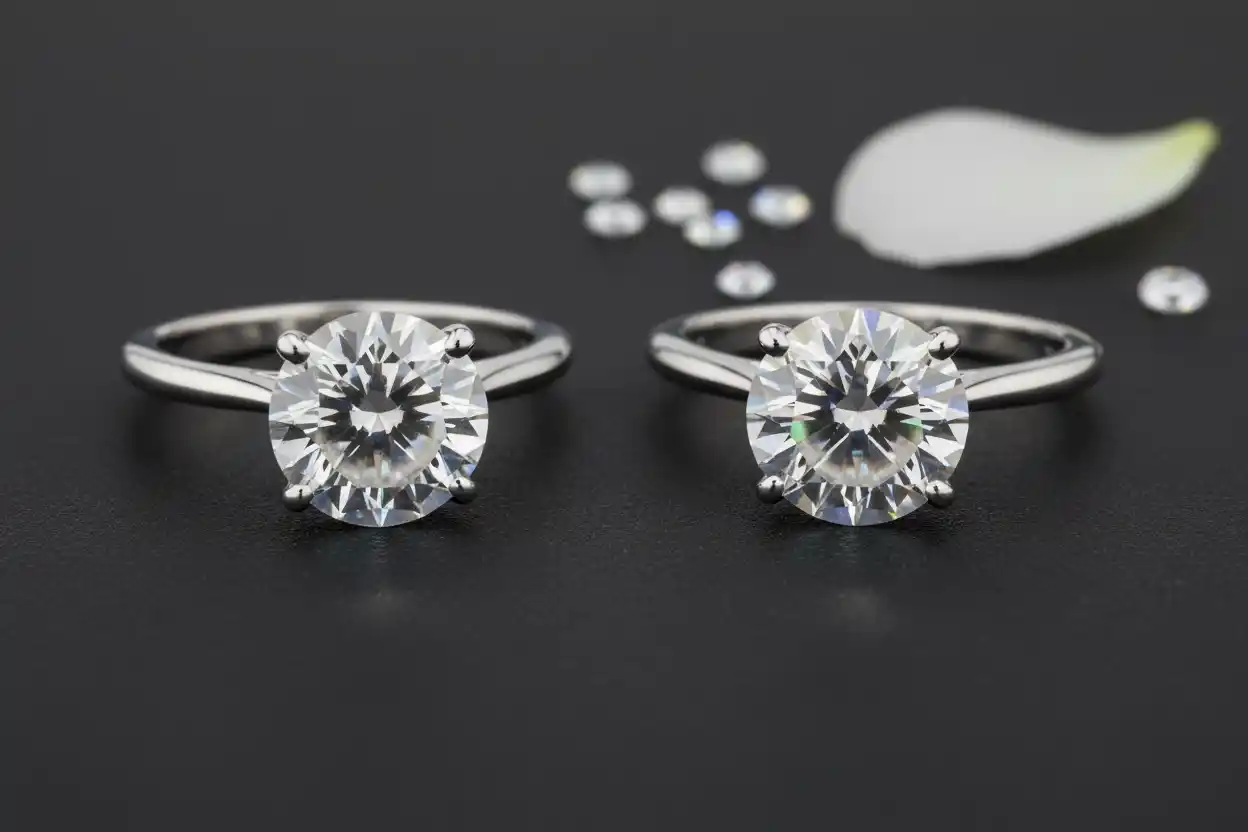
White Sapphire vs Moissanite: Differences, Durability & Sparkle
White sapphire and moissanite can both create a bright, colorless center stone without using diamond, but they do not look or behave the same. White sapphire has a calmer, more glass-like brilliance, while moissanite generally produces substantially stronger sparkle and rainbow fire.
They are also completely different materials. White sapphire is colorless corundum, Al₂O₃, while jewelry-grade moissanite is laboratory-grown silicon carbide, SiC. Sapphire ranks Mohs 9 and has excellent toughness with no cleavage. Moissanite is slightly harder at about Mohs 9.25 and has a much higher refractive index and dispersion.
For most buyers, the decision comes down to visual preference. Choose moissanite if you want maximum brilliance and fire. Choose white sapphire if you prefer a natural-gemstone option, sapphire identity and a more restrained style of sparkle.
White Sapphire vs Moissanite at a Glance
| Property | White Sapphire | Moissanite |
|---|---|---|
| Material | Corundum | Silicon carbide |
| Chemical formula | Al₂O₃ | SiC |
| Typical origin | Natural or laboratory-grown | Commercial jewelry material is laboratory-grown |
| Color | Colorless to near-colorless | Colorless to near-colorless |
| Mohs hardness | 9 | About 9.25 |
| Specific gravity | About 4.00 | About 3.22 |
| Refractive index | 1.762–1.770 | About 2.648–2.691 |
| Birefringence | 0.008–0.010 | About 0.043 |
| Dispersion / fire | Moderate to low | Very high |
| Brilliance | More subdued | Very strong |
| Facet doubling | Usually difficult to see | Often visible under magnification |
| Toughness | Excellent | Very durable |
| Cleavage | None | Not a major everyday concern in normal jewelry |
| Typical visual character | Crisp, quiet, glassier | Bright, fiery, rainbow-rich |
| Best for | Natural-gem preference, understated sparkle | Maximum sparkle and diamond-alternative performance |
The Biggest Visual Difference Is Sparkle
The easiest difference to notice is usually optical performance.
Moissanite is extremely brilliant.
Its refractive index is far higher than sapphire’s, which means it bends and returns light much more strongly.
It also has exceptionally high dispersion.
Dispersion separates white light into spectral colors, creating flashes of:
red, orange, yellow, green, blue and violet.
That rainbow effect is called fire.
White sapphire does not produce the same intensity.
Its sparkle tends to look:
cleaner, softer and less rainbow-heavy.
Neither appearance is inherently better.
Some people specifically want moissanite’s dramatic fire.
Others prefer white sapphire because its restrained brilliance looks less flashy.
What Is White Sapphire?
White sapphire is essentially colorless or near-colorless corundum.
Corundum has the chemical formula:
Al₂O₃
Ruby and sapphire are the same mineral species.
Red corundum is called ruby, while non-red gem corundum is classified as sapphire.
Most people associate sapphire with blue, but sapphire also occurs in:
yellow, pink, orange, green, purple and colorless varieties.
White sapphire is simply the colorless end of that spectrum.
The White Sapphire: Meaning, Properties & Symbolism article owns the broader mineral and variety-specific profile.
Is White Sapphire Natural?
It can be.
Natural colorless sapphire occurs in nature.
Laboratory-grown white sapphire is also widely available.
A synthetic sapphire is not chemically fake sapphire.
It has essentially the same:
Al₂O₃ chemistry, corundum structure and fundamental physical properties
as natural sapphire.
The difference is origin.
Natural sapphire formed geologically.
Synthetic sapphire grew in a controlled laboratory or manufacturing environment.
Therefore, when buying white sapphire, ask whether the stone is:
natural or laboratory-grown.
That distinction can affect rarity, price and personal preference.
What Is Moissanite?
Moissanite is silicon carbide:
SiC
Natural moissanite exists, but it is extremely rare and is not the source of ordinary jewelry stones.
Modern jewelry-grade moissanite is manufactured.
Consequently, a colorless moissanite engagement ring should normally be understood as containing a laboratory-grown gemstone material.
Moissanite is not synthetic diamond.
It has different:
chemistry, crystal structure, refractive index, density and optical behavior.
The Moissanite: Meaning, Properties & Symbolism guide covers the material itself, while this page stays focused on comparing it directly with white sapphire.
Which Looks More Like Diamond?
This depends on what aspect of diamond appearance you mean.
Moissanite usually looks more diamond-like in terms of:
high brilliance and strong light return.
However, it can produce substantially more rainbow fire than diamond, particularly in larger stones.
White sapphire generally produces less brilliance than diamond.
It can therefore look quieter or slightly glassier.
If your goal is maximum optical impact, moissanite generally comes closer.
If you want a white gemstone that is deliberately not trying to reproduce diamond’s intense brilliance, white sapphire may be more appealing.
The broader Best Diamond Alternatives comparison covers other substitute options without changing the direct intent of this article.
Moissanite Has Much More Fire
GIA describes synthetic moissanite as having very strong dispersion.
Its dispersion is approximately:
0.104
That is one reason rainbow flashes can become extremely noticeable.
White sapphire does not approach this level of fire.
In ordinary lighting, especially under spotlights, moissanite may display:
frequent spectral flashes.
A white sapphire usually gives more subdued white reflections.
For shoppers, this is arguably the most important aesthetic distinction.
Is Too Much Moissanite Fire a Bad Thing?
Not inherently.
Fire is a visual preference.
Some buyers love the colorful flashes.
Others find large moissanite’s rainbow effect too noticeable.
GIA notes that in larger stones, moissanite can show intense fire that makes its identity visually apparent.
Before buying, view the stone in several environments:
daylight, normal indoor light and bright directional lighting.
Jewelry-store spotlights exaggerate sparkle.
A stone that looks perfect under showroom lighting may behave differently in an office or at home.
White Sapphire Looks More Subdued
White sapphire’s refractive index is approximately:
1.762–1.770
That is respectable for a colored gemstone, but much lower than moissanite.
Its brilliance therefore tends to be calmer.
Well-cut white sapphire can still look attractive and lively.
However, poor cutting can make it appear:
watery, flat or glass-like.
Cut quality matters considerably because a colorless stone has no strong bodycolor to distract from poor light performance.
Moissanite Refractive Index
Synthetic moissanite has extremely high refractive indices.
Precision measurements cited by GIA give approximately:
2.648 and 2.691
The large values help explain its exceptional brilliance.
They are also well beyond the range of an ordinary contact refractometer used for many colored gemstones.
This optical difference makes moissanite fundamentally unlike sapphire even if both stones appear colorless in a jewelry case.
Refractive Index Easily Separates Them
Gemologically, white sapphire and moissanite are not difficult to distinguish.
| Material | Refractive Index |
|---|---|
| White sapphire | 1.762–1.770 |
| Moissanite | About 2.648–2.691 |
These ranges are nowhere near one another.
Sapphire produces a standard refractometer reading.
Moissanite is above the limit of most conventional gemstone refractometers.
Therefore, professional testing can separate them very quickly.
Both Are Doubly Refractive
An interesting similarity is that both sapphire and moissanite are doubly refractive.
However, the strength is dramatically different.
Sapphire birefringence is only approximately:
0.008–0.010
Moissanite is much higher:
about 0.043
That stronger birefringence creates a practical visual clue.
Moissanite Can Show Doubled Facet Edges
Under magnification, moissanite can show obvious doubling of pavilion facet junctions.
Look through the crown toward the back facets.
Depending on viewing direction and cut orientation, a single line may appear as:
two closely spaced lines.
This can make the interior appear slightly blurry or doubled.
GIA specifically uses facet doubling as a classic moissanite identification feature.
White sapphire is also doubly refractive, but its birefringence is much lower.
The effect is therefore far less pronounced.
Does Every Moissanite Show Obvious Doubling?
Not from every direction.
Moissanite has an optic axis.
When you look close to that direction, doubling can be difficult or impossible to see.
Cut orientation also affects visibility.
Therefore, failure to spot doubling once does not prove that a stone is white sapphire.
Rotate the stone and inspect several facet junctions.
A professional gemologist will combine optical observations with additional properties.
White Sapphire Is Denser
Specific gravity reverses the pattern you might expect from refractive index.
White sapphire is denser:
about 4.00
Moissanite is around:
3.22
Therefore, two stones with exactly the same physical volume would not have the same carat weight.
The sapphire would weigh more.
This matters when comparing stones by carat rather than dimensions.
Same Carat Does Not Mean Same Size
Suppose you compare a 1-carat white sapphire and a 1-carat moissanite.
Because sapphire is denser, the sapphire generally needs less physical volume to reach the same weight.
Therefore, the moissanite may face up larger at an equal carat weight, depending on cut proportions.
For engagement-ring shopping, compare:
millimeter dimensions
rather than relying exclusively on carat weight.
This gives a better idea of how large the center stone will actually appear.
Which Is Harder?
Moissanite is slightly harder.
White sapphire ranks:
Mohs 9
Moissanite is approximately:
Mohs 9.25
Both are extremely scratch resistant compared with most colored gemstones.
For context, quartz ranks Mohs 7.
The difference between sapphire and moissanite is therefore much less important in daily life than the difference between either stone and softer gems such as opal or fluorite.
The Gemstone Hardness Chart places both materials within the broader durability scale.
Is Moissanite More Durable?
Both are excellent for everyday jewelry.
White sapphire has:
high hardness, excellent toughness and no cleavage.
GIA specifically describes corundum as an excellent choice for rings and other mountings exposed to regular wear.
Moissanite is also highly durable and slightly more scratch resistant.
In practical engagement-ring terms, both are strong enough for daily wear.
Setting condition and accidental impact still matter.
Even a very hard gemstone can be damaged if hit hard enough.
Is White Sapphire Good for an Engagement Ring?
Yes.
Its durability is one of its strongest advantages.
Mohs 9 hardness means sapphire resists scratching far better than many popular colored gemstones.
Excellent toughness and lack of cleavage further improve ring performance.
White sapphire is particularly suitable for buyers who want:
a natural gemstone option, long-term durability and relatively understated brilliance.
The main compromise is optical.
Expect less sparkle than moissanite.
Is Moissanite Good for an Engagement Ring?
Yes.
Moissanite has become a major engagement-ring material because it combines:
very high hardness, excellent brilliance and relatively large visual size.
Its intense fire is the characteristic buyers either love or dislike.
A person who wants an extremely bright center stone will generally prefer moissanite over white sapphire.
Someone who dislikes rainbow flashes may prefer sapphire.
Natural vs Lab-Grown Is a Major Difference
This comparison is sometimes described purely as two diamond alternatives, but origin creates a more meaningful distinction.
White Sapphire
Can be:
natural or laboratory-grown.
Moissanite
Commercial jewelry stones are laboratory-grown.
Natural moissanite exists but is far too rare to supply ordinary jewelry manufacturing.
Therefore, buyers who specifically want a naturally formed center gemstone may prefer natural white sapphire.
Buyers who are comfortable with laboratory-grown material may prioritize moissanite’s stronger optical performance instead.
Is Lab-Grown White Sapphire the Same as Moissanite?
No.
Both can be laboratory-grown, but they remain completely different materials.
Synthetic white sapphire is:
Al₂O₃ corundum
Synthetic moissanite is:
SiC silicon carbide
Their optical and physical properties remain different.
A laboratory-grown origin does not erase mineral identity.
Is Moissanite a Synthetic Gemstone?
Yes.
Jewelry moissanite is synthetic moissanite.
However, “synthetic” has a specific gemological meaning.
It means the laboratory-grown material has essentially the same composition and crystal structure as the natural mineral it represents.
It does not mean:
glass, plastic or cubic zirconia.
Moissanite should therefore be described accurately rather than casually called a fake gemstone.
Is White Sapphire a Diamond Simulant?
When used specifically to resemble diamond, white sapphire functions as a diamond simulant.
So does moissanite.
However, both are independent gem materials with their own physical identities.
White sapphire is corundum.
Moissanite is silicon carbide.
A simulant imitates another gemstone’s appearance without sharing its chemistry.
That distinction becomes important when discussing authenticity.
A natural white sapphire is a genuine sapphire even when used in place of diamond.
Which Stone Stays Clearer Looking?
Both materials resist ordinary surface scratching well.
However, white sapphire’s lower brilliance can make surface oils and dirt particularly noticeable.
When the stone becomes coated with:
soap, lotion or skin oil,
its already subdued sparkle may appear significantly duller.
Moissanite also becomes dirty, but its high refractive index can preserve more apparent sparkle until buildup becomes substantial.
Regular cleaning matters for both.
Why Does White Sapphire Sometimes Look Cloudy?
Several factors can contribute.
The stone may have:
internal inclusions, poor cutting, surface wear or a film of oils and soap.
Because white sapphire has modest brilliance compared with moissanite, even a small amount of surface contamination may make it look noticeably less lively.
This is not necessarily evidence of a fake stone.
Cleaning the gemstone can sometimes restore a surprisingly large amount of brightness.
Does Moissanite Get Cloudy?
Moissanite itself does not routinely become permanently cloudy simply because it ages.
However, residue can accumulate on the surface.
Soap films, oils and environmental grime can reduce sparkle.
The stone may then appear hazy until cleaned.
Any persistent change should be examined by a jeweler to rule out:
surface damage, coating issues or setting-related problems.
Which Stone Has Better Color?
White sapphire quality depends partly on how colorless it appears.
Some stones show subtle:
gray, yellow or blue undertones.
Moissanite is also sold across colorless and near-colorless grades.
Older or lower-color material may show:
yellowish, greenish or grayish undertones in some viewing conditions.
Neither material should therefore be assumed perfectly neutral simply because it is sold as “white.”
View the actual stone against a neutral white background before buying.
Moissanite Can Look Different in Large Sizes
Size magnifies optical characteristics.
In a small moissanite, intense fire may appear attractive without dominating the stone.
In larger cuts, rainbow dispersion becomes much more obvious.
Likewise, facet doubling can become easier to notice.
GIA specifically points out that large moissanite can display unusually strong fire.
Therefore, someone selecting a 3-carat-equivalent center stone should not judge moissanite from a tiny sample stone.
White Sapphire Can Look Better in Smaller Sizes
The more restrained optical performance of white sapphire can be less obvious in:
small accent stones.
This is one reason white sapphire may perform differently as a halo or side stone than as a large solitaire.
In a large center stone, viewers see more of the gem’s internal light behavior.
Poor cut and low brilliance become more noticeable.
Therefore, cut quality becomes increasingly important as white sapphire size increases.
Cut Quality Matters for Both
Do not choose either gemstone based solely on material.
A poorly cut moissanite may show:
awkward dark areas, excessive doubling or unattractive proportions.
A poorly cut white sapphire may show:
windowing, weak brilliance or lifeless areas.
Compare the actual face-up stone.
Tilt it under normal lighting.
Look for even light return rather than one bright flash under a jewelry-store spotlight.
White Sapphire vs Moissanite in a Round Brilliant
Round brilliant cuts emphasize the differences strongly.
Moissanite will generally produce:
greater brilliance and more rainbow fire.
White sapphire gives:
less intense but cleaner-looking flashes.
If you want the strongest traditional engagement-ring sparkle, round moissanite is difficult to beat among non-diamond stones.
If you prefer a quieter look, white sapphire may be more comfortable visually.
Emerald and Step Cuts
Step cuts change the comparison.
Emerald cuts produce broader flashes and less scintillation than round brilliants.
That can make moissanite’s extreme fire somewhat less dominant.
It also suits white sapphire’s restrained optical character.
For buyers who dislike rainbow sparkle but still prefer moissanite’s durability and high RI, an emerald or other step cut can be worth considering.
Likewise, a precision-cut step-cut white sapphire can produce an elegant, glassy appearance intentionally rather than appearing merely dull.
Which Is Easier to Identify?
Professional identification is straightforward.
White sapphire has:
RI 1.762–1.770 and SG around 4.00.
Moissanite has:
RI far above the standard refractometer range and SG about 3.22.
Moissanite may also show obvious facet doubling.
A competent gemologist should therefore have little difficulty separating ordinary examples.
The broader How to Identify Crystals approach—combining several measurable properties rather than relying on appearance—applies here as well.
Can a Diamond Tester Tell Them Apart?
A basic thermal diamond tester is not an ideal tool for this comparison.
Synthetic moissanite has thermal properties sufficiently similar to diamond that older thermal testers may respond as though moissanite were diamond.
White sapphire generally will not produce that same response.
However, the safest conclusion is not to authenticate either stone with one handheld tester.
Modern multi-testers and professional gemological methods provide better separation.
Does White Sapphire Show Doubling?
Technically, sapphire is doubly refractive.
Its birefringence is approximately:
0.008–0.010
However, that is far lower than moissanite’s approximately 0.043.
Consequently, obvious facet-edge doubling is much more characteristic of moissanite.
If strong doubling is visible under magnification, moissanite becomes a strong possibility.
Which One Sparkles More?
Moissanite.
The difference is substantial.
Its combination of very high refractive index and dispersion produces much greater brilliance and fire than white sapphire.
If maximum sparkle is the sole priority, moissanite is the stronger choice.
If the preference is for a quieter, natural-gem appearance, white sapphire may be preferable precisely because it sparkles less.
Which Has More Rainbow Fire?
Moissanite by a wide margin.
Its dispersion of approximately 0.104 is exceptionally high.
That creates frequent colored flashes.
White sapphire’s visual effect is much more dependent on white brilliance and reflections rather than intense rainbow separation.
This is one of the easiest distinctions to notice without equipment.
Which Looks Whiter?
Either can appear white, but the answer depends on individual stone quality.
A high-quality colorless moissanite can look very neutral.
Some moissanite shows slight yellow, green or gray in certain orientations.
Natural white sapphire can also carry subtle color.
Therefore, inspect the actual gemstone rather than assuming one material is always whiter.
For white sapphire, transparency and lack of color are significant visual quality factors.
Which Is More Scratch Resistant?
Moissanite has a slight advantage.
At approximately Mohs 9.25, it exceeds sapphire’s Mohs 9.
Both are nevertheless exceptionally resistant to normal scratching.
For everyday wear, setting integrity and accumulated dirt will often become noticeable long before ordinary abrasion meaningfully separates these two materials.
Which Is Better for Daily Wear?
Both.
White sapphire offers:
Mohs 9 hardness, excellent toughness and no cleavage.
Moissanite offers:
slightly greater hardness and excellent practical durability.
Either can work for:
engagement rings, wedding jewelry and everyday rings.
The best choice should therefore be based more on:
appearance, origin preference and budget
than on a fear that one is too fragile.
Which Is More Affordable?
Both generally occupy lower price categories than comparable high-quality natural diamond, but their pricing structures are different.
Moissanite is laboratory-grown and manufactured in predictable sizes and qualities.
Brand, cut, size and color quality therefore influence retail pricing.
White sapphire can be either natural or synthetic.
Natural white sapphire pricing reflects:
natural origin, size, clarity, colorlessness and cutting.
Laboratory-grown white sapphire is generally a different market again.
Consequently, comparing one advertised price without confirming origin can be misleading.
Is Natural White Sapphire Rare?
Colorless natural corundum exists, but fine white sapphire must combine:
good transparency, sufficient size and attractive cutting.
Nevertheless, natural white sapphire is not valued in the same way as exceptional blue or padparadscha sapphire.
Its appeal is often practical and aesthetic rather than based on extreme color rarity.
Do not assume that every natural white sapphire is automatically more valuable than a well-cut moissanite of similar size.
White Sapphire vs Moissanite for Engagement Rings
For an engagement ring, both are physically strong choices.
Choose moissanite if you prioritize:
maximum brilliance, rainbow fire, large visual size and laboratory-grown consistency.
Choose white sapphire if you prioritize:
the possibility of natural origin, corundum identity, a traditional natural gemstone and more restrained sparkle.
Someone who frequently works with their hands does not need to avoid either solely for durability reasons.
A secure setting remains important in both cases.
White Sapphire vs Moissanite for Vintage Settings
White sapphire often works particularly well in vintage-style jewelry because its softer sparkle complements:
milgrain, engraving, filigree and antique-inspired proportions.
Moissanite creates a brighter, more modern optical appearance even when placed in an antique-style mounting.
Neither choice is wrong.
The question is whether you want the gemstone to:
blend with the setting
or
become the dominant sparkling feature.
White Sapphire vs Moissanite for Minimalist Rings
A solitaire exposes the optical differences clearly.
Moissanite produces stronger scintillation and rainbow fire.
White sapphire appears quieter.
For a minimalist ring where the stone itself supplies nearly all visual interest, many buyers prefer moissanite.
For an understated design where simplicity is the goal, white sapphire can be especially effective.
Natural White Sapphire vs Moissanite
This is probably the most meaningful version of the decision.
Natural white sapphire gives you:
a gemstone that formed in nature.
Moissanite gives you:
a laboratory-grown gemstone engineered with exceptional optical performance.
If natural geological origin is personally important, white sapphire wins automatically.
If origin matters less than visual performance, moissanite usually provides much more sparkle.
Lab White Sapphire vs Moissanite
When both choices are laboratory-grown, the distinction becomes primarily physical and aesthetic.
Synthetic sapphire still has:
Mohs 9 hardness, SG around 4.00 and RI around 1.76.
Synthetic moissanite has:
higher hardness, lower density and dramatically higher RI and dispersion.
At that point, there is little reason to treat them as substitutes for one another.
Choose based on the optical appearance you actually prefer.
Treatment and Disclosure
Natural and laboratory-grown origin should always be disclosed accurately.
Sapphire may also undergo treatments depending on the material.
For white sapphire, the key buying questions are:
Is it natural or synthetic?
Has any detectable treatment been applied?
Moissanite jewelry is already understood to be laboratory-grown, but sellers should still identify it correctly rather than implying it is diamond.
Treatment and synthetic-origin questions are handled separately in How to Spot Treated or Synthetic Sapphire and How to Spot Treated or Synthetic Moissanite.
Which One Should You Choose?
Choose white sapphire if you want:
natural-gemstone origin as an option, sapphire durability, lower rainbow fire and a more understated appearance.
Choose moissanite if you want:
maximum sparkle, extremely high fire, slightly greater hardness and a laboratory-grown stone available consistently in large sizes.
Neither is universally superior.
They solve different aesthetic problems.
The strongest mistake is buying one while expecting it to behave visually like the other.
Frequently Asked Questions
1. Which sparkles more, white sapphire or moissanite?
Moissanite sparkles substantially more. Its refractive index and dispersion are much higher, producing stronger brilliance and considerably more rainbow fire.
2. Which is harder, white sapphire or moissanite?
Moissanite is slightly harder at about Mohs 9.25, while white sapphire ranks Mohs 9. Both are excellent for everyday jewelry.
3. Is white sapphire natural?
White sapphire can be natural or laboratory-grown. Buyers should ask the seller to disclose origin clearly.
4. Is moissanite natural?
Natural moissanite exists but is extraordinarily rare. Commercial jewelry moissanite is laboratory-grown silicon carbide.
5. Does white sapphire look like moissanite?
Both can look colorless, but moissanite usually shows much stronger brilliance and rainbow fire. White sapphire has a quieter, more glass-like optical appearance.
6. How can a gemologist tell white sapphire from moissanite?
Refractive index provides an easy separation. White sapphire measures about 1.762–1.770, while moissanite is around 2.648–2.691 and exceeds the range of ordinary refractometers. Their specific gravities also differ.
7. Which is heavier, white sapphire or moissanite?
White sapphire is denser. Sapphire has a specific gravity around 4.00 compared with about 3.22 for moissanite.
8. Why does moissanite show doubled facet edges?
Moissanite has relatively strong birefringence. Light splits into two rays, so pavilion facet junctions can appear doubled when viewed from suitable directions under magnification.
9. Is white sapphire durable enough for an engagement ring?
Yes. Sapphire ranks Mohs 9, has excellent toughness and no cleavage, making it one of the strongest natural gemstone choices for daily-wear rings.
10. Does moissanite get cloudy over time?
Moissanite does not normally become permanently cloudy simply from age. Surface oils, soap and other residue can dull its appearance until cleaned.
11. Which is better if I want a natural gemstone?
Natural white sapphire is the appropriate choice because commercial jewelry moissanite is laboratory-grown.
12. Which is better overall, white sapphire or moissanite?
Moissanite is generally better for maximum brilliance and fire. White sapphire is better for someone who wants the option of natural origin, sapphire identity and a more restrained style of sparkle.
Conclusion
White sapphire and moissanite are both excellent durable white gemstones, but they create very different visual experiences.
White sapphire is colorless corundum. It ranks Mohs 9, has excellent toughness, no cleavage, a specific gravity around 4.00 and refractive index of approximately 1.762–1.770.
Moissanite is laboratory-grown silicon carbide in the modern jewelry market. It reaches about Mohs 9.25, has a specific gravity near 3.22 and exceptionally high refractive indices around 2.648–2.691.
Those optical differences matter far more than their small hardness difference.
Moissanite delivers dramatically stronger brilliance and rainbow fire. White sapphire offers a quieter appearance and, when natural, the geological origin that moissanite cannot provide in ordinary commercial jewelry.
For identification, refractive index, density and visible facet doubling can separate them easily.
For buying, the decision is simpler:
Choose moissanite for sparkle. Choose white sapphire for sapphire identity, understated brilliance and the option of natural origin.