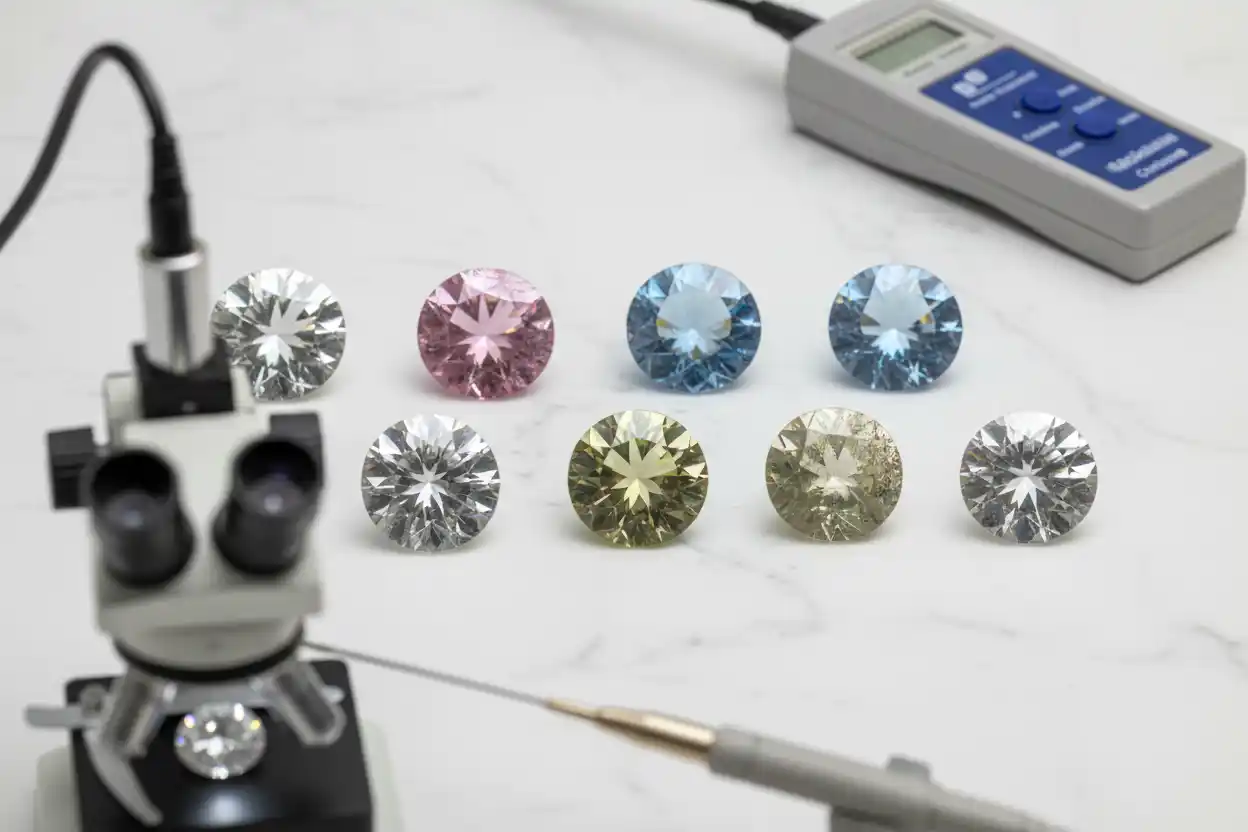
How to Spot Treated or Synthetic Moissanite
Nearly every Moissanite sold for jewelry is already laboratory grown. Commercial gem Moissanite is synthetic silicon carbide, while naturally occurring Moissanite is extraordinarily rare and has not supplied the ordinary faceted-jewelry market.
For that reason, the word synthetic does not identify a suspicious treatment or fake Moissanite. It accurately describes the growth origin of the standard jewelry product. The more useful questions concern whether the stone is actually Moissanite, whether its color exists throughout the crystal or comes from a surface coating, and whether the seller has confused it with Diamond, laboratory-grown Diamond, cubic zirconia, or another simulant.
Colorless and near-colorless Moissanite is normally sold without a color coating. However, pink, blue, green, black, and other fashion colors may be produced through changes in the bulk crystal, manufacturing chemistry, post-growth processing, surface films, or combinations of methods. The exact process matters because a stable bodycolor and a thin coating do not have the same durability or care requirements.
Moissanite treatment categories at a glance
| Product category | What it is | Common evidence | Correct description |
|---|---|---|---|
| Standard synthetic Moissanite | Laboratory-grown silicon carbide | Strong fire, double refraction, Moissanite spectroscopy | Laboratory-grown Moissanite |
| Bulk-colored Moissanite | Color distributed through the silicon carbide | Color remains through chips and facet wear | Colored synthetic Moissanite |
| Surface-coated Moissanite | Thin colored film applied after growth and cutting | Uneven surface color, worn edges, film damage | Coated synthetic Moissanite |
| Diamond-film-coated Moissanite | Silicon carbide covered with a very thin Diamond-bearing layer | Diamond tester confusion and surface-specific spectroscopy | Diamond-coated synthetic Moissanite |
| Repaired or filled Moissanite | Damaged stone containing adhesive or filler | Join lines, bubbles, resin, altered luster | Repaired or filled Moissanite |
| Assembled product | Moissanite joined to another material | Cement plane, backing, cap, or separate layers | Composite gemstone |
| Fraudulently inscribed Moissanite | Moissanite bearing a copied Diamond-report inscription | Report details fail to match the physical stone | Misrepresented Moissanite |
| Diamond simulant sold as Moissanite | Cubic zirconia, glass, synthetic Sapphire, or another material | Properties do not match silicon carbide | Moissanite imitation |
| Moissanite sold as Diamond | Synthetic silicon carbide represented as mined or lab Diamond | Double refraction and silicon-carbide spectrum | Diamond simulant |
Commercial Moissanite is laboratory grown
Moissanite is silicon carbide, commonly abbreviated SiC. Natural crystals occur in rare geological and extraterrestrial environments, but they are generally minute, fragmented, included, or unsuitable for mainstream jewelry cutting.
The durable transparent stones in rings, earrings, bracelets, and pendants are therefore grown under controlled industrial conditions.
The broader material profile appears in Moissanite: Meaning, Properties & Symbolism. Color, cut, crystal polytype, and commercial variety terminology belong to Types of Moissanite.
Laboratory growth does not make Moissanite an imitation of itself. It is synthetic Moissanite because the human-grown product reproduces the essential composition and crystal structure of the rare natural mineral.
Moissanite becomes a simulant when it is used to resemble Diamond. That relationship is explained in Moissanite vs Diamond vs Lab Diamond and Lab Diamond vs Moissanite.
Synthetic origin is not a post-growth treatment
Growth origin and treatment describe different stages.
Synthetic origin means the silicon carbide crystallized in a manufacturing environment. Post-growth treatment means a process later changed its surface, color, apparent identity, or construction.
A standard colorless Moissanite may be laboratory grown but otherwise untreated after cutting and polishing. A pink-coated Moissanite is both laboratory grown and surface treated. A Diamond-film-coated example adds another layer intended to alter surface properties or complicate identification.
This distinction follows the terminology in Lab-Grown vs Natural Gemstones and Gemstone Treatments Explained.
Bodycolor versus surface color
Color distributed through the Moissanite crystal should remain visible beneath worn facet junctions, small chips, and polished surfaces.
A coating sits primarily on the exterior. Its visual effect depends on film thickness, composition, uniformity, and how light interacts with the layer.
Inspect pavilion facets, girdle edges, culet areas, prong contact points, scratches, and existing chips. A coated stone may reveal colorless or differently colored silicon carbide beneath a damaged area.
Nevertheless, the absence of visible wear does not prove that the color exists throughout the crystal. Modern films can be extremely thin, transparent, and uniform.
A significant colored Moissanite should therefore be sold with a written statement explaining whether the hue is intrinsic, post-growth modified, or coating produced.
Pink-coated Moissanite
Pink is one of the best-documented coating colors.
Under magnification, a pink-coated stone may show uneven surface color, golden or metallic-looking particles, differences in luster, or concentrated color near facet boundaries.
Advanced research has identified nanoscale layers containing gold-related particles on coated synthetic Moissanite. The visual color results from the surface structure rather than pink silicon carbide throughout the gemstone.
A pink film may look stable during ordinary viewing but remain vulnerable to mechanical wear, corrosion, polishing, or heat.
An inexpensive fashion ring can still be a reasonable purchase when the coating is disclosed and the price reflects its limited permanence.
Blue and green coatings
Blue or green fashion Moissanite can have bulk color, a surface film, or a combination of processes.
A coating may produce a bronze-like reflection under some angles or a visible difference between upper and lower pavilion facets. Surface color can also appear stronger in protected areas and weaker at exposed junctions.
A clean, uniform appearance does not guarantee bulk color. Some thin films require specialized surface analysis because ordinary magnification reveals little.
The seller should avoid vague labels such as permanent blue Moissanite unless the manufacturing process and warranty support that claim.
Coating durability
A nanoscale film can delaminate, scratch, corrode, or change during mechanical or thermal stress.
Daily wear exposes a ring to dust, household chemicals, cosmetics, sweat, metal contact, and occasional impact. Even though the silicon-carbide core remains hard, the coating can be less durable than the stone beneath it.
Repolishing can remove part or all of the treated color. Prong retipping, resizing, or torch work may also damage a film.
The difference between the core’s hardness and the treatment’s permanence is crucial. Moissanite’s high Mohs rating does not protect a nanometer-scale surface layer from wear.
Diamond-film-coated Moissanite
A particularly unusual treatment covers synthetic Moissanite with a thin Diamond-bearing or nanodiamond surface layer.
Such a coating can change luster, surface chemistry, and tester response. GIA has documented Diamond-film-coated Moissanite that registered as Diamond on testing equipment despite having a silicon-carbide core.
The coating does not convert Moissanite into a laboratory-grown Diamond. The bulk material remains silicon carbide.
Raman spectroscopy, infrared analysis, microscopy, and testing through several areas can reveal the mismatch between the surface and interior.
This treatment also demonstrates why a single Diamond tester cannot establish the complete identity of an unfamiliar stone.
Heat and manufacturing processes
Moissanite manufacturers control color through growth chemistry, impurities, crystal structure, annealing, and other proprietary production steps.
Consumers should be cautious about universal claims that every colored Moissanite receives one identical treatment. Different manufacturers may use different processes, and some commercial details remain proprietary.
The practical question is whether the finished color exists throughout the crystal and remains stable under normal jewelry care.
A seller who cannot explain whether a pink or blue stone is coated should not present it as permanently colored without qualification.
Fracture filling and repair
Fracture filling is not a dominant Moissanite enhancement in the way it is for Emerald or heavily fractured Ruby.
However, a chipped or broken stone can be repaired with resin or adhesive, particularly in assembled jewelry or low-cost replacements.
Possible clues include bubbles, a straight join, different luster, glue around a fracture, or ultraviolet fluorescence from organic material.
A repair changes structural reliability even though the original pieces remain Moissanite.
Assembled products
Moissanite can be attached to backing, capped with another material, or incorporated into composite stones.
A composite may use a Moissanite crown to provide hardness and brilliance while a colored lower component creates a desired face-up appearance.
Inspect the stone from the side for cement planes, abrupt color changes, adhesive bubbles, and inclusions that stop at one boundary.
The wider construction framework appears in Gemstone Doublets and Triplets.
Fraudulent Diamond inscriptions
Moissanite has been found with counterfeit inscriptions corresponding to genuine Diamond grading reports.
A copied report number does not transform the stone into Diamond. It only makes the fraud more convincing.
Verify the report through the issuing laboratory, then compare the weight, millimeter measurements, shape, inscription style, and mapped clarity characteristics with the physical stone.
A Moissanite and Diamond of the same nominal carat weight do not necessarily have matching dimensions because their densities differ.
The report-verification process appears in How to Read a Gem Lab Report.
Moissanite versus laboratory-grown Diamond
Laboratory-grown Diamond is crystalline carbon. Moissanite is silicon carbide.
Both are human-grown, but they are not the same gem material.
Moissanite commonly shows stronger spectral fire and visible doubling of rear facet edges. Diamond is singly refractive and does not display the same facet doubling.
Their electrical conductivity, Raman spectra, refractive indices, density, dispersion, and fluorescence behavior also differ.
The dedicated Lab Diamond vs Moissanite page owns that complete comparison, while this article remains focused on Moissanite treatment and disclosure.
Moissanite versus cubic zirconia
Cubic zirconia is manufactured zirconium oxide. It is singly refractive, denser, softer, and generally more prone to abrasion than Moissanite.
The direct distinction belongs to Moissanite vs Cubic Zirconia.
A product marketed as synthetic Moissanite should not contain cubic zirconia. Synthetic means human-grown silicon carbide, not any artificial Diamond alternative.
Identifying Moissanite
Synthetic Moissanite is strongly doubly refractive. When examined through suitable crown facets, rear facet junctions can appear doubled.
Its dispersion is also exceptionally high, producing strong rainbow fire. These clues support Moissanite but do not identify a coating or determine how the color formed.
Raman spectroscopy provides a direct silicon-carbide identification. Electrical conductivity testing helps separate Moissanite from many Diamond simulants, although equipment and stone type matter.
The broader material workflow appears in Real vs Fake Moissanite and How to Identify Crystals.
Reports and buying disclosure
A routine inexpensive colorless Moissanite does not always justify a major gemological report. Written seller disclosure, precise measurements, a return policy, and a warranty may be sufficient.
A report becomes more useful for high-value branded stones, unusual colors, suspected coatings, Diamond-film products, fraudulent inscriptions, or identity disputes.
The completed Gemstone Certification Labs Compared explains laboratory services.
The Moissanite Buying Guide owns cut, color, clarity, size, warranty, and seller selection. The Moissanite Price Guide explains why brand, cut, color process, and size affect value.
Before ordering online, follow How to Buy Gemstones Online Without Getting Scammed.
Jewelry and care
Uncoated Moissanite is highly resistant to everyday scratching and suitable for frequent ring wear.
Colored coatings require greater caution. Avoid abrasive polishing compounds, harsh chemicals, and high repair heat unless the manufacturer confirms compatibility.
Warm water, mild soap, and a soft brush provide the safest universal method. The complete process appears in How to Clean Moissanite Jewelry Safely.
A jeweler should know that the stone is coated before resizing or retipping a setting. Design and wear considerations appear in Moissanite Engagement Rings and Moissanite Rings.
Frequently Asked Questions
1. Is all jewelry Moissanite synthetic?
Virtually all faceted Moissanite used in modern jewelry is laboratory-grown silicon carbide.
2. Is synthetic Moissanite fake Moissanite?
No. It is the standard commercial form of the material and reproduces Moissanite’s essential composition and structure.
3. Is Moissanite a laboratory-grown Diamond?
No. Moissanite is silicon carbide, while laboratory-grown Diamond is crystalline carbon.
4. Can Moissanite be color coated?
Yes. Pink, blue, and other colored surface films have been documented.
5. How can a coating appear under magnification?
It may show uneven color, metallic particles, different luster, worn edges, peeling, or a colorless area beneath a scratch.
6. Is coated Moissanite permanent?
Coating durability varies, but thin films can scratch, delaminate, corrode, or be removed during polishing and repair.
7. Can Moissanite have color throughout the crystal?
Yes. Some colors originate within the bulk synthetic silicon carbide rather than a surface film.
8. Can Diamond coating make Moissanite test as Diamond?
A sufficiently thin Diamond-bearing film can affect surface-based tester results, so advanced testing may be needed.
9. Can a Diamond tester separate Moissanite reliably?
Modern combination testers can help, but no single handheld result should replace microscopy and spectroscopy in a disputed case.
10. Can Moissanite be fracture filled?
It is not a routine enhancement, although damaged or composite products may contain resin, glue, or other repair material.
11. Does a laser inscription prove the stone is Diamond?
No. Fraudulent inscriptions have been found on synthetic Moissanite.
12. When should colored Moissanite receive laboratory testing?
Testing is useful when the color process is unclear, a coating is suspected, the stone is represented as Diamond, or the purchase price depends on unusual treatment claims.
Conclusion
Synthetic origin is normal for jewelry Moissanite. The important treatment question is whether the finished appearance comes from the silicon-carbide crystal itself or from a less durable surface modification.
Pink, blue, and other films can create attractive colors but may wear, delaminate, or be removed during repair. Diamond-film coatings demonstrate that even a tester result can describe only the surface rather than the whole stone.
A dependable conclusion combines facet-doubling observation, electrical testing, Raman spectroscopy, surface examination, report verification, and written disclosure of how the color was produced.