White Sapphire Meaning, Properties, Value and Identification
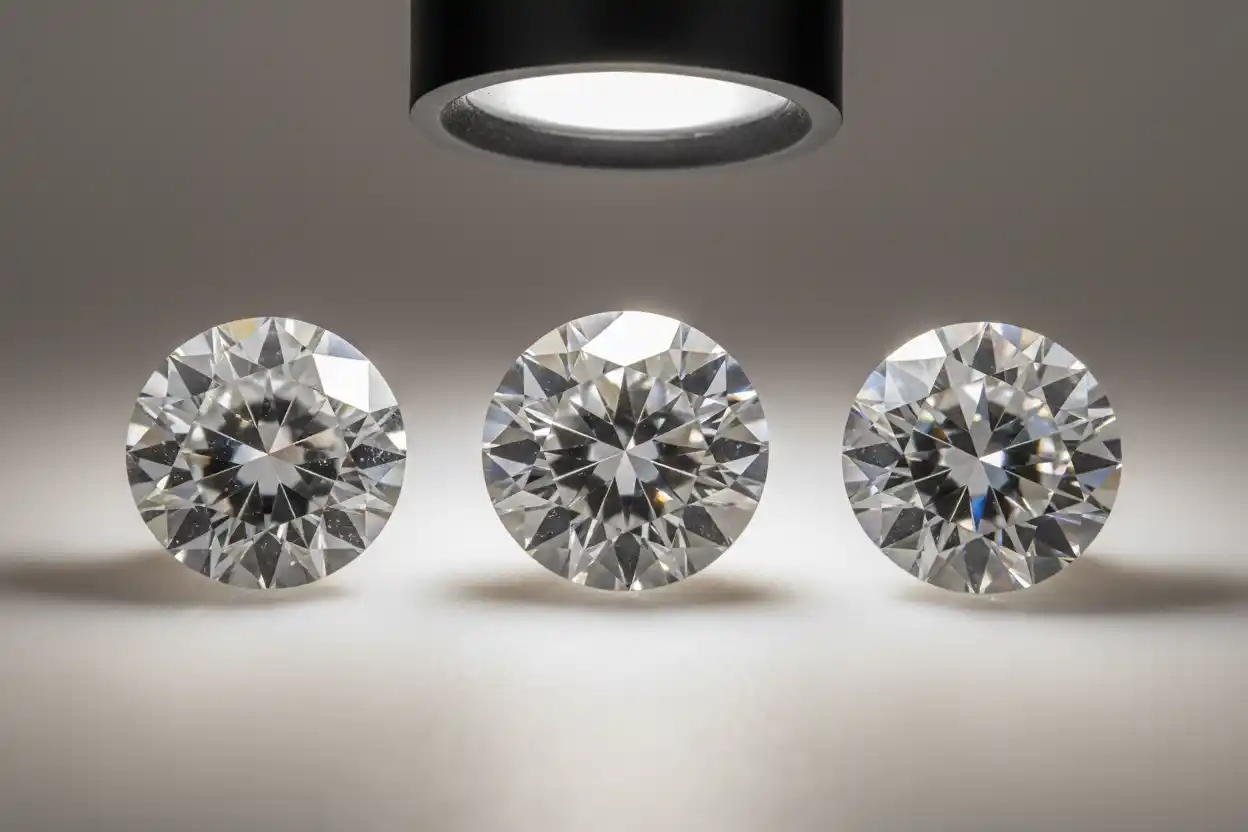
White sapphire is transparent colorless corundum. It has the same aluminum-oxide composition, hardness and crystal structure as blue, yellow, pink and other sapphires, but it contains too little color-producing trace material to develop a strong body color.
Its durability makes it practical for jewelry, including engagement rings, although it does not display diamond’s brilliance or dispersion. Buyers must also distinguish natural white sapphire from inexpensive laboratory-grown corundum and from colorless diamond simulants.
White Sapphire at a Glance
| Property | White Sapphire |
|---|---|
| Mineral species | Corundum |
| Chemical formula | Al₂O₃ |
| Trade color | Colorless or near-colorless |
| Crystal system | Trigonal |
| Common habit | Barrel-shaped, bipyramidal, tabular or rounded alluvial crystals |
| Luster | Vitreous to subadamantine |
| Transparency | Transparent to opaque, though jewelry-grade white sapphire is transparent |
| Refractive indices | Approximately 1.762–1.770 |
| Birefringence | Approximately 0.008–0.010 |
| Optical character | Uniaxial negative |
| Specific gravity | Approximately 3.95–4.10 |
| Mohs hardness | 9 |
| Cleavage | None, though parting may occur |
| Tenacity | Brittle with generally excellent jewelry durability |
| Dispersion | Approximately 0.018 |
| Common cuts | Rounds, ovals, cushions, pears, emerald cuts and rose cuts |
| Main care concern | Abraded facet edges, poor cutting, synthetic substitution and undisclosed treatment |
What Is White Sapphire?
White sapphire is colorless sapphire, and sapphire is any gem-quality corundum that does not qualify as ruby.
Pure corundum is colorless. Trace elements and structural defects create the familiar colored varieties.
Iron and titanium contribute to blue sapphire, chromium produces pink or red, and combinations of iron and color centers create yellow and related hues.
White sapphire lacks enough of these color-producing features to show a strong visible hue.
The parent sapphire guide owns corundum-family mineralogy, while Types of Sapphire explains the full color range.
Is White Sapphire Actually White?
The trade uses white to mean colorless or near-colorless.
Fine stones appear transparent and may show a faint gray, blue, yellow or brown tint under close examination.
Opaque white corundum also exists, but it is not the material usually intended by white sapphire in fine jewelry.
A commercial stone can be called white even when it would not receive the highest colorless grade in a laboratory comparison.
The most desirable material looks neutral face-up under daylight-equivalent and warm indoor lighting.
Why Is Pure Corundum Colorless?
Corundum’s basic structure contains aluminum and oxygen.
Neither element creates a strong visible body color in a pure crystal.
When trace elements replace small amounts of aluminum, they change how the crystal absorbs light.
Without sufficient chromium, iron, titanium, vanadium or color centers, most visible wavelengths pass through with relatively little selective absorption.
Natural stones still contain measurable trace elements, even when they appear colorless. Those trace patterns can help a laboratory separate natural from synthetic sapphire.
Natural White Sapphire
Natural white sapphire forms through geological processes in metamorphic rocks, igneous environments and gem-bearing gravels.
It can occur in marble, gneiss, schist, basalt-related deposits and alluvial sediments.
Natural crystals commonly contain mineral inclusions, healed fractures, growth zoning and other features reflecting their geological history.
Eye-clean white sapphire is available, but highly transparent large stones are less common than laboratory-grown equivalents.
Natural origin does not guarantee superior cut or appearance. A poorly cut natural sapphire can appear dull, gray and lifeless.
Laboratory-Grown White Sapphire
Synthetic white sapphire has essentially the same aluminum-oxide composition and corundum crystal structure as natural sapphire.
Flame-fusion production can create large quantities of inexpensive colorless corundum.
Czochralski pulling, flux growth and other processes can also produce synthetic sapphire for jewelry, optics, watch crystals and industrial applications.
A laboratory-grown white sapphire is not glass or cubic zirconia. It is synthetic corundum.
The distinction is explained in the dedicated lab-grown sapphire guide and Lab-Grown vs Natural Gemstones.
Synthetic stones should be priced and disclosed differently from natural sapphire, even when their physical durability is comparable.
Natural Versus Synthetic Identification
Microscopic examination may reveal natural mineral crystals, healed fissures and angular growth zoning.
Flame-fusion synthetic sapphire can show curved growth lines, gas bubbles or unusual fluorescence patterns.
Flux-grown material may contain flux residue, metallic platelets or synthetic growth features that resemble natural inclusions.
Highly clean colorless stones can be difficult to separate with basic instruments.
Natural sapphire commonly contains higher or more varied trace-element concentrations than synthetic colorless sapphire. Advanced laboratories can use chemical analysis and ultraviolet transparency to support the distinction.
The practical consumer workflow appears in Real vs Fake Sapphire.
White Sapphire Versus Diamond
Diamond has a hardness of 10, while sapphire has a hardness of 9.
Both are suitable for daily jewelry, but diamond is considerably more resistant to scratching.
Diamond has a higher refractive index and greater dispersion. It generally produces stronger white brilliance and more rainbow fire.
White sapphire tends to appear calmer, glassier or slightly softer in its reflections.
Sapphire is doubly refractive, although the effect is subtle. Diamond is singly refractive.
White sapphire is normally much less expensive and can provide a natural colorless gemstone without a diamond price.
The full comparison appears in White Sapphire vs Diamond.
White Sapphire Versus Moissanite
Moissanite has greater brilliance and far greater dispersion than white sapphire.
It frequently produces intense rainbow flashes, particularly in larger stones.
Moissanite has a hardness of approximately 9.25, making it slightly more scratch-resistant than sapphire.
Its strong double refraction can produce visible doubled facet edges in some cuts.
White sapphire has less fire and a more subdued appearance, which some buyers prefer for antique, understated or natural-gem designs.
The detailed comparison belongs to White Sapphire vs Moissanite.
White Sapphire Versus Cubic Zirconia
Cubic zirconia is synthetic zirconium oxide.
It has stronger dispersion than white sapphire and may look more diamond-like when new.
Cubic zirconia is softer, commonly measuring about 8–8.5, and tends to abrade or cloud more readily during long-term wear.
It is also significantly denser than sapphire, so a cubic-zirconia stone of the same dimensions usually weighs more.
White sapphire generally retains sharper facets longer and has the market identity of natural or synthetic corundum rather than a simple diamond simulant.
White Sapphire Versus White Topaz
White topaz measures 8 on the Mohs scale, while sapphire measures 9.
Topaz has perfect cleavage and can split under a sharp blow. Sapphire lacks true cleavage and generally performs better in daily-wear jewelry.
White topaz is more abundant and substantially less expensive.
Both usually show less fire than diamond, but sapphire maintains facet sharpness and polish longer.
A high-quality white sapphire is therefore the stronger long-term jewelry choice, while topaz serves as a more affordable occasional-wear option.
White Sapphire Versus Rock Crystal
Clear quartz or rock crystal has hardness 7 and a much lower refractive index.
Quartz can show doubled rear facet edges more clearly because of its birefringence, depending on cut orientation.
White sapphire is denser, harder and generally more brilliant.
Large clean quartz is abundant and inexpensive, making it a common substitution in poorly documented jewelry.
Gemological testing separates the materials quickly.
Sources of White Sapphire
Sri Lanka is a historically important source of colorless and pale sapphire. Alluvial deposits can yield rounded crystals with excellent transparency.
Madagascar produces sapphire in nearly every color, including colorless stones.
Myanmar, Tanzania, Kenya, Australia, Thailand, Cambodia and the United States also produce corundum that may be colorless or near-colorless.
Montana sapphires can include pale gray, greenish and near-colorless material.
Geographic origin is difficult to determine for a featureless colorless stone and may add limited market value compared with blue or padparadscha sapphire.
A seller should not claim Ceylon origin merely because the stone is pale and transparent.
Inclusions in White Sapphire
Natural white sapphire can contain rutile needles, zircon crystals, apatite, mica, spinel and other mineral inclusions.
Healed fractures may form fingerprint-like patterns.
Angular growth zoning can appear under immersion or specialized lighting even when no body color is obvious.
Small particles may produce silk or a cloudy appearance.
Parallel rutile needles can create a star effect when the stone is cut as a cabochon.
An inclusion-free appearance does not prove synthetic origin, but very clean stones deserve stronger testing when sold at a natural premium.
White Star Sapphire
Colorless or white star sapphire contains oriented needle-like inclusions that reflect light as asterism.
Most star sapphires display six rays, though twelve-rayed stones can occur when more than one inclusion system is present.
The star should remain centered and move smoothly as the light changes.
A weak star, poor dome or chalky body reduces value.
Diffusion treatment and synthetic growth can also create star effects, so laboratory identification is appropriate for expensive stones.
Heat Treatment
Heat treatment is widespread in the sapphire market.
It can improve clarity by dissolving rutile silk, heal certain fractures and alter unwanted color components.
Pale or lightly colored corundum can become more colorless through heating under suitable conditions.
A heat-treated natural white sapphire remains natural sapphire, but treatment should be disclosed when detectable or known.
Because colorless material has less obvious color enhancement than blue or yellow sapphire, buyers sometimes assume every white sapphire is unheated. That assumption is unsafe.
The complete enhancement guide remains with Treated Sapphire and Gemstone Treatments Explained.
Diffusion, Filling and Coatings
Lattice diffusion is usually used to add color to pale or colorless sapphire rather than to market it as white.
A colorless sapphire may therefore serve as the starting material for treated blue, orange or star sapphire.
Lead-glass fracture filling is associated more strongly with ruby, but filled sapphire and composite products can occur.
Clear coatings may improve apparent luster or disguise surface-reaching fractures.
Quench-crackled synthetic sapphire can be filled with dye, creating an imitation of another colored gem.
Treatment status should come from an independent laboratory rather than seller assumptions based on appearance.
Cutting White Sapphire
White sapphire requires excellent cutting because it lacks strong body color to distract from windows, extinction and uneven symmetry.
A shallow pavilion creates a transparent window through the center.
An overly deep stone retains weight but appears small and dark face-up.
Round and cushion brilliant cuts can maximize sparkle, while step cuts create a calmer geometric appearance.
Poorly aligned facets and thick girdles are particularly visible in colorless material.
Because rough sapphire is valuable, cutters may prioritize weight retention over ideal optical performance. Buyers should judge face-up dimensions and brightness rather than carat weight alone.
Hardness, Toughness and Cleavage
Sapphire measures 9 on the gemstone hardness chart.
Only diamond and a small number of specialist materials are harder in ordinary jewelry use.
Corundum has no true cleavage, though parting and fractures can develop along structural planes.
Its combination of high hardness and good toughness makes it suitable for frequently worn jewelry.
The difference between scratch resistance and breakage resistance is explained in gemstone toughness versus hardness.
A sharp impact can still chip a girdle or point, especially in a heavily included stone.
White Sapphire Engagement Rings
White sapphire appears among the principal white gemstones for engagement rings.
Its hardness and durability are suitable for daily wear.
However, it does not stay completely maintenance-free. Oils and soap films can reduce brilliance rapidly because the stone’s natural sparkle is already softer than diamond’s.
A well-cut stone should be chosen over the largest available carat weight.
The setting should protect points and corners, particularly in pear, marquise and princess-style cuts.
A halo of diamonds may make the visual difference between diamond brilliance and sapphire brilliance more obvious, so buyers should compare the combination in person.
White Sapphire Jewelry
A sapphire ring can withstand regular wear when the setting remains secure.
Sapphire necklaces and sapphire earrings require less impact protection and can use larger stones.
Sapphire bracelets need secure settings because repeated contact can loosen small accent stones.
White sapphire is particularly useful as durable accent material around colored gemstones.
Matched natural stones can cost more than single gems because consistency of size, clarity and appearance is difficult to achieve.
White Sapphire Prices in 2026
Commercial natural white sapphire below approximately three carats commonly retails for $50–$200 per carat.
Current market guides show similar ranges for ordinary faceted stones between approximately 0.5 and 3 carats.
Better natural stones with excellent clarity, neutral color and strong cutting commonly range from $200–$500 per carat.
Larger stones above three carats may range from approximately $300–$700 per carat, depending on cut, treatment and certification.
Exceptional unheated stones with excellent transparency, strong provenance or unusually large size may exceed $700–$1,000 per carat.
Laboratory-grown white sapphire is much cheaper, often costing only a small fraction of natural material. Small synthetic accent stones may cost only a few dollars each.
The complete family valuation framework remains with the Sapphire Price Guide.
What Determines White Sapphire Value?
Natural versus laboratory-grown origin is the first major distinction.
Transparency and neutral body color follow closely. Gray, yellow or brown tint generally reduces demand.
Clarity matters because inclusions are easy to see in colorless stones.
Cut quality strongly affects brilliance. A smaller well-cut gem can appear larger and livelier than a deep heavy stone.
Treatment status can add or reduce value. Unheated natural sapphire generally receives a premium when supported by a respected laboratory.
Size increases value when clarity and cut remain strong.
Origin has less influence than it does for famous blue sapphires, but reliable provenance can still interest collectors.
Buying Guidance
Use the Sapphire Buying Guide for the complete seller and documentation workflow.
Ask whether the stone is natural or laboratory-grown.
Request disclosure of heat, filling, diffusion and other treatment.
Compare millimeter dimensions with carat weight. Sapphire’s density means it can look smaller than some alternatives at the same weight.
View the gem under daylight-equivalent and warm light to check for unwanted tint.
Inspect facet edges for abrasion and the center for windowing.
For a major natural stone, obtain an independent report identifying origin category and treatment status.
Do not rely on the word certified unless the certificate comes from a recognized independent laboratory.
Cleaning and Maintenance
Clean white sapphire with warm water, mild soap and a soft brush.
Oil and soap collect on the pavilion and quickly reduce brilliance.
Untreated and heat-treated sapphire can often tolerate ultrasonic cleaning when it is free from significant fractures. However, warm soapy water is the safer default when treatment status is uncertain.
Avoid ultrasonic and steam cleaning for fracture-filled, coated or heavily included stones.
Check prongs periodically, particularly around small accent sapphires.
Store the gem away from softer stones because sapphire can scratch nearly every common jewelry material.
Meaning and Symbolism
White sapphire has been associated in modern jewelry traditions with honesty, commitment, clear intention and enduring partnership.
Its durability supports symbolism involving promises designed to withstand ordinary pressure rather than remain untouched.
Colorlessness can also represent openness, objectivity and the willingness to examine decisions without hiding inconvenient details.
Some wearers choose it as a natural-gem alternative to diamond while preserving the visual language of a colorless engagement stone.
These meanings are cultural, spiritual or personal rather than scientifically demonstrated effects.
White sapphire belongs in modern collections of white gemstones, but its corundum identity and durability separate it from softer colorless alternatives.
Frequently Asked Questions
1. Is white sapphire a real sapphire?
Yes. White sapphire is colorless corundum, the same mineral species as blue and yellow sapphire.
2. Is white sapphire naturally colorless?
Natural colorless sapphire exists, although heat treatment may also remove or reduce unwanted color.
3. Is white sapphire the same as diamond?
No. Sapphire is aluminum oxide, while diamond is carbon. Diamond has more brilliance, dispersion and scratch resistance.
4. Is white sapphire better than moissanite?
It depends on preference. Moissanite has more fire and slightly greater hardness, while white sapphire offers a subtler appearance and can be naturally mined.
5. Does white sapphire become cloudy?
The stone itself normally does not become cloudy through ordinary wear, but oil, soap and abrasion can make it appear dull.
6. How can natural white sapphire be distinguished from synthetic sapphire?
Microscopic growth features, inclusions, ultraviolet behavior and trace-element analysis help laboratories separate them.
7. Is white sapphire normally heated?
Some stones are unheated, while others may have been heated to improve clarity or reduce color. Treatment should be disclosed.
8. Is white sapphire suitable for an engagement ring?
Yes. Its hardness of 9 and good toughness make it one of the more practical non-diamond options.
9. Is white sapphire more durable than white topaz?
Yes. Sapphire is harder, tougher and lacks topaz’s perfect cleavage.
10. Can white sapphire go in an ultrasonic cleaner?
Untreated or heat-treated stones without significant fractures can often tolerate ultrasonic cleaning, but avoid it when filling or treatment is uncertain.
11. How much is white sapphire worth?
Commercial natural stones commonly cost $50–$200 per carat, while fine, large or unheated stones may reach several hundred dollars per carat or more.
12. Does white sapphire have scientifically proven healing properties?
No. Its symbolism may hold personal meaning, but scientific evidence does not establish healing effects.
White sapphire succeeds when it is judged as sapphire rather than as an inexpensive diamond. Its quieter brilliance, exceptional hardness and natural corundum identity create a distinct jewelry stone, but only good cutting and honest natural-versus-synthetic disclosure allow those strengths to remain visible.
White sapphire appears in Crystals That Start With W and Gemstones That Start With W.