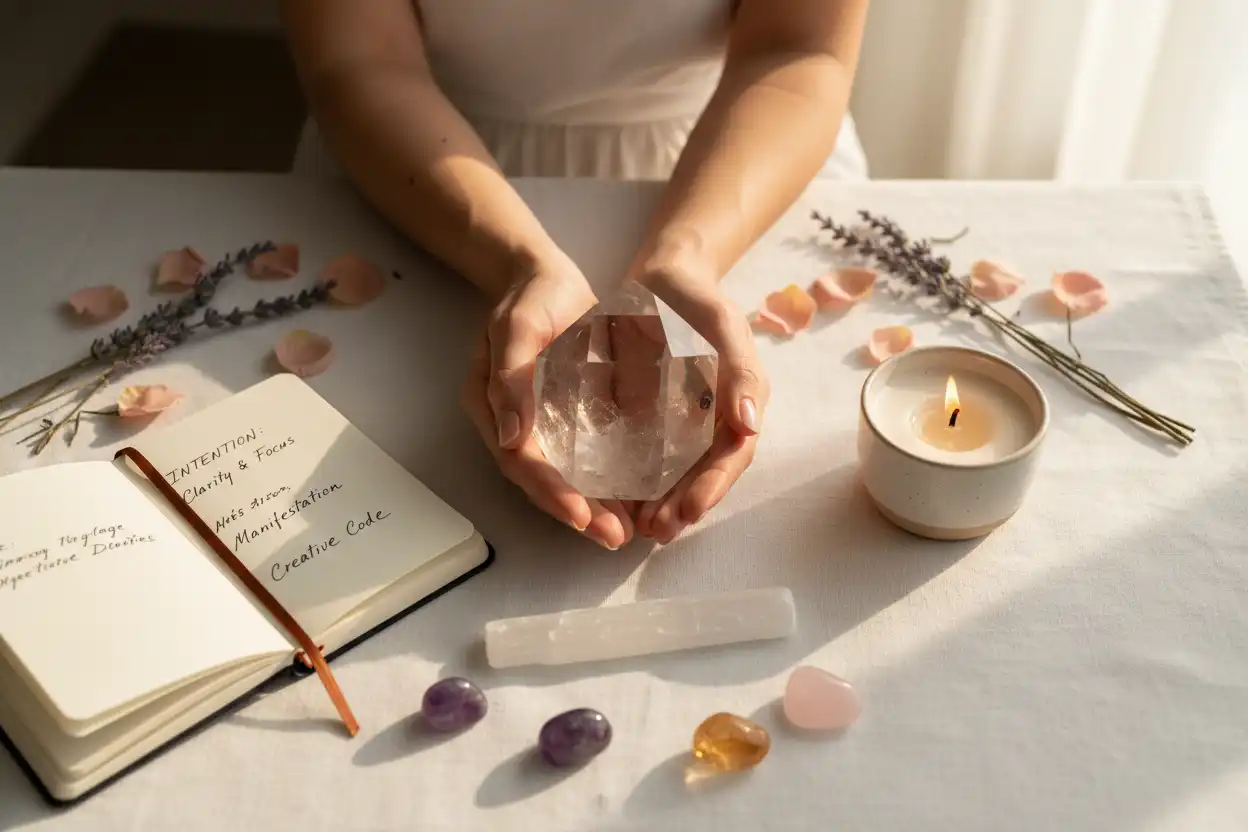
How to Program Crystals for Your Intentions
Programming a crystal means deliberately connecting it with a personal intention.
You might choose a stone to remind you to:
- Communicate calmly.
- Maintain a boundary.
- Complete a project.
- Follow a consistent routine.
- Approach change with confidence.
- Pause before reacting.
Programming does not scientifically alter the crystal, install information inside it or guarantee an outcome. It is an intention-setting practice that gives the object a clear symbolic purpose.
The most useful intention is specific, ethical and connected to practical action.
What Does Programming a Crystal Mean?
In crystal traditions, programming usually involves:
- Choosing a stone.
- Cleansing or preparing it.
- Stating an intention.
- Visualizing the desired behavior or outcome.
- Using the stone as a reminder.
- Reviewing the intention over time.
The crystal becomes a physical cue for the commitment you have made.
For example, a small stone on your desk may remind you to silence notifications and complete one focused work session.
Can Crystals Really Store Intentions?
There is no scientific evidence that a mineral stores thoughts, emotions or commands in the way electronic memory stores data.
Crystals do have measurable physical properties involving structure, light, heat, pressure and electricity. Those properties do not demonstrate that a stone can record a personal affirmation.
Programming may still be meaningful as:
- A ritual.
- A mindfulness exercise.
- A visual reminder.
- A journaling prompt.
- A way to clarify goals.
- A method for connecting an object with action.
Step 1: Choose One Clear Intention
Begin with one main purpose.
A strong intention is:
- Personal.
- Specific.
- Positive.
- Realistic.
- Ethical.
- Connected to your own behavior.
Examples include:
- “I communicate clearly and listen before responding.”
- “I complete one important task before checking social media.”
- “I maintain boundaries that protect my time.”
- “I approach this change with patience and preparation.”
- “I create a consistent evening routine.”
Avoid vague statements such as:
- “Make everything perfect.”
- “Give me unlimited money.”
- “Force this person to love me.”
- “Cure my illness.”
- “Make someone obey me.”
A crystal practice should not replace medical care, financial planning, consent or practical effort.
Step 2: Choose a Relevant Crystal
Select a stone whose traditional symbolism, color or personal meaning fits the intention.
Examples include:
| Intention | Traditionally associated stone |
|---|---|
| Focus | Fluorite |
| Confidence | Tiger’s eye |
| Calm communication | Blue lace agate |
| Motivation | Carnelian |
| Reflection | Amethyst |
| Grounding | Smoky quartz |
| Compassion | Rose quartz |
| New beginnings | Moonstone |
| Boundaries | Black tourmaline |
| Practical endurance | Red jasper |
You do not need a rare or expensive stone.
A familiar pebble, piece of jewelry or inherited gem may carry more personal meaning than a newly purchased crystal.
Step 3: Confirm the Material Is Safe
Before handling, carrying or cleansing the stone, identify it as accurately as possible.
Check whether it is:
- Toxic.
- Radioactive.
- Fibrous.
- Water-soluble.
- Light-sensitive.
- Fragile.
- Coated.
- Dyed.
- Glued.
- Sharp.
- Attached to unstable matrix.
Choose a stable polished stone when you plan to carry it or hold it frequently.
Step 4: Clean the Crystal Physically
Remove ordinary dirt, dust and residue with a method appropriate for the material.
Possible options include:
- A soft dry cloth.
- A slightly damp cloth.
- Mild soap and brief water contact.
- A soft brush.
- Professional jewelry cleaning.
Do not soak an unidentified stone.
Physical cleaning does not erase spiritual meaning. It maintains the object and helps you inspect it for damage.
Step 5: Cleanse It Symbolically
Cleansing is optional. People use it to mark the beginning of a new purpose.
Lower-risk methods include:
- Sound.
- Quiet reflection.
- Gentle moonlight.
- Resting the stone on a clean cloth.
- Smoke where safe and culturally appropriate.
- Holding it while releasing the previous intention.
The complete crystal-cleansing guide explains several methods and their material limitations.
Water, salt and sunlight should not be used automatically.
Step 6: Choose a Quiet Place
Programming does not require a special room, altar or ceremony.
Choose somewhere you can focus for a few minutes, such as:
- A desk.
- A chair.
- A meditation space.
- A quiet outdoor seat.
- A clean table.
- A bedside area during the day.
Remove unnecessary distractions and place the crystal where it will not fall.
Step 7: Hold or Place the Crystal
You may:
- Hold it in one hand.
- Hold it between both hands.
- Place it in front of you.
- Keep it in its jewelry setting.
- Set it at the center of a small layout.
- Rest it beside the written intention.
The crystal does not need to touch your skin.
Delicate, toxic or matrix-bound specimens should remain inside suitable containers rather than being held.
Step 8: State the Intention
Say the intention aloud or silently.
Use direct wording.
For example:
“This stone reminds me to prepare carefully and communicate clearly.”
Or:
“I use this crystal as a reminder to protect my time and complete my priorities.”
Avoid wording that places responsibility entirely on the object.
Instead of:
“This crystal will make me successful.”
Use:
“This crystal reminds me to take the consistent actions that support my goal.”
Step 9: Visualize the Action
Imagine yourself carrying out the behavior connected with the intention.
For a communication intention, visualize:
- Preparing your main points.
- Speaking at a measured pace.
- Listening carefully.
- Asking a clear question.
- Ending the conversation respectfully.
For a focus intention, visualize:
- Closing unnecessary tabs.
- Setting a timer.
- Completing one task.
- Taking a scheduled break.
- Reviewing your progress.
Visualization should lead toward realistic action rather than fantasy alone.
Step 10: Choose One Practical Commitment
Connect the intention with a specific next step.
Examples include:
| Intention | Practical commitment |
|---|---|
| Focus | Work without notifications for 30 minutes |
| Confidence | Practice the presentation twice |
| Communication | Write the main point before speaking |
| Boundaries | Decline one request that exceeds your capacity |
| Creativity | Schedule 20 minutes for idea generation |
| Calm | Follow the same evening routine for seven days |
| Financial stability | Review spending and update the budget |
| Career growth | Complete one application |
This action is the most important part of the practice.
Step 11: Close the Programming Ritual
Finish in a simple way.
You may:
- Take a slow breath.
- Repeat the intention once.
- Write the date in a journal.
- Place the crystal in its intended location.
- Put on the jewelry.
- Begin the practical action immediately.
No universal closing phrase is required.
How to Write a Crystal Intention
A useful formula is:
“This crystal reminds me to [behavior] so I can support [goal or value].”
Examples:
- “This crystal reminds me to pause before responding so I can communicate respectfully.”
- “This stone reminds me to finish one priority before starting another.”
- “This bracelet reminds me to protect my time and maintain clear boundaries.”
- “This pendant reminds me to prepare carefully and speak confidently.”
- “This crystal reminds me to follow my evening routine and reduce unnecessary stimulation.”
Can You Program More Than One Crystal?
Yes.
You may program:
- One stone for one intention.
- Several stones for the same intention.
- Different stones for separate purposes.
- A bracelet containing compatible beads.
- A crystal grid.
Keep each role clear.
A group might include:
- A primary stone for the goal.
- A supporting stone for a needed quality.
- A grounding stone for practical action.
Examples appear in Crystal Pairings.
Can One Crystal Have Several Intentions?
It can, but too many intentions may weaken the clarity of the practice.
One stone might reasonably represent related qualities such as:
- Calm communication.
- Patient listening.
- Respectful boundaries.
It becomes less coherent when assigned unrelated goals such as:
- Sleep.
- Wealth.
- Romance.
- Exam performance.
- Protection.
- Travel.
Use separate stones or update the intention when priorities change.
How to Program a Crystal Bracelet
To program a bracelet:
- Identify the bead materials.
- Check for coatings, elastic damage and loose components.
- Clean it safely.
- Hold the bracelet or place it on a cloth.
- State one intention.
- Connect the intention with a practical action.
- Put it on only when comfortable and appropriate.
The bracelet can become a tactile reminder whenever you notice it on your wrist.
Remove it during activities that could stretch, crush or contaminate the beads.
How to Program a Crystal Necklace
Choose an intention suitable for a visible daily reminder.
Check:
- Chain strength.
- Pendant weight.
- Sharp points.
- Prong condition.
- Whether the material tolerates perfume and perspiration.
State the intention before putting it on.
A necklace does not need to sit over a particular body area to serve as a reminder.
How to Program a Pocket Stone
Use a small, smooth and non-toxic stone.
Place it in a separate pouch rather than loose with keys or coins.
Each time you touch it, recall:
- The intention.
- The practical commitment.
- Your current progress.
The guide to how many crystals you can carry explains safe limits for pockets, bags and jewelry.
How to Program a Crystal Grid
A grid can represent one intention through a central stone and supporting pieces.
Write the purpose beneath or beside the layout, then define one action connected with it.
Use the steps in How to Make a Crystal Grid to arrange and maintain the stones safely.
How Often Should You Reprogram a Crystal?
There is no required schedule.
Update the intention when:
- The goal has been completed.
- Your priorities change.
- The current wording feels unclear.
- The crystal has been reassigned.
- You begin a new project.
- The object no longer feels relevant.
- You want to simplify the practice.
You do not need to reprogram the stone daily.
How Long Does Programming Last?
There is no scientifically measurable duration.
Symbolically, the intention can remain relevant until:
- You change it.
- You stop using the stone.
- The goal is complete.
- You forget the purpose.
- The object takes on a different meaning.
A small written card can help you remember what each stone represents.
Does Cleansing Erase a Program?
There is no scientific program stored inside the crystal to erase.
Within spiritual practice, some people treat cleansing as a reset. Others cleanse without changing the intention.
Choose one consistent interpretation that makes the practice understandable to you.
Can Someone Else Program a Crystal for You?
Someone may give you a crystal with a wish, blessing or symbolic intention.
You can:
- Accept that meaning.
- Add your own intention.
- Replace it.
- Use the object without programming.
- Decline the gift.
Another person’s intention does not remove your choice or control your behavior.
Can You Program a Crystal for Another Person?
You may give a crystal as a supportive gift, but avoid intentions that attempt to control another person.
Ethical wording might be:
“I hope this stone reminds you that you are supported.”
Avoid:
“This crystal will make you choose me.”
Consent and personal agency matter more than the ritual.
Can You Program a Crystal for Healing?
You may use a crystal as a reminder to:
- Attend appointments.
- Rest.
- Follow a treatment plan.
- Ask questions.
- Seek support.
- Maintain a healthy routine.
Do not claim that programming a stone treats disease, replaces medication or guarantees recovery.
Do You Need to Charge a Programmed Crystal?
Charging is optional.
People may use sound, moonlight, intention or rest as symbolic charging practices.
The safe options and physical limitations are explained in How to Charge Crystals.
Avoid sunlight, water, salt or heat when the material cannot tolerate them.
What If the Crystal Feels Different Later?
Your relationship with the object may change because:
- The goal is complete.
- You have become used to seeing it.
- The stone is dirty.
- It has faded or become damaged.
- The memory attached to it has changed.
- You no longer need the same reminder.
Crystals do not scientifically run out of a stored spiritual supply. The distinction is covered in Do Crystals Run Out of Energy?.
Common Programming Mistakes
Using a Vague Intention
“Make my life better” does not define a behavior.
Expecting the Stone to Act for You
A crystal cannot complete an application, create a boundary or hold a conversation.
Trying to Control Someone Else
Programming should focus on your choices and actions.
Using an Unsafe Crystal
Do not hold or carry toxic, radioactive, fibrous or unstable specimens.
Choosing Too Many Goals
One clear intention is usually more useful than several unrelated commands.
Using Damaging Cleansing Methods
Water, salt, sunlight and heat can harm certain stones.
Treating the Ritual as Medical Care
Intention-setting may complement reflection but cannot diagnose or treat illness.
Frequently Asked Questions
Do I have to cleanse a crystal before programming it?
No. Cleansing is optional. Accurate identification, physical cleanliness and a clear intention are more important.
How many times should I repeat the intention?
Once may be enough. Repeat it only when doing so improves focus rather than creating anxiety.
Can I write the intention instead of saying it?
Yes. You may write, speak, think or record it.
Can every crystal be programmed?
Any safe object can be connected with a personal intention. Hazardous or fragile minerals should not be held or carried.
Can I program a lab-grown crystal?
Yes. The practice depends on symbolism and intention rather than natural origin.
Can I change a crystal’s program?
Yes. State the new purpose and update the practical action.
Can two people program the same crystal?
They can assign shared meaning to it, provided both understand and consent to the intention.
What happens if I forget the program?
Nothing harmful happens. Review your notes or choose a new intention.
Can I program several stones at once?
Yes, but keep the purpose clear and ensure the materials are physically compatible.
Continue Exploring
Browse more practical intention, care and beginner resources in the Crystals 101 collection.